


Global Permethrin Market Size, Share, And Enhanced Productivity By Grade (Pharmaceutical Grade, Technical Grade, Agricultural Grade), By Form (Liquid, Powder), By Application (Agriculture (Crop Protection, Seed Treatment, Others), Public Health (Mosquito Control, Tick & Lice Control, Others), Textile Treatment (Military Uniforms, Outdoor Clothing, Camping Equipment, Others), Household (Indoor Pest Control, Garden & Lawn, Others), Animal Health (Livestock, Companion Animals, Others), Wood Preservation, Others), By Region and Companies - Industry Segment Outlook, Market Assessment, Competition Scenario, Trends, and Forecast 2026-2035
- Published date: February 2026
- Report ID: 179148
- Number of Pages: 381
- Format:
-
keyboard_arrow_up
Quick Navigation
Report Overview
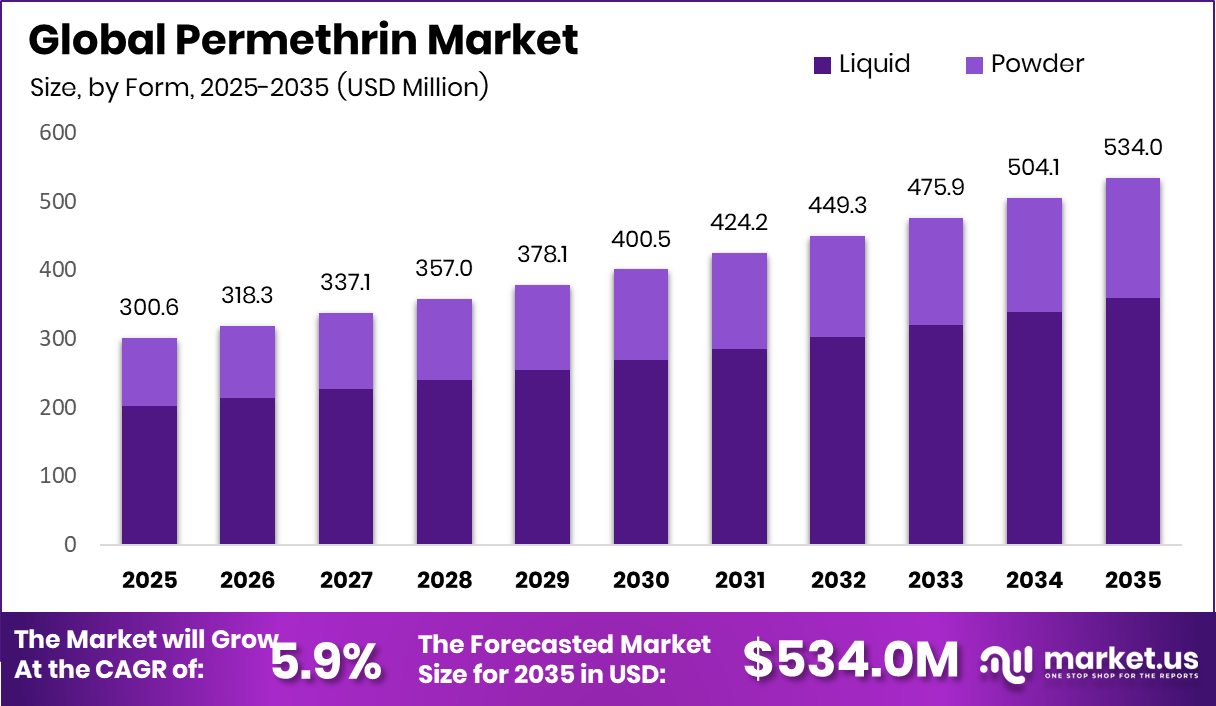
The Global Permethrin Market is expected to be worth around USD 534.0 Million by 2035, up from USD 300.6 Million in 2025, and is projected to grow at a CAGR of 5.9% from 2026 to 2035. Asia Pacific continues to lead market growth with its 42.6% share dominance.
The Permethrin Market is structured across grade, form, and application segments, reflecting its wide use in agriculture, public health, household care, and industrial protection. By grade, pharmaceutical, technical, and agricultural categories support differing purity and regulatory needs. Pharmaceutical-grade products are used in health-related treatments, while technical and agricultural grades supply large-scale pest-control and crop-protection applications. By form, liquid and powder variants serve different handling and formulation requirements. Liquid formats dominate many field and household uses due to easier application, while powder forms support manufacturing inputs and textile treatments.
Applications span agriculture, public health, textile protection, household insect control, animal health, wood preservation, and several other niche uses. The market’s diversity comes from widespread concerns surrounding pest outbreaks, vector-borne diseases, and protection of crops, livestock, and materials. As pest-management practices evolve, demand for fast-acting and stable synthetic pyrethroids like permethrin continues to grow. This structured taxonomy reflects a market shaped by varying end-user priorities, product performance expectations, and preventive-care strategies across multiple sectors.
Permethrin is a synthetic pyrethroid insecticide designed to control a broad range of insects through contact and residual action. It is widely used in agriculture, public-health programs, textile treatments, household insecticides, and livestock care due to its stability and long-lasting protection. Its mode of action focuses on disrupting insect nerve function, allowing it to work effectively in both direct application and treated materials. Because of its adaptability, permethrin appears in sprays, coatings, treated fabrics, lotions, and pest-control systems across many industries.
The Permethrin Market represents the global demand, production, and usage of permethrin across agriculture, public health, household care, textile protection, veterinary products, and industrial treatment segments. It includes manufacturers, formulators, distributors, and end-use industries that rely on permethrin as a dependable synthetic pyrethroid for pest control. Growth is influenced by shifting disease patterns, rising agricultural intensity, and the need for long-lasting insect protection in materials, homes, and public environments.
Growing awareness of vector-borne diseases is a major factor increasing the use of permethrin in public-health and preventive-care programs. A significant example comes from studies showing that permethrin-treated wraps can cut malaria rates in babies by 66%, highlighting the material’s value in protecting vulnerable populations. This type of evidence strengthens adoption in health programs and community-level initiatives. Demand also expands as researchers continue to explore new applications. One notable instance is the $2M CDC grant awarded to Meshnick to study Lyme disease in Rhode Island, where insect-control strategies play a central role.
Opportunities also grow in textile protection and military material treatments, where durability and long-term residue are essential. A strong example is San Lorenzo’s Bluewater Defense securing a $103M Army contract, demonstrating how treated fabrics and protective materials have become critical in defense supply chains. These developments reflect a wider shift toward preventive solutions that combine long-lasting protection, field durability, and adaptability across civilian and military settings.
Key Takeaways
- The Global Permethrin Market is expected to be worth around USD 534.0 Million by 2035, up from USD 300.6 Million in 2025, and is projected to grow at a CAGR of 5.9% from 2026 to 2035.
- Technical-grade permethrin dominates the Permethrin Market, holding 47.9% share due to broad industrial usage worldwide.
- Liquid permethrin leads the Permethrin Market with 67.2% adoption, driven by ease of application.
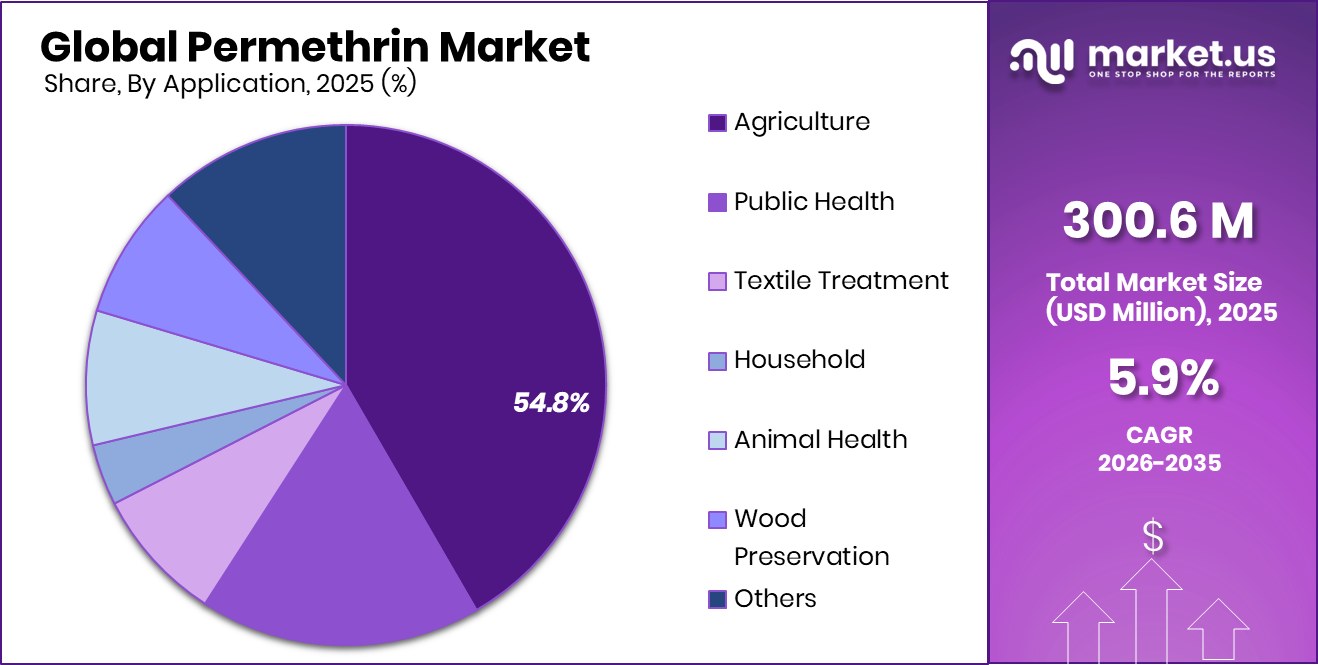
- Agriculture remains the biggest segment in the Permethrin Market, capturing 54.8% demand globally today.
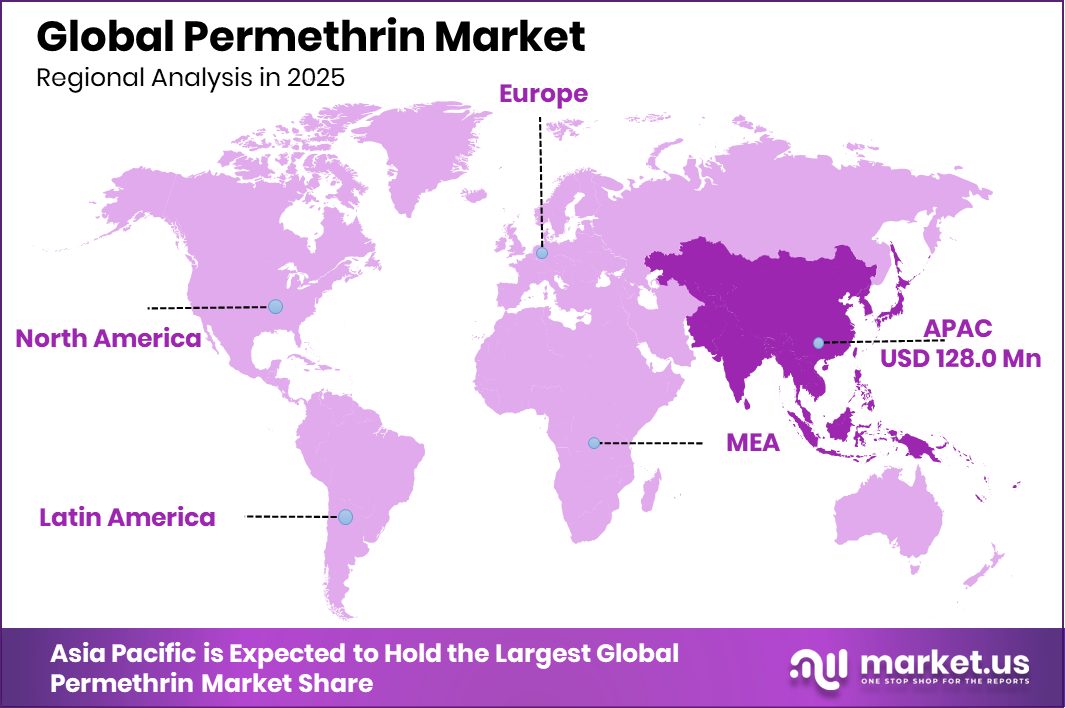
- The Asia Pacific permethrin demand is valued at USD 128.0 Mn in 2025.
By Grade Analysis
Permethrin Market was dominated by technical grade, holding a strong 47.9% share.
In 2025, the Permethrin Market is strongly shaped by the dominance of technical-grade permethrin, which accounts for 47.9% of the total share. This grade remains preferred due to its higher purity, better stability, and suitability for large-scale industrial formulations used across pest control, agriculture, textiles, and public health programs.
Manufacturers continue to rely on technical-grade material as the base ingredient for producing premium insecticidal products, especially where consistent performance and regulatory compliance are essential. Its wider acceptance in integrated pest management, vector-control campaigns, and crop protection solutions also supports its market leadership. As demand rises across developing economies, suppliers are expanding capacity and upgrading production lines to meet the growing consumption of this dominant grade.
By Form Analysis
Liquid form dominated the Permethrin Market, capturing the highest 67.2% share globally.
In 2025, the Permethrin Market sees liquid formulations dominating with 67.2% share, driven by their easy application and compatibility with modern spraying systems used in agriculture, households, and public health settings. Liquid permethrin continues to gain traction because it ensures uniform coverage, faster action, and better mixing with solvents and carriers required for large-scale pest-control programs.
The surge in demand for ready-to-use sprays, emulsifiable concentrates, and fogging solutions further reinforces the leadership of liquid form. Industrial users and pest-control companies prefer liquid formulations for their operational efficiency and reduced handling complexity. With the expanding usage of permethrin in farming, livestock protection, and sanitation activities, the liquid segment maintains clear dominance across global markets.
By Application Analysis
Agriculture applications dominated the Permethrin Market with a leading 54.8% share worldwide.
In 2025, the Permethrin Market is largely dominated by the agriculture segment, holding 54.8% of the total market share as farmers continue to rely on permethrin for effective crop protection. Its broad-spectrum activity against pests in cotton, fruits, vegetables, and cereals keeps it essential in high-intensity farming regions. Increasing pest resistance to older chemicals and the need for affordable, fast-acting insecticides support the sector’s strong adoption.
Permethrin also benefits from its compatibility with integrated pest-management programs, making it a preferred choice for controlling infestations while maintaining yield quality. As global food demand expands and farming intensifies, agriculture remains the leading application area, sustaining its dominant share in the overall permethrin landscape.
Key Market Segments
By Grade
- Pharmaceutical Grade
- Technical Grade
- Agricultural Grade
By Form
- Liquid
- Powder
By Application
- Agriculture
- Crop Protection
- Seed Treatment
- Others
- Public Health
- Mosquito Control
- Tick & Lice Control
- Others
- Textile Treatment
- Military Uniforms
- Outdoor Clothing
- Camping Equipment
- Others
- Household
- Indoor Pest Control
- Garden & Lawn
- Others
- Animal Health
- Livestock
- Companion Animals
- Others
- Wood Preservation
- Others
Driving Factors
Rising pest pressures boost usage
Rising pest pressures continue to boost permethrin usage as agriculture, public-health programs, and household sectors deal with increasing insect challenges across different climates. Farmers and community-health workers rely on stable and long-lasting insecticides, making permethrin a consistent choice for field and domestic protection.
A notable context in the agricultural landscape comes from Italy, where authorities uncovered an EPPO case involving a €1.4 million agricultural funding fraud, highlighting the scale and financial sensitivity surrounding farm-sector operations. Such incidents reinforce the need for dependable and well-regulated pest-control inputs that ensure crop safety and reduce losses. As pest intensity rises, markets turn toward reliable synthetic pyrethroids to maintain protection, supporting steady demand across major regions.
Restraining Factors
Regulatory limits restrict product expansion
Regulatory limits continue to restrict product expansion for permethrin, especially in regions with tight pesticide-approval frameworks and evolving chemical-safety requirements. Compliance costs and registration delays often slow down formulation updates or new launches, which can affect market agility. At the same time, the agricultural ecosystem faces educational and workforce challenges.
An example appears in Michigan, where $62K in scholarships were granted to 39 agriculture students, emphasizing the role of future professionals in navigating stricter regulations and responsible pesticide use. As these restrictions tighten, companies must match their production and labeling standards with regulatory expectations, creating hurdles for faster market penetration. These dynamics collectively limit how quickly permethrin-based products can expand into new segments.
Growth Opportunity
Expanding military fabric treatment needs
Expanding military fabric-treatment needs continue to create new opportunities for permethrin, especially for uniforms, tents, and protective gear that require long-lasting insect deterrence in field operations. Treated fabrics help reduce exposure to vector-borne diseases, making them essential in demanding climates. Broader development partnerships also create momentum.
A recent example includes AHTF and the ICRC securing a $1M grant from the Saudi Fund to support agriculture and food security in Afghanistan, showing how humanitarian and agricultural initiatives increasingly value integrated pest protection. These programs often depend on reliable, durable insect-control materials, opening doors for permethrin-treated solutions. As global defense and humanitarian sectors upgrade equipment and field practices, demand for advanced treatment applications continues to rise.
Latest Trends
Wider use of long-lasting formulations
Wider use of long-lasting permethrin formulations is emerging as a strong trend, driven by the need for products that maintain effectiveness on fabrics, surfaces, and field applications over extended periods. These formulations support public health, household protection, and agricultural sustainability by reducing repeated applications. Technology investments also shape this trend.
A clear example comes from Swiss AgTech scale-up Ecorobotix, which has raised €128 million in total to advance AI-driven sustainable farming solutions. Such innovation highlights how precision agriculture and smarter application methods are becoming mainstream. As farming systems adopt data-guided tools and targeted spraying technologies, longer-lasting insecticide formulations become more relevant, reinforcing permethrin’s position in evolving pest-management strategies.
Regional Analysis
In the Asia Pacific, the permethrin market holds a strong 42.6% share.
The Permethrin Market shows varied regional dynamics across North America, Europe, Asia Pacific, Middle East & Africa, and Latin America, reflecting differences in agricultural intensity, pest-control needs, and regulatory environments. Asia Pacific dominates the global landscape with a 42.6% market share valued at USD 128.0 Mn, supported by large-scale farming and high pest-management demand.
North America continues to show steady usage due to structured vector-control programs and established commercial pest-control industries. Europe maintains moderate growth, driven by the regulated adoption of synthetic pyrethroids and rising demand for efficient crop protection across major farming nations.
The Middle East & Africa region sees expanding consumption supported by increasing agricultural acreage and periodic pest outbreaks requiring reliable solutions. Latin America records steady uptake as countries strengthen crop protection practices in fruit, soybean, and vegetable cultivation. Overall, Asia Pacific remains the clear leader, reflecting its extensive agricultural base and dominant contribution to global permethrin consumption.
Key Regions and Countries
- North America
- US
- Canada
- Europe
- Germany
- France
- The UK
- Spain
- Italy
- Rest of Europe
- Asia Pacific
- China
- Japan
- South Korea
- India
- Australia
- Rest of APAC
- Latin America
- Brazil
- Mexico
- Rest of Latin America
- Middle East & Africa
- GCC
- South Africa
- Rest of MEA
Key Players Analysis
In 2025, BASF SE continues to strengthen its position in the permethrin landscape through its long-standing expertise in chemical synthesis and formulation technologies. The company’s strong R&D culture enables consistent refinement of active ingredients, ensuring product reliability for agricultural and public-health applications. BASF’s emphasis on sustainable chemistry also aligns with the growing market preference for efficient yet environmentally conscious insecticide solutions. Its ability to scale production and integrate advanced manufacturing methods supports steady demand from global distributors. As regulatory environments evolve, BASF’s technical depth and compliance capabilities help maintain its competitive edge within the permethrin value chain.
In 2025, Bayer AG remains an influential participant in the permethrin market, supported by its broad agricultural portfolio and long-standing experience in crop-protection chemistry. The company leverages a strong distribution network and field-level agronomic support to maintain engagement with growers seeking reliable pest-control solutions. Bayer’s ongoing optimization of synthetic pyrethroid formulations reinforces its positioning across key agricultural regions. With a reputation built on product performance and farmer-centric innovation, the company continues to contribute to the stability and evolution of the global permethrin supply landscape.
In 2025, Syngenta Group plays a significant role in shaping permethrin developments by integrating its formulation expertise with a strong global footprint in crop-protection markets. The company’s technical capabilities allow it to deliver application-ready solutions suited for diverse farming environments. Syngenta’s deep engagement with growers helps refine field-performance requirements and adapt permethrin-based products accordingly. Its continued focus on product stewardship, application efficiency, and farmer training further enhances trust and repeat adoption. Collectively, the company contributes to strengthening market availability and supporting consistent usage across both developed and emerging agricultural regions.
Top Key Players in the Market
- BASF SE
- Bayer AG
- Syngenta Group
- FMC Corporation
- Sumitomo Chemical Co., Ltd.
- Adama Agricultural Solutions
- Nufarm Limited
- UPL Limited
- Tagros Chemicals
- Gharda Chemicals
Recent Developments
- In June 2025, Bayer launched Bicota, a new insecticide in India to help rice farmers control stem borers in paddy fields with longer-lasting protection and easier application. It is targeted at major rice-growing states such as Punjab, Haryana, and West Bengal. This product reflects Bayer’s commitment to expanding farmer pest-control tools.
- In May 2024, BASF launched Efficon® insecticide in India, a new crop protection solution powered by its novel active ingredient Axalion® that helps farmers control piercing and sucking pests like aphids, jassids, and whiteflies across a variety of crops, including cotton and vegetables. This product was among BASF’s newest offerings in its insecticide portfolio.
Report Scope
Report Features Description Market Value (2025) USD 300.6 Million Forecast Revenue (2035) USD 534.0 Million CAGR (2026-2035) 5.9% Base Year for Estimation 2025 Historic Period 2020-2024 Forecast Period 2026-2035 Report Coverage Revenue Forecast, Market Dynamics, Competitive Landscape, Recent Developments Segments Covered By Grade (Pharmaceutical Grade, Technical Grade, Agricultural Grade), By Form (Liquid, Powder), By Application (Agriculture (Crop Protection, Seed Treatment, Others), Public Health (Mosquito Control, Tick & Lice Control, Others), Textile Treatment (Military Uniforms, Outdoor Clothing, Camping Equipment, Others), Household (Indoor Pest Control, Garden & Lawn, Others), Animal Health (Livestock, Companion Animals, Others), Wood Preservation, Others) Regional Analysis North America – US, Canada; Europe – Germany, France, The UK, Spain, Italy, Rest of Europe; Asia Pacific – China, Japan, South Korea, India, Australia, Singapore, Rest of APAC; Latin America – Brazil, Mexico, Rest of Latin America; Middle East & Africa – GCC, South Africa, Rest of MEA Competitive Landscape BASF SE, Bayer AG, Syngenta Group, FMC Corporation, Sumitomo Chemical Co., Ltd., Adama Agricultural Solutions, Nufarm Limited, UPL Limited, Tagros Chemicals, Gharda Chemicals Customization Scope Customization for segments, region/country-level will be provided. Moreover, additional customization can be done based on the requirements. Purchase Options We have three licenses to opt for: Single User License, Multi-User License (Up to 5 Users), Corporate Use License (Unlimited User and Printable PDF) 
-
-
- BASF SE
- Bayer AG
- Syngenta Group
- FMC Corporation
- Sumitomo Chemical Co., Ltd.
- Adama Agricultural Solutions
- Nufarm Limited
- UPL Limited
- Tagros Chemicals
- Gharda Chemicals
Our Clients

- 179148
- February 2026






