


Global Molybdenum Disulfide Market Size, Share, And Enhanced Productivity By Type (Molybdenum Disulfide (MoS2) Powder, Molybdenum Disulfide (MoS2) Crystals), By Application (Lubricants and Coatings, Semiconductor, Catalysts, Others), By End-User (Automotive, Aerospace and Defense, Electrical and Electronics, Construction, Chemical and Petrochemical, Others), By Region and Companies - Industry Segment Outlook, Market Assessment, Competition Scenario, Trends, and Forecast 2026-2035
- Published date: February 2026
- Report ID: 179284
- Number of Pages: 368
- Format:
-
keyboard_arrow_up
Quick Navigation
Report Overview
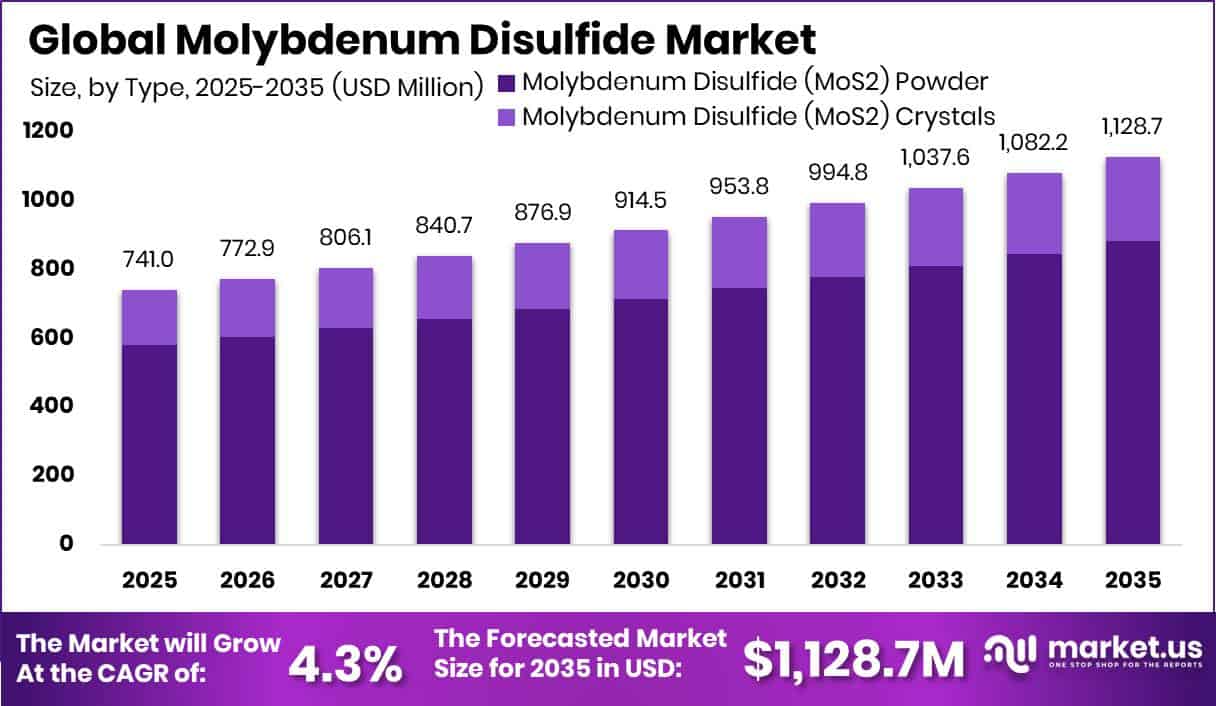
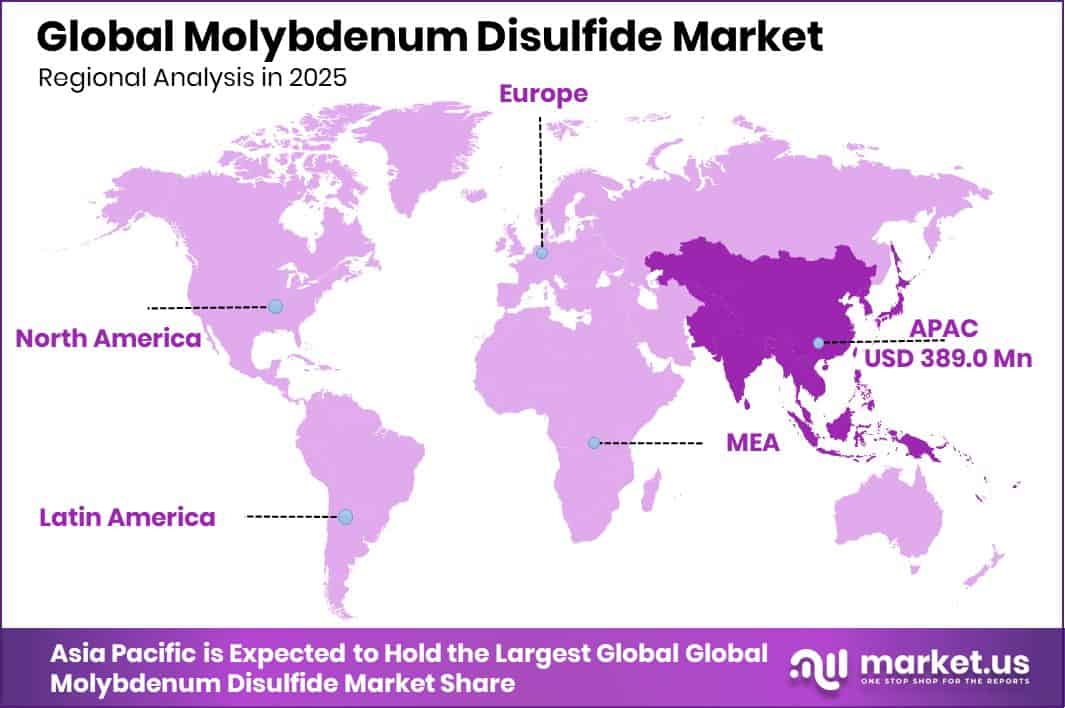
The Global Molybdenum Disulfide Market is expected to be worth around USD 1,128.7 million by 2035, up from USD 741.0 million in 2025, and is projected to grow at a CAGR of 4.3% from 2026 to 2035. Asia Pacific holds 52.5% dominance in this market valued at USD 389.0 Mn.
Molybdenum disulfide is a naturally occurring inorganic compound known for its strong lubrication properties, excellent thermal stability, and high resistance to wear. It is widely used as a solid lubricant and plays an important role in coatings, electronics, catalysts, and industrial machinery. In the market context, the Molybdenum Disulfide Market reflects the global demand for MoS₂ across powders and crystals, serving applications such as lubricants and coatings, semiconductors, catalysts, and multiple end-user sectors like automotive, aerospace, electronics, construction, and chemical processing.
The market’s growth is supported by rising industrial automation, expanding semiconductor use, and the shift toward advanced lubrication solutions that perform under extreme pressure and temperature. New technological developments also encourage adoption, including innovative coatings and friction-reducing materials. Funding activities—such as Anaphite securing £1.4m for dry-coating technology and NanoMech obtaining $10 million in Series C financing—highlight growing interest in material science improvements that indirectly support MoS₂ demand.
Demand is also strengthened by opportunities emerging in electronics and coatings, where high-purity MoS₂ plays a key role. Investments like the $6 million raised by a Canadian carbon-fiber start-up and LiquiGlide’s $16 million funding for advanced surface technologies reflect a broader ecosystem pushing for better material performance.
Opportunities continue to widen as industries explore new uses in energy, mobility, and high-efficiency components. Additional backing, such as a $10 million stake from the world’s largest oil company in a nanotechnology venture and the $10 million secured by Graphite Innovation & Technologies for marine emission-reduction solutions, shows expanding confidence in next-generation material applications that align closely with MoS₂ advancements.
Key Takeaways
- The Global Molybdenum Disulfide Market is expected to be worth around USD 1,128.7 million by 2035, up from USD 741.0 million in 2025, and is projected to grow at a CAGR of 4.3% from 2026 to 2035.
- The molybdenum disulfide market saw MoS₂ powder dominate with 78.3% due to strong industrial performance.
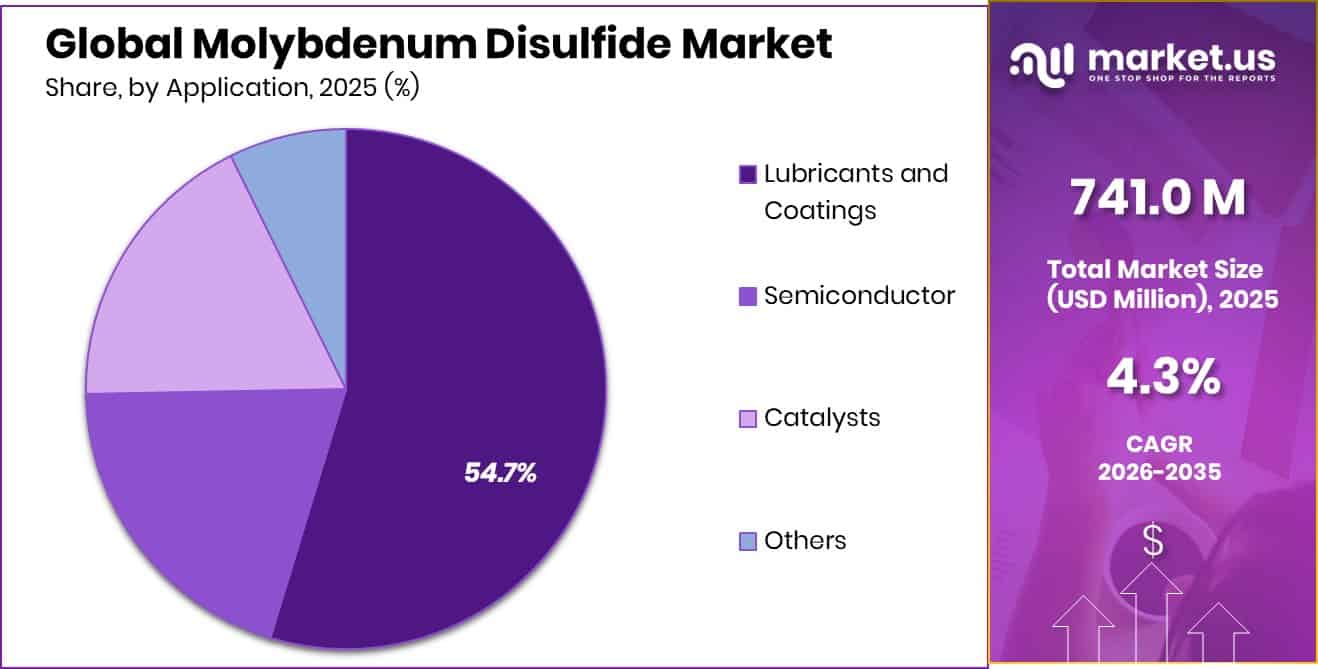
- Lubricants and coatings led the Molybdenum Disulfide Market, securing 54.7% through widespread manufacturing and engineering use.
- Automotive applications dominated the Molybdenum Disulfide Market, capturing 42.6% as vehicles increasingly rely on advanced lubrication materials.
- In the Asia Pacific, the market reaches 52.5% share, totaling USD 389.0 Mn.
By Type Analysis
Molybdenum Disulfide Market sees MoS₂ powder leading with a strong 78.3% share.
In 2025, Molybdenum Disulfide (MoS₂) powder is expected to hold a dominant 78.3% share in the Molybdenum Disulfide market, driven by its strong demand across lubrication, electronics, and advanced materials. Industries prefer MoS₂ powder because of its stability, low friction performance, and long-term wear resistance, making it suitable for both high-temperature and high-load environments.
The automotive, aerospace, and industrial machinery sectors continue to expand their use of MoS₂ powder coatings and additives, lifting overall consumption. Growing upgrades in mechanical systems, plus rising investment in precision components, are shaping stronger adoption levels. As manufacturers focus on more efficient and durable materials, MoS₂ powder maintains its lead as the most preferred type across global markets.
By Application Analysis
Molybdenum Disulfide Market grows as lubricants and coatings dominate with 54.7% usage.
In 2025, lubricants and coatings are projected to capture around 54.7% of the total Molybdenum Disulfide market as industries increase reliance on high-performance friction-reducing additives. MoS₂ continues to be used in greases, oils, dry-film coatings, and specialty surface treatments that support longer machinery life and improved energy efficiency.
The material’s ability to operate under extreme temperature and pressure conditions makes it suitable for automotive, industrial, and metalworking environments. Companies are also adopting MoS₂-based coatings to enhance corrosion resistance and overall equipment durability. As maintenance teams worldwide shift toward advanced lubrication solutions to minimize downtime, the lubricants and coatings segment remains the primary application area fueling steady market expansion.
By End-User Analysis
The molybdenum disulfide market expands steadily, with automotive end-users holding 42.6% demand share.
In 2025, the automotive sector is expected to represent 42.6% of the Molybdenum Disulfide market, reflecting strong industry dependence on MoS₂ for engine oils, drivetrain lubricants, brake components, and protective coatings. Automakers are increasingly using MoS₂ to improve efficiency, reduce wear, and meet stricter performance standards across combustion and electric vehicle platforms. The growth in EV manufacturing also adds demand, as MoS₂ supports thermal stability and helps optimize moving parts within compact electric systems.
Expanding vehicle production, rising aftermarket servicing, and the push toward more reliable lubrication technologies collectively strengthen MoS₂ adoption. With vehicle durability taking greater priority globally, the automotive industry remains one of the most influential end-user segments in the MoS₂ landscape.
Key Market Segments
By Type
- Molybdenum Disulfide (MoS2) Powder
- Molybdenum Disulfide (MoS2) Crystals
By Application
- Lubricants and Coatings
- Semiconductor
- Catalysts
- Others
By End-User
- Automotive
- Aerospace and Defense
- Electrical and Electronics
- Construction
- Chemical and Petrochemical
- Others
Driving Factors
Rising forestry activities boost chainsaw adoption
Rising demand for advanced industrial lubricants continues to push the Molybdenum Disulfide market forward, especially as industries look for materials that can handle extreme pressure, high temperatures, and long operating cycles.
MoS₂ remains a preferred solid lubricant because it delivers stable friction reduction across automotive, machinery, and heavy-equipment applications. This momentum is further supported by global investment activity, including European Semiconductor Co. securing $250M in new funding, which indirectly boosts material science innovations and encourages broader use of performance-enhancing materials.
As industrial systems become more efficient and technically demanding, the need for durable lubrication solutions strengthens, giving MoS₂ a solid platform for long-term growth within manufacturing and engineering environments.
Restraining Factors
Safety concerns limit widespread chainsaw usage
Price fluctuations in molybdenum ores and processing costs often create instability in the Molybdenum Disulfide market, especially for industries that rely on predictable raw material expenses. Sudden changes in supply conditions, mining output, or trade limitations can make it difficult for manufacturers to plan long-term production volumes. This uncertainty is echoed in the broader semiconductor ecosystem, where investment continues—such as VisIC securing US$26 million in funding for semiconductor technology—but material supply chains still face volatility. For MoS₂ producers and end users, these cost swings limit widespread adoption, forcing companies to balance performance benefits with procurement risks, particularly in sectors highly sensitive to budget fluctuations.
Growth Opportunity
Expanding landscaping services creates new demand
Increasing adoption of MoS₂ in semiconductor layer engineering opens new opportunities for the market, especially as the industry explores two-dimensional materials for improved mobility, conductivity, and device performance.
MoS₂’s unique structure makes it suitable for next-generation transistors, sensors, and flexible electronics. This direction is reinforced by innovation-driven investment, such as deep-tech startup Maieutic Semiconductor raising $4.15 million in a seed round, highlighting strong interest in emerging material technologies. As chip manufacturers look for alternatives to traditional silicon-based designs, MoS₂ gains importance as a functional layer material. This shift createsa significant opportunity for producers capable of achieving high-purity, ultra-thin, and application-specific MoS₂ formulations.
Latest Trends
Shift toward quieter battery-powered models
A major trend shaping the Molybdenum Disulfide market is the movement toward ultra-fine MoS₂ powder grades, which offer improved dispersion, higher purity, and better surface performance in lubrication, semiconductors, and coating applications. Manufacturers are focusing on refining particle size to meet the needs of precision engineering and advanced electronics.
At the same time, funding throughout the semiconductor ecosystem continues to influence material trends, including Chaince Digital securing $6.14 million for AI and semiconductor expansion, which supports broader demand for high-performance materials like MoS₂. The push toward miniaturization, cleaner surfaces, and higher efficiency keeps ultra-fine MoS₂ grades at the center of current market innovation.
Regional Analysis
Asia Pacific leads the Molybdenum Disulfide Market with 52.5%, worth USD 389.0 Mn.
**In 2025, the Molybdenum Disulfide Market shows varied regional performance across North America, Europe, Asia Pacific, the Middle East & Africa, and Latin America, with Asia Pacific emerging as the dominant hub. Asia Pacific leads decisively with a 52.5% share, accounting for USD 389.0 Mn, supported by strong manufacturing activity, extensive automotive production, and rising industrial lubrication demand.
North America continues to show stable uptake due to advanced machinery usage and increased reliance on performance lubrication materials. Europe remains consistent, driven by engineered coatings and automotive applications across major economies. The Middle East & Africa demonstrate gradual growth as industrial operations expand and material efficiency gains importance.
Latin America maintains a steady demand supported by automotive component manufacturing and industrial maintenance needs. Together, these regions outline a balanced yet clearly Asia-Pacific-driven market structure, shaped by rising production capabilities and stronger adoption of MoS₂ across key industries.
Key Regions and Countries
- North America
- US
- Canada
- Europe
- Germany
- France
- The UK
- Spain
- Italy
- Rest of Europe
- Asia Pacific
- China
- Japan
- South Korea
- India
- Australia
- Rest of APAC
- Latin America
- Brazil
- Mexico
- Rest of Latin America
- Middle East & Africa
- GCC
- South Africa
- Rest of MEA
Key Players Analysis
In 2025, Luoyang Shenyu Molybdenum Co Ltd continues to strengthen its position in the global Molybdenum Disulfide market through steady production capacity and dependable material quality. The company benefits from established supply networks and its focus on producing high-grade MoS₂ for industrial lubrication, coatings, and mechanical applications. Its strong integration within China’s broader molybdenum ecosystem allows it to maintain consistent output, which keeps it relevant in both domestic and international procurement cycles. As demand for MoS₂ grows across manufacturing and automotive systems, the company’s ability to deliver stable volumes positions it as a reliable contributor to global supply.
Meanwhile, Jinduicheng Molybdenum Co Ltd remains one of the more influential players due to its extensive ore resources and refined processing capabilities. With a long presence in the molybdenum value chain, the company supports a wide market base, particularly industries adopting MoS₂ for friction-reduction and durability enhancement. Its integrated operations—from mining to finished materials—enable controlled quality and efficient scaling. This strategic advantage helps the company respond effectively to shifts in global consumption patterns.
American Elements, operating from the United States, offers a different strength: specialization in engineered materials and diversified chemical formulations. The company’s portfolio includes tailored MoS₂ products suited for lubricants, coatings, electronics, and research applications. Its emphasis on precision manufacturing, consistent purity, and small-batch customization resonates with customers requiring technical-grade materials. In 2025, this adaptability helps American Elements serve niche, high-performance segments where specification accuracy is essential.
Top Key Players in the Market
- Luoyang Shenyu Molybdenum Co Ltd
- Jinduicheng Molybdenum Co Ltd
- American Elements
- Moly Metal LLP
- Rose Mill Co LLC
- Tribotecc
- ARK Co Ltd
Recent Developments
- In August 2024, Jinduicheng Molybdenum published its 2024 Semi-Annual Report, sharing performance results for the first half of the year and highlighting its operations in mining, processing, and chemical production, including molybdenum disulfide. This report outlines how the company continued its core activities in producing and selling molybdenum products, which include MoS₂, alongside other chemical and metal materials.
Report Scope
Report Features Description Market Value (2025) USD 741.0 Million Forecast Revenue (2035) USD 1,128.7 Million CAGR (2026-2035) 4.3% Base Year for Estimation 2025 Historic Period 2020-2024 Forecast Period 2026-2035 Report Coverage Revenue Forecast, Market Dynamics, Competitive Landscape, Recent Developments Segments Covered By Type (Molybdenum Disulfide (MoS2) Powder, Molybdenum Disulfide (MoS2) Crystals), By Application (Lubricants and Coatings, Semiconductor, Catalysts, Others), By End-User (Automotive, Aerospace and Defense, Electrical and Electronics, Construction, Chemical and Petrochemical, Others) Regional Analysis North America – US, Canada; Europe – Germany, France, The UK, Spain, Italy, Rest of Europe; Asia Pacific – China, Japan, South Korea, India, Australia, Singapore, Rest of APAC; Latin America – Brazil, Mexico, Rest of Latin America; Middle East & Africa – GCC, South Africa, Rest of MEA Competitive Landscape Luoyang Shenyu Molybdenum Co Ltd, Jinduicheng Molybdenum Co Ltd, American Elements, Moly Metal LLP, Rose Mill Co LLC, Tribotecc, ARK Co Ltd Customization Scope Customization for segments, region/country-level will be provided. Moreover, additional customization can be done based on the requirements. Purchase Options We have three licenses to opt for: Single User License, Multi-User License (Up to 5 Users), Corporate Use License (Unlimited User and Printable PDF)  Molybdenum Disulfide MarketPublished date: February 2026add_shopping_cartBuy Now get_appDownload Sample
 -
-
- Luoyang Shenyu Molybdenum Co Ltd
- Jinduicheng Molybdenum Co Ltd
- American Elements
- Moly Metal LLP
- Rose Mill Co LLC
- Tribotecc
- ARK Co Ltd
Our Clients

- 179284
- February 2026






