Location Based Services Market By Component (Hardware, Software, Services), By Location Type (Indoor, Outdoor), By Core Technology (GPS / A-GPS, Wi-Fi and WLAN Triangulation), By Application (Navigation and Mapping, Location-Based Advertising and Promotion), By End-user Industry (Retail and FMCG, Transportation and Logistics, Others), By Regional Analysis, Global Trends and Opportunity, Future Outlook By 2026-2035
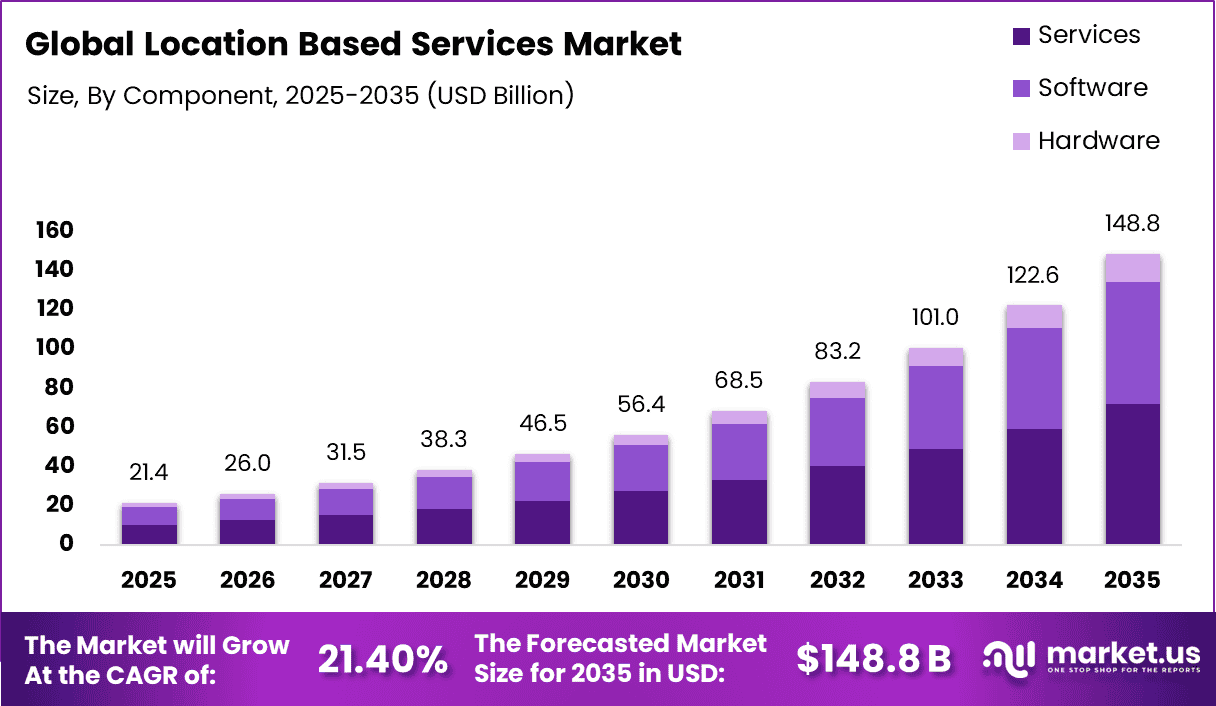
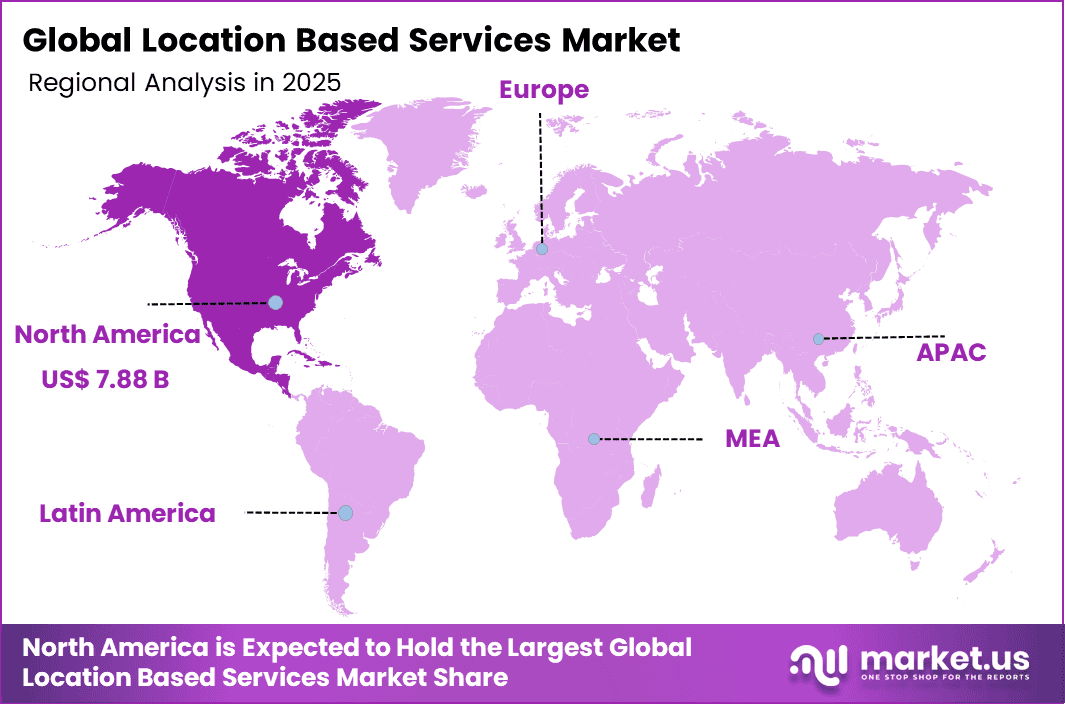
The Global Location Based Services Market generated USD 21.4 billion in 2025 and is predicted to register growth from USD 26 billion in 2026 to about USD 148.8 billion by 2035, recording a CAGR of 21.40% throughout the forecast span. In 2025, North America held a dominant market position, capturing more than a 36.83% share, holding USD 7.88 Billion revenue.
Top Market Takeaways
Services command 48.31% market share, delivering location intelligence platforms, geospatial analytics, and API integrations for dynamic enterprise applications.
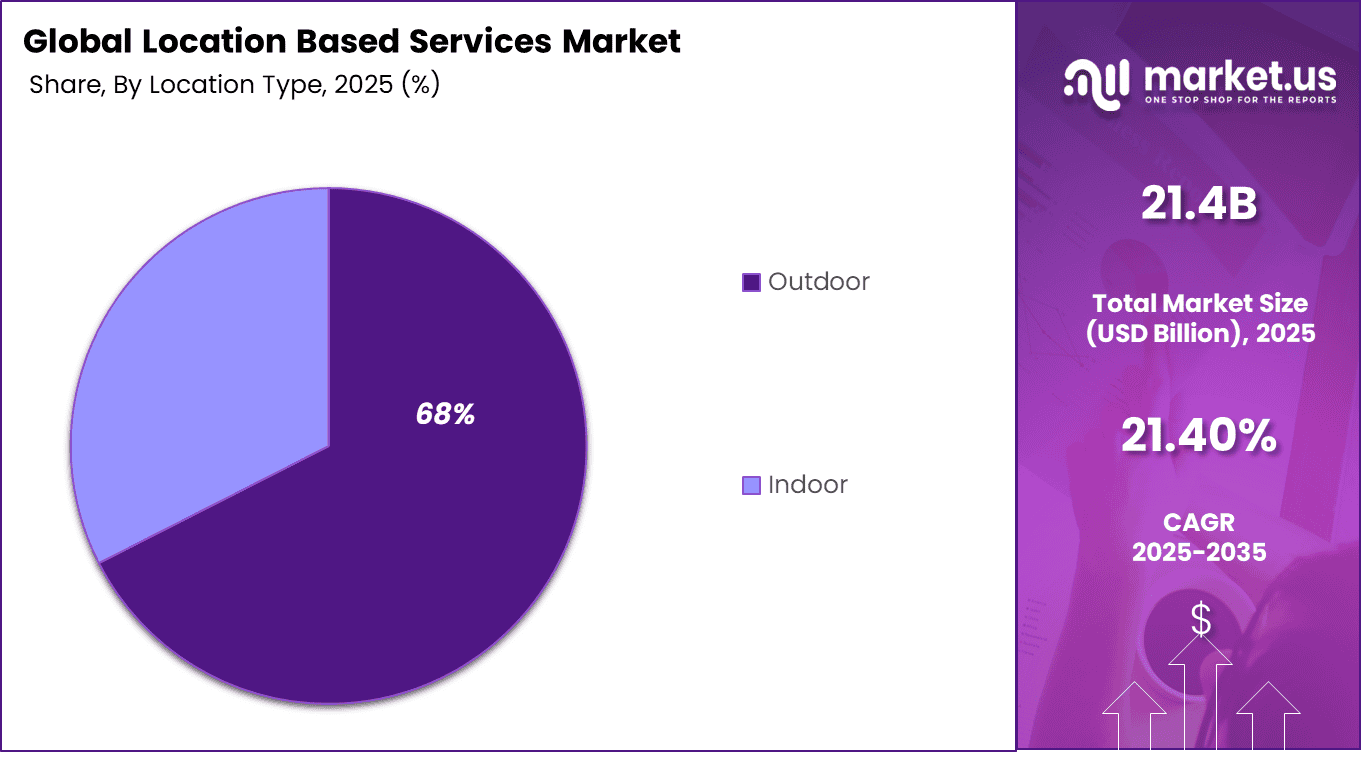
Outdoor location type captures 67.5%, enabling wide-area asset tracking, fleet telematics, and geofencing across urban, suburban, and highway environments.
GPS/A-GPS core technology dominates at 46.37%, providing carrier-assisted positioning, rapid time-to-first-fix, and seamless indoor-outdoor transitions.
Navigation and mapping applications claim 23.68%, powering turn-by-turn guidance, ETA predictions, and traffic-aware routing for commercial vehicle operations.
Transportation and logistics end-users hold 23.41%, leveraging LBS for last-mile optimization, dynamic rerouting, and proof-of-delivery verification.
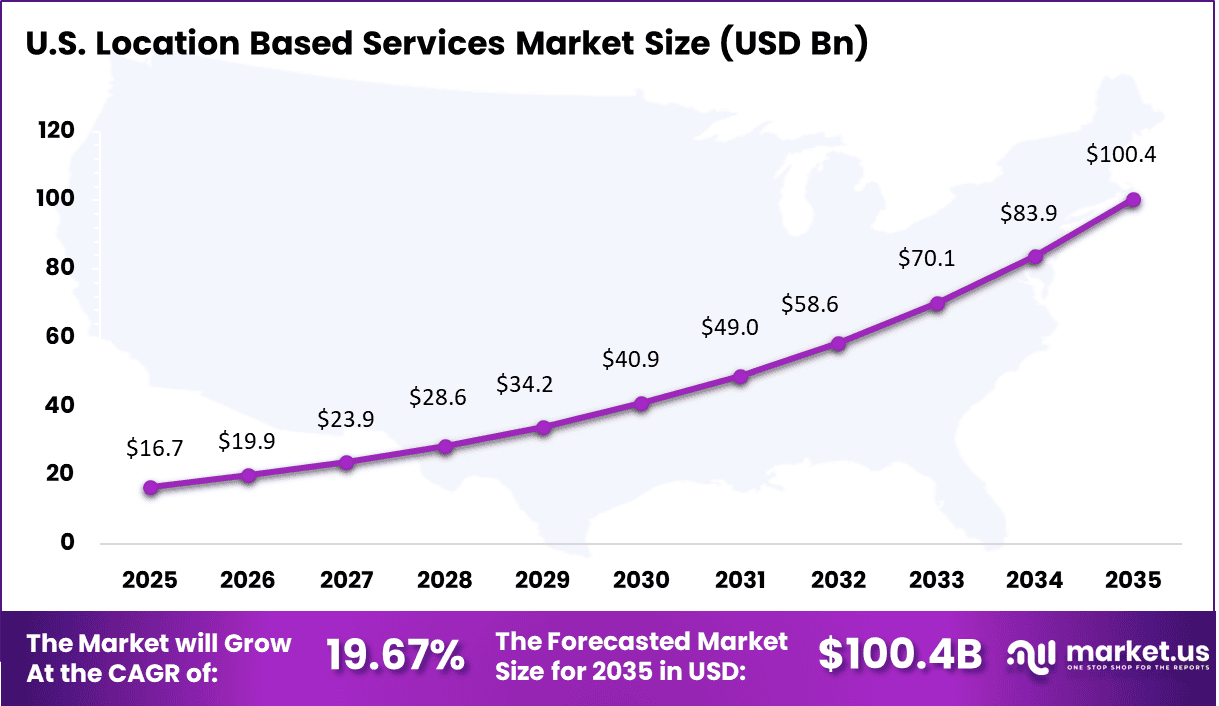
North America drives 36.83% global value, with U.S. market at USD 16.67 billion and 19.67% CAGR, fueled by e-commerce surge and supply chain digitalization.
Location based services are becoming a core part of digital applications by using geographic data to deliver relevant information and services to users in real time. These services are widely used in navigation, ride sharing, retail, advertising, and emergency response, where accurate location data helps improve user experience and operational efficiency.
With the growth of smartphones and connected devices, location data is now integrated into many everyday activities, allowing businesses to offer personalized services based on user movement and behavior. As digital ecosystems continue to expand, location based services are playing a key role in connecting users with timely and context aware information.
One of the main driving factors is the increasing use of mobile devices and applications that rely on real time location tracking. Consumers expect services such as navigation, delivery tracking, and local recommendations to be accurate and responsive.
In addition, businesses are using location data to improve customer engagement through targeted marketing and personalized offers. The expansion of smart cities and connected infrastructure is also supporting the use of location based solutions for traffic management, public safety, and urban planning. Improvements in positioning technologies and data accuracy are further strengthening the reliability of these services across different environments.
Demand for location based services is rising as organizations seek better ways to understand user behavior and optimize operations. There is a strong preference for solutions that can provide precise and real time location insights while maintaining user privacy and data security. Industries such as retail, transportation, healthcare, and logistics are actively adopting these services to enhance decision making and improve service delivery.
The demand is also driven by the need for seamless integration with mobile applications and digital platforms. As users continue to rely on location enabled experiences in their daily lives, the adoption of location based services is expected to grow steadily.
Drivers Impact Analysis
Key Driver
Impact on CAGR Forecast (~%)
Geographic Relevance
Impact Timeline
Additional Insight
Rising adoption of smartphones and mobile apps
+5.2%
Global
Short to medium term
Mobile usage drives location data demand
Growing demand for location-based advertising
+4.6%
North America, Europe, Asia Pacific
Medium term
Businesses target users based on location
Expansion of IoT and connected devices
+4.1%
Global
Medium to long term
Connected devices rely on location tracking
Increasing use in navigation and fleet management
+3.7%
Global
Medium term
Improves route optimization and efficiency
Integration of LBS in smart city initiatives
+3.4%
Developed and emerging markets
Medium to long term
Supports urban planning and services
Restraints Impact Analysis
Key Restraint
Impact on CAGR Forecast (~%)
Geographic Relevance
Impact Timeline
Additional Insight
Data privacy and security concerns
-3.8%
North America, Europe
Medium to long term
Privacy concerns limit data usage
Regulatory restrictions on location data usage
-3.2%
Europe, Asia Pacific
Medium term
Strict laws impact service deployment
High implementation and infrastructure costs
-2.7%
Emerging markets
Short to medium term
Cost barriers affect adoption
Accuracy limitations in certain environments
-2.3%
Global
Medium term
Indoor and dense areas affect precision
Dependence on GPS and connectivity availability
-2.0%
Global
Long term
Weak signals reduce service reliability
By Component Analysis
The services segment accounted for 48.31% of the market share, reflecting its strong role in delivering value-added capabilities such as consulting, integration, and maintenance. This dominance is supported by the growing need for customized solutions that align with specific business requirements. Organizations are increasingly relying on service providers to deploy and manage location-based systems effectively, ensuring smooth operations and continuous performance.
Another factor supporting this segment is the rising demand for ongoing support and system optimization. As location-based technologies become more complex, businesses prefer service-based models to handle updates, analytics, and system management. This approach helps reduce operational burden and ensures better utilization of location data across different applications.
By Location Type Analysis
The outdoor segment held 68% share, driven by the widespread use of location-based services in open environments such as roads, cities, and public spaces. Outdoor applications rely heavily on accurate positioning systems to support navigation, tracking, and real-time mapping. This has made outdoor environments the primary area of deployment for these services.
In addition, the increasing use of mobile devices and connected vehicles has strengthened the demand for outdoor location tracking. These applications require reliable and continuous location data, which is more effectively supported in outdoor settings. The expansion of smart city initiatives has also contributed to the growth of this segment.
By Core Technology Analysis
The GPS and A-GPS segment accounted for 46.37% of the market share, reflecting its fundamental role in enabling precise location tracking. These technologies are widely used due to their accuracy, reliability, and global coverage. GPS-based systems form the backbone of most location-based services, supporting applications across various industries.
Furthermore, advancements in assisted GPS have improved performance in challenging environments by enhancing signal acquisition and reducing positioning delays. This has expanded the usability of these technologies across a wider range of applications, making them a preferred choice for both consumers and enterprises.
By Application Analysis
The navigation and mapping segment held 23.68% share, driven by the increasing reliance on digital navigation tools for everyday travel and logistics planning. These applications provide real-time directions, traffic updates, and route optimization, making them essential for both individual users and businesses. The growing use of smartphones and connected devices has further boosted adoption.
Additionally, the need for efficient route planning and time management has encouraged the use of advanced mapping solutions. Businesses are integrating these tools to improve operational efficiency and reduce travel-related costs. This has reinforced the importance of navigation and mapping applications within the location-based services market.
By End-User Industry Analysis
The transportation and logistics segment captured 23.41% of the market, driven by the need for efficient fleet management and real-time tracking. Companies in this sector rely on location-based services to monitor vehicle movement, optimize routes, and ensure timely deliveries. This improves operational efficiency and enhances customer satisfaction.
Moreover, the increasing complexity of supply chains has encouraged the adoption of advanced tracking and monitoring solutions. Location-based services help businesses gain better visibility into their operations and respond quickly to changes or disruptions. This has made them a critical tool for the transportation and logistics industry.
Investor Type Impact Analysis
Investor Type
Growth Sensitivity
Risk Exposure
Geographic Focus
Investment Outlook
Venture capital firms
Very high
High
US, China, Europe
Investing in location intelligence startups
Private equity firms
High
Moderate
North America and Europe
Scaling analytics and mapping solution providers
Corporate investors
Very high
Moderate
Global
Strategic investments in digital and mobile ecosystems
Institutional investors
Moderate to high
Moderate
Developed markets
Focus on stable tech and data service firms
Government and public funding bodies
High
Low
Asia Pacific, EU
Supporting smart city and infrastructure projects
Technology Enablement Analysis
Technology
Impact on CAGR Forecast (~%)
Geographic Relevance
Impact Timeline
Additional Insight
GPS and GNSS advancements
+5.0%
Global
Medium to long term
Improves location accuracy
AI and big data analytics for location intelligence
+4.4%
US, China, Europe
Medium term
Enhances data insights
Integration with 5G networks
+4.1%
Global
Medium to long term
Enables faster and real-time tracking
Beacon and proximity-based technologies
+3.6%
Retail-heavy markets
Medium term
Supports indoor positioning
Cloud-based location services platforms
+3.3%
Global
Short to medium term
Enables scalable service delivery
Key Challenges
Privacy concerns as user location data is collected and tracked.
Data accuracy issues in areas with weak GPS or network signals.
High dependency on internet connectivity for real-time services.
Integration challenges with existing apps and business systems.
High cost of implementation for advanced location technologies.
Security risks related to unauthorized access to location data.
Battery consumption increases due to continuous location tracking.
Regulatory restrictions on data usage in different countries.
Difficulty in handling large volumes of location data in real time.
Limited adoption in regions with low smartphone penetration.
Emerging Trends
The location based services market is evolving toward more precise, real time, and context aware applications that go beyond basic navigation. One of the key emerging trends is the integration of artificial intelligence with geospatial data to deliver highly personalized experiences based on user behavior and movement patterns. This is enabling services such as targeted recommendations, smart advertising, and dynamic route optimization.
Another important trend is the increasing use of indoor positioning technologies, allowing accurate tracking inside malls, airports, and large facilities where traditional GPS signals are weak. There is also growing adoption of location intelligence in sectors such as retail, transportation, and public safety, where real time insights support better decision making. In addition, the combination of location data with augmented reality is creating new use cases, especially in navigation, tourism, and interactive customer engagement. Privacy focused features are also becoming more prominent, with users expecting better control over how their location data is collected and used.
Growth Factors
The growth of this market is driven by the widespread use of smartphones and connected devices that continuously generate location data. As digital services become more personalized, businesses are relying on location insights to understand customer behavior and improve engagement. The expansion of e commerce and on demand services is also supporting demand, as accurate location tracking is essential for delivery, ride sharing, and logistics operations.
Another major factor is the increasing importance of real time tracking and monitoring across industries, including fleet management and emergency response. Governments and urban planners are also using location based services to improve traffic management and public infrastructure planning. Furthermore, advancements in connectivity technologies are enhancing the accuracy and reliability of location data, making these services more effective and encouraging wider adoption across both consumer and enterprise applications.
Key Market Segments
By Component
Hardware
Software
Services
By Location Type
Indoor
Outdoor
By Core Technology
GPS / A-GPS
Wi-Fi and WLAN Triangulation
Bluetooth Low Energy (BLE)
Ultra-Wideband (UWB)
RFID and NFC
By Application
Navigation and Mapping
Location-Based Advertising and Promotion
Asset and Fleet Tracking
Emergency Services and Public Safety
Gaming and Augmented Reality
Social Media and Engagement
By End-user Industry
Retail and FMCG
Transportation and Logistics
Healthcare and Life Sciences
Telecom and IT Services
Oil, Gas and Energy
Government and Public Sector
Manufacturing and Industrial
Others
Regional Analysis
North America accounted for 36.83% of the Location Based Services market, supported by strong adoption of smartphones, high internet penetration, and widespread use of GPS-enabled applications. The region benefits from a mature digital ecosystem where businesses actively use location data for targeted advertising, navigation, fleet management, and customer engagement.
Consumers are increasingly relying on real-time location services for daily activities such as ride-hailing, food delivery, and retail discovery. In addition, growing integration of location intelligence into enterprise operations is strengthening demand across sectors including retail, transportation, and logistics.
The U.S. market reached USD 16.67 Billion and is projected to grow at a CAGR of 19.67%, driven by rising demand for personalized services and data-driven decision making. Companies are leveraging location insights to enhance customer experience, optimize operations, and improve marketing effectiveness.
The expansion of connected devices and mobile applications is further increasing the volume of location data generated, creating more opportunities for service providers. Strong growth in sectors such as e-commerce, mobility services, and smart city initiatives is expected to support continued expansion of the Location Based Services market in the US.
Key Regions and Countries
North America
US
Canada
Europe
Germany
France
The UK
Spain
Italy
Russia
Netherlands
Rest of Europe
Asia Pacific
China
Japan
South Korea
India
Australia
Singapore
Thailand
Vietnam
Rest of APAC
Latin America
Brazil
Mexico
Rest of Latin America
Middle East & Africa
South Africa
Saudi Arabia
UAE
Rest of MEA
Competitive Analysis
The competitive landscape of the Location Based Services Market is highly competitive, with strong participation from global technology companies and mapping platform providers. Companies such as Google LLC (Alphabet Inc.), Apple Inc., Microsoft Corporation, HERE Global B.V. (Nokia Corporation), and Baidu Inc. lead the market by offering advanced mapping, navigation, and location intelligence platforms.
These players focus on real-time data processing, high-accuracy mapping, and integration with mobile devices and applications. Their strong ecosystems and large user bases help them maintain a leading position, especially in navigation, ride-hailing, and consumer location services.
At the same time, companies such as Cisco Systems, Inc., IBM Corporation, Ericsson AB, Hewlett Packard Enterprise Company (Aruba Networks), and Alcatel-Lucent Enterprise International Limited focus on enterprise and network-based location solutions. Players like Zebra Technologies Corporation, Garmin Ltd., TomTom N.V., and Maxar Technologies Inc. provide specialized solutions for logistics, fleet management, and geospatial intelligence.
In addition, firms such as Esri Global Inc., Qualcomm Technologies Inc., IndoorAtlas Ltd., Sewio Networks s.r.o., Ubiquicom S.r.l., HID Global Corporation (ASSA ABLOY AB), Teldio Corporation, Creativity Software Ltd., and GL Communications Inc. focus on indoor positioning, analytics, and IoT-based tracking solutions. Competition in this market is driven by accuracy, real-time capabilities, and the ability to integrate location data across different platforms and industries.
Alcatel-Lucent Enterprise International Limited (ALE International)
Hewlett Packard Enterprise Company (Aruba Networks)
Zebra Technologies Corporation
Maxar Technologies Inc.
Esri Global Inc.
Qualcomm Technologies Inc.
Garmin Ltd.
TomTom N.V.
Baidu Inc.
IndoorAtlas Ltd.
Sewio Networks s.r.o.
Ubiquicom S.r.l.
HID Global Corporation (ASSA ABLOY AB)
Teldio Corporation
Creativity Software Ltd.
GL Communications Inc.
Others
Future Outlook
The future outlook for the Location Based Services Market looks very strong as smartphones, connected devices, and digital platforms continue to rely on real-time location data. The market is expected to grow with increasing use in areas such as navigation, targeted advertising, ride-hailing, and delivery services. Businesses are anticipated to use location insights more to understand customer behavior and improve services. In the coming years, advancements in 5G, AI, and geospatial technologies are expected to make location services more accurate and faster, while growing demand from smart cities and IoT applications is likely to further drive adoption.
Recent Developments
February, 2026 – Apple Maps expands Look Around street view to 100 new cities with photorealistic 3D flyovers while iOS 19.4 integrates Globalstar satellite connectivity for offline navigation. AR walking directions overlay arrows on camera view while privacy-preserving crowd-sourced traffic uses differential privacy. Customizable map themes, transit disruption alerts, and bicycle lane detection gain iPhone 17 camera fusion.
January, 2026 – IBM TRIRIGA Location Intelligence fuses digital twins with Maximo asset management optimizing 10B sq ft facility space globally. Watson AI predicts space utilization while ESG dashboards track carbon footprint by building zone. Campus navigation guides 1M+ daily visitors across Fortune 500 headquarters.
Report Scope
Report Features
Description
Market Value (2025)
USD 21.4 Billion
Forecast Revenue (2035)
USD 148.8 Billion
CAGR(2025-2035)
21.40%
Base Year for Estimation
2024
Historic Period
2020-2024
Forecast Period
2026-2035
Report Coverage
Revenue forecast, AI impact on Market trends, Share Insights, Company ranking, competitive landscape, Recent Developments, Market Dynamics and Emerging Trends
Segments Covered
By Component (Hardware, Software, Services), By Location Type (Indoor, Outdoor), By Core Technology (GPS / A-GPS, Wi-Fi and WLAN Triangulation), By Application (Navigation and Mapping, Location-Based Advertising and Promotion), By End-user Industry (Retail and FMCG, Transportation and Logistics, Others)
Regional Analysis
North America – US, Canada; Europe – Germany, France, The UK, Spain, Italy, Russia, Netherlands, Rest of Europe; Asia Pacific – China, Japan, South Korea, India, New Zealand, Singapore, Thailand, Vietnam, Rest of Latin America; Latin America – Brazil, Mexico, Rest of Latin America; Middle East & Africa – South Africa, Saudi Arabia, UAE, Rest of MEA
Competitive Landscape
Google LLC (Alphabet Inc.), Apple Inc., Cisco Systems, Inc., IBM Corporation, HERE Global B.V. (Nokia Corporation), Microsoft Corporation, Ericsson AB, Alcatel-Lucent Enterprise International Limited (ALE International), Hewlett Packard Enterprise Company (Aruba Networks), Zebra Technologies Corporation, Maxar Technologies Inc., Esri Global Inc., Qualcomm Technologies Inc., Garmin Ltd., TomTom N.V., Baidu Inc., IndoorAtlas Ltd., Sewio Networks s.r.o., Ubiquicom S.r.l., HID Global Corporation (ASSA ABLOY AB), Teldio Corporation, Creativity Software Ltd., GL Communications Inc., Others
Customization Scope
Customization for segments, region/country-level will be provided. Moreover, additional customization can be done based on the requirements.
Purchase Options
We have three license to opt for: Single User License, Multi-User License (Up to 5 Users), Corporate Use License (Unlimited User and Printable PDF)