


Global Glucaric Acid Market By Product Type (Pure Glucaric Acid, Calcium D-Glucarate, Potassium Sodium D-Glucarate, D-Glucaric Acid-1,4-Lactone, and Others), By Application (Detergents And Cleaning Agents, Food And Beverages, Pharmaceutical And Nutraceutical, Polymers And Bioplastics, and Others), By Region and Companies - Industry Segment Outlook, Market Assessment, Competition Scenario, Trends and Forecast 2025-2035
- Published date: Mar 2026
- Report ID: 180657
- Number of Pages: 397
- Format:
-
keyboard_arrow_up
Quick Navigation
Report Overview
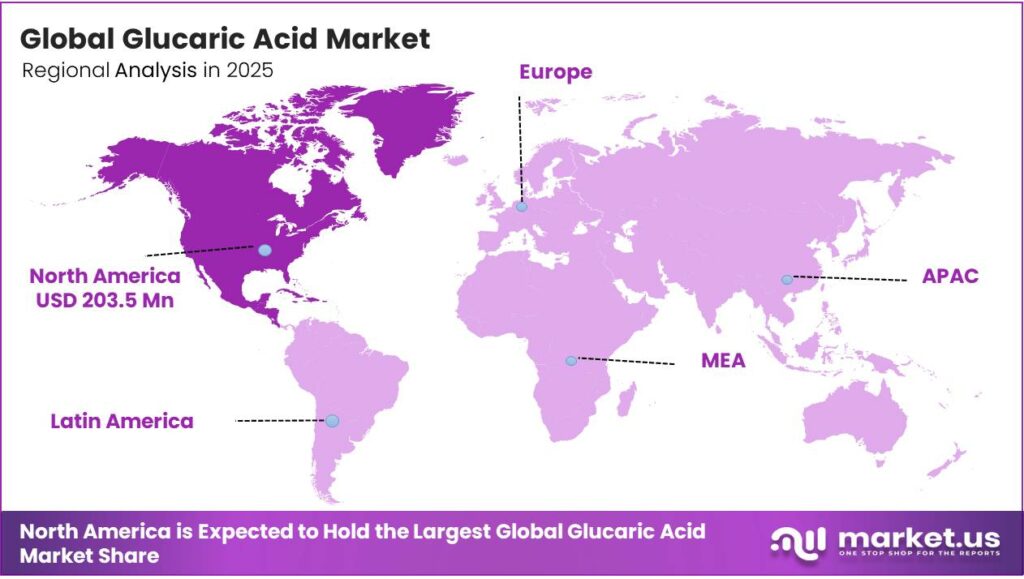
Global Glucaric Acid Market is expected to be worth around USD 1223.0 Million by 2035, up from USD 556.1 Million in 2025, at a CAGR of 8.2% from 2026 to 2035. The North America segment maintained 36.6%, supporting a Glucaric Acid value of USD 203.5 Mn.
Glucaric acid, also known as saccharic acid, is a naturally occurring dicarboxylic acid produced through the oxidation of glucose. It is found in various fruits and vegetables and plays a significant role in biological detoxification and industrial applications.
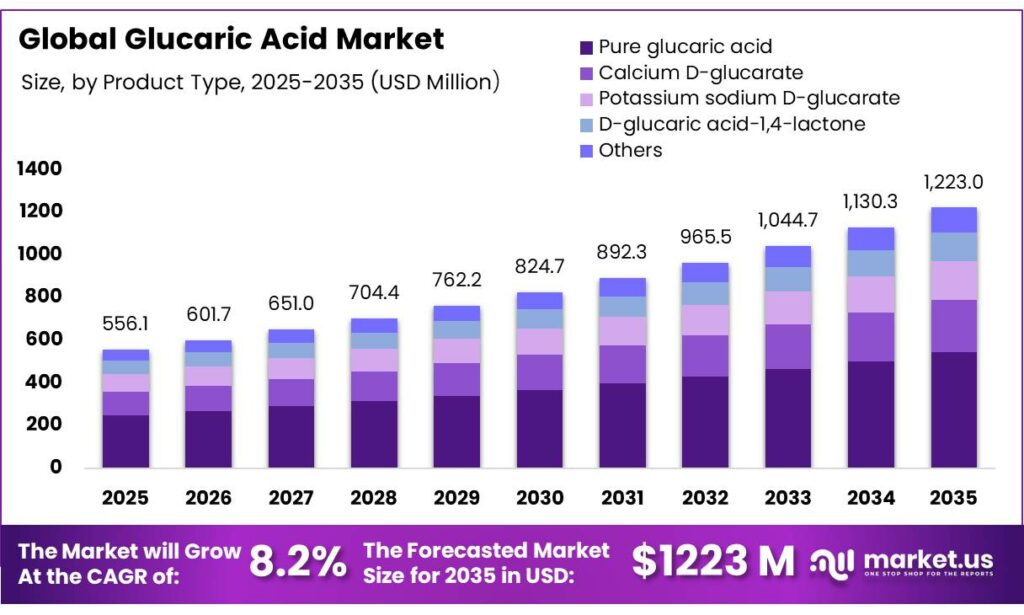
The glucaric acid market is primarily driven by its applications in environmentally sustainable industries such as detergents, cleaning agents, and water treatment. Its strong chelating properties make it an effective alternative to phosphates, reducing ecological impact in cleaning products, which is in line with global regulatory trends. North America is the largest market, supported by U.S. government initiatives such as the EPA’s Safer Choice program and the DOE’s focus on bio-based chemicals.
While pure glucaric acid dominates the market due to its versatility in industrial applications, its derivatives, such as calcium D-glucarate, have more niche uses in health and wellness. Despite growing interest in its potential for food and beverage or bioplastics, its adoption is constrained by higher production costs and regulatory hurdles. The market is shaped by a push for sustainability, with increasing demand for green alternatives in sectors with high environmental impact.
Key Takeaways:
- The global glucaric acid market was valued at USD 556.1 million in 2025.
- The global glucaric acid market is projected to grow at a CAGR of 8.2% and is estimated to reach USD 1223.0 Million by 2035.
- Based on the product type, pure glucaric acid dominated the market, with a market share of around 44.5%.
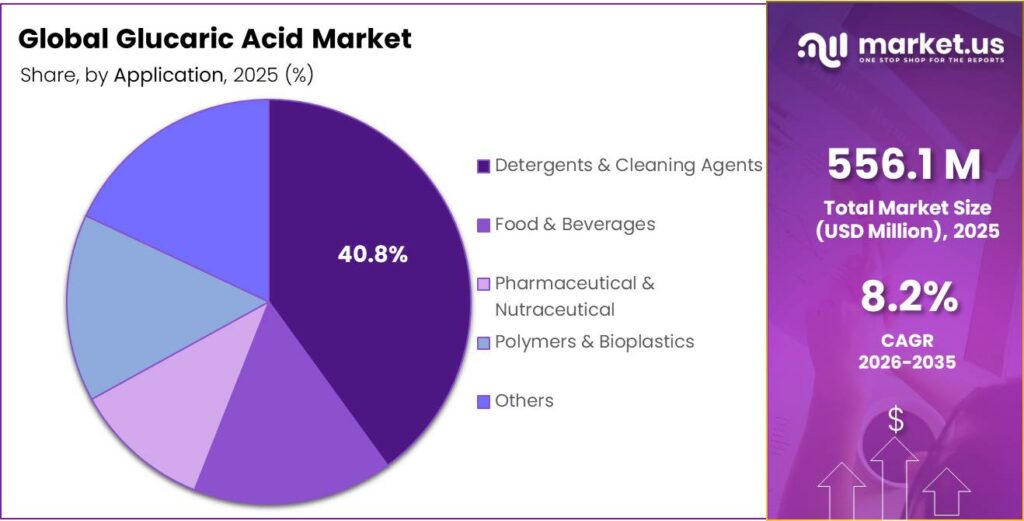
- Among the applications of glucaric acid, the detergents & cleaning agents held a major share in the market, 40.8% of the market share.
- In 2025, North America was the most dominant region in the glucaric acid market, accounting for around 36.6% of the total global consumption.
Product Type Analysis
Pure Glucaric Acid Held the Largest Share in the Market.
The glucaric acid market is segmented based on product type into pure glucaric acid, calcium D-glucarate, potassium sodium D-glucarate, D-glucaric acid-1,4-lactone, and others. The pure glucaric acid dominated the market, comprising around 44.5% of the market share, due to its versatility and direct applicability in various industries. In its pure form, glucaric acid is a more reactive compound, making it suitable for diverse chemical processes such as polymer synthesis, chelation in water treatment, and as a biodegradable alternative to phosphates in cleaning agents.
Its ability to form salts with different cations allows for more targeted formulations depending on the application. In contrast, derivatives such as calcium D-glucarate and potassium sodium D-glucarate are often used in niche health applications, such as supplements, but are less versatile in industrial and environmental applications due to their reduced reactivity and limited functionality outside specific use cases.
Application Analysis
The Glucaric Acids Are Mostly Utilized for Detergents & Cleaning Agents.
Based on the applications of glucaric acid, the market is divided into detergents & cleaning agents, food & beverages, pharmaceutical & nutraceutical, polymers & bioplastics, and others. The detergents & cleaning agents dominated the market, with a market share of 40.8%, due to their strong chelating properties and biodegradability, making it an ideal alternative to phosphates and other synthetic chemicals.
It effectively binds with metal ions and minerals, enhancing the cleaning power of detergents while being environmentally friendly. This aligns with increasing regulatory pressure on the cleaning industry to reduce the environmental impact of synthetic ingredients. In contrast, its use in food and beverages, pharmaceuticals, or polymers is more niche due to higher production costs and specialized regulatory hurdles.
Key Market Segments:
By Product Type
- Pure Glucaric Acid
- Calcium D-Glucarate
- Potassium Sodium D-Glucarate
- D-Glucaric Acid-1,4-Lactone
- Others
By Application
- Detergents & Cleaning Agents
- Food & Beverages
- Pharmaceutical & Nutraceutical
- Polymers & Bioplastics
- Others
Drivers
Increased Applications in Cleaning Agents and Water Treatment Drive the Glucaric Acids Market.
Glucaric acid is increasingly recognized for its applications in cleaning agents and water treatment as a biodegradable chelating and binder agent, as well as a sustainable alternative to phosphates. The demand for environmentally friendly chemicals has led to the adoption of glucaric acid due to its ability to effectively bind heavy metals and scale-forming ions in water treatment processes. In cleaning products, it serves as a chelating agent, enhancing the effectiveness of detergents while being biodegradable, reducing ecological impact.
The European Union’s REACH regulation (EC 1907/2006) has promoted the use of such sustainable agents by restricting phosphates in household laundry and dishwasher detergents. This regulatory shift has created a clear market demand for alternatives such as glucaric acid. For instance, companies such as Cargill and DuPont have highlighted glucaric acid’s role in formulating phosphate-free detergents. In addition, the U.S. EPA’s Safer Choice program encourages the use of such agents in cleaning products, bolstering adoption in the market.
Restraints
Scalability Issues Might Hamper the Demand for Glucaric Acid.
The commercialization of glucaric acid faces significant challenges due to the lack of economically viable and environmentally friendly production methods. Most production processes rely on expensive raw materials and energy-intensive steps. For instance, while the biotechnological synthesis of glucaric acid via fermentation offers a potential pathway, it remains costly. The U.S. Department of Energy’s National Renewable Energy Laboratory (NREL) has noted that achieving cost competitiveness with petrochemical-based alternatives requires substantial improvements in fermentation yields and process efficiencies.
Additionally, the production process generates by-products that require further treatment, adding to environmental concerns. In a study by the U.S. Environmental Protection Agency (EPA), it was highlighted that existing methods for glucaric acid production from glucose do not meet the desired environmental sustainability criteria, mainly due to high energy consumption and waste generation. These barriers hinder the large-scale adoption of glucaric acid in various applications, despite its potential as a green alternative to petroleum-based chemicals.
Opportunity
Glucaric Acid Demand in the Polymer and Fiber Industry Creates Opportunities in the Market.
The polymer and fiber industries present a significant opportunity for the glucaric acid market due to its potential as a building block for bio-based polymers. Glucaric acid, as a key precursor in the synthesis of polyamides and polyesters, has garnered attention for its ability to replace petroleum-based components. The bio-based materials, including those derived from glucaric acid, are essential for the future of sustainable polymers. These materials can be used in producing eco-friendly fibers, reducing dependence on fossil fuels.
The European Commission’s Circular Economy Action Plan emphasizes the transition to sustainable polymers in textiles and packaging, aligning with the use of bio-based alternatives such as glucaric acid. Additionally, research from the U.S. National Renewable Energy Laboratory (NREL) has demonstrated the feasibility of producing glucaric acid from renewable feedstocks for polymer applications, which could further reduce the environmental impact of the polymer and fiber industries. These factors position glucaric acid as a promising material in sustainable polymer manufacturing.
Trends
Adoption of Glucaric Acid in Health Supplements.
The adoption of glucaric acid in the food and beverage sector is driven by its potential as a natural preservative and functional ingredient. The U.S. Food and Drug Administration (FDA) has recognized glucaric acid as a generally recognized as safe (GRAS) substance, which supports its use in food products. Its application as an additive is primarily for extending shelf life and enhancing the stability of food products by preventing oxidative spoilage.
Additionally, the European Food Safety Authority (EFSA) has acknowledged glucaric acid’s potential in food safety, particularly in maintaining the quality of processed foods. A study observed that glucaric acid can act as a chelating agent, binding with trace metals and thus improving food preservation. Companies in the beverage industry have increasingly explored its use in formulations to stabilize ingredients such as vitamins and antioxidants. This trend aligns with the broader shift toward natural and sustainable food ingredients, in line with global regulatory efforts to reduce synthetic chemicals in food products.
Geopolitical Impact Analysis
Geopolitical Tensions Are Impacting the Glucaric Acid Market Due to Disrupted Supply Chains.
The geopolitical tensions are having a nuanced impact on the glucaric acid market, particularly through supply chain disruptions and shifts in regulatory landscapes. The U.S. trade tensions with China have caused uncertainty in the availability of raw materials for bio-based chemicals such as glucaric acid. In particular, the restriction of exports from China, a key supplier of glucose (a primary feedstock for glucaric acid production), has raised concerns about feedstock pricing and availability.
Furthermore, the European Union’s regulatory policies, as part of the Green Deal, are driving increased demand for sustainable chemicals, including glucaric acid. However, supply chain bottlenecks exacerbated by geopolitical tensions, such as those seen in the aftermath of the Russia-Ukraine conflict, have delayed the scaling of production capacity in certain regions.
These geopolitical challenges are compounded by shifts in trade policies, with some countries tightening export controls on bio-based materials. The U.S. Department of Commerce has emphasized this impact on the broader bio-economy, including sectors such as polymer production, where glucaric acid is gaining traction as an eco-friendly alternative.
Regional Analysis
North America Held the Largest Share of the Global Glucaric Acid Market.
In 2025, North America dominated the global glucaric acid market, holding about 36.6% of the total global consumption, driven by robust demand from industries such as cleaning, water treatment, and polymers, as well as regulatory support for sustainable chemicals. The U.S. Environmental Protection Agency (EPA) has been a key driver of this demand through programs such as the Safer Choice initiative, which encourages the use of bio-based ingredients in cleaning products. Similarly, the U.S. Department of Energy (DOE) has identified glucaric acid as a high-priority bio-based chemical, facilitating research into its production from renewable feedstocks.
Additionally, North America’s leadership in green chemistry initiatives, as seen in the U.S. Green Chemistry Program, has fostered innovation in bio-based chemicals, positioning glucaric acid as a viable alternative to petroleum-derived substances. The U.S. Food and Drug Administration (FDA) has further supported its use in food products, acknowledging its GRAS (Generally Recognized as Safe) status. These regulatory frameworks have bolstered North America’s role in advancing glucaric acid applications across diverse sectors.
Key Regions and Countries
- North America
- The US
- Canada
- Europe
- Germany
- France
- The UK
- Spain
- Italy
- Russia & CIS
- Rest of Europe
- APAC
- China
- Japan
- South Korea
- India
- ASEAN
- Rest of APAC
- Latin America
- Brazil
- Mexico
- Rest of Latin America
- Middle East & Africa
- GCC
- South Africa
- Rest of MEA
Key Players Analysis:
Manufacturers of glucaric acid focus on improving production efficiency through advancements in biotechnological processes, such as optimizing fermentation techniques to reduce costs and enhance yields. Additionally, companies invest in developing eco-friendly and sustainable production methods, aligning with growing regulatory demands for green chemistry and reducing environmental footprints.
Product diversification is another strategy, with manufacturers expanding glucaric acid applications into new industries, such as polymers and bioplastics, where sustainability is increasingly prioritized. Strategic partnerships and collaborations with research institutions and regulatory bodies help to foster innovation and ensure compliance with environmental standards, which is critical for maintaining market position in an evolving regulatory landscape.
The Major Players in The Industry
- Kalion, Inc.
- Rivertop Renewables
- Haihang Industry Co., Ltd
- Cayman Chemical Company
- NutriScience Innovations, LLC
- Henan Alfa Chemical Co., Ltd.
- Biosynth
- Bioacids Tech Brasil LTDA
- Other Key Players
Key Development:
- In September 2024, Lygos is taking a stab at large-scale biobased chemical production. The 13-year-old specialty chemical firm is partnering with CJ Bio to build a facility in Fort Dodge, Iowa, that will produce 40,000 metric tons (t) per year of polyaspartates and malonates from aspartic acid and malonic acid.
Report Scope:
Report Features Description Market Value (2025) US$556.1 Mn Forecast Revenue (2035) US$1223.0 Mn CAGR (2026-2035) 8.2% Base Year for Estimation 2025 Historic Period 2020-2024 Forecast Period 2026-2035 Report Coverage Revenue Forecast, Market Dynamics, Competitive Landscape, Recent Developments Segments Covered By Product Type (Pure Glucaric Acid, Calcium D-Glucarate, Potassium Sodium D-Glucarate, D-Glucaric Acid-1,4-Lactone, and Others), By Application (Detergents & Cleaning Agents, Food & Beverages, Pharmaceutical & Nutraceutical, Polymers & Bioplastics, and Others) Regional Analysis North America – The US & Canada; Europe – Germany, France, The UK, Spain, Italy, Russia & CIS, Rest of Europe; APAC– China, Japan, South Korea, India, ASEAN & Rest of APAC; Latin America– Brazil, Mexico & Rest of Latin America; Middle East & Africa– GCC, South Africa, & Rest of MEA Competitive Landscape Kalion, Inc., Rivertop Renewables, Haihang Industry Co., Ltd., Cayman Chemical Company, NutriScience Innovations, LLC, Henan Alfa Chemical Co., Ltd., Biosynth, Bioacids Tech Brasil LTDA, and Other Players. Customization Scope Customization for segments, region/country-level will be provided. Moreover, additional customization can be done based on the requirements. Purchase Options We have three licenses to opt for: Single User License, Multi-User License (Up to 5 Users), Corporate Use License (Unlimited Users and Printable PDF) 
-
-
- Kalion, Inc.
- Rivertop Renewables
- Haihang Industry Co., Ltd
- Cayman Chemical Company
- NutriScience Innovations, LLC
- Henan Alfa Chemical Co., Ltd.
- Biosynth
- Bioacids Tech Brasil LTDA
- Other Key Players
Our Clients

- 180657
- Mar 2026






