


Global Feed Testing Market Size, Share Analysis Report By Type (Pathogen Testing, Pesticide Residue Analysis, Nutritional Labeling Analysis, Fats and Oils Analysis, Mycotoxin Testing, Others), By Feed Type (Ruminant Feed, Poultry Feed, Swine Feed, Aquaculture Feed, Pet Food) , By Region and Companies - Industry Segment Outlook, Market Assessment, Competition Scenario, Trends and Forecast 2026-2035
- Published date: Mar 2026
- Report ID: 181150
- Number of Pages: 241
- Format:
-
keyboard_arrow_up
Quick Navigation
Report Overview
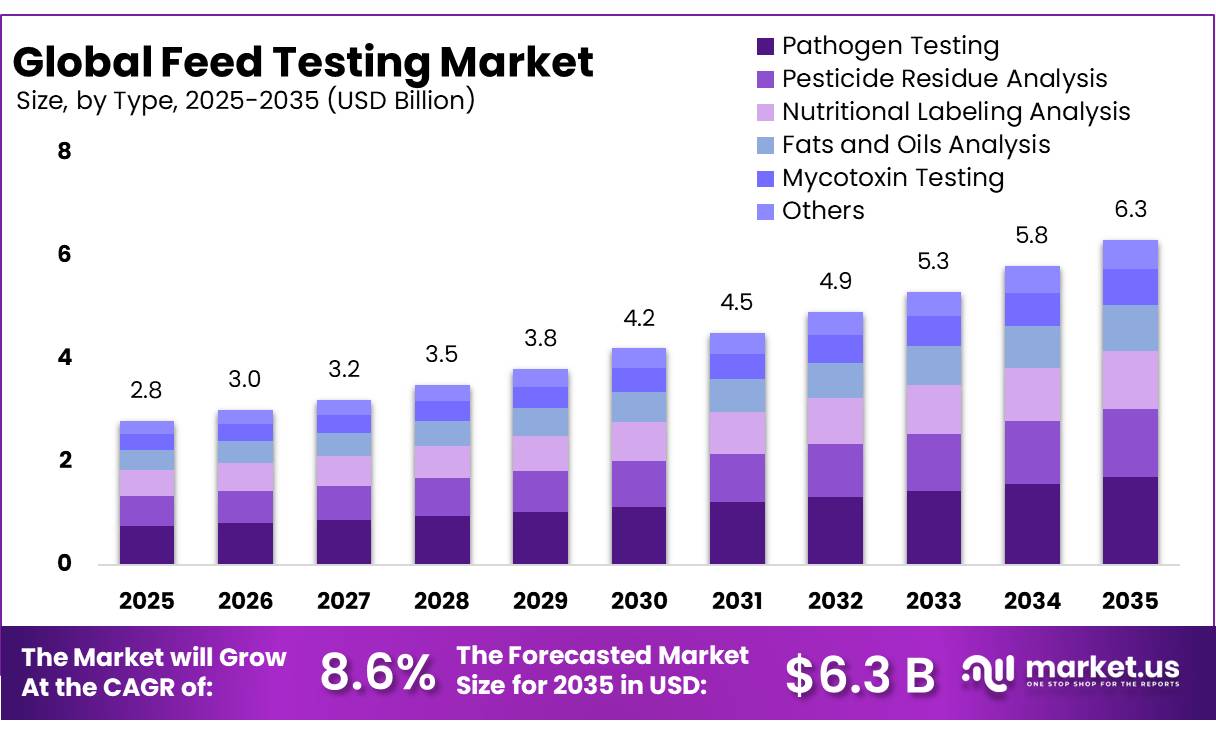
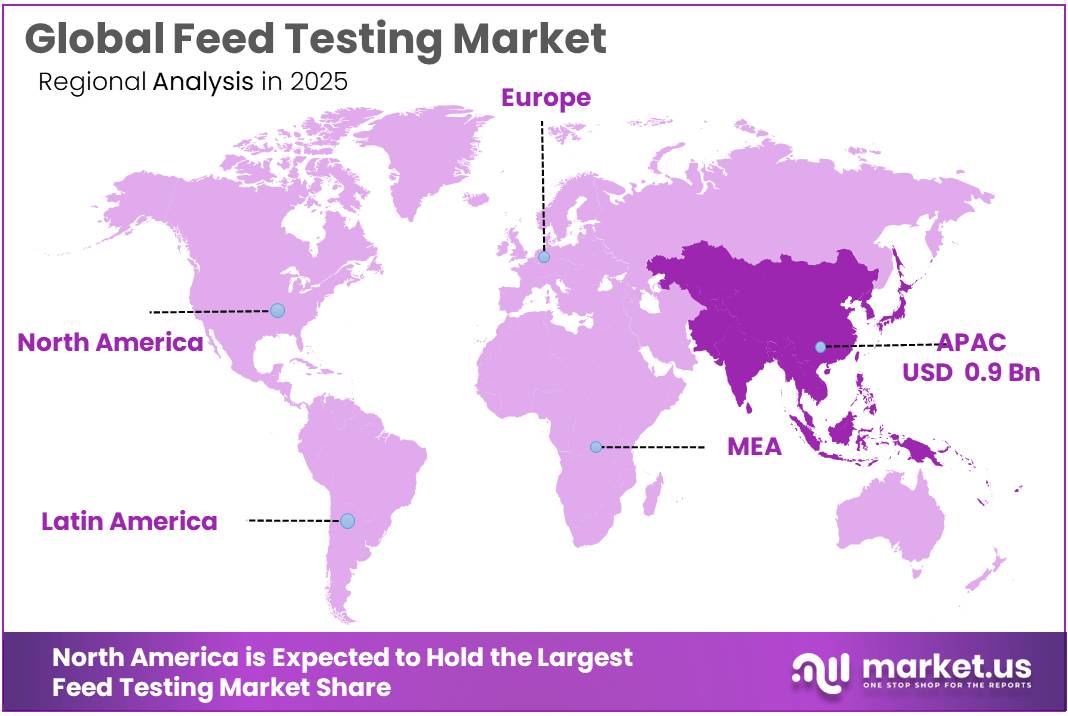
The Global Feed Testing Market size is expected to be worth around USD 6.3 Billion by 2035, from USD 2.8 Billion in 2025, growing at a CAGR of 8.6% during the forecast period from 2026 to 2035. In 2025, Asia Pacific held a dominant market position, capturing more than a 34.4% share, holding USD 0.9 billion revenue.
The feed testing industry plays a critical role in ensuring the safety, quality, and nutritional adequacy of animal feed used across livestock, poultry, aquaculture, and companion animal production systems. Feed testing refers to laboratory-based analysis of raw materials and finished feed products to detect contaminants such as mycotoxins, pathogens, pesticides, heavy metals, and nutritional imbalances that can affect animal health and ultimately human food safety. The global livestock and feed ecosystem has expanded significantly over the past decade, increasing the importance of feed quality assurance.
- According to the Food and Agriculture Organization (FAO), the global feed industry produces over 1 billion tonnes of livestock feed annually, generating an estimated annual commercial turnover exceeding USD 400 billion across more than 130 countries.
The global feed sector produces over 1 billion tonnes of livestock feed annually and generates more than US $400 billion in annual commercial turnover, highlighting the large industrial ecosystem requiring rigorous quality monitoring and testing. In 2023, global animal feed production reached approximately 1.29 billion metric tons, reflecting the rising scale of industrial feed manufacturing worldwide. The global growth in livestock production further strengthens the need for feed quality verification, as world meat production reached 374 million tonnes in 2024, driven by strong demand for poultry, pork, and beef products.
Several factors are driving demand for feed testing services globally. One major driver is the rapid increase in demand for animal protein due to population growth and changing dietary patterns. FAO projections indicate that global food demand is expected to increase by around 60% by 2050, while production of animal proteins is projected to expand significantly, including major increases in meat, dairy, and aquaculture outputs.
Key Takeaways
- Feed Testing Market size is expected to be worth around USD 6.3 Billion by 2035, from USD 2.8 Billion in 2025, growing at a CAGR of 8.6%.
- Pathogen Testing held a dominant market position, capturing more than a 26.8% share in the feed testing market.
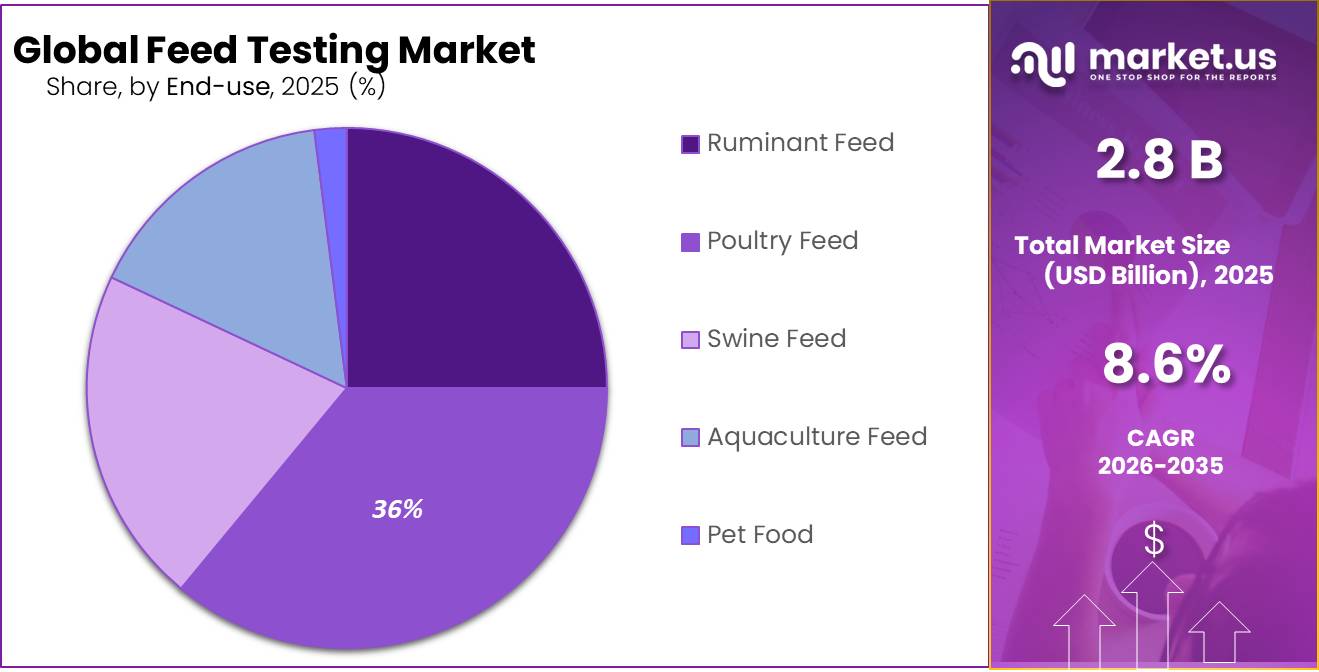
- Poultry Feed held a dominant market position, capturing more than a 36.1% share in the feed testing market.
- Asia Pacific emerged as the leading regional market for feed testing, accounting for 34.4% of the global market with an estimated value of about USD 0.9 billion.
By Type Analysis
Pathogen Testing dominates with 26.8% due to rising feed safety regulations and disease prevention needs
In 2024, Pathogen Testing held a dominant market position, capturing more than a 26.8% share in the feed testing market. This strong position is mainly linked to the increasing global focus on preventing animal diseases and ensuring safe feed for livestock and poultry. Feed contamination with pathogens such as Salmonella, E. coli, and Listeria can significantly affect animal health and may also enter the human food chain through meat, milk, and eggs. Because of this risk, feed manufacturers and livestock producers are giving high priority to routine pathogen screening during feed production and storage.
By Feed Type Analysis
Poultry Feed leads with 36.1% as poultry production continues to expand globally
In 2024, Poultry Feed held a dominant market position, capturing more than a 36.1% share in the feed testing market. The strong presence of this segment is mainly linked to the rapid growth of the poultry industry and the increasing demand for safe and high-quality feed. Poultry production is one of the fastest-growing sectors in the livestock industry because chicken meat and eggs are widely consumed and relatively affordable sources of animal protein.
As poultry farming becomes more commercial and large-scale, feed safety and nutritional quality have become major priorities for producers. This has increased the need for regular testing of poultry feed to ensure it meets safety standards and provides the required nutrients for bird health and productivity.
Key Market Segments
By Type
- Pathogen Testing
- Pesticide Residue Analysis
- Nutritional Labeling Analysis
- Fats and Oils Analysis
- Mycotoxin Testing
- Others
By Feed Type
- Ruminant Feed
- Poultry Feed
- Swine Feed
- Aquaculture Feed
- Pet Food
Emerging Trends
Rapid and Advanced Diagnostic Technologies Transforming Feed Testing Practices
One of the most noticeable recent trends in the feed testing sector is the growing use of rapid diagnostic technologies that allow laboratories and feed manufacturers to detect contaminants much faster than traditional testing methods. In the past, feed analysis often required lengthy laboratory procedures that could take several days to produce results.
Today, newer technologies such as rapid pathogen detection systems, molecular testing tools, and portable diagnostic equipment are helping laboratories identify contaminants in feed much more quickly. These technologies are increasingly being adopted because feed safety has become closely linked with global food safety and livestock productivity. Faster detection helps feed manufacturers take immediate action when contamination is detected, preventing unsafe feed from reaching farms and animals.
The need for faster testing is strongly connected to the scale and complexity of modern livestock production. According to the Food and Agriculture Organization (FAO), the intensification of livestock production and the increasing use of industrial compound feed have made safe feed management an essential part of producing safe animal-derived food products.
As livestock production systems become larger and more integrated, even a small contamination issue in feed can quickly spread across large animal populations. Rapid testing technologies therefore help feed producers monitor safety more frequently and respond to potential hazards before they affect animal health or the food supply chain.
A key example of why faster testing is needed can be seen in the case of mycotoxins, which are toxic compounds produced by certain molds that grow on crops such as corn and grains used in feed. The World Health Organization (WHO) notes that extremely low limits are set for certain toxins like aflatoxins because of their severe toxicity, with maximum allowed levels often ranging between 0.5 and 15 micrograms per kilogram (µg/kg) depending on the product. Detecting such small quantities requires precise analytical technologies, and rapid testing systems are increasingly used to screen large numbers of samples efficiently before more detailed laboratory analysis is performed.
Drivers
Rising Global Demand for Safe Animal Feed Driving the Need for Feed Testing
One of the major driving factors behind the growth of the feed testing sector is the rapid expansion of global livestock production and the increasing demand for safe and high-quality animal feed. As livestock farming grows to meet rising global consumption of meat, milk, and eggs, ensuring the safety and nutritional quality of feed has become a critical priority for both governments and the food industry. Feed is the foundation of animal health and productivity, and any contamination in feed can directly affect livestock and eventually enter the human food chain through animal-derived products. Because of this connection, testing feed for pathogens, toxins, and chemical residues has become an essential step in modern food safety systems.
The scale of the global feed ecosystem itself highlights why feed testing has become so important. According to the Food and Agriculture Organization (FAO), livestock around the world consume about 6 billion tonnes of feed dry matter every year, making feed one of the largest inputs in the agricultural system. This massive volume of feed production and consumption requires strong quality control mechanisms to prevent contamination and maintain nutritional balance. In addition, global feed manufacturing has continued to expand as the livestock sector grows. Industry estimates show that global animal feed production reached about 1.29 billion metric tons in 2023, reflecting the enormous scale of feed supply chains that must be monitored and regulated.
Another major reason driving feed testing demand is the increasing global consumption of animal-based foods. Livestock products provide a significant share of human nutrition worldwide. Research cited by FAO shows that animal products contribute around 18% of global calories and about 34% of global protein consumption. As populations grow and diets shift toward higher protein intake, livestock production continues to expand, which in turn increases the need for safe and well-tested feed supplies. If feed quality is compromised, it can lead to disease outbreaks in animals, lower productivity, and food safety risks for consumers. This has pushed regulators and producers to adopt stronger feed monitoring systems.
Restraints
High Cost of Testing Infrastructure and Laboratory Setup Limiting Wider Adoption
One of the key restraining factors affecting the feed testing sector is the high cost involved in establishing and maintaining testing laboratories and quality monitoring systems. Feed testing requires specialized laboratory equipment, trained technicians, certified analytical methods, and regular calibration of instruments.
These requirements make testing operations expensive, particularly for small feed producers and farmers in developing regions. Many feed manufacturers operate on narrow profit margins, and investing in advanced laboratory infrastructure or outsourcing frequent testing can become financially challenging. As a result, in several parts of the world, especially in emerging agricultural economies, feed testing is still not conducted as regularly as recommended by international food safety standards.
The complexity of feed testing also contributes to the cost barrier. Establishing a fully functional feed analysis laboratory requires multiple steps including laboratory design, equipment procurement, personnel training, and accreditation under quality standards such as ISO/IEC laboratory systems. According to technical guidance from the Food and Agriculture Organization (FAO), setting up a reliable feed quality analysis laboratory can involve a multi-stage process that may take up to four years to fully establish and implement quality assurance systems.
Another economic challenge comes from the scale of feed production in the livestock industry. Feed represents one of the largest operational costs in animal agriculture. FAO reports that feed costs can account for up to 70% of the total cost of producing animal products, including meat, milk, and eggs. Because feed already represents such a large portion of production expenses, many livestock producers are cautious about adding additional testing costs unless it is required by regulation or export standards.
Feed contamination issues also illustrate why testing is necessary but difficult to implement widely. Research referenced by FAO indicates that around 25% of the world’s food crops are contaminated with mycotoxins, toxic substances produced by fungi that can easily enter the animal feed supply chain. Detecting such contaminants requires advanced analytical technologies such as chromatography or molecular testing, which further increases operational costs for laboratories and feed manufacturers. In regions where laboratory capacity is limited, contaminated feed may go undetected simply because testing services are not easily accessible.
Opportunity
Expanding Global Livestock Production Creating Strong Growth Opportunities for Feed Testing
One of the biggest growth opportunities for the feed testing sector comes from the steady expansion of global livestock production and the rising demand for animal-based foods. As populations grow and incomes increase in many regions, consumption of meat, milk, and eggs continues to rise. This expansion directly increases the need for safe, nutritious, and well-regulated animal feed. Feed testing plays an important role in ensuring that the feed used in livestock production meets quality standards and is free from harmful contaminants. As livestock production becomes more industrialized and supply chains become more global, regular testing of feed ingredients and finished feed products is becoming a standard practice across many countries.
The scale of feed use in global agriculture clearly shows why this trend creates major opportunities for testing services. According to the Food and Agriculture Organization (FAO), livestock worldwide consume around 6 billion tonnes of feed dry matter every year, making feed one of the largest inputs in the agricultural sector. This massive consumption means that even small quality issues in feed can affect millions of animals and potentially disrupt food supply chains. Because of this, livestock producers, feed manufacturers, and regulators are increasingly focusing on preventive monitoring through laboratory testing. Feed testing helps identify pathogens, toxins, heavy metals, and nutritional imbalances before feed reaches farms, which protects both animal health and human food safety.
The global feed manufacturing industry itself is also expanding rapidly. Data from the International Feed Industry Federation (IFIF) indicates that worldwide compound feed production now exceeds 1 billion tonnes annually, with the commercial feed industry generating over USD 400 billion in annual turnover. As feed production grows at this scale, maintaining consistent quality across large production volumes becomes more challenging. This creates strong demand for advanced testing services, laboratory infrastructure, and rapid diagnostic technologies that can analyze feed ingredients and finished feed products efficiently.
Another important driver of opportunity is the projected increase in demand for livestock products over the coming decades. FAO estimates that the global population could reach about 9.6 billion people by 2050, and demand for livestock products such as meat, milk, and eggs is expected to grow by around 20% as a result of population growth, urbanization, and rising incomes. As food demand increases, livestock producers must expand production while maintaining strict safety and quality standards. Feed testing becomes essential in this context because feed quality directly affects animal productivity, disease prevention, and food safety.
Regional Insights
Asia Pacific dominates the Feed Testing Market with 34.4% share valued at around USD 0.9 Bn
Asia Pacific emerged as the leading regional market for feed testing, accounting for 34.4% of the global market with an estimated value of about USD 0.9 billion. The region’s dominance is largely supported by the rapid expansion of livestock production, increasing demand for high-quality animal feed, and stronger regulatory focus on feed safety.
Asia Pacific also leads the world in feed manufacturing capacity. According to global industry data, the region produces around 466 million tons of compound feed, representing about 36.8% of global feed production. This large production base directly increases the need for feed testing services because every stage of feed production—from raw materials to finished feed products—requires quality verification.
Government programs and regional initiatives are also contributing to the development of feed safety systems in Asia Pacific. Organizations such as the FAO’s Animal Production and Health Commission for Asia and the Pacific (APHCA) promote improved livestock productivity, safe feed management, and stronger veterinary and laboratory infrastructure across member countries.
Key Regions and Countries Insights
- North America
- US
- Canada
- Europe
- Germany
- France
- The UK
- Spain
- Italy
- Rest of Europe
- Asia Pacific
- China
- Japan
- South Korea
- India
- Australia
- Rest of APAC
- Latin America
- Brazil
- Mexico
- Rest of Latin America
- Middle East & Africa
- GCC
- South Africa
- Rest of MEA
Key Players Analysis
SGS SA is one of the largest global testing, inspection, and certification companies and plays an important role in the feed testing sector. The company was founded in 1878 and operates through a global network of about 2,600 laboratories and offices across more than 115 countries, supported by around 99,600 employees. The company reported revenue of approximately CHF 6.6 billion in 2023. SGS provides services including feed quality analysis, contamination detection, and regulatory compliance testing for livestock feed and agricultural products, helping producers maintain safety and international trade standards.
Intertek Group PLC is a global assurance, testing, inspection, and certification provider serving industries including agriculture and feed safety. Established in 1888, the company operates with a workforce of around 40,000 employees and maintains more than 1,000 laboratories and offices across about 100 countries. Intertek reported revenue of about £3,431.6 million in 2025. The company offers analytical testing solutions that help feed manufacturers detect pathogens, toxins, and chemical residues while ensuring regulatory compliance across global livestock supply chains.
Eurofins Scientific is one of the largest laboratory testing networks in the world and a major contributor to feed and food safety testing services. Founded in 1987, the company operates a network of more than 900 laboratories across 62 countries with approximately 63,000 employees globally. Eurofins supports feed testing through advanced analytical methods designed to verify feed composition, detect contaminants, and ensure compliance with safety standards. The company’s laboratory network provides over 200,000 analytical methods, enabling comprehensive testing services for agriculture, food, environmental, and pharmaceutical industries.
Top Key Players Outlook
- SGS SA
- Intertek Group PLC
- Bruker Biosciences Corporation
- Eurofins Scientific
- Control Union
- PerkinElmer Inc.
- Agro Lab Group
- R J Hill Laboratories Ltd
- Invisible Sentinel Inc.
- NSF International
Recent Industry Developments
In 2024, Eurofins Scientific reported revenue of about €6.95 billion, showing steady growth supported partly by increased demand for food and feed safety testing across Europe, North America, and emerging markets.
In 2024, Intertek Group PLC continued to play an important role in the global feed testing and agricultural quality assurance sector by offering laboratory analysis, inspection, and certification services for feed ingredients and agricultural commodities. The company operates a large global network with more than 1,000 laboratories and offices across around 100 countries and about 40,000–45,000 employees worldwide, allowing it to support feed manufacturers, grain suppliers, and livestock producers with testing and quality verification services.
Report Scope
Report Features Description Market Value (2025) USD 2.8 Bn Forecast Revenue (2035) USD 6.3 Bn CAGR (2026-2035) 8.6% Base Year for Estimation 2025 Historic Period 2020-2024 Forecast Period 2026-2035 Report Coverage Revenue Forecast, Market Dynamics, Competitive Landscape, Recent Developments Segments Covered By Type (Pathogen Testing, Pesticide Residue Analysis, Nutritional Labeling Analysis, Fats and Oils Analysis, Mycotoxin Testing, Others), By Feed Type (Ruminant Feed, Poultry Feed, Swine Feed, Aquaculture Feed, Pet Food) Regional Analysis North America – US, Canada; Europe – Germany, France, The UK, Spain, Italy, Rest of Europe; Asia Pacific – China, Japan, South Korea, India, Australia, Singapore, Rest of APAC; Latin America – Brazil, Mexico, Rest of Latin America; Middle East & Africa – GCC, South Africa, Rest of MEA Competitive Landscape SGS SA, Intertek Group PLC, Bruker Biosciences Corporation, Eurofins Scientific, Control Union, PerkinElmer Inc., Agro Lab Group, R J Hill Laboratories Ltd, Invisible Sentinel Inc., NSF International Customization Scope Customization for segments, region/country-level will be provided. Moreover, additional customization can be done based on the requirements. Purchase Options We have three licenses to opt for: Single User License, Multi-User License (Up to 5 Users), Corporate Use License (Unlimited User and Printable PDF) 
-
-
- SGS SA
- Intertek Group PLC
- Bruker Biosciences Corporation
- Eurofins Scientific
- Control Union
- PerkinElmer Inc.
- Agro Lab Group
- R J Hill Laboratories Ltd
- Invisible Sentinel Inc.
- NSF International
Our Clients

- 181150
- Mar 2026






