


Global Facial Cleanser Market Size, Share, Growth Analysis By Skin Type (Normal Skin, Oily Skin, Dry Skin, Sensitive Skin, Combination Skin, Others), By Product Type (Gel Cleanser, Cream & Lotion Cleanser, Foaming Cleanser, Bar Cleanser, Others), By Consumer Group (Male, Female, Unisex), By End Use (Individual, Commercial), By Distribution Channel (Online, Supermarkets, Departmental Stores, Others), Region and Companies - Industry Segment Outlook, Market Assessment, Competition Scenario, Statistics, Trends and Forecast 2026-2035
- Published date: Feb 2026
- Report ID: 179293
- Number of Pages: 226
- Format:
-
keyboard_arrow_up
Quick Navigation
Market Overview
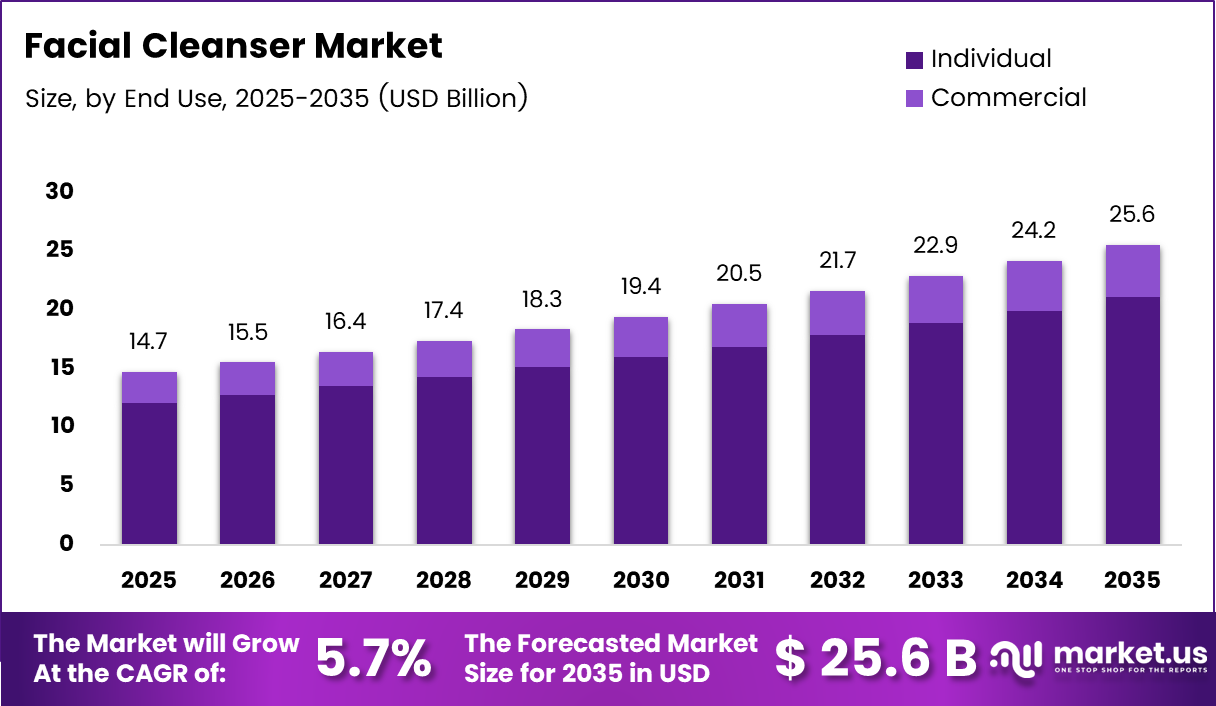
Global Facial Cleanser Market size is expected to be worth around USD 25.6 Billion by 2035 from USD 14.7 Billion in 2025, growing at a CAGR of 5.7% during the forecast period 2026 to 2035.
The facial cleanser market refers to the global industry focused on skincare products designed to remove dirt, oil, makeup, and impurities from the face. These products are available in multiple forms including gels, foams, creams, and bars. Consequently, they serve a wide range of skin types and consumer preferences across all age groups.
Facial cleansers have become a core component of daily skincare routines worldwide. Moreover, the growing consumer awareness around skin health and hygiene has significantly increased product adoption. This awareness is further supported by dermatologist recommendations and the expansion of medicated and clinically tested cleansing products.
The market is experiencing strong growth driven by rising disposable incomes, increasing urbanization, and the influence of social media on beauty habits. Additionally, the popularity of K-Beauty product and science-backed skincare solutions has expanded the global consumer base. Brands are investing in innovation to address diverse skin conditions and preferences.
Government regulations around cosmetic product safety and labeling have also shaped market dynamics. Regulatory bodies across North America, Europe, and Asia Pacific continue to enforce standards that ensure product quality and consumer protection. Therefore, compliant and clinically backed formulations are gaining stronger market acceptance.
According to CeraVe, up to 80% of Americans make at least one common mistake when washing their face, including using improper products such as body wash or soap. Additionally, 66% of men and 40% of women use hand soap or body wash to cleanse their face, and more than a third use just water. This highlights a significant education and product adoption opportunity for facial cleanser brands.
According to CeraVe, over 50% of respondents fail to wash their face properly before going to bed, despite dermatologists recommending face washing twice daily. However, this gap between recommended and actual behavior signals a strong opportunity for brands to educate consumers and drive consistent product usage across demographics.
Key Takeaways
- The global Facial Cleanser Market was valued at USD 14.7 Billion in 2025 and is projected to reach USD 25.6 Billion by 2035.
- The market is growing at a CAGR of 5.7% during the forecast period 2026 to 2035.
- By Skin Type, Normal Skin dominates with a market share of 26.9% in 2025.
- By Product Type, Gel Cleanser leads the segment with a 39.6% market share.
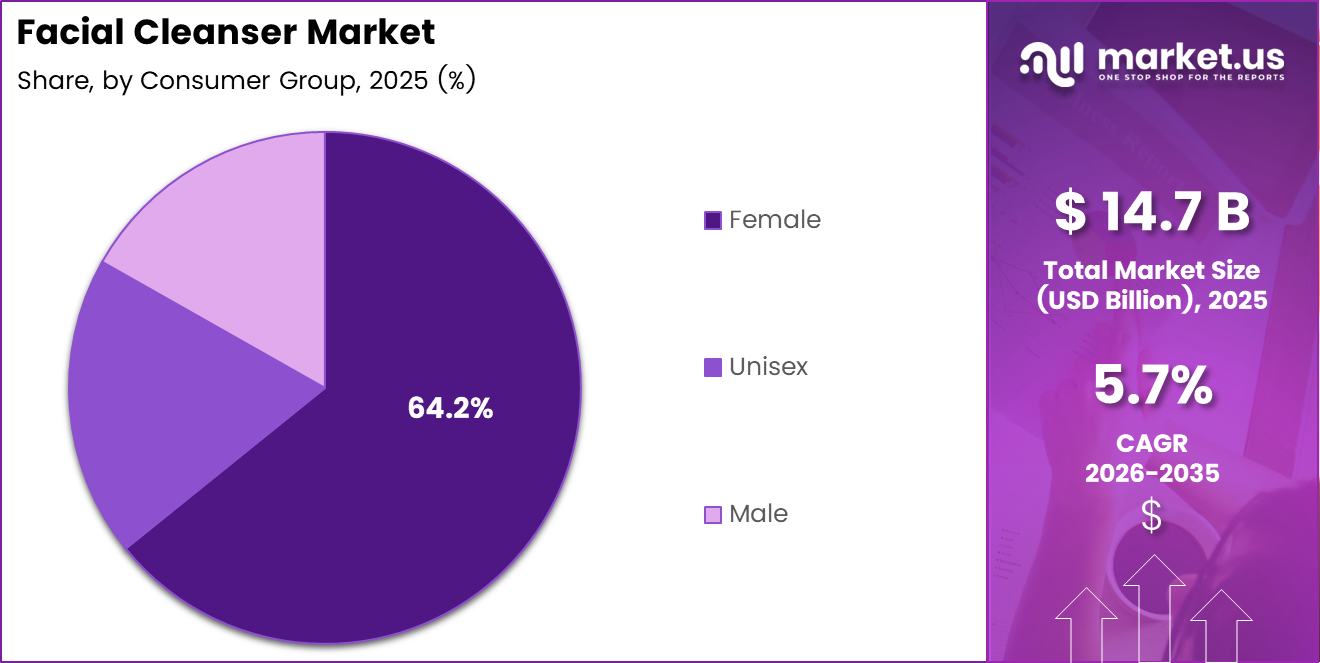
- By Consumer Group, Female consumers hold the dominant share at 64.2%.
- By End Use, Individual use accounts for 82.4% of the market.
- By Distribution Channel, Supermarkets lead with a 39.7% share.
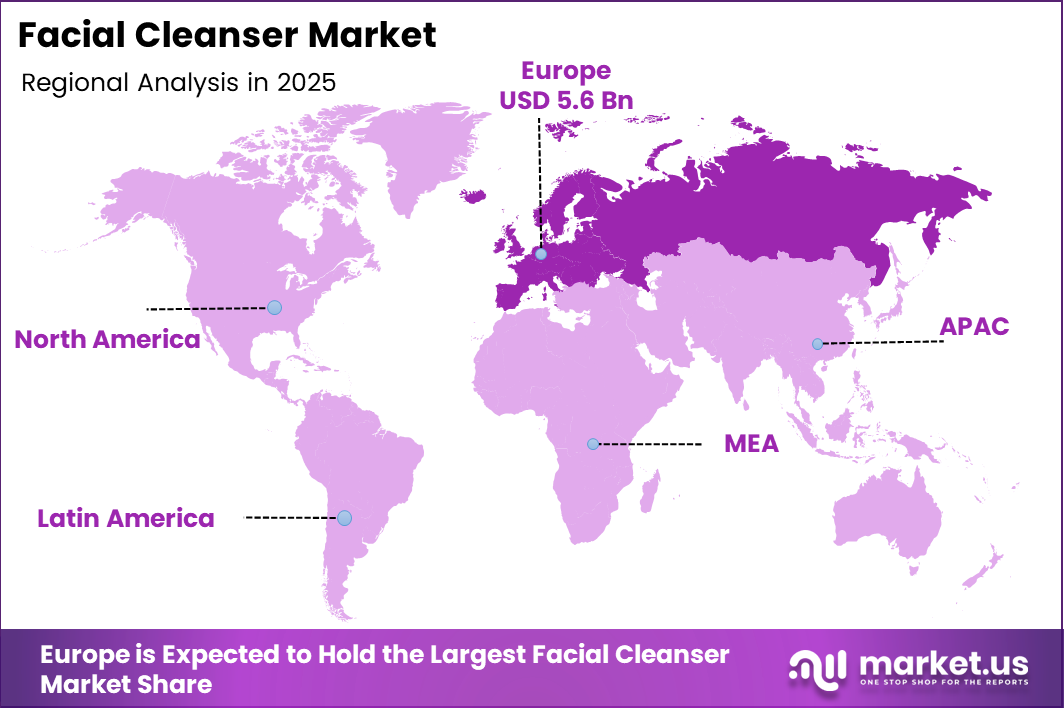
- Europe dominates the regional landscape with a market share of 38.60%, valued at USD 5.6 Billion.
Skin Type Analysis
Normal Skin dominates with 26.9% due to its broad consumer base and wide product compatibility.
In 2025, Normal Skin held a dominant market position in the Skin Type segment of the Facial Cleanser Market, with a 26.9% share. This segment leads due to the large consumer base with balanced skin and the availability of a wide range of suitable products. Moreover, normal skin users often seek mild, daily-use cleansers that maintain hydration without causing irritation.
Oily Skin represents a significant portion of the market, driven by growing consumer awareness around sebum control and acne prevention. Additionally, the rising demand for gel-based and foaming cleansers that deep-cleanse pores has fueled product development in this segment. Brands are actively launching targeted formulations to address oiliness and shine control effectively.
Dry Skin consumers are increasingly seeking cream and lotion cleansers that offer gentle cleansing without stripping natural moisture. Consequently, product innovation focused on hydrating and barrier-protecting ingredients has gained strong traction in this sub-segment. Furthermore, dermatologist-endorsed formulations for dry skin are becoming a preferred choice among health-conscious consumers globally.
Sensitive Skin consumers are driving demand for hypoallergenic and fragrance-free facial cleansers that minimize the risk of irritation. Rising awareness of skin conditions such as rosacea and eczema has encouraged brands to develop clinically tested and gentle formulations. Moreover, dermatologist recommendations continue to play a key role in influencing purchase decisions within this sub-segment.
Combination Skin users require cleansers that balance oil control in the T-zone while maintaining moisture in drier areas. This need has led to strong demand for multi-benefit and adaptive cleansing formulations. Additionally, brands are investing in targeted product lines that address the unique and complex needs of combination skin consumers worldwide.
Others category covers niche skin concerns such as acne-prone, mature, and post-procedure skin that require specialized cleansing solutions. These consumers often seek clinically advanced and dermatologist-developed products tailored to their specific conditions. Consequently, this sub-segment continues to expand as awareness of diverse skin needs grows among global consumers.
Product Type Analysis
Gel Cleanser dominates with 39.6% due to its effectiveness across multiple skin types and high consumer preference.
In 2025, Gel Cleanser held a dominant market position in the Product Type segment of the Facial Cleanser Market, with a 39.6% share. Gel cleansers are preferred for their lightweight texture and ability to effectively remove excess oil and impurities. Moreover, they are widely recommended by dermatologists for oily and combination skin types.
Cream and Lotion Cleansers are gaining popularity among consumers with dry and sensitive skin. These formulations offer a gentle cleansing experience while maintaining the skin’s natural moisture barrier. Additionally, the growing demand for hydrating and nourishing skincare has supported this sub-segment’s expansion in both retail and online channels.
Foaming Cleansers continue to attract consumers seeking a deep-cleansing and refreshing daily skincare experience. Their rich lather and effective dirt removal make them a consistently popular choice across age groups. Furthermore, the availability of foaming cleansers across mass-market and premium price points ensures broad consumer accessibility worldwide.
Bar Cleansers are gaining renewed interest among eco-conscious consumers who prefer minimal packaging and sustainable product formats. Their long-lasting nature and low environmental footprint align well with the growing clean beauty movement. Consequently, brands are reformulating bar cleansers with skin-friendly ingredients to attract a wider and more health-aware consumer base.
Others category encompasses micellar waters, cleansing oils, and balm-based formats that cater to specific skincare needs and preferences. These products are particularly popular among consumers following multi-step skincare routines influenced by K-Beauty and J-Beauty trends. Therefore, this sub-segment continues to grow as consumer interest in diverse and specialized cleansing formats expands globally.
Consumer Group Analysis
Female consumers dominate with 64.2% due to higher skincare engagement and broader product usage patterns.
In 2025, Female consumers held a dominant market position in the Consumer Group segment of the Facial Cleanser Market, with a 64.2% share. Women demonstrate higher engagement with skincare routines and are more likely to use dedicated facial cleansers as part of their daily regimen. Moreover, targeted female-focused marketing and product development continue to reinforce this dominance.
Male consumers represent a rapidly growing sub-segment, driven by increasing awareness of skincare among men and the expansion of men grooming products. Brands are actively launching gender-specific cleansing formulations to capture this underserved demographic. Additionally, social media and influencer-driven content are encouraging more men to adopt structured skincare habits.
Unisex products are gaining traction as consumers move toward inclusive and simplified skincare routines. These formulations appeal to a broad demographic and are often positioned as versatile, effective, and accessible. Consequently, the unisex segment supports market growth by attracting consumers who prefer gender-neutral options.
End Use Analysis
Individual use dominates with 82.4% due to widespread personal skincare adoption globally.
In 2025, Individual use held a dominant market position in the End Use segment of the Facial Cleanser Market, with an 82.4% share. Personal skincare adoption has grown significantly across all age groups, supported by rising health awareness and the influence of digital beauty content. Moreover, the availability of diverse products across price points has made facial cleansers accessible to a wide consumer base.
Commercial use encompasses professional skincare services such as spas, salons, dermatology clinics, and hospitality establishments. This sub-segment benefits from the growing demand for professional-grade skincare treatments and the expansion of wellness tourism. Additionally, commercial buyers increasingly prefer premium and clinically tested formulations that meet professional standards.
Distribution Channel Analysis
Supermarkets dominate with 39.7% due to wide product availability and strong consumer footfall.
In 2025, Supermarkets held a dominant market position in the Distribution Channel segment of the Facial Cleanser Market, with a 39.7% share. Supermarkets offer consumers the convenience of browsing multiple brands and product types in a single location. Moreover, promotional offers and in-store visibility continue to drive impulse purchases and brand loyalty among regular shoppers.
Online channels are experiencing rapid growth, driven by the expansion of e-commerce platforms and the rising preference for home delivery. Digital marketing, subscription models, and personalized product recommendations have significantly boosted online sales. Additionally, direct-to-consumer brand strategies have strengthened online channel performance across global markets.
Departmental Stores remain a preferred retail environment for premium and luxury facial cleanser brands seeking curated product presentation. Their ability to offer personalized shopping assistance and exclusive product ranges attracts higher-spending consumers. Consequently, departmental stores continue to support brand positioning and premium product sales in key urban markets.
Others category includes pharmacies, specialty beauty stores, and direct sales channels that serve niche and brand-loyal consumer segments. Pharmacies in particular benefit from growing consumer preference for dermatologist-recommended and clinically tested facial cleansers. Therefore, this channel plays an important role in reaching health-conscious and targeted skincare consumers globally.
Key Market Segments
By Skin Type
- Normal Skin
- Oily Skin
- Dry Skin
- Sensitive Skin
- Combination Skin
- Others
By Product Type
- Gel Cleanser
- Cream & Lotion Cleanser
- Foaming Cleanser
- Bar Cleanser
- Others
By Consumer Group
- Male
- Female
- Unisex
By End Use
- Individual
- Commercial
By Distribution Channel
- Online
- Supermarkets
- Departmental Stores
- Others
Drivers
Rising Consumer Awareness and Demand for Effective Skincare Drive Facial Cleanser Market Growth
Growing consumer awareness about skin health and hygiene has significantly increased the adoption of facial cleansers worldwide. Moreover, dermatologist recommendations and the influence of social media beauty content have encouraged more consumers to incorporate dedicated cleansing products into their daily routines. This shift is creating consistent and sustained demand across global markets.
The expanding middle-class population in emerging economies is driving higher spending on personal care and skincare products. Additionally, rising disposable incomes are enabling consumers to move beyond basic hygiene products toward specialized and premium facial cleansers. This trend is particularly strong in Asia Pacific and Latin America, where urbanization is accelerating rapidly.
The growing popularity of K-Beauty and science-backed skincare has introduced consumers to more effective and targeted cleansing formulations. Consequently, brands are investing in clinically tested, dermatologist-approved products to meet rising consumer expectations. Furthermore, the expansion of multi-step skincare routines has positioned facial cleansers as an essential and non-negotiable daily product.
Restraints
High Product Costs and Consumer Misinformation Restrain Wider Facial Cleanser Market Adoption
Premium facial cleansers with specialized ingredients and clinical formulations often carry high price points that limit accessibility for lower-income consumers. Moreover, price sensitivity in developing markets continues to push consumers toward substitute products such as general soaps and body washes. This restricts the full market penetration of dedicated facial cleansing products globally.
Consumer misinformation about proper skincare practices remains a significant barrier to market growth. According to CeraVe, over 50% of respondents do not wash their face properly before bed, and many use inappropriate products on their face. Consequently, this lack of awareness reduces the effective demand for purpose-built facial cleansers in key consumer segments.
The market also faces challenges from the proliferation of counterfeit and low-quality products in unregulated retail channels. Additionally, inconsistent regulatory standards across regions create compliance complexities for brands operating internationally. Therefore, ensuring product safety, authenticity, and consumer trust requires significant ongoing investment from established market players.
Growth Factors
E-Commerce Expansion and Product Innovation Accelerate Facial Cleanser Market Growth
The rapid expansion of e-commerce platforms has made facial cleansers accessible to a much broader global audience. Moreover, direct-to-consumer brands are leveraging digital marketing and personalized product recommendations to drive online sales. This shift toward online purchasing is opening new revenue streams and reducing the reliance on traditional brick-and-mortar retail distribution.
Increasing product innovation, particularly in sustainable and natural ingredient formulations, is attracting health-conscious and eco-aware consumers. Additionally, brands are developing multifunctional cleansers that combine cleansing with moisturizing, anti-aging, or brightening benefits. Consequently, these value-added products command higher price points and support overall market revenue growth.
The growing male grooming segment presents a significant untapped opportunity for facial cleanser brands. Furthermore, expanding into professional and commercial channels such as spas and dermatology clinics offers additional revenue potential. As consumer education around skincare improves, demand for specialized and targeted cleansing products is expected to strengthen across all demographics.
Emerging Trends
Sustainability, Personalization, and Science-Backed Formulations Reshape the Facial Cleanser Market
The shift toward sustainable beauty is one of the most prominent trends reshaping the facial cleanser market. Consumers are increasingly seeking products with eco-friendly packaging, biodegradable formulations, and ethically sourced ingredients. Moreover, brands that align with environmental values are gaining stronger consumer loyalty and competitive differentiation in both online and offline retail channels.
Personalization is emerging as a major growth driver, with brands offering customized cleansing solutions based on individual skin type, concern, and lifestyle. Additionally, advances in skin diagnostics technology and AI-driven skincare platforms are enabling more precise product recommendations. Consequently, personalized skincare is commanding premium pricing and fostering deeper consumer engagement with brands.
The integration of dermatological science into mainstream facial cleanser formulations is gaining significant momentum. Furthermore, the influence of K-Beauty and J-Beauty trends has introduced consumers to multi-step cleansing rituals and innovative textures. As clinical efficacy becomes a key purchase driver, brands investing in research and dermatologist-endorsed products are well-positioned for sustained long-term growth.
Regional Analysis
Europe Dominates the Facial Cleanser Market with a Market Share of 38.60%, Valued at USD 5.6 Billion
Europe leads the global Facial Cleanser Market, holding a dominant share of 38.60% and valued at USD 5.6 Billion in 2025. The region benefits from high consumer awareness of skincare, strong purchasing power, and a well-established retail infrastructure. Moreover, stringent EU cosmetic regulations ensure product quality and safety, which reinforces consumer trust and supports premium product adoption across the region.
North America Facial Cleanser Market Trends
North America is a major market for facial cleansers, driven by high consumer spending on personal care and widespread dermatologist-recommended product usage. Additionally, the strong presence of established skincare brands and the growing influence of clean beauty trends are shaping product demand. The United States remains the primary revenue contributor within the region.
Asia Pacific Facial Cleanser Market Trends
Asia Pacific is the fastest-growing regional market, fueled by rising disposable incomes, rapid urbanization, and the global influence of K-Beauty and J-Beauty cultures. Moreover, countries such as China, South Korea, Japan, and India are experiencing strong demand for both mass-market and premium facial cleansers. Consequently, the region presents significant long-term growth opportunities for international and domestic brands alike.
Latin America Facial Cleanser Market Trends
Latin America is witnessing steady market growth, supported by an expanding middle class and increasing consumer interest in personal grooming and skincare. Additionally, the growing penetration of international brands through e-commerce and modern retail channels is boosting product accessibility. Brazil and Mexico remain the dominant markets driving regional revenue performance.
Middle East and Africa Facial Cleanser Market Trends
The Middle East and Africa market is growing gradually, supported by a young and beauty-conscious population and increasing urbanization across key economies. Furthermore, the expansion of modern retail and online channels is improving product availability in previously underserved markets. The GCC region leads demand within this geography, driven by high consumer spending on premium personal care products.
Key Regions and Countries
North America
- US
- Canada
Europe
- Germany
- France
- The UK
- Spain
- Italy
- Rest of Europe
Asia Pacific
- China
- Japan
- South Korea
- India
- Australia
- Rest of APAC
Latin America
- Brazil
- Mexico
- Rest of Latin America
Middle East & Africa
- GCC
- South Africa
- Rest of MEA
Key Company Insights
Amorepacific is a South Korean beauty conglomerate recognized for its deep expertise in skincare science and botanical ingredient innovation. The company has a strong global presence, particularly across Asia Pacific, and continues to expand its facial cleanser portfolio through K-Beauty inspired formulations. Its focus on research-driven product development positions it as a leading authority in premium skincare globally.
Avon Products operates through a well-established direct-to-consumer sales model that gives it a broad and loyal consumer base across emerging and developed markets. The company offers a diverse range of facial cleansers targeting multiple skin types and consumer demographics. Additionally, Avon’s accessible pricing strategy and community-based distribution model support strong penetration in price-sensitive markets.
Beiersdorf is a globally recognized personal care company known for its science-backed and clinically tested skincare solutions. Its facial cleanser offerings are supported by strong dermatological credentials and a reputation for efficacy and gentleness. Moreover, Beiersdorf continues to invest in sustainable formulations and packaging, aligning its portfolio with the growing consumer demand for responsible beauty products.
Coty operates a diversified beauty portfolio spanning mass-market and prestige skincare categories, including facial cleansers. The company leverages its strong brand architecture and global retail partnerships to maintain competitive market positioning. Furthermore, Coty’s ongoing investment in digital marketing and influencer-led campaigns has strengthened consumer engagement across key international markets.
Key Players
- Amorepacific
- Avon Products
- Beiersdorf
- Coty
- Johnson & Johnson
- Kao
- L’Oréal
- Mary Kay
- Neutrogena
- Olay
- Procter & Gamble
- Shiseido Company
- The Body Shop International
- Unilever
Recent Developments
- December 2024 – L’Oréal Groupe announced its acquisition of Gowoonsesang Cosmetics Co., Ltd. from Swiss retail group Migros, including the Korean skincare brand Dr.G, founded in 2003 by dermatologist Dr. Gun Young Ahn MD, PhD and headquartered in Seoul. Dr.G will join L’Oréal Groupe’s Consumer Products Division to meet rising global demand for K-Beauty and scientifically developed yet affordable skincare solutions.
- January 2026 – Japan’s Lion Corporation acquired Australian natural beauty brand Sukin, marking a strategic full-scale entry into the Asian personal care and skincare market. This acquisition is expected to accelerate Lion’s presence in the natural beauty segment and expand its distribution reach across key Asia Pacific markets.
Report Scope
Report Features Description Market Value (2025) USD 14.7 Billion Forecast Revenue (2035) USD 25.6 Billion CAGR (2026-2035) 5.7% Base Year for Estimation 2025 Historic Period 2020-2024 Forecast Period 2026-2035 Report Coverage Revenue Forecast, Market Dynamics, Competitive Landscape, Recent Developments Segments Covered By Skin Type (Normal Skin, Oily Skin, Dry Skin, Sensitive Skin, Combination Skin, Others), By Product Type (Gel Cleanser, Cream & Lotion Cleanser, Foaming Cleanser, Bar Cleanser, Others), By Consumer Group (Male, Female, Unisex), By End Use (Individual, Commercial), By Distribution Channel (Online, Supermarkets, Departmental Stores, Others) Regional Analysis North America (US and Canada), Europe (Germany, France, The UK, Spain, Italy, and Rest of Europe), Asia Pacific (China, Japan, South Korea, India, Australia, and Rest of APAC), Latin America (Brazil, Mexico, and Rest of Latin America), Middle East & Africa (GCC, South Africa, and Rest of MEA) Competitive Landscape Amorepacific, Avon Products, Beiersdorf, Coty, Johnson & Johnson, Kao, L’Oréal, Mary Kay, Neutrogena, Olay, Procter & Gamble, Shiseido Company, The Body Shop International, Unilever Customization Scope Customization for segments, region/country-level will be provided. Moreover, additional customization can be done based on the requirements. Purchase Options We have three licenses to opt for: Single User License, Multi-User License (Up to 5 Users), Corporate Use License (Unlimited User and Printable PDF) 
-
-
- Amorepacific
- Avon Products
- Beiersdorf
- Coty
- Johnson & Johnson
- Kao
- L'Oréal
- Mary Kay
- Neutrogena
- Olay
- Procter & Gamble
- Shiseido Company
- The Body Shop International
- Unilever
Our Clients

- 179293
- Feb 2026






