


Report Overview
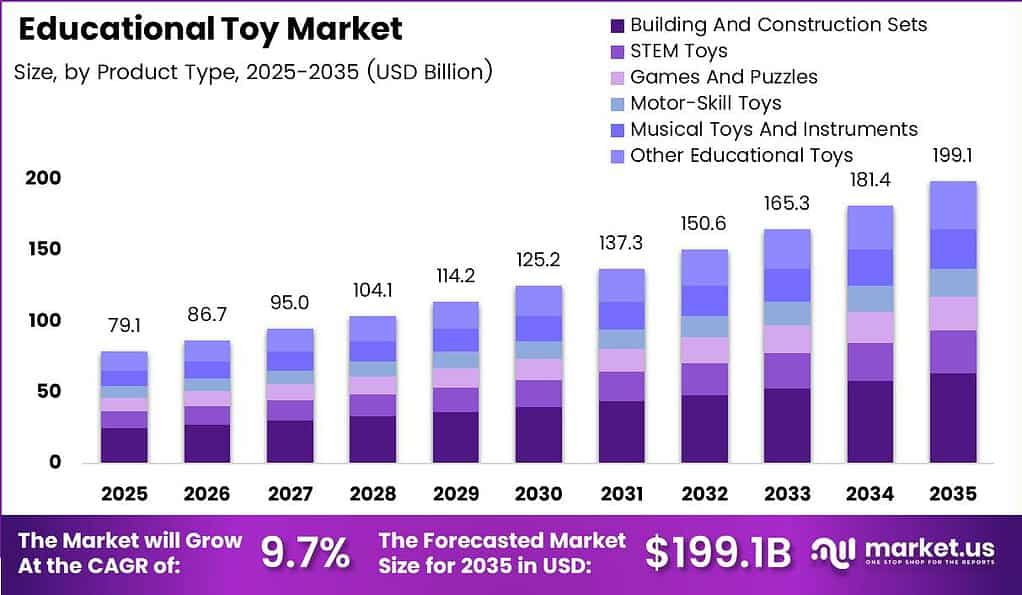
Global Educational Toy Market size is expected to be worth around USD 199.1 Billion by 2035 from USD 79.1 Billion in 2025, growing at a CAGR of 9.7% during the forecast period 2026 to 2035. This trajectory reflects a sustained structural shift in how families, schools, and policymakers approach early childhood development and skill-based learning.
The educational toy market encompasses physical and hybrid learning products designed to develop cognitive, motor, creative, social, and STEM-related competencies across age-defined developmental stages. The market spans building and construction sets, STEM toys, games and puzzles, motor-skill toys, musical instruments, and other structured learning formats. Household buyers, schools, daycare centers, and institutional purchasers form the primary demand base.
Key Takeaways
- The global Educational Toy Market is valued at USD 79.1 Billion in 2025 and is forecast to reach USD 199.1 Billion by 2035.
- The market grows at a CAGR of 9.7% during the forecast period 2026 to 2035.
- By Product Type, Building And Construction Sets dominate with a 32.00% share in 2025.
- By Age Group, the Up To 4 Years segment holds the largest share at 40.00%.
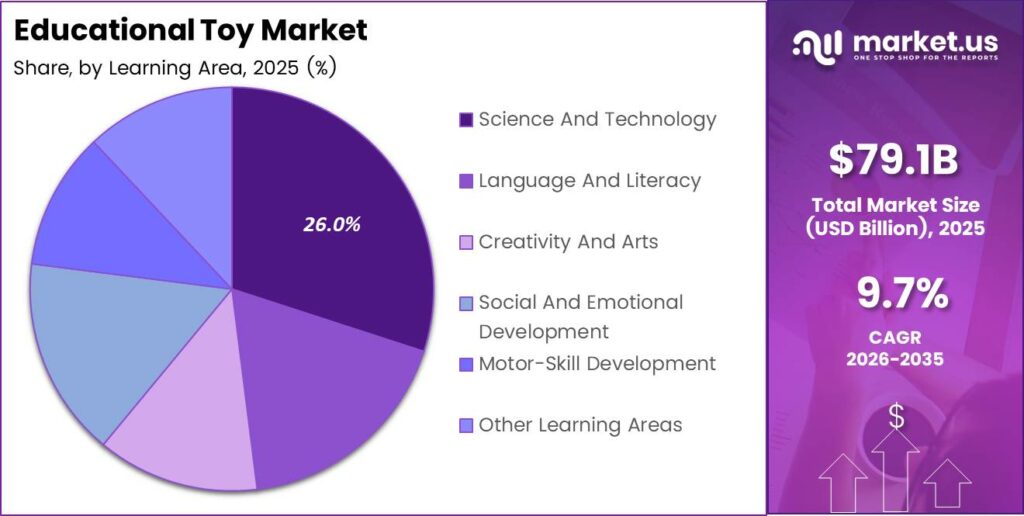
- By Learning Area, Science And Technology leads with a 26.00% share.
- By End User, Households account for 72.00% of total market demand.
- By Distribution Channel, Online Retail is the dominant channel with a 44.00% share.
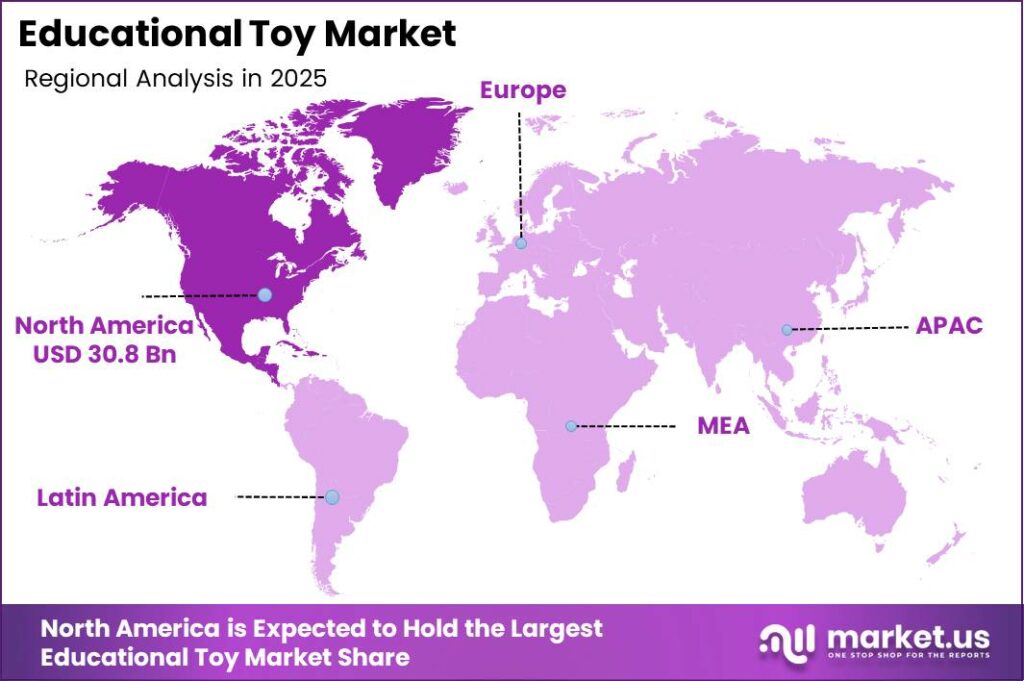
- North America is the leading region, holding 38.50% of global market share, valued at USD 30.8 Billion.
According to the Toy Association, 58% of parents in 2025 preferred toys that help children build a skill set. This preference signals that outcome-driven purchasing has replaced novelty as the primary buying trigger. Vendors who position products around measurable developmental outcomes will command stronger shelf placement and repeat purchase cycles.
In the same 2025 Toy Association research, 60% of U.S. parents sought toys that build STEAM-related skills, including coding and art. This breadth of STEAM interest creates product differentiation headroom across multiple sub-categories simultaneously. As a result, manufacturers who bundle art-based activities with structured coding elements can address two buyer priorities within a single SKU. In September 2026, Indian educational gaming company Skillmatics entered talks to explore an institutional investment round following consecutive profitable quarters and accelerated direct-to-consumer growth in FY26, reflecting how STEAM-driven demand is drawing investment even beyond established Western markets.
Product Type Analysis
Building And Construction Sets dominates with 32.00% due to broad age-range appeal and STEM alignment.
In 2025, Building And Construction Sets held a dominant market position in the By Product Type segment of the Educational Toy Market, with a 32.00% share. As reported by LEGO Education data, students with access to hands-on learning were 1.5 times more likely to report confidence in science than those without. This confidence gap gives construction-format products a measurable advantage in both household and institutional procurement decisions.
STEM Toys represent the fastest-expanding sub-segment within this category, driven by school curriculum alignment and parent investment in future-skill preparation. Buyers in North America, Europe, and urban Asian markets actively seek products that map to classroom learning objectives. This curriculum linkage shortens the purchase decision cycle and reduces returns, improving unit economics for STEM-focused manufacturers.
Games And Puzzles serve as accessible entry-points across all age brackets, offering lower price thresholds that attract first-time buyers and gift purchasers. Their versatility across solo and group play formats supports both household and daycare procurement. Toy And Specialty Stores and Online Retail remain the primary channels through which puzzle and game SKUs gain consumer visibility and trial.
Motor-Skill Toys address a defined developmental window, particularly for children up to four years of age, where physical coordination milestones drive parent purchase intent. The Toy Association’s 2025 research found that 56% of U.S. parents looked for toys encouraging outdoor or active play. This preference strengthens the category’s positioning in early-childhood retail assortments. Musical Toys And Instruments and Other Educational Toys collectively account for the remaining share, serving niche developmental and enrichment needs.
Age Group Analysis
Up To 4 Years dominates with 40.00% due to early developmental intervention purchasing intensity.
In 2025, Up To 4 Years held a dominant market position in the By Age Group segment of the Educational Toy Market, with a 40.00% share. This age cohort drives the highest purchase frequency because each developmental milestone creates a separate product need within a compressed timeline of roughly 24 to 48 months. Parents and caregivers repurchase across multiple formats, from sensory toys to language kits, rather than making a single transaction.
The 4 to 8 Years cohort occupies a structurally valuable mid-tier position where STEM toys, games, and construction sets gain primary traction. Buyers in this age window begin prioritizing curriculum-alignment and measurable skill outcomes rather than purely sensory or motor stimulation. This shift in buyer criteria widens the average selling price range and creates room for premium product positioning.
The Above 8 Years segment benefits from rising interest in coding, robotics, and complex construction formats. A peer-reviewed 2026 systematic review synthesizing 131 studies confirmed positive learning and development outcomes from toy-based pedagogy across children up to roughly 12 years old. This evidence base strengthens institutional procurement arguments for products targeting older children. In February 2026, LeapFrog Enterprises launched the “LeapMove” ecosystem with motion-tracking educational games that personalize cognitive and vocabulary development, directly expanding the addressable product set for this age group.
Learning Area Analysis
Science And Technology dominates with 26.00% due to curriculum integration and parental STEM investment.
In 2025, Science And Technology held a dominant market position in the By Learning Area segment of the Educational Toy Market, with a 26.00% share. LEGO Education’s 2025 global study found that only 55% of students worldwide regularly received hands-on science-learning opportunities. This access gap validates institutional procurement of science-oriented educational toys as a direct classroom solution rather than a supplementary purchase.
Language And Literacy products serve a persistent demand base across all age brackets and geographic markets, supported by bilingual household growth and national literacy policy mandates. Products that combine phonics, storytelling, and cultural context attract both household buyers and school procurement teams. This dual-channel demand reduces the seasonal dependency that constrains other sub-segments.
Creativity And Arts represents a growing counter-trend to purely STEM-led buying, with 63% of Millennial parents in the Toy Association’s 2025 research considering a toy’s ability to support children’s mental, emotional, and social health during purchase decisions. This outcome-led criterion elevates arts-based educational toys beyond discretionary gifting into deliberate developmental purchasing. Products that combine creative expression with measurable well-being outcomes are positioned to command premium price points.
Social And Emotional Development and Motor-Skill Development collectively address foundational competencies that institutional buyers treat as non-negotiable procurement criteria. Other Learning Areas serve niche segments within specialized educational and therapy-adjacent markets. These sub-segments hold the remaining share and offer differentiation opportunities for brands focused on underserved developmental categories.
End User Analysis
Households dominate with 72.00% due to parental purchase autonomy and gifting cycles.
In 2025, Households held a dominant market position in the By End User segment of the Educational Toy Market, with a 72.00% share. The Toy Association’s 2025 research found that 78% of parents wanted more toys that help children develop skills such as creativity and problem-solving. This unmet demand signals that household buyers are actively searching for products that the current mass-market assortment does not fully address, creating a clear product gap for targeted entrants.
Schools And Educational Institutions represent the most structurally stable demand channel because procurement follows budget cycles rather than seasonal gifting trends. Research from LEGO Education’s 2025 study found that 75% of science teachers using hands-on learning agreed it supports higher test scores and grades. This teacher endorsement directly strengthens the business case for institutional toy and kit procurement across primary and middle school segments.
Daycare And Childcare Centers drive consistent replenishment demand for durable, safety-certified products suited to shared and supervised play environments. Their procurement decisions favor brands with established compliance documentation and multi-unit pricing structures. Other End Users, including therapy centers and enrichment programs, account for the remaining share and represent emerging channels for specialized developmental products.
Distribution Channel Analysis
Online Retail dominates with 44.00% due to assortment breadth and direct-to-consumer reach.
In 2025, Online Retail held a dominant market position in the By Distribution Channel segment of the Educational Toy Market, with a 44.00% share. Digital channels remove geographic barriers for niche educational formats that traditional retail cannot shelf-space efficiently. This structural advantage benefits direct-to-consumer brands that lack the promotional budgets required to secure shelf placement in major retail chains.
Supermarkets And Hypermarkets serve as high-footfall, impulse-driven channels for entry-level and widely recognized educational toy brands. Their role in the channel mix is primarily transactional rather than discovery-led, meaning brand awareness built through other channels converts into supermarket volume. Retailers in this format face growing shelf-space rationalization pressure, which limits assortment depth for smaller or newer educational toy entrants.
Toy And Specialty Stores retain a strategic role in purchase decisions that require tactile evaluation, particularly for premium and complex construction or STEM formats. Department Stores and Other Channels, including institutional procurement platforms and subscription fulfillment, account for the remaining distribution share. These channels are gaining structural relevance as schools and daycares shift toward centralized purchasing rather than individual retail transactions.
Key Market Segments
By Product Type
- Building And Construction Sets
- STEM Toys
- Games And Puzzles
- Motor-Skill Toys
- Musical Toys And Instruments
- Other Educational Toys
By Age Group
- Up To 4 Years
- 4–8 Years
- Above 8 Years
By Learning Area
- Science And Technology
- Language And Literacy
- Creativity And Arts
- Social And Emotional Development
- Motor-Skill Development
- Other Learning Areas
By End User
- Households
- Schools And Educational Institutions
- Daycare And Childcare Centers
- Other End Users
By Distribution Channel
- Online Retail
- Supermarkets And Hypermarkets
- Toy And Specialty Stores
- Department Stores
- Other Channels
Regional Analysis
North America Dominates the Educational Toy Market with a Market Share of 38.50%, Valued at USD 30.8 Billion
North America’s 38.50% share reflects deep household spending on developmental products, strong institutional procurement infrastructure, and a well-established direct-to-consumer digital retail ecosystem. The United States drives the bulk of regional revenue through both household and school channel purchases. Tariff exposure on China-linked toy imports creates near-term margin pressure for brands dependent on Asian manufacturing, making supply chain diversification a strategic priority for regional market leaders.
Asia-Pacific is the fastest-growing region, propelled by expanding early-childhood enrollment programs, rising household income levels in urban centers, and government investment in foundational education quality. India and China represent the highest-volume growth corridors within the region. In February 2026, early-learning startup Panda’s Box raised ₹1.2 crore following its appearance on Shark Tank India to scale its inventory of culturally rooted, screen-free educational products for children under age six, illustrating how local demand is generating domestic investment in the region.
Europe maintains a structurally significant market position driven by premium product demand, sustainability-conscious purchasing, and mandatory safety certification frameworks that favor established, compliant brands over lower-cost entrants. Latin America and the Middle East and Africa represent earlier-stage markets with growing household spending on education-oriented products. These regions offer long-term volume upside for brands able to localize product formats and navigate import cost structures.
Key Regions and Countries
North America
- US
- Canada
Europe
- Germany
- France
- The UK
- Spain
- Italy
- Rest of Europe
Asia Pacific
- China
- Japan
- South Korea
- India
- Australia
- Rest of APAC
Latin America
- Brazil
- Mexico
- Rest of Latin America
Middle East and Africa
- GCC
- South Africa
- Rest of MEA
Drivers
Expansion of formal and informal early-childhood learning converts developmental play from a seasonal gift purchase into a repeatable household and classroom input. Education systems, childcare operators, and parents continued to prioritize foundational numeracy, literacy, motor skills, and socio-emotional development through the 2024 to 2025 period. This shift increases purchase frequency across age-stage transitions rather than concentrating sales within a single seasonal window.
A child can move through multiple developmental product formats within roughly 24 to 48 months, supporting an estimated +2.1% incremental contribution to the 9.7% baseline CAGR. Higher replenishment rates, broader classroom procurement, and reduced dependence on licensed entertainment cycles allow manufacturers to defend premium price points through demonstrable learning outcomes. This creates a durable demand floor that insulates category revenue from short-term consumer sentiment shifts.
| Driver | (~) % Impact on CAGR Forecast | Geographic Relevance | Impact Timeline |
|---|---|---|---|
| Early-learning enrollment expansion | +2.1% | Global, strongest in Asia-Pacific and Middle East | Short term (≤ 2 years) |
| STEM learning adoption | +1.8% | North America, Europe, East Asia, urban India | Short term (≤ 2 years) |
| Screen-light play preference | +1.4% | North America, Europe, Australia, affluent Asian cities | Short term (≤ 2 years) |
| Premium gifting demand | +1.1% | North America, Western Europe, Gulf Cooperation Council | Short term (≤ 2 years) |
| Direct-to-consumer assortment reach | +0.9% | Global, especially digitally connected emerging markets | Medium term (2–4 years) |
| School-home learning convergence | +0.8% | Global metropolitan education markets | Medium term (2–4 years) |
Restraints
Tariff volatility on China-linked toy imports creates an immediate cost burden because the category remains deeply dependent on Asian manufacturing for molded plastics, electronic modules, packaging, and labor-intensive assembly. During 2025, effective tariff rates on Chinese toy imports in the United States rose to around 20%, compared to a historical base rate of 0% for many toy categories. This sharp cost increase compresses margins already constrained by retailer allowances, freight, testing, and promotional funding requirements.
Manufacturers face three unpalatable trade-offs: price increases that suppress unit velocity, margin absorption that reduces innovation budgets, or supplier reallocation requiring duplicate tooling and additional working capital. Each option carries a distinct revenue risk. The combined effect of margin compression and delayed capital expenditure justifies an estimated -2.3% deduction from the 9.7% baseline CAGR across exposed import-dependent channels.
| Restraint | (~) % Impact on CAGR Forecast | Geographic Relevance | Impact Timeline |
|---|---|---|---|
| Import tariff pass-through | -2.3% | United States, China-linked global supply chains | Short term (≤ 2 years) |
| Household discretionary-spend pressure | -1.6% | Global, highest in price-sensitive emerging markets | Short term (≤ 2 years) |
| Mandatory safety certification costs | -1.2% | India, European Union, North America | Medium term (2–4 years) |
| Online counterfeit product leakage | -1.0% | Global cross-border e-commerce markets | Short term (≤ 2 years) |
| Retail shelf-space rationalization | -0.8% | North America and Western Europe | Short term (≤ 2 years) |
| High product-return exposure | -0.6% | Digital-first retail markets | Short term (≤ 2 years) |
Challenges
Multi-market compliance complexity acts as a continuing growth friction rather than a current-sales freeze because exporters can still sell certified products but must repeatedly redesign, test, document, label, and audit assortments across jurisdictions. India requires toys for children under 14 years to carry the BIS Standard Mark, while the European Union’s Regulation (EU) 2025/2509 introduces a digital product passport framework applicable broadly from 1 August 2030 after a transition period of roughly 4.5 years.
Safety scrutiny remains material in the United States, where approximately 300 of roughly 1,020 consumer-product violation notices issued from January through July 2024 related to toys. This compliance burden adds low-single-digit percentages to landed product cost and delays localized product releases by several months. Firms that invest in centralized regulatory-data systems and modular product design can limit the estimated -1.7% drag on achievable market growth.
| Challenge | (~) % CAGR Friction Drag | Geographic Relevance | Mitigation Horizon |
|---|---|---|---|
| Multi-market compliance complexity | -1.7% | Global exporters serving Europe, North America and India | Medium term (2–4 years) |
| Component supply concentration | -1.3% | Global, concentrated Asian manufacturing corridors | Medium term (2–4 years) |
| Learning-outcome validation gaps | -1.1% | Global premium and institutional segments | Medium term (2–4 years) |
| Connected-toy data governance | -0.9% | European Union, North America, advanced Asian markets | Long term (≥ 4 years) |
| Seasonal demand forecasting | -0.8% | Global retail-led markets | Short term (≤ 2 years) |
| Recyclable material scalability | -0.7% | Europe, North America, Japan and South Korea | Long term (≥ 4 years) |
Opportunities
Subscription learning-kit ecosystems represent the clearest untapped upside because most educational-toy revenue remains transaction-led, seasonal, and concentrated in one-off product sales. Deliberate execution can convert age-segmented physical kits, parent guidance content, replacement consumables, and digital activity libraries into recurring revenue across 12-month or 24-month child-development journeys. The coordinating mechanism is curriculum progression aligned with replenishment timing at each age-stage transition.
A well-designed subscription program can raise annual customer retention by roughly 15% to 25% and reduce end-of-season inventory markdown exposure by approximately 5% to 10%. Higher lifetime value and a greater share of direct sales can expand gross-margin potential by roughly 3 to 6 percentage points. This model could add approximately +2.0% above the 9.7% baseline CAGR for manufacturers who build these ecosystems without relying on aggressive discounting.
| Opportunity | (~) % Potential CAGR Upside | Geographic Relevance | Execution Window |
|---|---|---|---|
| Subscription learning-kit ecosystems | +2.0% | North America, Europe, India, urban Asia-Pacific | Medium term (2–4 years) |
| Therapy and special-needs kits | +1.6% | North America, Europe, Japan, Australia | Medium term (2–4 years) |
| Institutional procurement platforms | +1.4% | Public and private schools globally | Medium term (2–4 years) |
| Refurbishment and circular resale | +1.1% | Europe, North America, Japan | Long term (≥ 4 years) |
| Localized vernacular learning formats | +1.0% | India, Southeast Asia, Africa, Latin America | Medium term (2–4 years) |
| Inclusive sensory-play portfolios | +0.9% | Global, led by mature education markets | Medium term (2–4 years) |
Key Company Insights
The LEGO Group holds a structural advantage through its dual-channel presence across both household retail and institutional education procurement. Its LEGO Education division builds direct relationships with schools, reducing exposure to consumer sentiment volatility. In August 2025, VTech launched the “Get Growing Tractor & Mower Ride-On,” a 3-in-1 playset engineered to teach numbers and weather concepts, signaling how direct competitors are investing in the same toddler development segment LEGO targets at scale.
Mattel, Inc. leverages licensed intellectual property across multiple age segments to sustain shelf presence and gifting-cycle relevance. However, its heavy reliance on licensed entertainment cycles creates revenue concentration risk when film or media performance underperforms expectations. In December 2025, Tonies SE finalized a global intellectual property partnership with Pikachu Press to release customized Pokémon audio narrative blocks, illustrating the competitive intensity building around premium licensed educational content formats. Market.us data indicates that only 52% of science teachers believed their students were engaged, and 73% felt unequipped to teach science effectively, identifying a large institutional gap that brands with curriculum-backed products can systematically address. LEGO Education’s Spring 2025 U.S. pilot deployed science kits across 3 school districts with 9 teachers and 201 students in kindergarten through Grade 8, demonstrating the model for replicable institutional penetration at scale.
Key Players
- The LEGO Group
- Mattel, Inc.
- Hasbro, Inc.
- VTech Holdings Limited
- Spin Master Corp.
- Melissa & Doug, LLC
- Ravensburger AG
- TOMY Company, Ltd.
- Bandai Namco Holdings Inc.
- Learning Resources, Inc.
- Hape International AG
- Clementoni S.p.A.
- Thames & Kosmos
- Educational Insights
- Sphero, Inc.
Recent Developments
- January 2026 – The LEGO Group debuted its “SMART Play” platform at the Consumer Electronics Show, introducing standard-sized bricks embedded with micro-chips, accelerometers, and light sensors to trigger context-aware sound effects without requiring digital screens.
- September 2026 – Rajkot-based STEM toy manufacturer Aditi Toys secured ₹36 crore (approximately USD 3.9 million) in a fresh funding round led by Gujarat Venture Finance Limited to scale its private-label manufacturing and expand global distribution.
- February 2026 – VTech Holdings Limited launched an AI-enhanced early learning series at the annual Toy Fair, expanding its portfolio with responsive music-based roleplay toys designed to teach literacy and numeracy through interactive dialogue.
- November 2025 – Tech-toy developer Mirana Toys secured ₹57.5 crore in a corporate funding round to increase production of its proprietary AI-enabled smart robots, AR-integrated remote control vehicles, and physical STEM learning kits.
- January 2025 – LEGO Education officially rolled out “LEGO Education Science,” a physical-to-digital curriculum package containing over 120 standardized, grade-aligned lesson plans distributed across age-bracketed student kits.
Report Scope
| Report Features | Description |
|---|---|
| Market Value (2025) | USD 79.1 Billion |
| Forecast Revenue (2035) | USD 199.1 Billion |
| CAGR (2026-2035) | 9.7% |
| Base Year for Estimation | 2025 |
| Historic Period | 2020-2024 |
| Forecast Period | 2026-2035 |
| Report Coverage | Revenue Forecast, Market Dynamics, Market Opportunity Analysis, Technology and Innovation Landscape, Competitive Landscape, Recent Developments |
| Segments Covered | By Product Type (Building And Construction Sets, STEM Toys, Games And Puzzles, Motor-Skill Toys, Musical Toys And Instruments, Other Educational Toys), By Age Group (Up To 4 Years, 4–8 Years, Above 8 Years), By Learning Area (Science And Technology, Language And Literacy, Creativity And Arts, Social And Emotional Development, Motor-Skill Development, Other Learning Areas), By End User (Households, Schools And Educational Institutions, Daycare And Childcare Centers, Other End Users), By Distribution Channel (Online Retail, Supermarkets And Hypermarkets, Toy And Specialty Stores, Department Stores, Other Channels) |
| Regional Analysis | North America (US and Canada), Europe (Germany, France, The UK, Spain, Italy, and Rest of Europe), Asia Pacific (China, Japan, South Korea, India, Australia, and Rest of APAC), Latin America (Brazil, Mexico, and Rest of Latin America), Middle East and Africa (GCC, South Africa, and Rest of MEA) |
| Competitive Landscape | The LEGO Group, Mattel, Inc., Hasbro, Inc., VTech Holdings Limited, Spin Master Corp., Melissa & Doug, LLC, Ravensburger AG, TOMY Company, Ltd., Bandai Namco Holdings Inc., Learning Resources, Inc., Hape International AG, Clementoni S.p.A., Thames & Kosmos, Educational Insights, Sphero, Inc. |
| Customization Scope | Customization for segments, region/country-level will be provided. Additional customization can be done based on requirements. |
| Purchase Options | We have three licenses to opt for: Single User License, Multi-User License (Up to 5 Users), Corporate Use License (Unlimited User and Printable PDF) |





































