


Quick Navigation
Report Overview
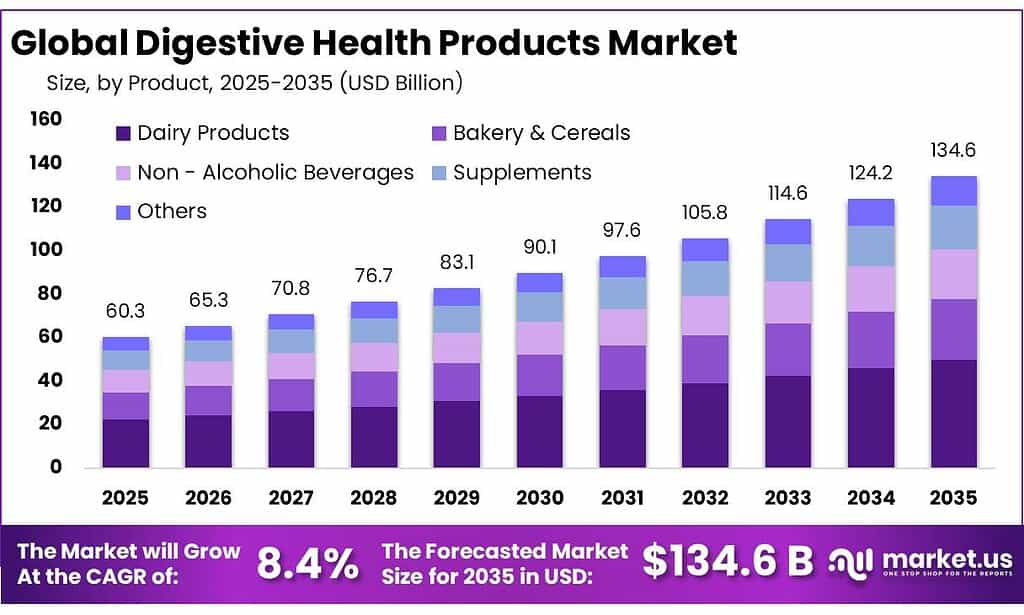
The Global Digestive Health Products Market size is expected to be worth around USD 134.6 Billion by 2035, from USD 60.3 Billion in 2025, growing at a CAGR of 8.4% during the forecast period from 2026 to 2035. In 2025, North America held a dominant market position, capturing more than a 38.5% share, holding USD 23.2 Billion revenue.
Digestive health products comprise probiotics, prebiotics, fiber-fortified foods and beverages, digestive enzyme supplements, medical nutrition, and specialized ingredients that support gut function, microbiome balance, nutrient absorption, and gastrointestinal comfort. The category is moving from a niche wellness segment into a broader preventive-nutrition space because leading health authorities now frame digestive health through everyday diet quality.
- The World Health Organization recommends at least 400 g of fruit and vegetables per day and at least 25 g of naturally occurring dietary fiber per day for adults, while the U.S. FDA sets a Daily Value of 28 g of dietary fiber on Nutrition Facts labels.
In the United States alone, gastrointestinal diagnoses were associated with 47.5 million ambulatory visits, 2.9 million hospital admissions, 23.5 million GI endoscopies, and USD 111.8 billion in healthcare expenditures, according to a 2025 burden review in Gastroenterology. On the nutrition-access side, FAO reported that the global average cost of a healthy diet rose to PPP 4.46 per person per day in 2023–2024, which reinforces demand for affordable, functional digestive-health formats that can be integrated into daily eating habits.
Industry demand is being driven by four linked forces: digestive discomfort prevalence, rising microbiome awareness, preventive healthcare behavior, and tightening nutrition standards. WHO also recommends adult sodium intake below 2,000 mg per day, equivalent to less than 5 g of salt, which is accelerating product reformulation toward cleaner-label, gut-supportive, and better-balanced foods.
Government-led labeling and public-health actions are strengthening this environment. In the United Kingdom, the government stated in 2025 that reducing intake by 50 calories per day could lift 340,000 children and 2 million adults out of obesity, and it expects restrictions on less healthy food advertising from 1 October 2025 to remove up to 7.2 billion calories from children’s diets annually.
Government and regulatory activity is also improving category legitimacy. In the United States, the FDA finalized its updated “healthy” nutrient content framework with an effective date moved to April 28, 2025, which strengthens the policy environment around foods aligned with modern nutrition science. In digestive health specifically, the FDA also recognizes that eligible dietary fibers can have beneficial physiological effects, including increased bowel movement frequency and reductions in blood glucose, blood cholesterol, and calorie intake.
Nestlé SA remains strategically relevant because its 2025 results showed CHF 6,551 million in sales for Nestlé Health Science, with 3.2% organic growth for the business, while the broader Nutrition and Health Science category delivered CHF 14,304 million in sales and 0.6% organic growth. Nestlé’s 2025 Annual Review also emphasized that probiotics support the gut microbiome and immunity in early life, and highlighted continued rollout of NAN Sinergity, described as the first infant formula combining probiotics with six HMOs structurally identical to those in breastmilk.
Key Takeaways
- Digestive Health Products Market size is expected to be worth around USD 134.6 Billion by 2035, from USD 60.3 Billion in 2025, growing at a CAGR of 8.4%.
- Dairy Products held a dominant market position, capturing more than a 37.4% share in the digestive health products market.
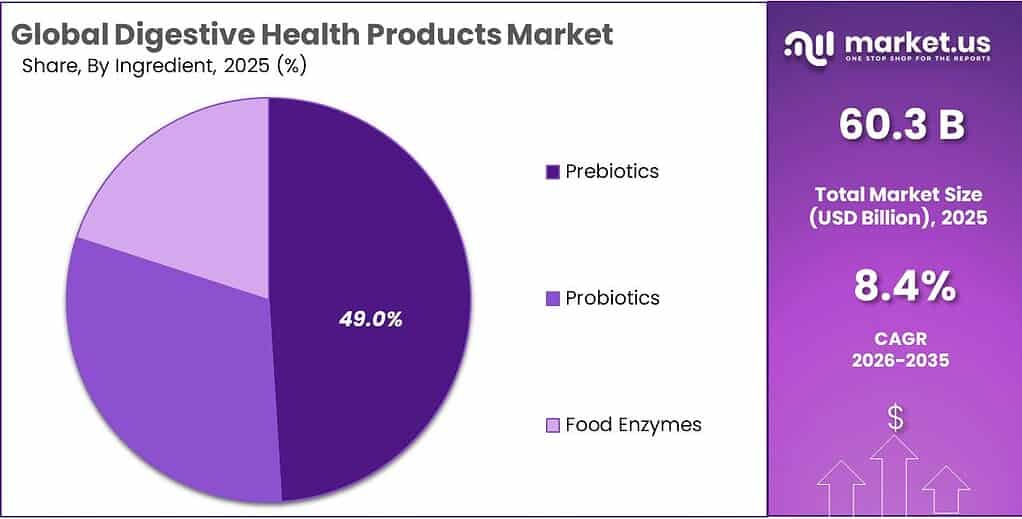
- Prebiotics held a dominant market position, capturing more than a 49.6% share in the digestive health products market.
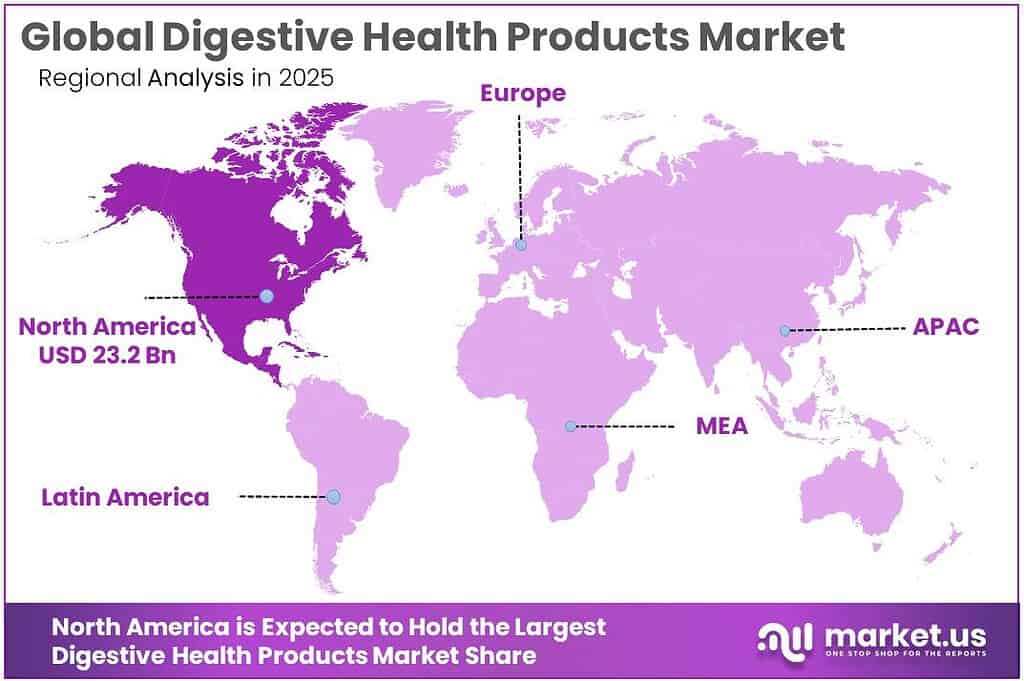
- North America held the dominant position in the Digestive Health Products Market, accounting for 38.5% of the global market and reaching USD 23.2 billion.
By Product Analysis
Dairy Products leads the digestive health products market with 37.4% share, supported by strong daily consumer use and growing preference for gut-friendly nutrition.
In 2025, Dairy Products held a dominant market position, capturing more than a 37.4% share in the digestive health products market. This leadership was mainly supported by the strong consumer preference for familiar and easy-to-consume products such as yogurt, probiotic milk drinks, kefir, and other fermented dairy-based offerings. Many consumers continue to associate dairy products with natural digestive support, especially because these products are already a regular part of everyday diets.
By Ingredient Analysis
Prebiotics dominate with 49.6% share as consumers increasingly prefer everyday gut-health ingredients that fit easily into regular diets.
In 2025, Prebiotics held a dominant market position, capturing more than a 49.6% share in the digestive health products market by ingredient. This strong position was largely driven by the growing use of prebiotic fibers in daily food, beverages, and dietary supplements designed to support gut health naturally. Consumers increasingly favored prebiotics because they help nourish beneficial gut bacteria and are commonly found in easy-to-understand ingredients used in functional foods. The segment also gained momentum from the rising demand for preventive health products, where digestive wellness is becoming a regular focus area.
Key Market Segments
By Product
- Dairy Products
- Bakery & Cereals
- Non – Alcoholic Beverages
- Supplements
- Others
By Ingredient
- Prebiotics
- Probiotics
- Food Enzymes
- Animal Based
- Plant Based
- Microbial Based
Emerging Trends
Personalized Gut Nutrition and Synbiotic Innovation Are Emerging as the Biggest Latest Trend
One of the most important latest trends in the digestive health products market is the shift toward personalized gut nutrition supported by synbiotics and advanced fermented foods. Consumers are moving beyond regular probiotic capsules and now prefer products that match their lifestyle, microbiome needs, and daily food habits. A strong proof of this trend comes from global food industry research showing that 80% of consumers are now aware of probiotics or cultures, while 44% directly associate fermented foods with digestive health. This shows that digestive wellness is becoming a mainstream food choice rather than a niche supplement category.
In 2025 and continuing into 2026, brands are increasingly launching synbiotics, postbiotics, kombucha, kefir, probiotic yogurts, and fiber-enriched snack formats that combine convenience with stronger gut support. Trusted scientific and government-backed initiatives are also supporting this movement. In India, the Ministry of Science & Technology highlighted in 2025 that fermented foods such as yogurt, idli, miso, natto, and kimchi contain bioactive peptides of 2 to 20 amino acids, helping improve immunity, inflammation, and metabolic health. The study also encouraged adding traditional fermented foods into public health nutrition programs.
Traditional Fermented Foods Are Becoming Modern Functional Daily Products
Another strong latest trend is the revival of traditional fermented foods in modern ready-to-eat and clean-label formats. Across 2025, digestive health innovation has increasingly focused on turning regional fermented staples into easy daily wellness products. This includes cultured dairy drinks, ready batter mixes, millet ferments, kombucha bottles, and probiotic snack cups.
This trend is creating strong opportunities for brands to localize digestive health products with ingredients consumers already trust. Instead of selling gut health only through supplements, companies are now placing it inside breakfast, snacks, beverages, and dairy alternatives. The growing focus on microbiome-friendly everyday foods, clean labels, and science-backed strain combinations is expected to remain a defining trend through 2026.
Drivers
Rising Digestive Disorders and Preventive Nutrition Habits Are Driving Strong Product Demand
One of the biggest growth drivers for digestive health products is the rising number of people facing stomach and gut-related issues in daily life. Poor eating habits, processed food intake, stress, low-fiber diets, and irregular meal timing are making bloating, constipation, acidity, and IBS more common across both developed and emerging countries. A strong industry-backed indicator of this trend comes from the U.S., where more than 70 million people are affected by digestive diseases each year, according to data widely referenced by leading gastroenterology organizations and healthcare institutions.
At the same time, consumers are moving from treatment-based healthcare to preventive daily wellness, where digestive balance is now seen as closely linked with immunity, metabolism, and energy levels. This shift is pushing everyday demand for yogurt drinks, fortified dairy, gut-friendly cereals, and supplement capsules. Government-led nutrition awareness campaigns in several countries, especially those promoting balanced diets, fiber intake, and reduced ultra-processed food consumption, are also indirectly supporting market expansion.
Functional Food Expansion and Trusted Nutrition Programs Are Strengthening Market Growth
Another major factor supporting the digestive health products market is the rapid rise of the broader functional food and probiotic food industry, which has made digestive wellness products easier to access through daily diets. In 2025, the global functional food probiotics industry was valued at USD 57.30 billion, reflecting how strongly consumers now prefer food-based digestive support instead of only supplements. This growth is especially visible in dairy products, cereals, and fermented beverages, where digestive benefits are clearly communicated on-pack and easy for consumers to understand.
The expansion is also supported by government and food-industry initiatives focused on healthier eating patterns. Many national nutrition missions now encourage higher intake of fermented foods, whole grains, and fiber-rich ingredients, which naturally aligns with digestive health product innovation. School nutrition programs, public food labeling reforms, and sugar-reduction policies are also indirectly pushing manufacturers toward functional formulations with digestive benefits. From an industry point of view, this is creating a strong pipeline for launches in prebiotic dairy, probiotic beverages, and fiber-based snack products.
Restraints
High Product Cost and Premium Pricing Remain a Key Barrier to Wider Adoption
One of the biggest restraining factors for the digestive health products market is the high cost of premium probiotics, prebiotics, and enzyme-based formulations. While consumer interest in gut wellness is rising, regular use of these products often becomes expensive for middle-income and price-sensitive households. Clinically validated probiotic supplements, refrigerated dairy cultures, and advanced synbiotic blends usually involve higher production costs because of strain stabilization, cold-chain storage, quality testing, and strict label compliance.
This pricing challenge becomes even more visible in developing regions, where digestive support is often treated as a “nice-to-have” wellness product instead of an essential nutrition item. Many government nutrition initiatives mainly focus on affordable staples such as fiber-rich grains, fruits, and fermented traditional foods rather than packaged premium supplements. Public health agencies continue to promote food-based gut health through balanced diet guidelines, but supplement pricing still limits repeat purchase behavior.
Regulatory Compliance and Claim Validation Costs Further Limit Market Expansion
Another major restraint comes from the complex regulatory environment around digestive health claims, especially for probiotics and functional foods. Manufacturers must invest heavily in ingredient validation, shelf-life studies, human clinical support, and country-specific labeling approvals before making digestive benefit claims. Scientific reviews from trusted food research sources continue to highlight the need for tighter rules to prevent misleading probiotic and gut-health claims in food and beverage products.
For smaller brands, these compliance costs directly increase the final shelf price, which again reduces affordability. In 2025, the digestive health products industry in several developed markets continued to shift toward clinically documented strains and evidence-backed formulations, making entry more difficult for low-cost regional players. Government food safety authorities and regulatory agencies are also strengthening standards around ingredient traceability, CFU counts, and health-benefit communication. While these initiatives improve consumer trust in the long term, they raise product development timelines and approval expenses in the short term.
Opportunity
Expansion of Functional Foods and Fiber-Fortified Daily Diets Creates a Strong Growth Opportunity
One of the strongest growth opportunities for the digestive health products market is the rapid expansion of functional foods and fiber-enriched everyday nutrition. Consumers are no longer looking at gut health as something limited to capsules or specialty supplements. Instead, they want digestive support through regular foods such as yogurt, cereals, fermented drinks, snack bars, and dairy alternatives.
Government-backed nutrition guidance and trusted health bodies are also supporting this direction. Public dietary guidelines in many countries continue to encourage higher intake of fiber, whole grains, and fermented foods, which naturally aligns with digestive health product innovation. Recent scientific nutrition reviews also continue to show that fermented foods support gut microbiota balance and broader metabolic health outcomes.
Fermented Foods and Prebiotic Fiber Innovation Offer Untapped Long-Term Potential
Another major opportunity lies in the growing use of fermented foods and prebiotic fibers across mainstream food categories. Consumers are increasingly choosing simple products like kefir, kimchi, kombucha, sourdough, and fiber-fortified cereals because they fit easily into breakfast, snacks, and beverages. This trend gives digestive health brands a large innovation space beyond traditional supplements. In 2025, the global dietary fibers market was valued at USD 10.5 billion, highlighting the scale of opportunity linked with prebiotic and digestive fiber applications.
As governments and food authorities continue promoting preventive nutrition, manufacturers have an opening to develop region-specific products using traditional fermented ingredients and clean-label fibers. This is especially promising in urban markets where consumers want digestive support in convenient, ready-to-eat formats. Over the next few years, brands that combine science-backed strains with familiar food formats are likely to benefit the most from this growing shift toward food-led gut wellness.
Regional Insights
North America dominates the Digestive Health Products Market with 38.5% share, reaching USD 23.2 Bn on the back of strong probiotic and functional food adoption
North America held the dominant position in the Digestive Health Products Market, accounting for 38.5% of the global market and reaching USD 23.2 billion in 2025. The region’s leadership is strongly supported by high consumer awareness around gut wellness, preventive healthcare, and the growing daily use of probiotics, prebiotics, digestive enzymes, and fiber-based supplements. The United States remains the core revenue contributor, driven by a large health-conscious population that increasingly links digestive balance with immunity, energy, and overall well-being.
Another key factor behind North America’s dominance is the well-established functional food and dairy ecosystem, where probiotic yogurts, kefir drinks, fortified cereals, kombucha, and digestive gummies are already part of mainstream consumption. The region also benefits from continuous innovation by food and nutrition companies introducing clean-label, sugar-free, vegan, and clinically backed gut-health formulations. Supportive regulatory oversight from agencies such as the U.S. FDA and Health Canada has helped improve consumer confidence in product quality, labeling, and ingredient safety, encouraging repeat purchases and long-term category trust.
Key Regions and Countries Insights
- North America
- US
- Canada
- Europe
- Germany
- France
- The UK
- Spain
- Italy
- Rest of Europe
- Asia Pacific
- China
- Japan
- South Korea
- India
- Australia
- Rest of APAC
- Latin America
- Brazil
- Mexico
- Rest of Latin America
- Middle East & Africa
- GCC
- South Africa
- Rest of MEA
Key Players Analysis
In 2025, BASF SE continued to strengthen its position in digestive health ingredients through its Nutrition & Care business, which reported €6,509 million in sales. The company remains highly relevant in probiotics, enzymes, vitamins, and specialty nutrition inputs used by digestive health product manufacturers. Its science-led portfolio supports functional foods, dietary supplements, and gut-health formulations.
Nestlé SA remains one of the strongest consumer-facing players in digestive health products, supported by its CHF 89,490 million total sales in 2025. Within this, CHF 10,114 million came from Nutrition and Health Science, highlighting its strength in gut-friendly nutrition, probiotic dairy, infant nutrition, and science-based wellness products.
DuPont de Nemours, Inc. remains an influential name in digestive health through its legacy nutrition and biosciences expertise, particularly in probiotics, enzymes, and food cultures used across functional foods. The company’s digestive ingredient business has historically supported major dairy and supplement brands with high-performance strains and fermentation systems. Its strength lies in scientific validation, strain stability, and large-scale industrial partnerships.
Top Key Players Outlook
- BASF SE
- Nestle SA
- International Flavors & Fragrances Inc.
- DuPont de Nemours, Inc.
- Bayer AG
- Danone
- Arla Foods amba
- Sanofi
- Cargill, Inc.
Recent Industry Developments
In 2025, BASF SE continued to play an important role in the digestive health products sector through its Nutrition & Care and Nutrition & Health businesses, which supply key ingredients used in probiotics, gut-friendly foods, dietary supplements, enzymes, vitamins, and microbiome-support formulations. The company’s Nutrition & Care segment generated €6,509 million in sales in 2025, while the Nutrition & Health division contributed €1,744 million, showing BASF’s strong presence in food and health ingredient solutions that directly support digestive wellness applications.
In 2025, Nestlé S.A. continued to strengthen its role in the digestive health products sector through its Nutrition and Health Science, dairy, and probiotic food businesses, with a strong focus on science-backed gut wellness solutions. The company reported CHF 89.49 billion in total sales in 2025, while 16.0% of total sales came from Nutrition and Health Science, showing the scale of its health-focused portfolio.
Report Scope
| Report Features | Description |
|---|---|
| Market Value (2025) | USD 60.3 Bn |
| Forecast Revenue (2035) | USD 134.6 Bn |
| CAGR (2026-2035) | 8.4% |
| Base Year for Estimation | 2025 |
| Historic Period | 2020-2024 |
| Forecast Period | 2026-2035 |
| Report Coverage | Revenue Forecast, Market Dynamics, Competitive Landscape, Recent Developments |
| Segments Covered | By Product (Dairy Products, Bakery And Cereals, Non – Alcoholic Beverages, Supplements, Others), By Ingredient (Prebiotics, Probiotics, Food Enzymes, Animal Based, Plant Based, Microbial Based) |
| Regional Analysis | North America – US, Canada; Europe – Germany, France, The UK, Spain, Italy, Rest of Europe; Asia Pacific – China, Japan, South Korea, India, Australia, Singapore, Rest of APAC; Latin America – Brazil, Mexico, Rest of Latin America; Middle East & Africa – GCC, South Africa, Rest of MEA |
| Competitive Landscape | BASF SE, Nestle SA, International Flavors & Fragrances Inc., DuPont de Nemours, Inc., Bayer AG, Danone, Arla Foods amba, Sanofi, Cargill, Inc. |
| Customization Scope | Customization for segments, region/country-level will be provided. Moreover, additional customization can be done based on the requirements. |
| Purchase Options | We have three licenses to opt for: Single User License, Multi-User License (Up to 5 Users), Corporate Use License (Unlimited User and Printable PDF) |





































