Global Database Management System Market Size, Share and Analysis By Type (Relational, Non-relational), By Deployment (Cloud, On-premises), By Organization Size (Large Enterprises, SMEs), By Vertical (BFSI, IT & Telecom, Retail & E-commerce, Healthcare & Life Sciences, Government, Manufacturing, Media & Entertainment, Others), By Regional Analysis, Global Trends and Opportunity, Future Outlook By 2025-2035
- Published date: April 2026
- Report ID: 183488
- Number of Pages: 293
- Format:
-
keyboard_arrow_up
Quick Navigation
Report Overview
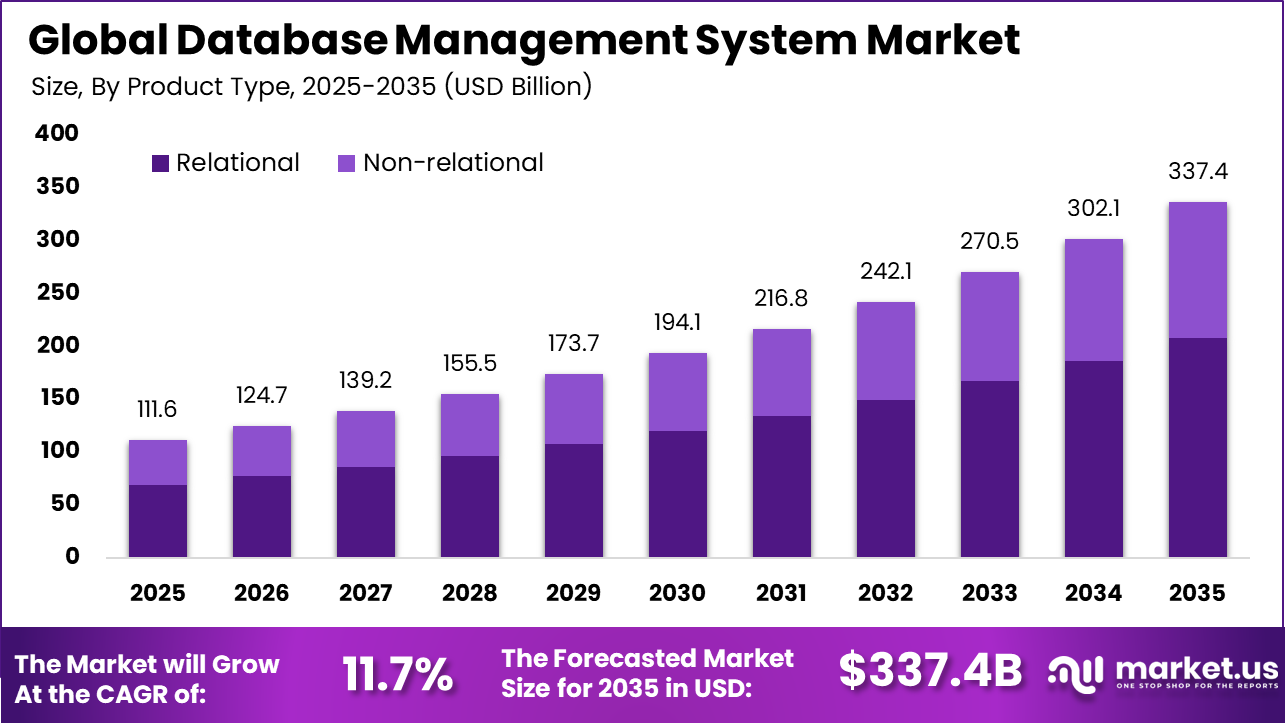
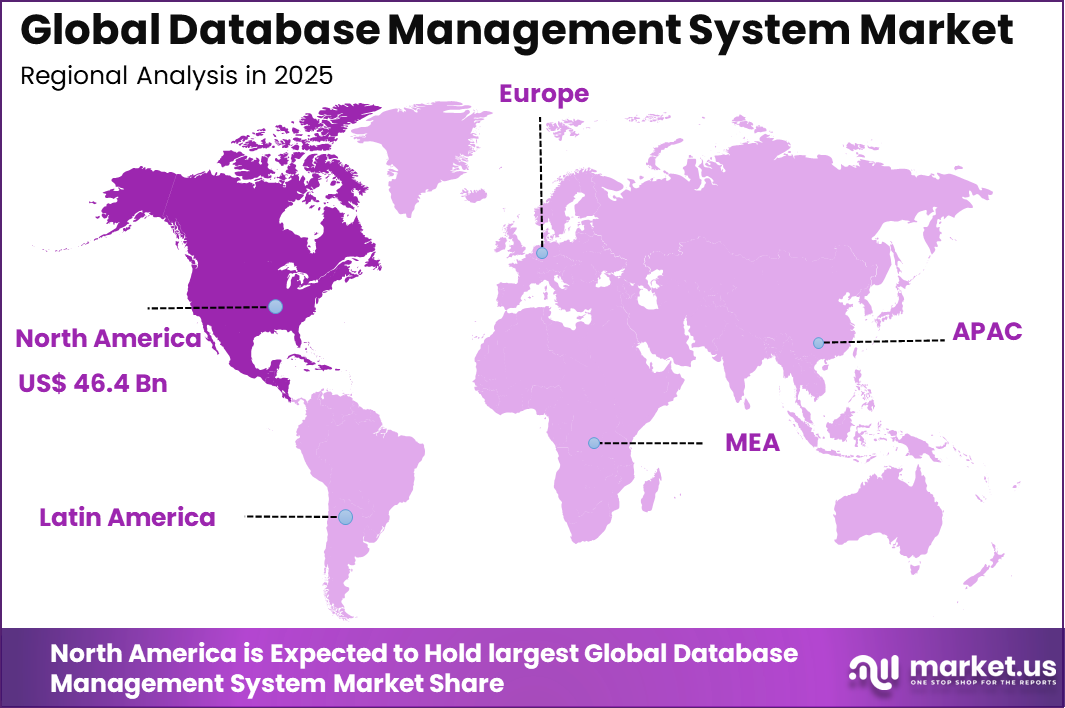
The Global Database Management System Market size is expected to be worth around USD 337.4 billion by 2035, from USD 111.6 billion in 2025, growing at a CAGR of 11.7% during the forecast period from 2025 to 2035. North America held a dominant market position, capturing more than a 41.6% share, holding USD 46.4 billion in revenue.
The Database Management System Market refers to software platforms used to store, organize, retrieve, secure, and manage structured or unstructured data across enterprise and consumer environments. A database management system serves as the core layer that allows applications, websites, analytics tools, and business systems to access data reliably and efficiently. This market includes relational, document, graph, vector, and other database models, reflecting the growing need to support transactional processing, analytics, cloud workloads, and AI driven applications.
The top driving factors behind this market are the rapid expansion of digital business, the growth of cloud native applications, and the rising value of data in decision making. As organizations move more operations online, the need for reliable data storage and fast access becomes more critical. This is being reinforced by the rise of distributed applications, AI systems, and real time digital services, all of which require stronger database performance and availability.
The broader cloud native ecosystem has also grown quickly, with CNCF reporting 19.9 million cloud native developers globally in Q1 2026, up from 15.6 million in Q3 2025, reflecting a 28% increase in six months. That expansion directly supports stronger demand for modern database platforms. Demand analysis shows that database systems remain essential across finance, retail, healthcare, telecom, manufacturing, public sector, and digital consumer services.
Enterprises are no longer looking only for systems that store records. They increasingly need platforms that can handle mixed workloads, real time analytics, application scale, and AI ready data pipelines. Developer usage data also confirms how central database technologies remain in software development. In the 2025 Stack Overflow Developer Survey, 58.6% of respondents said they worked with SQL, underlining the continued importance of database driven application development across the global developer community.
For instance, in February 2026, Teradata launched VantageCloud Lakehouse, emphasizing low‑code analytics, ML‑ready data preparation, and cross‑cloud data sharing. The platform is tailored for large utilities and telecoms in North America, pushing Teradata deeper into regulated, high‑volume analytical DBMS deployments.
Key Takeaway
- The relational segment led the global database management system market in 2025, accounting for 61.8% share, supported by its reliability and widespread use in structured data management.
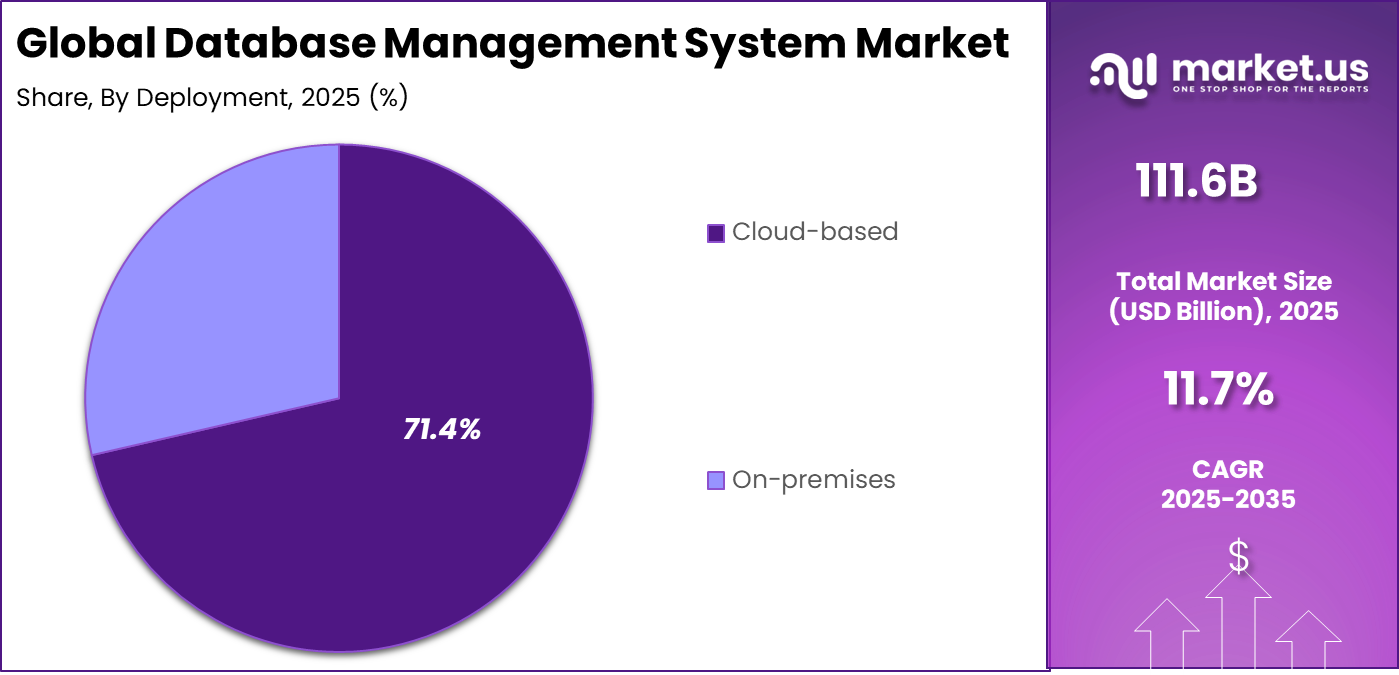
- Cloud-based deployment dominated with a 71.4% share, driven by growing demand for scalable, flexible, and cost-efficient data infrastructure solutions.
- Large enterprises held a leading position with a 67.7% share, reflecting higher data volumes and increased investment in advanced database technologies.
- The BFSI sector accounted for 24.3% share, supported by the need for secure, high-performance data management systems.
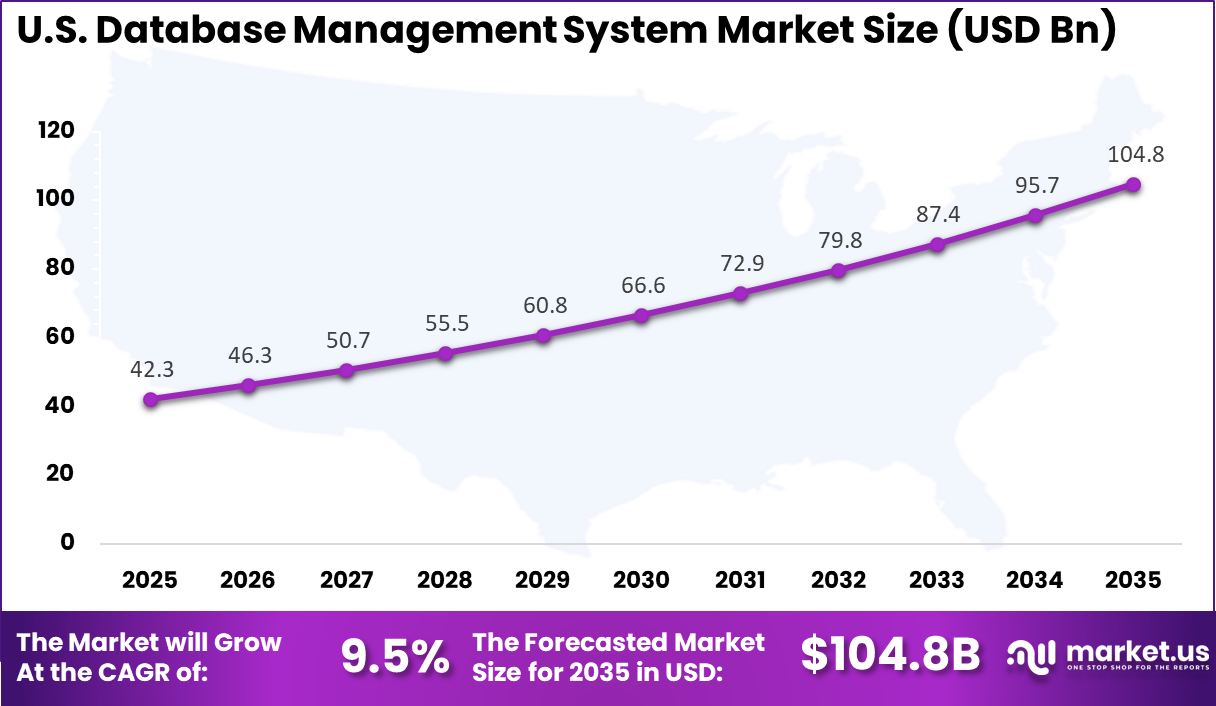
- The U.S. database management system market reached USD 42.3 billion in 2025, expanding at a CAGR of 9.5%, driven by strong digital transformation initiatives.
- North America maintained its leading position globally, capturing over 41.6% share, supported by advanced IT infrastructure and early adoption of data technologies.
U.S. Market Size
In 2025, North America held a leading 39.2% share in the Database Management System market. The region benefits from advanced IT infrastructure and high adoption of data driven technologies. Organizations across industries are investing in database systems to support digital transformation initiatives. This has strengthened the region’s position in the global market.
For instance, in February 2026, IBM advanced North American Database Management System leadership with watsonx.data 2.0, integrating hybrid cloud and AI governance across Db2 and NoSQL systems. The platform’s open-table format supports and accelerates enterprise AI adoption while maintaining strict compliance. U.S. firms gain unmatched data federation capabilities.
The U.S. market reached USD 37.5 billion and is growing at a CAGR of 9.7%. Growth is driven by increasing demand for cloud computing, data analytics, and enterprise applications. Businesses are focusing on improving data management capabilities to gain competitive advantages. As data continues to play a critical role in decision making, North America remains a key market for database systems.
For instance, in January 2026, AWS reinforced U.S. dominance in Database Management Systems by launching enhanced Aurora AI features, enabling real-time analytics on petabyte-scale data. This innovation helps enterprises process massive workloads faster, solidifying North America’s lead in cloud database infrastructure with unmatched scalability. Fortune 500 adoption continues to grow rapidly.
Type Analysis
In 2025, The Relational segment held a dominant market position, capturing a 61.8% share of the Global Database Management System Market. This dominance is due to the strong reliability and structured approach offered by relational databases. They organize data into tables with defined relationships, making it easier to manage large datasets. Businesses prefer these systems because they support accurate transactions and ensure data integrity across financial, operational, and customer-related processes.
Relational databases are widely trusted for handling critical workloads where consistency is essential. Their ability to support complex queries and maintain stable performance makes them suitable for long-term use. Organizations continue to rely on them as they provide a proven framework for managing structured data efficiently across multiple departments.
For Instance, in February 2026, IBM Corporation launched Db2 12.1.4, cutting operational friction with better data connectivity. Teams can now link modern platforms more easily, simplifying workflows in relational environments. From what I’ve seen, this kind of tweak keeps relational databases feeling fresh and reliable for core tasks.
Deployment Analysis
In 2025, the Cloud-Based segment held a dominant market position, capturing a 71.4% share of the Global Database Management System Market. This dominance is due to the flexibility and scalability provided by cloud-based database systems. Organizations can quickly adjust storage and processing capacity based on demand without heavy infrastructure investments. This model supports faster deployment and allows businesses to respond quickly to changing data needs and operational requirements.
Cloud-based systems also reduce the burden of maintenance and upgrades, which helps organizations focus on core activities. They enable remote access, improve collaboration, and support digital transformation efforts. As more businesses shift toward online operations, cloud deployment continues to gain strong acceptance across industries.
For instance, in April 2026, Google Cloud announced events at Next 2026, showcasing cloud-native database tools with AI boosts. Partners highlighted seamless scaling for cloud deployments, making it simpler to handle growing data loads remotely. This push shows why the cloud keeps winning for flexible, anywhere-access setups.
Organization Size Analysis
In 2025, The Large Enterprises segment held a dominant market position, capturing a 67.7% share of the Global Database Management System Market. This dominance is due to the extensive data requirements and complex operations within large enterprises. These organizations manage vast amounts of information across multiple functions, which requires strong database systems to ensure consistency, security, and performance. DBMS platforms help maintain centralized control over data usage and access.
Large enterprises also prioritize data governance and compliance, which increases their reliance on advanced database solutions. These systems support strategic decision-making by providing accurate and timely insights. Their ability to integrate with multiple business systems further strengthens their importance in large-scale operations.
For Instance, in March 2026, Oracle shared enterprise-grade enhancements for large-scale data handling in their cloud relational services. Focused on high-volume transactions, it supports big firms with non-stop performance across global teams. Large enterprises love this reliability for their complex, round-the-clock needs.
Vertical Analysis
In 2025, The BFSI segment held a dominant market position, capturing a 24.3% share of the Global Database Management System Market. This dominance is due to the high need for secure and accurate data handling in financial services. The BFSI sector deals with sensitive transactions and customer information, which requires reliable database systems. These systems help ensure that data is processed correctly and is available in real time for operational needs.
Database systems also support fraud detection, compliance monitoring, and risk management within the sector. Financial institutions depend on them to maintain transparency and accountability. As digital banking and online transactions increase, the importance of strong database systems continues to grow in this industry.
For Instance, in February 2026, IBM Corporation debuted Safer Payments with AI fraud detection for financial data systems. Built for BFSI, it spots threats faster in high-stakes transaction environments. This kind of targeted update keeps banks secure amid rising digital volumes.
Emerging Trend Analysis
Cloud-Native, AI-Ready, and Multi-Model Databases
A major trend in the Database Management System market is the shift toward cloud-native and AI-ready database architectures. Modern databases are designed to support distributed environments, enabling scalability, high availability, and flexible deployment across cloud and hybrid infrastructures. This allows organizations to handle growing data volumes without relying on rigid on-premise systems. Cloud-native design also supports faster development cycles and easier integration with modern applications.
Another important trend is the rise of multi-model and intelligent databases that can handle different data types within a single system. Organizations are increasingly working with structured, semi-structured, and unstructured data, which requires more flexible database capabilities. AI integration is also improving database operations through automation, query optimization, and predictive maintenance. These developments are transforming databases from storage systems into intelligent data platforms that support analytics and decision-making.
Growth Factors
Digitalization, Cloud Adoption, and Data Explosion
The growth of the Database Management System market is supported by the rapid expansion of digital activities and data generation. Businesses, governments, and individuals are producing large volumes of data through online transactions, connected devices, and digital services. This continuous data growth is increasing the need for efficient storage and management systems.
Another key growth factor is the widespread adoption of cloud computing and data-driven strategies. Organizations are moving toward flexible and scalable data infrastructures that support analytics, automation, and AI. As the importance of data continues to rise across industries, the demand for advanced database management systems is expected to grow steadily.
Key Market Segments
By Type
- Relational
- Non-relational
By Deployment
- Cloud
- On-premises
By Organization Size
- Large Enterprises
- SMEs
By Vertical
- BFSI
- IT & Telecom
- Retail & E-commerce
- Healthcare & Life Sciences
- Government
- Manufacturing
- Media & Entertainment
- Others
Key Regions and Countries
North America
- US
- Canada
Europe
- Germany
- France
- The UK
- Spain
- Italy
- Russia
- Netherlands
- Rest of Europe
Asia Pacific
- China
- Japan
- South Korea
- India
- Australia
- Singapore
- Thailand
- Vietnam
- Rest of APAC
Latin America
- Brazil
- Mexico
- Rest of Latin America
Middle East & Africa
- South Africa
- Saudi Arabia
- UAE
- Rest of MEA
Drivers
Real-Time Data Needs
The market is being driven by the growing need for instant access to business information. Companies want systems that can process transactions, customer activity, and operational updates without delay. This has made database platforms essential for supporting faster decisions, smoother workflows, and better service delivery across industries.
Real-time data needs are also rising because businesses now operate through digital channels that generate constant information. From online payments to inventory tracking, every function depends on timely and accurate data. Database management systems help organizations respond quickly, improve efficiency, and maintain better control over daily operations.
For instance, in April 2025, AWS rolled out stronger features in DynamoDB for handling live data flows across regions. This helps teams keep operations running smoothly even during high-traffic moments, cutting down on delays for apps that need instant updates from users or devices. It fits right into the push for systems that respond without a pause.
Restraint
Security Risk
Security risk remains a major restraint in the database management system market because large volumes of sensitive business and customer data are stored in one place. Any weakness in protection can lead to breaches, data loss, or unauthorized access, which may damage trust and disrupt business operations.
Organizations are becoming more cautious as cyber threats grow more frequent and more complex. Protecting databases requires constant monitoring, regular updates, and strong access controls. For many businesses, especially smaller ones, maintaining this level of protection can be costly and difficult, which slows wider adoption.
For instance, in March 2024, Microsoft brought in Defender for Cloud on Azure Database for MySQL to spot odd access patterns early. It watches for threats like sneaky logins or unusual queries, giving admins simple alerts to lock things down fast. This tackles the constant worry of breaches in busy data setups.
Opportunities
AI-Ready Platforms
A strong opportunity is emerging through AI-ready database platforms that can support faster analytics and smarter automation. Businesses want systems that can manage modern workloads while preparing data for machine learning and predictive tools. This creates demand for platforms that are flexible, intelligent, and designed for evolving digital needs.
AI-ready platforms also help organizations improve data use across customer service, operations, and planning functions. They make it easier to connect large datasets with advanced applications and real-time insights. As AI adoption expands, database vendors have a clear opportunity to deliver systems built for this new environment.
For instance, in February 2025, Snowflake enhanced its platform with seamless AI integrations for clean data pipelines. Users can now feed structured info straight into learning models, speeding up tasks like forecasts or personalization. This creates fresh paths for teams to build without wrestling with old data issues.
Challenges
Compliance Complexity
Compliance complexity is a major challenge because businesses must manage data under different legal and industry rules. Database systems must support privacy, retention, access control, and audit requirements at the same time. Meeting these obligations can be difficult, especially for organizations operating across multiple regions or sectors.
The challenge becomes greater as regulations continue to change and enforcement becomes stricter. Companies need database systems that can adapt without disrupting operations or increasing risk. This often requires continuous updates, internal oversight, and skilled teams, which can place pressure on both budgets and technical resources.
For instance, in October 2024, SAP updated HANA with deeper logging for global standards, making it easier to pull reports for checks. Still, blending these with daily tasks means more training and tools, stretching teams thin. It highlights the ongoing pull between rules and smooth workflows.
Key Players Analysis
In the Database Management System market, Amazon Web Services (AWS), Microsoft, and Google Cloud are dominant players due to their strong cloud infrastructure and scalable database offerings. These companies provide managed database services that support high performance, flexibility, and global accessibility. IBM Corporation and Oracle also maintain a strong presence with enterprise-grade database solutions focused on reliability, security, and large-scale data processing.
MongoDB, Inc., Redis, and Snowflake Inc. are shaping the modern database landscape with their focus on NoSQL, in-memory processing, and cloud-native data warehousing. Their platforms enable real-time analytics, faster query performance, and flexible data models for modern applications. SAP SE and Teradata also contribute significantly by offering advanced analytics and enterprise data management solutions tailored for complex business environments.
PostgreSQL, Couchbase, SQLite, Redis Labs, and MariaDB Corporation add strong open-source and hybrid database capabilities to the market. These technologies are widely adopted due to their cost efficiency, flexibility, and strong developer support. Other key players continue to enhance the competitive landscape by introducing specialized solutions, improving performance optimization, and supporting diverse data workloads across industries.
Top Key Players in the Market
- Amazon Web Services (AWS)
- Google Cloud
- IBM Corporation
- Microsoft
- MongoDB, Inc.
- Oracle
- Redis
- SAP SE
- Snowflake Inc.
- Teradata
- PostgreSQL
- Couchbase
- SQLite
- Redis Labs
- MariaDB Corporation
- Other Key Players
Recent Developments
- In March 2026, MongoDB announced Atlas Vector Search 2.0 and upgraded its workload autoscaling, targeting AI and real‑time search use cases across enterprise apps. The enhancements are already driving higher adoption among U.S. SaaS and fintech firms, reinforcing North America’s lead in developer‑centric NoSQL.
- In January 2026, Oracle rolled out Autonomous Database 26Ai, adding built‑in vector search, AI‑driven performance tuning, and Apache Iceberg integration. The suite targets hybrid deployments and complex analytics‑heavy workloads, continuing Oracle’s strong footprint in enterprise DBMS in North America.
Report Scope
Report Features Description Market Value (2025) USD 111.6 Bn Forecast Revenue (2035) USD 337.4 Bn CAGR (2026-2035) 11.7% Base Year for Estimation 2025 Historic Period 2020-2024 Forecast Period 2026-2035 Report Coverage Revenue forecast, AI impact on Market trends, Share Insights, Company ranking, competitive landscape, Recent Developments, Market Dynamics and Emerging Trends Segments Covered By Type (Relational, Non-relational), By Deployment (Cloud, On-premises), By Organization Size (Large Enterprises, SMEs), By Vertical (BFSI, IT & Telecom, Retail & E-commerce, Healthcare & Life Sciences, Government, Manufacturing, Media & Entertainment, Others) Regional Analysis North America – US, Canada; Europe – Germany, France, The UK, Spain, Italy, Russia, Netherlands, Rest of Europe; Asia Pacific – China, Japan, South Korea, India, New Zealand, Singapore, Thailand, Vietnam, Rest of Latin America; Latin America – Brazil, Mexico, Rest of Latin America; Middle East & Africa – South Africa, Saudi Arabia, UAE, Rest of MEA Competitive Landscape Amazon Web Services (AWS), Google Cloud, IBM Corporation, Microsoft, MongoDB, Inc., Oracle, Redis, SAP SE, Snowflake Inc., Teradata, PostgreSQL, Couchbase, SQLite, Redis Labs, MariaDB Corporation, Other Key Players Customization Scope Customization for segments, region/country-level will be provided. Moreover, additional customization can be done based on the requirements. Purchase Options We have three license to opt for: Single User License, Multi-User License (Up to 5 Users), Corporate Use License (Unlimited User and Printable PDF)  Database Management System MarketPublished date: April 2026add_shopping_cartBuy Now get_appDownload Sample
 -
-
- Amazon Web Services (AWS)
- Google Cloud
- IBM Corporation
- Microsoft
- MongoDB, Inc.
- Oracle
- Redis
- SAP SE
- Snowflake Inc.
- Teradata
- PostgreSQL
- Couchbase
- SQLite
- Redis Labs
- MariaDB Corporation
- Other Key Players
Our Clients

- 183488
- April 2026