


Global Bran Market Size, Share, And Enhanced Productivity By Source (Wheat, Rice, Corn, Barley, Others), By Application (Food (Bakery Goods, Brekfast Cereals, Pasta and Noodles, Oil, Others), Animal Feed, Health and Wellness, Others), By Distribution Channel (B2B, B2C (Online, Hypermarkets/Supermarkets, Specialty Stores, Others)), By Region and Companies - Industry Segment Outlook, Market Assessment, Competition Scenario, Trends, and Forecast 2026-2035
- Published date: March 2026
- Report ID: 182439
- Number of Pages: 383
- Format:
-
keyboard_arrow_up
Quick Navigation
Report Overview
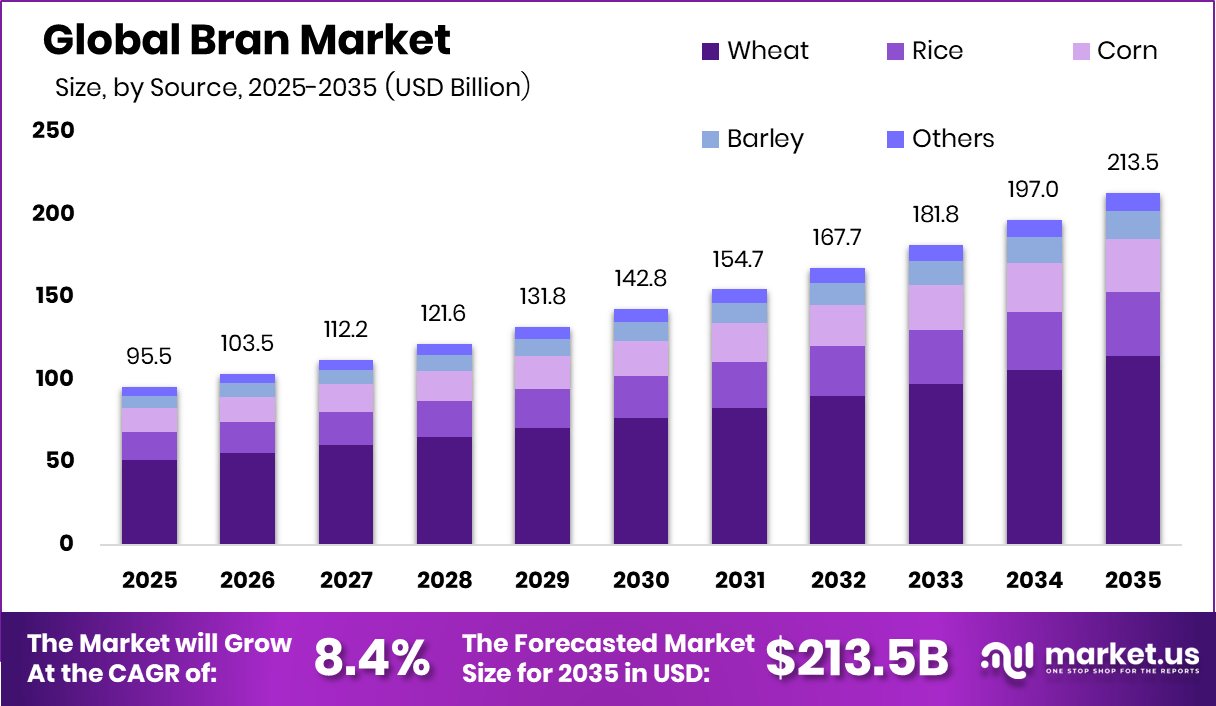
The Global Bran Market is expected to be worth around USD 213.5 billion by 2035, up from USD 95.5 billion in 2025. It is projected to grow at a CAGR of 8.4% from 2026 to 2035. Bran market in Asia Pacific accounted for 56.5%, totaling USD 53.9 Bn value.
Bran is the outer layer of cereal grains such as Wheat, Rice, Corn, and Barley, separated during milling. It is rich in dietary fiber, vitamins, and minerals, making it valuable for both human consumption and animal nutrition. The bran market refers to the production, processing, and distribution of these grain byproducts across food, feed, and wellness applications. It is segmented by source, application, and distribution channel, including B2B and B2C supply chains serving diverse industries.
The market is driven by steady growth factors such as increasing awareness of digestive health and the importance of fiber-rich diets. Bran is widely used in food products like bakery items and cereals, as well as in animal feed formulations. Supportive funding initiatives such as MDARD awarding over $3.1 million through resilient food system programs and $300,000 for regenerative agriculture education are helping strengthen agricultural output and supply systems.
Demand for bran continues to rise across both developed and emerging regions due to its versatility and cost-effectiveness. The animal feed sector remains a major contributor, while health and wellness applications are gaining traction. Programs like the NJEDA FEED NJ grants providing $9.3 million and research funding of $450,000 from the Michigan Craft Beverage Council further support innovation and utilization of grain-based resources.
Opportunities are expanding with improvements in supply chains and sustainable farming practices. Investments such as Aviwell’s EUR 11 million funding, MGA Thermal’s AU$3.25 million support, and regional efforts addressing drought-related logistics challenges highlight a broader push toward efficiency and resilience. These developments create favorable conditions for bran utilization across multiple industries.
- In March 2025, Astra Alliance continued advancing its traceability and sustainability systems for food and feed raw materials. The company ensures 100% traceability and non-GMO product standards, improving quality of grain-derived products such as bran. This development strengthens customer trust and supports demand for safe, high-quality agricultural ingredients.
Key Takeaways
- The Global Bran Market is expected to be worth around USD 213.5 billion by 2035, up from USD 95.5 billion in 2025. It is projected to grow at a CAGR of 8.4% from 2026 to 2035.
- The Bran Market is dominated by wheat sources, accounting for 53.7% of total production globally.
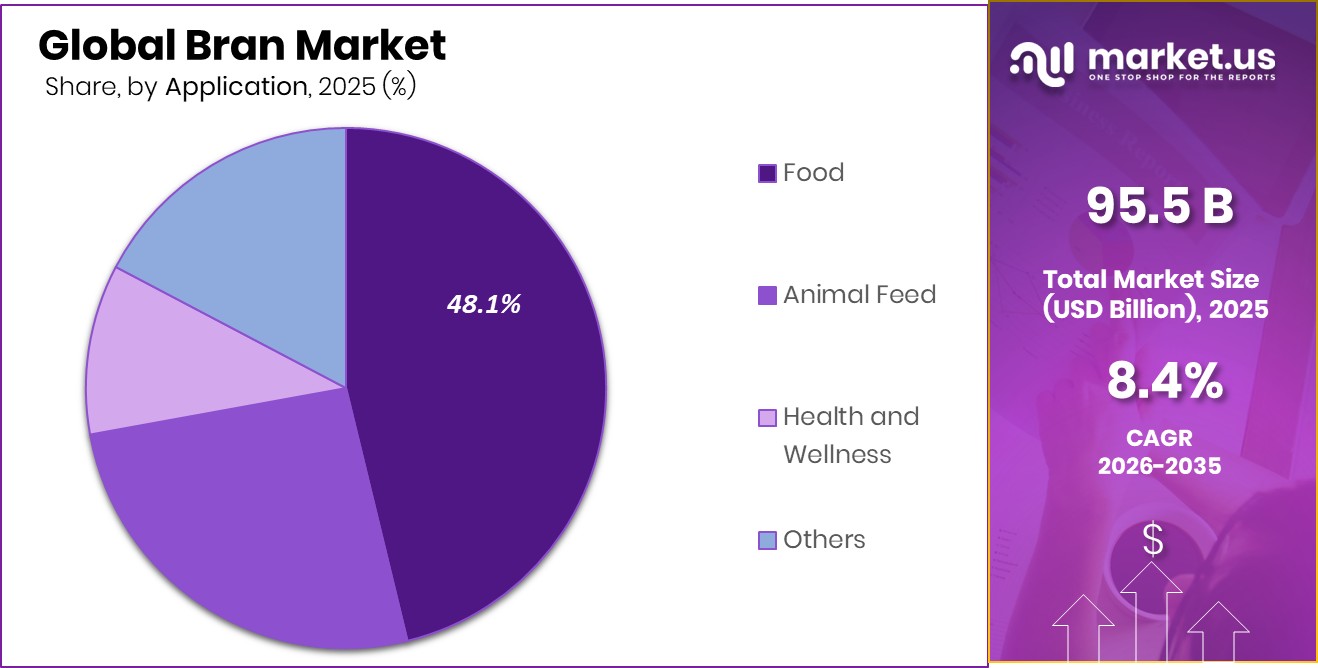
- In the Bran Market, food applications lead usage, contributing 48.1% of overall demand worldwide.
- B2B distribution channels dominate the Bran Market, representing 74.3% of total product sales globally.
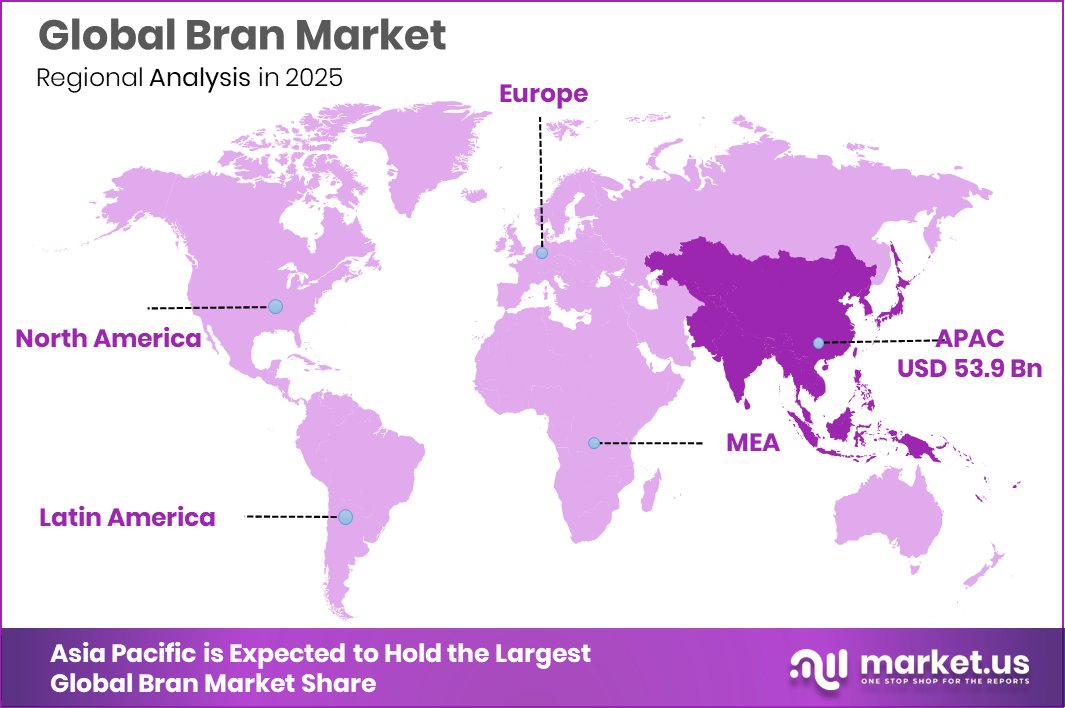
- Asia Pacific region held 56.5% bran market share, reaching USD 53.9 Bn valuation.
By Source Analysis
Bran Market by source shows wheat dominating with a strong 53.7% share.
In 2025, the bran market showed strong dominance of wheat-based products, accounting for 53.7% of the total share. Wheat bran remains the most widely used type due to its high fiber content, affordability, and easy availability across major agricultural regions. It is extensively utilized in both developed and emerging economies, supported by rising awareness of digestive health and nutritional benefits. The consistent demand from food manufacturers and feed producers further strengthens its position.
Additionally, wheat bran’s compatibility with various processing techniques makes it a preferred choice for large-scale production. This segment is expected to maintain its lead as consumers increasingly shift toward fiber-rich diets and functional food ingredients.
By Application Analysis
Bran Market by application highlights food segment leading with 48.1% demand.
In 2025, the bran market was largely driven by food applications, which held a 48.1% share. The growing focus on healthy eating habits and preventive healthcare has significantly increased the use of bran in food products such as cereals, bakery items, snacks, and dietary supplements. Consumers are actively seeking natural sources of fiber, vitamins, and minerals, positioning bran as a key ingredient in product innovation.
Food manufacturers are incorporating bran to enhance nutritional profiles while meeting clean-label demands. This trend is especially prominent in urban markets where lifestyle-related health concerns are rising. As a result, the food application segment continues to expand, supported by evolving consumer preferences and product diversification.
By Distribution Channel Analysis
Bran Market distribution channels are driven by B2B dominance at 74.3%.
In 2025, the bran market was heavily influenced by the B2B distribution channel, which accounted for 74.3% of the total share. Bulk purchasing by food processors, feed manufacturers, and industrial buyers drives this segment’s dominance. Businesses rely on consistent supply chains and cost-effective sourcing, making B2B channels essential for large-volume transactions. The structured nature of these transactions ensures steady demand and long-term contracts between suppliers and buyers.
Additionally, the rise of organized food production and commercial livestock industries further boosts B2B distribution. Companies are increasingly focusing on strengthening partnerships and logistics networks to maintain efficiency. This channel is expected to remain the backbone of the bran market’s distribution ecosystem.
Key Market Segments
By Source
- Wheat
- Rice
- Corn
- Barley
- Others
By Application
- Food
- Bakery Goods
- Brekfast Cereals
- Pasta and Noodles
- Oil
- Others
- Animal Feed
- Health and Wellness
- Others
By Distribution Channel
- B2B
- B2C
- Online
- Hypermarkets/Supermarkets
- Specialty Stores
- Others
Driving Factors
Rising demand for fiber rich foods
The Bran Market continues to benefit from growing consumer preference for fiber-rich diets, driven by increasing awareness around digestive health and balanced nutrition. Bran, derived from grains like wheat and rice, is widely used in food products such as cereals and baked goods, supporting this shift. Consumers are actively choosing natural ingredients that offer functional benefits, which strengthens demand across food applications.
Additionally, broader wellness-focused initiatives, such as The Our Fund Foundation awarding $440,000 in grants through its LGBTQ+ Health & Wellness Fund, reflect a wider societal push toward healthier lifestyles. This evolving mindset supports consistent inclusion of bran in daily diets, reinforcing its importance as a key nutritional ingredient across both developed and emerging markets.
Growing use in animal feed industry
The Bran Market is strongly supported by its widespread use in animal feed, where bran serves as a cost-effective and nutrient-rich ingredient. Livestock producers rely on bran for its fiber content and energy value, making it an essential component in feed formulations. The steady growth of the livestock sector continues to drive demand for bran across various regions.
Local funding activities, such as Wheat Penny seeking $5,000 from Effingham’s tourism fund, highlight ongoing support for grain-related ecosystems and rural economies. This indirect support helps sustain agricultural supply chains that produce bran. As demand for meat and dairy products rises, the use of bran in feed is expected to remain a stable and significant growth driver.
Restraining Factors
Fluctuating raw material supply availability
The Bran Market faces challenges due to fluctuations in the availability of raw materials such as wheat, rice, and corn. Weather conditions, supply chain disruptions, and variations in crop yields directly impact bran production volumes. Inconsistent supply can lead to price volatility and affect processing stability for manufacturers.
Broader funding initiatives, including Texas receiving more than $1.4 billion in federal funding to improve rural health care, indicate the scale of investment needed to support rural systems, which are closely tied to agricultural productivity. However, despite such support, uncertainties in farming outputs remain a concern. These fluctuations can limit the consistent availability of bran, affecting both food and feed industries that depend on reliable supply.
Limited awareness in developing regions
Limited awareness regarding the nutritional benefits of bran in certain developing regions continues to restrict market growth. While bran is widely recognized in developed markets, its value in improving health and nutrition is not fully understood in some areas. This results in lower consumption and reduced integration into food products.
Government-level agreements, such as Egypt and the UAE signing a deal worth $500 million to fund wheat supplies for five years, emphasize the focus on staple grain supply rather than value-added components like bran. This gap in awareness and utilization slows market penetration. Addressing education and awareness challenges remains essential to unlocking the full potential of bran across underserved markets.
Growth Opportunity
Expansion in health wellness applications
The Bran Market holds strong growth potential through its increasing use in health and wellness applications. Bran is being incorporated into dietary supplements, functional foods, and nutrition-focused products due to its high fiber and micronutrient content. Consumers are actively seeking products that support digestive health, weight management, and overall well-being.
Initiatives such as the £110,000 Community Wellbeing Fund launched to boost mental health and physical activity in West Berkshire reflect a broader emphasis on holistic wellness. This environment creates favorable conditions for bran-based innovations. As manufacturers continue to develop products aligned with health trends, bran is expected to gain wider acceptance beyond traditional food uses.
Increasing demand in emerging economies
Emerging economies present significant opportunities for the Bran Market due to rising urbanization, income growth, and changing dietary patterns. As consumers in these regions adopt more processed and health-oriented foods, the demand for bran is gradually increasing. Investments like the 1803 Fund acquiring Portland grain silos in a $70 million deal highlight expanding infrastructure and storage capabilities within grain supply chains.
Such developments improve accessibility and distribution of grain byproducts, including bran. With improving supply networks and growing awareness, emerging markets are becoming key areas for expansion. This shift supports long-term growth and diversification of bran applications across both food and feed sectors.
Latest Trends
Adoption of sustainable grain processing
Sustainability is becoming a key trend in the Bran Market, with increasing focus on efficient grain processing and reduced waste. Producers are adopting methods that maximize the utilization of grain components, ensuring that bran is effectively processed and used across industries. Environmental and social initiatives, such as Kawartha Lakes Paramedics and Police Service receiving $25,000 each to support mental health and wellness, reflect a broader commitment to sustainable and responsible practices.
In agriculture, this translates into improved resource management and reduced environmental impact. Sustainable processing not only enhances production efficiency but also aligns with consumer expectations for environmentally conscious products, strengthening the long-term viability of bran production.
Rising popularity of clean label ingredients
The demand for clean label and minimally processed ingredients is influencing the Bran Market significantly. Consumers prefer products with simple, recognizable ingredients, and bran fits well within this trend due to its natural origin. Food manufacturers are increasingly highlighting bran as a functional ingredient that supports transparency and health claims.
Large-scale funding efforts, such as Texas applying for $1 billion in federal funding for rural health initiatives, indicate growing investment in systems that support healthier communities. This aligns with the shift toward clean eating and natural products. As clean label trends continue to gain momentum, bran is expected to see increased adoption across a wide range of food and wellness products.
Regional Analysis
In 2025, Asia Pacific dominated bran market with 56.5% share, valued USD 53.9 Bn.
The bran market demonstrates varied regional dynamics across North America, Europe, Asia Pacific, the Middle East & Africa, and Latin America, shaped by consumption patterns and industrial demand.
Among these, Asia Pacific emerges as the dominating region, accounting for 56.5% of the global bran market and reaching a valuation of USD 53.9 Bn. This dominance is attributed to strong agricultural output, large-scale wheat processing, and rising demand for fiber-rich food products. In contrast, North America and Europe exhibit stable demand driven by established food processing industries and consistent consumption of health-oriented products.
Meanwhile, Latin America and Middle East & Africa represent emerging markets, supported by growing awareness of nutritional benefits and gradual expansion of food manufacturing sectors. Across all regions, the bran market continues to be influenced by dietary shifts toward fiber-enriched products and the integration of bran into both food and feed applications, reinforcing steady global market expansion.
Key Regions and Countries
- North America
- US
- Canada
- Europe
- Germany
- France
- The UK
- Spain
- Italy
- Rest of Europe
- Asia Pacific
- China
- Japan
- South Korea
- India
- Australia
- Rest of APAC
- Latin America
- Brazil
- Mexico
- Rest of Latin America
- Middle East & Africa
- GCC
- South Africa
- Rest of MEA
Key Players Analysis
Ardent Mills demonstrates a strong operational foundation in the bran market through its integrated milling capabilities and consistent product quality. Its ability to process large volumes of wheat efficiently supports a stable output of wheat bran, aligning with demand from food and feed industries. The company’s structured supply chain and focus on ingredient solutions position it well to cater to industrial buyers seeking reliability and scalability. Its emphasis on product consistency and operational efficiency continues to reinforce its presence in bran-related segments.
Riceland Foods, Inc. plays a significant role through its specialization in rice-based products, including rice bran. As a farmer-owned cooperative, it benefits from direct access to raw materials, ensuring traceability and supply continuity. The company’s approach supports both domestic and export markets, with rice bran being a valuable byproduct utilized across multiple applications. Its integrated operations allow it to maintain quality standards while supporting diversified usage of bran within its portfolio.
Wilmar International Limited brings a diversified agribusiness model that strengthens its position in the bran market. Its extensive processing infrastructure and global supply chain enable efficient handling of agricultural byproducts, including bran. The company’s scale and vertical integration support cost optimization and consistent supply, making it a key participant in bulk distribution and industrial demand fulfillment across various regions.
Top Key Players in the Market
- Ardent Mills
- Riceland Foods, Inc.
- Wilmar International Limited
- Archer Daniels Midland Company
- Hindustan Animal Feeds
- Astra Alliance
- Siemer Milling Company
- Didion Inc.
- Grain Millers Inc.
- Grain Processing Corporation
Recent Developments
- In July 2025, Ardent Mills entered an agreement to acquire Stone Mill, a specialty grain cleaning facility. This move enhances its processing capabilities for grains, including wheat and specialty ingredients, which support bran production. The acquisition improves supply chain control, product quality, and ability to deliver innovative grain-based solutions to customers.
- In November 2024, Riceland Foods partnered with Hill’s Pet Nutrition to promote sustainably grown rice. As a company involved in rice milling and bran-based products, this collaboration supports improved sourcing and long-term availability of rice byproducts such as rice bran. The initiative focuses on climate-smart farming and strengthens supply chain sustainability.
Report Scope
Report Features Description Market Value (2025) USD 95.5 Billion Forecast Revenue (2035) USD 213.5 Billion CAGR (2026-2035) 8.4% Base Year for Estimation 2025 Historic Period 2020-2024 Forecast Period 2026-2035 Report Coverage Revenue Forecast, Market Dynamics, Competitive Landscape, Recent Developments Segments Covered By Source (Wheat, Rice, Corn, Barley, Others), By Application (Food (Bakery Goods, Brekfast Cereals, Pasta and Noodles, Oil, Others), Animal Feed, Health and Wellness, Others), By Distribution Channel (B2B, B2C (Online, Hypermarkets/Supermarkets, Specialty Stores, Others)) Regional Analysis North America – US, Canada; Europe – Germany, France, The UK, Spain, Italy, Rest of Europe; Asia Pacific – China, Japan, South Korea, India, Australia, Singapore, Rest of APAC; Latin America – Brazil, Mexico, Rest of Latin America; Middle East & Africa – GCC, South Africa, Rest of MEA Competitive Landscape Ardent Mills, Riceland Foods, Inc., Wilmar International Limited, Archer Daniels Midland Company, Hindustan Animal Feeds, Astra Alliance, Siemer Milling Company, Didion Inc., Grain Millers Inc., Grain Processing Corporation Customization Scope Customization for segments, region/country-level will be provided. Moreover, additional customization can be done based on the requirements. Purchase Options We have three licenses to opt for: Single User License, Multi-User License (Up to 5 Users), Corporate Use License (Unlimited User and Printable PDF) 
-
-
- Ardent Mills
- Riceland Foods, Inc.
- Wilmar International Limited
- Archer Daniels Midland Company
- Hindustan Animal Feeds
- Astra Alliance
- Siemer Milling Company
- Didion Inc.
- Grain Millers Inc.
- Grain Processing Corporation
Our Clients

- 182439
- March 2026






