


Global Barley Market Size, Share, And Enhanced Productivity By Type (Whole Grain, Non-Whole Grain, Flakes, Flour, Malted), By Application (Food, Feed, Beverages), By Distribution Channel (Food and Beverage Industry, Online, Hypermarkets/Supermarkets, Wholesale Stores, Others), By Region and Companies - Industry Segment Outlook, Market Assessment, Competition Scenario, Trends, and Forecast 2026-2035
- Published date: March 2026
- Report ID: 182423
- Number of Pages: 319
- Format:
-
keyboard_arrow_up
Quick Navigation
Report Overview
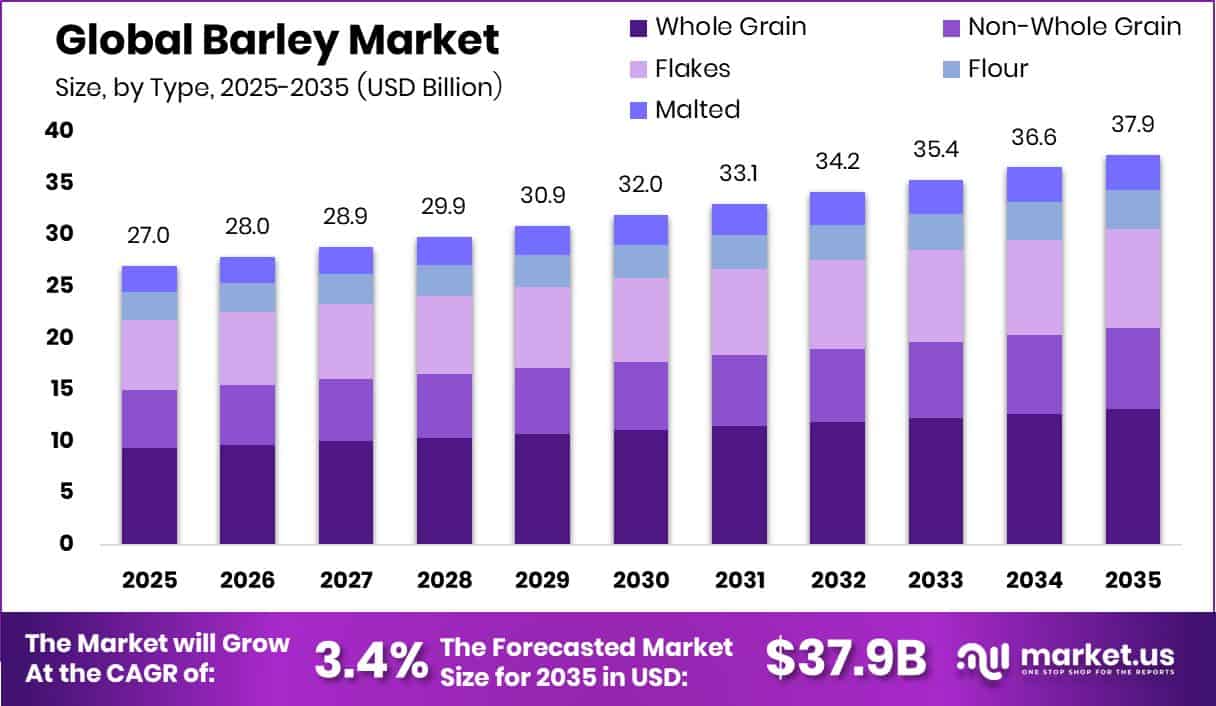
The Global Barley Market is expected to be worth around USD 37.9 billion by 2035, up from USD 27.0 billion in 2025. It is projected to grow at a CAGR of 3.4% from 2026 to 2035. The Barley Market in Europe holds 42.9% share, approximately totaling USD 11.5 Bn
Barley is a widely cultivated cereal grain known for its versatility and nutritional value. It is commonly used in food products, animal feed, and beverage production, particularly in malting. Rich in dietary fiber, vitamins, and minerals, barley supports digestive health and is increasingly recognized as a functional ingredient in modern diets. Its adaptability to different climates and soil conditions makes it an important crop across many regions.
The Barley Market refers to the global production, processing, distribution, and consumption of barley across various industries. It includes different types such as whole grain, non-whole grain, flakes, flour, and malted barley. Applications span food, feed, and beverages, while distribution channels range from the food and beverage industry to online platforms and retail outlets. The market reflects a balance between traditional uses and evolving consumer preferences.
Growth in the barley market is supported by increasing investment in research and development. Funding initiatives such as Barley raising $4 million in a seed round and CBRC committing $1.8 million and $2.7 million to CDC barley breeding activities are strengthening crop quality and yield. Additionally, $19 million allocated to whole grain research and $4 million in federal funding for food and health projects further enhance innovation and long-term development.
Demand for barley continues to rise due to its expanding use in food and beverages. Consumers are showing greater interest in nutritious grains, while industries value barley for its functional properties. Its role in feed also remains significant, ensuring consistent demand across agricultural sectors.
Opportunities in the barley market are growing with advancements in product development and supply chain improvements. Increased focus on whole grain consumption, improved processing techniques, and expanding distribution channels are creating new avenues for market expansion across regions and applications.
- In July 2024, GrainCorp, which works in grain storage, handling, and barley supply for food and beverage use, entered a Memorandum of Understanding with Ampol and IFM Investors. This development focuses on building a low-carbon fuel supply chain using agricultural feedstocks like grains and oilseeds. The project supports better use of barley and other crops in energy applications while strengthening its processing business.
Key Takeaways
- The Global Barley Market is expected to be worth around USD 37.9 billion by 2035, up from USD 27.0 billion in 2025. It is projected to grow at a CAGR of 3.4% from 2026 to 2035.
- Whole grain barley dominates the Barley Market, accounting for 34.7% share due to health benefits.
- Food application leads the Barley Market with 45.8%, driven by rising demand for nutritious products.
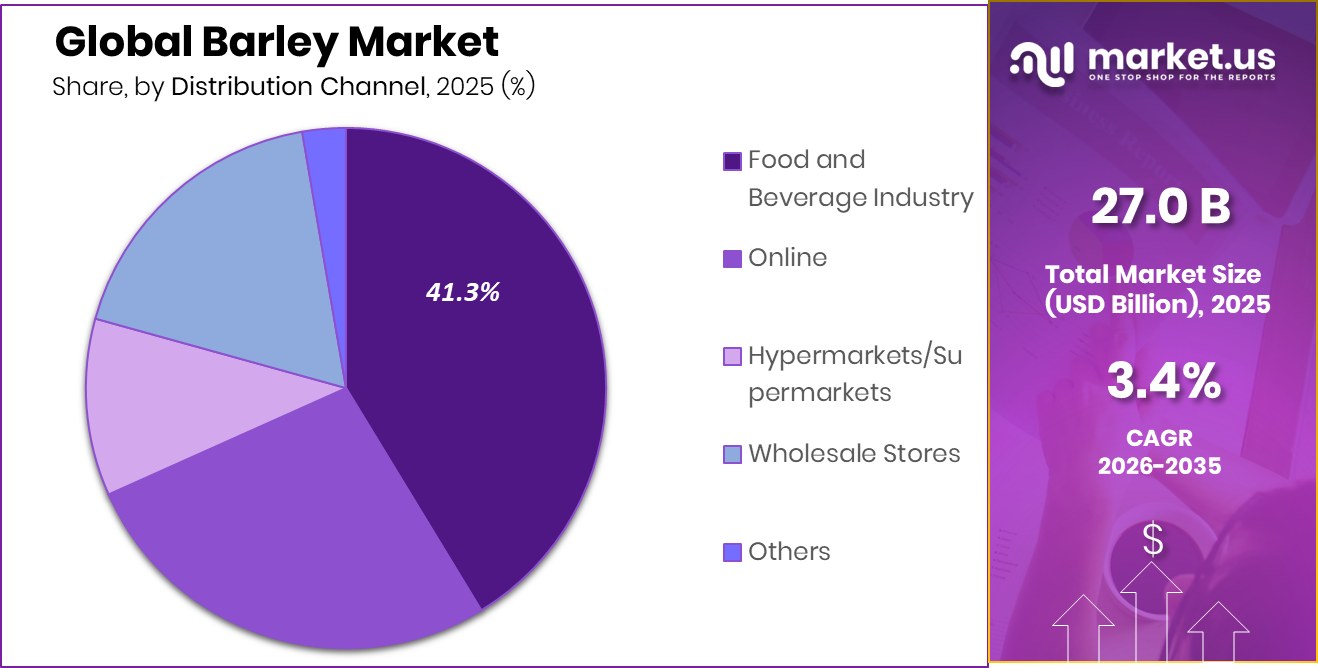
- Food and beverage industry distribution holds 41.3% in the Barley Market, supporting widespread consumption globally.
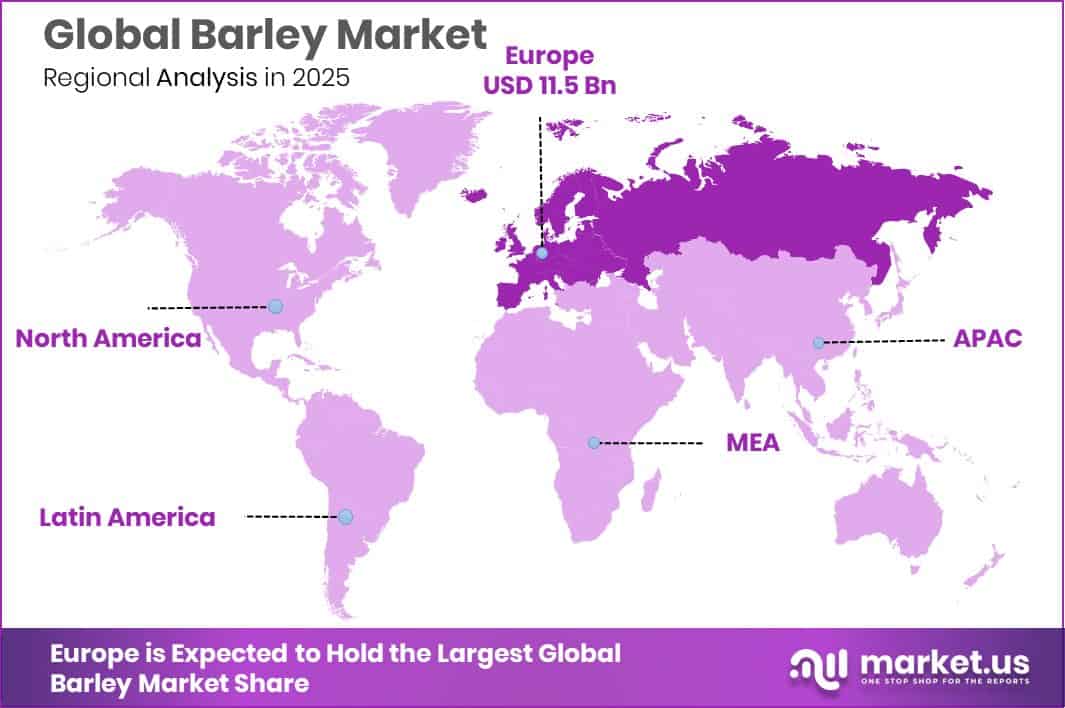
- Europe accounts for 42.9% of Barley Market, reaching USD 11.5 Bn valuation total.
By Type Analysis
Barley Market by type shows whole grain segment holds 34.7% share.
In 2025, the Barley Market shows a strong preference for whole grain barley, accounting for 34.7% of the total share. This dominance is driven by increasing consumer awareness of health and nutrition, as whole grain barley retains essential nutrients such as fiber, vitamins, and minerals. The rising demand for functional foods and clean-label products has further encouraged food manufacturers to incorporate whole grain barley into their offerings.
Additionally, dietary trends promoting heart health and digestive wellness have contributed to its popularity. As consumers continue to prioritize natural and minimally processed ingredients, whole grain barley is expected to maintain its leading position, supported by expanding applications in cereals, bakery products, and health-focused food innovations.
By Application Analysis
Barley Market by application indicates food segment accounts for 45.8% share overall.
In 2025, the food segment leads the Barley Market by application, capturing 45.8% of the overall share. This growth is largely attributed to the versatile use of barley in a wide range of food products, including soups, stews, baked goods, and breakfast cereals. The increasing inclination toward plant-based diets and sustainable food sources has also boosted barley consumption, as it is considered an eco-friendly and nutrient-dense grain.
Food manufacturers are leveraging barley’s functional properties, such as its texture and nutritional value, to develop innovative products that meet evolving consumer preferences. Furthermore, the expansion of the global food processing industry and the demand for healthier ingredients continue to reinforce barley’s significance within the food application segment.
By Distribution Channel Analysis
Barley Market by distribution channel shows food and beverage industry dominates 41.3%.
In 2025, the food and beverage industry dominates the Barley Market by distribution channel, holding a 41.3% share. This leadership is supported by the extensive use of barley in both food production and beverage manufacturing, particularly in brewing and malt-based products. The strong presence of established supply chains and large-scale procurement by manufacturers has enabled efficient distribution and consistent demand.
Additionally, the growth of craft beverages and specialty food products has further increased the industry’s reliance on high-quality barley. As companies focus on product diversification and premium offerings, the food and beverage industry remains a critical channel for market expansion, ensuring steady growth and widespread availability of barley-based products worldwide.
Key Market Segments
By Type
- Whole Grain
- Non-Whole Grain
- Flakes
- Flour
- Malted
By Application
- Food
- Feed
- Beverages
By Distribution Channel
- Food and Beverage Industry
- Online
- Hypermarkets/Supermarkets
- Wholesale Stores
- Others
Driving Factors
Rising demand for healthy whole grains
The Barley Market is witnessing steady momentum driven by the rising demand for healthy whole grains, as consumers increasingly shift toward nutrient-rich and fiber-based diets. Barley’s strong nutritional profile makes it a preferred choice in food applications, supporting this upward trend. This growth is further reinforced by funding initiatives that strengthen research and product innovation.
For instance, $19 million funding boosts Washington whole grain research and market development, helping expand awareness and product usage. Additionally, Sara Lee owner Grupo Bimbo acting as lead investor in a $4M funding round for Olyra highlights growing interest in grain-based product innovation. These developments collectively enhance barley’s position across food segments and support long-term market expansion.
Restraining Factors
Climate variability affecting barley crop yields
The Barley Market faces notable challenges due to climate variability affecting barley crop yields, which creates uncertainty in production and supply stability. Changes in temperature, rainfall patterns, and extreme weather conditions directly impact farming output, influencing availability and pricing. At the same time, funding activities in the broader food sector reflect efforts to improve accessibility and resilience.
The Good Food Innovation Fund’s first cohort receiving $1 million to make better food accessible to Africans indicates a push toward improving food systems, though it also highlights existing gaps. Additionally, Quinn raising $10 million in Series B funding shows investment in alternative food solutions, which may shift focus away from traditional grains like barley.
Growth Opportunity
Expansion in organic and specialty barley
The Barley Market presents strong growth opportunities through the expansion of organic and specialty barley, driven by evolving consumer preferences for clean and premium ingredients. This shift is supported by research and innovation aimed at improving crop quality and sustainability. For example, researchers exploring perennial grains with a $1.77M grant are working toward developing more resilient and sustainable grain varieties, which could benefit barley production in the long term.
Furthermore, Edacious raising $8.1 million to measure nutrient density in whole foods highlights the growing importance of transparency and nutritional value, positioning barley as a strong candidate within high-quality grain segments and opening new avenues for product differentiation.
Latest Trends
Shift toward clean label grain products
The Barley Market is increasingly influenced by the shift toward clean label grain products, as consumers demand transparency, simplicity, and natural ingredients in their food choices. This trend is encouraging producers to focus on minimally processed barley products and clearer labeling practices. Alongside this, Grain emerging from stealth with $50 million to help businesses hedge against foreign exchange volatility reflects broader financial innovation supporting agricultural trade stability.
Additionally, Oregon State receiving a $3.5 million grant to develop barley varieties for chefs, brewers, and farmers highlights ongoing efforts to enhance barley’s versatility and quality. These developments collectively shape modern trends, driving innovation and strengthening barley’s relevance across diverse applications.
Regional Analysis
In 2025, Europe Barley Market with 42.9% share, valued at USD 11.5 Bn.
In 2025, the Barley Market demonstrates varied regional dynamics across North America, Europe, Asia Pacific, the Middle East & Africa, and Latin America, with Europe emerging as the dominating region. Europe holds a leading 42.9% market share, valued at USD 11.5 Bn, reflecting its well-established agricultural infrastructure and strong demand across food and beverage applications. The region’s dominance is supported by consistent production capabilities and widespread industrial utilization.North America represents a mature market, driven by steady consumption patterns and established supply chains, particularly in food processing and beverage sectors. Asia Pacific shows growing potential due to increasing population and evolving dietary preferences, contributing to rising demand for barley-based products.
Meanwhile, the Middle East & Africa region demonstrates gradual expansion supported by shifting consumption trends and import reliance. Latin America also reflects steady development, with regional demand influenced by agricultural activities and food industry applications. Overall, Europe continues to lead the global Barley Market in both share and value.
Key Regions and Countries
- North America
- US
- Canada
- Europe
- Germany
- France
- The UK
- Spain
- Italy
- Rest of Europe
- Asia Pacific
- China
- Japan
- South Korea
- India
- Australia
- Rest of APAC
- Latin America
- Brazil
- Mexico
- Rest of Latin America
- Middle East & Africa
- GCC
- South Africa
- Rest of MEA
Key Players Analysis
In 2025, Soufflet Group continues to demonstrate a strong strategic position within the global barley landscape through its integrated value chain and long-standing expertise in grain sourcing and processing. The company’s focus on quality control and supply consistency supports its operational efficiency, particularly in serving industrial and food-related requirements. Its established relationships across agricultural networks further strengthen its ability to maintain stability in sourcing and distribution.
GrinCorp Limited reflects a focused approach toward barley handling and distribution, emphasizing adaptability and regional engagement. The company’s operational model highlights flexibility in managing supply channels while catering to evolving demand patterns. Its presence within the value chain supports steady participation, with attention to maintaining product standards and meeting client-specific requirements across different applications.
Cargill maintains a significant role through its scale, diversified operations, and strong global network. The company’s structured approach to procurement, logistics, and distribution enables consistent performance in barley-related activities. Its ability to align supply capabilities with demand requirements positions it as a stable participant, reinforcing its influence through operational depth and broad market reach.
Top Key Players in the Market
- Soufflet Group
- GrinCorp Limited
- Cargill
- Boortmalt Group
- Malteurop Groupe
- Crisp Malting Group
- Muntons Plc
- Maltexco S.A.
- Grain Millers Inc
- Malt Products Corp
- Bries Malt & Ingredients Co.
Recent Developments
- In March 2025, Soufflet Group, which works in barley sourcing and malt production through its malt division, partnered with Heineken to build a new malt production facility in South Africa. This development focuses on using locally grown barley and strengthening the supply chain for beer production. The plant is designed to reduce imports and support regional barley farmers while ensuring steady malt supply for beverages.
- In June 2024, Cargill, which works in sourcing, processing, and supplying barley for food and beverage use, introduced its “First Choice” barley contract program in Canada. This development helps farmers grow specific barley varieties for malt and brewing purposes. The program ensures better quality control, stable supply, and pricing support for barley used in malt production. It also strengthens the connection between farmers and end users like brewers.
Report Scope
Report Features Description Market Value (2025) USD 37.9 Billion Forecast Revenue (2035) USD 27.0 Billion CAGR (2026-2035) 3.4% Base Year for Estimation 2025 Historic Period 2020-2024 Forecast Period 2026-2035 Report Coverage Revenue Forecast, Market Dynamics, Competitive Landscape, Recent Developments Segments Covered By Type (Whole Grain, Non-Whole Grain, Flakes, Flour, Malted), By Application (Food, Feed, Beverages), By Distribution Channel (Food and Beverage Industry, Online, Hypermarkets/Supermarkets, Wholesale Stores, Others) Regional Analysis North America – US, Canada; Europe – Germany, France, The UK, Spain, Italy, Rest of Europe; Asia Pacific – China, Japan, South Korea, India, Australia, Singapore, Rest of APAC; Latin America – Brazil, Mexico, Rest of Latin America; Middle East & Africa – GCC, South Africa, Rest of MEA Competitive Landscape Soufflet Group, GrinCorp Limited, Cargill, Boortmalt Group, Malteurop Groupe, Crisp Malting Group, Muntons Plc, Maltexco S.A., Grain Millers Inc, Malt Products Corp, Bries Malt & Ingredients Co. Customization Scope Customization for segments, region/country-level will be provided. Moreover, additional customization can be done based on the requirements. Purchase Options We have three licenses to opt for: Single User License, Multi-User License (Up to 5 Users), Corporate Use License (Unlimited User and Printable PDF) 
-
-
- Soufflet Group
- GrinCorp Limited
- Cargill
- Boortmalt Group
- Malteurop Groupe
- Crisp Malting Group
- Muntons Plc
- Maltexco S.A.
- Grain Millers Inc
- Malt Products Corp
- Bries Malt & Ingredients Co.
Our Clients

- 182423
- March 2026






