


Global Banana Flour Market Size, Share, And Enhanced Productivity By Source (Organic, Conventional), By Process (Sun-dried, Freeze-dried, Spray-dried, Others), By End-user (Water Treatment, Food and Beverage Processing, Pharmaceutical and Medical, Automotive, Air Purification, Others), By Sales Channel (Modern Trade, Convenience Store, Specialty Store, E-Retailers, Others), By Region and Companies - Industry Segment Outlook, Market Assessment, Competition Scenario, Trends, and Forecast 2026-2035
- Published date: March 2026
- Report ID: 182947
- Number of Pages: 371
- Format:
-
keyboard_arrow_up
Quick Navigation
Report Overview
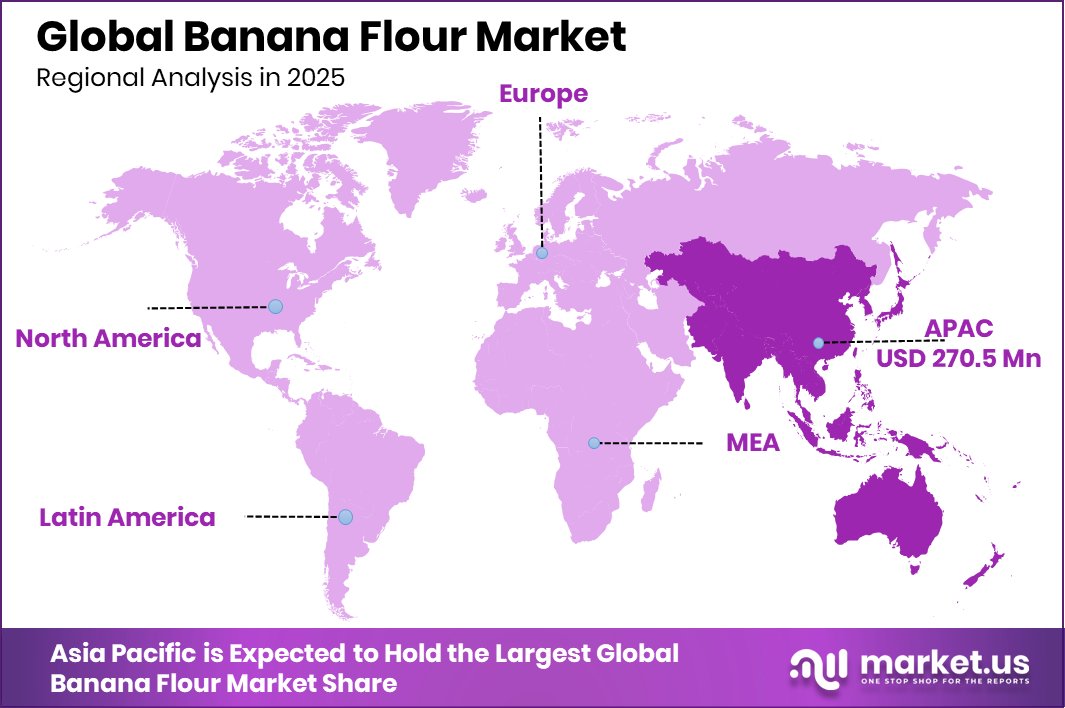
The Global Banana Flour Market is expected to be worth around USD 1,259.4 million by 2035, up from USD 745.4 million in 2025. It is projected to grow at a CAGR of 5.4% from 2026 to 2035. Asia Pacific generated 36.3% revenue share, equivalent to USD 270.5 Mn banana flour.
Banana flour is a fine powder made from raw green or ripe bananas that are peeled, dried, and milled into flour form. It is widely valued for its natural starch content, gluten-free nature, mild taste, and easy blending properties. Depending on the process used—such as sun-dried, freeze-dried, or spray-dried—it can serve different industrial and food formulation needs. Its use extends from food and beverage processing to pharmaceutical, water treatment, air purification, and other specialty applications because of its absorbent and binding characteristics.
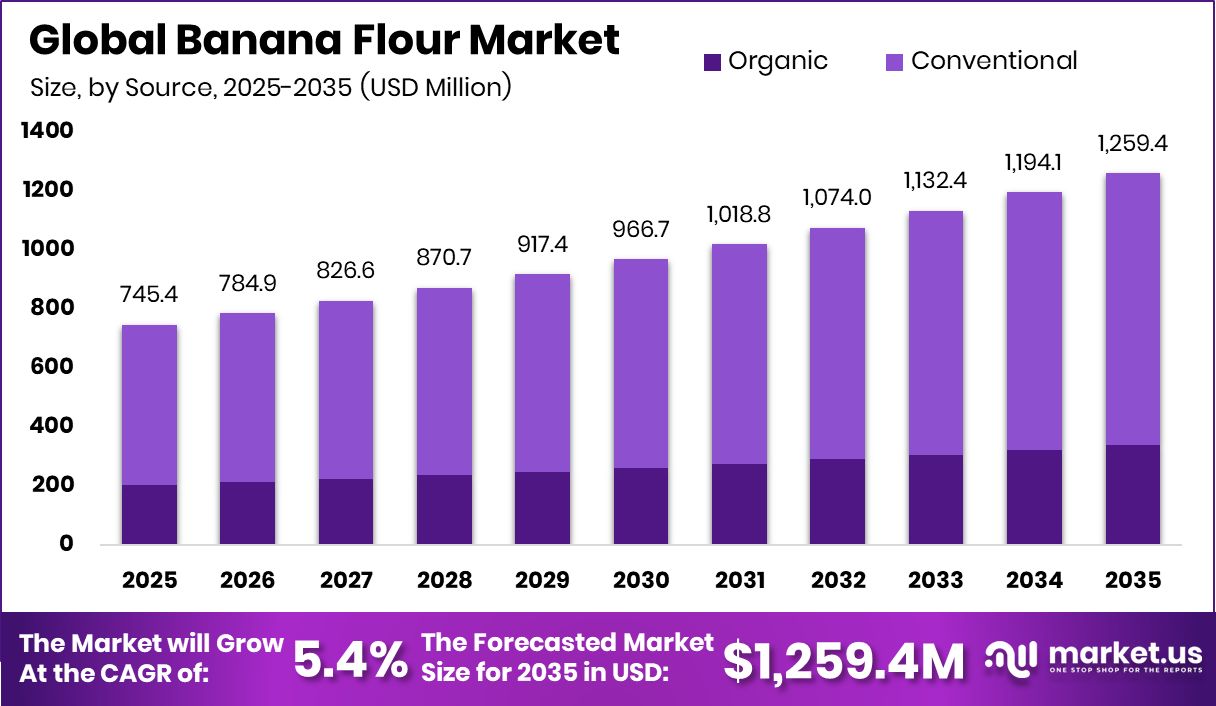
The Banana Flour Market refers to the global trade, production, processing, and sales ecosystem built around banana-derived flour across source, process, end-user, and sales channel segments. The market includes organic and conventional raw material sourcing, multiple drying technologies, and distribution through modern trade, specialty stores, convenience outlets, and e-retailers. Its expansion is supported by increasing use in industrial formulations and specialty ingredient demand.
A key growth factor is the rising demand for multifunctional plant-based powders that support binding, thickening, filtration support, and natural formulation requirements. Wider process flexibility across sun-dried, freeze-dried, and spray-dried formats also improves application suitability across industries.
Demand is growing from food and beverage processing, pharmaceutical, medical, automotive, air purification, and especially water treatment uses, where natural starch-based materials are increasingly explored in filtration and absorbent systems.
A major opportunity area comes from infrastructure and water investment momentum, including Graham’s $3M drinking water grant, Winter Springs’ $65.8M new water treatment plant approval, India’s $250B water investment pipeline, and Membrane Group’s $50 million global water treatment expansion funding. These developments create strong long-term potential for banana flour-based natural treatment and specialty industrial applications.
- In February 2025, Divine Foods continued expanding its native flour and fruit-based wellness range, supported by visible cross-category products such as jackfruit flour and banana powder. In simple words, the company is building a stronger traditional flour platform for health-focused consumers, which supports banana flour growth through wider native ingredient visibility and consumer trust.
Key Takeaways
- The Global Banana Flour Market is expected to be worth around USD 1,259.4 million by 2035, up from USD 745.4 million in 2025. It is projected to grow at a CAGR of 5.4% from 2026 to 2035.
- In the banana flour market, conventional sources dominate demand, accounting for 73.2% share across applications worldwide.
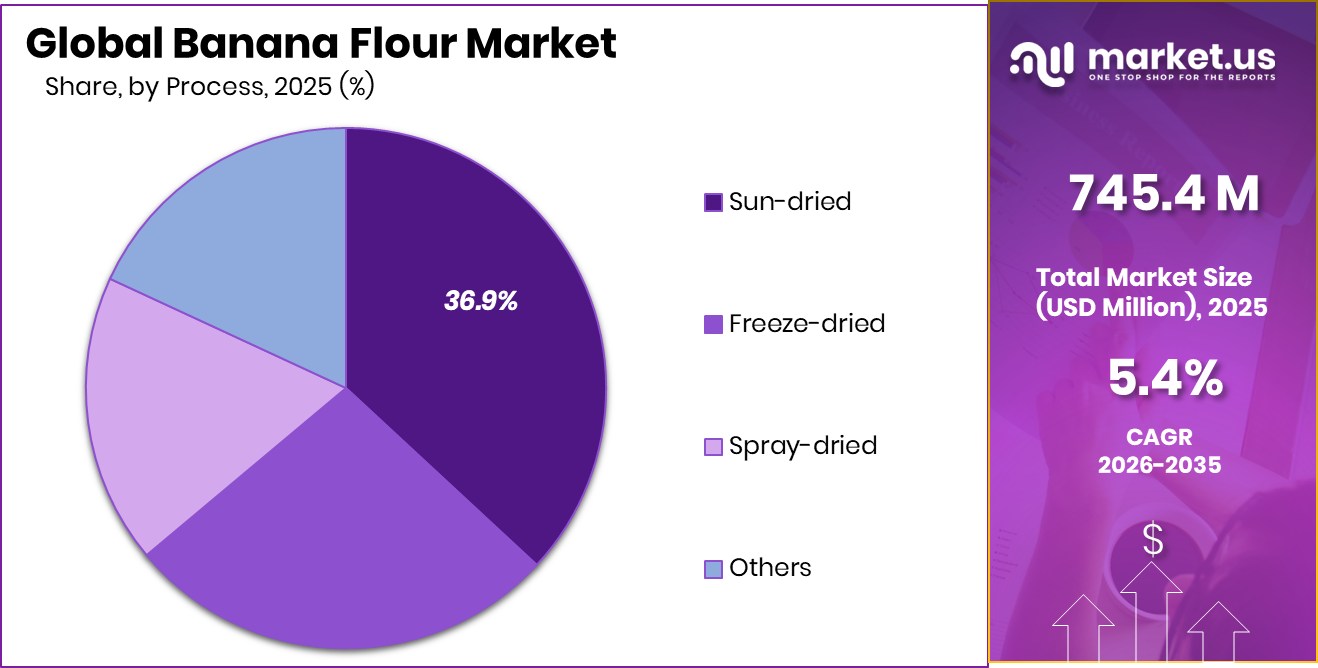
- Within the banana flour market, sun-dried processing leads with 36.9% preference among manufacturers seeking natural quality.
- The banana flour market sees food and beverage processing as the largest end-user, contributing 43.8% overall demand.
- In the banana flour market, modern trade channels capture 32.5%, reflecting strong organized retail expansion globally.
- In the Asia Pacific, banana flour sales totaled USD 270.5 Mn with a 36.3% share.
By Source Analysis
Banana Flour Market source favors conventional products, commanding a dominant 73.2% share globally.
In 2025, the Banana Flour Market by source is led by the conventional segment, accounting for 73.2% of the total share, reflecting its strong commercial dominance across global supply chains. Conventional banana cultivation remains widely preferred because it offers higher yield consistency, easier farm management, and lower production costs compared to specialty or organic alternatives.
Large-scale food manufacturers continue to depend on conventionally sourced banana flour for bakery mixes, snacks, infant foods, and gluten-free formulations due to its steady availability and competitive pricing. The segment’s strength is also supported by expanding cultivation areas in major banana-producing countries, where farmers prioritize output efficiency. Growing industrial demand for starch-rich ingredients in processed foods further reinforces conventional sourcing as the most practical and scalable foundation of the banana flour industry.
By Process Analysis
Banana Flour Market sun-dried process leads with 36.9% share across applications worldwide.
In 2025, the sun-dried segment holds 36.9% of the Banana Flour Market by process, highlighting its importance as a preferred traditional and cost-effective production method. Sun drying remains popular among processors because it reduces energy consumption and preserves the natural characteristics of bananas without requiring sophisticated machinery. This method is especially common in tropical producing regions where climatic conditions support efficient natural dehydration throughout the year.
Manufacturers favor sun-dried banana flour for applications that value mild flavor retention, natural color, and lower processing costs, particularly in bakery, snack, and household food products. Rising interest in minimally processed ingredients also supports this segment’s growth, as consumers increasingly associate traditional drying techniques with authenticity and clean-label appeal. Its affordability keeps it highly relevant for both local and export markets.
By End-user Analysis
Banana Flour Market food and beverage processing end-users hold 43.8% globally today.
In 2025, food and beverage processing dominates the Banana Flour Market by end-user with a 43.8% share, driven by the ingredient’s expanding role in diverse product formulations. Banana flour is increasingly used in bakery products, baby food, smoothies, instant mixes, pasta, and functional snacks due to its gluten-free nature, resistant starch content, and natural binding properties.
Food manufacturers are incorporating it to improve texture, enhance nutritional value, and meet rising demand for clean-label and plant-based ingredients. The segment is further strengthened by consumer preference for healthier alternatives to wheat flour, especially in digestive wellness and low-glycemic food categories. Beverage companies are also exploring banana flour in powdered nutrition drinks and meal replacements. Its versatility across mainstream and specialty food innovation makes this end-user segment the primary revenue contributor.
By Sales Channel Analysis
Banana Flour Market’s modern trade sales channel captures 32.5% overall worldwide currently.
In 2025, modern trade accounts for 32.5% of the Banana Flour Market by sales channel, reflecting the growing importance of supermarkets, hypermarkets, and organized retail chains in product distribution. Modern trade channels give consumers easier access to branded banana flour products, multiple packaging sizes, and value-added variants such as organic, gluten-free, and fortified options. Strong shelf visibility, in-store promotions, and growing urban consumer preference for one-stop shopping continue to support this segment’s expansion.
Retailers are increasingly dedicating shelf space to specialty flours and health-focused ingredients, helping banana flour gain stronger mainstream recognition. The rise of premium food aisles and health sections within major stores also boosts product trials and repeat purchases. This channel remains especially influential in urban markets where convenience, product comparison, and trusted branding drive buying decisions.
Key Market Segments
By Source
- Organic
- Conventional
By Process
- Sun-dried
- Freeze-dried
- Spray-dried
- Others
By End-user
- Water Treatment
- Food and Beverage Processing
- Pharmaceutical and Medical
- Automotive
- Air Purification
- Others
By Sales Channel
- Modern Trade
- Convenience Store
- Specialty Store
- E-Retailers
- Others
Driving Factors
Rising gluten-free food ingredient demand globally
The Banana Flour Market is strongly supported by rising global demand for gluten-free food ingredients, as consumers increasingly prefer wheat alternatives in bakery, snacks, baby food, and health-focused formulations. Banana flour benefits from its natural gluten-free composition, mild flavor, and easy blending across processed foods.
A strong financial signal supporting this expansion is Shore Capital Partners’ closing of over $450 million for Food & Beverage Fund III while promoting three partners, reflecting growing institutional confidence in scalable food ingredient platforms. This funding momentum strengthens manufacturing expansion, product innovation, and distribution capabilities across alternative flour categories. As food brands continue reformulating products toward allergen-friendly and digestive wellness positioning, banana flour is expected to gain stronger traction across mainstream packaged food and specialty nutrition applications worldwide.
Expanding the usage of resistant starch functional food
The growing use of resistant starch in functional foods is another major driver for the Banana Flour Market, particularly as food processors seek ingredients that support digestive wellness, satiety, and low-glycemic formulations. Green banana flour is naturally rich in resistant starch, making it suitable for cereals, smoothies, bakery products, and meal replacements. Supportive industry momentum is visible through Ontario’s $24 million investment in agri-food manufacturing, which strengthens processing infrastructure and innovation in advanced food ingredient production.
Such investments encourage wider development of value-added flour ingredients that align with health-focused consumer demand. As nutrition-led product development expands across global markets, banana flour is increasingly positioned as a practical starch-rich ingredient that delivers both functionality and clean-label appeal in modern food processing.
Restraining Factors
Raw banana supply price volatility
A key challenge for the Banana Flour Market remains raw banana supply price volatility, which directly affects production costs, margin stability, and long-term contract pricing for processors. Seasonal crop fluctuations, climate variability, and sourcing dependency in banana-producing regions can create uneven raw material costs. However, supply chain resilience efforts are improving through public support, such as MDARD awarding over $3.1 million through the Resilient Food System Infrastructure Program. This type of funding helps strengthen storage, logistics, and agricultural processing systems, which may gradually reduce sourcing disruptions.
Even so, price instability continues to restrain consistent market expansion, especially for smaller processors dependent on conventional supply networks. Maintaining steady access to green banana inputs remains critical for ensuring production continuity and predictable pricing in flour manufacturing operations.
Limited consumer awareness in emerging markets
Limited consumer awareness across emerging markets continues to restrict faster adoption in the Banana Flour Market, especially in regions where wheat, rice, and maize flour remain dominant staples. Many consumers are still unfamiliar with banana flour’s gluten-free benefits, resistant starch profile, and use in bakery or nutritional products. Awareness-building initiatives are becoming more possible with sector support, such as WA food and beverage businesses receiving a $680k funding share, which can strengthen regional product education, branding, and retail visibility.
Despite such support, slow familiarity in developing consumer markets remains a barrier to widespread retail penetration. Expanding educational campaigns, recipe-based marketing, and specialty health product placement will be essential to improve recognition and unlock stronger category adoption in these regions.
Growth Opportunity
Expansion in clean-label bakery applications
A major growth opportunity in the Banana Flour Market lies in expanding clean-label bakery applications, where food brands increasingly seek simple, plant-based, and recognizable ingredients. Banana flour works well in breads, muffins, cookies, pancake mixes, and gluten-free baking blends due to its starch functionality and natural origin. Additional momentum comes from South Carolina considering $85 million in state-funded incentives for an unnamed food and beverage packager, highlighting broader investment in advanced food manufacturing capabilities.
Such infrastructure support can accelerate production scale-up for clean-label baked goods using alternative flours. As consumers continue moving toward transparent ingredient lists and wellness-driven bakery products, banana flour has strong potential to expand into premium, allergen-friendly, and fiber-rich baked food categories.
Rising e-retail penetration for specialty flours
The rise of e-retail platforms presents a strong growth opportunity for the Banana Flour Market, particularly for specialty, gluten-free, and organic flour products that benefit from direct-to-consumer visibility. Online channels allow brands to reach niche health-focused buyers, improve product education, and offer wider pack-size flexibility. A supportive agricultural ecosystem is strengthened by Canada and Ontario investing $20 million to protect local farmers and agribusinesses, which helps secure raw material continuity and supports value-added processing growth.
As digital grocery platforms continue expanding, banana flour can gain faster household penetration through subscription models, health marketplaces, and recipe-driven online marketing. E-retail also improves access in regions where physical specialty stores remain limited, making it a major long-term channel expansion opportunity.
Latest Trends
Increasing adoption of organic banana flour
A leading trend in the Banana Flour Market is the increasing adoption of organic banana flour, driven by stronger consumer preference for chemical-free, sustainably sourced, and premium wellness ingredients. Organic variants are gaining visibility across health stores, modern trade, and online clean-label product ranges.
Premium food category momentum is reinforced by OLIPOP’s valuation reaching $1.85 billion following its Series C funding, signaling continued investor confidence in health-oriented packaged food innovation. This broader movement toward premium natural foods supports organic banana flour adoption across bakery, baby food, and nutritional mixes. As consumers increasingly associate organic ingredients with digestive wellness and ingredient transparency, this trend is expected to strengthen premium positioning and pricing opportunities.
Growth in freeze-dried premium formulations
The growth of freeze-dried premium formulations is emerging as an important trend in the Banana Flour Market, especially in high-value nutrition, infant food, and specialty beverage mixes. Freeze-dried processing supports better nutrient retention, lighter texture, and premium product positioning compared to conventional drying.
A broader innovation push in food intelligence is reflected in Tastewise raising $50 million to power the intelligence engine behind Kraft, Mars, and Campbell’s, highlighting the importance of faster product trend alignment and premium ingredient development. This trend supports banana flour innovation in performance-focused formulations where texture, nutrition, and shelf-life are key buying factors. Freeze-dried banana flour is therefore becoming increasingly relevant in premium and export-oriented product categories.
Regional Analysis
Asia Pacific captured 36.3% market share, reaching USD 270.5 Mn in 2025 value.
In 2025, the Banana Flour Market demonstrated a well-established regional presence across North America, Europe, Asia Pacific, the Middle East & Africa, and Latin America, with demand patterns shaped by food processing expansion, rising gluten-free product adoption, and increasing use of alternative flours in health-focused applications.
Among all regions, Asia Pacific emerged as the dominating region, accounting for 36.3% of the global market and reaching a value of USD 270.5 Mn, supported by its strong banana cultivation base, cost-efficient raw material availability, and widespread use of banana-derived ingredients in mainstream food manufacturing. The region’s leadership is further reinforced by its large consumer base and the presence of major banana-producing economies that support stable supply chains for flour processors.
Meanwhile, North America and Europe continue to represent important markets driven by growing interest in clean-label and specialty flour formulations, while Latin America and the Middle East & Africa maintain steady participation due to expanding processed food demand. Overall, Asia Pacific remains the core revenue-generating regional segment, setting the pace for market expansion with its leading 36.3% share and USD 270.5 Mn valuation.
Key Regions and Countries
- North America
- US
- Canada
- Europe
- Germany
- France
- The UK
- Spain
- Italy
- Rest of Europe
- Asia Pacific
- China
- Japan
- South Korea
- India
- Australia
- Rest of APAC
- Latin America
- Brazil
- Mexico
- Rest of Latin America
- Middle East & Africa
- GCC
- South Africa
- Rest of MEA
Key Players Analysis
In 2025, the competitive positioning of the global Banana Flour Market reflects a focused mix of specialty food ingredient participants, with Pereg Gourmet Spices standing out through its strong alignment with premium packaged food and specialty pantry categories. From an analyst’s viewpoint, the company’s presence within value-added flour and niche health-food shelves supports strong brand visibility among consumers seeking alternative baking and gluten-free ingredients. Its strength lies in product presentation, retail adaptability, and the ability to serve quality-conscious buyers through branded offerings that fit modern cooking and wellness trends.
Dr. Food Banatone represents a more function-driven player perspective, with its identity closely associated with banana-based nutritional and food ingredient applications. The company appears strategically positioned to address demand from health-oriented consumption segments where banana flour is valued for digestive benefits, resistant starch content, and natural formulation advantages. Its focused category relevance gives it a differentiated role, particularly in nutrition-led product lines and specialized food uses requiring banana-derived flour consistency.
Seawind Foods adds competitive depth through its food ingredient orientation and likely strength in supply-linked product distribution. From an analyst standpoint, the company contributes to market competitiveness through dependable banana flour availability, processing support, and alignment with broader food manufacturing requirements. Its role appears especially relevant in serving industrial and bulk ingredient demand, where reliability and product continuity remain critical.
Top Key Players in the Market
- Pereg Gourmet Spices
- Dr. Food Banatone
- Seawind Foods
- Woodland Foods
- Divine Foods
- APKA Industries
- Miski Organics
- Saipro Biotech Private Limited
- LiveKuna
- Diana Foods
- Synergy Food Industries
Recent Developments
- In March 2025, Woodland (now Woodland Gourmet) acquired Sevillo Fine Foods, a company known for ready-to-eat frozen vegetables, spreads, and culinary ingredients. This move shows Woodland is building a broader ingredient platform around chef-inspired and plant-based solutions. For banana flour, this strengthens cross-category formulation opportunities in baking, coatings, mixes, and prepared foods.
- In January 2025, Seawind Foods’ monthly product and seasonal ingredient updates through its “Grounded” newsletter indicate ongoing new ingredient commercialization and customer-specific food formulation support. This is an important development because the company works closely with processors on innovative dried fruit ingredients, making banana flour and related banana powders a natural extension of its fruit solutions business.
Report Scope
Report Features Description Market Value (2025) USD 745.4 Billion Forecast Revenue (2035) USD 1,259.4 Billion CAGR (2026-2035) 5.4% Base Year for Estimation 2025 Historic Period 2020-2024 Forecast Period 2026-2035 Report Coverage Revenue Forecast, Market Dynamics, Competitive Landscape, Recent Developments Segments Covered By Source (Organic, Conventional), By Process (Sun-dried, Freeze-dried, Spray-dried, Others), By End-user (Water Treatment, Food and Beverage Processing, Pharmaceutical and Medical, Automotive, Air Purification, Others), By Sales Channel (Modern Trade, Convenience Store, Specialty Store, E-Retailers, Others) Regional Analysis North America – US, Canada; Europe – Germany, France, The UK, Spain, Italy, Rest of Europe; Asia Pacific – China, Japan, South Korea, India, Australia, Singapore, Rest of APAC; Latin America – Brazil, Mexico, Rest of Latin America; Middle East & Africa – GCC, South Africa, Rest of MEA Competitive Landscape Pereg Gourmet Spices, Dr. Food Banatone, Seawind Foods, Woodland Foods, Divine Foods, APKA Industries, Miski Organics, Saipro Biotech Private Limited, LiveKuna, Diana Foods, Synergy Food Industries Customization Scope Customization for segments, region/country-level will be provided. Moreover, additional customization can be done based on the requirements. Purchase Options We have three licenses to opt for: Single User License, Multi-User License (Up to 5 Users), Corporate Use License (Unlimited User and Printable PDF) 
-
-
- Pereg Gourmet Spices
- Dr. Food Banatone
- Seawind Foods
- Woodland Foods
- Divine Foods
- APKA Industries
- Miski Organics
- Saipro Biotech Private Limited
- LiveKuna
- Diana Foods
- Synergy Food Industries
Our Clients

- 182947
- March 2026






