


Global Animal Feed Micronutrient Market Size, Share, And Enhanced Productivity By Nutrient Type (Trace Minerals, Vitamins, Amino Acids, Enzymes, Others), By Form (Dry/Premix, Liquid, Others), By Livestock (Poultry, Ruminants, Swine, Aquaculture, Equine, Others), By Region and Companies - Industry Segment Outlook, Market Assessment, Competition Scenario, Trends, and Forecast 2025-2034
- Published date: March 2026
- Report ID: 181567
- Number of Pages: 394
- Format:
-
keyboard_arrow_up
Quick Navigation
Report Overview
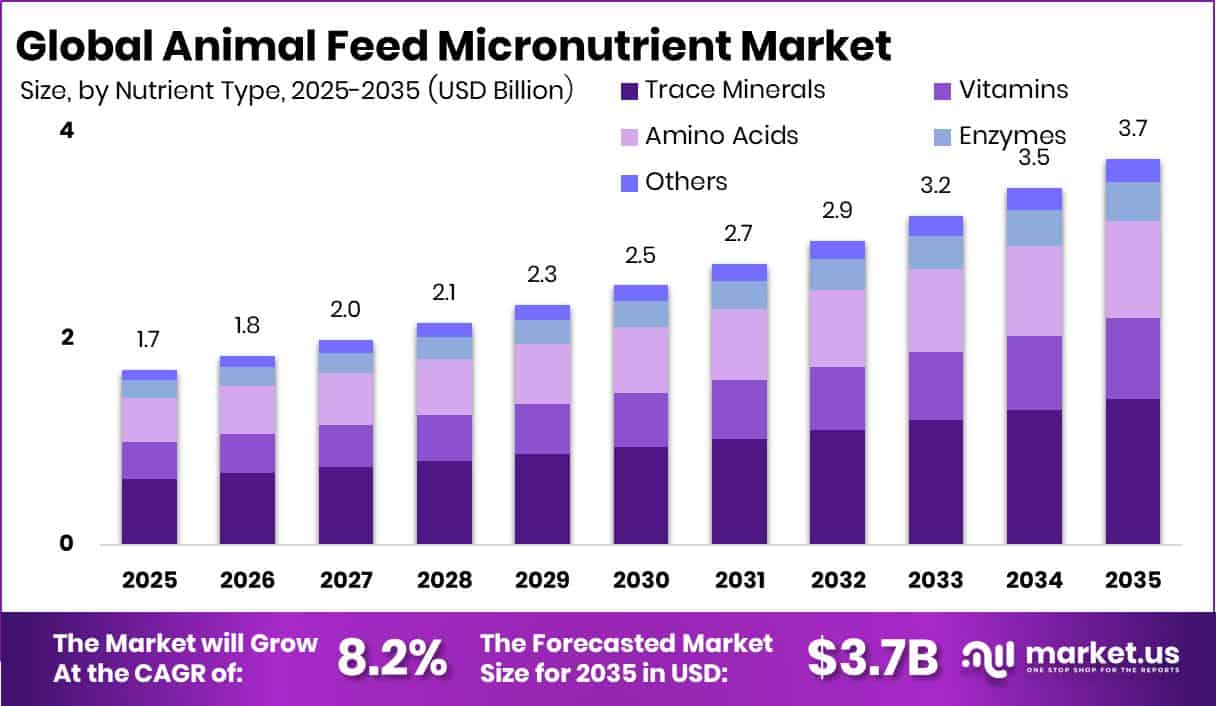
The Global Animal Feed Micronutrient Market is expected to be worth around USD 3.7 billion by 2034, up from USD 1.7 billion in 2024, and is projected to grow at a CAGR of 8.2% from 2025 to 2034. The animal feed micronutrient market in the Asia Pacific accounts for 42.7%, totaling USD 0.7 Bn.
The animal feed micronutrient market is structured across key segments, including nutrient type, form, and livestock. By nutrient type, it covers trace minerals, vitamins, amino acids, enzymes, and others, each supporting specific biological functions in animals. By form, the market is divided into dry or premix, liquid, and other delivery formats, offering flexibility in feed production and application. Livestock includes poultry, ruminants, swine, aquaculture, equine, and others, reflecting diverse nutritional requirements across species and production systems.
Animal feed micronutrients refer to essential nutrients required in small quantities that support growth, immunity, reproduction, and metabolic functions in animals. These include minerals, vitamins, and other functional additives that enhance feed efficiency and animal health. The animal feed micronutrient market involves the production, distribution, and use of these nutrients within commercial and small-scale livestock farming, aiming to improve productivity and overall animal performance.
Growth in this market is driven by increasing focus on animal health and productivity, alongside rising concerns about food quality and safety. Investments such as the UK providing £8 million to tackle child malnutrition in Afghanistan and MDARD awarding nearly $300K in grants for food safety education highlight broader efforts toward improving nutrition systems, indirectly supporting advancements in feed quality and standards.
Demand is supported by the need for efficient livestock production and improved feed utilization. Technological and financial developments, including MGA Thermal securing AU$3.25 million for energy-related studies and BinSentry raising $68.8 million CAD for remote feed monitoring, reflect the growing integration of innovation in feed management and supply systems.
Opportunities are emerging through innovation and investment in nutrition science. For instance, Aviwell raising EUR 11 million for microbiota-based solutions indicates a shift toward advanced nutritional approaches. These developments create pathways for more precise, sustainable, and effective micronutrient applications across the global livestock sector.
Key Takeaways
- The Global Animal Feed Micronutrient Market is expected to be worth around USD 3.7 billion by 2034, up from USD 1.7 billion in 2024, and is projected to grow at a CAGR of 8.2% from 2025 to 2034.
- In the Animal Feed Micronutrient Market, trace minerals account for 37.8% share globally overall total.
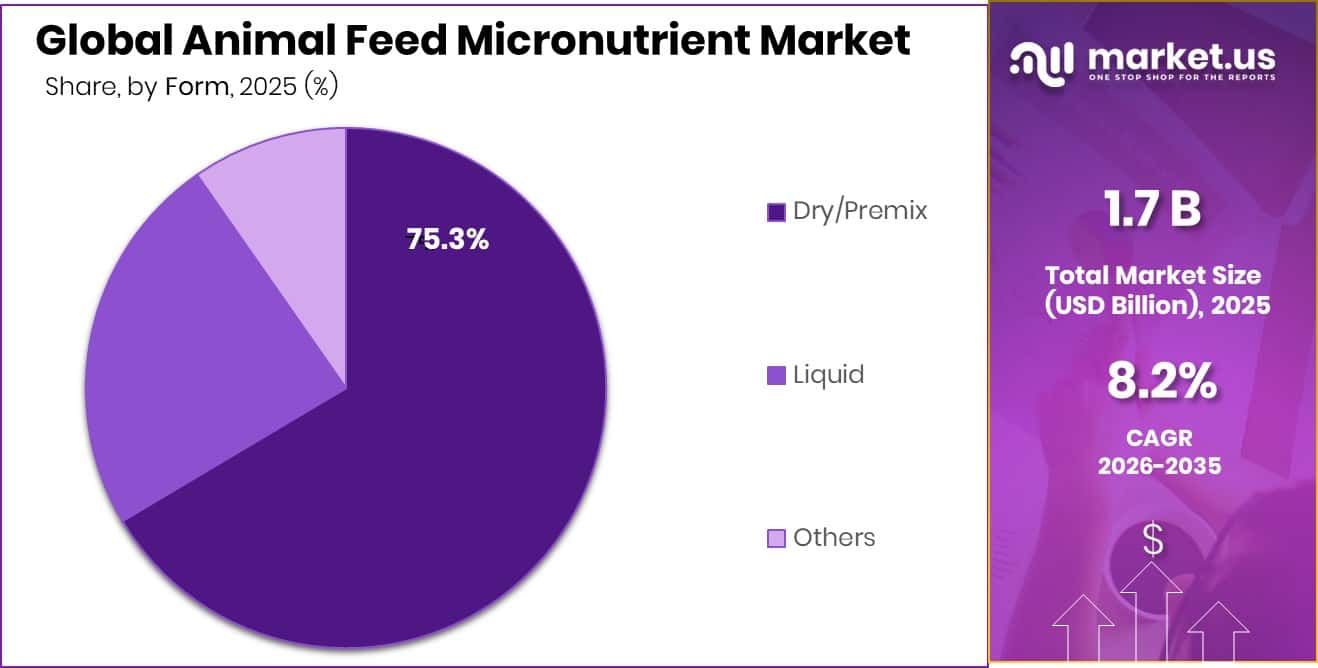
- Dry premix forms dominate the Animal Feed Micronutrient Market, contributing 75.3% share globally across applications.
- The poultry segment leads the Animal Feed Micronutrient Market, representing 41.6% of the total livestock-based demand worldwide.
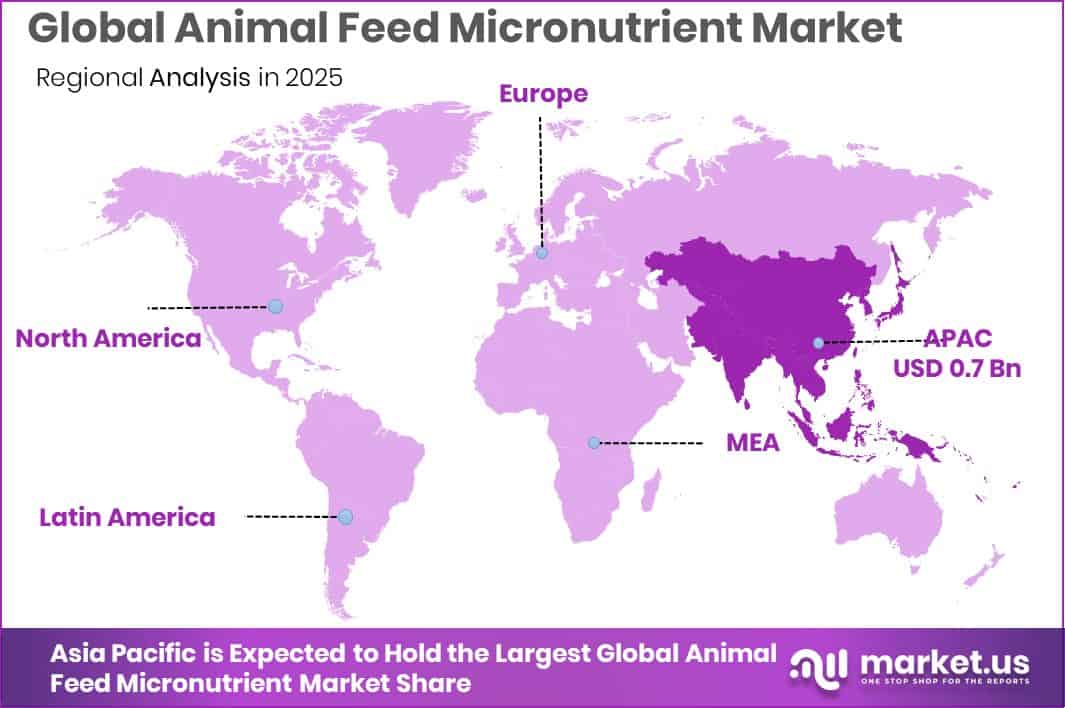
- The Asia Pacific region dominates with 42.7% share, reaching a USD 0.7 Bn market value.
By Nutrient Type Analysis
The Animal Feed Micronutrient Market shows the Trace Minerals segment holding a 37.8% share globally.
In 2025, the animal feed micronutrient market shows a strong segmentation by nutrient type, with trace minerals accounting for 37.8% of total demand. These micronutrients, including zinc, iron, copper, and selenium, play a critical role in improving animal immunity, reproduction, and overall productivity. Increasing awareness among livestock producers about the importance of balanced nutrition is driving the adoption of trace mineral-enriched feed.
Additionally, the rise in intensive farming practices has heightened the need for precise nutrient supplementation to prevent deficiencies. Regulatory support for animal health and food safety further boosts the demand for high-quality micronutrient formulations, positioning trace minerals as a dominant and essential component in modern feed strategies.
By Form Analysis
In the Animal Feed Micronutrient Market, the dry premix form dominates with 75.3% share.
In 2025, the market is largely dominated by the dry or premix form segment, which holds 75.3% of the total share. This dominance is attributed to the convenience, longer shelf life, and ease of transportation associated with dry formulations. Premixes allow for uniform distribution of micronutrients in feed, ensuring consistent intake across livestock populations. Feed manufacturers prefer premix solutions as they simplify the production process and reduce the risk of dosage errors.
Moreover, advancements in blending technologies have enhanced the stability and bioavailability of nutrients in dry form. As commercial feed production continues to expand globally, the demand for standardized, efficient, and cost-effective premix solutions remains a key growth driver in the market.
By Livestock Analysis
Poultry livestock leads the Animal Feed Micronutrient Market, contributing 41.6% overall demand globally.
In 2025, poultry emerges as the leading livestock segment in the animal feed micronutrient market, contributing 41.6% of the overall demand. The rapid growth of the poultry industry, driven by rising global consumption of eggs and chicken meat, significantly fuels this segment. Poultry requires precise micronutrient supplementation to support fast growth rates, improve feed conversion ratios, and enhance disease resistance.
Producers are increasingly investing in fortified feed to maintain productivity and meet consumer expectations for quality protein. Additionally, the shorter production cycles in poultry farming necessitate efficient nutrition management, further increasing reliance on micronutrient-rich feed solutions. This trend solidifies poultry as a major contributor to market expansion.
Key Market Segments
By Nutrient Type
- Trace Minerals
- Vitamins
- Amino Acids
- Enzymes
- Others
By Form
- Dry/Premix
- Liquid
- Others
By Livestock
- Poultry
- Ruminants
- Swine
- Aquaculture
- Equine
- Others
Driving Factors
Rising demand for high-quality animal protein
The Animal Feed Micronutrient Market is strongly influenced by the growing global demand for high-quality animal protein, including meat, milk, eggs, and fish. As populations expand and dietary preferences shift toward protein-rich foods, livestock producers are focusing on improving productivity and feed efficiency through micronutrient-enriched formulations. This shift is particularly visible in aquaculture and poultry sectors, where balanced nutrition directly impacts output quality.
Supporting this momentum, Aqua-Spark has closed its Africa fund with USD 48 million in investments, highlighting increased financial attention toward sustainable protein production. Such developments reflect the need for advanced feed solutions, where micronutrients play a vital role in enhancing animal growth, health, and overall production efficiency.
Increased focus on livestock health and nutrition
A growing emphasis on animal health and preventive nutrition is driving the adoption of micronutrients in feed across various livestock segments. Producers are increasingly recognizing that proper micronutrient intake supports immunity, reduces disease risks, and improves reproductive performance. This shift aligns with evolving farming practices that prioritize long-term productivity and animal welfare.
Financial support, such as the £10.8 million export funding received by a Canadian aquaculture supplier, highlights efforts to strengthen nutrition-focused supply chains. Within the Animal Feed Micronutrient Market, such initiatives contribute to the expansion of scientifically formulated feed solutions, ensuring animals receive balanced diets that enhance performance while meeting quality expectations in global food systems.
Restraining Factors
High cost of micronutrient feed additives
The high cost associated with micronutrient feed additives remains a significant restraint in the Animal Feed Micronutrient Market, particularly for small and medium-scale farmers. Premium ingredients, advanced formulations, and quality control processes often increase the overall cost of feed, limiting widespread adoption in cost-sensitive regions. While micronutrients improve efficiency and animal health, the initial investment can be a barrier for many producers.
At the same time, research initiatives such as the University of Stirling receiving a £1.4 million grant for salmon health studies indicate ongoing efforts to improve feed effectiveness and cost efficiency. However, balancing affordability with performance continues to challenge the market, especially in regions with limited financial resources.
Limited awareness in developing farming regions
Limited awareness regarding the benefits of micronutrient supplementation in animal feed continues to restrict market growth in several developing regions. Many small-scale farmers still rely on traditional feeding practices, often overlooking the role of micronutrients in improving animal productivity and disease resistance. This knowledge gap reduces adoption rates and slows the transition toward optimized nutrition systems.
However, large-scale initiatives such as the Fisheries Ministry seeking $1.6 billion from Danantara for coastal aquaculture revitalization indicate growing attention toward improving farming practices. Despite such efforts, the Animal Feed Micronutrient Market still faces challenges in educating farmers and building trust in advanced nutritional solutions.
Growth Opportunity
Advancements in precision animal nutrition technologies
Technological advancements in precision nutrition present strong growth opportunities within the Animal Feed Micronutrient Market. Modern tools enable more accurate formulation and delivery of micronutrients based on species, lifecycle stage, and environmental conditions. These innovations help optimize feed efficiency, reduce waste, and improve animal health outcomes.
Public investments, such as Galicia allocating €59.5 million in grants to boost aquaculture, reflect increasing support for advanced and sustainable farming practices. As precision nutrition continues to evolve, it opens new possibilities for customized micronutrient solutions, allowing producers to enhance productivity while maintaining resource efficiency across livestock and aquaculture operations.
Expanding the aquaculture and poultry farming sectors
The rapid expansion of aquaculture and poultry farming is creating significant opportunities for the Animal Feed Micronutrient Market. These sectors require highly controlled and nutrient-rich feed to support fast growth cycles and maintain health standards. As production intensifies, the demand for specialized micronutrient formulations continues to rise.
Investment activity such as Remora Robotics raising USD 16 million, highlights increasing innovation and interest in aquaculture technologies. This growth supports the adoption of improved feeding strategies, where micronutrients play a key role in ensuring optimal performance, feed conversion, and product quality across high-demand protein production systems.
Latest Trends
Adoption of sustainable and eco-friendly feed
Sustainability is becoming a central trend in the Animal Feed Micronutrient Market, with increasing focus on eco-friendly feed solutions that reduce environmental impact. Producers are exploring formulations that improve nutrient absorption while minimizing waste and emissions. This shift is driven by the need to balance productivity with environmental responsibility.
Data indicating that feral swine cost U.S. agriculture $1.6 billion annually highlights the broader economic and environmental pressures on agricultural systems. As a result, there is growing interest in micronutrient solutions that support efficient digestion and reduce resource loss, aligning feed practices with sustainable agriculture goals.
Integration of digital feed monitoring solutions
The integration of digital technologies into feed management is an emerging trend shaping the Animal Feed Micronutrient Market. Smart monitoring systems allow real-time tracking of feed intake, nutrient levels, and animal performance, enabling more precise micronutrient usage. These tools help producers make data-driven decisions, improving efficiency and reducing waste.
Innovation in the sector is supported by developments such as Chinese cellular pork producer Joe’s Future raising $11 million in Series A funding, reflecting broader technological advancements in food production. As digital solutions become more accessible, they are expected to enhance feed optimization and strengthen the role of micronutrients in modern livestock systems.
Regional Analysis
In 2025, the Asia Pacific animal feed micronutrient market holds 42.7%, valued at USD 0.7 Bn.
In 2025, the global animal feed micronutrient market demonstrates varied regional dynamics across North America, Europe, Asia Pacific, the Middle East & Africa, and Latin America, shaped by differences in livestock production, feed practices, and nutritional awareness.
Asia Pacific emerges as the dominant region, accounting for 42.7% of the market and valued at USD 0.7 Bn, driven by its large-scale poultry and livestock industries and increasing demand for high-quality feed solutions. The region benefits from expanding commercial farming and a growing focus on improving animal productivity through micronutrient supplementation.
North America and Europe represent mature markets, characterized by established feed industries and consistent demand for advanced micronutrient formulations. Meanwhile, the Middle East & Africa and Latin America show gradual growth, supported by improving agricultural practices and rising awareness of balanced animal nutrition.
Across all regions, the market is influenced by the need to enhance feed efficiency, support animal health, and meet evolving consumption patterns, reinforcing steady demand for micronutrient-enriched feed solutions globally.
Key Regions and Countries
- North America
- US
- Canada
- Europe
- Germany
- France
- The UK
- Spain
- Italy
- Rest of Europe
- Asia Pacific
- China
- Japan
- South Korea
- India
- Australia
- Rest of APAC
- Latin America
- Brazil
- Mexico
- Rest of Latin America
- Middle East & Africa
- GCC
- South Africa
- Rest of MEA
Key Players Analysis
In 2025, Cargill, Incorporated, continues to demonstrate strong positioning in the animal feed micronutrient market through its integrated approach to nutrition solutions. The company leverages its extensive supply chain capabilities and global reach to deliver consistent, high-quality micronutrient offerings. Its focus on tailored feed solutions enables it to address diverse livestock requirements, supporting productivity and health outcomes. Cargill’s operational scale and emphasis on innovation contribute to its ability to adapt to evolving feed formulation needs across different regions.
ADM maintains a competitive edge by combining its deep expertise in agricultural processing with advanced feed ingredient development. The company’s structured approach to micronutrient integration supports efficient feed production and consistent nutrient delivery. ADM’s portfolio reflects a balance between functionality and scalability, allowing it to cater to both large commercial operations and emerging markets. Its continued focus on precision nutrition strengthens its role in supporting optimized animal performance.
DSM-Firmenich stands out for its science-driven approach to micronutrient development, emphasizing quality and effectiveness. The company prioritizes innovation in nutrient formulation to enhance bioavailability and stability in feed applications. Its commitment to sustainable and efficient nutrition solutions aligns with the evolving expectations of livestock producers. DSM-Firmenich’s strong technical capabilities reinforce its influence in shaping advanced micronutrient strategies globally.
Top Key Players in the Market
- Cargill, Incorporated
- ADM
- DSM-Firmenich
- BASF SE
- Nutreco N.V.
- Alltech, Inc.
- Evonik Industries AG
- Adisseo
- Kemin Industries, Inc.
- Zinpro Corporation
Recent Developments
- In February 2024, DSM-Firmenich, which works in animal nutrition, vitamins, and feed additives, announced in February 2024 that it will separate its Animal Nutrition & Health (ANH) business. This step was taken to focus more on its core nutrition and health segments while restructuring its feed business. This move also prepared the unit for a possible sale or independent operation in the future.
- In September 2025, ADM, which works in animal nutrition and feed ingredient solutions, launched a new product called Digest Carb in September 2025. This feed solution helps dairy animals improve nutrient use, digestion, and milk production. It works by improving how animals break down fiber, starch, and sugars in feed. The product was introduced at the SPACE 2025 event in France and is aimed at improving feed efficiency and animal performance.
- In November 2025, Cargill expanded its micronutrition production facility in Austria, increasing capacity by 50%. The plant can now produce around 30,000 metric tons annually, supporting global demand for micronutrient feed solutions. This expansion helps Cargill meet rising demand for advanced animal nutrition and improve production efficiency and sustainability.
Report Scope
Report Features Description Market Value (2025) USD 1.7 Billion Forecast Revenue (2035) USD 3.7 Billion CAGR (2026-2035) 8.2% Base Year for Estimation 2025 Historic Period 2020-2024 Forecast Period 2026-2035 Report Coverage Revenue Forecast, Market Dynamics, Competitive Landscape, Recent Developments Segments Covered By Nutrient Type (Trace Minerals, Vitamins, Amino Acids, Enzymes, Others), By Form (Dry/Premix, Liquid, Others), By Livestock (Poultry, Ruminants, Swine, Aquaculture, Equine, Others) Regional Analysis North America – US, Canada; Europe – Germany, France, The UK, Spain, Italy, Rest of Europe; Asia Pacific – China, Japan, South Korea, India, Australia, Singapore, Rest of APAC; Latin America – Brazil, Mexico, Rest of Latin America; Middle East & Africa – GCC, South Africa, Rest of MEA Competitive Landscape Cargill, Incorporated, ADM, DSM-Firmenich, BASF SE, Nutreco N.V. , Alltech, Inc., Evonik Industries AG, Adisseo, Kemin Industries, Inc., Zinpro Corporation Customization Scope Customization for segments, region/country-level will be provided. Moreover, additional customization can be done based on the requirements. Purchase Options We have three licenses to opt for: Single User License, Multi-User License (Up to 5 Users), Corporate Use License (Unlimited User and Printable PDF)  Animal Feed Micronutrient MarketPublished date: March 2026add_shopping_cartBuy Now get_appDownload Sample
 -
-
- Cargill, Incorporated
- ADM
- DSM-Firmenich
- BASF SE
- Nutreco N.V.
- Alltech, Inc.
- Evonik Industries AG
- Adisseo
- Kemin Industries, Inc.
- Zinpro Corporation
Our Clients

- 181567
- March 2026






