


Global Air Purifier Market By Technology (High Efficiency Particulate Air (HEPA), Activated Carbon, Ionic Filters, Electrostatic Precipitator, and Others), By Type (Stand-alone/Portable and In-duct/Fixed), By Connectivity (Smart and Non-smart), By Coverage Range (Below 250 Sq. Ft., 250-400 Sq. Ft., 401-700 Sq. Ft., and Above 700 Sq. Ft.), By End-User (Residential, Commercial, and Industrial), By Region and Companies - Industry Segment Outlook, Market Assessment, Competition Scenario, Trends and Forecast 2025-2035
- Published date: Mar 2026
- Report ID: 181071
- Number of Pages: 225
- Format:
-
keyboard_arrow_up
Quick Navigation
Report Overview
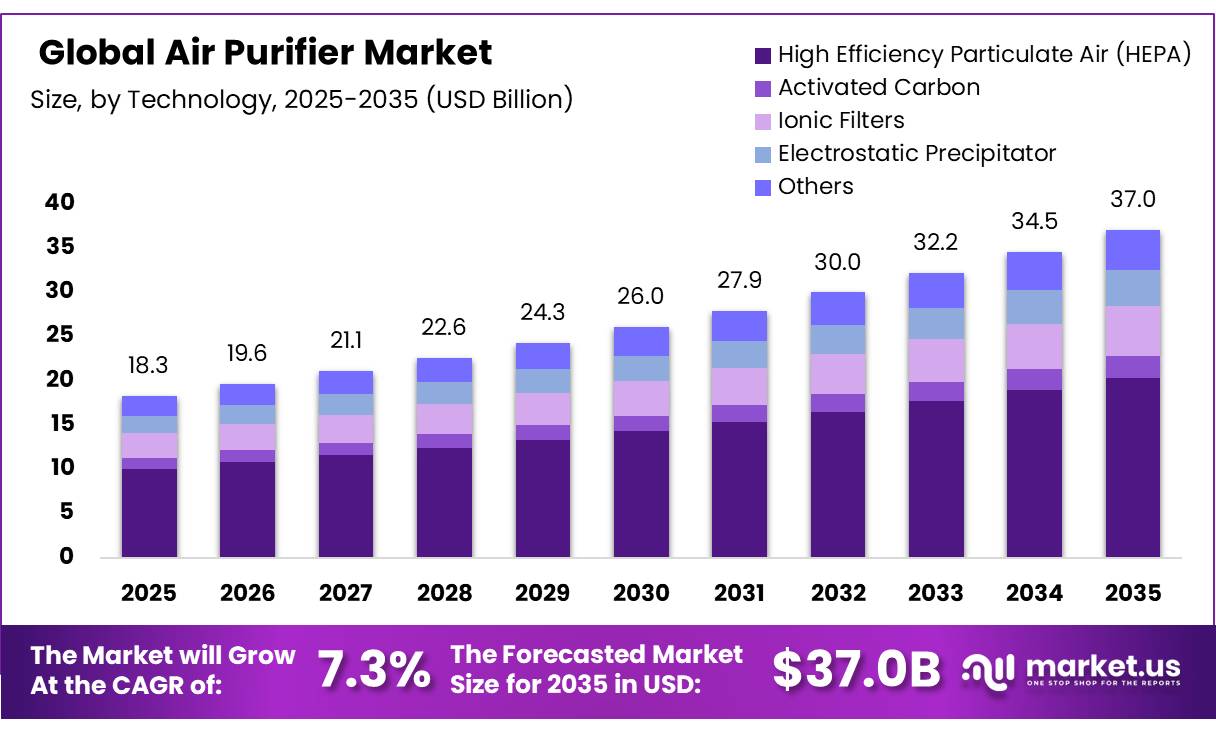
The Global Air Purifier Market size is expected to be worth around USD 37.0 Billion by 2035, from USD 18.3 Billion in 2025, growing at a CAGR of 7.3% during the forecast period from 2026 to 2035. In 2025, North America held a dominant market position, capturing more than a 34.8% share, holding USD 2.3 Billion revenue.
An air purifier is a device designed to improve indoor air quality by removing airborne pollutants such as dust, pollen, pet dander, smoke, and odors. It often consists of a fan that draws in ambient air and passes it through one or more filters to trap contaminants before circulating the cleaned air back. The market is largely driven by factors such as increasing air pollution, urbanization, and health awareness.
- In the European Union, 94% of the urban population remains exposed to fine particulate matter (PM2.5) levels exceeding World Health Organization (WHO) guideline levels.
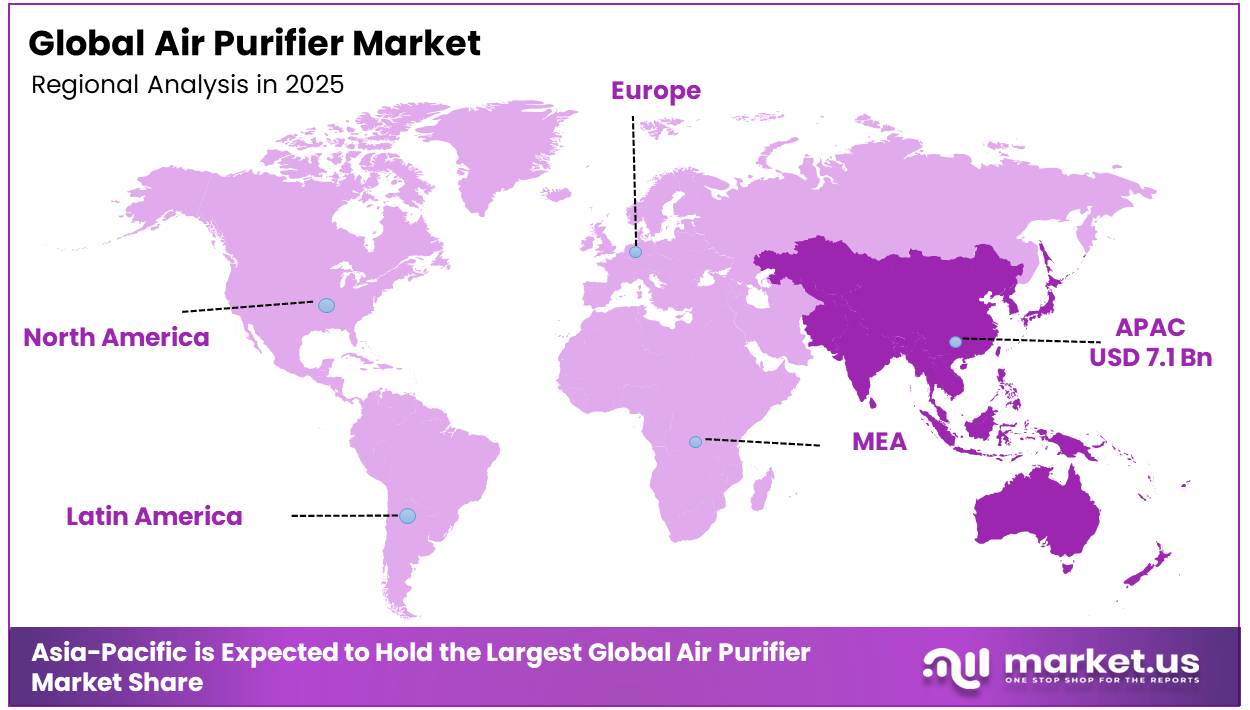
The Asia Pacific region stands as the largest market, with countries such as China and India facing significant air quality issues. Government regulations and heightened consumer health concerns further boost demand, especially for technologies such as HEPA filters, known for their high efficiency in removing particulate matter.
- The sustained presence of unhealthy air, exceeding WHO interim targets in 41% of global cities, creates a consistent requirement for mitigation technologies. In addition, the focus on PM2.5, which is responsible for 79.37% of air pollution in certain regions, reinforces the shift toward high-efficiency particulate air (HEPA) standards in consumer devices.
While portable, non-smart air purifiers are the most commonly used due to their affordability, simplicity, and effectiveness in smaller spaces, there is a growing interest in smart models offering IoT connectivity for real-time air quality monitoring. Commercial users, particularly in offices, healthcare, and retail spaces, dominate the market due to higher air quality demands and larger budgets.
However, challenges such as high total cost of ownership, consumer skepticism, and the complexity of larger systems hinder broader residential and industrial adoption. The market is expanding, driven by regulatory pressure and evolving consumer health priorities.
Key Takeaways:
- The global air purifier market was valued at US$18.3 billion in 2025.
- The global air purifier market is projected to grow at a CAGR of 7.3% and is estimated to reach US$37.0 billion by 2035.
- On the basis of technology, high-efficiency particulate air (HEPA) dominated the market, constituting 54.9% of the total market share.
- Based on the types of air purifiers, the stand-alone/portable air purifier dominated the market, with a substantial market share of around 73.3%.
- Based on the connectivity, the non-smart air purifier led the market, comprising 80.6% of the total market.
- Among the coverage range, air purifiers with a coverage range below 250 sq. ft. held a major share in the market, 36.2% of the market share.
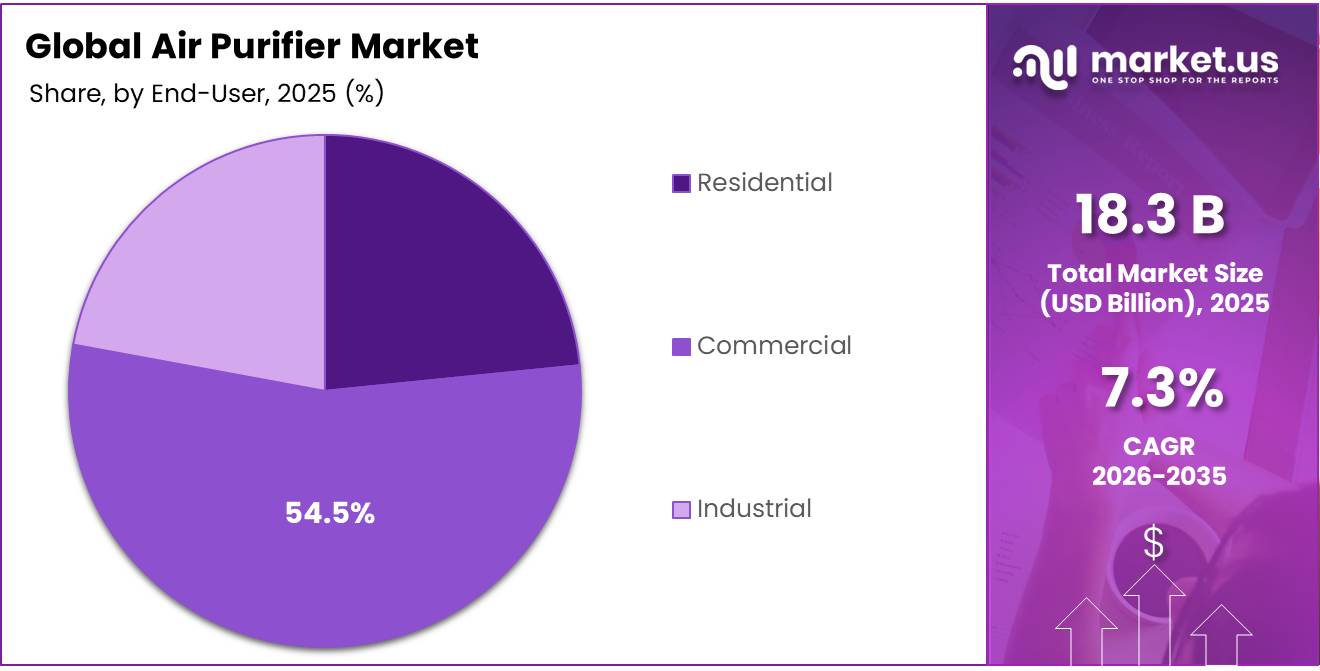
- Among the end-users of air purifiers, commercial users are the most considerable within the market, accounting for around 54.5% of the revenue.
- In 2025, the Asia Pacific was the most dominant region in the air purifier market, accounting for 38.7% of the total global consumption.
Technology Analysis
High Efficiency Particulate Air (HEPA) is a Prominent Segment in the Market.
The market is segmented based on technologies into high efficiency particulate air (HEPA), activated carbon, ionic filters, electrostatic precipitator, and others. The high efficiency particulate air (HEPA) led the market, comprising 54.9% of the market share, as it provides the most effective and reliable filtration of fine particles, such as dust, pollen, mold spores, and pet dander. HEPA filters are proven to capture 99.97% of particles as small as 0.3 microns, making them highly efficient at improving indoor air quality, especially for individuals with respiratory conditions.
In contrast, activated carbon filters primarily address gases, odors, and volatile organic compounds (VOCs), but they do not filter particulate matter as effectively as HEPA. Similarly, ionic filters and electrostatic precipitators can generate ozone or require frequent maintenance, which may reduce their appeal. HEPA’s proven performance, minimal maintenance needs, and broad acceptance by regulatory bodies make it the preferred choice for consumers seeking reliable air purification.
Type Analysis
Stand-alone/Portable Air Purifiers Dominated the Market.
Based on types of air purifiers, the market is segmented into stand-alone/portable and in-duct/fixed. The stand-alone/portable air purifiers dominated the market, comprising 73.3% of the market share, due to their convenience, flexibility, and cost-effectiveness. Portable units are easy to move between rooms or locations, making them ideal for users who need targeted purification in specific areas, such as bedrooms or offices. Similarly, they require minimal installation, allowing consumers to use them immediately upon purchase. In contrast, in-duct systems are more permanent and require professional installation, which can be costly and complicated.
Additionally, portable air purifiers are often more affordable and cater to a wider range of consumers, whereas in-duct systems are often reserved for larger homes or commercial spaces. This accessibility, coupled with the growing focus on individual health and indoor air quality, makes portable units a more attractive option for most users.
Connectivity Analysis
The Non-Smart Air Purifiers Are Most Widely Utilized.
The non-smart air purifiers dominated the market, with a notable market share of 80.6%, due to their simplicity, affordability, and reliability. Several consumers prefer the straightforward operation of non-smart units, which do not require internet connectivity, mobile apps, or frequent software updates. These air purifiers are easy to use, often have fewer points of failure, and are more affordable, making them accessible to a broader range of users.
Additionally, some consumers may be skeptical about the additional features of smart air purifiers, such as remote monitoring or automatic adjustments, viewing them as unnecessary or overly complex. Furthermore, non-smart air purifiers do not rely on external technology, reducing concerns about privacy, data security, or potential connectivity issues.
Coverage Range Analysis
Below 250 Sq. Ft. Air Purifiers Held a Major Share of the Market.
Based on coverage range, the air purifier market is segmented into below 250 sq. ft., 250-400 sq. ft., 401-700 sq. ft., and above 700 sq. ft. Among the coverage range, 36.2% of the air purifiers consumed globally are of a range below 250 sq. ft., due to their suitability for smaller, more common living spaces, such as apartments, bedrooms, or offices. These areas typically have lower air purification demands, making smaller units sufficient to address air quality needs.
Additionally, they are more affordable, energy-efficient, and portable, appealing to consumers who want cost-effective solutions for personal spaces. In contrast, larger air purifiers designed for areas between 250-700 sq. ft. or above require more substantial investment in terms of upfront cost and energy consumption, which may deter some users. Moreover, these larger units are typically less portable and require more space, making them less ideal for smaller homes or apartments where the air quality issue may be more localized.
End-User Analysis
Air Purifier Are Mostly Utilized by Commercial Users.
Among the end-users, 54.5% of the total global consumption of air purifiers is by commercial users, as commercial environments, such as offices, retail spaces, and healthcare facilities, often have a higher demand for air quality management. These spaces often house a large number of people, making air purification essential for improving indoor air quality and ensuring employee and customer health. Moreover, commercial users are more likely to have the budget for the necessary systems, which can offer advanced features such as continuous monitoring and higher filtration capacity.
In contrast, residential users tend to favor more affordable, portable options for smaller spaces. Furthermore, industrial users often require highly specialized air filtration systems tailored to specific manufacturing processes, making air purifiers less common in those settings.
Key Market Segments:
By Technology
- High Efficiency Particulate Air (HEPA)
- Activated Carbon
- Ionic Filters
- Electrostatic Precipitator
- Others
By Type
- Stand-alone/Portable
- In-duct/Fixed
By Connectivity
- Smart
- Non-smart
By Coverage Range:
- Below 250 Sq. Ft.
- 250-400 Sq. Ft.
- 401-700 Sq. Ft.
- Above 700 Sq. Ft.
By End-Users
- Residential
- Family Houses
- Apartments
- Others
- Commercial
- Office Buildings
- Retail Spaces
- Hospitality
- Healthcare
- Others
- Industrial
Drivers
Rapid Urbanization & Increased Pollution Drive the Air Purifier Market.
Rapid urbanization and escalating pollution levels serve as primary structural drivers for the air purifier market, as densely populated urban environments increasingly exceed international safety benchmarks. Urban populations are expanding at an unprecedented rate. According to a report by the United Nations, over 55% of the world’s population lives in urban areas, a number projected to rise to 68% by 2050. This urban growth directly correlates with rising air pollution levels.
The World Health Organization (WHO) reports that approximately 91% of the global population lives in areas where air quality exceeds safe levels. Ambient pollution is linked to 4.2 million premature deaths annually, with 89% occurring in low- and middle-income countries (LMICs). This urban congestion often results in the accumulation of particulate matter (PM2.5), nitrogen dioxide (NO2), and volatile organic compounds (VOCs), all of which contribute to respiratory diseases and other health problems.
The U.S. Environmental Protection Agency (EPA) reports that indoor pollutant levels are frequently 2 to 5 times higher than outdoor concentrations. Given that individuals spend approximately 90% of their time indoors, the indoor environment has become a critical focal point for health-driven air filtration demand. The demand for air purifiers is responding to these environmental stressors, with manufacturers expanding product lines to address specific pollutants.
Restraints
High Total Cost of Ownership and Consumer Skepticism Pose Challenges to the Air Purifier Market.
The high total cost of ownership (TCO) and performance-related consumer skepticism remain significant challenges for the air purifier market. The air purifiers often require regular maintenance, including the replacement of HEPA filters every 6-12 months and activated carbon filters needing change every 3 to 6 months, which can lead to substantial ongoing costs. In addition, non-certified units can consume up to 550 kWh annually. ENERGY STAR reports that standard models may use more electricity than some new refrigerators, while certified units reduce energy use by approximately 56%.
Moreover, consumer skepticism about the efficacy of air purifiers exacerbates market challenges. A significant portion of consumers remains uncertain about the health benefits of air purifiers, questioning whether these devices effectively improve indoor air quality. Such skepticism often stems from unclear or contradictory product performance claims, leading to hesitancy in investment, despite growing concerns over air pollution and health risks. For instance, the California Air Resources Board (CARB) had identified that some electronic cleaners emit ozone, a lung irritant, at levels exceeding health standards. This led to a landmark ban on intentional ozone generators in residential spaces.
Opportunity
Government Regulations and Health Focus Consumers Create Opportunities in the Air Purifier Market.
Government regulations and health-centric consumer behavior provide significant growth vectors for the air purifier market, as public health standards and individual awareness converge on indoor air quality (IAQ). The European Union’s Ambient Air Quality Directive (2008/50/EC) mandates strict limits on levels of particulate matter (PM2.5) and nitrogen dioxide (NO2) in ambient air, prompting increased demand for indoor air quality solutions.
Similarly, the U.S. Environmental Protection Agency (EPA) has established air quality standards that influence local air quality management and promote awareness of air pollution. Furthermore, the U.S. Department of Energy (DOE) has implemented new energy efficiency standards for air cleaners. These regulatory efforts support the integration of air purifiers as a necessary household item in regions facing pollution challenges.
Moreover, a growing focus on health among consumers is shaping market demand. According to the U.S. Centers for Disease Control and Prevention (CDC), respiratory illnesses such as asthma, affecting over 8% American individuals, and chronic obstructive pulmonary disease (COPD) are on the rise, pushing consumers to seek solutions for improving indoor air quality.
Trends
Adoption of Smart Air Purifiers.
The adoption of smart air purifiers represents a structural shift in the market, moving from standalone filtration units to integrated, data-driven, always-on indoor air quality (IAQ) management systems. Smart features such as IoT connectivity, remote monitoring, and automatic air quality adjustments are gaining traction. Most modern units utilize Wi-Fi and Bluetooth to interface with smartphone applications, such as the VeSync App for Levoit or the Dyson Link app. This connectivity enables features such as real-time PM2.5 monitoring and automated mode switching based on ambient conditions.
The integration of sensors and real-time data tracking can optimize the performance of air purifiers, particularly in homes with variable pollution levels. For instance, smart air purifiers can automatically adjust filtration speed based on detected particle levels, thereby improving energy efficiency and prolonging filter life. In addition, smart air purifiers can be controlled via mobile applications, enabling consumers to track air quality remotely. This trend is driven by increasing urbanization, air quality concerns, and a desire for more personalized, real-time environmental control.
Geopolitical Impact Analysis
Geopolitical Tensions Have Led to Increased Prices of Air Purifier.
Current geopolitical tensions have exerted a significant impact on the air purifier market, primarily through their influence on supply chains and regional air quality concerns. The air purifier industry is highly dependent on specialized materials, particularly HEPA filter media and activated carbon, often sourced from concentrated manufacturing hubs.
For instance, the geopolitical friction in East Asia has led to increased lead times for semiconductor chips, essential for smart sensor integration, affecting high-end purifier production schedules. Similarly, shifts in trade policy and tariffs on aluminum and plastic resins (used in chassis construction) have forced manufacturers to re-evaluate vendor diversity to avoid tariff-related price hikes on imported sub-assemblies.
Additionally, geopolitical tensions have exacerbated air pollution concerns in certain regions, leading to heightened demand for air purifiers. In Southeast Asia, geopolitical instability, such as territorial disputes and industrial emissions linked to regional conflicts, has worsened air quality, particularly during periods of heightened geopolitical stress. The World Health Organization (WHO) reports that air pollution in conflict zones is often compounded by the destruction of infrastructure, contributing to long-term air quality degradation.
Regional Analysis
Asia Pacific Held the Largest Share of the Global Air Purifier Market.
In 2025, the Asia Pacific dominated the global air purifier market, holding about 38.7% of the total global consumption, driven by severe air pollution and rapid urbanization. The World Health Organization (WHO) reports that nearly 90% of the population in the Asia Pacific breathes air that exceeds safety standards. In major regional hubs such as Delhi and Beijing, PM2.5 concentrations frequently reach levels 10 to 15 times higher than WHO guidelines. This sustained exposure has transitioned air purifiers from luxury items to essential household health appliances.
The Chinese government, in its 13th Five-Year Plan for Ecological and Environmental Protection, has made substantial efforts to improve air quality, which directly influences demand for air purifiers. Additionally, the growing middle class and rising awareness about health in countries such as China, Japan, and South Korea have further accelerated adoption. In Japan, the Ministry of the Environment has implemented air quality monitoring systems, heightening public sensitivity to indoor air quality and driving product demand across the region.
Key Regions and Countries
- North America
- The US
- Canada
- Europe
- Germany
- France
- The UK
- Spain
- Italy
- Russia & CIS
- Rest of Europe
- APAC
- China
- Japan
- South Korea
- India
- ASEAN
- Rest of APAC
- Latin America
- Brazil
- Mexico
- Rest of Latin America
- Middle East & Africa
- GCC
- South Africa
- Rest of MEA
Key Players Analysis:
Manufacturers of air purifiers invest in technological advancements, such as the development of smart air purifiers with IoT connectivity, remote monitoring, and automatic filtration adjustments, addressing consumer demand for more efficient and user-friendly products. In addition, they emphasize product innovation by incorporating advanced filtration technologies, such as HEPA, UV-C, and activated carbon filters, to effectively address a wider range of pollutants.
Similarly, manufacturers often expand their distribution channels, including e-commerce platforms and partnerships with healthcare institutions, to reach broader consumer segments. Furthermore, they focus on enhancing brand reputation through certifications from environmental and health organizations, aligning products with increasing regulatory standards. Moreover, after-sales service and maintenance plans play a crucial role in fostering customer loyalty and repeat business.
The Major Players in The Industry
- Daikin Industries Ltd.
- LG Electronics Inc.
- Dyson Ltd.
- Panasonic Corporation
- Samsung Electronics Co., Ltd.
- Whirlpool Corporation
- Sharp Corporation
- Koninklijke Philips N.V
- Unilever PLC
- Honeywell International, Inc.
- Xiaomi Corp.
- IQAir
- Winix Inc.
- Coway Co., Ltd.
- Carrier
- Other Key Players
Key Development:
- In February 2026, Daikin Industries (Thailand) announced the introduction of its new brand, Air Creator, in the ASEAN region. The launch included three product categories: the residential air conditioner, Air Creator AC, the aroma-diffusing air purifier, Air Creator AD, and the air purifier, Air Creator AP.
- In February 2026, LG Electronics unveiled the LG PuriCare AeroMini, a compact air purifier engineered to provide robust and dependable air purification in a space-saving design. With its 360-degree airflow, smart connectivity, and versatile placement options, the AeroMini enhances LG’s air care portfolio for contemporary residential settings, including bedrooms, children’s rooms, and studio apartments.
Report Scope
Report Features Description Market Value (2024) US$18.3 Bn Forecast Revenue (2034) US$37.0 Bn CAGR (2025-2034) 7.3% Base Year for Estimation 2024 Historic Period 2020-2023 Forecast Period 2025-2034 Report Coverage Revenue Forecast, Market Dynamics, Competitive Landscape, Recent Developments Segments Covered By Technology (High Efficiency Particulate Air (HEPA), Activated Carbon, Ionic Filters, Electrostatic Precipitator, and Others), By Type (Stand-alone/Portable and In-duct/Fixed), By Connectivity (Smart and Non-smart), By Coverage Range (Below 250 Sq. Ft., 250-400 Sq. Ft., 401-700 Sq. Ft., and Above 700 Sq. Ft.), By End-User (Residential, Commercial, and Industrial) Regional Analysis North America – The US & Canada; Europe – Germany, France, The UK, Spain, Italy, Russia & CIS, Rest of Europe; APAC– China, Japan, South Korea, India, ASEAN & Rest of APAC; Latin America– Brazil, Mexico & Rest of Latin America; Middle East & Africa– GCC, South Africa, & Rest of MEA Competitive Landscape Daikin Industries Ltd., LG Electronics Inc., Dyson Ltd., Panasonic Corporation, Samsung Electronics Co., Ltd., Whirlpool Corporation, Sharp Corporation, Koninklijke Philips N.V., Unilever PLC, Honeywell International, Inc., Xiaomi Corp., IQAir, Winix Inc., Coway Co., Ltd., Carrier, and Other Players. Customization Scope Customization for segments, region/country-level will be provided. Moreover, additional customization can be done based on the requirements. Purchase Options We have three licenses to opt for: Single User License, Multi-User License (Up to 5 Users), Corporate Use License (Unlimited Users and Printable PDF) 
-
-
- Daikin Industries Ltd.
- LG Electronics Inc.
- Dyson Ltd.
- Panasonic Corporation
- Samsung Electronics Co., Ltd.
- Whirlpool Corporation
- Sharp Corporation
- Koninklijke Philips N.V
- Unilever PLC
- Honeywell International, Inc.
- Xiaomi Corp.
- IQAir
- Winix Inc.
- Coway Co., Ltd.
- Carrier
- Other Key Players
Our Clients

- 181071
- Mar 2026






