


Key findings at a glance
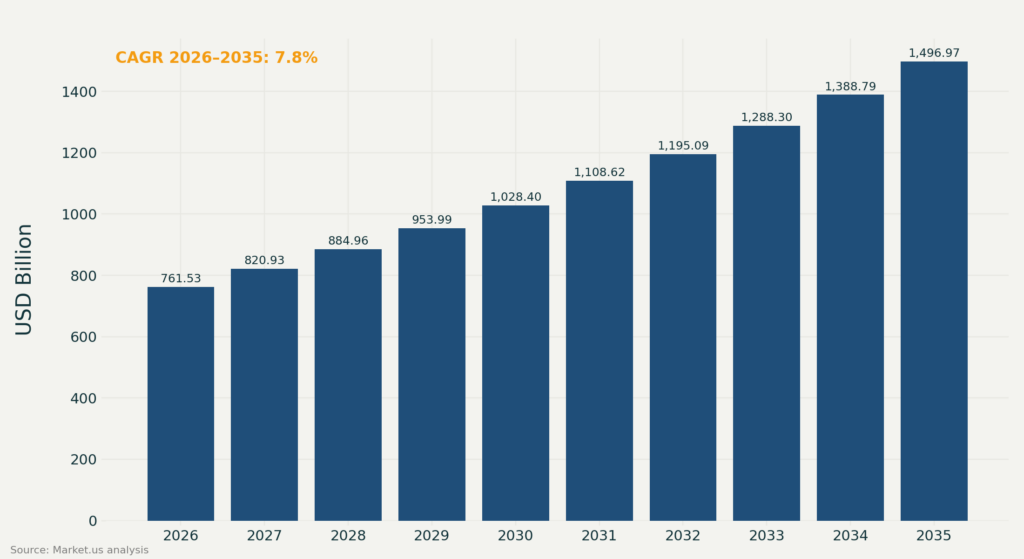
- Germany’s residential real estate market is estimated at USD 761.53 Billion in 2026 and is projected to reach USD 1,496.97 Billion by 2035, a CAGR of 7.8%.
- 53% of people in Germany rent their home, the highest share of any large European economy (Eurostat, 2024).
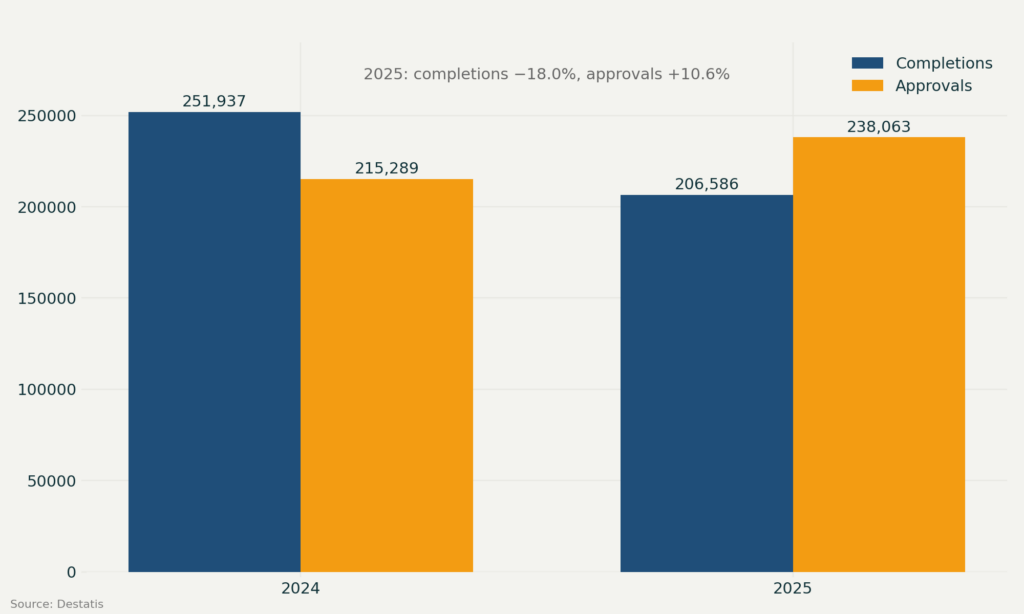
- Germany completed 206,586 homes in 2025, down from 251,937 in 2024 (Destatis).
- The ECB raised its deposit rate to 2.50% in September 2026, and 10-year fixed mortgage rates reached 4.41%.
- Primary new-build (9.4% CAGR) is the fastest-growing segment, and Leipzig (9.6% CAGR) is the fastest-growing city.
Market Overview
The Germany Residential Real Estate Market is estimated at USD 761.53 Billion in 2026 and is projected to reach USD 1,496.97 Billion by 2035, growing at a CAGR of 7.8% over the forecast period.
According to Eurostat, 53% of people in Germany lived in rented homes in 2024. No other large European economy has a majority of renters. As a result, rental demand stays strong whether interest rates rise or fall. Investors get steady, long-term demand rather than demand that comes and goes with the economy.
The main driver of growth is the housing shortage in Berlin, Munich, Hamburg and Frankfurt. More people move to these job centres each year than new homes are finished, and the gap keeps widening. Building costs have been high since 2022, so fewer projects have started, and completions have not returned to earlier levels. Companies and investors who focus on this supply gap should benefit throughout the forecast period.
Analyst insight: “The 2025 figures show a turning point that headline numbers hide. Completions fell 18.0% to 206,586 homes, while approvals rose 10.6% to 238,063. That leaves about 31,500 more approvals than completions in a single year, a pipeline that should start turning into finished homes from 2027. However, the ECB’s rate rises in 2026 put that recovery at risk. If financing costs stay high, many of these approvals will stay on paper, and the supply gap will last into the next decade. That is why our forecast gives primary new-build the fastest growth, at a 9.4% CAGR, but only from 2027 onward.”
— Research Team, Market.us
Market Definition
This report measures the total annual value of Germany’s residential real estate market. It has three parts:
- Property transactions: The value of all residential property sales, both new-build and existing homes.
- Construction and modernisation: New residential construction and renovation spending that is not already counted in property sales.
- Rental income: Gross rents paid by tenant households, including service charges.
“Sales” in this report covers parts 1 and 2, and “Rental” covers part 3. The market includes apartments, condominiums, villas, detached houses and single-family rental homes. It does not include commercial property, hotels, care homes, holiday homes or social housing owned directly by public bodies.
Key Takeaways
- The market is valued at USD 761.53 Billion in 2026 and is expected to reach USD 1,496.97 Billion by 2035, at a CAGR of 7.8%.
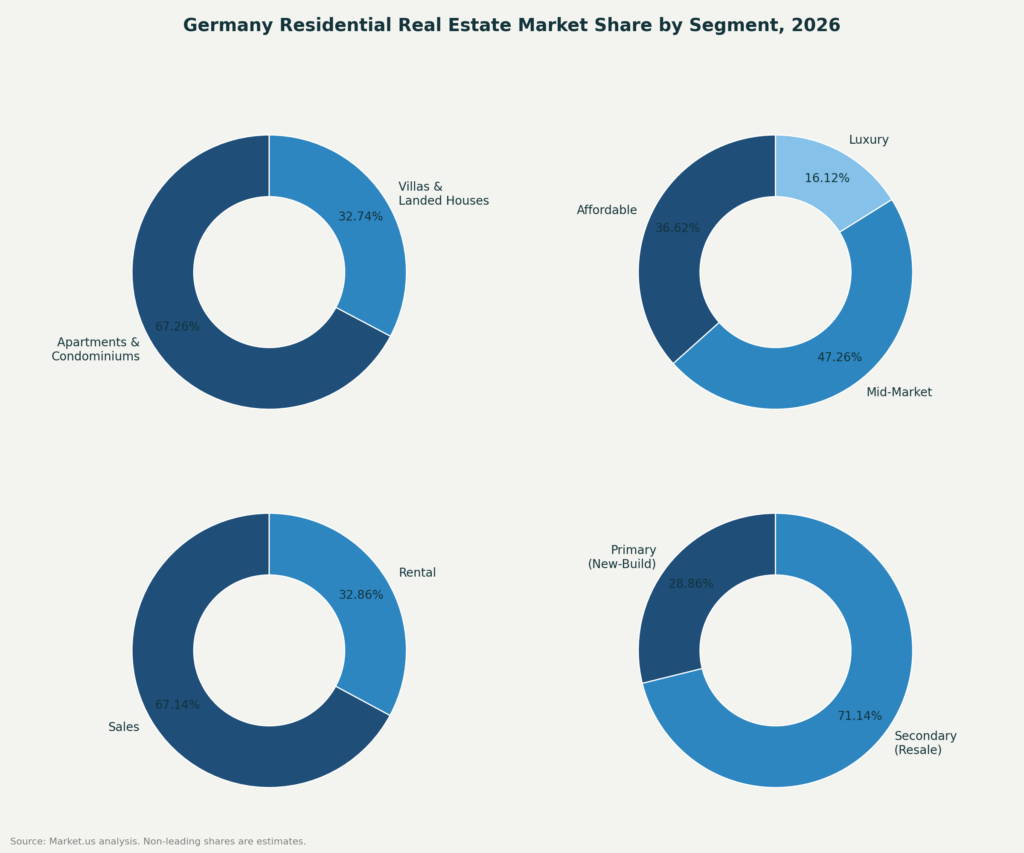
- By Property Type: Apartments & Condominiums led with a 67.26% share in 2026.
- By Price Band: Mid-Market led with a 47.26% share in 2026.
- By Business Model: Sales led with a 67.14% share in 2026.
- By Mode of Sale: Secondary (Existing Home Resale) led with a 71.14% share in 2026.
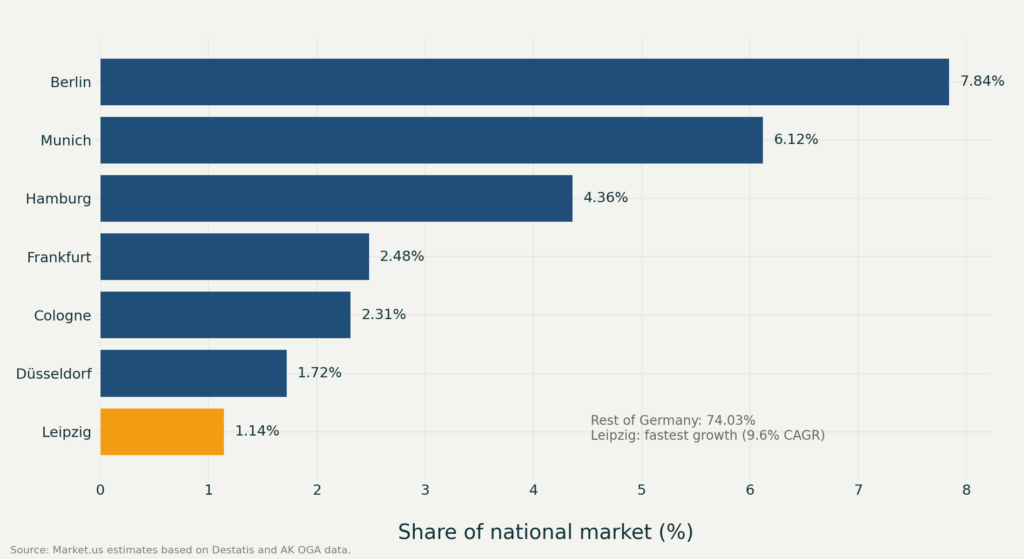
- By Region: Berlin was the largest single city market, with a 7.84% share in 2026.
- Fastest-growing categories: Villas & Landed Houses (8.9% CAGR), Affordable (9.1%), Rental (9.2%), Primary New-Build (9.4%) and Leipzig (9.6%).
- Top key players: Vonovia SE, Deutsche Wohnen SE, LEG Immobilien SE, TAG Immobilien AG, Grand City Properties S.A.
Key Market Statistics
| Indicator | Value / Source |
|---|---|
| Share of population renting (2024) | 53% — Eurostat |
| Total homes (end-2025) | 44.0 million — Destatis |
| Number of households (2025) | 41.126 million — Destatis |
| Average household size (2025) | 2.01 people — Destatis |
| Homes completed (2025) | 206,586 — Destatis |
| Homes completed (2024) | 251,937 — Destatis |
| Homes approved (2025) | 238,063 — Destatis |
| Homes approved (2024) | 215,289 — Destatis |
| Residential property purchases (2025) | €198 billion — AK OGA |
| Residential permits, Jan–Nov 2024 vs 2019 | −40% — European Commission |
| Home building share of total investment (2020–2024) | 31% — European Commission |
| ECB deposit rate (from 16 Sept 2026) | 2.50% — European Central Bank |
| 10-year fixed mortgage rate (29 Sept 2026) | 4.41% — Hypofriend |
| Inflation rate (Sept 2026, provisional) | 3.3% — Destatis |
| GDP growth forecast (2026) | 1.3% — Leading German economic institutes |
Research Methodology
How the Market Size Was Built
| Component (2025 base year) | Basis / Value |
|---|---|
| Residential property transactions | AK OGA transaction data — EUR 198 Bn / USD 224 Bn |
| Construction and modernisation not counted in transactions | Bundesbank and Destatis residential investment data, less new-build sales — ~EUR 240 Bn (est.) / ~USD 271 Bn |
| Gross rental income | ~20 million tenant households × average gross rent — ~EUR 216 Bn (est.) / ~USD 244 Bn |
| Total, 2025 | ~EUR 654 Bn / ~USD 739 Bn |
| Total, 2026 (estimate) | 2025 base + 3.0% growth — USD 761.53 Bn |
Forecast Approach
The 7.8% CAGR for 2026–2035 is the sum of three nominal growth drivers:
- Rent growth: About 3.5–4.0% a year, in line with current rent trends in the largest cities.
- Price recovery: About 2.0–2.5% a year, as prices recover from the 2022–2024 correction.
- Volume recovery: About 1.5–2.0% a year, as transactions and construction move back towards pre-2022 levels.
Segment and regional CAGRs are set above or below this rate based on expected household formation, completions and rent growth. They are balanced so that each segment adds up to the national forecast.
Data and Validation
- Top-down: National totals from Destatis, Eurostat, the European Commission, the Bundesbank and AK OGA were split by segment and region.
- Bottom-up: Portfolio data from listed housing companies, regional transaction records and city-level rent data were used to check the totals.
- Segment and regional shares: Non-leading shares were modelled from housing stock, average floor area and price or rent per square metre. Modelled figures are labelled as estimates.
- Primary research: For this 2026 edition, findings were checked against first-hand statements from market participants published between February 2025 and September 2026. Analysts reviewed FY2025 annual reports, H1 2026 interim reports and investor presentations from Vonovia, Deutsche Wohnen, LEG Immobilien, TAG Immobilien and Grand City Properties, which together own about 787,000 homes in Germany. Management guidance on rent growth, vacancy, disposals and refinancing was used to test the report’s rent, vacancy and forecast assumptions. Analysts also reviewed 12 transactions and partnerships announced between February 2025 and September 2026. These include deals by PSP Investments and Goldman Sachs Alternatives, Ardian and Reneo, PGIM, Catella, PATRIZIA, Primus and Greystar, and BauMont, and they were used to validate the investment, build-to-rent and city-level growth trends. Policy assumptions were checked against European Central Bank monetary policy decisions from June and September 2026, the Bau-Turbo law in force since 30 October 2025, and the Mietrecht II draft approved by the federal cabinet on 29 April 2026.
How this report was produced: Market.us analysts collected and checked data from official statistics, central bank releases and company filings. AI tools assisted with drafting and formatting. All figures, analysis and conclusions were reviewed and approved by Market.us Research Team before publication.
| Segment / Category | Details |
|---|---|
| Apartments & Condominiums | 67.26% share in 2026 — USD 512.21 Bn → USD 959.92 Bn by 2035 — CAGR 7.23% |
| Villas & Landed Houses | 32.74% share in 2026 — USD 249.32 Bn → USD 537.05 Bn by 2035 — CAGR 8.90% |
| Affordable | 36.62% share in 2026 — USD 278.87 Bn → USD 610.70 Bn by 2035 — CAGR 9.10% |
| Mid-Market | 47.26% share in 2026 — USD 359.90 Bn → USD 662.47 Bn by 2035 — CAGR 7.01% |
| Luxury | 16.12% share in 2026 — USD 122.76 Bn → USD 223.80 Bn by 2035 — CAGR 6.90% |
| Sales | 67.14% share in 2026 — USD 511.29 Bn → USD 944.44 Bn by 2035 — CAGR 7.06% |
| Rental | 32.86% share in 2026 — USD 250.24 Bn → USD 552.53 Bn by 2035 — CAGR 9.20% |
| Primary (New-Build) | 28.86% share in 2026 — USD 219.78 Bn → USD 493.33 Bn by 2035 — CAGR 9.40% |
| Secondary (Existing Home Resale) | 71.14% share in 2026 — USD 541.75 Bn → USD 1,003.64 Bn by 2035 — CAGR 7.09% |
Note: Non-leading shares, 2035 values and CAGRs are Market.us estimates based on the methodology above.
Apartments & Condominiums Analysis
Apartments & Condominiums made up 67.26% of the property type segment in 2026, worth USD 512.21 Billion. This is expected to reach USD 959.92 Billion by 2035.
German cities are densely built, and most people rent, so apartments are the normal choice for most buyers and tenants. In Berlin, Munich and Hamburg, land is expensive and planning rules are strict, which makes large-scale single-family building unprofitable. Large investors own big apartment portfolios because one building with many units is much cheaper to run than many separate houses.
Villas and detached houses are the fastest-growing property type, at an 8.9% CAGR. Since the pandemic, higher-income families have moved to suburbs and the edges of cities looking for more space. This shows buyer preferences splitting into two groups rather than a move away from apartments.
Mid-Market Analysis
Mid-Market held a 47.26% share in 2026, worth USD 359.90 Billion, the largest of any price band.
Mid-market homes appeal to both owner-occupiers and buy-to-let investors because they suit Germany’s large professional workforce. Rents in this band match what an average household can pay, so homes stay occupied and landlords face little vacancy risk. New digital platforms let people buy small shares of mid-market properties (tokenization), which opens the market to smaller investors.
Affordable housing is the fastest-growing price band, at a 9.1% CAGR. In the first half of 2026, asking rents in the cheapest segment of Germany’s largest cities rose 5.5%, compared with 2.3% in the premium segment. Luxury holds 16.12% and is concentrated in the best areas of Munich and Hamburg. Growth in the affordable band gives developers who work with government subsidy programmes good short-term opportunities.
Sales Analysis
Sales held 67.14% of the business model segment in 2026, worth USD 511.29 Billion, including property transactions plus construction and modernisation spending.
Sales lead because German households with enough savings keep buying homes, even after mortgage rates rose from record lows. Large investors also buy new apartments in bulk, especially in the seven largest cities: Berlin, Munich, Hamburg, Frankfurt, Cologne, Düsseldorf and Stuttgart. These bulk deals make up a large part of new-build sales, while most transactions overall are resales of existing homes.
Rental is the fastest-growing business model, at a 9.2% CAGR, rising from USD 250.24 Billion in 2026 to USD 552.53 Billion by 2035. German cities do not have enough rental homes. Investors are moving into build-to-rent (BTR) projects, which are buildings designed to be rented out. These take two to three years to finish, so rents keep rising in the meantime.
Secondary (Existing Home Resale) Analysis
Secondary (Existing Home Resale) led the Mode of Sale segment with a 71.14% share in 2026, worth USD 541.75 Billion.
Resale homes lead because Germany has a large and mostly old housing stock. Buyers can find far more existing homes than new ones, since planning delays and high building costs hold back new construction. Buying an existing home is also faster than waiting for one to be built, which lowers financing risk while interest rates are high.
Primary (new-build) is the fastest-growing mode of sale, at a 9.4% CAGR, supported by government incentives and investor money for rental and affordable housing. Too few new homes are being finished to meet demand. Developers who can deliver in cities with shortages can charge higher prices than sellers of existing homes.
Key Market Segments
By Property Type
- Apartments & Condominiums
- Villas & Landed Houses
By Price Band
- Affordable
- Mid-Market
- Luxury
By Business Model
- Sales
- Rental
By Mode of Sale
- Primary (New-Build)
- Secondary (Existing Home Resale)
City and Regional Analysis
| Region | Details |
|---|---|
| Berlin | 7.84% share — USD 59.70 Bn (2026) → USD 120.35 Bn (2035) — CAGR 8.10% |
| Munich | 6.12% share — USD 46.61 Bn (2026) → USD 95.52 Bn (2035) — CAGR 8.30% |
| Hamburg | 4.36% share — USD 33.20 Bn (2026) → USD 65.82 Bn (2035) — CAGR 7.90% |
| Frankfurt | 2.48% share — USD 18.89 Bn (2026) → USD 37.75 Bn (2035) — CAGR 8.00% |
| Cologne | 2.31% share — USD 17.59 Bn (2026) → USD 34.58 Bn (2035) — CAGR 7.80% |
| Düsseldorf | 1.72% share — USD 13.10 Bn (2026) → USD 25.54 Bn (2035) — CAGR 7.70% |
| Leipzig | 1.14% share — USD 8.68 Bn (2026) → USD 19.81 Bn (2035) — CAGR 9.60% |
| Rest of Germany | 74.03% share — USD 563.76 Bn (2026) → USD 1,097.60 Bn (2035) — CAGR 7.68% |
| Total | 100% — USD 761.53 Bn (2026) → USD 1,496.97 Bn (2035) — CAGR 7.80% |
Note: Regional shares are Market.us estimates based on housing stock, floor area and price/rent data from Destatis and AK OGA.
Analyst insight: “The rent gap between German cities is wider than most international investors expect. Munich’s average asking rent of €23.70 per square metre is 2.3 times Leipzig’s €10.50. Yet Leipzig is among the cities where rental listings fell fastest, by 40%. That combination of low rents and shrinking supply is why we expect Leipzig to grow faster than any other German city, at an estimated 9.6% CAGR.”
— Research Team, Market.us
Berlin
Berlin is Germany’s largest single city market, with a 7.84% share in 2026 and an expected 8.1% CAGR. Its market share is higher than its 4.7% share of the country’s homes because more than 80% of Berliners rent, and rents and prices are well above the national average.
Berlin’s population keeps growing, thanks to tech jobs and steady international migration. Demand is strong in every price band, and the city has one of the lowest vacancy rates of any major European capital. Rent controls limit increases, but total rental income is still higher than in most similar European cities.
Munich
Munich holds an estimated 6.12% share and has the highest home prices per square metre in Germany. Its technology and car industries pay high salaries, so residents have strong buying power. Far too few new homes are being built compared with the number of new households. Investors accept lower starting returns because they expect values to rise faster here than in any other German city.
Hamburg
Hamburg holds an estimated 4.36% share. Its port and financial services sector attract well-paid professionals who support both mid-market ownership and high-end rentals. Planning approvals take longer than in Berlin, which limits new supply. Rental listings fell 57% as tenants with protected rents chose not to move. Investors seeking steady, low-risk income find Hamburg especially attractive.
Frankfurt
Frankfurt holds an estimated 2.48% share. As a financial centre and home of the European Central Bank, it has the most internationally mobile residents of any German housing market. As office vacancy rises, more offices are being converted into homes. Micro-living and student housing do well thanks to the city’s universities and short-term professional demand.
Cologne
Cologne holds an estimated 2.31% share. Jobs in media, insurance and consumer goods create steady mid-market demand. Rental returns are higher than in Munich or Hamburg, which makes Cologne a better entry point for income-focused investors. New projects along the Rhine are slowly adding homes, but new supply is taken up as fast as it is built.
Düsseldorf
Düsseldorf holds an estimated 1.72% share. Its large Japanese business community and strong fashion and advertising industries create small but well-funded demand for high-end homes. There are not enough mid-market rental homes for the many new workers arriving each year. Large investors face less competition here than in Berlin or Munich.
Leipzig
Leipzig is Germany’s fastest-growing residential city, with an estimated 9.6% CAGR from a 1.14% share in 2026. Lower living costs draw people from Berlin, and creative and tech industries are growing. It is the cheapest of Germany’s eight largest rental markets, with median asking rents of €11.19 per square metre in the first half of 2026. Early developers in inner-city districts are seeing above-average rent growth.
Rest of Germany
The rest of Germany makes up an estimated 74.03% of the market, covering smaller cities, suburbs and rural areas. Regions such as Baden-Württemberg, Bavaria and North Rhine-Westphalia take in buyers and renters priced out of the largest cities. Cheaper land and simpler planning help affordable and mid-market projects. Returns are lower than in Leipzig but more predictable.
Rental Market Indicators
| City | Average Asking Rent, Q2 2026 (€/sqm/month) |
|---|---|
| Munich | €23.70 |
| Frankfurt | €17.80 |
| Hamburg | €16.50 |
| Berlin | €15.30 |
| Düsseldorf | €14.90 |
| Leipzig | €10.50 |
| Germany average | €14.30 |
JLL reports a median asking rent of €17.98 per square metre across Germany’s eight largest cities in the first half of 2026. Munich reached €25.41, about 41% higher. Data providers measure rents differently, so compare figures only within one source.
Large landlords report very few empty homes:
- Vonovia: 1.8% (end-2025).
- Deutsche Wohnen: 1.5% (September 2025).
- LEG: 2.6% (end-2025).
These low rates confirm how tight the rental market is.
Macroeconomic Impact
The European Commission reports that home building made up 31% of Germany’s total investment between 2020 and 2024. It fell 5% in 2024 and 15% in total over the five years. Higher interest rates cut developer profits and household borrowing power, so demand and supply shrank at the same time.
The economy is now sending mixed signals. Leading economic institutes raised their 2026 GDP growth forecast to 1.3%. Meanwhile, higher energy prices pushed inflation to 3.3% in September 2026. High inflation reduces the real value of fixed rents, so landlords are seeking inflation-linked leases where the law allows. Uncertain global trade policy weighs on Germany’s export industries, which makes households cautious and delays first-time buyers.
Impact of Interest Rates
Interest rates are the biggest short-term factor for this market. After a long series of cuts, the ECB raised its deposit rate to 2.25% in June 2026 and to 2.50% in September 2026. The 10-year fixed mortgage rate rose from 3.98% to 4.41% in six months.
| Scenario | What happens / Impact on the market |
|---|---|
| Rates stay high (base case) | Deposit rate stays around 2.50% — Fewer buyers, more renters, rising rents, slow construction recovery |
| Rates fall | Inflation eases and the ECB cuts again — Cheaper mortgages bring buyers back; projects and sales pick up |
| Rates rise further | Energy-driven inflation continues — Pressure on property values, harder refinancing, more developer distress |
Analyst insight: “The jump in mortgage rates looks small but hits buyers directly. With 10-year fixed rates rising from 3.98% to 4.41% in six months, the monthly repayment on a €400,000, 30-year loan rises from about €1,905 to about €2,005. That is roughly €100 more a month, or 5%. For first-time buyers already at the limit of bank affordability tests, this is enough to keep them renting. It supports our view that rental will grow faster (9.2% CAGR) than sales (7.06%).”
— Research Team, Market.us
Market Dynamics
Driver: Housing Shortages and Migration Keep Rental Demand High
According to Destatis, Germany had 41.126 million households in 2025, with an average of 2.01 people each. At current building rates, there are not enough new homes for them. Berlin, Munich and Frankfurt gain residents every year, yet fewer homes are finished than new households need. Landlords keep almost all units rented without lowering rents.
In July 2025, PSP Investments and Goldman Sachs Alternatives formed a German single-family rental partnership. It targeted €550 million of equity, about €1.2 billion of investment and around 3,000 homes. Several partners are looking at modular construction, where parts of a home are factory-built and assembled on site, to deliver homes faster.
Restraint: High Building Costs and Fewer Permits Limit New Supply
The European Commission reports that residential building permits through November 2024 were 19% below 2023 and 40% below 2019. High borrowing costs make many projects unprofitable, especially for smaller developers. Builders who cannot recover higher costs through sale prices have put projects on hold.
Destatis data show Germany finished 206,586 homes in 2025, down sharply from 251,937 in 2024. Rent controls, energy rules and carbon costs also reduce landlord profits on older buildings. Owners who must pay for upgrades but cannot raise rents are selling to large investors with more money to absorb these costs.
Opportunity: Build-to-Rent and Energy Upgrades Create New Investment Options
Destatis data show Germany approved 238,063 new homes in 2025, up from 215,289 in 2024. This partial recovery suggests developers are regaining confidence in certain types of projects. Student housing, micro-apartments and affordable build-to-rent schemes attract government co-investment and long-term pension fund capital.
In September 2025, PGIM bought an empty Frankfurt office building to convert into more than 300 micro-apartments and student housing units. Energy upgrades to ageing apartment buildings let landlords charge higher “green rents” and protect buildings from losing value as EU energy rules tighten.
Porter’s Five Forces
| Force / Level | Explanation |
|---|---|
| Threat of new entrants — Low | Expensive land, planning approvals of two to five years in major cities and complex rules limit building to well-funded companies |
| Supplier power — High | Builders and material suppliers hold strong bargaining power due to worker shortages and rising costs |
| Buyer power — Low (renters), moderate (buyers) | Few empty homes leave renters little room to negotiate; buyers gain choice when mortgages become harder to afford |
| Threat of substitutes — Low | Co-living and student housing serve niches but do not replace family rentals |
| Competitive rivalry — Moderate to high, rising | Global investors are entering; scale and technology-driven management are the main differentiators |
AI and Gen AI Impact
Artificial intelligence (AI) is spreading quickly across German real estate. It is used most in property valuation, due diligence and tracking environmental, social and governance (ESG) rules. Large landlords use AI to value properties almost in real time, replacing manual quarterly valuations that were often out of date.
Generative AI speeds up lease paperwork, tenant messages and energy reports, which cuts administration costs per unit. Companies that use AI for energy upgrade planning and green-rent pricing save money and comply more easily. Companies still working manually face a higher risk of fines as energy reporting rules tighten.
Market Trends
Prices Settle and Smaller Deals Replace Large Portfolio Sales
Prime rental yields in the seven largest cities have settled at an estimated 3.4%, ending the price correction that began in 2022. Buyers and sellers now price deals on today’s interest rates, not the record lows of 2020–2021. Single-building sales now dominate because large portfolios are hard to sell at acceptable prices. Digital twins (virtual building models) and modular building are shortening build times and making smaller projects easier to finance.
Tenants Stay Put as Rental Listings Shrink
Tenants with older, cheaper leases are staying put because new leases cost far more. This “lock-in effect” cut available rental listings by 57% in Hamburg, 43% in Frankfurt and 40% in Leipzig. Fewer homes coming back onto the market keeps rents for new tenants rising.
Rents Rise Fastest at the Affordable End
Across the eight largest cities, asking rents rose 3.0% in the first half of 2026. The cheapest segment rose 5.5%, against 2.3% in the premium segment, as households reached the limit of what they can pay.
Offices Become Homes
Rising office vacancy, especially in Frankfurt, is speeding up office-to-residential conversions. Projects like PGIM’s Frankfurt conversion add homes without needing new land.
Market Competition Overview
The market is moderately concentrated at the top. A few listed companies own hundreds of thousands of homes across the largest cities. Vonovia SE and Deutsche Wohnen SE together manage the largest professionally run rental portfolio. Mid-sized players such as LEG Immobilien SE and TAG Immobilien AG own large regional portfolios and compete on efficiency.
In December 2025, PATRIZIA bought 237 new rental apartments covering more than 21,500 square metres near Stuttgart. The deal shows mid-sized investors shifting towards higher-quality homes that need less upkeep. Private landlords still own most rental homes in Germany, but their share is shrinking as large companies grow.
Analyst insight: “Germany’s biggest landlords look dominant, but they are small compared with the whole market. Vonovia (including Deutsche Wohnen), LEG, TAG and Grand City together own about 787,000 German homes. That is only around 3–4% of the country’s roughly 23 million rental homes. The rest belongs mostly to private landlords, many of whom face expensive energy upgrades they cannot afford. We expect this group to be the main source of homes sold to institutional buyers through 2035.”
— Research Team, Market.us
Competitive Benchmarking
| Company | Key Data |
|---|---|
| Vonovia SE | 471,153 residential units (Germany) — Vacancy 1.8% — Avg. rent €8.19/sqm/month — Adjusted EBITDA Total €2,800.8M — Data as of 31 Dec 2025 |
| Deutsche Wohnen SE | 140,460 residential units — Vacancy 1.5% — Avg. rent €8.23/sqm/month — Data as of 30 Sept 2025 |
| LEG Immobilien SE | 171,360 residential units — Vacancy 2.6% (EPRA) — Avg. rent €7.04/sqm/month — Net cold rent €919.9M — Data as of 31 Dec 2025 |
| TAG Immobilien AG | 83,504 residential units — Vacancy 3.2% — Avg. rent €5.98/sqm/month — FFO I €181.0M — Data as of 31 Dec 2025 |
| Grand City Properties S.A. | 61,189 residential units — Vacancy 3.7% — Avg. rent €9.80/sqm/month — Annualised net rent €442M — Data as of 30 June 2026 |
Note: Deutsche Wohnen is part of the Vonovia group and reports separately. Do not add its units to Vonovia’s total.
Company Profiles
Vonovia SE
Vonovia SE owns Germany’s largest housing portfolio. As of 31 December 2025, it held 471,153 homes in Germany, with a 1.8% vacancy rate and an average rent of €8.19 per square metre per month. Across all countries, it owned 530,979 homes. 2025 Adjusted EBITDA reached €2,800.8 million, up 6%, reflecting savings from digital management and centralised maintenance. Scale is its main advantage: cost per home falls as the portfolio grows.
Deutsche Wohnen SE
Deutsche Wohnen SE is part of the Vonovia group, with a portfolio concentrated in Berlin and other growth regions. As of 30 September 2025, it owned 140,460 homes, up 0.5% year on year. Average rent rose 4.1% to €8.23 per square metre, and vacancy was 1.5%. Its Berlin focus gives it direct exposure to Germany’s largest and tightest rental market.
LEG Immobilien SE
LEG Immobilien SE focuses on affordable housing, mainly in North Rhine-Westphalia. At the end of 2025, it managed 171,360 homes. 2025 net cold rent (rent before utility costs) reached €919.9 million. Average rent grew 3.5% like-for-like to €7.04 per square metre, with EPRA vacancy at 2.6%. LEG also sold about 3,500 homes for €250 million, slightly above book value, to reduce debt.
TAG Immobilien AG
TAG Immobilien AG owns affordable homes mainly in northern and eastern Germany, including Leipzig, Dresden and Chemnitz, and is building a rental business in Poland. At the end of 2025, it owned about 83,500 German homes. Vacancy fell from 3.6% to 3.2%, and like-for-like rent growth was 3.0%. Average rent was €5.98 per square metre, and FFO I (rental profit) rose to €181.0 million, beating guidance.
Grand City Properties S.A.
Grand City Properties S.A. buys poorly managed buildings and improves them through energy upgrades, better tenants and higher rents. As of June 2026, it owned 61,189 homes. Its investment property was worth €9.201 billion, annual net rent was €442 million and average rent was €9.80 per square metre. Its 3.7% vacancy rate reflects buildings still being upgraded, not weak demand. Upgraded buildings often sell above book value.
Key Players
- Vonovia SE
- Deutsche Wohnen SE
- LEG Immobilien SE
- TAG Immobilien AG
- Grand City Properties S.A.
- Covivio Immobilien GmbH
- Adler Group S.A.
- Patrizia SE
- Vivawest GmbH
- SAGA Unternehmensgruppe Hamburg
- Degewo AG
- ABG Frankfurt Holding
- GAG Immobilien AG
- BUWOG GmbH
- Heimstaden Germany GmbH
- Consus Real Estate AG
- Residia Care Holding GmbH & Co. KG
- Wohnungsbaugenossenschaft Musikwinkel eG
- Wertgrund Immobilien AG
- Bayerische Versorgungskammer – Immobilien
Pricing Analysis
Home prices vary widely by city, property type and energy rating. Munich has the highest prices of any major city, with new apartments in central districts selling for more than €10,000 per square metre. Berlin and Frankfurt follow. In both cities, existing homes sell for 15–25% less than comparable new homes nearby. Homes rated A or B on the energy performance certificate (EPC) earn an estimated 5–10% more rent than lower-rated homes nearby.
Rising building costs push prices up by raising the cost of replacing any home. Cautious mortgage lending pushes prices down: strict affordability tests exclude more would-be buyers, who keep renting instead. This supports rents, even though sales remain below their pre-2022 levels.
Supply Chain and Value Chain Analysis
The value chain runs from land purchase and planning approval through design, construction and finishing to property management, resale or refinancing. Most value is created at two stages:
- Planning approval: Land with approval sells for much more than land without it.
- Property management: AI-based maintenance and energy upgrades cut costs and raise rental profit.
Construction sits in the middle of the chain but earns a shrinking share of profit as material and labour costs squeeze margins.
The biggest delays happen at the planning stage. One planning decision can hold up a project for one to three years while developers pay interest on land with no income. Large investors who control several stages, from land to letting, are less exposed to these delays.
Regulatory Landscape
Housing rules are set at the federal, state and city levels.
- Rent rules: Germany’s Constitutional Court struck down Berlin’s rent cap (the “Mietendeckel”). States still apply the federal rent brake (the “Mietpreisbremse”), which limits rent increases for new tenants in high-demand areas.
- Mietrecht II: The federal cabinet approved this rent law reform on 29 April 2026, and the Bundestag held its first reading on 9 July 2026. In tight markets, it would limit increases on inflation-linked (index) leases: any yearly price rise above 3% would count only half towards the rent increase. It would also add rules for furnished and short-term rentals. Until it is final, investors are building this uncertainty into their valuations.
- Energy rules: EU building energy rules require minimum energy ratings in stages. Buildings that fall short could lose much of their value, or be forced onto the market, by the early 2030s.
- Bau-Turbo: This law to speed up housing construction came into force on 30 October 2025 and applies until 31 December 2030. With local council consent, authorities can approve housing projects that do not match existing development plans. Uptake is uneven, but developers in Bavaria and Baden-Württemberg report shorter waits.
Investment and White Space Analysis
Most investor money is going into build-to-rent, student housing and affordable housing in the largest cities. Global investors have shifted from buying existing portfolios to funding new projects, which lets them build in energy and ESG standards from the start.
Leipzig is the clearest untapped opportunity among established cities. New buildings there earn returns 0.5–1.0 percentage points (50–100 basis points) above similar Berlin assets, and the population is growing faster. Smaller cities in Baden-Württemberg and Bavaria offer similar premiums with lower risk.
Two segments still see little competition from large investors:
- Energy-efficient new homes in mid-sized cities.
- Affordable housing backed by public guarantees.
Lending to housing projects, including mezzanine finance (a mix of debt and equity), offers exposure to the supply recovery without owning property. Developers relying only on bank loans may struggle to refinance. That gives patient lenders chances to buy distressed properties or loans at a discount.
Analyst View
- Germany’s renter majority gives the market a stable demand base that does not depend on the economic cycle.
- Supply will stay short for years: completions fell to 206,586 in 2025, and approvals are only partly recovering.
- Higher interest rates in 2026 will slow purchases but strengthen rental demand, which makes rental the fastest-growing business model at a 9.2% CAGR.
- Leipzig (9.6% CAGR), smaller southern German cities and energy-efficient new builds offer the best balance of return and risk.
- Mietrecht II and EU energy rules are the main regulatory risks. Large, well-funded landlords are best placed to absorb them.
Report Scope
| Report Features | Description |
|---|---|
| Market Value (2026) | USD 761.53 Billion |
| Forecast Revenue (2035) | USD 1,496.97 Billion |
| CAGR (2026 to 2035) | 7.8% |
| Base Year for Estimation | 2025 |
| Historic Period | 2020 to 2024 |
| Forecast Period | 2026 to 2035 |
| Report Coverage | Revenue Forecast, Market Dynamics, Competitive Landscape, Recent Developments |
| Segments Covered | By Property Type (Apartments & Condominiums, Villas & Landed Houses), By Price Band (Affordable, Mid-Market, Luxury), By Business Model (Sales, Rental), By Mode of Sale (Primary New-Build, Secondary Existing Home Resale) |
| Regions Covered | Berlin, Munich, Hamburg, Frankfurt, Cologne, Düsseldorf, Leipzig, Rest of Germany |
| Competitive Landscape | Vonovia SE, Deutsche Wohnen SE, LEG Immobilien SE, TAG Immobilien AG, Grand City Properties S.A., Covivio Immobilien GmbH, Adler Group S.A., Patrizia SE, Vivawest GmbH, SAGA Unternehmensgruppe Hamburg, Degewo AG, ABG Frankfurt Holding, GAG Immobilien AG, BUWOG GmbH, Heimstaden Germany GmbH, Consus Real Estate AG, Residia Care Holding GmbH & Co. KG, Wohnungsbaugenossenschaft Musikwinkel eG, Wertgrund Immobilien AG, Bayerische Versorgungskammer – Immobilien |
| Customization Scope | Customization for segments and region or country level will be provided. Additional customization can be done based on requirements. |
| Purchase Options | Three license options: Single User License, Multi-User License (Up to 5 Users), Corporate Use License (Unlimited Users and Printable PDF) |
Recent Developments
- 25 February 2025: KINGSTONE RE bought a development in Weil am Rhein with 48 subsidised apartments and about 1,100 square metres of retail space. Completion is planned for late 2026.
- 29 April 2025: Ardian and Reneo formed a German residential partnership that plans to invest about €100 million by the end of 2026. Its first property, in Frankfurt-Ginnheim, has more than 60 units.
- 10 November 2025: Catella and Edge announced SILBERlin, a build-to-rent joint venture in Berlin-Neukölln with about 92 apartments (24 subsidised) and 1,600 square metres of retail space.
- 10 December 2025: Catella Investment Management bought two developments in Göttingen with 118 apartments and 7,810 square metres of rental space. Completion is planned for 2027.
- 24 September 2026: Primus and Greystar formed a joint venture with about €200 million of equity and more than €600 million of planned build-to-rent projects in Berlin, Munich, Hamburg and Frankfurt.
- 30 September 2026: BauMont entered Germany through a €200 million residential partnership with Reneo, starting with a property purchase in Munich.
Sources and References
- Destatis (Federal Statistical Office of Germany): housing stock, households, completions, permits and consumer prices, 2024–2026
- Eurostat: housing tenure statistics, 2024
- European Commission: Germany country report and economic forecast
- European Central Bank: monetary policy decisions and euro reference exchange rates, 2025–2026
- Deutsche Bundesbank: residential construction investment indicators
- AK OGA: Immobilienmarktbericht Deutschland 2025
- JLL: Germany Living Market Overview, H1 2026
- Hypofriend: German mortgage rate data, September 2026
- German Bundestag and Federal Ministry of Justice: Mietrecht II and Bau-Turbo legislation
- Company reports: Vonovia, Deutsche Wohnen, LEG Immobilien, TAG Immobilien and Grand City Properties (FY2025 and H1 2026)





































