


Global Fox Nuts Market Size, Share Analysis Report By Product (Inorganic, Organic), By Type (Raw, Processed, By Application, Direct Human Consumption, Industrial Use), By Distribution Channel (Supermarkets And Hypermarkets, Specialty Stores, Online, Others) , By Region and Companies - Industry Segment Outlook, Market Assessment, Competition Scenario, Trends and Forecast 2026-2035
- Published date: Mar 2026
- Report ID: 181003
- Number of Pages: 394
- Format:
-
keyboard_arrow_up
Quick Navigation
Report Overview
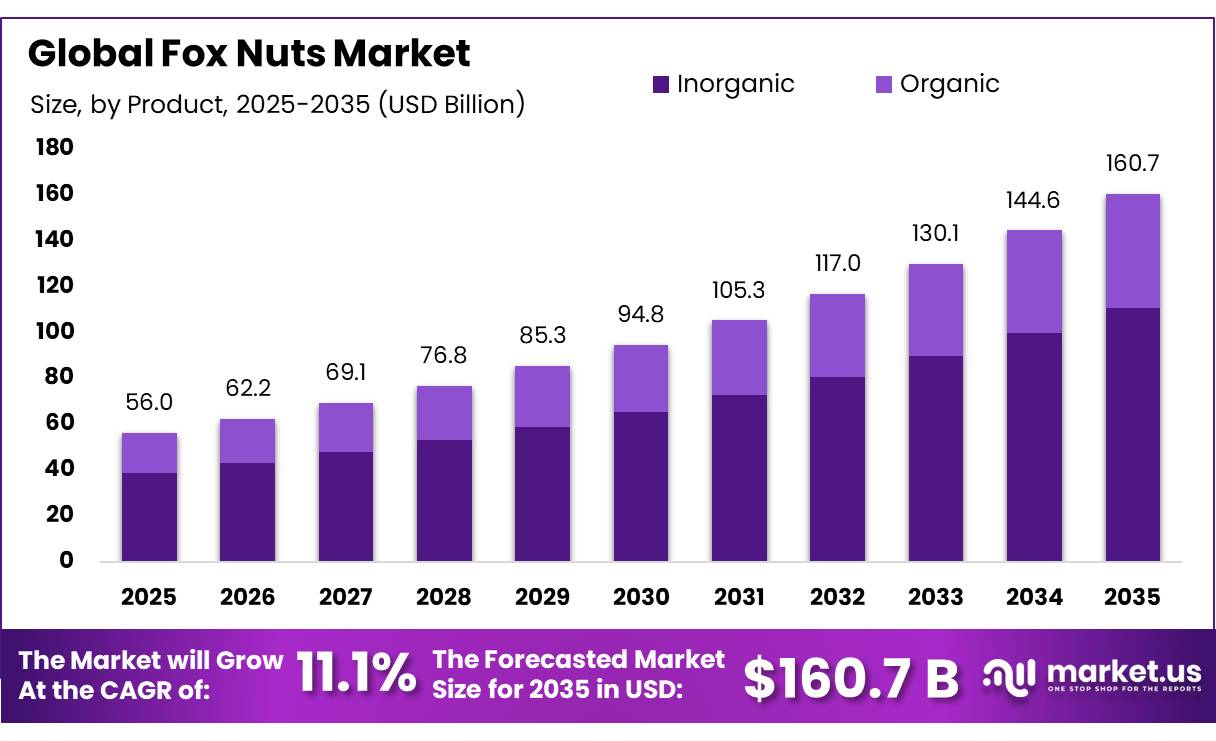
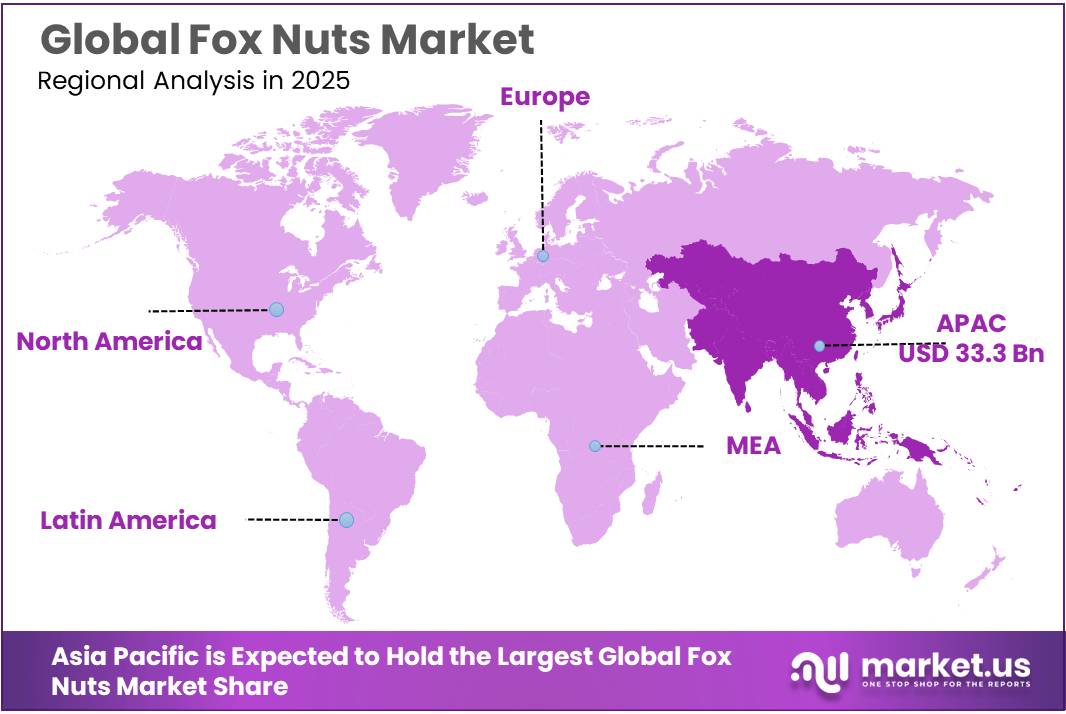
The Global Fox Nuts Market size is expected to be worth around USD 160.7 Billion by 2035, from USD 56.0 Billion in 2025, growing at a CAGR of 11.1% during the forecast period from 2026 to 2035. In 2025, Asia Pacific held a dominant market position, capturing more than a 9.6% share, holding USD 33.3 billion revenue.
The fox nuts industry, commonly associated with makhana, has emerged as a niche yet rapidly expanding segment within the global healthy snack and aquatic crop markets. Fox nuts are edible seeds derived from an aquatic plant cultivated in ponds and wetlands, primarily across parts of South and East Asia.
Traditionally consumed in India and China for centuries, makhana has gained increasing global recognition due to its nutritional profile, including high protein, low fat, and antioxidant properties. From an industry standpoint, fox nuts are positioned within the broader category of plant-based snacks and functional foods, which are experiencing strong consumer demand worldwide. According to government information presented in the Indian Parliament, India accounts for nearly 80% of the global makhana production, establishing the country as the dominant supplier in the global fox nuts industry.
The industrial production landscape of fox nuts is highly concentrated geographically, with India serving as the principal cultivation hub. Within India, the state of Bihar dominates production, contributing approximately 85–90% of the country’s total makhana output, supported by favorable agro-climatic conditions and traditional cultivation practices in wetland ecosystems.
- According to estimates from the ICAR National Research Centre for Makhana, India cultivates makhana across approximately 15,000 hectares, generating nearly 120,000 metric tons of makhana seeds annually, which after processing yield about 40,000 metric tons of popped makhana. The sector generates significant rural income, with farm-level production value estimated at around ₹250 crore, while trade and distribution revenues reach nearly ₹550 crore across the supply chain.
Several structural factors are driving the expansion of the fox nuts industry globally. One of the most prominent drivers is the rising consumer shift toward healthier snack alternatives. Surveys of urban consumers in India indicate that around 60–65% of snack consumers actively seek healthier snack options, contributing to increasing demand for low-calorie and nutrient-rich foods such as makhana.
As a result, fox nuts have transitioned from a traditional regional food into a modern packaged snack product. In parallel, the global market value of fox nuts has experienced notable growth. Industry estimates indicate that the global fox nuts market was valued at approximately USD 44 million in 2023 and is projected to exceed USD 97 million by 2030, reflecting expanding consumption and export opportunities.
Government initiatives and policy interventions have also played a significant role in strengthening the fox nuts ecosystem. The Government of India has undertaken multiple measures to promote makhana cultivation and commercialization, including the recognition of “Mithila Makhana” with a Geographical Indication (GI) tag in 2022, which enhances product authenticity, branding, and export competitiveness.
Key Takeaways
- Fox Nuts Market size is expected to be worth around USD 160.7 Billion by 2035, from USD 56.0 Billion in 2025, growing at a CAGR of 11.1%.
- Inorganic held a dominant market position, capturing more than a 69.2% share in the fox nuts market.
- Processed held a dominant market position, capturing more than a 67.3% share in the fox nuts market.
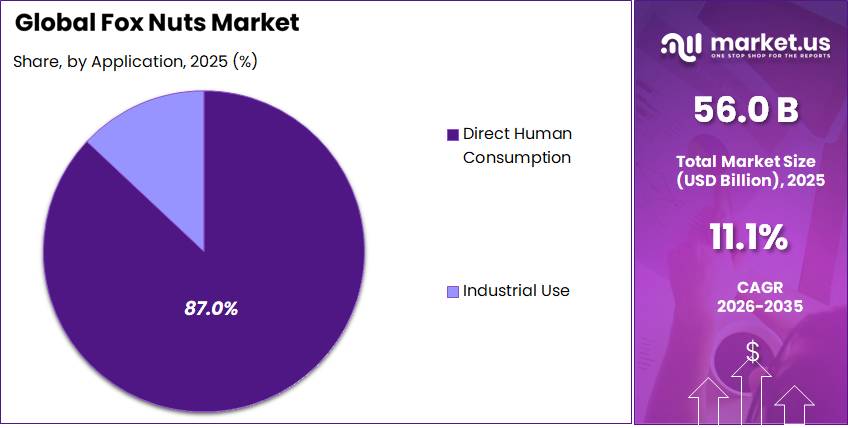
- Direct Human Consumption held a dominant market position, capturing more than a 87.4% share.
- Supermarkets & Hypermarkets held a dominant market position, capturing more than a 47.1% share.
- Asia Pacific holds the leading position in the fox nuts market, accounting for 59.6% of the global market with an estimated value of USD 33.3 billion.
By Product Analysis
Inorganic Fox Nuts dominate with 69.2% share due to higher availability and established cultivation practices
In 2024, Inorganic held a dominant market position, capturing more than a 69.2% share in the fox nuts market. This strong presence is mainly attributed to the long-standing traditional cultivation practices followed in major producing regions. Most fox nuts are grown in natural ponds and wetlands where farmers rely on conventional farming techniques rather than certified organic systems. Because of this, inorganic production remains the most common approach, allowing farmers to maintain stable output levels and supply large volumes to processors and snack manufacturers.
By Type Analysis
Processed fox nuts lead with 67.3% share driven by rising demand for ready-to-eat healthy snacks
In 2024, Processed held a dominant market position, capturing more than a 67.3% share in the fox nuts market. The strong share of this segment is largely linked to the growing popularity of ready-to-eat snack products made from fox nuts. Over the past few years, fox nuts have moved beyond traditional consumption and are now widely sold as roasted, flavored, and packaged snack products in supermarkets, convenience stores, and online platforms. This shift toward convenient and packaged foods has significantly increased the demand for processed fox nuts across both domestic and international markets.
By Application Analysis
Direct human consumption leads with 87.4% share driven by growing demand for healthy snack options
In 2024, Direct Human Consumption held a dominant market position, capturing more than a 87.4% share in the fox nuts market. This large share mainly reflects the traditional and modern consumption patterns of fox nuts as a food product. For decades, fox nuts have been widely eaten in many Asian households, especially in India and China, where they are used in snacks, sweets, and religious fasting foods. In recent years, the product has gained strong popularity as a healthy snack, which has further increased its direct consumption across different age groups.
By Distribution Channel Analysis
Supermarkets & Hypermarkets lead with 47.1% share as consumers prefer organized retail for healthy snacks
In 2024, Supermarkets & Hypermarkets held a dominant market position, capturing more than a 47.1% share in the fox nuts market. This leading position is largely driven by the growing role of organized retail in the distribution of packaged food products. Supermarkets and hypermarkets provide a wide shelf presence for healthy snack items, including fox nuts, allowing consumers to easily compare brands, flavors, and packaging formats in one place. The structured retail environment also helps brands display their products prominently, which supports higher sales volumes.
Key Market Segments
By Product
- Inorganic
- Organic
By Type
- Raw
- Processed
By Application
- Direct Human Consumption
- Industrial Use
By Distribution Channel
- Supermarkets & Hypermarkets
- Specialty Stores
- Online
- Others
Emerging Trends
Rising Popularity of Flavoured and Value-Added Fox Nut Snacks
One of the latest trends shaping the fox nuts market is the rapid rise of flavored and value-added snack products. Traditionally, makhana was mostly consumed in its plain roasted form or used in dishes such as kheer and curries. However, in recent years the product has undergone a transformation, moving into the modern packaged snack category.
Food companies and snack brands are increasingly introducing flavored varieties such as cheese, peri-peri, mint, caramel, and spice blends to attract younger consumers and urban buyers. This shift toward innovation in taste and packaging has helped fox nuts gain popularity as a convenient “healthy on-the-go” snack.
The growing popularity of value-added fox nut snacks is also reflected in rising global trade. Data from the Agricultural and Processed Food Products Export Development Authority (APEDA) shows that India’s makhana exports increased significantly from 6,700 metric tons in 2020 to about 25,130 metric tons in 2024, indicating strong international demand for processed and packaged fox nut products. Many international buyers prefer roasted and flavored makhana because it aligns with global healthy snack trends.
The strong supply base of fox nuts also supports this trend toward value addition. India is the largest producer of makhana in the world, accounting for nearly 80% of global production, and the crop is cultivated on roughly 15,000 hectares of water bodies, producing around 120,000 metric tons of seeds annually. After processing and popping, this production results in approximately 40,000 metric tons of edible makhana, which is widely used for packaged snack products.
Government initiatives are also encouraging the development of value-added makhana products. The Government of India has launched a ₹476 crore development programme for the makhana sector aimed at improving production technology, strengthening processing infrastructure, and expanding export opportunities.
Drivers
Rising Consumer Demand for Healthy and Functional Snacks Driving the Fox Nuts Market
One of the major factors driving the growth of the fox nuts (makhana) market is the rapid shift in consumer preferences toward healthier snack options. Across many countries, consumers are becoming more conscious about what they eat and are actively replacing fried or heavily processed snacks with natural and nutritious alternatives. Fox nuts fit well into this trend because they are naturally low in fat, gluten-free, and rich in essential nutrients such as protein, fibre, magnesium, and potassium. These qualities have helped makhana move from being a traditional regional food to a modern healthy snack widely accepted in urban and international markets.
- According to export data from the Agricultural and Processed Food Products Export Development Authority (APEDA), India’s makhana exports increased nearly four times, from about 6,700 metric tons in 2020 to around 25,130 metric tons in 2024, reflecting strong international demand driven largely by health-focused consumers.
Production capacity and availability also support this growing demand. India is currently the largest producer of fox nuts globally, accounting for nearly 80% of global makhana production, with most cultivation concentrated in the state of Bihar. The crop is grown in wetland ecosystems covering around 15,000 hectares, producing roughly 120,000 metric tons of makhana seeds annually, which are later processed into approximately 40,000 metric tons of popped makhana used for food consumption.
Government initiatives are further supporting the expansion of the fox nuts sector. The Government of India has introduced several policies aimed at improving cultivation, processing, and marketing of makhana. For example, a ₹476.03 crore central sector scheme for the development of the makhana industry (2025–2031) has been launched to support research, improve seed quality, strengthen processing infrastructure, and promote exports. In addition, the GI tag granted to “Mithila Makhana” in 2022 has strengthened the branding and authenticity of the product, improving its visibility in global markets and helping farmers gain better prices.
Restraints
Labor-Intensive Cultivation and Processing Limiting Large-Scale Production
One of the major restraining factors for the fox nuts (makhana) market is the highly labor-intensive nature of its cultivation and processing. Unlike many other commercial crops that have adopted modern mechanization, makhana farming still depends largely on traditional and manual methods. Farmers harvest the seeds from ponds and wetlands by physically entering the water and collecting the floating seeds from the bottom, a process that requires significant physical effort and time.
Processing also remains heavily dependent on manual labour. After harvesting, the seeds undergo several stages such as drying, roasting, cracking, and popping before they become the white edible makhana seen in markets. Studies on makhana processing show that around 76.05% of the total processing cost is associated with labour, because most of the work is performed manually and requires skilled workers. Additionally, the cost of processing raw fox nut seeds is estimated at ₹16.43 per kilogram, while the cost of producing popped makhana rises to around ₹39.13 per kilogram, reflecting the intensive effort required during processing.
- The dependence on manual work also affects the expansion of cultivation areas. India currently grows makhana on about 15,000 hectares of wetland area, producing approximately 120,000 metric tons of makhana seeds annually before processing. Although global demand for fox nuts is increasing, expanding production beyond traditional wetland regions has proven challenging due to the labour-heavy nature of farming and the requirement for specialized skills in harvesting and processing.
To address these limitations, the government and research institutions have started introducing initiatives to modernize the sector. The Government of India has proposed the establishment of a National Makhana Board, which aims to improve production efficiency, strengthen processing infrastructure, and support farmers through better technology and training. Agricultural universities and research centers are also working on improved cultivation practices and new equipment that could reduce manual labour in harvesting and processing.
Opportunity
Expanding Global Export Demand Creating Major Growth Opportunities for Fox Nuts
One of the biggest growth opportunities for the fox nuts (makhana) industry lies in the expanding global demand for healthy and plant-based snacks. Over the last few years, makhana has gained international attention as a “superfood” because of its nutritional value and its suitability for gluten-free and low-fat diets. As consumers around the world increasingly shift toward healthier eating habits, the demand for natural snack alternatives has grown significantly. This trend is creating strong export opportunities for fox nuts, especially for countries like India that already dominate global production.
- India currently holds a leading position in the global fox nuts industry, producing the majority of the world’s supply. According to agricultural reports, makhana is cultivated on around 15,000 hectares in India and produces nearly 120,000 metric tons of seeds annually, which are processed into about 40,000–50,000 metric tons of edible popped makhana. Most of this production comes from Bihar, which contributes roughly 85–90% of India’s total makhana output.
Despite this large production capacity, a surprisingly small portion of makhana currently reaches global markets. Industry trade data indicates that less than 2% of India’s total makhana production is exported, suggesting a significant untapped export potential. This gap between production and export highlights a major opportunity for the industry. With better processing facilities, stronger branding, and improved global marketing strategies, the fox nuts sector could significantly expand its presence in international markets such as North America, Europe, and the Middle East.
Export statistics already show how quickly the international market for fox nuts is growing. According to data from the Agricultural and Processed Food Products Export Development Authority (APEDA), India’s makhana exports increased sharply from 6,700 metric tons in 2020 to about 25,130 metric tons in 2024, reflecting strong demand for healthy snack products worldwide.
Regional Insights
Asia Pacific Dominates the Fox Nuts Market with 59.6% Share Valued at USD 33.3 Bn
Asia Pacific holds the leading position in the fox nuts market, accounting for 59.6% of the global market with an estimated value of USD 33.3 billion. The region’s dominance is largely supported by strong production, traditional consumption patterns, and expanding demand for healthy snack foods. Countries such as India, China, Japan, and South Korea play a key role in the regional market, both as producers and consumers of fox nuts. In Asia, makhana has long been used in daily diets, traditional medicines, and festive foods, which has helped maintain steady consumption across generations.
The region also benefits from large cultivation areas and established farming systems. In India alone, makhana is grown on approximately 15,000 hectares of wetland areas, producing nearly 120,000 metric tons of seeds annually, which after processing yields about 40,000 metric tons of edible popped makhana. These production levels provide the foundation for strong regional supply chains and expanding snack processing industries. The increasing availability of flavored and packaged fox nut products in supermarkets and online retail platforms across Asia has further supported regional market growth.
Demand for fox nuts in Asia Pacific is also driven by the rising preference for healthier snack alternatives. Consumers in countries such as India, China, and South Korea are increasingly adopting nutritious and plant-based snack options, which has helped boost the popularity of makhana as a natural and low-calorie snack. At the same time, the regional market benefits from strong export activity, with Asian producers supplying fox nuts to markets in North America, Europe, and the Middle East.
Key Regions and Countries Insights
- North America
- US
- Canada
- Europe
- Germany
- France
- The UK
- Spain
- Italy
- Rest of Europe
- Asia Pacific
- China
- Japan
- South Korea
- India
- Australia
- Rest of APAC
- Latin America
- Brazil
- Mexico
- Rest of Latin America
- Middle East & Africa
- GCC
- South Africa
- Rest of MEA
Key Players Analysis
K.K. Products is one of the recognized processors and suppliers in the fox nuts industry, operating mainly from Bihar, India. The company focuses on bulk processing and distribution of makhana for domestic snack brands and wholesale buyers. It handles large quantities of raw seeds collected from regional farmers and processes them into popped fox nuts for retail and food manufacturers. The company supports supply chains across several Indian states and exports to international buyers. Its operations contribute to India’s ~80% share of global makhana production, strengthening the country’s role in the industry.
Manju Makhana Enterprises is a well-known supplier involved in the processing and trading of fox nuts from the Mithila region of Bihar. The company sources makhana from local cultivation areas where India grows the crop across about 15,000 hectares of wetlands, producing nearly 120,000 metric tons of seeds annually. Manju Makhana Enterprises focuses on cleaning, grading, roasting, and packaging makhana for domestic and export markets. The company supplies wholesalers, snack brands, and food retailers, supporting the growing demand for packaged healthy snack products in India and overseas.
Maruti Makhana is a regional processor and trader specializing in raw and popped fox nuts. The company works closely with farmers in Bihar, a state responsible for nearly 85–90% of India’s total makhana production. Maruti Makhana focuses on bulk processing, grading, and packaging to meet the needs of distributors and snack product manufacturers. The company contributes to the growing supply chain of makhana used in roasted and flavored snacks. Its operations support India’s expanding export activity, which increased from 6,700 metric tons in 2020 to about 25,130 metric tons in 2024.
Top Key Players Outlook
- K.K. Products
- Manju Makhana Enterprises
- Maruti Makhana
- Sattviko
- Shakti Sudha
- Caryopses
- hftgroup.in
- Madhubani Makhana Private Limited
- Nijjer Agro Foods Ltd’s
- Gopala Fresh Produce Private Limited.
- Strictly Nuts
Recent Industry Developments
In 2024–2025, K.K. Products continued expanding its presence through packaged makhana products marketed under the “Chappan Bhog” brand and sold through retail and e-commerce platforms. The company manufactures different pack sizes such as 250 g, 500 g, and 1 kg makhana packs, targeting both household consumers and wholesale buyers.
As of 2024–2025, Sattviko operates as a packaged healthy snack company selling roasted fox nuts, millet puffs, trail mixes, and dry fruits through online platforms and retail stores. The brand offers multiple makhana snack formats such as 40 g, 50 g, and combo packs, with individual packs commonly priced around ₹90 per pack in the retail market.
Report Scope
Report Features Description Market Value (2025) USD 56.0 Bn Forecast Revenue (2035) USD 160.7 Bn CAGR (2026-2035) 11.1% Base Year for Estimation 2025 Historic Period 2020-2024 Forecast Period 2026-2035 Report Coverage Revenue Forecast, Market Dynamics, Competitive Landscape, Recent Developments Segments Covered By Product (Inorganic, Organic), By Type (Raw, Processed, By Application, Direct Human Consumption, Industrial Use), By Distribution Channel (Supermarkets And Hypermarkets, Specialty Stores, Online, Others) Regional Analysis North America – US, Canada; Europe – Germany, France, The UK, Spain, Italy, Rest of Europe; Asia Pacific – China, Japan, South Korea, India, Australia, Singapore, Rest of APAC; Latin America – Brazil, Mexico, Rest of Latin America; Middle East & Africa – GCC, South Africa, Rest of MEA Competitive Landscape K.K. Products, Manju Makhana Enterprises, Maruti Makhana, Sattviko, Shakti Sudha, Caryopses, hftgroup.in, Madhubani Makhana Private Limited, Nijjer Agro Foods Ltd’s, Gopala Fresh Produce Private Limited., Strictly Nuts Customization Scope Customization for segments, region/country-level will be provided. Moreover, additional customization can be done based on the requirements. Purchase Options We have three licenses to opt for: Single User License, Multi-User License (Up to 5 Users), Corporate Use License (Unlimited User and Printable PDF) 
-
-
- K.K. Products
- Manju Makhana Enterprises
- Maruti Makhana
- Sattviko
- Shakti Sudha
- Caryopses
- hftgroup.in
- Madhubani Makhana Private Limited
- Nijjer Agro Foods Ltd's
- Gopala Fresh Produce Private Limited.
- Strictly Nuts
Our Clients

- 181003
- Mar 2026






