


Global Fly Trap Market Size, Share, And Enhanced Productivity By Product Type (Sticky Traps, UV Light Traps, Disposable Bag Traps, Electric Grid Traps, Others), By Trap Mechanism (Physical Attraction, Chemical/Pheromone Attraction, Integrated Hybrid), By Application (Greenhouses, Crop Fields, Orchards and Vineyards, Livestock Facilities, Storage and Processing Units, Others), By Region and Companies - Industry Segment Outlook, Market Assessment, Competition Scenario, Trends, and Forecast 2026-2035
- Published date: March 2026
- Report ID: 180736
- Number of Pages: 324
- Format:
-
keyboard_arrow_up
Quick Navigation
Report Overview
The Global Fly Trap Market is expected to be worth around USD 733.1 million by 2035, up from USD 378.9 million in 2025, and is projected to grow at a CAGR of 6.8% from 2026 to 2035. North America fly trap market reports a 42.6% share with a valuation of USD 161.4 Mn.
A fly trap is a device designed to attract, capture, and control flies and other flying insects in different environments. These traps use various mechanisms such as sticky surfaces, ultraviolet light, bait attractants, or electric grids to lure flies and prevent them from spreading. Fly traps are commonly used in agricultural areas, food storage facilities, livestock farms, greenhouses, and residential spaces to reduce insect populations. By limiting the presence of flies, these devices help maintain hygiene, protect crops, and support healthier working and living conditions.
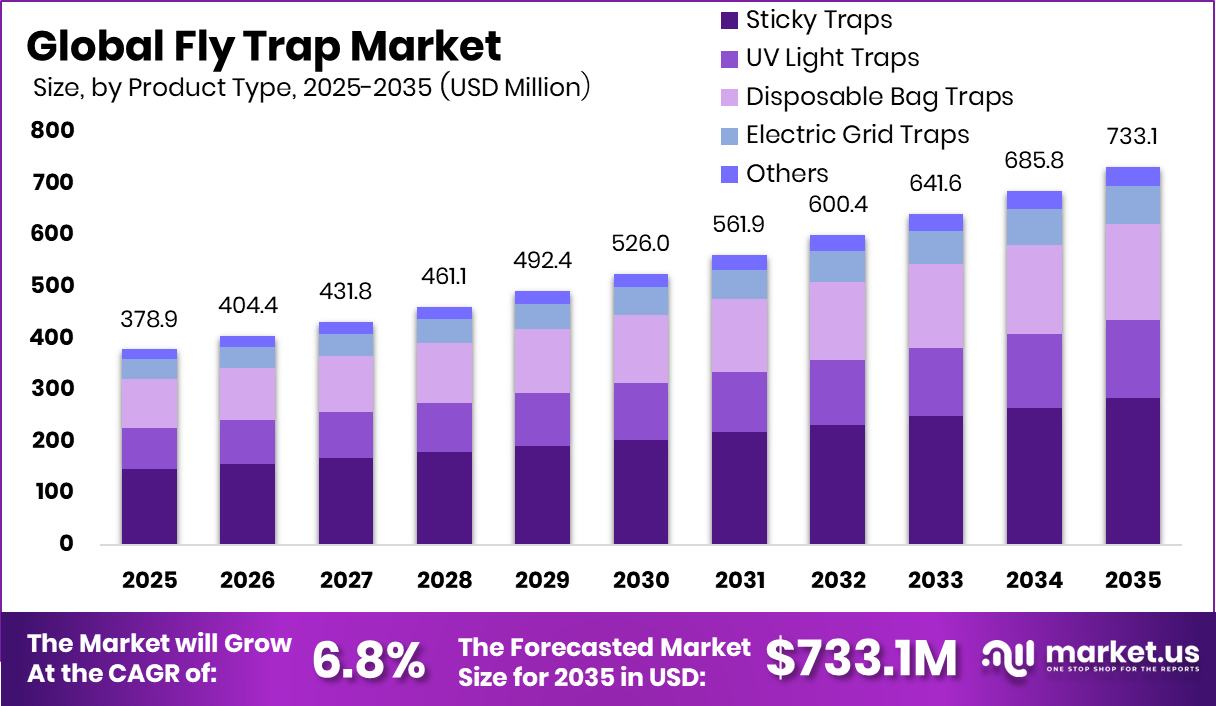
The Fly Trap Market refers to the industry involved in manufacturing and supplying trapping devices used to control fly populations across agricultural and commercial settings. The market includes different product types such as sticky traps, UV light traps, disposable bag traps, electric grid traps, and other specialized trapping systems. These solutions operate through mechanisms including physical attraction, chemical or pheromone attraction, and integrated hybrid methods. Fly traps are widely applied in greenhouses, crop fields, orchards and vineyards, livestock facilities, and storage or processing units where pest control is essential.
One of the key growth factors for the fly trap market is the expansion of controlled farming environments such as greenhouses. Governments and private initiatives are increasingly supporting greenhouse cultivation to improve agricultural productivity. For instance, farmers in the Vinnytsia region have constructed 13.3 hectares of greenhouses through grants under the eRobota state program, which highlights growing investment in protected cultivation systems where pest monitoring tools like fly traps are essential.
The demand for fly traps is also supported by technological development in greenhouse operations. Automation and monitoring solutions are becoming more common as growers aim to maintain crop health and improve production efficiency. Investments in this field continue to grow, with developments such as Bloemteknik receiving £700k funding to accelerate autonomous greenhouse growing and the rise of technology companies working on smart cultivation systems.
Looking ahead, the market presents strong opportunities as advanced greenhouse technologies continue to expand. Investment in digital agriculture is accelerating, illustrated by AI startups receiving around $1.8B in funding across sectors, including greenhouse technology and gaming, while Seattle-based startup IUNU raised $20M to develop plant monitoring technology for greenhouses. These developments highlight how modern greenhouse management and monitoring systems are becoming more advanced, creating opportunities for integrated pest control tools such as fly traps that support crop protection and efficient farming operations.
Key Takeaways
- The Global Fly Trap Market is expected to be worth around USD 733.1 million by 2035, up from USD 378.9 million in 2025, and is projected to grow at a CAGR of 6.8% from 2026 to 2035.
- In the Fly Trap Market, sticky traps dominate product types, accounting for 38.8% market share globally.
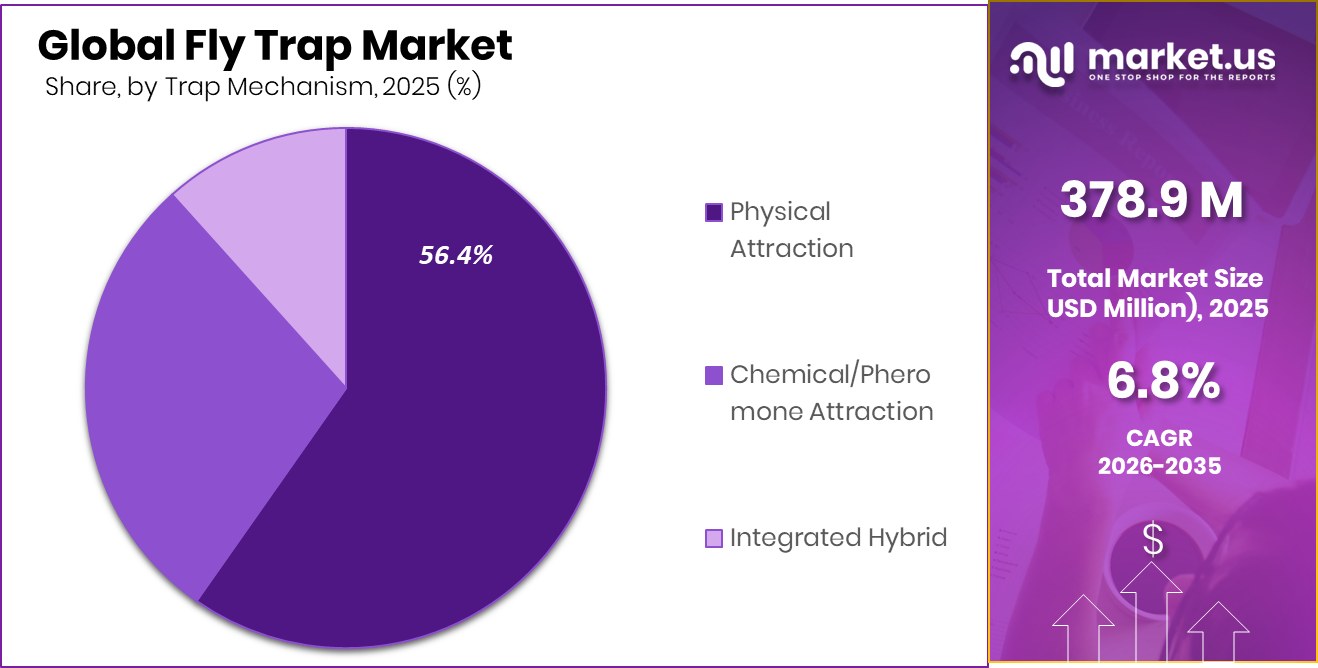
- In the Fly Trap Market, physical attraction mechanisms lead trap technologies, representing 56.4% of adoption worldwide.
- In the Fly Trap Market, greenhouse applications hold major demand, contributing 44.5% share of overall usage.
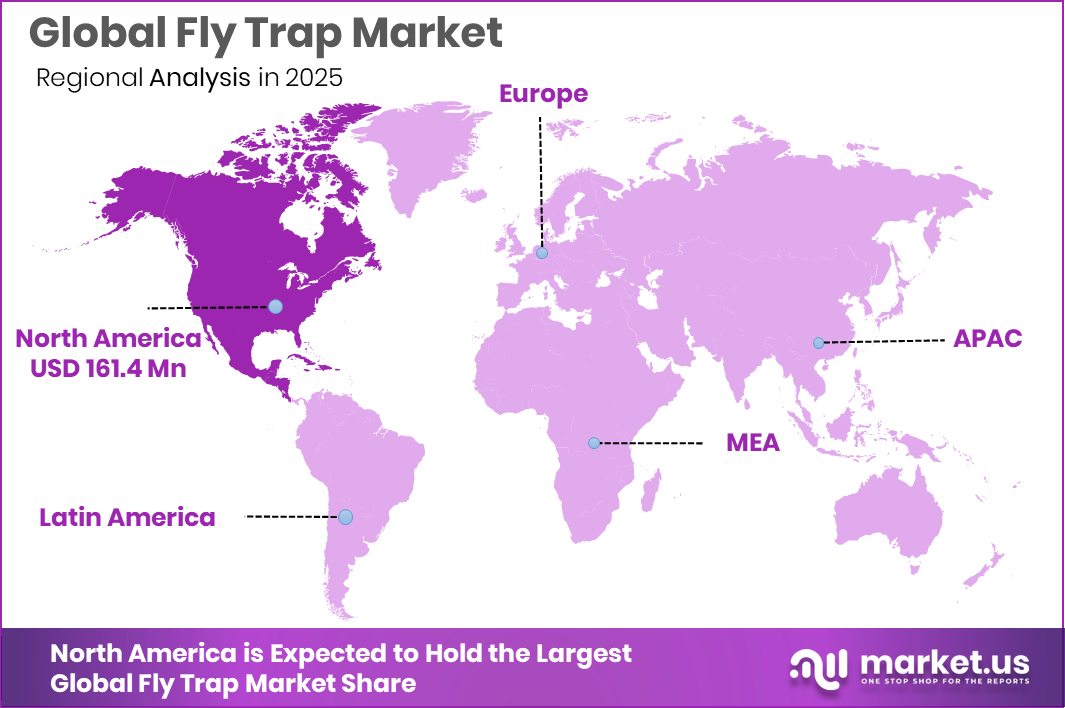
- North America dominates the fly trap market with a 42.6% share, reaching USD 161.4 Mn.
By Product Type Analysis
Sticky traps dominate the Fly Trap Market, accounting for 38.8% product share globally.
In 2025, the Fly Trap Market shows strong demand for sticky traps, accounting for 38.8% of the overall product type segment. Sticky traps are widely used because they are simple, cost-effective, and easy to install in both indoor and outdoor environments. These traps work by attracting flies and capturing them on adhesive surfaces, reducing the need for chemical insecticides.
Many households, farms, and commercial facilities prefer sticky traps due to their low maintenance and environmentally friendly nature. The growing focus on hygienic food handling and pest management in restaurants, food processing units, and agricultural settings has further increased their adoption.
Manufacturers are also introducing improved adhesive materials and longer-lasting trap designs, which enhance efficiency and durability, supporting the steady growth of sticky traps in the global fly trap market.
By Trap Mechanism Analysis
Physical attraction mechanisms lead the Fly Trap Market with a 56.4% adoption rate.
In 2025, physical attraction mechanisms dominate the Fly Trap Market with a share of 56.4%. These traps use visual cues, light, or bait to lure flies toward the device without relying on harmful chemicals. This method has become popular due to increasing awareness about safe pest control solutions in homes, commercial kitchens, and agricultural facilities.
Physical attraction traps are widely used because they are safer for people, pets, and the surrounding environment. Businesses in food storage, restaurants, and food processing plants particularly prefer these traps to maintain hygiene standards while complying with safety regulations.
Additionally, advancements in trap design, such as improved light sources and more effective bait formulations, have enhanced capture efficiency, making physical attraction traps a preferred solution in the fly trap market.
By Application Analysis
Greenhouses represent 44.5% of application demand within the growing fly trap market worldwide.
In 2025, greenhouses represent a significant application segment in the Fly Trap Market, holding 44.5% of the total share. Greenhouses create controlled environments that are ideal for plant growth, but can also attract flies and other pests that damage crops and spread diseases.
As a result, growers rely on fly traps to maintain pest control without harming plants or affecting crop quality. Sticky traps and other non-chemical trapping solutions are widely used in greenhouse farming because they support integrated pest management practices.
The increasing adoption of greenhouse cultivation for vegetables, fruits, and ornamental plants has strengthened the demand for fly traps. Farmers and commercial growers are increasingly using these traps to monitor pest activity and protect crop yields, contributing to the steady expansion of the fly trap market.
Key Market Segments
By Product Type
- Sticky Traps
- UV Light Traps
- Disposable Bag Traps
- Electric Grid Traps
- Others
By Trap Mechanism
- Physical Attraction
- Chemical/Pheromone Attraction
- Integrated Hybrid
By Application
- Greenhouses
- Crop Fields
- Orchards and Vineyards
- Livestock Facilities
- Storage and Processing Units
- Others
Driving Factors
Limited awareness in developing agricultural regions
Limited awareness about effective pest monitoring solutions remains a challenge for the Fly Trap Market, particularly in developing agricultural regions where traditional pest control methods are still widely used. Many farmers continue to rely on chemical insecticides or basic field practices instead of adopting dedicated trapping technologies. This slows the adoption of modern pest monitoring systems, especially in smaller farming communities. However, innovation and funding initiatives are gradually encouraging the development of smarter agricultural tools.
For instance, autonomous agricultural robots are advancing with a $200,000 investment supporting a Purdue University startup, highlighting efforts to improve farm management technologies. In addition, policymakers are discussing at least $15 billion in additional farmer aid, which could support agricultural modernization. Despite these efforts, awareness and training gaps continue to restrict the faster adoption of fly trap technologies in several regions.
Restraining Factors
Rising greenhouse farming increases pest control demand
The expansion of greenhouse cultivation is becoming a major driving force for the Fly Trap Market, as controlled environments require consistent pest monitoring and management. Greenhouses provide ideal conditions for crop growth, but also create favorable conditions for flies and other insects, making reliable trapping systems necessary for maintaining crop health and hygiene. Growers increasingly depend on non-chemical pest control tools such as sticky traps and monitoring traps to protect plants while maintaining production standards. Investments in agricultural technology are also supporting this shift.
For example, Kubota recently led a €6.5 million funding round in Kilter, a developer of ultra-precise spot-spraying robots designed to improve pest and weed management in farming. Such developments highlight the growing emphasis on advanced and efficient pest management systems that support the demand for fly traps.
Growth Opportunity
Expansion of protected cultivation farming worldwide
The increasing adoption of protected cultivation systems such as greenhouses, polyhouses, and controlled farming environments is creating strong growth opportunities for the Fly Trap Market. As farmers seek higher crop yields and improved quality, protected cultivation is expanding across different regions, leading to a greater need for pest monitoring and management tools. Fly traps play an important role in detecting and controlling insect populations before they affect plant health or productivity. Research investments and agricultural innovation programs are further supporting this trend.
For example, a $2 million gift was provided to support field crop research and teaching at the University of Guelph’s Ridgetown Campus, strengthening agricultural development efforts. Additionally, Montana organic farmers and Montana State University secured a $2 million grant to address perennial weeds, demonstrating continued investment in sustainable crop protection methods that indirectly support pest monitoring solutions.
Latest Trends
Smart monitoring traps integrated with sensors
One of the latest trends influencing the Fly Trap Market is the integration of smart monitoring technologies into pest control systems. Modern agricultural practices are increasingly adopting digital tools that allow farmers to track pest activity and crop conditions more efficiently. Smart traps and sensor-based monitoring systems help growers detect fly populations early and respond quickly, reducing crop damage and improving farm productivity. These technologies are becoming more relevant as agricultural research focuses on sustainability and precision farming.
Supporting this direction, the Brock research farm in Canada received a $3.5 million grant from the Canada Foundation for Innovation (CFI) to advance sustainable agriculture research. Such initiatives encourage the development of advanced monitoring systems and modern pest control strategies, which align with the growing interest in smart fly trap solutions for agricultural environments.
Regional Analysis
North America Fly Trap Market holds 42.6% share valued at USD 161.4 Mn.
The Fly Trap Market demonstrates varied growth patterns across major regions, including North America, Europe, Asia Pacific, the Middle East & Africa, and Latin America, driven by differences in agricultural practices, food safety regulations, and pest control awareness.
Asia Pacific stands as the dominating region, accounting for 48.5% of the global Fly Trap Market with a market value of USD 320.8 Mn. The region’s leadership is supported by large-scale agricultural production, expanding greenhouse farming, and increasing demand for cost-effective pest management solutions in densely populated countries.
Growing horticulture activities and rising concerns about crop protection continue to strengthen fly trap adoption across commercial farms and controlled cultivation environments. North America represents a mature market characterized by strong hygiene standards in food processing facilities, restaurants, and livestock operations, which sustain steady demand for non-chemical pest control solutions.
Europe also shows consistent adoption due to strict environmental regulations and increasing preference for eco-friendly pest control products. Meanwhile, the Middle East & Africa and Latin America are emerging markets where agricultural expansion and rising awareness of integrated pest management practices are gradually supporting the adoption of fly traps across farming and commercial sectors.
Key Regions and Countries
- North America
- US
- Canada
- Europe
- Germany
- France
- The UK
- Spain
- Italy
- Rest of Europe
- Asia Pacific
- China
- Japan
- South Korea
- India
- Australia
- Rest of APAC
- Latin America
- Brazil
- Mexico
- Rest of Latin America
- Middle East & Africa
- GCC
- South Africa
- Rest of MEA
Key Players Analysis
In 2025, AP and G Company (Catchmaster) continues to strengthen its presence in the global Fly Trap Market through a focused portfolio of pest management solutions. The company is recognized for developing practical trapping products designed for commercial, residential, and agricultural use. Its Catchmaster product line emphasizes reliability, ease of application, and consistent trapping performance. The company’s approach centers on improving product efficiency through better adhesive technologies and durable trap designs. By prioritizing functional innovation and dependable pest monitoring solutions, AP and G Company maintains a stable position among suppliers serving pest control professionals and facility management sectors.
Koppert Biological Systems B.V. plays a significant role in the fly trap ecosystem by integrating trapping solutions with broader biological pest control strategies. The company focuses on sustainable agriculture by supporting growers with tools that help manage pests while maintaining ecological balance. Within controlled farming environments such as greenhouses, Koppert’s approach combines monitoring systems with biological solutions to help growers detect and manage pest populations effectively. Its emphasis on environmentally responsible pest management strengthens its influence among commercial horticulture producers seeking reliable monitoring and trapping methods.
BioFirst Group (Biobest Group) contributes to the market through its expertise in integrated pest management for horticulture and protected crop cultivation. The company supports growers with monitoring tools and trapping products designed to improve pest detection and management practices. By focusing on practical pest monitoring systems, BioFirst helps growers maintain crop health and productivity. Its solutions are particularly relevant for greenhouse cultivation, where early pest detection plays a critical role in maintaining balanced crop environments.
Top Key Players in the Market
- AP and G Company (Catchmaster)
- Koppert Biological Systems B.V.
- BioFirst Group (Biobest Group)
- Russell IPM Ltd
- The Wonderful Company (Suterra LLC)
- ISCA Technologies, Inc
- Trécé Incorporated
- Alpha Fragrances Private Limited
- A.G.BIO-SYSTEMS PRIVATE LIMITED
- InVivo (Soufflet Group)
- Andermatt Group AG
Recent Developments
- In October 2024, Russell IPM participated in PestTech 2024, an industry event for pest management professionals. During the event, the company presented its range of pest monitoring tools, including traps used to capture and monitor flying insects such as flies in commercial and agricultural environments. The participation helped demonstrate practical trapping solutions and pheromone-based monitoring technologies used to control insect populations in food facilities and farms.
- In January 2024, Koppert introduced a new packaging design for its Horiver sticky trap portfolio, which is used for monitoring and trapping flying insects in crops and greenhouses. The redesign focused on clearer product presentation and easier application for growers. The packaging includes a transparent section showing the hanging device and highlights the trap’s monitoring function. These traps help detect pests early so growers can manage infestations using biological methods instead of chemicals.
Report Scope
Report Features Description Market Value (2025) USD 378.9 Million Forecast Revenue (2035) USD 733.1 Million CAGR (2026-2035) 6.8% Base Year for Estimation 2025 Historic Period 2020-2024 Forecast Period 2026-2035 Report Coverage Revenue Forecast, Market Dynamics, Competitive Landscape, Recent Developments Segments Covered By Product Type (Sticky Traps, UV Light Traps, Disposable Bag Traps, Electric Grid Traps, Others), By Trap Mechanism (Physical Attraction, Chemical/Pheromone Attraction, Integrated Hybrid), By Application (Greenhouses, Crop Fields, Orchards and Vineyards, Livestock Facilities, Storage and Processing Units, Others) Regional Analysis North America – US, Canada; Europe – Germany, France, The UK, Spain, Italy, Rest of Europe; Asia Pacific – China, Japan, South Korea, India, Australia, Singapore, Rest of APAC; Latin America – Brazil, Mexico, Rest of Latin America; Middle East & Africa – GCC, South Africa, Rest of MEA Competitive Landscape AP and G Company (Catchmaster), Koppert Biological Systems B.V., BioFirst Group (Biobest Group), Russell IPM Ltd, The Wonderful Company (Suterra LLC), ISCA Technologies, Inc, Trécé Incorporated, Alpha Fragrances Private Limited, A.G.BIO-SYSTEMS PRIVATE LIMITED, InVivo (Soufflet Group), Andermatt Group AG Customization Scope Customization for segments, region/country-level will be provided. Moreover, additional customization can be done based on the requirements. Purchase Options We have three licenses to opt for: Single User License, Multi-User License (Up to 5 Users), Corporate Use License (Unlimited User and Printable PDF) 
-
-
- AP and G Company (Catchmaster)
- Koppert Biological Systems B.V.
- BioFirst Group (Biobest Group)
- Russell IPM Ltd
- The Wonderful Company (Suterra LLC)
- ISCA Technologies, Inc
- Trécé Incorporated
- Alpha Fragrances Private Limited
- A.G.BIO-SYSTEMS PRIVATE LIMITED
- InVivo (Soufflet Group)
- Andermatt Group AG
Our Clients

- 180736
- March 2026






