


Global Finance Lease Market Size, Share and Analysis Report By Product (International Business, Domestic Business), By Provider (Banks, Non-banks), By Application (Transportation, Medical Devices, Energy & Environment, Construction Equipment, Industrial Machinery, IT & Telecom, Others), By Regional Analysis, Global Trends and Opportunity, Future Outlook By 2025-2035
- Published date: Feb. 2026
- Report ID: 177462
- Number of Pages: 232
- Format:
-
keyboard_arrow_up
Quick Navigation
- Report Overview
- Top Market Takeaways
- By Product Analysis
- By Provider Analysis
- By Application Analysis
- Regional Analysis
- Driver Analysis
- Restraint Analysis
- Opportunity Analysis
- Challenge Analysis
- Emerging Trends Analysis
- Growth Factors Analysis
- Competitive Analysis
- Recent Developments
- Key Market Segments
- Report Scope
Report Overview
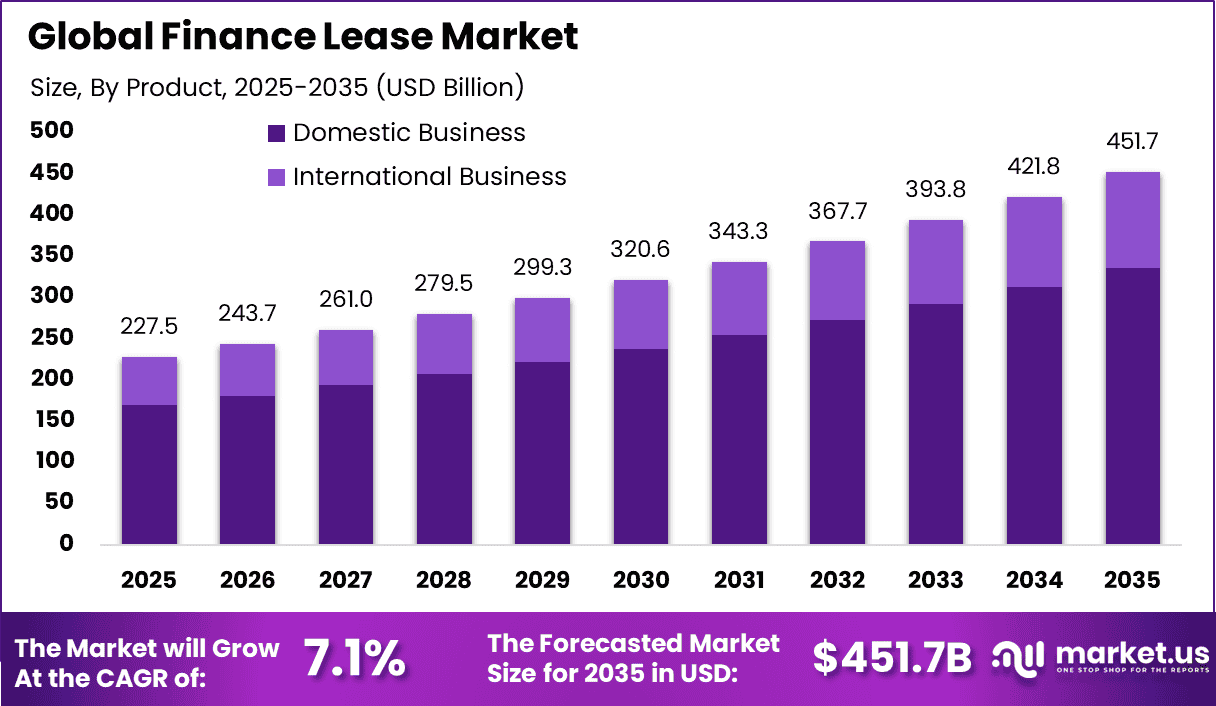
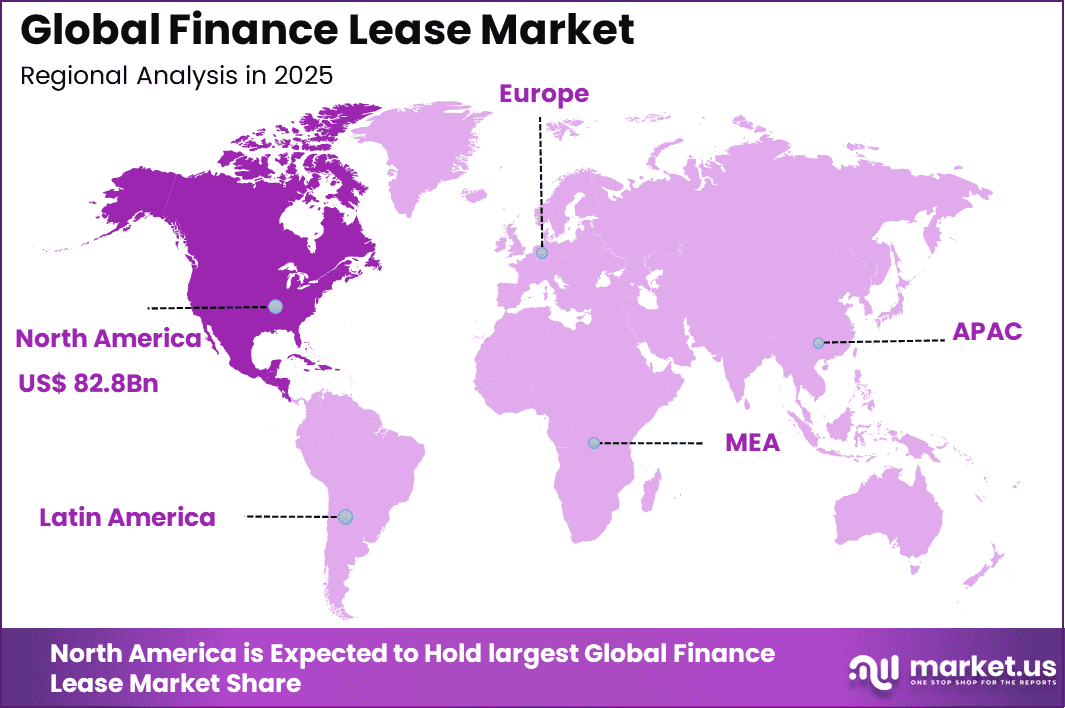
The Global Finance Lease Market size is expected to be worth around USD 451.7 Billion By 2035, from USD 227.5 billion in 2025, growing at a CAGR of 7.1% during the forecast period from 2026 to 2035. North America held a dominant Market position, capturing more than a 36.4% share, holding USD 82.8 Billion revenue.
The Finance Lease Market refers to long term leasing arrangements where the lessee uses an asset for most of its economic life while assuming the majority of risks and rewards associated with ownership. Under a finance lease, assets such as machinery, vehicles, equipment, and technology infrastructure are recorded on the lessee’s balance sheet. This structure allows businesses to access high value assets without full upfront capital expenditure.
The market plays a critical role in asset financing across industries. Finance leases are widely used by enterprises seeking predictable payment structures and long term asset use. These arrangements support capital planning and operational continuity. Industry observations indicate that more than 55% of equipment financing transactions in commercial sectors are structured as finance leases. This reflects strong preference for ownership like control with spread out payments.
Adoption and usage of finance leases are accelerating in 2026, particularly across capital intensive industries where technology cycles are shortening. In the United States, around 80% of businesses, ranging from small enterprises to Fortune 500 companies, use some form of equipment financing to acquire assets. Leasing remains the most widely used approach, as it allows organizations to preserve capital, manage risk, and upgrade technology more efficiently.
One of the main driving factors is the rising cost of capital assets across industries. Purchasing equipment outright can strain cash reserves and limit growth flexibility. Finance leases allow businesses to spread costs over time while retaining operational control. This structure supports capital efficiency and balance sheet planning.
Demand for finance leases is strong among small and mid sized enterprises that prioritize cash flow management. These businesses often lack access to large upfront financing. Internal financial studies show that leasing can preserve up to 30% of working capital compared to outright purchase. This liquidity benefit directly supports demand growth.
Top Market Takeaways
- By product type, domestic business leasing led the Finance Lease Market with a 74.2% share, reflecting strong demand from local enterprises for asset financing.
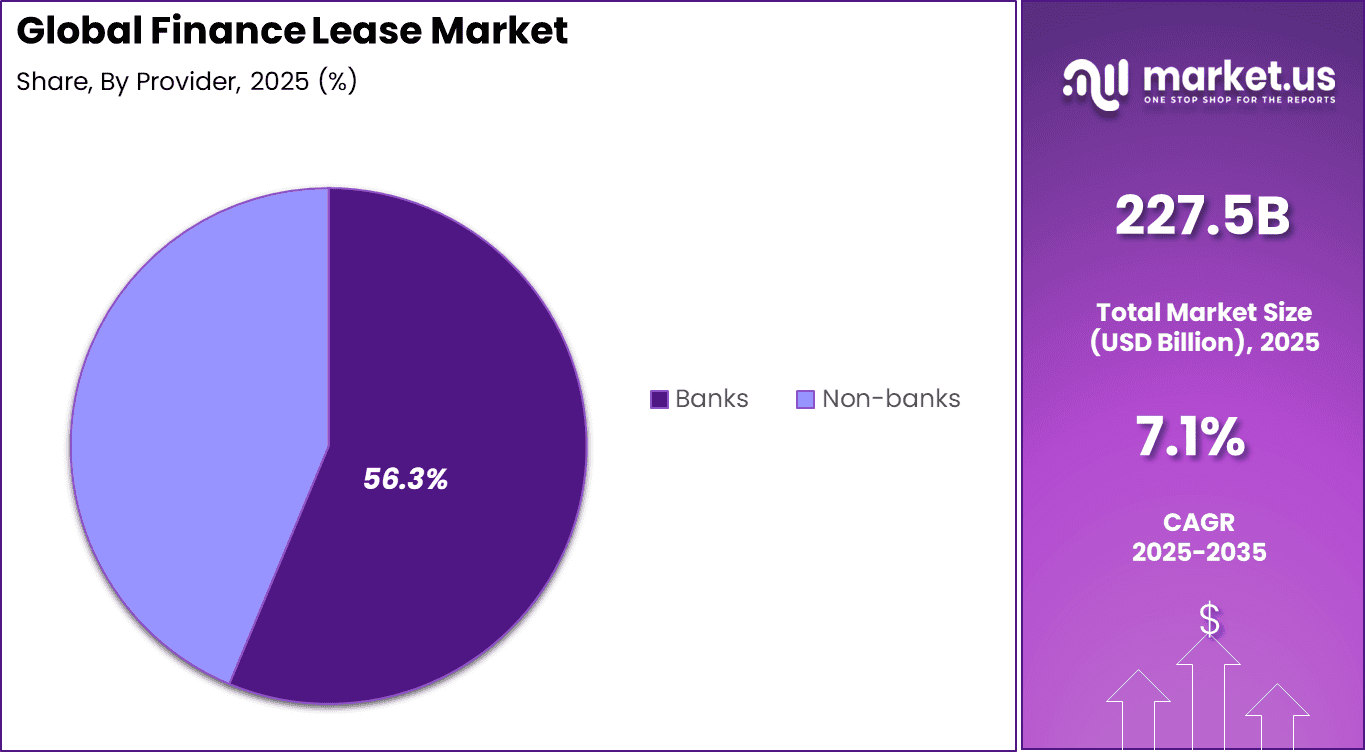
- By provider, banks accounted for 56.3% of total market share, supported by established lending networks and structured lease financing solutions.
- By application, transportation represented 37.8% of total leasing activity, driven by fleet expansion and equipment replacement needs.
- Regionally, North America held a 36.4% share of the market, supported by mature financial infrastructure.
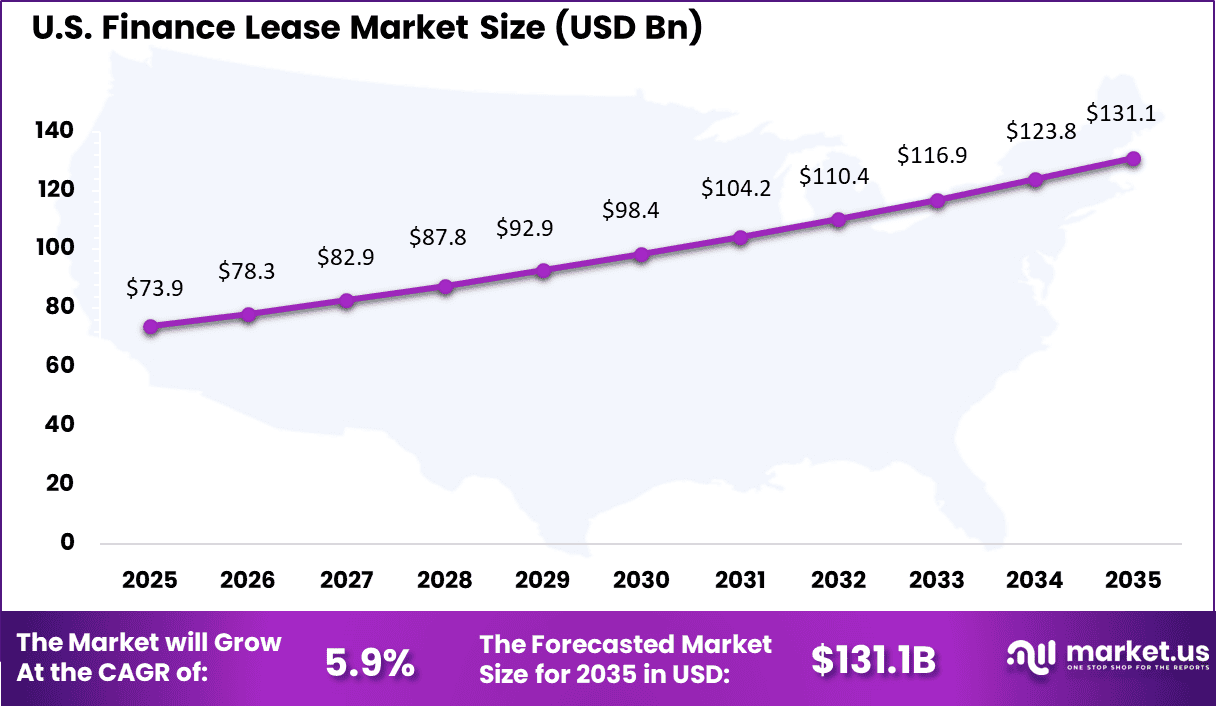
- In the US, the Finance Lease Market reached USD 73.9 billion and recorded a CAGR of 5.9%, reflecting steady growth in asset based financing.
By Product Analysis
By product, domestic business finance leases accounted for 74.2% of usage. Companies often prefer domestic leasing due to regulatory familiarity and lower cross border risk. Local currency contracts reduce exposure to exchange rate volatility. This makes domestic finance leasing more attractive for long term asset planning.
Domestic leases also allow faster execution and approval processes. Banks and leasing institutions can assess local credit risk more efficiently. This shortens deal cycles and improves funding access. As a result, domestic business leasing dominates overall activity.
Local infrastructure development further supports this segment. Transportation and logistics projects often rely on domestic financing structures. This reinforces demand for domestic finance lease products. The segment continues to benefit from stable policy environments.
By Provider Analysis
By provider, banks held a dominant share of 56.3%. Banks offer strong balance sheets and competitive interest rates. Their ability to bundle leasing with other financial services increases client retention. This positions banks as preferred finance lease providers.
Banks also benefit from established risk assessment frameworks. Asset backed leasing aligns well with traditional banking models. This allows banks to manage credit exposure effectively. As a result, banks continue to lead finance lease origination.
Relationship driven lending further strengthens bank participation. Long term client relationships support repeat leasing activity. This provides stable revenue streams for banks. Their dominance reflects trust and scale advantages.
By Application Analysis
By application, transportation accounted for 37.8% of finance lease demand. Vehicles, aircraft, rail assets, and logistics equipment require high capital investment. Finance leasing enables operators to access these assets without ownership burden. This improves fleet flexibility and renewal cycles.
Transportation businesses face constant asset replacement needs. Leasing allows regular upgrades to meet efficiency and regulatory standards. Predictable lease payments support cost planning. This makes finance leases well suited for transportation operations.
Growth in logistics and mobility services has reinforced this trend. Increased freight movement and urban transportation demand have driven asset requirements. Finance leasing supports rapid capacity expansion. Transportation remains the leading application segment.
Regional Analysis
North America accounted for 36.4% of market activity, supported by mature financial systems and strong asset leasing culture. Businesses in the region widely use leasing for capital equipment financing. Stable legal frameworks encourage long term lease agreements. This has sustained consistent demand.
In April 2025, Barings, headquartered in Charlotte, committed more than USD 200 million to acquire 12 aging aircraft along with their associated leases. The investment was made in anticipation of sustained passenger demand despite aircraft supply constraints. This transaction reflects how North American leasing firms actively manage large asset portfolios and structure complex lease arrangements within a mature leasing ecosystem.
The United States leads the region with finance lease activity valued at USD 73.9 Bn and a CAGR of 5.9%. Transportation, construction, and industrial sectors are key contributors. Businesses increasingly use leasing to manage capital efficiency.
Ongoing infrastructure investment supports regional growth. Fleet modernization and equipment upgrades continue across industries. Finance leasing remains a preferred mechanism to fund these assets. North America is expected to retain its leadership position.
Driver Analysis
A primary driver of the finance lease market is the need for businesses to acquire essential assets without immediate capital outlay. Large ticket items such as industrial machinery or advanced technology systems can strain cash reserves if purchased outright. Finance leasing spreads payments over time, allowing firms to preserve liquidity for operational needs, expansion, or strategic investments.
Another important driver is the attraction of predictable payment structures. Finance leases often include fixed periodic payments, which help businesses plan cash flows and budgeting over the lease term. Predictability reduces financial uncertainty and supports more disciplined financial management practices.
For instance, In October 2025, expanding aircraft production programs by Airbus and Boeing increased leasing demand from airlines. Carriers are increasingly relying on leasing to manage fleet costs and maintain flexibility amid delivery timelines and capital constraints. This trend reinforces the strategic role of leasing in global fleet planning.
Restraint Analysis
A key restraint in the finance lease market is credit risk concerns, particularly for smaller or financially unstable lessees. Lenders and lessors must assess the risk of default over multi-year periods. High perceived risk can result in stricter underwriting criteria, higher lease rates, or limited availability for some businesses. Tight credit conditions can slow market activity.
Another restraint relates to tax and regulatory complexity. Finance leases are treated differently from operating leases under accounting and tax standards in various jurisdictions. Complex regulatory frameworks may require specialised expertise, which increases transaction costs and administrative burden.
Opportunity Analysis
A significant opportunity in the finance lease market lies in emerging sectors with high capital intensity, such as renewable energy, logistics automation, and advanced manufacturing technology. Assets in these sectors often represent substantial cost barriers for direct purchase, making finance leases an attractive acquisition route. Lessors that develop tailored solutions for these verticals can capture growing demand.
Another opportunity is digitalisation of lease origination and management. Technology enabled platforms can streamline credit assessment, document workflows, and asset tracking. Enhanced automation reduces processing time and improves customer experience. Digital infrastructure also supports data driven pricing and risk management, strengthening competitive positioning.
Challenge Analysis
A major challenge for the finance lease market is balancing risk pricing with competitive rates. Lessors must determine appropriate lease rates that compensate for credit risk while remaining attractive to clients. Fluctuating interest rates, economic uncertainty, and asset resale value considerations complicate pricing strategies. Achieving a sustainable balance is critical for long term market viability.
Another challenge is asset residual value risk. At the end of a lease term, lessors may face uncertainty regarding the resale value of the leased asset. Market conditions, technological obsolescence, and depreciation trends influence residual value. Inaccurate residual estimates can affect profitability.
Emerging Trends Analysis
An emerging trend in the finance lease market is increased adoption of usage based and flexible lease structures. Instead of fixed payment schedules, some arrangements link payments to utilisation metrics or business performance indicators. This trend shifts risk sharing and aligns costs with asset productivity. Flexible leasing models are gaining interest among asset intensive industries.
Another trend is integration of embedded finance and leasing within broader procurement platforms. Buyers are accessing finance lease options directly within equipment procurement or online marketplaces. This embedded approach reduces friction and supports faster decision making.
Growth Factors Analysis
One of the key growth factors for the finance lease market is increased capital expenditure by enterprises seeking productivity enhancements. Investments in automation, replacement cycles, and strategic technology upgrades drive demand for asset financing solutions. Finance leases support these investment patterns.
Another growth factor is supportive tax and regulatory environments in many jurisdictions that encourage leasing through favourable treatment. Lease related incentives can improve after tax cost of asset use. Policy alignment with lease financing further supports market expansion.
Competitive Analysis
Large banking and financial institutions such as BNP Paribas, HSBC Group, and Wells Fargo Bank N.V. play a major role in the finance lease market. Their leasing portfolios cover equipment, vehicles, industrial machinery, and technology assets. Strong capital capacity and risk management frameworks support large-ticket financing. Fifth Third Bank and Commerce Bancshares, Inc. strengthen mid-market reach. Demand is driven by businesses seeking asset access without upfront capital expenditure.
Specialized leasing and financial service providers such as Sumitomo Mitsui Finance and Leasing Co. Ltd, SMBC Group, and CIT Group focus on structured finance and sector-specific leasing solutions. DLL Group and Societe Generale Equipment Finance emphasize vendor partnerships and international expansion. These players benefit from diversified asset portfolios and global distribution networks.
Industry-linked and niche lenders such as Hitachi Capital Corporation and John Deere integrate leasing with product sales. North Star Leasing and Crest Capital address SMEs with flexible terms. Texas Capital Bancshares, Inc. supports regional clients. Other providers expand competition and tailored financing solutions across industries.
Top Key Players in the Market
- Sumitomo Mitsui Finance and Leasing Co. Ltd
- BNP Paribhas
- HSBC Group
- Fifth Third Bank
- Commerce Bancshares, Inc.
- Texas Capital Bancshares, Inc.
- Wells Fargo Bank N.V.
- North Star Leasing
- Crest Capital
- SMBC Group
- CIT Group
- DLL Group
- Hitachi Capital Corporation
- John Deere
- Societe Generale Equipment Finance
- Others
Recent Developments
- In September 2025, Air Lease Corporation agreed to be acquired for USD 7.4 billion by a consortium led by Sumitomo Corporation, SMBC Aviation Capital, Apollo Global Management, and Brookfield Asset Management.
- Earlier, in May 2025, Wells Fargo agreed to sell its rail equipment leasing business to a joint venture between GATX Corporation and Brookfield Infrastructure. These developments highlight increasing consolidation and foreign investment across the finance leasing sector.
Key Market Segments
By Product
- International Business
- Domestic Business
By Provider
- Banks
- Non-banks
By Application
- Transportation
- Medical Devices
- Energy & Environment
- Construction Equipment
- Industrial Machinery
- IT & Telecom
- Other
Regional Analysis and Coverage
- North America
- US
- Canada
- Europe
- Germany
- France
- The UK
- Spain
- Italy
- Russia
- Netherlands
- Rest of Europe
- Asia Pacific
- China
- Japan
- South Korea
- India
- Australia
- Singapore
- Thailand
- Vietnam
- Rest of Latin America
- Latin America
- Brazil
- Mexico
- Rest of Latin America
- Middle East & Africa
- South Africa
- Saudi Arabia
- UAE
- Rest of MEA
Report Scope
Report Features Description Market Value (2025) USD 227.5 Bn Forecast Revenue (2035) USD 451.7 Bn CAGR(2026-2035) 7.1% Base Year for Estimation 2025 Historic Period 2020-2024 Forecast Period 2026-2035 Report Coverage Revenue forecast, AI impact on Market trends, Share Insights, Company ranking, competitive landscape, Recent Developments, Market Dynamics and Emerging Trends Segments Covered By Product (International Business, Domestic Business), By Provider (Banks, Non-banks), By Application (Transportation, Medical Devices, Energy & Environment, Construction Equipment, Industrial Machinery, IT & Telecom, Others) Regional Analysis North America – US, Canada; Europe – Germany, France, The UK, Spain, Italy, Russia, Netherlands, Rest of Europe; Asia Pacific – China, Japan, South Korea, India, New Zealand, Singapore, Thailand, Vietnam, Rest of Latin America; Latin America – Brazil, Mexico, Rest of Latin America; Middle East & Africa – South Africa, Saudi Arabia, UAE, Rest of MEA Competitive Landscape Sumitomo Mitsui Finance and Leasing Co. Ltd, BNP Paribas, HSBC Group, Fifth Third Bank, Commerce Bancshares, Inc., Texas Capital Bancshares, Inc., Wells Fargo Bank N.V., North Star Leasing, Crest Capital, SMBC Group, CIT Group, DLL Group, Hitachi Capital Corporation, John Deere, Societe Generale Equipment Finance, Others Customization Scope Customization for segments, region/country-level will be provided. Moreover, additional customization can be done based on the requirements. Purchase Options We have three license to opt for: Single User License, Multi-User License (Up to 5 Users), Corporate Use License (Unlimited User and Printable PDF) 
-
-
- Sumitomo Mitsui Finance and Leasing Co. Ltd
- BNP Paribhas
- HSBC Group
- Fifth Third Bank
- Commerce Bancshares, Inc.
- Texas Capital Bancshares, Inc.
- Wells Fargo Bank N.V.
- North Star Leasing
- Crest Capital
- SMBC Group
- CIT Group
- DLL Group
- Hitachi Capital Corporation
- John Deere
- Societe Generale Equipment Finance
- Others
Our Clients

- 177462
- Feb. 2026






