


Global Feed Preservatives Market Size, Share Analysis Report By Type (Acidifiers, Antioxidants, Mold Inhibitors, Anti-caking Agent), By Feed Type (Compound Feed, Feed Premix, Feed Meal, Silage, Others), By Livestock (Poultry, Ruminants, Aquaculture, Swine, Others), By Region and Companies - Industry Segment Outlook, Market Assessment, Competition Scenario, Trends and Forecast 2026-2035
- Published date: Mar 2026
- Report ID: 182101
- Number of Pages: 300
- Format:
-
keyboard_arrow_up
Quick Navigation
Report Overview
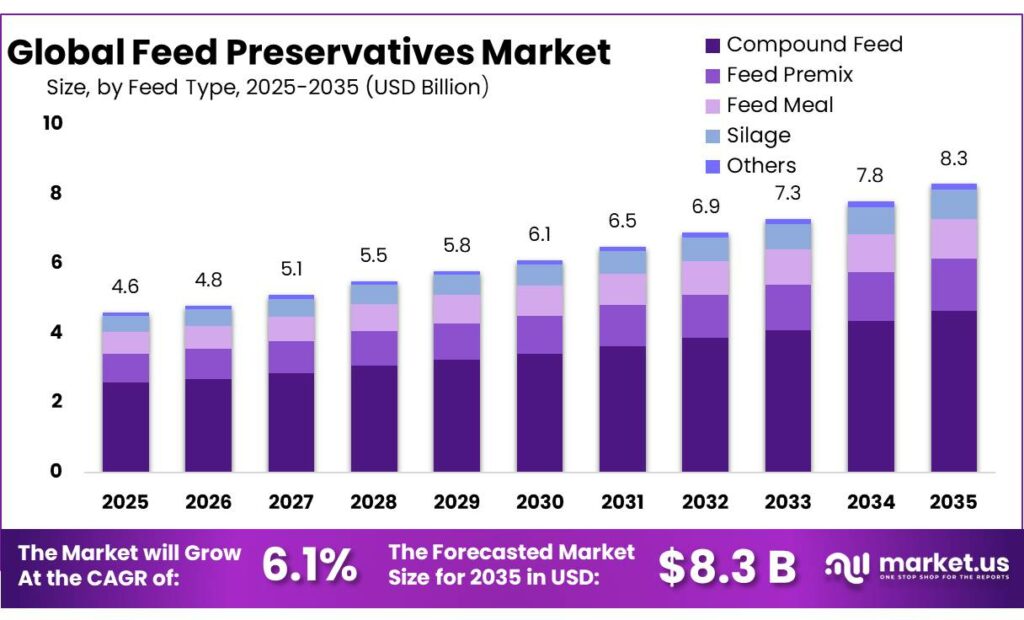
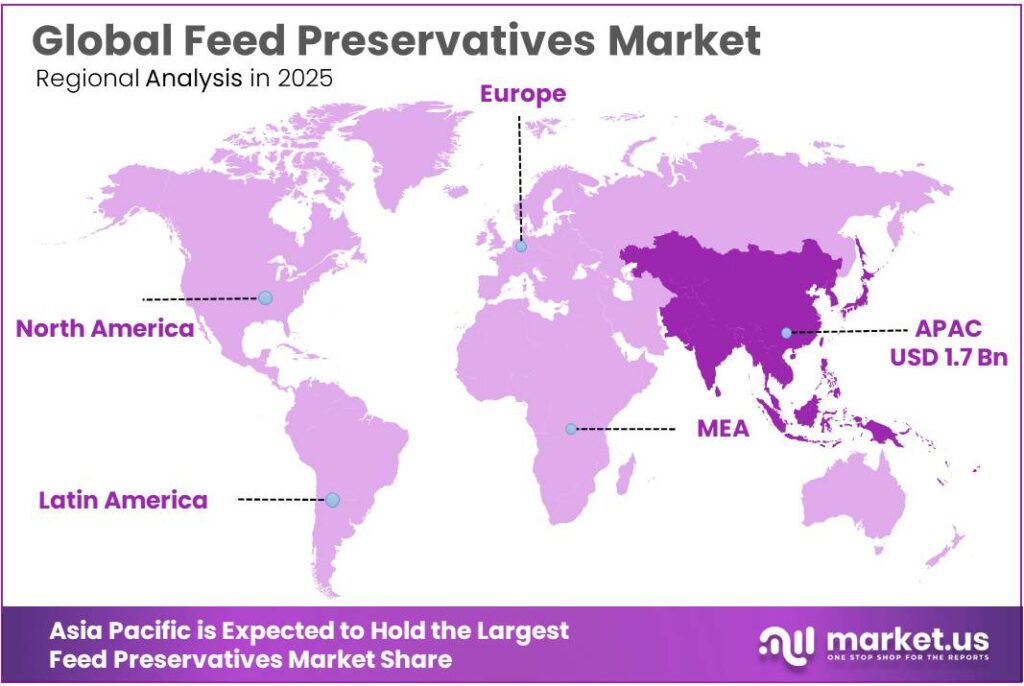
The Global Feed Preservatives Market size is expected to be worth around USD 8.4 Billion by 2035, from USD 4.6 Billion in 2025, growing at a CAGR of 6.1% during the forecast period from 2026 to 2035. In 2025, Asia Pacific held a dominant market position, capturing more than a 37.1% share, holding USD 1.7 Billion revenue.
Feed preservatives represent a strategically important input segment within the animal nutrition value chain because they protect compound feed, premixes and stored raw materials from mold, yeast, oxidation and nutrient degradation during transport and storage. Their commercial relevance is strengthening alongside the scale of global livestock production: world meat output reached 374 million tonnes in 2024, global milk production stood at 985 million tonnes, and world egg production reached 100 million tonnes, according to FAO.
In parallel, Alltech’s 2025 Agri-Food Outlook estimated total global feed production at 1.396 billion metric tons in 2024, up 1.2% year on year, indicating that even small improvements in feed stability can influence very large physical volumes across poultry, swine, ruminant, aquaculture and pet food systems.
From an industrial scenario perspective, the category is being shaped less by speculative demand and more by operational necessity. Feed remains one of the largest cost items in animal agriculture; USDA projects U.S. feed spending at $65.6 billion in 2026, after a 6.8% decline from 2025, still leaving it among the biggest production expense categories. That cost intensity increases the value of preservatives that can reduce spoilage losses, preserve palatability and support shelf life in humid or long-logistics environments.
Regulatory oversight is also reinforcing adoption. In the United States, FDA’s FSMA rule for animal food requires covered facilities to maintain written food-safety plans and preventive controls, while in Europe the authorization system continues to formalize preservative use. A notable example is Commission Implementing Regulation (EU) 2024/1755, which authorized acetic acid, calcium acetate and sodium diacetate as feed additives for fish; the EU food and feed portal lists an authorization date of 16 July 2024 and an expiry date of 16 July 2034.
Government and multilateral initiatives are also strengthening the category’s outlook. In March 2025, Codex published a discussion paper to revise its 1997 code of practice for reducing aflatoxin B1 in feed for milk-producing animals; the document says the updated work is intended for consideration through 2027 and is meant to provide member countries and industry with updated guidance.
Key Takeaways
- Feed Preservatives Market size is expected to be worth around USD 8.4 Billion by 2035, from USD 4.6 Billion in 2025, growing at a CAGR of 6.1%.
- Acidifiers held a dominant market position, capturing more than a 37.4% share.
- Compound Feed held a dominant market position, capturing more than a 56.3% share.
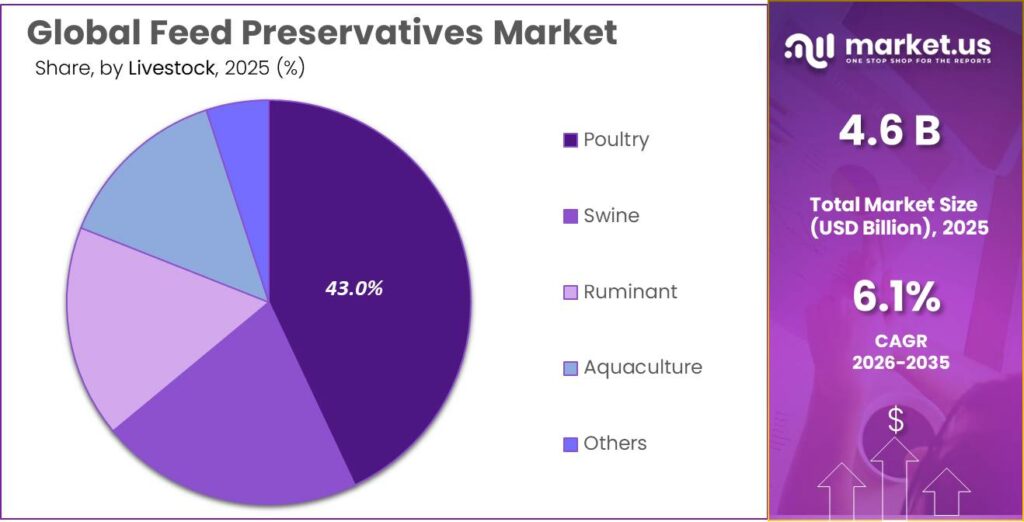
- Poultry held a dominant market position, capturing more than a 43.2% share.
- Asia Pacific holds a leading position in the Feed Preservatives market, accounting for a dominant 37.1% share valued at USD 1.7 Bn.
By Type Analysis
Acidifiers dominate with 37.4% as they improve feed safety and shelf life effectively
In 2025, Acidifiers held a dominant market position, capturing more than a 37.4% share. This strong presence is mainly because acidifiers play an important role in preserving feed quality and preventing microbial growth. They help control harmful bacteria such as salmonella and improve gut health in animals, which makes them highly preferred by feed manufacturers. Acidifiers like formic acid, lactic acid, and propionic acid are widely used as they not only extend shelf life but also support better digestion and nutrient absorption in livestock.
By Feed Type Analysis
Compound Feed dominates with 56.3% as large-scale feed production drives preservative demand
In 2025, Compound Feed held a dominant market position, capturing more than a 56.3% share. This leadership is mainly due to the high volume production of compound feed used across poultry, livestock, and aquaculture sectors. Compound feed is produced in bulk and stored for longer periods, which increases the need for preservatives to maintain quality and prevent spoilage. Feed manufacturers rely heavily on preservatives to control mold growth, bacteria, and moisture-related damage, ensuring consistent feed safety and performance.
By Livestock Analysis
Poultry dominates with 43.2% as high production cycles increase need for feed protection
In 2025, Poultry held a dominant market position, capturing more than a 43.2% share. This strong position is mainly driven by the large-scale production of poultry feed and the fast growth cycle of birds, which requires consistent and high-quality nutrition. Feed preservatives play a key role in preventing spoilage, controlling mold, and maintaining feed freshness, especially since poultry feed is often stored and transported in bulk. Farmers and producers rely on these preservatives to ensure better feed intake and overall bird health.
Key Market Segments
By Type
- Acidifiers
- Antioxidants
- Mold Inhibitors
- Anti-caking Agent
By Feed Type
- Compound Feed
- Feed Premix
- Feed Meal
- Silage
- Others
By Livestock
- Poultry
- Ruminants
- Aquaculture
- Swine
- Others
Emerging Trends
Shift Toward Natural and Safer Feed Preservatives Becoming a Key Market Trend
One of the most noticeable trends in the feed preservatives market is the growing shift toward natural and safer preservation solutions. Over time, concerns around chemical residues, animal health, and food safety have pushed both producers and regulators to rethink how feed is preserved. Today, there is a clear movement toward organic acids, plant-based preservatives, and fermentation-based solutions that are considered safer and more sustainable.
This trend is strongly linked to feed safety risks. According to FAO and WHO findings, contamination in animal feed—especially from fungi and toxins—can directly affect livestock health and food safety, leading to reduced productivity and even disease outbreaks. Because of this, producers are looking for preservatives that not only extend shelf life but also actively reduce microbial risks.
Increasing Focus on Feed Safety and Contamination Control Driving Innovation
According to FAO guidelines, feed must be stored and handled in a way that minimizes deterioration and contamination, especially from bacteria and fungi. Moisture, poor storage conditions, and long transportation times often lead to mold growth, which can produce harmful mycotoxins. Studies show that mycotoxin-contaminated feed can cause reduced feed intake, poor weight gain, and even higher mortality rates in animals.
At the same time, adoption of feed safety practices is increasing globally, with research showing that improved on-farm feed management supports both animal health and environmental sustainability. Governments and international bodies are promoting traceability systems, quality checks, and hazard control methods like HACCP to ensure safer feed production.
Drivers
Rising Feed Spoilage and Food Loss Driving Demand for Feed Preservatives
One of the strongest driving factors for the feed preservatives market is the growing issue of feed spoilage and overall food loss across the supply chain. A significant portion of feed gets damaged due to mold, bacteria, and poor storage conditions, which directly affects animal health and farm productivity. According to global estimates, nearly one-third of all food produced worldwide is lost or wasted, which equals about 931 million tonnes annually.
Feed spoilage is a major concern in livestock farming. Research shows that a large amount of livestock feed is wasted every year due to microbial growth, oxidation, and nutrient degradation. When feed spoils, it not only leads to economic loss but also reduces its nutritional value, directly impacting animal performance. In regions with high humidity and temperature, spoilage risk becomes even higher, making preservatives essential for maintaining feed quality during storage and transport.
Increasing Focus on Feed Quality, Safety, and Livestock Productivity Supporting Market Growth
Another major factor driving the feed preservatives market is the rising focus on feed quality and safety, which directly impacts livestock productivity and food safety for humans. Animal feed is a critical part of the global food chain, and any contamination or quality issue can affect meat, milk, and egg production. According to FAO and industry guidelines, feed must meet strict safety standards to avoid health risks and ensure proper animal growth
Governments and regulatory bodies are also playing a strong role by introducing food safety programs and feed hygiene standards. These initiatives encourage the use of safe additives and preservatives to ensure compliance and protect public health. At the same time, modern livestock farming is becoming more intensive, requiring longer storage and transportation of feed, which increases the need for effective preservation.
Restraints
Safety Concerns and Strict Regulations Limiting Adoption of Feed Preservatives
One of the major restraining factors for the feed preservatives market is the growing concern around safety, toxicity, and strict regulatory approvals. Feed preservatives, like other additives, must meet detailed safety standards because they directly affect animal health and indirectly impact human food consumption. According to global food safety frameworks, feed additives are assessed not only for animal safety but also for consumer health, worker exposure, and environmental impact, making approval processes complex and time-consuming.
International bodies like the Joint FAO/WHO Expert Committee on Food Additives (JECFA) have already evaluated more than 2,500 food additives and around 90 veterinary drug residues, showing how strict and detailed the global regulatory system has become. This level of scrutiny slows down the introduction of new preservative products and increases compliance costs for manufacturers. Many companies need to conduct multiple safety studies, including toxicity and long-term exposure tests, before their products can be approved for use.
Consumer Perception and Preference for Natural Alternatives Reducing Market Growth
Another important restraint comes from changing consumer preferences and increasing skepticism toward chemical-based additives. Today, consumers are more aware of food quality and are concerned about what goes into the food chain, including animal feed. Reports show that many consumers are worried about the long-term effects of additives, with concerns ranging from allergies to possible chronic health risks
Government initiatives promoting safe and sustainable agriculture are also encouraging reduced use of synthetic chemicals in feed. This is especially visible in regions where organic farming and antibiotic-free production are gaining popularity. As consumers demand transparency and natural products, feed producers are forced to adapt, often reducing reliance on traditional preservatives.
Opportunity
Reducing Feed Loss and Improving Storage Efficiency Creating Strong Growth Opportunity
One of the biggest growth opportunities in the feed preservatives market comes from the need to reduce feed loss and improve storage efficiency across the supply chain. A large portion of feed ingredients and raw materials is lost due to spoilage, contamination, and poor storage conditions. According to the Food and Agriculture Organization (FAO), nearly one-third of global food production is lost or wasted every year, showing the scale of inefficiency across the system.
Feed spoilage directly impacts livestock productivity. When feed quality drops, animals consume less or gain weight more slowly, which reduces farm output. Studies also show that improving feed quality through better nutrition practices can increase farm income by 10% to 15%, highlighting the economic importance of maintaining feed integrity. Governments and global organizations are actively promoting food loss reduction under sustainability goals such as SDG 12.3, which focuses on cutting food waste across supply chains.
Growing Use of Circular Economy and Waste-to-Feed Solutions Expanding Market Scope
Another important opportunity is the increasing focus on circular economy practices, especially the conversion of food waste into animal feed. With rising concerns about resource use and environmental impact, industries are exploring ways to reuse and recycle food by-products as feed ingredients. Research shows that food waste can be effectively converted into animal feed, reducing waste disposal and creating an alternative nutrient source for livestock.
Globally, food waste is estimated at around 931 million tonnes annually, which highlights a massive untapped resource that can be redirected into feed systems. However, one of the key challenges in using such materials is maintaining their quality and preventing spoilage during processing and storage. This is where feed preservatives become essential, as they help stabilize recycled feed materials and ensure they remain safe for animal consumption.
Regional Insights
Asia Pacific dominates the Feed Preservatives market with 37.1% share, valued at USD 1.7 Bn, driven by large-scale feed production and rising livestock demand
Asia Pacific holds a leading position in the Feed Preservatives market, accounting for a dominant 37.1% share valued at USD 1.7 Bn, supported by its massive livestock base and rapidly expanding feed industry.
The region is recognized as the largest producer of animal feed globally, with Asia-Pacific contributing around 466 million tons, or 36.8% of total global compound feed production, highlighting its strong manufacturing scale. This large volume of feed production naturally increases the need for preservatives to maintain quality, prevent spoilage, and ensure longer shelf life during storage and transportation.
Key Regions and Countries Insights
- North America
- US
- Canada
- Europe
- Germany
- France
- The UK
- Spain
- Italy
- Rest of Europe
- Asia Pacific
- China
- Japan
- South Korea
- India
- Australia
- Rest of APAC
- Latin America
- Brazil
- Mexico
- Rest of Latin America
- Middle East & Africa
- GCC
- South Africa
- Rest of MEA
Key Players Analysis
Cargill Incorporated is one of the largest players in the feed preservatives market, supported by its strong global supply chain and animal nutrition business. In 2025, the company reported USD 154 billion in total revenue, maintaining its position as a global leader in agriculture and food ingredients. It operates in 70+ countries with over 160,000 employees, and runs 250+ feed and nutrition facilities worldwide. Around 25–30% of its business is linked to animal nutrition, including preservatives and feed additives, supporting large-scale livestock production.
Kemin Industries, Inc. is a leading company in feed preservatives and animal nutrition technologies, with operations in 90+ countries. The company employs over 3,000 people and offers 500+ specialty ingredients, including mold inhibitors and antimicrobial preservatives. Around 30% of its total revenue comes from animal nutrition and health products. Kemin invests nearly 6–7% of annual revenue in research and innovation, supporting development of advanced preservation technologies that improve feed quality and shelf life.
Top Key Players Outlook
- Cargill Incorporated
- Biomin Holding GmbH
- Perstorp Holding AB
- Kemin Industries, Inc.
- Pestell Minerals & Ingredients Inc.
- Novus International, Inc.
- Nutreco NV
- Impextraco NV
- Eastman Chemical Company
Recent Industry Developments
In 2025, Cargill reported US$154 billion revenue, 155,000+ employees, operations in 70 countries, and supply reach across 125 markets; within Animal Nutrition & Health, the company says it operates in 40 countries, runs 280 locations, produces more than 62,000 tons of feed per day, and more than 16 million tons per year.
In 2025, Perstorp continues to be recognized among key global players in the animal nutrition organic acids market, which itself reached around US$2.11 billion in 2025 and is growing steadily with demand for antibiotic alternatives.
Report Scope
Report Features Description Market Value (2025) USD 4.6 Bn Forecast Revenue (2035) USD 8.3 Bn CAGR (2026-2035) 6.1% Base Year for Estimation 2025 Historic Period 2020-2024 Forecast Period 2026-2035 Report Coverage Revenue Forecast, Market Dynamics, Competitive Landscape, Recent Developments Segments Covered By Type (Acidifiers, Antioxidants, Mold Inhibitors, Anti-caking Agent), By Feed Type (Compound Feed, Feed Premix, Feed Meal, Silage, Others), By Livestock (Poultry, Ruminants, Aquaculture, Swine, Others) Regional Analysis North America – US, Canada; Europe – Germany, France, The UK, Spain, Italy, Rest of Europe; Asia Pacific – China, Japan, South Korea, India, Australia, Singapore, Rest of APAC; Latin America – Brazil, Mexico, Rest of Latin America; Middle East & Africa – GCC, South Africa, Rest of MEA Competitive Landscape Cargill Incorporated, Biomin Holding GmbH, Perstorp Holding AB, Kemin Industries, Inc., Pestell Minerals & Ingredients Inc., Novus International, Inc., Nutreco NV, Impextraco NV, Eastman Chemical Company Customization Scope Customization for segments, region/country-level will be provided. Moreover, additional customization can be done based on the requirements. Purchase Options We have three licenses to opt for: Single User License, Multi-User License (Up to 5 Users), Corporate Use License (Unlimited User and Printable PDF) 
-
-
- Cargill Incorporated
- Biomin Holding GmbH
- Perstorp Holding AB
- Kemin Industries, Inc.
- Pestell Minerals & Ingredients Inc.
- Novus International, Inc.
- Nutreco NV
- Impextraco NV
- Eastman Chemical Company
Our Clients

- 182101
- Mar 2026






