


Global Feature Licensing Platform Market By Component (Platform/Solutions (Activation-based, Consumption-based, Entitlement-based), Services (Consulting Services, Implementation Services, Managed Services)), By Deployment (Cloud-Based, On-Premises), By Enterprise Size (Large Enterprises, Small & Mid-sized Enterprises (SMEs)), By Application (Digital Media, Software as a Service (SaaS), Gaming, Enterprise Software, Others),By Regional Analysis, Global Trends and Opportunity, Future Outlook By 2025-2035
- Published date: Mar. 2026
- Report ID: 180570
- Number of Pages: 269
- Format:
-
keyboard_arrow_up
Quick Navigation
- Report Overview
- Top Market Takeaways
- Drivers Impact Analysis
- Restraints Impact Analysis
- By Component
- By Deployment
- By Enterprise Size
- By Application
- Investor Type Impact Matrix
- Technology Enablement Analysis
- Key Challenges
- Emerging Trends
- Growth Factors
- Key Market Segments
- Regional Analysis
- Competitive Analysis
- Future Outlook
- Recent Developments
- Report Scope
Report Overview
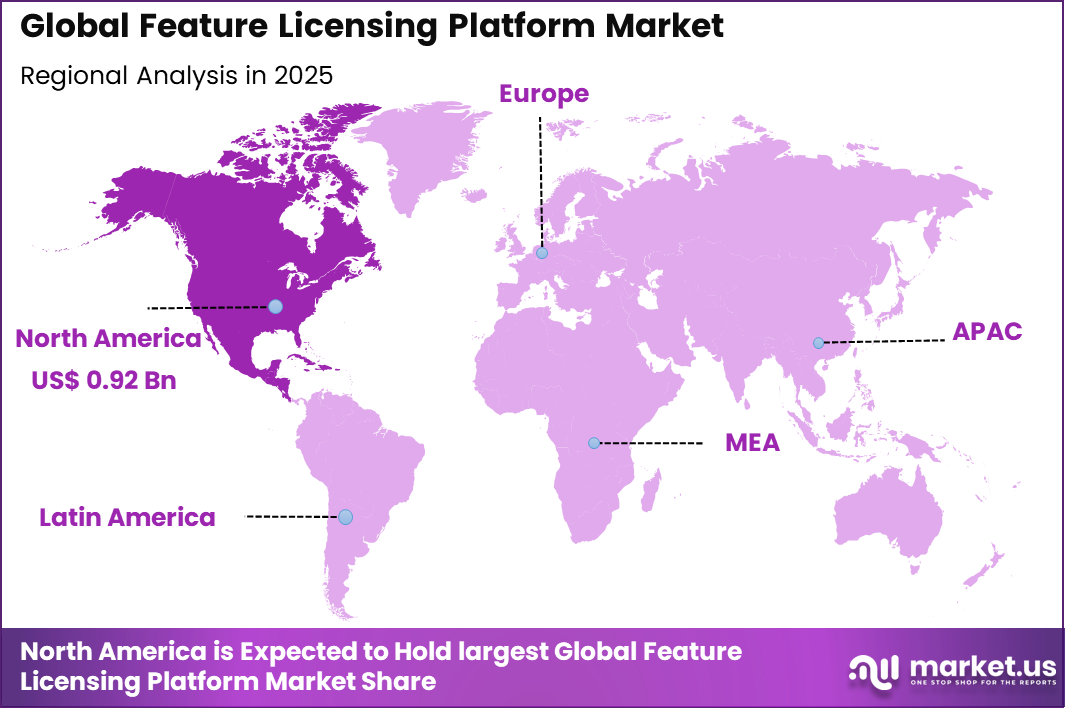
The Global Feature Licensing Platform Market generated USD 2.4 billion in 2025 and is predicted to register growth from USD 2.8 billion in 2026 to about USD 9.4 billion by 2035, recording a CAGR of 14.60% throughout the forecast span. In 2025, North America held a dominan market position, capturing more than a 38.23% share, holding USD 0.92 Billion revenue.
The feature licensing platform market focuses on technologies that allow software vendors and digital product providers to control access to specific features within their applications. These platforms manage licensing rules, entitlements, and usage tracking so that organizations can enable or disable functionality based on subscription plans or usage policies. As software delivery shifts toward subscription and usage based models, the need for flexible licensing control has increased.
Feature licensing platforms help companies monetize digital products more efficiently while maintaining product security. Feature Licensing Platforms help organizations monitor and control how software features are accessed and used across users and devices. These platforms provide detailed analytics on feature consumption, license denials, and user activity, enabling businesses to identify underutilized resources and improve license allocation.
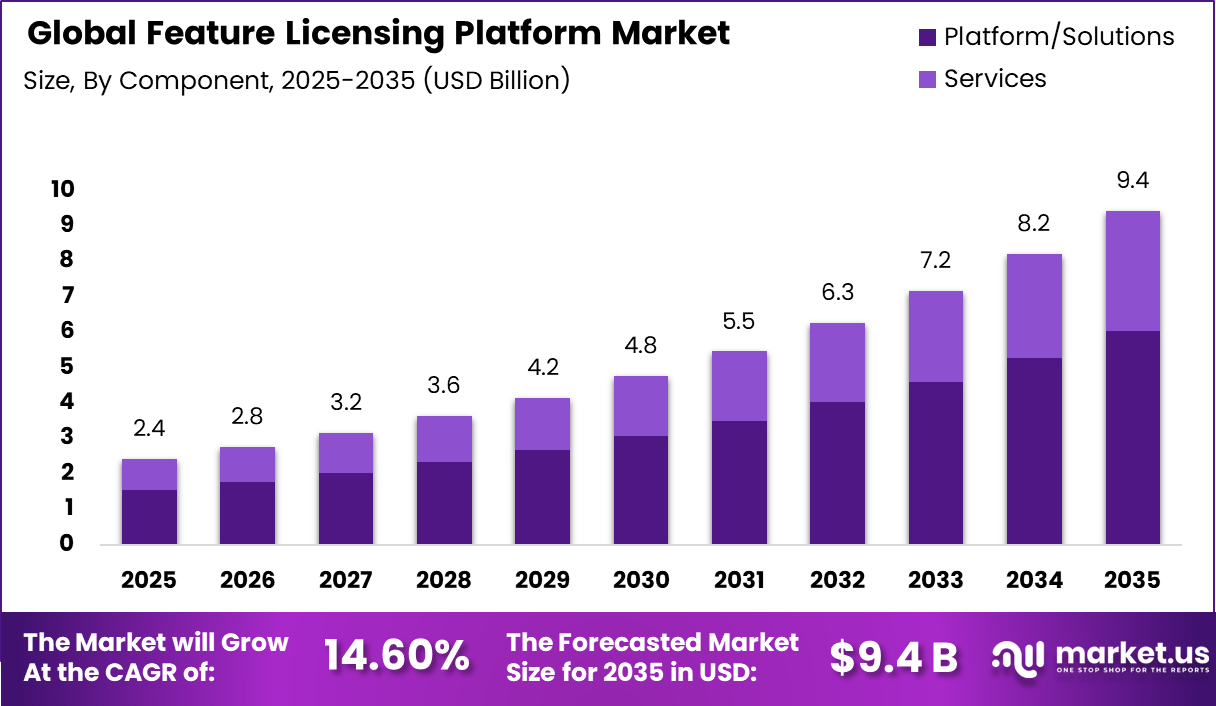
By optimizing software usage and managing subscription models more effectively, companies can reduce licensing expenses by up to 30% while improving compliance and operational visibility. Industry observations indicate that around 61% of companies are prioritizing subscription or term-based licensing as their primary growth model in 2025, reflecting the increasing shift toward flexible and usage-based software monetization strategies.
Top Market Takeaways
- By Component, platform/solutions dominate with 64.25% share, enabling granular feature flags, usage metering, and automated entitlement enforcement across multi-tenant architectures.
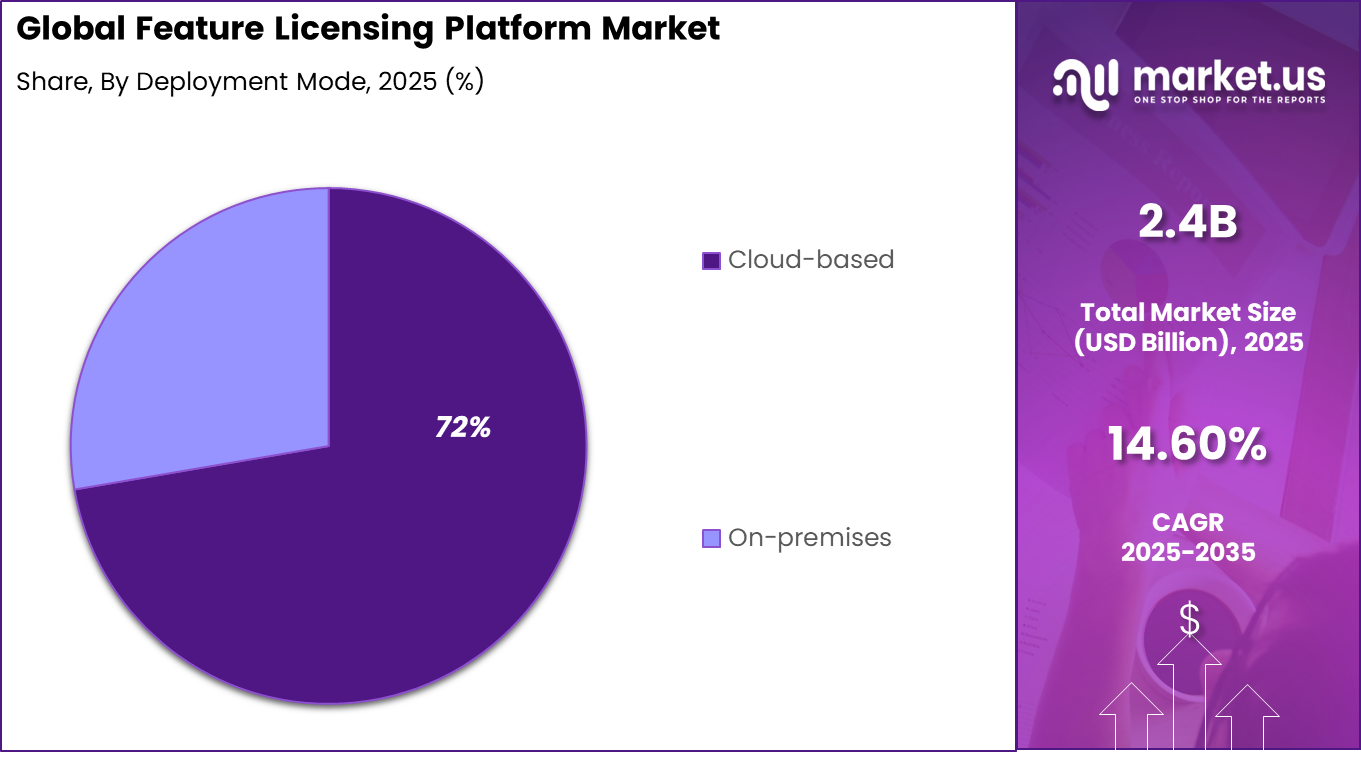
- By Deployment, cloud-based captures 72.3%, delivering elastic scaling, real-time license synchronization, and integration with hyperscale billing systems.
- By Enterprise Size, large enterprises hold 58.61%, orchestrating complex licensing models across global SaaS portfolios with analytics-driven revenue optimization.
- By Application, Software as a Service (SaaS) leads at 39.4%, powering freemium upgrades, trial conversions, and pay-per-feature consumption tracking.
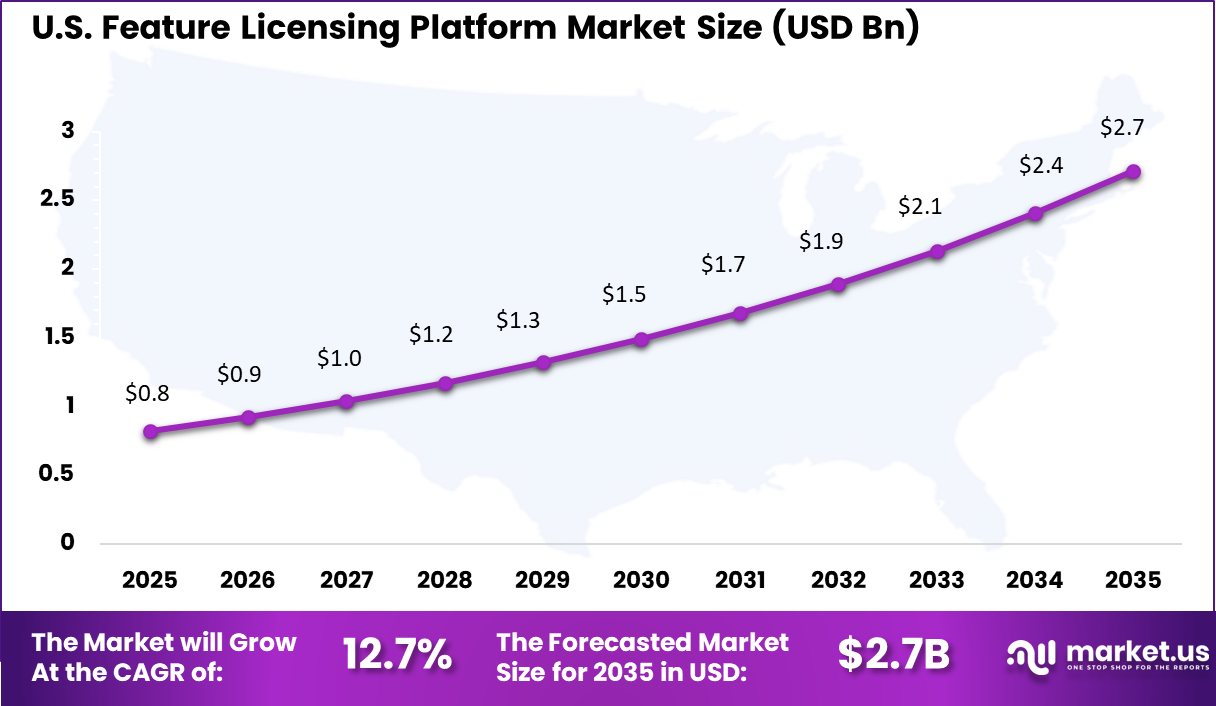
- Regionally, North America accounts for 38.23% global share, with the U.S. market valued at USD 0.82 billion and a CAGR of 12.7%, driven by SaaS unicorns and IP monetization strategies.
Drivers Impact Analysis
Key Drivers Impact on CAGR Forecast (~%) Geographic Relevance Impact Timeline Strategic Importance Increasing Adoption of Subscription-based Software Models +3.4% North America, Europe Short to Medium Term Encourages flexible licensing structures Rising Demand for Software Monetization Platforms +2.9% Global Medium Term Supports dynamic pricing and usage tracking Growth of Cloud-native Software Applications +2.5% North America, APAC Medium to Long Term Expands licensing control in distributed environments Expansion of IoT-enabled Devices Requiring Feature Activation +2.1% APAC, North America Long Term Enables feature-based device licensing Integration with Enterprise Software Management Systems +1.7% Global Medium Term Enhances operational visibility of software usage Restraints Impact Analysis
Key Restraints Impact on CAGR Forecast (~%) Geographic Relevance Impact Timeline Market Constraint Level Complexity in Managing Multiple Licensing Models -2.0% Global Medium Term Increases operational overhead Integration Challenges with Legacy Software Systems -1.7% Europe, APAC Medium Term Slows enterprise adoption Security Risks Associated with License Key Management -1.4% Global Medium Term Requires advanced protection mechanisms High Deployment and Customization Costs -1.1% Emerging Markets Short to Medium Term Limits adoption among smaller software vendors By Component
Platform and solution based offerings account for 64.25% of adoption in the feature licensing platform market, as organizations require centralized systems to manage software entitlements and product feature access. These platforms allow vendors to enable or disable specific software capabilities based on licensing agreements. This approach supports flexible pricing models and product customization.
Feature licensing platforms also integrate with billing systems and customer management tools. Automated entitlement management reduces manual administration and improves compliance with licensing terms. This functionality continues to position platforms as the leading component.
By Deployment
Cloud based deployment holds 72%, reflecting the need for scalable and easily accessible licensing infrastructure. Cloud platforms allow vendors to manage licensing rules and updates across distributed applications in real time. This capability is especially important for modern digital services and subscription based software.
Cloud deployment also supports faster rollout of new product features and licensing models. Vendors can adjust permissions instantly without requiring local updates. These operational advantages continue to reinforce strong cloud adoption.
 By Enterprise Size
Large enterprises represent 58.61% of adoption due to their complex software product portfolios and extensive customer bases. These organizations require robust licensing systems to manage multiple product editions and feature tiers. Centralized platforms help maintain consistent entitlement control across global markets.
Large firms also prioritize revenue optimization and compliance with licensing agreements. Automated tracking and reporting improve transparency and operational efficiency. This sustains steady demand among enterprise scale vendors.
By Application
Software as a Service accounts for 39.4% of application demand, driven by the growing shift toward subscription based software delivery. SaaS providers rely on feature licensing platforms to control access to product capabilities based on subscription levels. This enables flexible pricing and product differentiation.
Feature licensing also supports rapid experimentation with service packages and upgrades. Vendors can introduce new features without disrupting existing deployments. This continues to anchor SaaS as a key application area in the feature licensing platform market.
Investor Type Impact Matrix
Investor Type Growth Sensitivity Risk Exposure Geographic Focus Investment Outlook Venture Capital High Medium to High North America Focus on developer infrastructure and SaaS monetization startups Private Equity Medium to High Medium North America, Europe Attractive enterprise software revenue models Strategic Software Vendors High Medium Global Integration with software lifecycle management platforms Institutional Investors Medium Medium Developed Markets Long-term enterprise software infrastructure allocation Corporate Technology Investors Medium Low to Medium Global Expansion of product lifecycle and monetization platforms Technology Enablement Analysis
Technology Enabler Impact on CAGR Forecast (~%) Geographic Relevance Impact Timeline Adoption Momentum Cloud-based License Management Platforms +3.7% North America, Europe Short to Medium Term Enables scalable licensing deployment Usage-based and Consumption Licensing Models +3.1% Global Medium Term Supports flexible monetization strategies AI-driven Software Usage Analytics +2.4% North America Medium to Long Term Improves pricing and product optimization API-based Licensing Integration Frameworks +2.0% Global Medium Term Enhances interoperability with enterprise systems Blockchain-based License Verification Systems +1.6% Europe, North America Long Term Improves security and transparency Key Challenges
- Complexity in managing licensing rules across multiple software products
- Integration challenges with existing billing, CRM, and product management systems
- Risk of license misuse or unauthorized feature access
- Difficulty in tracking feature usage accurately across different user environments
- Need for continuous updates to support evolving product features and pricing models
Emerging Trends
In the Feature Licensing Platform market, a clear trend is the increasing use of flexible licensing models that allow software providers to activate or deactivate specific features based on customer needs. Instead of offering a single fixed product configuration, organisations are structuring their software so that capabilities can be enabled individually through licensing controls.
This approach allows customers to select functions that match their operational requirements while keeping the overall software environment manageable. Another visible trend is the integration of centralised license management dashboards, which provide product teams with a clear view of feature usage, access permissions, and activation status across multiple deployments.
Growth Factors
A key growth factor in this market is the growing demand for software customisation across industries. Organisations prefer solutions that can be adapted to their workflows rather than adopting rigid software packages with unnecessary features. Feature licensing platforms support this need by allowing software vendors to deliver modular capabilities while giving customers greater control over which functions they use.
Another important factor is the increasing importance of software lifecycle management and product governance. As software systems become more complex, organisations need structured mechanisms to manage upgrades, feature access, and compliance with licensing agreements. Feature licensing platforms provide a clear framework that helps companies manage product capabilities, monitor usage patterns, and maintain consistent control over software distribution and access.
Key Market Segments
By Component
- Platform/Solutions
- Activation-based
- Consumption-based
- Entitlement-based
- Services
- Consulting Services
- Implementation Services
- Managed Services
By Deployment
- Cloud-Based
- On-Premises
By Enterprise Size
- Large Enterprises
- Small & Mid-sized Enterprises (SMEs)
By Application
- Digital Media
- Software as a Service (SaaS)
- Gaming
- Enterprise Software
- Others
Regional Analysis
North America accounts for 38.23% of the feature licensing platform market, supported by strong adoption of software monetization models across enterprise software, industrial equipment, and connected devices. Companies in the region are increasingly using feature licensing platforms to control software functionality, manage subscription-based offerings, and enable flexible product configurations. Demand is driven by the shift toward digital product delivery, need for usage-based licensing, and growing focus on protecting intellectual property within software ecosystems.
The United States market is valued at USD 0.82 Billion and is expanding at a CAGR of 12.7%, reflecting rising adoption of feature-based licensing strategies across technology vendors. Adoption is influenced by increasing preference for subscription and consumption-based pricing models that allow customers to activate specific capabilities as required. Growth is further supported by integration of licensing platforms with cloud services, product lifecycle systems, and digital entitlement management tools that improve revenue control and product customization.
Key Regions and Countries
- North America
- US
- Canada
- Europe
- Germany
- France
- The UK
- Spain
- Italy
- Russia
- Netherlands
- Rest of Europe
- Asia Pacific
- China
- Japan
- South Korea
- India
- Australia
- Singapore
- Thailand
- Vietnam
- Rest of APAC
- Latin America
- Brazil
- Mexico
- Rest of Latin America
- Middle East & Africa
- South Africa
- Saudi Arabia
- UAE
- Rest of MEA
Competitive Analysis
The Feature Licensing Platform market is led by established software licensing providers such as Flexera, SafeNet under Gemalto, Reprise Software, Nalpeiron, Wibu Systems with CodeMeter, Revulytics, LM-X Licensing, and QLM Software.
These companies compete on secure license enforcement, flexible feature based licensing models, and integration with enterprise software distribution systems. Their platforms are widely used by software vendors that require control over product features, subscription models, and compliance with licensing agreements.
Specialized and emerging providers including Cryptlex, LicenseSpring, Keygen, AppLicense, Cryptonity, Prism License Manager, Cloud License Manager Solutions, Infralution, EZLynx, Xtracta, Soracom, and others compete through lightweight licensing frameworks and easier integration with modern software applications.
Competition in this segment is driven by cloud based license management, real time usage tracking, and support for subscription and consumption based pricing models. These vendors are often selected by independent software vendors seeking flexible licensing tools with faster deployment and simpler management.
Top Key Players in the Market
- Flexera
- SafeNet (Gemalto)
- Reprise Software
- Nalpeiron
- Cryptlex
- LicenseSpring
- EZLynx
- Xtracta
- Wibu-Systems
- Keygen
- AppLicense
- Cryptonity
- Cloud License Manager Solutions
- Prism License Manager
- LM-X Licensing
- Soracom
- CodeMeter
- Revulytics
- Infralution
- QLM Software
- Others
Future Outlook
The future outlook for the Feature Licensing Platform Market is positive as software and technology companies increasingly adopt flexible licensing models for their products. Feature licensing platforms allow organizations to control and manage access to specific software features, helping businesses offer customized services and better product monetization.
As digital products, cloud services, and subscription-based models continue to expand, demand for advanced licensing management tools is expected to grow. Overall, the market is likely to expand as companies focus on flexible product offerings, improved customer experience, and efficient license management.
Recent Developments
- February, 2025 – Flexera released its 2025 OneShot licensing engine. SaaS providers now control feature flags across hybrid deployments. Teams report 35% faster rollout of premium modules. The platform tracks usage patterns in real time. Developers toggle access without code changes. Enterprise clients cut revenue leakage from over-provisioning by 28%.
- January, 2026 – Cryptlex introduced floating licenses for containerized apps. DevOps teams assign features by Kubernetes pod. Gaming studios saw subscription churn drop 22%. The dashboard shows granular usage by tenant. API-first design integrates with Stripe billing. Cryptlex processes 15 million activations monthly now.
Report Scope
Report Features Description Market Value (2025) USD 2.4 Billion Forecast Revenue (2035) USD 9.4 Billion CAGR(2025-2035) 14.60% Base Year for Estimation 2024 Historic Period 2020-2024 Forecast Period 2025-2035 Report Coverage Revenue forecast, AI impact on Market trends, Share Insights, Company ranking, competitive landscape, Recent Developments, Market Dynamics and Emerging Trends Segments Covered By Component (Platform/Solutions (Activation-based, Consumption-based, Entitlement-based), Services (Consulting Services, Implementation Services, Managed Services)), By Deployment (Cloud-Based, On-Premises), By Enterprise Size (Large Enterprises, Small & Mid-sized Enterprises (SMEs)), By Application (Digital Media, Software as a Service (SaaS), Gaming, Enterprise Software, Others) Regional Analysis North America – US, Canada; Europe – Germany, France, The UK, Spain, Italy, Russia, Netherlands, Rest of Europe; Asia Pacific – China, Japan, South Korea, India, New Zealand, Singapore, Thailand, Vietnam, Rest of Latin America; Latin America – Brazil, Mexico, Rest of Latin America; Middle East & Africa – South Africa, Saudi Arabia, UAE, Rest of MEA Competitive Landscape Flexera, SafeNet (Gemalto), Reprise Software, Nalpeiron, Cryptlex, LicenseSpring, EZLynx, Xtracta, Wibu-Systems, Keygen, AppLicense, Cryptonity, Cloud License Manager Solutions, Prism License Manager, LM-X Licensing, Soracom, CodeMeter, Revulytics, Infralution, QLM Software, Others Customization Scope Customization for segments, region/country-level will be provided. Moreover, additional customization can be done based on the requirements. Purchase Options We have three license to opt for: Single User License, Multi-User License (Up to 5 Users), Corporate Use License (Unlimited User and Printable PDF)  Feature Licensing Platform MarketPublished date: Mar. 2026add_shopping_cartBuy Now get_appDownload Sample
 -
-
- Flexera
- SafeNet (Gemalto)
- Reprise Software
- Nalpeiron
- Cryptlex
- LicenseSpring
- EZLynx
- Xtracta
- Wibu-Systems
- Keygen
- AppLicense
- Cryptonity
- Cloud License Manager Solutions
- Prism License Manager
- LM-X Licensing
- Soracom
- CodeMeter
- Revulytics
- Infralution
- QLM Software
- Others
Our Clients

- 180570
- Mar. 2026









