


Global Enterprise Content Search Market By Component (Software, Services), By Deployment Mode (On-Premises, Cloud), By Enterprise Size (Small and Medium Enterprises, Large Enterprises), By Application (Document Management, Knowledge Management, Data Governance, Legal and Compliance, Others), By End-User (BFSI, Healthcare, IT and Telecommunications, Retail and E-commerce, Government, Manufacturing, Others), By Regional Analysis, Global Trends and Opportunity, Future Outlook By 2025-2035
- Published date: Feb. 2026
- Report ID: 179719
- Number of Pages: 254
- Format:
-
keyboard_arrow_up
Quick Navigation
- Report Overview
- Top Market Takeaways
- Drivers Impact Analysis
- Restraints Impact Analysis
- By Component
- By Deployment Mode
- By Enterprise Size
- By Application
- By End User
- Investors Type Impact Analysis
- Technology Enablement Analysis
- Key Challenges
- Emerging Trends
- Growth Factors
- Key Market Segments
- Regional Analysis
- Competitive Analysis
- Future Outlook
- Recent Developments
- Report Scope
Report Overview
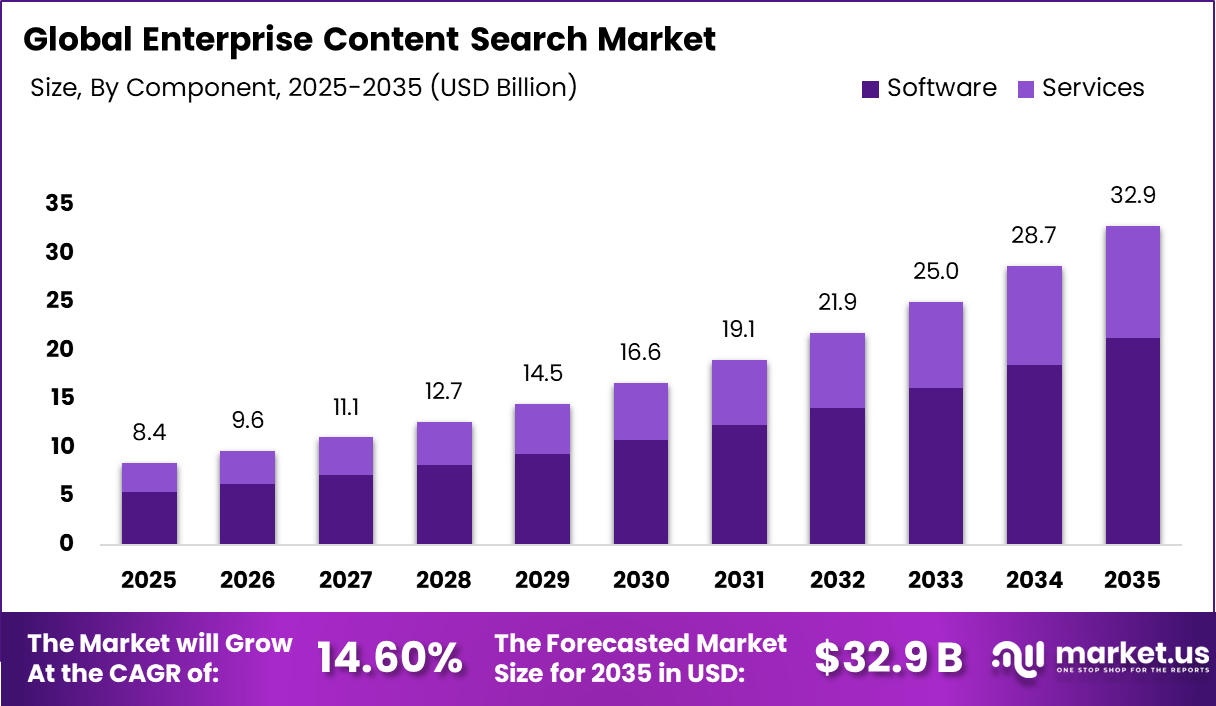
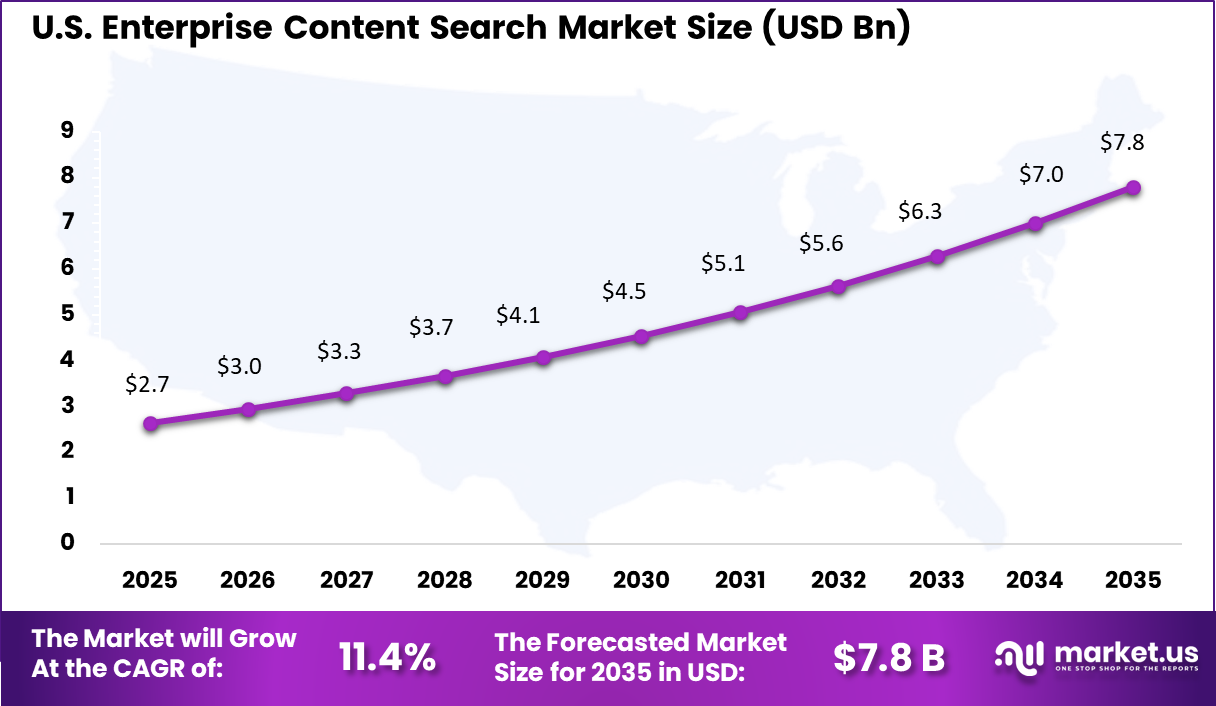
The Global Enterprise Content Search Market generated USD 8.4 billion in 2025 and is predicted to register growth from USD 9.6 billion in 2026 to about USD 32.9 billion by 2035, recording a CAGR of 14.60% throughout the forecast span. In 2025, North America held a dominan market position, capturing more than a 37.1% share, holding USD 3.12 Billion revenue.
The enterprise content search market refers to technologies and platforms that enable organizations to locate, retrieve, and analyze information stored across enterprise systems. These solutions index structured and unstructured content from sources such as document repositories, emails, databases, intranets, and collaboration platforms. By providing centralized search capabilities and relevance ranking, enterprise content search reduces time spent locating information and supports knowledge discovery across complex digital ecosystems.
The importance of enterprise content search has grown as organizations accumulate large volumes of digital records and generate data at scale. Teams often struggle to find relevant information when content is dispersed across multiple applications and formats. Advanced search platforms help overcome this fragmentation by unifying access, applying semantic understanding, and enabling contextual retrieval, which supports decision making, operational efficiency, and regulatory compliance.
One major driver is the exponential growth of enterprise data across digital platforms. Organizations manage documents, contracts, financial records, compliance files, and communication archives across multiple repositories. Without advanced search systems, retrieving specific content becomes time consuming and inefficient. Enterprise content search platforms improve productivity by reducing search time and enabling faster decision cycles.
Demand is particularly strong among large enterprises that operate across multiple geographies and manage high data volumes. These organizations require scalable indexing systems capable of handling millions of documents and diverse file formats. Enterprise wide search solutions enable cross departmental collaboration and reduce duplication of information. As digital operations expand, large enterprises continue to dominate adoption patterns.
Top Market Takeaways
- By Component, software dominates with 64.7% share, powering semantic indexing, NLP-driven retrieval, and federated search across repositories, SharePoint, and legacy archives.
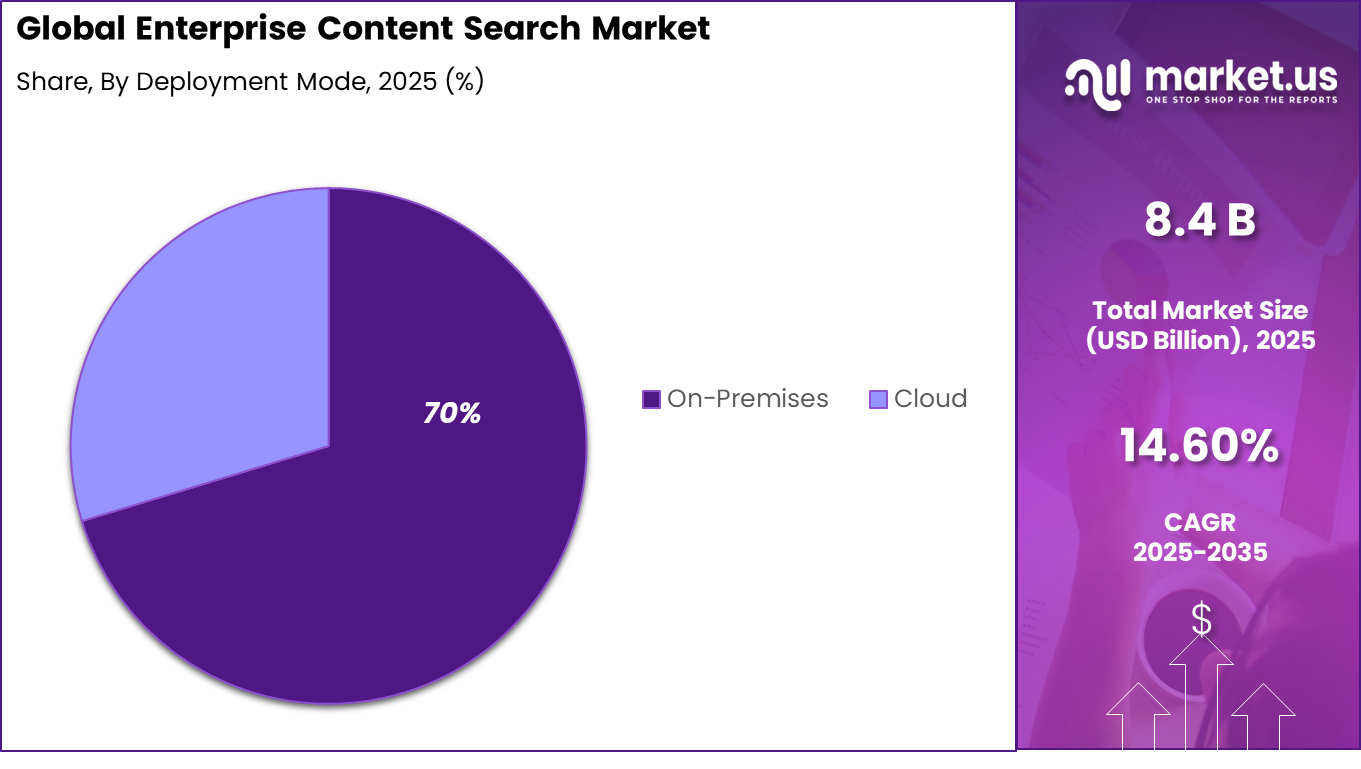
- By Deployment Mode, on-premises captures 70.3%, ensuring data sovereignty, customized indexing pipelines, and integration with air-gapped compliance environments.
- By Enterprise Size, large enterprises hold 72.7%, deploying enterprise-grade search fabrics spanning petabyte-scale content lakes with governance and eDiscovery workflows.
- By Application, document management leads at 38.5%, accelerating contract analysis, legal reviews, and knowledge worker productivity through contextual ranking.
- By End-User, BFSI commands 36.2%, securing regulatory-compliant search across transaction records, customer agreements, and audit trails.
- Regionally, North America accounts for 37.1% global share, with the U.S. market valued at USD 2.65 billion and a CAGR of 11.4%, driven by AI-enhanced RAG systems and hybrid work mandates.
Drivers Impact Analysis
Key Drivers Impact on CAGR Forecast (~%) Geographic Relevance Impact Timeline Strategic Importance Rapid Growth of Unstructured Enterprise Data +3.4% Global Short to Long Term Expands need for advanced search indexing Increasing Adoption of Digital Workplace Platforms +2.9% North America, Europe Medium Term Enhances collaboration and knowledge access Integration of AI and Natural Language Processing +2.6% North America, APAC Medium to Long Term Improves contextual search accuracy Rising Remote and Hybrid Workforce Models +2.1% Global Short to Medium Term Increases reliance on searchable content repositories Regulatory Requirements for Document Retrieval and Audit +1.8% Europe, North America Medium Term Strengthens compliance-driven adoption Restraints Impact Analysis
Restraints Impact on CAGR Forecast (~%) Geographic Relevance Impact Timeline Market Constraint Level Data Silos Across Enterprise Systems -2.0% Global Medium Term Limits unified search implementation Integration Complexity with Legacy Applications -1.7% Europe, APAC Medium Term Slows deployment cycles Concerns Over Data Privacy and Access Control -1.5% Europe, North America Medium Term Restricts open indexing strategies High Customization and Implementation Costs -1.2% Emerging Markets Short to Medium Term Budget limitations for SMEs By Component
Software represents 64.7% of the market, indicating its central role in indexing, search optimization, and content classification. Modern enterprise search platforms use natural language processing, semantic search, and relevance ranking algorithms to improve retrieval accuracy. As organizations aim to reduce time spent searching for information, investment in intelligent search software continues to expand.
Enterprise content search software is increasingly integrated with collaboration tools, content management systems, and data repositories. These integrations ensure unified access across structured and unstructured data environments. The dominance of software solutions reflects the need for scalable platforms that can process large content volumes while maintaining governance controls.
By Deployment Mode
On premises deployment accounts for 70.3% of the market, highlighting enterprise preference for direct control over content repositories. Sensitive corporate documents, intellectual property, and regulatory records are often maintained within internal infrastructure to meet compliance standards. On premises systems allow customized security configurations aligned with organizational policies.
Many enterprises operate legacy systems and internal archives that are deeply integrated with on premises search platforms. Migrating these systems to external environments may involve operational and regulatory complexity. As a result, organizations in highly regulated industries continue to prioritize on premises deployment to safeguard critical content assets.
By Enterprise Size
Large enterprises hold 72.7% of the market share due to their extensive data environments and complex workflows. These organizations manage multiple business units, global operations, and high document volumes, increasing the need for centralized search capabilities. Enterprise wide indexing ensures employees can access accurate information across departments.
The scale of operations in large enterprises also increases the importance of knowledge management and compliance tracking. Dedicated IT and governance teams implement structured search frameworks to maintain audit trails and information consistency. As digital transformation initiatives expand, large enterprises remain the leading adopters of enterprise search solutions.
By Application
Document management accounts for 38.5% of application usage, reflecting the importance of organized content storage and retrieval. Enterprises require searchable repositories to manage contracts, policy documents, reports, and regulatory filings. Efficient document indexing reduces administrative time and enhances operational productivity.
Search integrated document management systems also support version control and access monitoring. Regulatory audits often require quick retrieval of specific documents, which strengthens demand for reliable search tools. As digital documentation replaces paper based systems, document centric search applications continue to expand.
By End User
The BFSI sector represents 36.2% of market adoption due to strict compliance and reporting requirements. Financial institutions manage large volumes of transactional records, policy documents, and client data that must be searchable and traceable. Enterprise content search platforms help streamline risk assessment, audit preparation, and customer service processes.
High regulatory scrutiny in this sector increases the need for secure and accurate document retrieval. Errors in information access can lead to compliance penalties and operational delays. As financial institutions continue to digitize operations, structured enterprise search systems remain essential.
Investors Type Impact Analysis
Investor Type Growth Sensitivity Risk Exposure Geographic Focus Investment Outlook Venture Capital High Medium to High North America Focus on AI-driven enterprise search startups Private Equity Medium to High Medium North America, Europe Attractive SaaS subscription models Strategic Enterprise Software Vendors Medium to High Low to Medium Global Portfolio expansion into AI knowledge platforms Institutional Investors Medium Medium Developed Markets Stable long-term enterprise IT allocation Cloud Infrastructure Providers Medium Low Global Integration with cloud collaboration ecosystems Technology Enablement Analysis
Technology Enabler Impact on CAGR Forecast (~%) Geographic Relevance Impact Timeline Adoption Momentum AI-powered Semantic Search +3.8% North America, Europe Medium to Long Term Enhances contextual relevance Natural Language Processing Engines +3.0% Global Medium Term Improves conversational search interfaces Cloud-native Search Architectures +2.4% APAC, North America Medium Term Supports scalable deployments Real-time Indexing and Analytics +1.9% Global Short to Medium Term Accelerates information retrieval Knowledge Graph Integration +1.5% Europe, North America Long Term Enables structured relationship mapping Key Challenges
- Difficulty in indexing large volumes of unstructured and structured data
- Data stored in separate systems making unified search complex
- Poor metadata quality reducing search accuracy
- Strict access control requirements limiting content visibility
- High infrastructure cost to maintain fast and scalable search performance
Emerging Trends
In the Enterprise Content Search market, a clear trend is the move toward unified search interfaces that let users find information across different repositories from one place. Organisations are bringing together files, emails, databases, and knowledge bases so that a single query can return results from all relevant sources.
This helps users spend less time switching between systems and reduces frustration when key information is hard to locate. Another emerging pattern is the use of simpler, natural language queries so employees can enter questions the way they think about them, rather than relying on exact keywords, making search more intuitive and human centered.
Growth Factors
A key growth driver in this market is the increasing volume and diversity of digital content within organisations. As teams create and store documents in many formats and locations, the difficulty of finding accurate information quickly grows, which strengthens the need for effective search tools. Better search capability supports day-to-day work by reducing time spent hunting for documents and improving confidence in decision making.
Another important factor is the rising demand for knowledge sharing across departments. When search is effective, employees can tap into collective learning and avoid repeating work, which supports collaboration and faster response to internal and external requests. Together, these factors are encouraging broader adoption of enterprise search approaches that feel straightforward, reliable, and aligned with how people work.
Key Market Segments
By Component
- Software
- Services
By Deployment Mode
- On-Premises
- Cloud
By Enterprise Size
- Small and Medium Enterprises
- Large Enterprises
By Application
- Document Management
- Knowledge Management
- Data Governance
- Legal and Compliance
- Others
By End-User
- BFSI
- Healthcare
- IT and Telecommunications
- Retail and E-commerce
- Government
- Manufacturing
- Others
Regional Analysis
North America holds a 37.1% share of the enterprise content search market, supported by high digital content generation across banking, healthcare, legal, and technology sectors. Organizations in the region are adopting advanced search platforms to manage large volumes of structured and unstructured data across internal systems. Demand is driven by the need to improve information retrieval speed, enhance knowledge management, and ensure compliance with data governance and audit requirements.
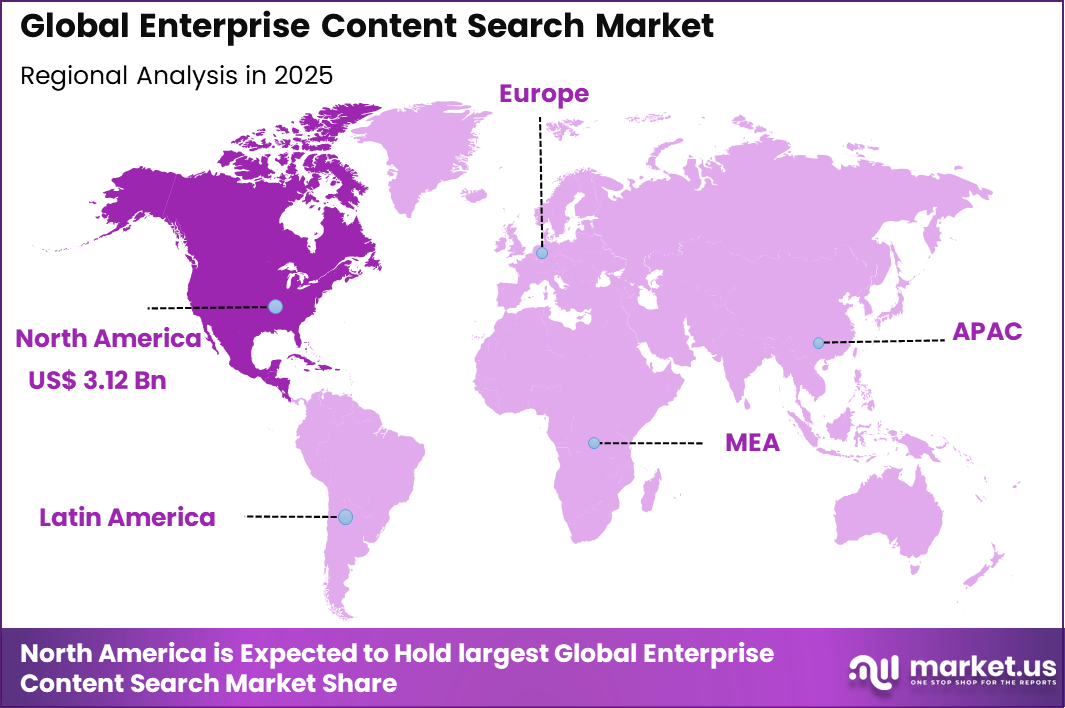
The U.S. market is valued at USD 2.65 Bn and is expanding at a CAGR of 11.4%, reflecting steady investment in intelligent search and content discovery tools. Adoption is influenced by increasing remote work environments, growing enterprise data repositories, and rising expectations for contextual and AI-driven search capabilities. Growth is further supported by integration with collaboration platforms, document management systems, and advanced analytics frameworks to enhance productivity and operational efficiency.
Key Regions and Countries
- North America
- US
- Canada
- Europe
- Germany
- France
- The UK
- Spain
- Italy
- Russia
- Netherlands
- Rest of Europe
- Asia Pacific
- China
- Japan
- South Korea
- India
- Australia
- Singapore
- Thailand
- Vietnam
- Rest of APAC
- Latin America
- Brazil
- Mexico
- Rest of Latin America
- Middle East & Africa
- South Africa
- Saudi Arabia
- UAE
- Rest of MEA
Competitive Analysis
The Enterprise Content Search Market is driven by large technology providers that integrate search functionality within productivity and enterprise platforms. Microsoft, Google, IBM, Oracle, and SAP embed intelligent search capabilities across collaboration, CRM, and ERP environments. Their solutions leverage AI based indexing, natural language processing, and contextual ranking to improve information discovery. Strong integration with cloud ecosystems and security frameworks supports enterprise wide deployment.
Search focused vendors contribute advanced indexing engines and scalable architectures. Elastic with Elasticsearch, Lucidworks, and Algolia provide high performance distributed search platforms. These companies emphasize real time analytics, relevance tuning, and API driven deployment models. Their technology is widely adopted in e commerce, media, and knowledge intensive industries that require fast and accurate retrieval of large data volumes.
Content management and AI driven search specialists strengthen competitive intensity. OpenText, Coveo, Hyland Software, and Micro Focus combine document management with enterprise search tools. Providers such as Sinequa, BA Insight, X1 Discovery, Attivio, MarkLogic, Dassault Systèmes, and Veritone differentiate through cognitive search, semantic analysis, and industry specific solutions.
Top Key Players in the Market
- Microsoft
- IBM
- Oracle
- Elastic (Elasticsearch)
- Coveo
- OpenText
- Lucidworks
- SAP
- Amazon Web Services (AWS)
- Hyland Software
- Micro Focus
- Sinequa
- BA Insight
- X1 Discovery
- Algolia
- Attivio
- MarkLogic
- Dassault Systèmes
- Veritone
- Others
Future Outlook
The future outlook of the Enterprise Content Search Market can be characterised by strong expansion driven by the rising need for efficient information access and improved productivity within organisations. As data volumes continue to grow across structured and unstructured sources, demand for advanced search solutions that deliver relevant results quickly is expected to rise. Adoption of artificial intelligence and machine learning technologies will play a key role in enhancing search accuracy, contextual understanding, and user experience.
Integration of content search capabilities with cloud platforms and enterprise applications will be increasingly prioritised as businesses pursue digital transformation and hybrid work models. Regulatory and compliance requirements will also reinforce the need for robust search tools that support data governance and security. Overall, market momentum is anticipated to remain positive as enterprises seek faster insight generation and operational efficiency.
Recent Developments
- January 2026, Microsoft enhanced Copilot Search within Microsoft 365 for real-time indexing of Teams conversations and SharePoint files. This update improves accuracy by incorporating user context and past interactions into query results. Teams now experience fewer irrelevant hits during collaborative projects.
- December 2025, Google Cloud rolled out Vertex AI Search updates supporting multimodal queries across text, images, and video content. Enterprises can now surface insights from diverse repositories like Drive and BigQuery seamlessly. Multilingual support aids global teams handling cross-border documentation.
Report Scope
Report Features Description Market Value (2025) USD 8.4 Billion Forecast Revenue (2035) USD 32.9 Billion CAGR(2025-2035) 14.60% Base Year for Estimation 2024 Historic Period 2020-2024 Forecast Period 2025-2035 Report Coverage Revenue forecast, AI impact on Market trends, Share Insights, Company ranking, competitive landscape, Recent Developments, Market Dynamics and Emerging Trends Segments Covered By Component (Software, Services), By Deployment Mode (On-Premises, Cloud), By Enterprise Size (Small and Medium Enterprises, Large Enterprises), By Application (Document Management, Knowledge Management, Data Governance, Legal and Compliance, Others), By End-User (BFSI, Healthcare, IT and Telecommunications, Retail and E-commerce, Government, Manufacturing, Others) Regional Analysis North America – US, Canada; Europe – Germany, France, The UK, Spain, Italy, Russia, Netherlands, Rest of Europe; Asia Pacific – China, Japan, South Korea, India, New Zealand, Singapore, Thailand, Vietnam, Rest of Latin America; Latin America – Brazil, Mexico, Rest of Latin America; Middle East & Africa – South Africa, Saudi Arabia, UAE, Rest of MEA Competitive Landscape Microsoft, Google, IBM, Oracle, Elastic (Elasticsearch), Coveo, OpenText, Lucidworks, SAP, Amazon Web Services (AWS), Hyland Software, Micro Focus, Sinequa, BA Insight, X1 Discovery, Algolia, Attivio, MarkLogic, Dassault Systèmes, Veritone, Others Customization Scope Customization for segments, region/country-level will be provided. Moreover, additional customization can be done based on the requirements. Purchase Options We have three license to opt for: Single User License, Multi-User License (Up to 5 Users), Corporate Use License (Unlimited User and Printable PDF)  Enterprise Content Search MarketPublished date: Feb. 2026add_shopping_cartBuy Now get_appDownload Sample
 -
-
- Microsoft
- IBM
- Oracle
- Elastic (Elasticsearch)
- Coveo
- OpenText
- Lucidworks
- SAP
- Amazon Web Services (AWS)
- Hyland Software
- Micro Focus
- Sinequa
- BA Insight
- X1 Discovery
- Algolia
- Attivio
- MarkLogic
- Dassault Systèmes
- Veritone
- Others
Our Clients

- 179719
- Feb. 2026









