Employee Advocacy Platform Market By Component (Software (Cloud-based, On-premises), Services (Consulting, Implementation, Training and Support, Managed Services)), By Application (Marketing, Sales, Human Resources, Corporate Communication, Others), By End User (Large Enterprises, Small and Medium Enterprises (SMEs)), By Functionality (Content Creation, Content Scheduling, Employee Engagement, Performance Tracking, Others), By Regional Analysis, Global Trends and Opportunity, Future Outlook By 2026-2035
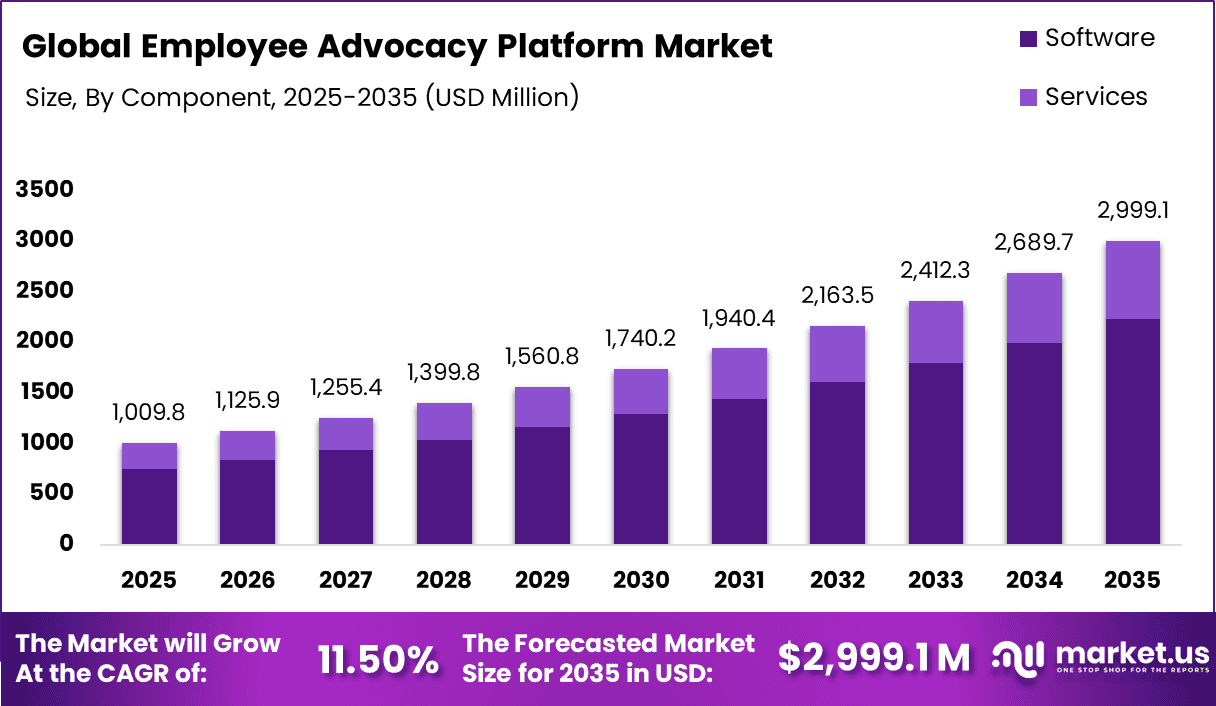
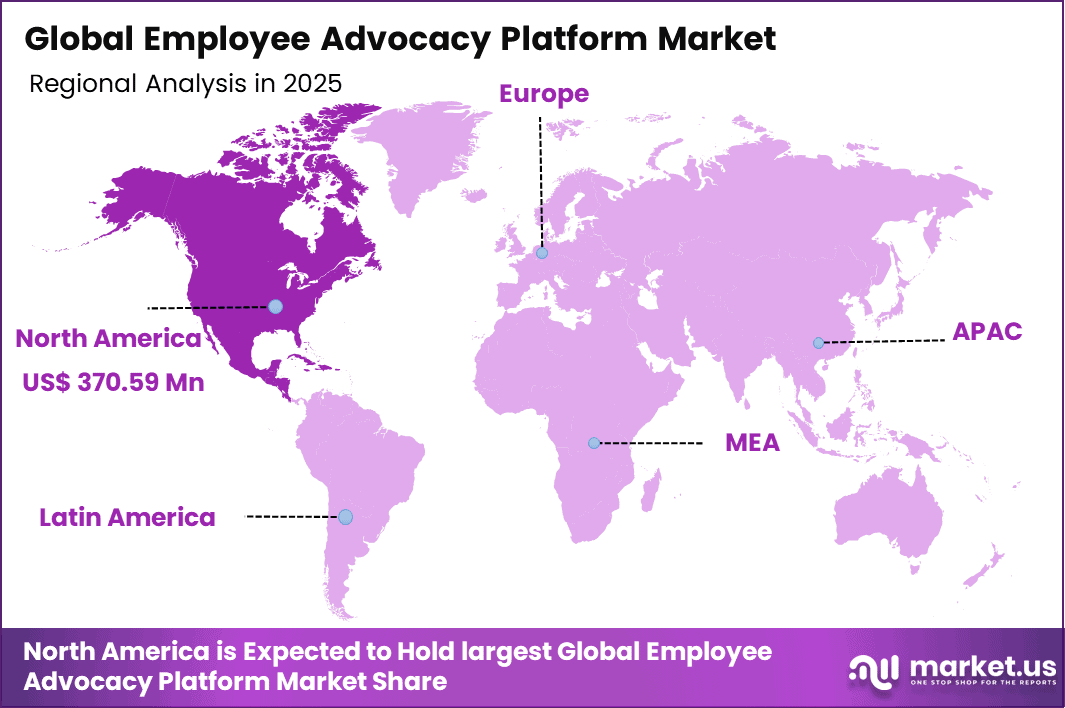
The Global Employee Advocacy Platform Market generated USD 1,009.8 million in 2025 and is predicted to register growth from USD 1,125.9 million in 2026 to about USD 2,999.1 million by 2035, recording a CAGR of 11.50% throughout the forecast span. In 2025, North America held a dominant market position, capturing more than a 36.7% share, holding USD 370.59 Million revenue.
Top Market Takeaways
Software commands 74.3% market share, delivering centralized content curation, personalized feeds, and gamified sharing incentives for enterprise-wide social amplification.
Human Resources applications capture 39.6%, enabling talent branding, employee ambassador programs, and internal communication alignment with external messaging.
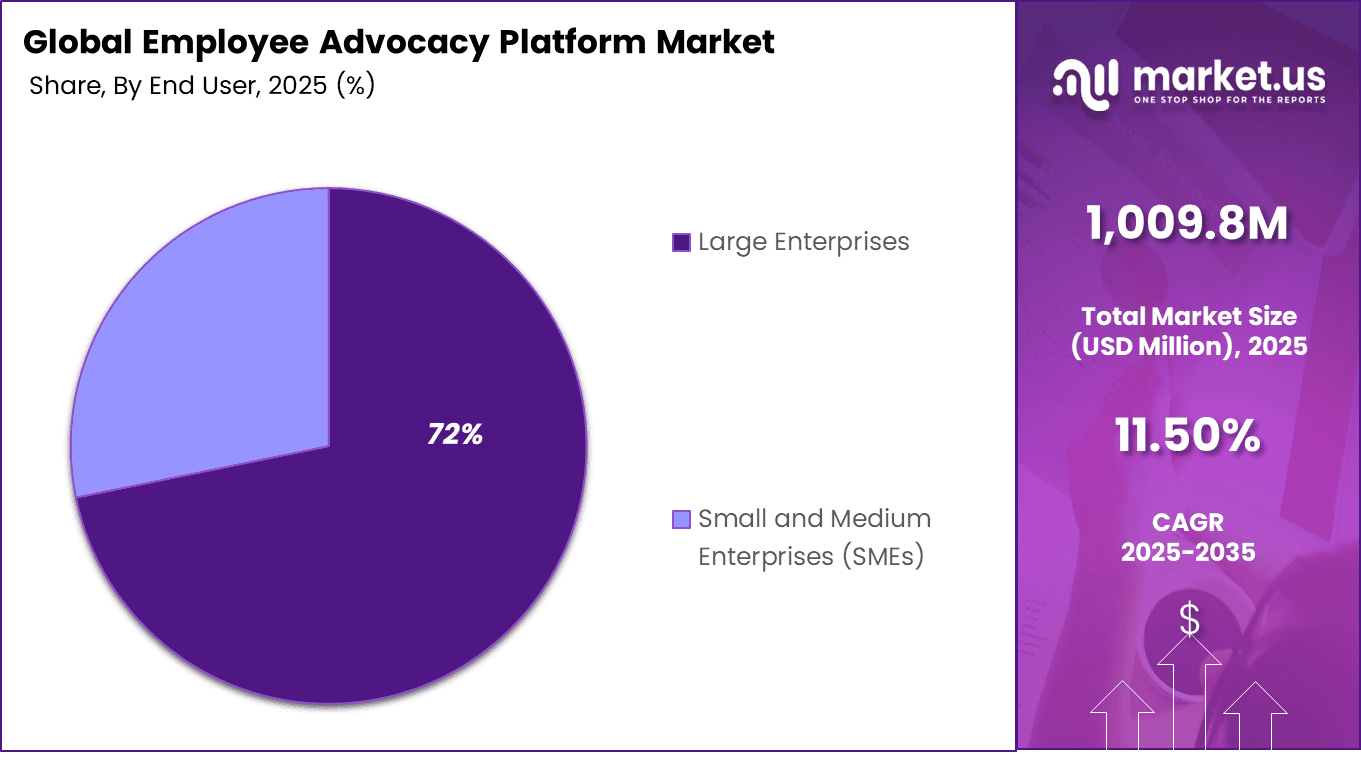
Large enterprises hold 71.8%, leveraging scalable platforms for global workforce activation, compliance controls, and ROI measurement across marketing channels.
Content scheduling functionality claims 37.4%, powering automated post queuing, optimal timing recommendations, and cross-platform distribution workflows.
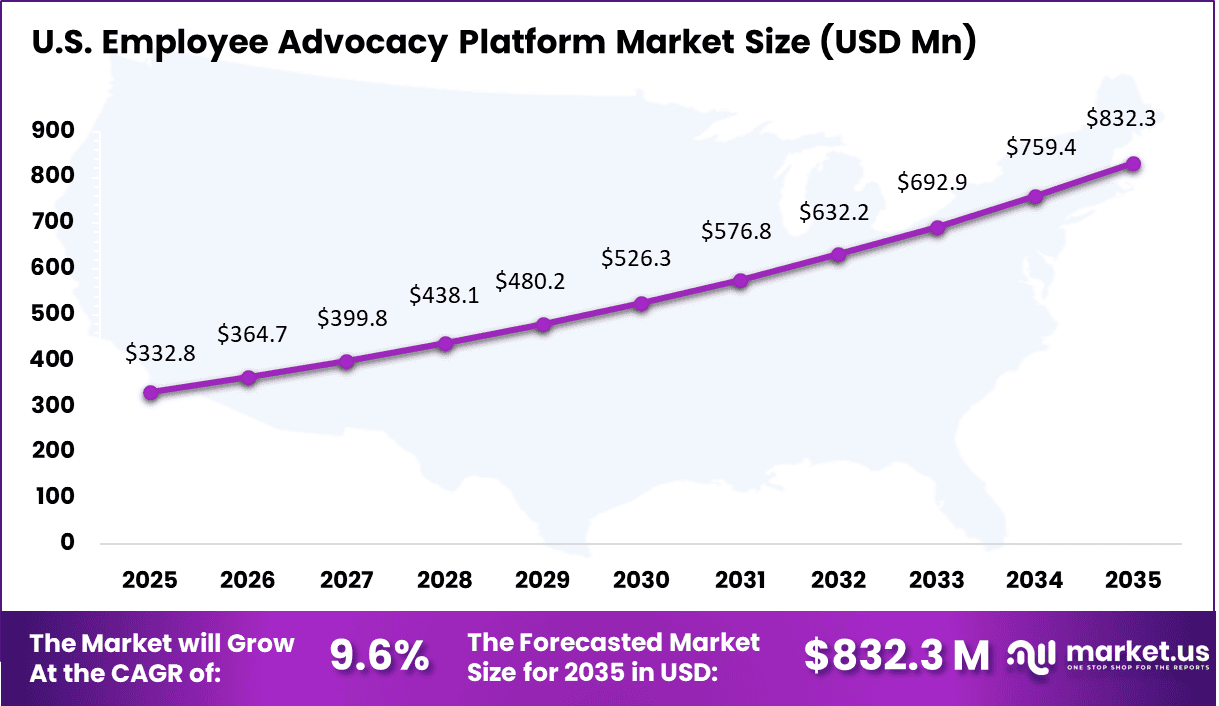
North America drives 36.7% global value, with U.S. market at USD 332.8 million and 9.6% CAGR, fueled by B2B thought leadership mandates and hybrid work cultures.
Employee advocacy platforms are gaining importance as organizations look to strengthen their brand presence through their own workforce. These platforms enable employees to share company content on their personal social networks in a structured and secure way, helping businesses expand their reach and build authentic engagement.
Companies are recognizing that messages shared by employees often carry more trust compared to traditional corporate communication. As digital communication becomes central to business growth, these platforms are becoming a key part of marketing and internal communication strategies.
One of the main driving factors is the growing need for authentic brand communication in a crowded digital space. Consumers are more likely to engage with content that feels genuine, and employee voices play a strong role in building that trust. Organizations are also focusing on improving employee engagement and creating a sense of ownership among staff, which advocacy platforms help support.
In addition, the rise of social media as a business tool is encouraging companies to formalize how employees represent the brand online. Compliance and content control features within these platforms are also helping companies manage risks while encouraging participation. The shift toward remote and hybrid work environments is further increasing the importance of digital tools that keep employees connected and aligned with company messaging.
Demand for employee advocacy platforms is increasing as companies seek measurable impact from their digital outreach efforts. Businesses are looking for solutions that can track content performance, monitor engagement, and provide insights into how employee sharing contributes to brand visibility. There is also a growing preference for platforms that are easy to use and integrate with existing communication and marketing tools.
Companies are encouraging more employees to participate, which is creating demand for scalable solutions that can manage large user bases. As organizations continue to focus on building trust and extending their digital presence, the demand for structured and data driven employee advocacy solutions is expected to grow steadily.
Drivers Impact Analysis
Key Driver
Impact on CAGR Forecast (~%)
Geographic Relevance
Impact Timeline
Additional Insight
Growing importance of employee-driven brand promotion
+3.2%
North America and Europe, expanding globally
Short to medium term
Employees amplify brand reach organically
Rising adoption of social media in corporate communication
+2.9%
Global
Medium term
Social platforms drive engagement
Increasing focus on employer branding and talent attraction
+2.6%
Developed markets
Medium to long term
Strong branding improves hiring outcomes
Demand for authentic marketing and peer influence
+2.4%
Global
Medium term
Trust in employee voices is higher
Integration of analytics in advocacy platforms
+2.1%
North America and Europe
Medium to long term
Data insights improve campaign effectiveness
Restraints Impact Analysis
Key Restraint
Impact on CAGR Forecast (~%)
Geographic Relevance
Impact Timeline
Additional Insight
Low employee participation and engagement levels
-2.5%
Global
Short to medium term
Limited participation reduces impact
Concerns over content control and brand risk
-2.1%
North America and Europe
Medium term
Companies fear misuse of messaging
Lack of clear ROI measurement
-1.8%
Global
Medium term
Difficulty in tracking performance
Data privacy and compliance concerns
-1.6%
Europe and North America
Medium to long term
Regulations affect data usage
Integration challenges with existing marketing tools
-1.3%
Global
Medium term
System compatibility issues arise
By Component Analysis
The software segment accounted for 74.3% of the market share, reflecting its central role in enabling employee advocacy programs across organizations. This dominance is supported by the growing need for platforms that can manage content distribution, track engagement, and measure performance in a structured way. Software solutions help companies streamline communication and ensure consistent brand messaging through employee networks.
Another key factor driving this segment is the shift toward digital workplace strategies where organizations rely on centralized platforms to manage employee-driven marketing efforts. These solutions offer scalability, easy integration with social media channels, and analytics capabilities, making them essential for companies looking to expand their outreach and improve brand visibility.
By Application Analysis
The human resources segment held 39.6% share, driven by the increasing involvement of HR teams in employee engagement and internal communication initiatives. HR departments are leveraging advocacy platforms to strengthen employer branding, enhance employee participation, and build a more connected workforce. These tools support internal campaigns and help align employees with company values and messaging.
In addition, organizations are focusing on improving employee experience and retention, which has elevated the role of HR in managing communication strategies. Advocacy platforms enable HR teams to monitor engagement levels and encourage active participation, contributing to a more engaged and motivated workforce across different organizational levels.
By End-User Analysis
The large enterprises segment captured 72% of the market, reflecting their strong adoption of employee advocacy platforms to manage large-scale communication and branding efforts. These organizations have a broad employee base, making advocacy programs more impactful in reaching wider audiences. The need to maintain consistent messaging across multiple departments and regions further supports adoption in this segment.
Moreover, large enterprises often have the resources to invest in advanced platforms that offer analytics, automation, and integration capabilities. They use these tools to amplify their brand presence, support marketing campaigns, and improve employee engagement. This structured approach allows them to maximize the value of employee advocacy initiatives.
By Functionality Analysis
The content scheduling segment held 37.4% share, driven by the need for organized and timely content distribution across employee networks. Content scheduling features allow organizations to plan and automate posts, ensuring consistent communication without manual effort. This helps maintain regular engagement and improves the effectiveness of advocacy campaigns.
Furthermore, scheduled content reduces the burden on employees by providing ready-to-share posts at optimal times. This increases participation and ensures that messaging reaches the intended audience more efficiently. As companies focus on improving campaign performance and engagement rates, content scheduling continues to be a key functionality within employee advocacy platforms.
Investor Type Impact Analysis
Investor Type
Growth Sensitivity
Risk Exposure
Geographic Focus
Investment Outlook
Venture capital firms
High
High
US, Europe
Investing in SaaS-based advocacy platforms
Private equity firms
Moderate to high
Moderate
North America and Europe
Scaling established digital marketing solutions
Corporate investors
High
Moderate
Global
Strategic investments in employee engagement tools
Institutional investors
Moderate
Low to moderate
Developed markets
Favor stable SaaS companies with recurring revenue
Government and public funding bodies
Low to moderate
Low
Europe and Asia Pacific
Supporting digital workplace transformation initiatives
Technology Enablement Analysis
Technology
Impact on CAGR Forecast (~%)
Geographic Relevance
Impact Timeline
Additional Insight
AI-driven content recommendation engines
+3.4%
US, Europe
Medium to long term
Personalizes content sharing
Cloud-based SaaS platforms
+3.0%
Global
Short to medium term
Enables scalability and remote access
Integration with enterprise collaboration tools
+2.6%
Global
Medium term
Improves workflow efficiency
Advanced analytics and performance tracking
+2.3%
North America and Europe
Medium to long term
Measures campaign success
Mobile-first platform capabilities
+2.0%
Global
Short to medium term
Supports on-the-go engagement
Key Challenges
Low employee participation reduces the overall impact of advocacy programs.
Difficulty in maintaining consistent and engaging content for employees to share.
Lack of clear guidelines can lead to inappropriate or off-brand messaging.
Measuring return on investment and performance remains challenging.
Privacy concerns among employees about sharing company content on personal profiles.
Resistance from employees who are not comfortable promoting their workplace online.
Integration issues with existing marketing and social media tools.
Training requirements for employees to use the platform effectively.
Risk of misinformation if content is not properly monitored.
Dependence on continuous motivation and incentives to keep employees active.
Emerging Trends
The employee advocacy platform market is evolving toward more structured and data driven engagement models that align employee activity with brand communication goals. One of the key emerging trends is the use of AI based content recommendation engines that suggest personalized posts to employees based on their interests, role, and audience behavior. This is improving participation rates and ensuring that shared content feels authentic rather than forced.
Another trend is the integration of advocacy platforms with internal communication and collaboration tools, allowing employees to access and share content within their daily workflows. Gamification is also gaining traction, where leaderboards, rewards, and recognition programs are used to motivate employees to actively participate in brand promotion. In addition, advanced analytics capabilities are being introduced to track engagement, reach, and conversion impact at an individual and organizational level. There is also a shift toward mobile first platforms, enabling employees to engage with content and share updates easily from anywhere, which supports real time brand amplification.
Growth Factors
The growth of this market is driven by the increasing importance of organic brand visibility and trust in digital communication. Organizations are recognizing that employee voices often carry more credibility than traditional corporate messaging, which is encouraging investment in advocacy platforms. The rise of social media as a primary marketing and communication channel is also supporting this demand, as companies aim to expand their reach without relying entirely on paid campaigns.
Another important factor is the need to strengthen employer branding and talent acquisition, where employees act as ambassadors showcasing company culture and values. As remote and hybrid work models become more common, businesses are looking for ways to keep employees engaged and connected to the brand, which is further driving adoption. Additionally, marketing teams are seeking measurable outcomes from advocacy efforts, and modern platforms provide clear insights into performance, making it easier to justify investment and scale programs effectively.
Key Market Segments
By Component
Software
Cloud-based
On-premises
Services
Consulting
Implementation
Training and Support
Managed Services
By Application
Marketing
Sales
Human Resources
Corporate Communication
Others
By End User
Large Enterprises
Small and Medium Enterprises (SMEs)
By Functionality
Content Creation
Content Scheduling
Employee Engagement
Performance Tracking
Others
Regional Analysis
North America accounted for 36.7% of the Employee Advocacy Platform market, supported by strong enterprise adoption of digital marketing and brand communication strategies. Organizations in this region increasingly recognize employees as key brand ambassadors who can amplify company messaging across social media and professional networks.
The growing focus on authentic engagement and peer-driven communication has encouraged businesses to invest in advocacy platforms that enable content sharing, performance tracking, and employee participation at scale. In addition, the presence of a highly mature corporate ecosystem and widespread use of social platforms has strengthened the demand for structured employee advocacy programs across industries.
The U.S. market reached USD 332.8 Million and is projected to grow at a CAGR of 9.6%, driven by rising emphasis on employer branding and workforce engagement. Companies are adopting these platforms to improve internal communication, boost employee morale, and enhance external brand visibility through trusted voices. Marketing teams are increasingly integrating advocacy tools into their broader digital strategies to extend reach beyond traditional channels.
The shift toward remote and hybrid work environments has further increased the importance of digital collaboration and employee-driven content sharing. This trend is expected to support steady growth in the US market as organizations continue to prioritize engagement and brand credibility.
Key Regions and Countries
North America
US
Canada
Europe
Germany
France
The UK
Spain
Italy
Russia
Netherlands
Rest of Europe
Asia Pacific
China
Japan
South Korea
India
Australia
Singapore
Thailand
Vietnam
Rest of APAC
Latin America
Brazil
Mexico
Rest of Latin America
Middle East & Africa
South Africa
Saudi Arabia
UAE
Rest of MEA
Competitive Analysis
The competitive landscape of the Employee Advocacy Platform Market is competitive, with a mix of social media management and dedicated advocacy platform providers. Companies such as Hootsuite, Sprinklr, Sprout Social, and Oktopost focus on integrating advocacy features into broader marketing platforms. At the same time, players like EveryoneSocial, GaggleAMP, Sociabble, Smarp, and Ambassify specialize in employee engagement and content sharing tools that help organizations expand their brand reach through employees.
Other vendors including Act-On, Agorapulse, DrumUp, DSMN8, Dynamic Signal, LumApps, Apostle, Influitive, and Socxo are enhancing their platforms with features such as automation, analytics, and easy integration with workplace tools. Competition is driven by ease of use, content performance tracking, and the ability to increase employee participation, as companies look for simple and effective ways to strengthen brand communication.
The future outlook for the Employee Advocacy Platform Market looks strong as companies continue to focus on building trust and authentic communication through their employees. The market is expected to grow steadily with more businesses using these platforms to improve brand reach, employee engagement, and social media presence. The shift toward remote and hybrid work is also increasing the need for digital tools that keep employees connected and active in brand promotion.
Recent Developments
February, 2026 – Act-On adds employee advocacy to marketing automation with personalized content feeds. Tracks ROI per employee and integrates CRM data. B2B marketers pick for lead scoring.
March, 2026 – Agorapulse boosts social inbox with advocacy workflows. Unified calendar across team channels and auto-approval queues. SMB agencies favorite.
Report Scope
Report Features
Description
Market Value (2025)
USD 1,009.8 Million
Forecast Revenue (2035)
USD 2,999.1 Million
CAGR(2025-2035)
11.50%
Base Year for Estimation
2024
Historic Period
2020-2024
Forecast Period
2026-2035
Report Coverage
Revenue forecast, AI impact on Market trends, Share Insights, Company ranking, competitive landscape, Recent Developments, Market Dynamics and Emerging Trends
Segments Covered
By Component (Software (Cloud-based, On-premises), Services (Consulting, Implementation, Training and Support, Managed Services)), By Application (Marketing, Sales, Human Resources, Corporate Communication, Others), By End User (Large Enterprises, Small and Medium Enterprises (SMEs)), By Functionality (Content Creation, Content Scheduling, Employee Engagement, Performance Tracking, Others)
Regional Analysis
North America – US, Canada; Europe – Germany, France, The UK, Spain, Italy, Russia, Netherlands, Rest of Europe; Asia Pacific – China, Japan, South Korea, India, New Zealand, Singapore, Thailand, Vietnam, Rest of Latin America; Latin America – Brazil, Mexico, Rest of Latin America; Middle East & Africa – South Africa, Saudi Arabia, UAE, Rest of MEA