Global Educational Hardware Market Size, Share and Analysis Report By Product Type (Interactive Whiteboards & Displays, Student Computing Devices, Classroom Audio & Visual Systems, Document Cameras & Visualizers, 3D Printers & Makerspace Equipment, STEM/Robotics Kits & Hardware, Others), By End-User (K-12 Schools, Higher Education Institutions, Corporate & Training Centers, Government & Non-profit Organizations), By Technology (Standard Classroom Hardware, Connected & IoT-enabled Devices, AR/VR & Immersive Learning Hardware, Others), By Distribution Channel (Direct Sales from OEMs, Value-Added Resellers (VARs) & System Integrators, Educational Technology Distributors), By Regional Analysis, Global Trends and Opportunity, Future Outlook By 2025-2035
- Published date: Feb. 2026
- Report ID: 178916
- Number of Pages: 223
- Format:
-
keyboard_arrow_up
Quick Navigation
Report Overview
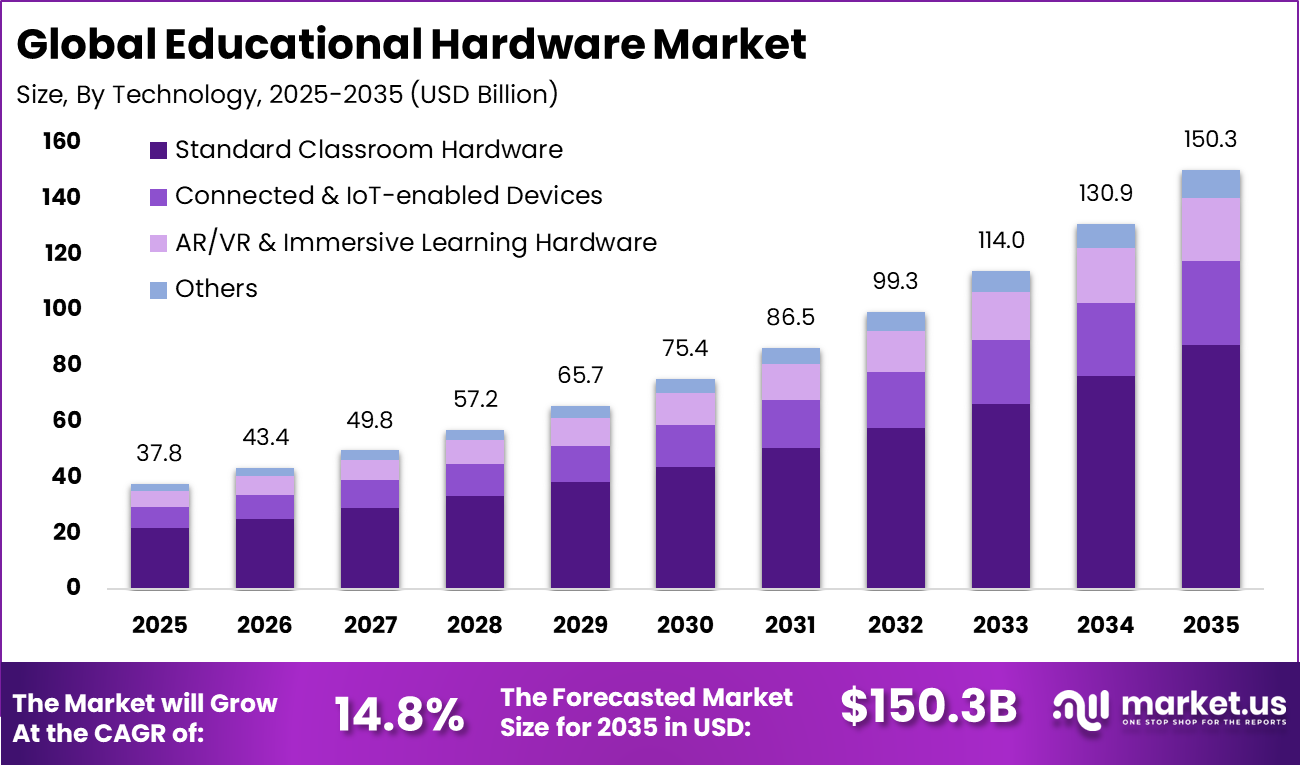
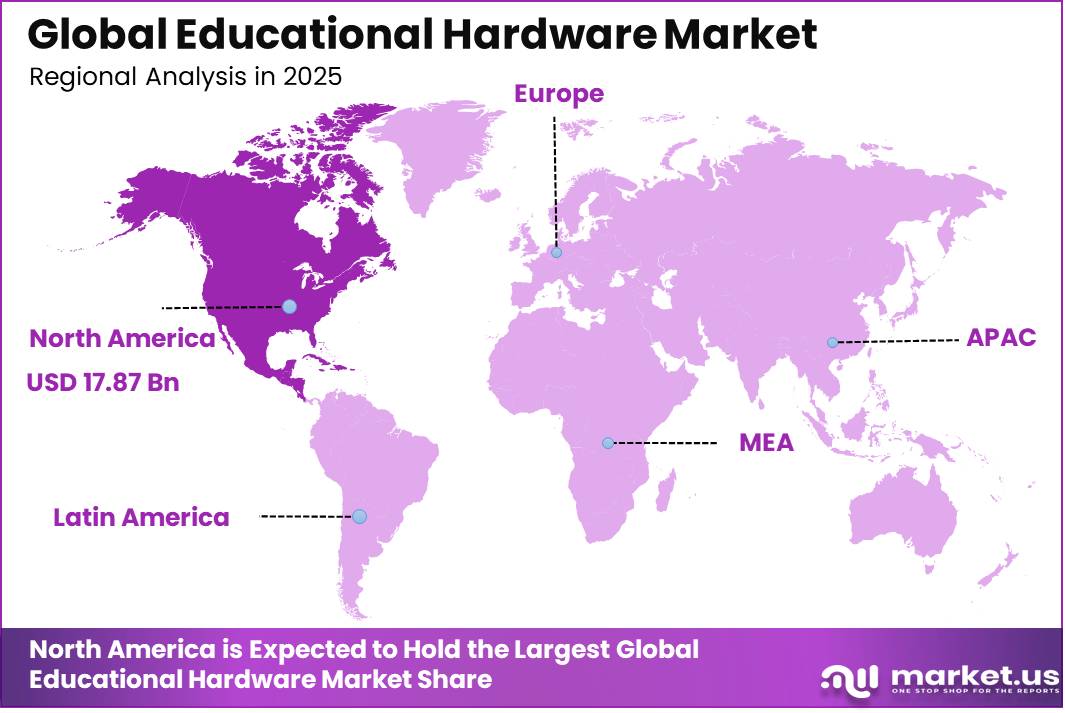
The Global Educational Hardware Market size is expected to be worth around USD 150.3 billion by 2035, from USD 37.8 billion in 2025, growing at a CAGR of 14.8% during the forecast period from 2025 to 2035. North America held a dominant market position, capturing more than a 47.3% share, holding USD 17.87 billion in revenue.
The educational hardware market is expanding as institutions modernize classroom infrastructure to support digital learning models. Schools are investing in computing devices, interactive displays, networking equipment, and classroom management hardware to enhance instructional delivery. The shift toward blended and technology enabled education has created sustained demand for reliable and scalable hardware ecosystems.
Educational institutions are also prioritizing hardware that integrates seamlessly with learning management systems and cloud based platforms. Device compatibility, durability, and centralized management features are important purchasing criteria. As digital curriculum adoption grows, hardware infrastructure has become foundational to daily classroom operations. This structural transition supports consistent demand across K-12 and higher education segments.
One key driver of the Educational Hardware Market is the expansion of technology enabled learning initiatives within schools, colleges, and training organizations. Policymakers and institutional leaders prioritise investment in devices that support digital curricula, online assessments, and collaborative learning environments. These investments aim to bridge gaps in access, enhance student engagement, and modernize traditional pedagogical practices.
Demand for educational hardware is strong across primary, secondary, and higher education sectors. Primary and secondary schools often prioritise durable and easy-to-manage devices that support classroom collaboration and teacher facilitation. Higher education institutions require a broader range of hardware that can support specialised applications, research computing, and blended learning models.
For instance, in January 2026, Lenovo unveiled new Chromebook additions at FETC 2026, including the ThinkPad T14s Gen 6 with 16:10 displays and Google AI integration for enhanced teaching efficiency. As a top supplier to U.S. education, Lenovo’s focus on repairable, sustainable devices keeps them ahead in powering personalized learning.
Key Takeaway
- In 2025, the Student Computing Devices segment held a leading position, accounting for 58.4% of the global Educational Hardware market, driven by large-scale device deployment in schools.
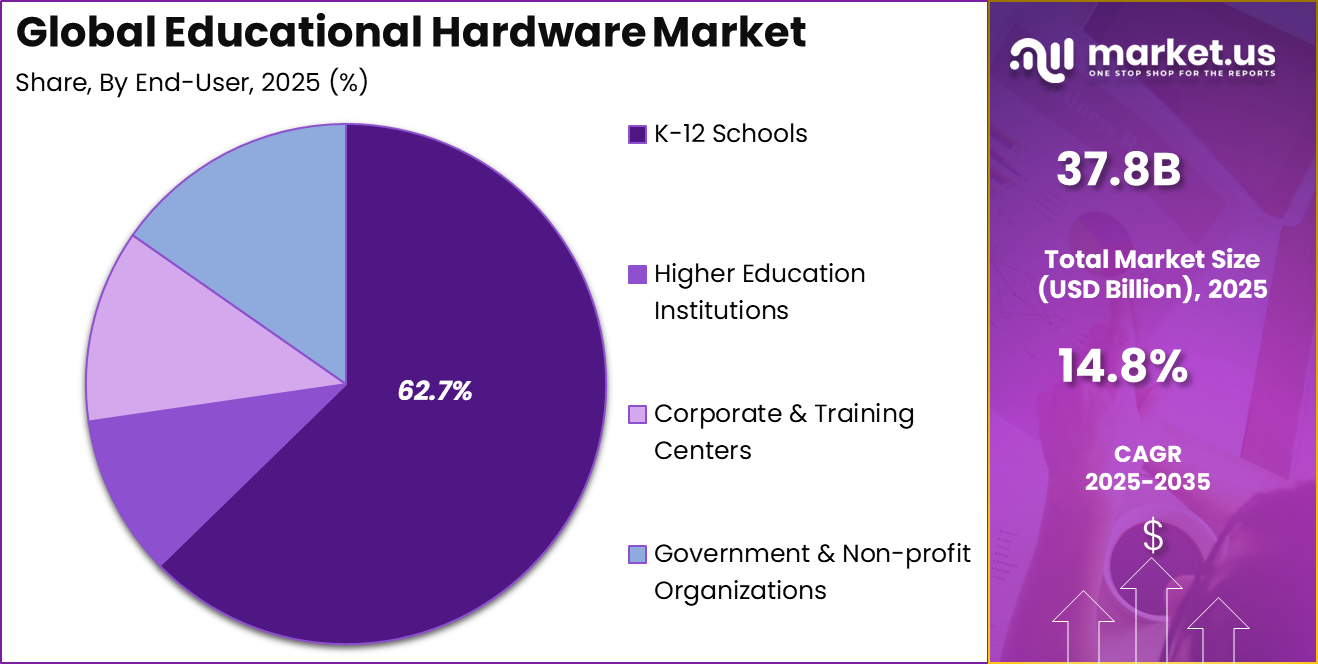
- In 2025, the K-12 Schools segment captured 62.7% share, reflecting sustained investments in classroom digital infrastructure and one-to-one device programs.
- In 2025, Standard Classroom Hardware represented 71.5% of total market demand, supported by continued procurement of interactive displays, projectors, and computing systems.
- In 2025, Value-Added Resellers accounted for 52.8% share, as institutions relied on integrated supply, installation, and support services.
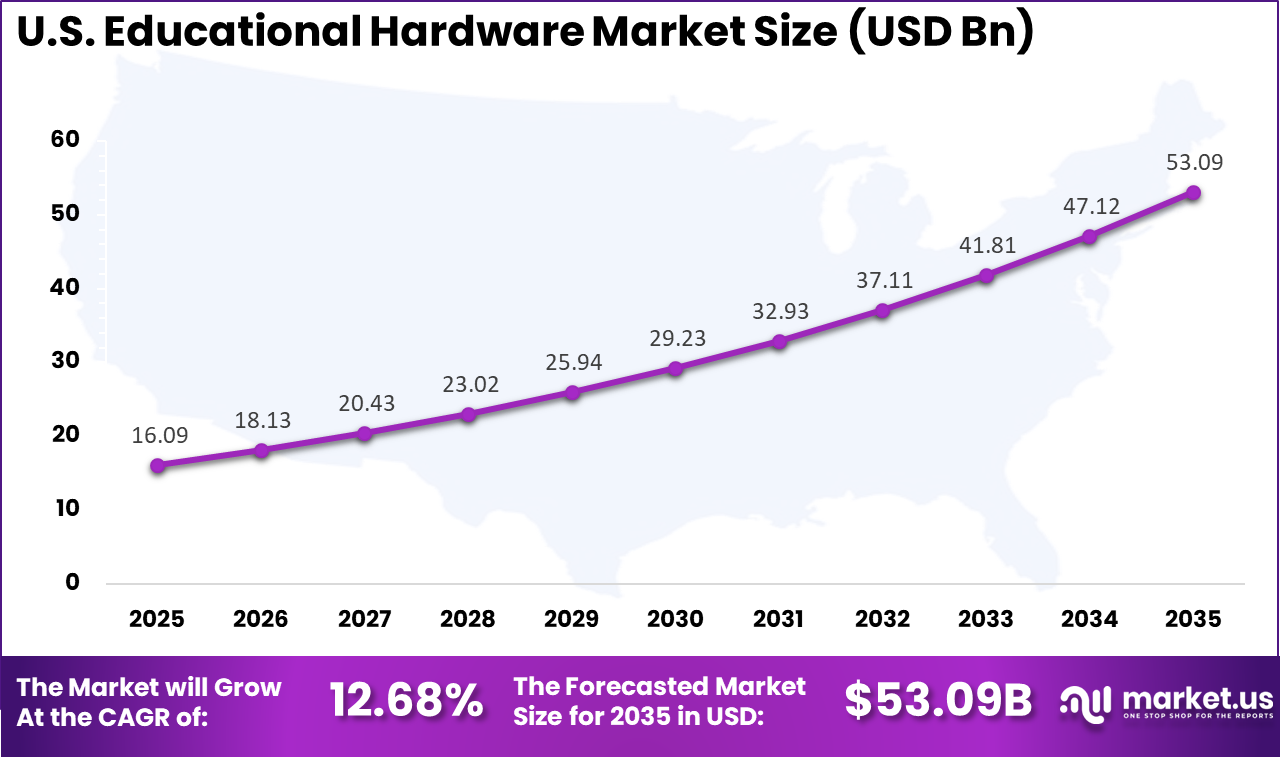
- The United States Educational Hardware market was valued at USD 16.09 billion in 2025 and is projected to expand at a 12.68% CAGR, supported by technology modernization initiatives.
- In 2025, North America held a dominant 47.3% share of the global market, driven by strong public funding, digital curriculum adoption, and advanced education infrastructure.
Classroom Adoption and Usage
- Approximately 88% of U.S. public schools have implemented one-to-one device programs, with 89% issuing laptops and 27% providing tablets, reflecting widespread digital access initiatives.
- Around 65% of K-12 teachers use electronic tools on a daily basis, indicating strong integration of digital platforms into lesson planning and classroom delivery.
- In the United States, 71% of students use laptops during classroom instruction, significantly higher than the 37% global average, highlighting stronger technology penetration in U.S. education systems.
By Product Type
Student computing devices represent 58.4% of the market as individual learning becomes device centric. Laptops, tablets, and hybrid notebooks are widely deployed to enable digital textbooks, assessments, and remote collaboration. One to one device programs have accelerated adoption across many school districts.
The increasing use of cloud platforms in education further strengthens this segment. Students require consistent access to online learning portals, assignment submissions, and virtual classrooms. Computing devices serve as the primary interface between learners and digital content ecosystems.
Durability and lifecycle management also influence purchasing decisions. Educational institutions prioritize hardware designed for extended classroom use with centralized management capabilities. Device standardization simplifies technical support and maintenance processes.
For Instance, in January 2026, Dell Technologies launched new Dell Pro Education laptops and Chromebooks ruggedized to military standards for student use. These devices feature spill-resistant keyboards, all-day battery life, and Intel processors, making them ideal for daily classroom handling and modern curricula. Schools can choose Windows or Chrome OS models starting in February, boosting access to interactive learning tools.
By End User
K 12 schools account for 62.7% of hardware adoption because foundational education systems are undergoing rapid digital transformation. Governments and districts are allocating budgets to improve digital literacy and classroom connectivity. Large student populations generate sustained demand for computing equipment and instructional hardware.
In K 12 environments, classroom hardware supports both curriculum delivery and administrative functions. Interactive boards, projectors, and network infrastructure are integrated into daily teaching routines. Schools seek scalable solutions that can be deployed uniformly across campuses.
Teacher training and curriculum digitization further drive adoption in this segment. As lesson plans shift toward multimedia and online assessments, hardware becomes essential to instructional success. This alignment between pedagogy and infrastructure reinforces long term market growth.
For instance, in June 2025, Lenovo unveiled AI-enhanced solutions for K-12 teachers and students, featuring durable Chromebooks and ThinkPads. These open doors to AI exploration in STEAM courses, with VR and esports support via Legion gear. The EDU Matrix 2025 aids immersive, inclusive education across districts.
By Technology
Standard classroom hardware leads with 71.5% due to continued reliance on core instructional equipment. Interactive displays, projectors, audio systems, and network devices remain essential components of modern classrooms. These technologies support teacher led instruction and collaborative learning activities.
Despite growth in advanced technologies, institutions prioritize dependable and easy to maintain systems. Standard hardware solutions are often more cost efficient and compatible with existing infrastructure. This practicality explains the strong market share.
Integration with software ecosystems also strengthens this segment. Standard classroom hardware is increasingly designed to connect seamlessly with cloud platforms and digital content libraries. This ensures smooth instructional delivery without complex technical adjustments.
For Instance, in January 2026, ViewSonic debuted Android 16-powered ViewBoard IFP35-1 and IFP41-1 interactive displays at Bett 2026. With 64-point touch, motion sensors for energy savings, and myViewBoard software, they enable real-time collaboration in standard classrooms. EDLA-certified for secure, responsive daily use.
By Distribution Channel
Value added resellers account for 52.8% of distribution because institutions prefer bundled service models. Resellers provide installation, customization, maintenance, and technical support alongside hardware supply. This comprehensive approach reduces operational burden on school IT teams.
Educational procurement often involves competitive bidding and structured contracts. Value added resellers are experienced in navigating institutional purchasing frameworks. Their expertise strengthens long term vendor relationships.
Support services remain a critical differentiator. Schools require reliable troubleshooting, warranty management, and system updates. Reseller partnerships ensure continuity and reduce downtime in classroom environments.
For Instance, in February 2025, Dell Technologies updated its Partner Program with AI incentives and 3X multipliers for networking sales to VARs. The program simplifies growth for resellers handling education hardware like AI Factory gear. New competencies train partners on Dell’s school solutions.
Regional Analysis
North America holds 47.3% of the educational hardware market due to advanced digital infrastructure and strong public education investment. Schools in the region have widely adopted device based learning models and interactive classroom systems. This maturity supports consistent replacement cycles and upgrades.
For instance, in July 2025, Google rolled out Gemini for Education and new Chromebook Plus devices with AI features like image generation and Class tools for classroom management. These updates empower educators with AI-driven teaching aids across Google Workspace.
The United States represents the largest contributor within the region, with expansion supported by technology modernization initiatives across districts. The projected CAGR of 12.68% reflects ongoing investment in digital classrooms and secure network infrastructure. Federal and state funding programs continue to encourage hardware deployment in underserved communities.
For instance, in January 2026, Dell Technologies expanded its education portfolio with new Dell Pro Education laptops, 2-in-1 devices, and Chromebooks designed for AI-ready classrooms. These durable, serviceable systems support modern curricula with Windows and Chrome OS options, reinforcing Dell’s leadership in U.S. educational hardware.
Emerging Trends Analysis
The Educational Hardware market is increasingly influenced by the adoption of interactive and connected classroom devices. Smart boards, tablets, student laptops, and virtual reality equipment are being integrated into teaching environments to enhance engagement and collaboration. These devices support multimedia content delivery and real time assessment. As digital curricula expand, hardware solutions are becoming essential components of modern learning infrastructure.
Another emerging trend is the growth of hybrid and remote learning hardware ecosystems. Educational institutions are investing in webcams, digital projectors, interactive displays, and network enabled devices to support blended learning models. Hardware compatibility with cloud based learning platforms is becoming a priority. This integration strengthens continuity between in classroom and remote education settings.
Driver Analysis
A primary driver of the Educational Hardware market is the increasing digitalization of education systems worldwide. Governments and private institutions are allocating funds to upgrade classroom infrastructure and bridge digital learning gaps. Technology enabled teaching improves accessibility and supports interactive learning methods. These investments are accelerating hardware procurement across schools and universities.
Another key driver is the rising demand for personalized and technology supported learning experiences. Students and educators require devices that enable adaptive learning applications, digital collaboration, and multimedia access. Hardware devices serve as gateways to digital content ecosystems. As educational methodologies evolve, demand for compatible and high performance devices continues to grow.
Restraint Analysis
One significant restraint in the Educational Hardware market is the high cost associated with large scale device deployment. Budget limitations in public education systems can delay procurement cycles. Maintenance, software licensing, and infrastructure upgrades further increase total ownership costs. These financial considerations may slow adoption in resource constrained regions.
Another restraint involves technical challenges related to infrastructure readiness. Reliable internet connectivity, cybersecurity measures, and IT support are required to maximize hardware utilization. Institutions lacking adequate technical support may experience underutilization of devices. Infrastructure gaps can therefore limit effective implementation.
Opportunity Analysis
A major opportunity lies in expanding educational hardware adoption in emerging economies. Growing youth populations and increasing government focus on digital literacy create sustained demand for classroom devices. International development initiatives are supporting technology integration in schools. Vendors offering cost efficient and durable hardware solutions can capture expanding regional demand.
Another opportunity is the development of specialized hardware for STEM education and immersive learning. Devices such as robotics kits, 3D printers, and augmented reality tools enhance experiential education. Institutions are emphasizing science and technology competencies to meet workforce requirements. This focus is expected to generate continued investment in advanced educational hardware.
Challenge Analysis
A primary challenge in the Educational Hardware market is managing device lifecycle and sustainability concerns. Educational institutions must address device replacement, repair, and electronic waste management. Long term durability and upgrade compatibility are critical factors in purchasing decisions. Vendors must balance innovation with product longevity.
Another challenge involves ensuring cybersecurity and data protection across connected devices. Educational hardware often interacts with student data and online learning platforms. Weak security controls can expose sensitive information to breaches. Implementing secure device management frameworks is essential for sustained trust and compliance.
Key Market Segments
By Product Type
- Interactive Whiteboards & Displays
- Student Computing Devices
- Chromebooks
- Tablets
- Laptops
- Classroom Audio & Visual Systems
- Document Cameras & Visualizers
- 3D Printers & Makerspace Equipment
- STEM/Robotics Kits & Hardware
- Others
By End-User
- K-12 Schools
- Higher Education Institutions
- Corporate & Training Centers
- Government & Non-profit Organizations
By Technology
- Standard Classroom Hardware
- Connected & IoT-enabled Devices
- AR/VR & Immersive Learning Hardware
- Others
By Distribution Channel
- Direct Sales from OEMs
- Value-Added Resellers (VARs) & System Integrators
- Educational Technology Distributors
Key Regions and Countries
North America
- US
- Canada
Europe
- Germany
- France
- The UK
- Spain
- Italy
- Russia
- Netherlands
- Rest of Europe
Asia Pacific
- China
- Japan
- South Korea
- India
- Australia
- Singapore
- Thailand
- Vietnam
- Rest of APAC
Latin America
- Brazil
- Mexico
- Rest of Latin America
Middle East & Africa
- South Africa
- Saudi Arabia
- UAE
- Rest of MEA
Key Players Analysis
Global computing device manufacturers such as Dell Technologies, Inc., HP, Inc., Lenovo Group, Ltd., Apple, Inc., Microsoft Corporation, and Google LLC dominate the educational hardware market. Their portfolios include laptops, tablets, and hybrid devices optimized for classroom use. Demand is driven by digital learning adoption and one-to-one device initiatives in schools.
Interactive display and classroom technology providers such as Promethean World, Ltd., SMART Technologies ULC, ViewSonic Corporation, BenQ Corporation, and Epson America, Inc. support collaborative learning environments. These vendors focus on touch-enabled screens and integrated teaching tools. Adoption is strong in K-12 and higher education institutions upgrading traditional classrooms.
Networking and specialized hardware providers such as Cisco Systems, Inc. and Poly enhance connectivity and hybrid learning. Dremel and MakerBot Industries, LLC expand STEM-focused hardware adoption. Other vendors contribute niche and regional offerings, supporting steady growth in educational hardware solutions globally.
Top Key Players in the Market
- Dell Technologies, Inc.
- HP, Inc.
- Lenovo Group, Ltd.
- Microsoft Corporation
- Google LLC (Chromebooks)
- Apple, Inc.
- Promethean World, Ltd.
- SMART Technologies ULC
- ViewSonic Corporation
- BenQ Corporation
- Epson America, Inc.
- Cisco Systems, Inc.
- Poly
- Dremel
- MakerBot Industries, LLC
- Others
Recent Developments
- In June 2025, Microsoft introduced Surface Copilot+ PCs tailored for educators, boasting AI-driven security and app optimization on Snapdragon X chips. Deployed widely in U.S. districts, these devices underscore Microsoft’s dominance in premium education hardware for interactive teaching.
- In October 2025, Apple previewed 2026 education-focused iPad and Mac updates with enhanced Apple Intelligence features for student collaboration. Building on their stronghold in higher ed, these launches reinforce Apple’s premium hardware leadership across U.S. campuses.
Report Scope
Report Features Description Market Value (2025) USD 37.8 Bn Forecast Revenue (2035) USD 150.3 Bn CAGR(2026-2035) 14.8% Base Year for Estimation 2025 Historic Period 2020-2024 Forecast Period 2026-2035 Report Coverage Revenue forecast, AI impact on Market trends, Share Insights, Company ranking, competitive landscape, Recent Developments, Market Dynamics and Emerging Trends Segments Covered By Product Type (Interactive Whiteboards & Displays, Student Computing Devices, Classroom Audio & Visual Systems, Document Cameras & Visualizers, 3D Printers & Makerspace Equipment, STEM/Robotics Kits & Hardware, Others), By End-User (K-12 Schools, Higher Education Institutions, Corporate & Training Centers, Government & Non-profit Organizations), By Technology (Standard Classroom Hardware, Connected & IoT-enabled Devices, AR/VR & Immersive Learning Hardware, Others), By Distribution Channel (Direct Sales from OEMs, Value-Added Resellers (VARs) & System Integrators, Educational Technology Distributors) Regional Analysis North America – US, Canada; Europe – Germany, France, The UK, Spain, Italy, Russia, Netherlands, Rest of Europe; Asia Pacific – China, Japan, South Korea, India, New Zealand, Singapore, Thailand, Vietnam, Rest of Latin America; Latin America – Brazil, Mexico, Rest of Latin America; Middle East & Africa – South Africa, Saudi Arabia, UAE, Rest of MEA Competitive Landscape Dell Technologies, Inc., HP, Inc., Lenovo Group, Ltd., Microsoft Corporation, Google LLC (Chromebooks), Apple, Inc., Promethean World, Ltd., SMART Technologies ULC, ViewSonic Corporation, BenQ Corporation, Epson America, Inc., Cisco Systems, Inc., Poly, Dremel, MakerBot Industries, LLC, Others Customization Scope Customization for segments, region/country-level will be provided. Moreover, additional customization can be done based on the requirements. Purchase Options We have three license to opt for: Single User License, Multi-User License (Up to 5 Users), Corporate Use License (Unlimited User and Printable PDF)  Educational Hardware MarketPublished date: Feb. 2026add_shopping_cartBuy Now get_appDownload Sample
 -
-
- Dell Technologies, Inc.
- HP, Inc.
- Lenovo Group, Ltd.
- Microsoft Corporation
- Google LLC (Chromebooks)
- Apple, Inc.
- Promethean World, Ltd.
- SMART Technologies ULC
- ViewSonic Corporation
- BenQ Corporation
- Epson America, Inc.
- Cisco Systems, Inc.
- Poly
- Dremel
- MakerBot Industries, LLC
- Others
Our Clients

- 178916
- Feb. 2026