EasyMesh Certified Gateway Market By Product Type (Standalone Gateways, Integrated Gateways, Mesh Routers), By Connectivity (Wired, Wireless), By Distribution Channel (Online, Offline), By End-User (Internet Service Providers, Enterprises, Individuals, Other End-Users), By Regional Analysis, Global Trends and Opportunity, Future Outlook By 2026-2035
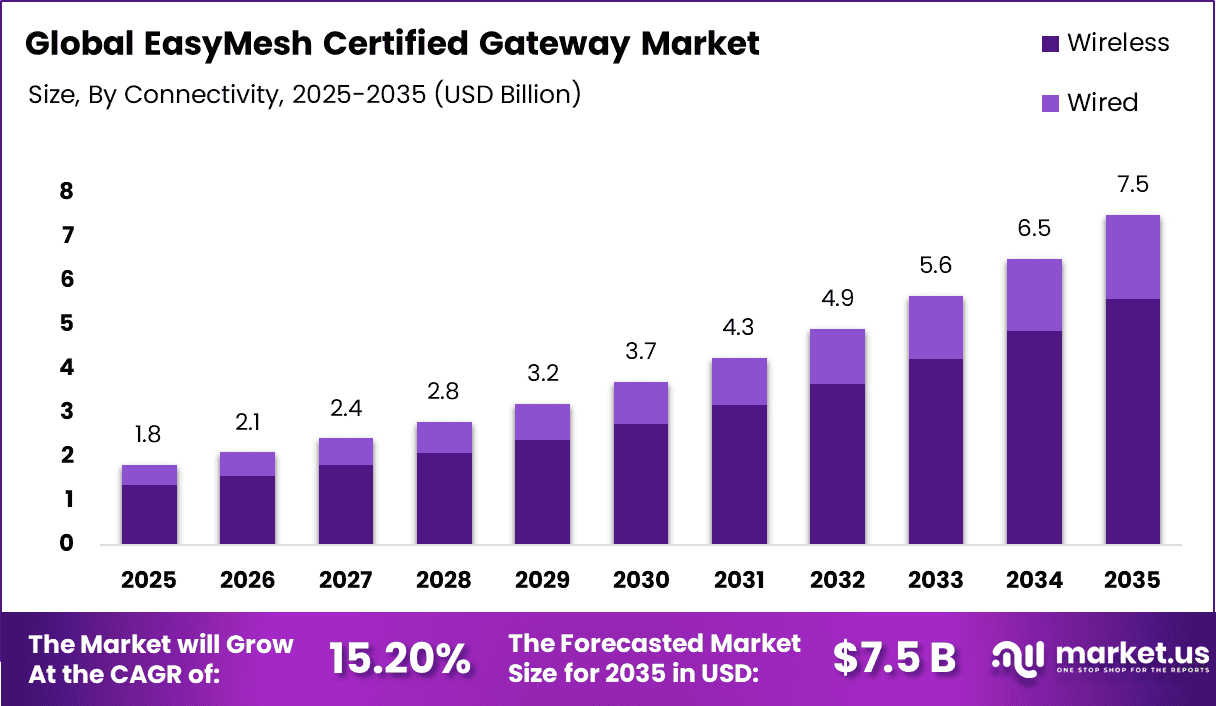
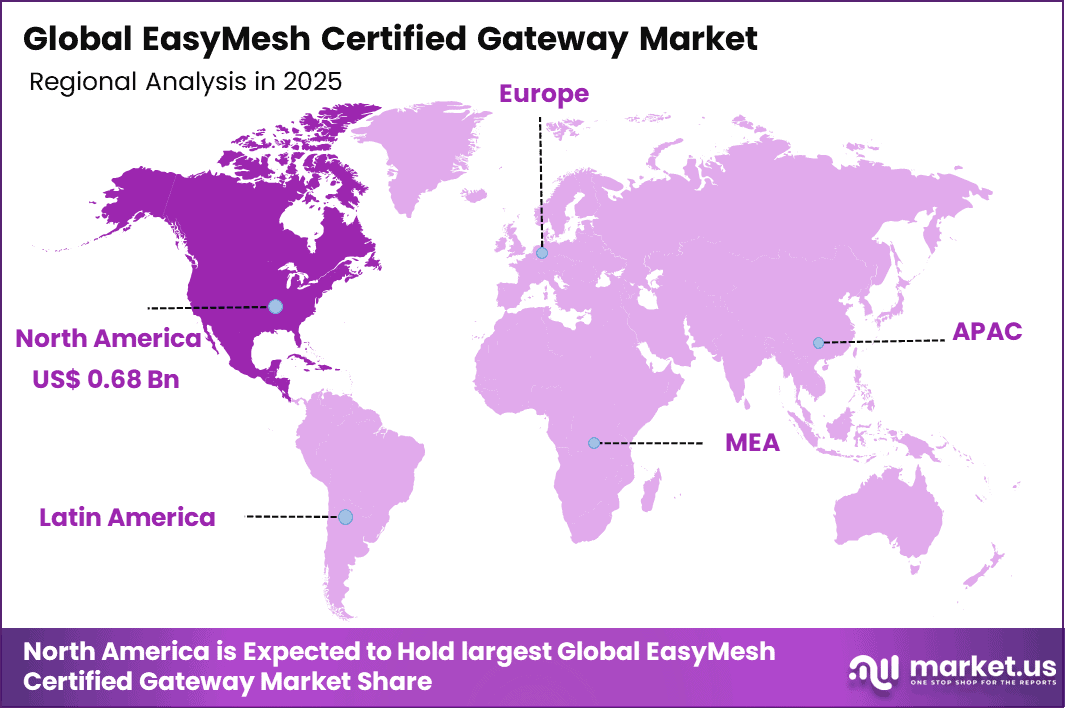
The Global EasyMesh Certified Gateway Market generated USD 1.8 billion in 2025 and is predicted to register growth from USD 2.1 billion in 2026 to about USD 7.5 billion by 2035, recording a CAGR of 15.20% throughout the forecast span. In 2025, North America held a dominant market position, capturing more than a 37.5% share, holding USD 0.68 Billion revenue.
Top Market Takeaways
Integrated gateways command 46.8% market share, combining modem, router, and mesh extender functions for seamless single-SSID coverage across multi-story homes.
Wireless connectivity captures 74.6%, enabling self-organizing backhaul, band steering, and client load balancing without wired infrastructure upgrades.
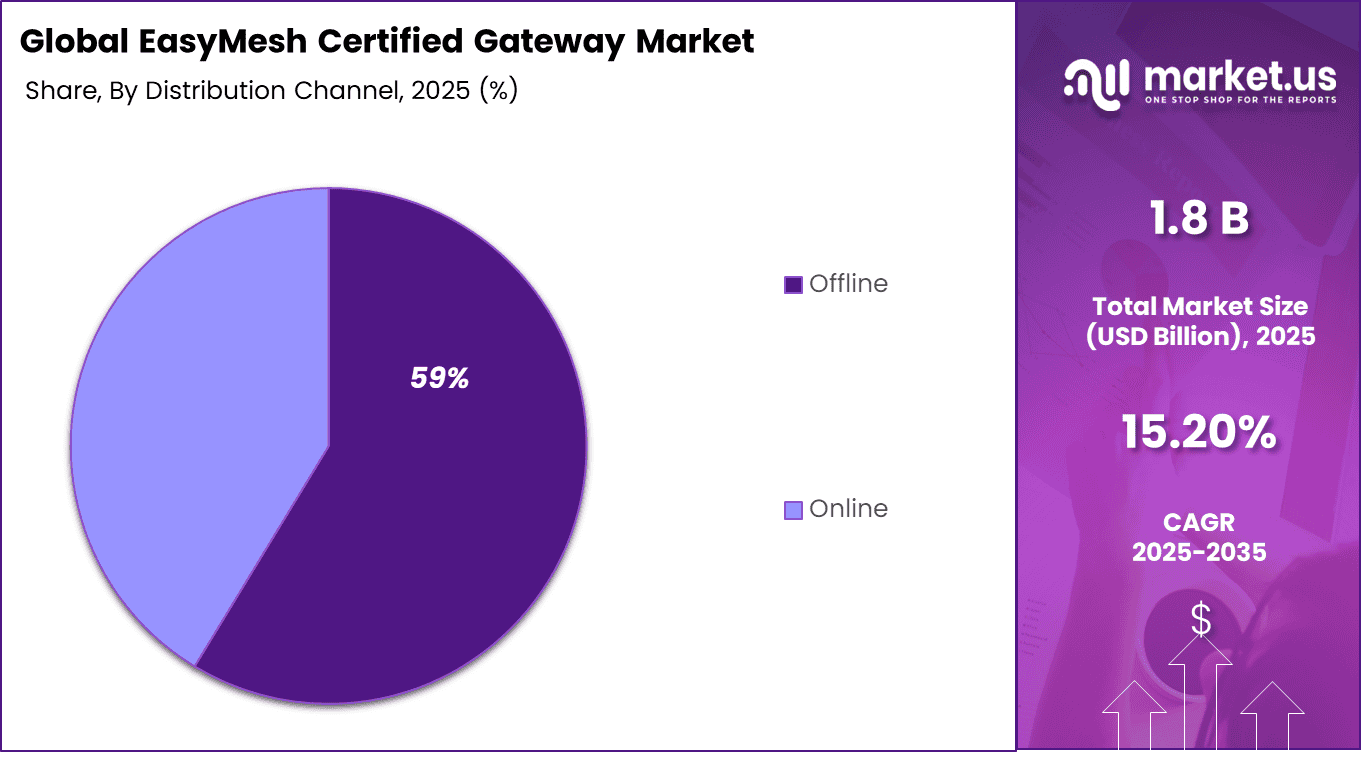
Offline distribution holds 58.7%, facilitating ISP bundling, retail partnerships, and technician-led installations with activation support.
Internet service providers represent 55.2%, deploying EasyMesh gateways for customer premises Wi-Fi 6/7 upgrades and churn reduction through superior coverage.
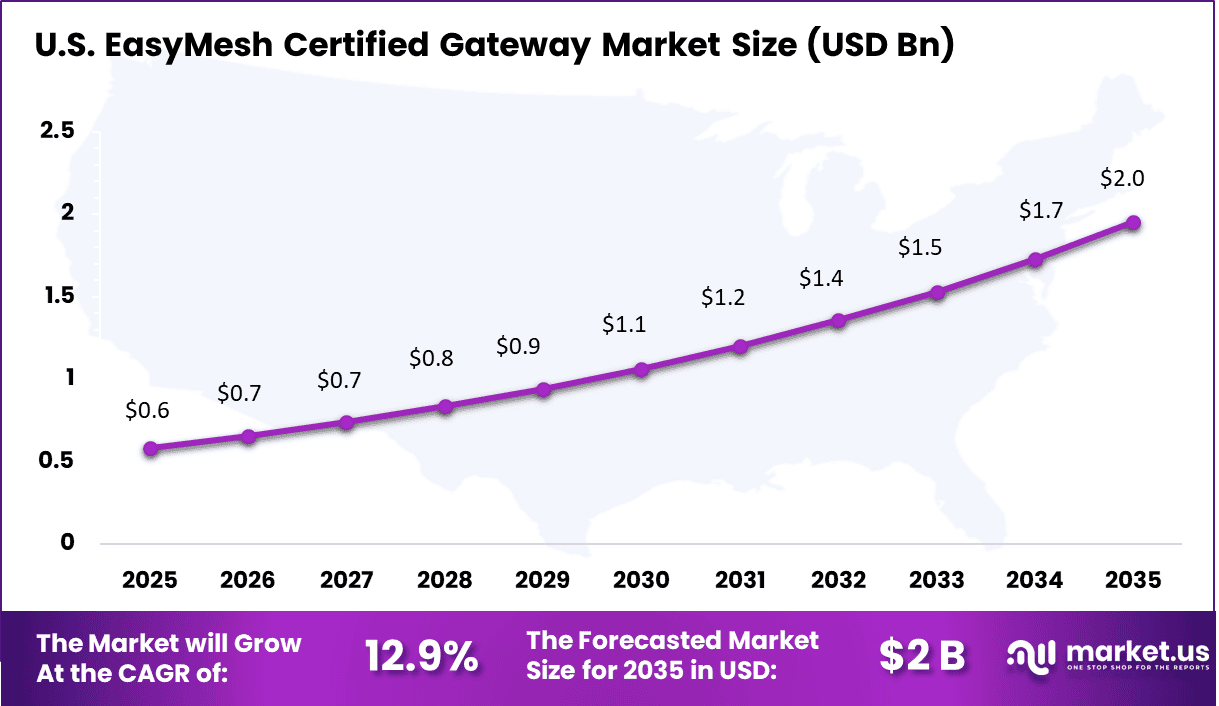
North America drives 37.5% global value, with U.S. market at USD 0.58 billion and 12.9% CAGR, fueled by Comcast/AT&T mesh rollouts and cord-cutting acceleration.
The EasyMesh certified gateway market is developing as users move toward more flexible and unified home networking systems. EasyMesh technology allows routers and access points from different devices to work together as a single network, with the gateway acting as the central controller. This helps improve coverage across homes and small offices while maintaining stable connectivity.
As digital usage grows across streaming, remote work, and smart home applications, users are placing higher importance on networks that can deliver consistent performance in every corner of the space. This is making EasyMesh certified gateways an important part of next generation home connectivity.
One of the main driving factors is the increasing need for interoperability and ease of network expansion. Users no longer want to be restricted to one brand when building a mesh network, and EasyMesh provides that flexibility. At the same time, the rise in connected devices within households is creating pressure on networks to handle higher traffic without performance drops.
Internet service providers are also focusing on improving user experience by offering gateways that can automatically optimize network performance and reduce manual setup. The growing adoption of smart home devices and advanced wireless technologies is further pushing the demand for gateways that can manage multiple connections efficiently and support seamless upgrades.
Demand for EasyMesh certified gateways is steadily increasing as users look for simple and reliable networking solutions. There is a strong preference for systems that can eliminate dead zones and provide uninterrupted connectivity across rooms. Consumers are also seeking solutions that require minimal technical knowledge, with features such as automatic configuration and real time network adjustments.
The demand is especially visible in environments where multiple users and devices are connected at the same time, such as modern households and small offices. As expectations for stable and high quality internet continue to rise, the need for intelligent and scalable gateway solutions is expected to grow further.
Drivers Impact Analysis
Key Driver
Impact on CAGR Forecast (~%)
Geographic Relevance
Impact Timeline
Additional Insight
Growing demand for seamless whole-home Wi-Fi coverage
+3.8%
Strong in North America and Europe, rising in Asia Pacific
Short to medium term
Mesh systems improve connectivity across larger homes
Increasing adoption of smart home ecosystems
+3.5%
Global, especially US, China, and Europe
Medium to long term
More connected devices require stable and unified networks
Rising broadband penetration and fiber deployment
+3.2%
Asia Pacific and Europe leading, expanding globally
Medium term
High-speed internet supports mesh gateway demand
Standardization through Wi-Fi EasyMesh certification
+2.9%
Global
Medium to long term
Interoperability encourages multi-brand adoption
Growing consumer preference for self-optimizing networks
+2.6%
Developed markets
Medium term
Automated network management enhances user experience
Restraints Impact Analysis
Key Restraint
Impact on CAGR Forecast (~%)
Geographic Relevance
Impact Timeline
Additional Insight
High initial cost of mesh-enabled gateways
-2.8%
Emerging markets
Short to medium term
Cost sensitivity limits early adoption
Limited awareness of EasyMesh benefits
-2.2%
Developing regions
Medium term
Consumers often stick to traditional routers
Compatibility challenges with legacy routers
-1.7%
Global
Medium term
Older devices may not support mesh standards
Dependence on ISP-driven deployments
-1.5%
North America and Europe
Medium term
Limited user control over hardware selection
Network complexity in multi-device environments
-1.3%
Global
Long term
Setup and optimization challenges affect adoption
By Product Type Analysis
The integrated gateways segment accounted for 46.8% of the market share, reflecting its strong position as a preferred solution for seamless network management. This dominance is supported by the ability of integrated gateways to combine routing, modem, and mesh functionalities into a single device. Such integration simplifies deployment and reduces the need for multiple hardware components, making it attractive for both service providers and end users seeking efficiency and ease of use.
Another factor contributing to this segment’s growth is the increasing demand for compact and cost-effective networking solutions. Integrated gateways help reduce installation complexity while ensuring consistent performance across connected devices. Their compatibility with mesh standards further enhances coverage and connectivity, which is becoming essential as households and businesses expand their digital ecosystems.
By Connectivity Analysis
The wireless segment held 74.6% share, driven by the growing need for flexible and cable-free network environments. Wireless connectivity supports seamless device movement and enables broader coverage across homes and commercial spaces. This has become particularly important with the increasing number of smart devices that rely on stable and continuous internet access without physical constraints.
In addition, advancements in wireless technologies have improved speed, reliability, and security, encouraging higher adoption. Users prefer wireless setups due to their convenience and scalability, especially in environments where wiring is not practical. The ability to support multiple devices simultaneously without compromising performance further strengthens the position of wireless connectivity in the market.
By Distribution Channel Analysis
The offline segment dominated with a 59% share, reflecting continued reliance on physical retail and authorized distribution networks. Customers often prefer to purchase networking equipment through stores where they can receive direct assistance, product demonstrations, and installation support. This is particularly relevant for EasyMesh certified gateways, where proper setup and compatibility play a key role in performance.
Furthermore, offline channels help build trust among buyers who value expert guidance before making purchasing decisions. Retailers and service providers offer personalized recommendations based on user requirements, which enhances customer confidence. The availability of after-sales support and immediate service also contributes to the sustained importance of offline distribution.
By End-User Analysis
The internet service providers segment captured 55.2% of the market, driven by their central role in delivering and managing network infrastructure. Service providers are increasingly deploying EasyMesh certified gateways to improve network coverage and customer experience. These solutions enable better control over network performance and allow providers to offer value-added services to their subscribers.
Additionally, internet service providers benefit from the ability to remotely manage and optimize network settings, reducing operational challenges. The growing demand for uninterrupted connectivity and higher data speeds has encouraged providers to adopt advanced gateway solutions. This trend is expected to continue as competition among service providers intensifies and customer expectations for reliable connectivity rise.
Investor Type Impact Analysis
Investor Type
Growth Sensitivity
Risk Exposure
Geographic Focus
Investment Outlook
Venture capital firms
High
High
US, China
Targeting innovative mesh networking startups
Private equity firms
Moderate to high
Moderate
North America and Europe
Focus on scaling network hardware providers
Corporate investors
High
Moderate
Global
Investing in integrated smart home connectivity solutions
Institutional investors
Moderate
Low to moderate
Developed markets
Favor stable telecom and networking companies
Government and public funding bodies
Moderate
Low
Asia Pacific and Europe
Supporting broadband and digital infrastructure projects
Technology Enablement Analysis
Technology
Impact on CAGR Forecast (~%)
Geographic Relevance
Impact Timeline
Additional Insight
Wi-Fi EasyMesh interoperability standards
+4.0%
Global
Medium to long term
Enables seamless multi-vendor device integration
AI-driven network optimization
+3.4%
US, Japan, South Korea
Medium term
Improves signal distribution and performance
Cloud-based network management
+2.9%
North America and Europe
Short to medium term
Allows remote monitoring and updates
Wi-Fi 6 and Wi-Fi 7 integration
+3.6%
Global
Medium to long term
Enhances speed and supports dense device environments
Edge intelligence in gateways
+2.5%
Global
Medium term
Supports faster local decision-making and performance
Emerging Trends
The EasyMesh certified gateway market is seeing a strong shift toward standardized whole home connectivity that removes compatibility issues across devices. A key emerging trend is the growing adoption of interoperable mesh systems that allow gateways and extenders from different vendors to work together seamlessly under a unified network. This is improving user experience by eliminating the need for single brand ecosystems and enabling flexible network expansion. Another important trend is the integration of advanced network management features within gateways, such as intelligent traffic steering, device prioritization, and self optimizing connectivity.
These capabilities ensure stable performance even as the number of connected devices increases within homes. There is also a noticeable move toward combining EasyMesh certification with next generation Wi Fi standards, which enhances speed, reduces latency, and supports bandwidth intensive applications like streaming, gaming, and smart home automation. Service providers are also showing interest in remotely managed mesh gateways, allowing them to monitor and optimize home networks without direct user intervention.
Growth Factors
The growth of this market is driven by the rising demand for consistent and high quality internet coverage across residential spaces. As households adopt multiple connected devices, including smart appliances and entertainment systems, traditional single router setups are becoming less effective. This is pushing demand for mesh based gateways that can deliver uniform connectivity in every room. Increasing reliance on digital services such as remote work, online learning, and cloud applications is also strengthening the need for uninterrupted and reliable internet access.
Another major growth factor is the push from telecom operators to improve customer satisfaction by offering EasyMesh certified solutions that simplify installation and reduce network issues. In addition, consumer awareness regarding network performance and coverage is improving, encouraging upgrades from basic routers to advanced mesh enabled gateways. The growing smart home ecosystem further supports this demand, as users require stable and scalable network infrastructure to manage multiple devices efficiently.
Key Market Segments
By Product Type
Standalone Gateways
Integrated Gateways
Mesh Routers
By Connectivity
Wired
Wireless
By Distribution Channel
Online
Offline
By End-User
Internet Service Providers
Enterprises
Individuals
Other End-Users
Regional Analysis
North America accounted for 37.5% of the EasyMesh Certified Gateway market, supported by strong adoption of whole-home Wi-Fi solutions and increasing demand for seamless connectivity across multiple devices. The region benefits from advanced broadband infrastructure and high penetration of smart homes, where users expect uninterrupted internet coverage in every corner of the house.
EasyMesh technology is gaining traction as it allows interoperability between devices from different manufacturers, which appeals to consumers looking for flexible and cost-effective networking setups. Service providers across the region are also encouraging mesh-based gateway deployments to improve customer experience and reduce connectivity complaints, further strengthening regional demand.
The U.S. market reached USD 0.58 Billion and is projected to grow at a CAGR of 12.9%, driven by rising data consumption and the growing number of connected devices per household. Consumers are increasingly shifting toward mesh-enabled gateways to address issues such as dead zones and inconsistent speeds, especially in larger homes.
The demand is also supported by remote work, streaming services, and online gaming, all of which require stable and high-speed connections. Telecom operators are integrating EasyMesh-certified gateways into their offerings to simplify network management for users. This trend, combined with ongoing upgrades in Wi-Fi standards, is expected to support steady growth in the US market over the forecast period.
Key Regions and Countries
North America
US
Canada
Europe
Germany
France
The UK
Spain
Italy
Russia
Netherlands
Rest of Europe
Asia Pacific
China
Japan
South Korea
India
Australia
Singapore
Thailand
Vietnam
Rest of APAC
Latin America
Brazil
Mexico
Rest of Latin America
Middle East & Africa
South Africa
Saudi Arabia
UAE
Rest of MEA
Competitive Analysis
The competitive landscape of the EasyMesh Certified Gateway Market is diverse, with a combination of telecom equipment providers, networking hardware companies, and smart home solution vendors competing to expand their presence. Companies such as Huawei Technologies Co. Ltd., Extreme Networks Inc., Calix Inc., and SIAE Microelettronica S.p.A. focus on delivering carrier-grade gateway solutions designed for telecom operators and broadband service providers. These players emphasize scalable infrastructure, remote network management, and high-performance connectivity.
At the same time, consumer-focused brands like Xiaomi Corporation, Netgear Inc., D-Link Corporation, Zyxel Communications Corporation, and Cudy Technology Co. Ltd. offer EasyMesh-compatible devices aimed at improving home Wi-Fi coverage with simple setup and affordability. The adoption of EasyMesh standards allows interoperability between devices from different brands, which increases competition and pushes companies to improve product reliability and user experience.
In addition, manufacturers such as Sercomm Corporation and Arcadyan Technology Corporation play an important role as OEM and ODM suppliers, supporting large-scale deployments for service providers and global brands. Companies like Ubiquiti Inc., Fiberstore Co. Ltd., and Edgecore Networks Corporation target enterprise and advanced user segments by offering centralized network control and high-capacity solutions.
Meanwhile, players including Fortinet Inc., Alarm.com Holdings Inc., Verkada Inc., and Wyze Labs Inc. are expanding into integrated ecosystems by combining network connectivity with security, surveillance, and smart home automation. Emerging firms such as Accuver Co. Ltd., RMS Omega Technologies Inc., and Heights Telecom Ltd. are contributing through specialized testing, deployment services, and niche connectivity offerings. Overall, competition in this market is driven by innovation in mesh networking performance, ease of deployment, and the ability to deliver seamless connectivity across multiple devices.
The future outlook for the EasyMesh Certified Gateway Market appears strong, supported by the increasing demand for seamless whole-home connectivity and simplified network management. As households continue to adopt multiple connected devices, consumers are expected to prefer mesh networking solutions that eliminate dead zones and provide consistent performance across larger spaces. EasyMesh-certified gateways are anticipated to gain traction due to their interoperability across devices from different brands, reducing vendor lock-in and improving user flexibility.
Recent Developments
March, 2026 – Huawei WiFi AX6 gets EasyMesh cert for HarmonyOS homes and covers 6,000 sq ft. China smart home leader with AI self-healing networks. Adds HarmonyOS app ecosystem and voice control.
February, 2026 – Xiaomi AX6000 mesh gateway hits EasyMesh with Mi Home app and budget Wi-Fi 7. India bundles popular with voice control integration. Xiaomi HyperOS connectivity included.
Report Scope
Report Features
Description
Market Value (2025)
USD 1.8 Billion
Forecast Revenue (2035)
USD 7.5 Billion
CAGR(2025-2035)
15.20%
Base Year for Estimation
2024
Historic Period
2020-2024
Forecast Period
2026-2035
Report Coverage
Revenue forecast, AI impact on Market trends, Share Insights, Company ranking, competitive landscape, Recent Developments, Market Dynamics and Emerging Trends
Segments Covered
By Product Type (Standalone Gateways, Integrated Gateways, Mesh Routers), By Connectivity (Wired, Wireless), By Distribution Channel (Online, Offline), By End-User (Internet Service Providers, Enterprises, Individuals, Other End-Users)
Regional Analysis
North America – US, Canada; Europe – Germany, France, The UK, Spain, Italy, Russia, Netherlands, Rest of Europe; Asia Pacific – China, Japan, South Korea, India, New Zealand, Singapore, Thailand, Vietnam, Rest of Latin America; Latin America – Brazil, Mexico, Rest of Latin America; Middle East & Africa – South Africa, Saudi Arabia, UAE, Rest of MEA