


Global Dispersing Agents Market By Type (Anionic, Non-Ionic, Hydrophilic, Amphoteric, and Cationic), By Formulations (Waterborne and Solvent-based), By Application (Paints And Coatings, Construction, Pulp And Paper, Agrochemicals, Oil And Gas, Detergents, Plastics And Polymers, Ceramics, Pharmaceuticals, and Others), By Region and Companies - Industry Segment Outlook, Market Assessment, Competition Scenario, Trends and Forecast 2025-2035
- Published date: Feb 2026
- Report ID: 179788
- Number of Pages: 363
- Format:
-
keyboard_arrow_up
Quick Navigation
Report Overview
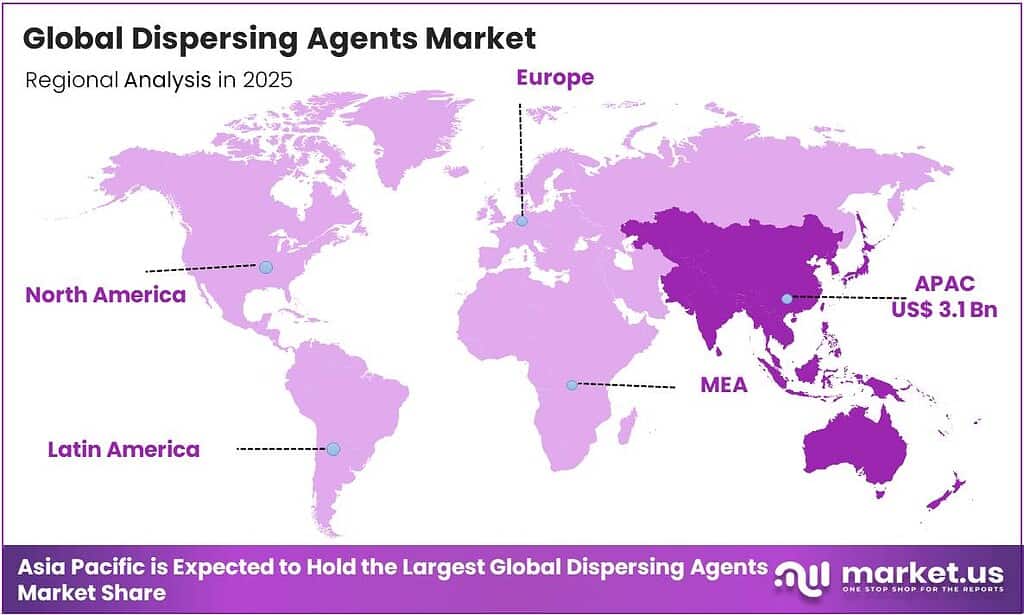
The Global Dispersing Agents Market is expected to be worth around USD 15.2 Billion by 2035, up from USD 8.2 Billion in 2025, at a CAGR of 6.4% from 2026 to 2035. The Asia Pacific segment maintained 38.1%, supporting a Dispersing Agents value of USD 3.1 Bn.
Dispersing agents, or dispersants, are specialized chemical additives, typically surfactants or polymers, designed to stabilize the suspension of solid particles or liquid droplets within a liquid medium. Their primary role is to prevent particles from clumping together, called agglomeration, and settling to the bottom, called sedimentation. Dispersants generally consist of two parts: an anchoring group that attaches to the particle and a soluble tail that stays in the liquid.
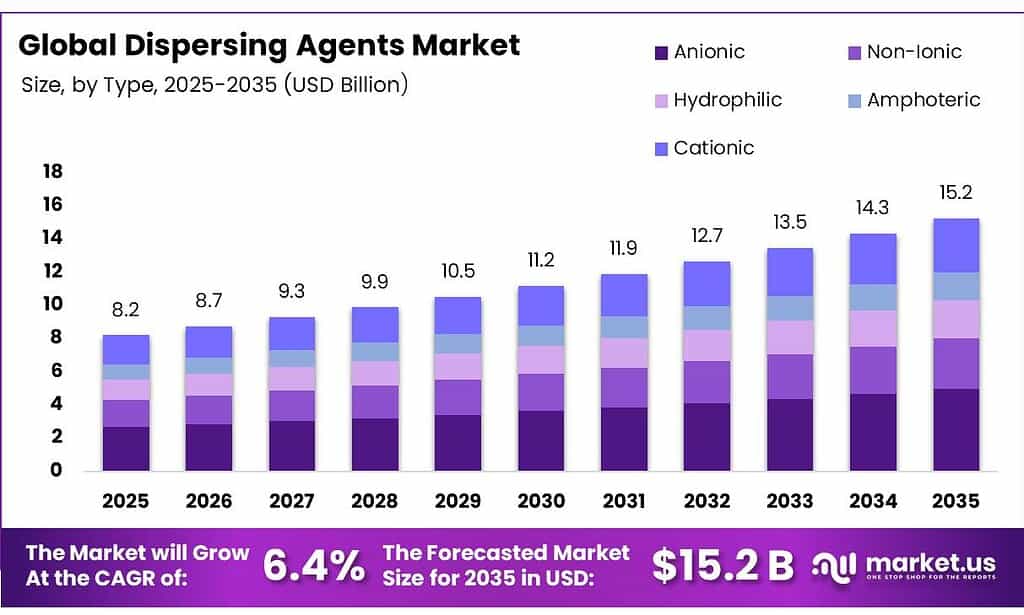
The dispersing agents market is largely driven by the demand for enhanced performance across various industries, especially in paints and coatings. Anionic dispersing agents dominate due to their cost-effectiveness, versatility, and strong performance in waterborne systems, which are increasingly preferred due to their lower environmental impact and regulatory compliance.
While dispersing agents are used in other sectors such as construction, pulp and paper, and detergents, their primary application remains in the coatings industry, where dispersion is crucial for achieving smooth finishes and color consistency. Similarly, the market is witnessing a shift towards eco-friendly, bio-based dispersing agents, driven by stricter environmental regulations and consumer preference for sustainable products.
Key Takeaways:
- The global dispersing agents market was valued at USD 8.2 billion in 202.5
- The global dispersing agents market is projected to grow at a CAGR of 6.4% and is estimated to reach USD 15.2 billion by 2035.
- Based on type, anionic dispersing agents dominated the market, constituting 32.5% of the total market share.
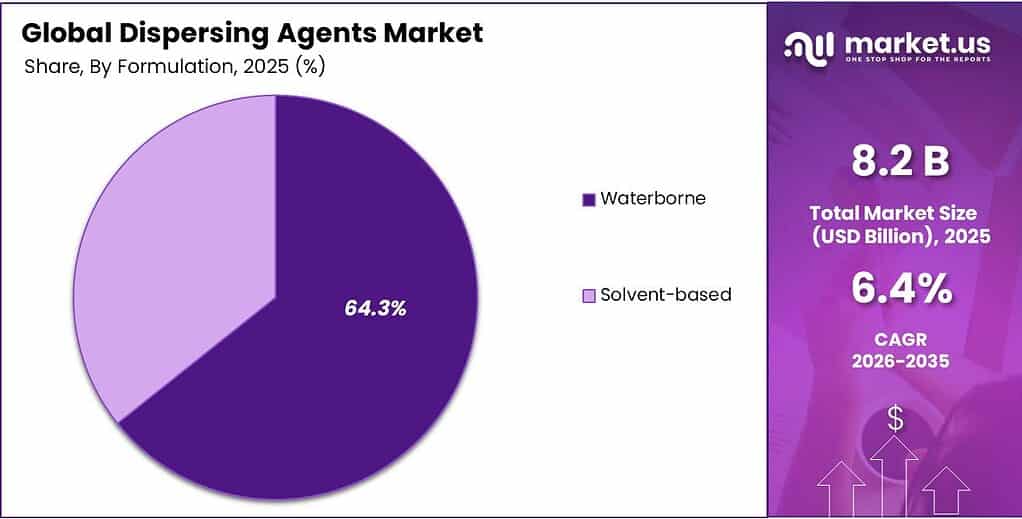
- Based on the formulations, waterborne dispersing agents dominated the market, with a substantial market share of around 64.3%.
- Among the end-uses of dispersing agents, the paints & coatings industry held a major share in the market, 31.7% of the market share.
- In 2025, the Asia Pacific was the most dominant region in the dispersing agents market, accounting for 38.1% of the total global consumption.
Type Analysis
Anionic Dispersing Agents Dominated the Market.
On the basis of type, the dispersing agents market is segmented into anionic, non-ionic, hydrophilic, amphoteric, and cationic. The anionic dispersing agents dominated the market, comprising 32.5% of the market share, primarily due to their effectiveness, cost efficiency, and versatility. Their negative charge enables them to effectively interact with and stabilize a wide range of particles, particularly in formulations such as paints, coatings, and inks, where efficient pigment dispersion is critical.
Anionic agents tend to offer superior performance in water-based systems, which are increasingly preferred for environmental and regulatory reasons. Additionally, anionic dispersing agents are typically more economical compared to other types, making them more accessible for large-scale commercial applications. Their stability, cost-effectiveness, and broad utility across multiple industries contribute to their dominant position in the market.
Formulations Analysis
Waterborne Dispersing Agents Held the Largest Share in the Market.
Based on the formulations, the dispersing agents market is divided into waterborne and solvent-based. The waterborne dispersing agents dominated the market, with a notable market share of 64.3%, primarily due to environmental and regulatory advantages. Waterborne systems are more eco-friendly, as they contain lower levels of volatile organic compounds (VOCs), which contribute to air pollution and health hazards.
Regulations around VOC emissions, particularly in regions such as Europe and North America, have made waterborne formulations more attractive, as they comply with stricter environmental standards. Additionally, waterborne dispersing agents are safer for workers, as they reduce exposure to harmful solvents. Similarly, waterborne agents provide effective pigment dispersion in water-based paints and coatings without compromising quality, making them the preferred choice in a wide range of industries.
End-use Analysis
The Paints & Coatings Industry Accounted for a Significant Portion of the Dispersing Agents Market.
The dispersing agents market is categorized by end-use into paints & coatings, construction, pulp & paper, agrochemicals, oil & gas, detergents, plastics & polymers, ceramics, pharmaceuticals, and others. The paints & coatings industry accounts for 31.7% of the total global usage of dispersing agents market, as this industry relies heavily on precise pigment dispersion for color consistency, stability, and product quality.
In paints and coatings, dispersing agents help ensure that pigments remain evenly distributed in the formulation, preventing settling and clumping, which is critical for achieving smooth, durable finishes. This demand for superior dispersion is fundamental to achieving the desired visual and functional properties of the product, such as gloss, opacity, and durability.
While dispersing agents are used in other industries, such as construction or detergents, these sectors typically require fewer performance parameters. In contrast, paints and coatings require constant innovation and high standards, making dispersing agents a core component in formulation development and production.
Key Market Segments:
By Type
- Anionic
- Non-Ionic
- Hydrophilic
- Amphoteric
- Cationic
By Formulations
- Waterborne
- Solvent-based
By End-use
- Paints & Coatings
- Construction
- Pulp & Paper
- Agrochemicals
- Oil & Gas
- Detergents
- Plastics & Polymers
- Ceramics
- Pharmaceuticals
- Others
Drivers
Performance Requirements in Various End-Use Industries Drive the Dispersing Agents Market.
Dispersing agents are critical in achieving the desired performance characteristics across various end-use industries, including paints, inks, coatings, and cosmetics, to ensure product stability and functional efficiency. In the paints, inks, and coatings industry, dispersing agents enhance pigment dispersion, improving color consistency and stability, particularly in automotive and industrial coatings, where durability and finish quality are paramount.
The dispersing agents help reduce viscosity and improve application efficiency, making them essential in achieving high-performance coatings. In the cosmetics sector, dictated by dermal compatibility and emulsion stability, dispersing agents enable uniform suspension of pigments in formulations, such as foundations and lipsticks, contributing to smooth texture and color integrity. The dispersants must remain stable across a wide pH range, around 4.0 to 9.0, to accommodate various active ingredients in skincare formulations.
Similarly, in paper coating, dispersants must maintain stability at high solids content, often at more than 70%, to ensure high-speed machine runnability. The construction industry requires superplasticizers, polycarboxylate ethers, to reduce water-to-cement ratios while maintaining workability. These industry-specific demands drive a steady need for advanced dispersing agents in these sectors.
Restraints
Regulatory Constraints and Environmental Impact Might Pose Challenges to the Dispersing Agents Market.
Regulatory frameworks and documented environmental risks present significant technical and operational challenges to the conventional dispersing agents market, primarily affecting petroleum-based and alkylphenol-derived chemistries. For instance, the U.S. Environmental Protection Agency (EPA) has highlighted the harmful effects of certain surfactants, which can persist in water systems, impacting aquatic life.
Similarly, the European Union’s REACH regulation further restricts the use of chemicals that do not meet environmental safety standards, compelling manufacturers to seek more sustainable alternatives. The conventional dispersing agents often contain solvents and other volatile organic compounds (VOCs) that contribute to air pollution and ground-level ozone formation.
- Under the EU REACH regulation (Regulation (EC) No 1907/2006), the use of nonylphenol (NP) and its ethoxylates (NPEs) is strictly limited to concentrations below 0.1% by weight in most mixtures.
The European Coatings Association has raised concerns over the high VOC content in certain formulations, which has led to stricter limits in various regions, including the EU and North America. Consequently, manufacturers are under pressure to develop eco-friendly dispersing agents that comply with evolving environmental regulations.
Opportunity
Expansion of Waterborne Systems Creates Opportunities in the Dispersing Agents Market.
The expansion of waterborne systems presents a significant opportunity for the dispersing agents market, driven by increasing demand for environmentally friendly alternatives in coatings, paints, and adhesives. Waterborne formulations, promoted by regulations such as the European Union’s REACH and U.S. EPA standards, reduce the use of volatile organic compounds (VOCs) and other harmful chemicals.
The U.S. Environmental Protection Agency (EPA) reported that water-based coatings can achieve up to an 80% volumetric reduction in VOCs compared to traditional solvent-based alternatives. These waterborne coatings help lower air pollution and improve worker safety, providing an impetus for increased adoption.
Waterborne systems require specific dispersing agents that can enhance pigment stability and maintain performance without the use of organic solvents. This shift towards waterborne systems in sectors such as automotive and industrial coatings further underscores the growing need for effective dispersing agents that support these environmentally compliant formulations.
Trends
Shift Towards Eco-Friendly and Bio-Based Dispersing Agents.
The transition toward bio-based and biodegradable dispersing agents is driven by regulatory mandates and technical requirements for reduced environmental toxicity. This shift is characterized by the replacement of petroleum-derived surfactants with chemistries derived from renewable feedstocks.
Governmental frameworks, such as the European Commission’s Green Deal and the U.S. EPA’s Safer Choice program, have accelerated the phase-out of conventional agents like alkylphenol ethoxylates (APEOs). For instance, some new-generation dispersants utilize sugar-based (alkyl polyglucosides) or plant-oil-based (glucamides) hydrophobes, which achieve a ready biodegradability rating (OECD 301B) of more than 60% degradation within 28 days.
The shift is particularly evident in the coatings industry, where bio-based dispersing agents derived from renewable sources, such as plant-based oils and sugars, are being incorporated to replace traditional petrochemical-based agents. Similarly, in the agricultural sector, the U.S. Department of Agriculture (USDA) Biopreferred program lists dispersants derived from lignin and soy, which facilitate the suspension of active ingredients in aqueous media while ensuring the final formulation meets non-toxicity standards for soil microorganisms.
Geopolitical Impact Analysis
The Geopolitical Reality of Supply Chain Disruptions for Dispersing Agents.
The geopolitical tensions, including trade disruptions, supply chain challenges, and regulatory shifts, have a significant impact on the dispersing agents market. For instance, dispersing agents rely heavily on petroleum-derived intermediates. The instability in Eastern Europe contributed to an increase in crude oil prices.
Natural gas prices in Europe rose within six months of the conflict’s onset, directly impacting the energy-intensive production of polymeric dispersants, such as polyacrylates and polyphosphates. Similarly, attacks on commercial vessels forced a rerouting of cargo around the Cape of Good Hope, bypassing the Suez Canal, which handles roughly 15% of global ocean traffic. This diversion added 7 to 15 days to transit times for chemicals moving from Asia to Western Europe and the U.S. East Coast.
Furthermore, the ongoing U.S.-China trade war has led to higher tariffs on chemicals, affecting the cost and availability of raw materials for dispersing agents, resulting in supply shortages and increased production costs for manufacturers. These geopolitical factors lead to increased production costs, supply chain instability, and regulatory complexities, all of which influence the dispersing agent market’s dynamics.
Regional Analysis
Asia Pacific Held the Largest Share of the Global Dispersing Agents Market.
In 2025, the Asia Pacific dominated the global dispersing agents market, holding about 38.1% of the total global consumption, driven by rapid industrialization, high demand from the paints and coatings industry, and a burgeoning manufacturing sector. The region’s growing infrastructure and construction activities significantly contribute to the need for dispersing agents, particularly in waterborne coatings.
Additionally, the expanding automotive and electronics industries in countries such as China, India, and Japan are major consumers of dispersing agents used in coatings and adhesives. Government regulations in countries such as Japan and South Korea, which promote the adoption of environmentally friendly products, further drive the demand for sustainable dispersing agents. This trend, coupled with the region’s dominant role in global manufacturing, solidifies Asia Pacific’s position as the largest market.
Key Regions and Countries
- North America
- The US
- Canada
- Europe
- Germany
- France
- The UK
- Spain
- Italy
- Russia & CIS
- Rest of Europe
- APAC
- China
- Japan
- South Korea
- India
- ASEAN
- Rest of APAC
- Latin America
- Brazil
- Mexico
- Rest of Latin America
- Middle East & Africa
- GCC
- South Africa
- Rest of MEA
Key Players Analysis:
Manufacturers of dispersing agents prioritize innovation in product development, investing in eco-friendly and bio-based dispersing agents to meet growing regulatory demands and consumer preference for sustainable products. Additionally, manufacturers focus on enhancing formulation efficiency, offering dispersing agents that improve performance, such as better dispersion stability and reduced viscosity, particularly for waterborne systems.
Similarly, geographic expansion is another key strategy, as companies increase their presence in rapidly developing markets, particularly in the Asia Pacific, to cater to local industries such as automotive, construction, and textiles. Furthermore, manufacturers often engage in strategic partnerships and collaborations with end-users in industries such as paints and coatings to develop customized solutions that meet specific performance requirements.
The major players in the industry
- Arkema
- BASF SE
- Kemira Oyj
- Dow Inc
- Evonik Industries AG
- Clariant
- Rudolf GmbH
- The Lubrizol Corporation
- Nouryon
- SNF Group
- Altana AG
- Croda International Plc
- Elementis PLC
- Lanxess AG
- NIPPON SHOKUBAI CO., LTD.
- Other Key Players
Key Development:
- In January 2025, Arkema, a leading company in Specialty Materials, introduced its ENCOR range of bio-based waterborne dispersions, specifically designed for textile printing and finishing applications. These binders contain up to 30% bio-based content and offer a reduction in carbon footprint of up to 40% compared to conventional textile resins.
- In November 2025, BASF officially launched its high-performance dispersant production line at the Jiangbei New Material Technology Park in Nanjing, China. This investment allowed the local manufacturing of cutting-edge dispersants utilizing Controlled Free Radical Polymerization (CFRP) technology.
Report Scope:
Report Features Description Market Value (2025) USD 8.2 Bn Forecast Revenue (2035) USD 15.2 Bn CAGR (2026-2035) 6.4% Base Year for Estimation 2025 Historic Period 2021-2024 Forecast Period 2024-2035 Report Coverage Revenue Forecast, Market Dynamics, Competitive Landscape, Recent Developments Segments Covered By Type (Anionic, Non-Ionic, Hydrophilic, Amphoteric, and Cationic), By Formulations (Waterborne and Solvent-based), By Application (Paints & Coatings, Construction, Pulp & Paper, Agrochemicals, Oil & Gas, Detergents, Plastics & Polymers, Ceramics, Pharmaceuticals, and Others) Regional Analysis North America – The US & Canada; Europe – Germany, France, The UK, Spain, Italy, Russia & CIS, Rest of Europe; APAC– China, Japan, South Korea, India, ASEAN & Rest of APAC; Latin America– Brazil, Mexico & Rest of Latin America; Middle East & Africa– GCC, South Africa, & Rest of MEA Competitive Landscape Arkema, BASF SE, Kemira Oyj, Dow Inc., Evonik Industries AG, Clariant, Rudolf GmbH, The Lubrizol Corporation, Nouryon, SNF Group, Altana AG, Croda International plc, Elementis plc, Lanxess AG, Nippon Shokubai Co., Ltd., and Other Players. Customization Scope Customization for segments, region/country-level will be provided. Moreover, additional customization can be done based on the requirements. Purchase Options We have three licenses to opt for: Single User License, Multi-User License (Up to 5 Users), Corporate Use License (Unlimited Users and Printable PDF) 
-
-
- Arkema
- BASF SE
- Kemira Oyj
- Dow Inc
- Evonik Industries AG
- Clariant
- Rudolf GmbH
- The Lubrizol Corporation
- Nouryon
- SNF Group
- Altana AG
- Croda International Plc
- Elementis PLC
- Lanxess AG
- NIPPON SHOKUBAI CO., LTD.
- Other Key Players
Our Clients

- 179788
- Feb 2026






