


Global Digital Agriculture Market Size, Share Analysis Report By Technology (Guidance Systems, Remote Sensing, Variable Rate Technology, Artificial Intelligence, Internet of Things, Blockchain and Traceability, Robotics and Automation), By Solution (Hardware, Software, Services), By Farm Size (Small-Scale Farms (Less Than 100 ha), Medium-Scale Farms (100-500 ha), Large-Scale Farms (More Than 500 ha)), By Application (Crop Monitoring, Yield Mapping, Soil Monitoring, Weather Tracking, Precision Spraying, Drone Analytics, Livestock Health Tracking), By Region and Companies - Industry Segment Outlook, Market Assessment, Competition Scenario, Trends and Forecast 2026-2035
- Published date: Mar 2026
- Report ID: 180749
- Number of Pages: 374
- Format:
-
keyboard_arrow_up
Quick Navigation
Report Overview
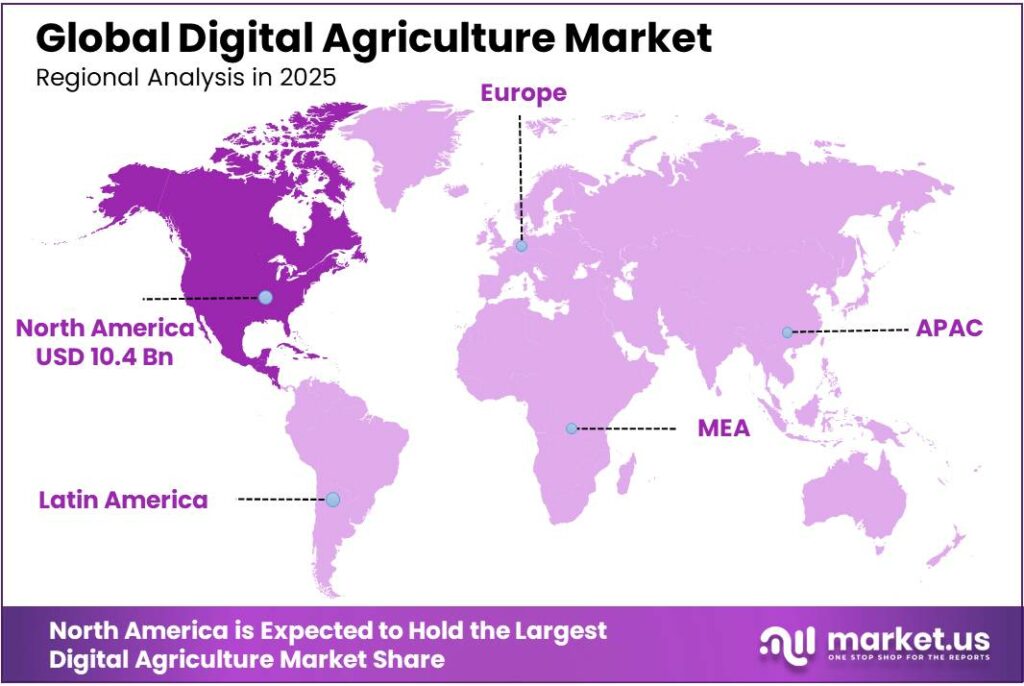
The Global Digital Agriculture Market size is expected to be worth around USD 64.2 Billion by 2035, from USD 24.4 Billion in 2025, growing at a CAGR of 10.2% during the forecast period from 2026 to 2035. In 2025, North America held a dominant market position, capturing more than a 42.8% share, holding USD 10.4 billion revenue.
Digital agriculture refers to the integration of advanced digital technologies such as artificial intelligence (AI), Internet of Things (IoT), remote sensing, drones, satellite imagery, and big data analytics into agricultural production and supply chain management. These technologies enable precision farming, real-time monitoring of crops and livestock, predictive analytics for weather and disease outbreaks, and improved decision-making across agricultural value chains.
- According to the Food and Agriculture Organization (FAO), approximately 892 million people globally depend on agriculture and forestry for their income, highlighting the sector’s significant socioeconomic importance and the need for technological transformation to improve productivity and resilience.
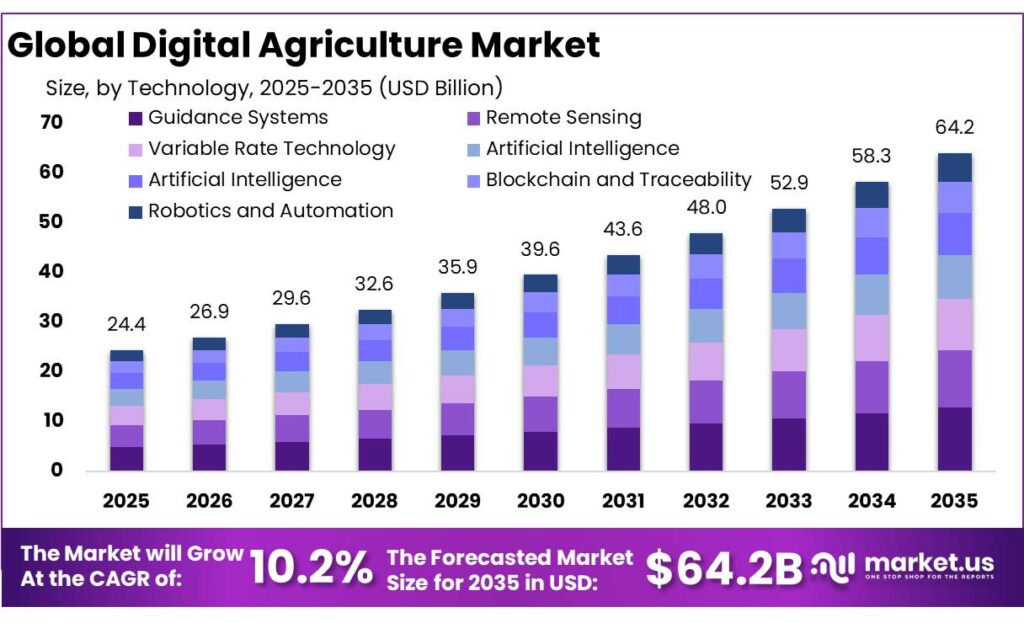
In the industrial scenario, digital agriculture has rapidly emerged as a strategic response to global challenges such as population growth, climate change, resource scarcity, labour shortages, and evolving food demand patterns. According to recent estimates, the global digital agriculture market was valued at approximately US $229 billion in 2025 and is projected to grow to US $650 billion by 2035, reflecting a compound annual growth rate (CAGR) of around 11% over that decade.
- The United Nations Food and Agriculture Organization (UN FAO) estimates that by 2050 the world must produce roughly 70% more food while accessing only around 5% more farmland, highlighting the necessity of digital tools that enhance output without expanding land use.
At the policy level, targeted initiatives are accelerating digital adoption. The Government of India’s Digital Agriculture Mission aims to establish a farmer-centric digital ecosystem to improve transparency, efficiency, and evidence-based policymaking across the agricultural value chain. Similarly, Indian states like Maharashtra and Andhra Pradesh are committing substantial funds and platforms to integrate AI, ML, and digital services for farmers, including Rs 500 crore for AI-assisted agriculture (2025–2029) and statewide digitization of agricultural governance from Kharif 2025.
Key Takeaways
- Digital Agriculture Market size is expected to be worth around USD 64.2 Billion by 2035, from USD 24.4 Billion in 2025, growing at a CAGR of 10.2%.
- Guidance Systems held a dominant market position, capturing more than a 19.2% share.
- Hardware held a dominant market position, capturing more than a 52.7% share.
- Medium-Scale Farms (100–500 ha) held a dominant market position, capturing more than a 43.9% share.
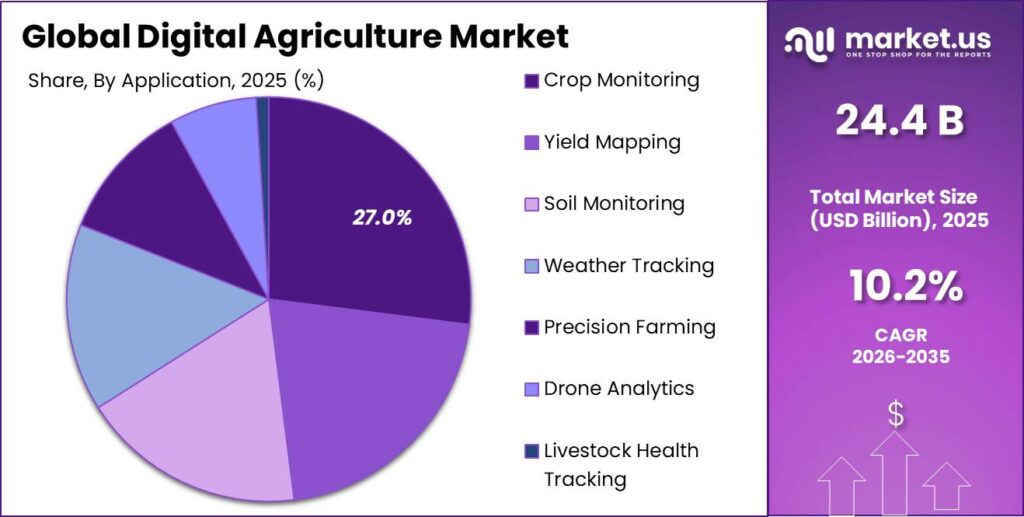
- Crop Monitoring held a dominant market position, capturing more than a 27.5% share.
- North America continued to dominate the global digital agriculture landscape, accounting for a commanding 42.8% share of the market with an estimated regional value of USD 10.4 billion.
By Technology Analysis
Guidance Systems dominate with 19.2% share driven by precision farming adoption
In 2024, Guidance Systems held a dominant market position, capturing more than a 19.2% share. This strong position reflects the growing reliance of farmers on precision-based navigation tools to improve field accuracy and operational efficiency. Guidance systems, including GPS-enabled tractors, auto-steering equipment, and real-time positioning tools, have become essential in modern farming practices. These systems help reduce overlaps and gaps during planting, spraying, and harvesting, allowing farmers to optimize input usage and improve productivity. The increasing need to lower operational costs and improve yield consistency has further strengthened their adoption across both developed and developing agricultural economies.
By Solution Analysis
Hardware leads strongly with 52.7% share supported by rising on-field equipment adoption
In 2024, Hardware held a dominant market position, capturing more than a 52.7% share. This leadership was largely driven by the growing installation of physical digital farming components such as sensors, GPS devices, drones, automated irrigation systems, and smart monitoring equipment. Farmers across major agricultural regions invested significantly in on-field hardware to improve productivity and reduce manual effort. Unlike software platforms that depend on connectivity and training, hardware solutions provide visible and immediate operational benefits, which made them a preferred starting point for digital transformation in agriculture.
By Farm Size Analysis
Medium-Scale Farms (100–500 ha) lead adoption with 43.9% share driven by balanced scale and investment capacity
In 2024, Medium-Scale Farms (100–500 ha) held a dominant market position, capturing more than a 43.9% share. This segment emerged as the most active adopter of digital agriculture solutions due to its balanced operational scale and financial flexibility. Farms within this size range typically operate with structured management systems and commercial production goals, making them more open to investing in precision tools, smart equipment, and farm management technologies. At the same time, they are not as capital-heavy as very large estates, allowing them to adopt digital solutions in a phased and practical manner.
By Application Analysis
Crop Monitoring leads with 27.5% share as farmers prioritize real-time field visibility
In 2024, Crop Monitoring held a dominant market position, capturing more than a 27.5% share. This strong position reflects the increasing importance of real-time crop health assessment and field surveillance in modern farming. Farmers are placing greater emphasis on monitoring plant growth, soil conditions, moisture levels, and pest activity throughout the crop cycle. Digital tools such as satellite imaging, drone-based field mapping, and sensor-driven analytics have become essential in helping growers make timely and accurate decisions.
Key Market Segments
By Technology
- Guidance Systems
- Remote Sensing
- Variable Rate Technology
- Artificial Intelligence
- Internet of Things
- Blockchain and Traceability
- Robotics and Automation
By Solution
- Hardware
- Software
- Services
By Farm Size
- Small-Scale Farms (Less Than 100 ha)
- Medium-Scale Farms (100-500 ha)
- Large-Scale Farms (More Than 500 ha)
By Application
- Crop Monitoring
- Yield Mapping
- Soil Monitoring
- Weather Tracking
- Precision Farming
- Drone Analytics
- Livestock Health Tracking
Emerging Trends
Rise of Sensor-Driven Farming: A New Era of Connected Fields
One of the most important trends shaping digital agriculture today is the rapid adoption of sensor-driven farming technologies. Sensors placed in fields, on machinery, and even embedded in soil and crops are giving farmers immediate insights into conditions that once could only be guessed at. This trend is significant not just because it brings new tools into farming, but because it fundamentally changes how farmers make decisions — turning gut feel into data-backed choices that improve efficiency, reduce waste, and protect natural resources.
Governments are also supporting this trend. For example, India’s Digital Agriculture Mission tied digital sensor use into its larger strategy by mapping soil health and integrating digital data streams into the advisory services offered to farmers. So far, the mission has completed soil profile mapping for 29 million hectares of land, contributing to databases that help farmers understand soil conditions at a detailed level. This data, collected through digital tools and sensors, is helping to craft better crop plans and nutrient recommendations tailored to specific locations and seasons.
The shift toward sensor-driven farming also brings young people into agriculture. Many young farmers and agri-entrepreneurs are building mobile apps and cloud platforms that interpret sensor data and make it easy to understand. This human element — the connection between technology and everyday life on the farm — inspires creativity and expands opportunities beyond traditional farming roles.
Drivers
Feeding a Growing World: Why Food Security Drives Digital Agriculture
One of the most important reasons digital agriculture is spreading so fast around the world is the urgent need to produce more food with fewer resources. As the global population keeps growing, agriculture faces pressure unlike anything before. The Food and Agriculture Organization of the United Nations (FAO) estimates that by 2050, agriculture must produce about 70 % more food while using only about 5 % more land than it does today to meet demand. This huge gap between food demand and available agricultural land makes traditional farming methods untenable and pushes farmers, businesses, and governments toward digital solutions that can help do more with less.
Governments are taking concrete steps in this direction. For example, in India, the Digital Agriculture Mission was approved with a total financial outlay of Rs 2,817 crore, including Rs 1,940 crore from the central government, to build digital public infrastructure for agriculture. This plan includes large-scale soil mapping over almost 142 million hectares of farmland and digital estimation surveys to improve yield accuracy and decision-making.
Another dimension of this driving force is the essential link between food production and economic stability. Countries with strong agricultural productivity are usually able to support thriving rural communities, lower poverty rates and strengthen their national economy. According to World Bank data, agriculture provides jobs and income for about 80 % of the world’s poorest people, most of whom live in rural areas and depend directly on farming for their food and livelihood. This deep connection between agriculture and rural prosperity pushes governments to adopt digital agriculture strategies that can help farmers improve both productivity and income.
Restraints
Limited Digital Access in Rural Areas Hampers Digital Agriculture Progress
One of the biggest challenges slowing down the spread of digital agriculture is the lack of reliable digital access and connectivity in rural farming communities. This gap doesn’t just make it harder for farmers to adopt new tools — it creates a barrier that keeps many of them from even seeing the benefits of digital technology. While farmers around the world are increasingly aware that data, sensors, apps, and connected machines can make farming more productive, many still struggle with basic connectivity and access to digital infrastructure needed to use these tools in the first place.
Governments and development agencies recognize this problem, and some have begun to take steps to close the digital gap. For example, when India launched its Digital Agriculture Mission, the plan included efforts to expand rural digital infrastructure alongside soil mapping and advisory services. The idea was that better connectivity would make it easier for farmers to access digital platforms and benefit from precision farming tools; but scaling this infrastructure across hundreds of millions of hectares of farmland is still a massive undertaking.
A report by the Food and Agriculture Organization of the United Nations (FAO) highlights this divide clearly. According to FAO’s analysis, roughly 70% of the rural population in least developed countries still does not have access to the internet. This means a large proportion of farmers in the countries that need productivity gains the most are unable to tap into digital services such as remote crop monitoring, weather forecasts, or mobile advisory tools that could help improve yields and reduce losses.
Opportunity
Expanding Digital Tools Offers New Horizons for Farmers and Food Systems
One of the biggest growth opportunities for digital agriculture today lies in enhanced access to real-time data and decision support tools, which have the potential to transform how farmers make choices and manage their crops. Digital technologies — such as sensors, remote sensing systems, mobile advisory services, and integrated data platforms — are being increasingly recognized as vital tools for improving agricultural productivity while reducing waste and risk.
What makes this opportunity especially compelling is that these tools help farmers not just increase output, but do so in ways that are more efficient, sustainable, and resilient to challenges like climate change and market volatility. The Food and Agriculture Organization (FAO) underscores the importance of these digital solutions, explaining that they “boost efficiency and productivity and tackle bottlenecks in food safety, postharvest handling, market access, finance and supply chain management.”
- Government initiatives based on digital tools amplify this opportunity further. India’s Digital Agriculture Mission is a strong example, where detailed soil profile maps are being created on a 1:10,000 scale for about 142 million hectares of agricultural land. As of 2024, 29 million hectares of soil profile inventory have already been mapped under this programme, helping both farmers and policymakers understand soil health and make smarter decisions about crop planning and nutrient management.
What makes this growth opportunity humane and far-reaching is how it supports smallholder farmers and rural communities. For many smallholders, access to digital advisories via mobile phones or apps means they no longer have to wait for occasional visits from extension workers to get critical information. Instead, they can receive tailored crop advice, pest alerts, and market insights in their own hands. FAO’s broader digital agriculture strategy intentionally seeks to empower rural households and inspire youth entrepreneurship by making digital solutions more accessible and locally relevant.
Regional Insights
North America stands tall with a 42.8% share and USD 10.4 billion in digital agriculture as the region leads global adoption
In 2024, North America continued to dominate the global digital agriculture landscape, accounting for a commanding 42.8% share of the market with an estimated regional value of USD 10.4 billion. This dominance stems from a combination of highly mechanized agriculture, well-developed farm equipment infrastructure, and significant investment in cutting-edge technologies such as GPS-enabled machinery, IoT sensors, remote sensing, and data analytics.
The widespread use of precision farming systems across major crop belts has been one of the key reasons behind this leadership. In many parts of North America, farmers use digital apps to monitor soil moisture, crop health, and weather patterns in real time, enabling more informed decisions that reduce waste and save costs. Historical agricultural surveys show that technologies such as yield mapping and guidance automation are increasingly applied across the major corn, soybean, and wheat acres, indicating a deeper penetration of digital tools into everyday farm operations.
Key Regions and Countries Insights
- North America
- US
- Canada
- Europe
- Germany
- France
- The UK
- Spain
- Italy
- Rest of Europe
- Asia Pacific
- China
- Japan
- South Korea
- India
- Australia
- Rest of APAC
- Latin America
- Brazil
- Mexico
- Rest of Latin America
- Middle East & Africa
- GCC
- South Africa
- Rest of MEA
Key Players Analysis
Deere & Company, often known by its trademark John Deere, is one of the most recognizable names in agriculture machinery and precision farming technology. In 2025, the company reported an operating income of about USD 6.26 billion and a net income of approximately USD 5.03 billion, driven in part by its investment in precision agriculture solutions, autonomous tractors, GPS-based guidance, and digital farm management systems that help farmers optimise inputs and reduce waste across large farms globally.
AGCO Corporation is a global manufacturer of agricultural equipment and increasingly embeds smart farming technology into its tractors and machinery. With a reported revenue of USD 14.41 billion and a net income of USD 1.17 billion in 2023, AGCO is enhancing connectivity in farm machinery and offering digital farm management tools through its Fendt, Massey Ferguson, and Valtra brands. Its focus includes fleet telematics, precision seeding, and data-driven support that improve farm productivity while reducing input overlap.
Syngenta Group, headquartered in Switzerland, reported revenue of around USD 16.98 billion in 2024 while integrating digital tools into its agricultural portfolio. Syngenta’s digital farming platform, Cropwise, combines data analytics, weather modelling, and field insights, empowering growers to improve yield, resource efficiency, and crop quality. Alongside crop protection and seed businesses, Syngenta leverages digital tools to support sustainable farming decisions and to strengthen farm-to-market connectivity for growers worldwide.
Top Key Players Outlook
- Deere & Company
- Bayer AG
- AGCO Corporation
- Syngenta Group
- International Business Machines Corporation
- Microsoft Corporation
- Hexagon AB
- Kubota Corporation
- Topcon Corporation
- SZ DJI Technology Co., Ltd.
- Planet Labs PBC
Recent Industry Developments
In 2024, Syngenta reported USD 16.98 billion in revenue, showing the scale of its operations across seeds, crop protection, and digital solutions.
Report Scope
Report Features Description Market Value (2025) USD 24.4 Bn Forecast Revenue (2035) USD 64.2 Bn CAGR (2026-2035) 10.2% Base Year for Estimation 2025 Historic Period 2020-2024 Forecast Period 2026-2035 Report Coverage Revenue Forecast, Market Dynamics, Competitive Landscape, Recent Developments Segments Covered By Technology (Guidance Systems, Remote Sensing, Variable Rate Technology, Artificial Intelligence, Internet of Things, Blockchain and Traceability, Robotics and Automation), By Solution (Hardware, Software, Services), By Farm Size (Small-Scale Farms (Less Than 100 ha), Medium-Scale Farms (100-500 ha), Large-Scale Farms (More Than 500 ha)), By Application (Crop Monitoring, Yield Mapping, Soil Monitoring, Weather Tracking, Precision Spraying, Drone Analytics, Livestock Health Tracking) Regional Analysis North America – US, Canada; Europe – Germany, France, The UK, Spain, Italy, Rest of Europe; Asia Pacific – China, Japan, South Korea, India, Australia, Singapore, Rest of APAC; Latin America – Brazil, Mexico, Rest of Latin America; Middle East & Africa – GCC, South Africa, Rest of MEA Competitive Landscape Deere & Company, Bayer AG, AGCO Corporation, Syngenta Group, International Business Machines Corporation, Microsoft Corporation, Hexagon AB, Kubota Corporation, Topcon Corporation, SZ DJI Technology Co., Ltd., Planet Labs PBC Customization Scope Customization for segments, region/country-level will be provided. Moreover, additional customization can be done based on the requirements. Purchase Options We have three licenses to opt for: Single User License, Multi-User License (Up to 5 Users), Corporate Use License (Unlimited User and Printable PDF) 
-
-
- Deere & Company
- Bayer AG
- AGCO Corporation
- Syngenta Group
- International Business Machines Corporation
- Microsoft Corporation
- Hexagon AB
- Kubota Corporation
- Topcon Corporation
- SZ DJI Technology Co., Ltd.
- Planet Labs PBC
Our Clients

- 180749
- Mar 2026






