


Global Dietary Fiber Gummies Market Size, Share Analysis Report By Flavor (Strawberry, Mixed Berry, Peach, Raspberry, Others), By Source (Plant-based Fiber, Synthetic Fiber), By Target Group (Adults, Children, Pregnant Women, Geriatric), By Distribution Channel (Supermarkets/Hypermarkets, Pharmacies And Drug Stores, Online Retail, Specialty Stores, Others), By Region and Companies - Industry Segment Outlook, Market Assessment, Competition Scenario, Trends and Forecast 2026-2035
- Published date: Mar 2026
- Report ID: 182415
- Number of Pages: 378
- Format:
-
keyboard_arrow_up
Quick Navigation
Report Overview
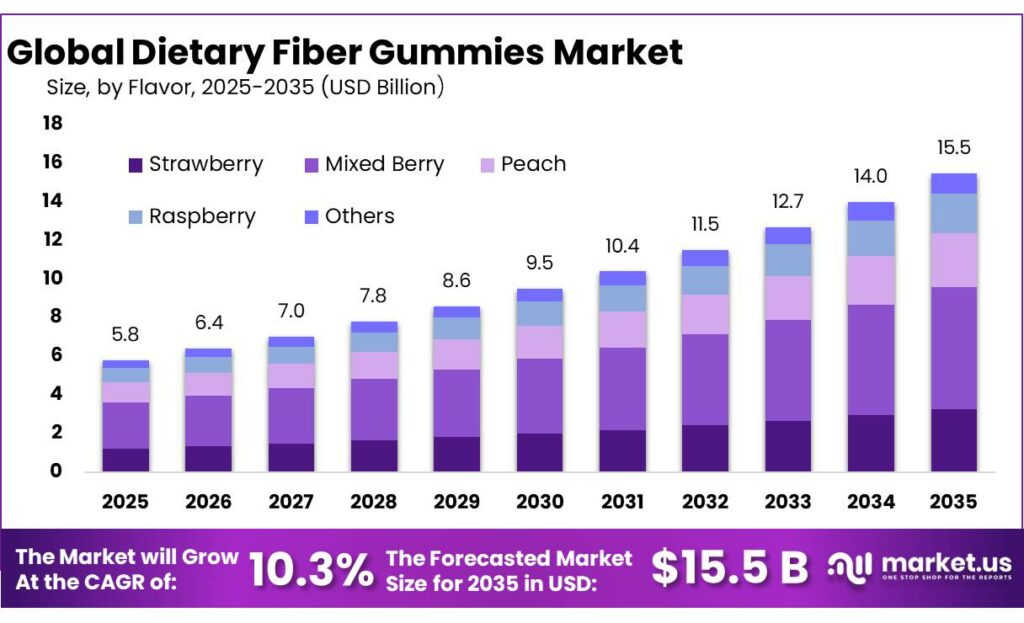
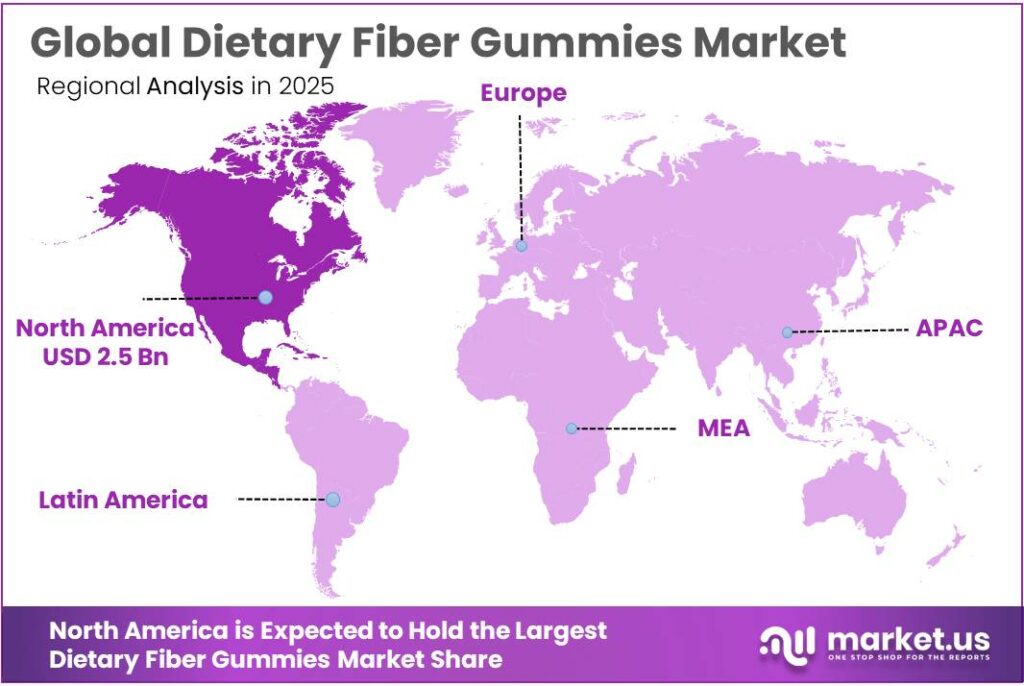
The Global Dietary Fiber Gummies Market size is expected to be worth around USD 15.5 Billion by 2035, from USD 5.8 Billion in 2025, growing at a CAGR of 10.3% during the forecast period from 2026 to 2035. In 2025, North America held a dominant market position, capturing more than a 44.5% share, holding USD 2.5 Billion revenue.
Dietary fiber gummies are emerging as a focused sub-segment within functional gummies because they translate a clear nutritional gap into an easy-to-consume format. The category’s relevance is supported by public-health guidance rather than speculative market sizing.
The World Health Organization states that adults should consume at least 25 grams of naturally occurring dietary fibre per day, while the U.S. FDA sets the Daily Value for dietary fiber at 28 grams on Nutrition Facts labels. This creates a strong positioning platform for fiber gummies as convenient adjunct products for digestive wellness, regularity support, and daily nutrition routines.
The industrial scenario remains favorable because fiber underconsumption is still widespread across developed consumer markets. USDA data show that U.S. consumers averaged only 8.1 grams of fiber per 1,000 calories in 2017–2018, equal to just 58% of the recommended 14 grams per 1,000 calories. In the UK, government guidance recommends 30 grams of fibre per day, yet adults consume only around 20 grams on average, showing another persistent intake gap.
Demand is also being supported by regulatory and public-health guidance. The FDA states that 20% Daily Value or more of a nutrient per serving is considered “high,” and the Daily Value for fiber remains 28 grams; that framework encourages manufacturers to formulate more meaningful fiber claims on packaging. Internationally, WHO recommends at least 25 grams of naturally occurring dietary fibre per day for adults, and EFSA also identifies 25 grams per day as an adequate intake for adults.
Government and regulatory developments are adding further momentum. In the United States, the FDA reaffirmed its nutrition agenda in June 2025, emphasizing tools that help consumers build healthier diets, and it also updated the “healthy” nutrient-content claim framework, with implementation milestones tied to February 25, 2025 and April 28, 2025. In parallel, USDA’s SNAP-Ed continues to operate as an evidence-based nutrition education program that promotes healthier eating behaviors.
For SmartyPants Vitamins, the strategic relevance is similar but sits within Unilever’s wider wellbeing platform. Unilever said at acquisition that SmartyPants products were sold in more than 30,000 stores, and that the brand had already reached over 14 million mothers and children worldwide through Vitamin Angels, with a goal of 100 million by 2025.
Key Takeaways
- Dietary Fiber Gummies Market size is expected to be worth around USD 15.5 Billion by 2035, from USD 5.8 Billion in 2025, growing at a CAGR of 10.3%.
- Mixed Berry held a dominant market position, capturing more than a 41.7% share.
- Plant-based Fiber held a dominant market position, capturing more than a 74.6% share.
- Adults held a dominant market position, capturing more than a 62.9% share.
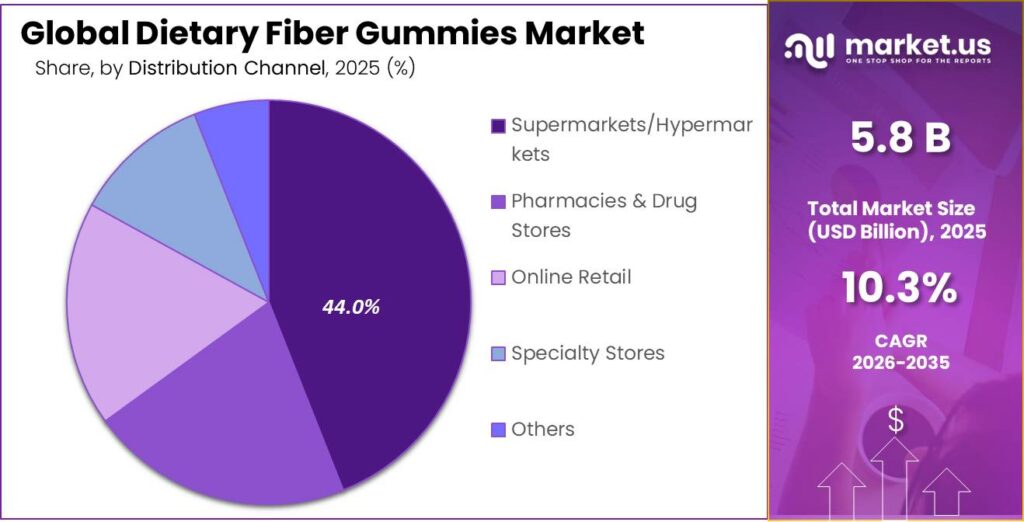
- Supermarkets/Hypermarkets held a dominant market position, capturing more than a 44.8% share.
- North America emerged as the dominating region in the dietary fiber gummies market, accounting for 44.5% share with a market value of around USD 2.5 billion.
By Flavor Analysis
Mixed Berry dominates with 41.7% thanks to its familiar taste and wide consumer appeal
In 2025, Mixed Berry held a dominant market position, capturing more than a 41.7% share in the dietary fiber gummies market by flavor. This strong performance was mainly driven by consumer preference for flavors that feel both natural and enjoyable, especially those that combine sweetness with a slight tang. Mixed berry profiles, often blending strawberry, blueberry, and raspberry notes, have become a go-to option for daily supplement intake, making fiber consumption feel less like a routine and more like a treat.
By Source Analysis
Plant-based Fiber dominates with 74.6% as consumers shift toward natural and clean-label options
In 2025, Plant-based Fiber held a dominant market position, capturing more than a 74.6% share in the dietary fiber gummies market by source. This growth was largely supported by rising consumer awareness around natural ingredients and a clear preference for plant-derived nutrition. Ingredients such as inulin, pectin, and other fruit- and vegetable-based fibers became widely accepted, especially among health-conscious buyers looking for clean-label and vegan-friendly supplements. The shift away from synthetic or animal-derived ingredients also played a key role in strengthening this segment.
By Target Group Analysis
Adults dominate with 62.9% as daily digestive health becomes a priority
In 2025, Adults held a dominant market position, capturing more than a 62.9% share in the dietary fiber gummies market by target group. This was mainly driven by increasing awareness of digestive health, busy lifestyles, and the need for convenient supplement formats. Many adults preferred gummies over traditional tablets or powders, as they are easier to consume and fit well into daily routines. Rising concerns around gut health, irregular eating habits, and overall wellness also pushed demand higher in this segment.
By Distribution Channel Analysis
Supermarkets/Hypermarkets dominate with 44.8% due to easy access and wide product visibility
In 2025, Supermarkets/Hypermarkets held a dominant market position, capturing more than a 44.8% share in the dietary fiber gummies market by distribution channel. This was mainly because these stores offer a wide variety of brands and flavors in one place, making it easier for consumers to compare and choose. Shoppers often prefer buying health supplements during routine grocery trips, and the ability to physically check products before purchase adds to their confidence. Attractive shelf placement and in-store promotions also played a big role in driving sales through this channel.
Key Market Segments
By Flavor
- Strawberry
- Mixed Berry
- Peach
- Raspberry
- Others
By Source
- Plant-based Fiber
- Synthetic Fiber
By Target Group
- Adults
- Children
- Pregnant Women
- Geriatric
By Distribution Channel
- Supermarkets/Hypermarkets
- Pharmacies & Drug Stores
- Online Retail
- Specialty Stores
- Others
Emerging Trends
“Fiber-rich functional gummies” trend is reshaping product innovation
One of the latest trends in the dietary fiber gummies market is the rise of functional, multi-benefit formulations. Consumers today are not just looking for basic fiber—they want added value like digestive support, immunity, and heart health in a single product. This shift is pushing brands to develop gummies that combine fiber with prebiotics, probiotics, and other nutrients. Research shows that fortified gummy products can contain over 60 g of fiber per kg, allowing them to qualify as “high in fiber” while still maintaining taste and texture
At the same time, global health guidelines continue to reinforce the importance of fiber. Organizations such as WHO and FAO recommend at least 25 g of fiber per day for adults, yet many people fall short of this target. This gap is encouraging innovation in convenient formats like gummies, especially those that deliver multiple health benefits in one serving. Governments and health bodies are also promoting better nutrition through updated dietary guidelines, which indirectly supports the growth of functional supplements.
“Fibermaxxing” and gut health awareness driving new consumer behavior
Another major trend shaping the market is the growing popularity of fiber-focused lifestyles, often referred to as “fibermaxxing.” This trend is driven by increasing awareness of gut health and its connection to overall well-being. Reports suggest that only about 5% of people meet the recommended daily fiber intake, while average consumption remains around 16 g per day, far below recommended levels
This gap is pushing consumers to actively seek easy and enjoyable ways to increase fiber intake. As a result, fiber-enriched snacks, beverages, and gummies are becoming more common on store shelves. The trend is especially popular among younger consumers who prefer convenient and tasty health solutions over traditional dietary changes.
Drivers
Low daily fiber intake is pushing demand for easy supplements
One of the biggest reasons behind the growth of dietary fiber gummies is simple—most people are not getting enough fiber from their daily food. According to the World Health Organization, adults should consume at least 25 grams of dietary fiber per day to maintain good health and digestion. But in reality, intake levels are much lower. Data from the US Department of Agriculture shows that average consumption is only around 16 grams per day, which is far below recommended levels
Governments and health bodies are also encouraging higher fiber consumption through public health campaigns and dietary guidelines. These efforts are indirectly supporting the demand for convenient formats like gummies, especially among working adults who prefer simple solutions over major diet changes.
Health benefits linked to fiber are encouraging regular consumption
Another strong driving factor is the clear link between fiber intake and long-term health benefits. Research shows that consuming adequate fiber can reduce the risk of major health issues such as heart disease, diabetes, and digestive disorders. Studies indicate that higher fiber intake is associated with 15–16% lower risk of overall mortality compared to low intake levels
Despite these benefits, global data suggests that fiber intake remains below recommended levels in many regions. Some studies show average intake around 17–18 grams per day, with only a small portion of the population meeting daily requirements. This growing awareness gap is pushing consumers to actively look for supplements that can support their health goals.
Restraints
Digestive discomfort and side effects limit regular consumption
One key factor slowing down the growth of dietary fiber gummies is the digestive discomfort linked to excessive or improper fiber intake. While fiber is essential, taking it in supplement form—especially gummies—can sometimes lead to unwanted side effects. According to clinical research, symptoms like bloating, gas, and abdominal cramps are commonly reported when fiber intake increases quickly or exceeds normal levels. In one study, nearly 50% of participants experienced gas (flatus) after consuming certain fiber supplements, showing how sensitive the digestive system can be to added fiber
Health experts also note that fiber supplements, including gummies, can initially cause stomach discomfort, particularly in people with sensitive digestion. The Mayo Clinic highlights that fiber supplements may lead to bloating and gas, especially when not taken with enough fluids. This becomes a concern for new users who expect a smooth health benefit but instead experience discomfort.
Risk of overconsumption and nutrient absorption concerns
Another important restraint is the risk of taking too much fiber, especially through supplements rather than whole foods. According to dietary guidelines, adults typically need around 25–38 grams of fiber per day, but exceeding this can cause problems like constipation, nausea, or even intestinal blockage in rare cases. Reports also show that sudden increases in fiber intake can lead to discomfort such as bloating, diarrhea, and stomach pain
Government bodies like the U.S. Food and Drug Administration also regulate which fibers can be labeled as beneficial, emphasizing that not all added fibers provide the same health effects. This adds another layer of caution for consumers and manufacturers. Altogether, these concerns make some consumers more careful, slightly limiting the growth pace of dietary fiber gummies.
Opportunity
Rising focus on preventive healthcare is creating strong growth opportunities
One of the biggest growth opportunities for dietary fiber gummies comes from the increasing shift toward preventive healthcare. People are no longer waiting to treat health problems—they are trying to avoid them in the first place. Research shows that higher fiber intake can reduce the risk of major health issues like heart disease, diabetes, and even early death. In fact, studies indicate that increasing fiber intake from around 20 g to 35 g per day can reduce premature mortality by 10% to 48%, highlighting how powerful this nutrient is in long-term health management
This growing awareness is pushing consumers to look for easy and consistent ways to include fiber in their daily routine. However, most people still struggle to meet recommended intake levels. Studies show that average intake often ranges between 11.8 g and 19.8 g per day, which is far below the recommended 25–35 g. This gap creates a clear opportunity for convenient formats like gummies, which are easier to consume compared to traditional fiber-rich foods.
Strong link between fiber and reduced disease risk supports product adoption
Another key opportunity lies in the well-established health benefits of dietary fiber, which continue to gain attention globally. Scientific studies have consistently shown that higher fiber intake is linked to lower risks of chronic diseases and overall mortality. For example, meta-analyses indicate that high fiber consumption can reduce the risk of all-cause mortality by 15% to 30%, along with lowering the chances of heart disease, stroke, and type 2 diabetes
As awareness spreads, consumers are actively seeking simple ways to meet these recommendations. Fiber gummies fit well into this demand because they combine health benefits with convenience and taste. This makes them especially appealing to younger consumers and working professionals who prefer easy-to-follow health habits. With growing education around nutrition and disease prevention, the market has a clear opportunity to expand further through accessible and consumer-friendly formats like gummies.
Regional Insights
North America leads with 44.5% share driven by high supplement adoption and fiber deficiency awareness
In 2025, North America emerged as the dominating region in the dietary fiber gummies market, accounting for 44.5% share with a market value of around USD 2.5 billion. This leadership is mainly supported by strong consumer awareness around digestive health and a well-established dietary supplement culture across the region. In the United States, supplement usage is widely accepted, with a significant portion of adults regularly including vitamins and functional products in their daily routine. This behavior creates a strong base for fiber gummies, which are seen as a convenient and easy-to-consume solution for improving gut health.
A key driver behind regional demand is the widespread gap in fiber intake. Studies indicate that around 95% of Americans do not meet the recommended daily fiber intake, making it a major public health concern. On average, adults consume only about 15–16 grams of fiber per day, which is nearly half of the recommended levels. This gap has pushed both consumers and healthcare professionals to increasingly rely on supplements like fiber gummies to meet nutritional needs.
Key Regions and Countries Insights
- North America
- US
- Canada
- Europe
- Germany
- France
- The UK
- Spain
- Italy
- Rest of Europe
- Asia Pacific
- China
- Japan
- South Korea
- India
- Australia
- Rest of APAC
- Latin America
- Brazil
- Mexico
- Rest of Latin America
- Middle East & Africa
- GCC
- South Africa
- Rest of MEA
Key Players Analysis
Church & Dwight Co., Inc. is a key player in the dietary supplements space, supported by its strong brand portfolio and wide retail presence. In 2025, the company reported quarterly net sales of around USD 1,585.6 million, reflecting a 5.0% growth, showing steady performance in consumer health products. Its e-commerce channel contributed nearly 23% of total consumer sales, highlighting strong digital reach.
Pharmavite LLC, known for its Nature Made brand, plays a significant role in the dietary supplement market. The company operates with large-scale manufacturing and distribution capabilities, supplying products across major retail chains. Nature Made has been recognized as a leading pharmacist-recommended brand, with distribution across 100,000+ retail outlets globally.
Renew Life Formulas, LLC focuses on digestive health products, including fiber-based supplements and probiotics. The company has built a niche in gut health solutions, with products targeting specific digestive concerns. Its formulations often include multiple probiotic strains (10–30 billion CFU range), combined with fiber ingredients to improve effectiveness.
Top Key Players Outlook
- Fiber Choice
- Church & Dwight Co., Inc.
- Smarty Pants Vitamins
- Pharmavite LLC
- Renew Life Formulas, LLC
- Better Nutritionals
- BELLWAY INC
- Swanson
- Procter & Gamble
- Balance of Nature
- Nestle Health Science
Recent Industry Developments
In 2025, Pharmavite LLC strengthened its role in the dietary fiber gummies segment by expanding its production and innovation capabilities, especially through its flagship brand Nature Made. The company invested around USD 250 million in a new 225,000 sq. ft. manufacturing and R&D facility in Ohio, aimed at boosting gummy production and product developmen.
Renew Life has built its portfolio around digestive wellness, offering products that combine probiotics, enzymes, and fiber, including gummy formats designed for easier consumption. Its e-commerce channel shows growing traction, with approximately 53,000 monthly website visitors and estimated monthly revenue of about USD 243,000, indicating stable consumer demand for its products.
Report Scope
Report Features Description Market Value (2025) USD 5.8 Bn Forecast Revenue (2035) USD 15.5 Bn CAGR (2026-2035) 10.3% Base Year for Estimation 2025 Historic Period 2020-2024 Forecast Period 2026-2035 Report Coverage Revenue Forecast, Market Dynamics, Competitive Landscape, Recent Developments Segments Covered By Flavor (Strawberry, Mixed Berry, Peach, Raspberry, Others), By Source (Plant-based Fiber, Synthetic Fiber), By Target Group (Adults, Children, Pregnant Women, Geriatric), By Distribution Channel (Supermarkets/Hypermarkets, Pharmacies And Drug Stores, Online Retail, Specialty Stores, Others) Regional Analysis North America – US, Canada; Europe – Germany, France, The UK, Spain, Italy, Rest of Europe; Asia Pacific – China, Japan, South Korea, India, Australia, Singapore, Rest of APAC; Latin America – Brazil, Mexico, Rest of Latin America; Middle East & Africa – GCC, South Africa, Rest of MEA Competitive Landscape Fiber Choice, Church & Dwight Co., Inc., Smarty Pants Vitamins, Pharmavite LLC, Renew Life Formulas, LLC, Better Nutritionals, BELLWAY INC, Swanson, Procter & Gamble, Balance of Nature, Nestle Health Science Customization Scope Customization for segments, region/country-level will be provided. Moreover, additional customization can be done based on the requirements. Purchase Options We have three licenses to opt for: Single User License, Multi-User License (Up to 5 Users), Corporate Use License (Unlimited User and Printable PDF)  Dietary Fiber Gummies MarketPublished date: Mar 2026add_shopping_cartBuy Now get_appDownload Sample
 -
-
- Fiber Choice
- Church & Dwight Co., Inc.
- Smarty Pants Vitamins
- Pharmavite LLC
- Renew Life Formulas, LLC
- Better Nutritionals
- BELLWAY INC
- Swanson
- Procter & Gamble
- Balance of Nature
- Nestle Health Science
Our Clients

- 182415
- Mar 2026






