


Global Data Lake Governance AI Market Size, Share and Analysis Report By Component (Software, Services), By Deployment Mode (Cloud-based/SaaS, On-premises), By Organization Size (Large Enterprises, Small and Medium-sized Enterprises), By Application (Regulatory Compliance (GDPR, CCPA, etc.), Data Security & Access Control, Data Quality & Trust Assurance, Self-service Data Discovery, Others), By Regional Analysis, Global Trends and Opportunity, Future Outlook By 2025-2035
- Published date: Jan. 2026
- Report ID: 176056
- Number of Pages: 304
- Format:
-
keyboard_arrow_up
Quick Navigation
- Report Overview
- Key Takeaway
- Key Insights Summary
- Drivers Impact Analysis
- Restraint Impact Analysis
- U.S. Market Size
- Regional Driver Comparison
- Component Analysis
- Deployment Mode Analysis
- Organization Size Analysis
- Application Analysis
- Investor Type Impact Matrix
- Technology Enablement Analysis
- Emerging Trends Analysis
- Opportunity Analysis
- Challenge Analysis
- Key Market Segments
- Key Regions and Countries
- Key Players Analysis
- Recent Developments
- Report Scope
Report Overview
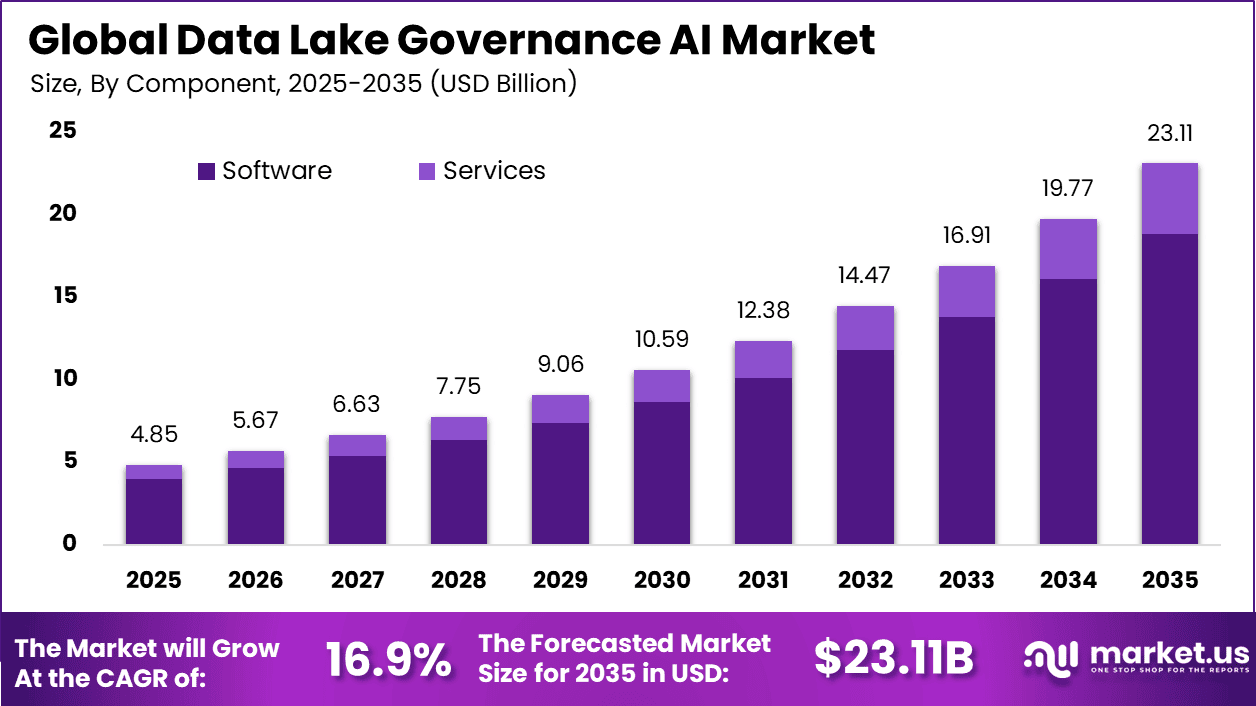
The Global Data Lake Governance AI Market is experiencing strong expansion, projected to grow from USD 4.85 billion in 2025 to approximately USD 23.11 billion by 2035, registering a CAGR of 16.9% over the forecast period. North America dominated the market, capturing more than 42.62% share and generating USD 2.06 billion in revenue, reflecting robust enterprise demand for AI-driven data governance and compliance solutions.
The Data Lake Governance AI market refers to software, platforms, and services that use artificial intelligence to manage, secure, and monitor data stored in large-scale data lake environments. Data lakes are central repositories for raw, structured, semi-structured, and unstructured data that support analytics and AI workloads across enterprises. Effective governance in these environments ensures data quality, access control, metadata management, compliance with regulations, and reliable data lineage tracking so that data can be trusted and used securely.
A major driving factor is the rapid increase in enterprise data volumes and complexity. Industry studies show that global data creation continues to grow at over 20% annually, with unstructured data accounting for a dominant share of new data generated. This growth makes manual data oversight impractical and increases the need for automated governance across distributed data lake environments. Another important driver is regulatory pressure related to data privacy, security, and accountability.
Based on data from market.us, The global AI Governance market was valued at USD 550.7 million in 2024 and is expected to expand rapidly over the forecast period. The market is projected to reach approximately USD 16,625.2 million by 2034, growing at a strong CAGR of 40.6%. This growth is driven by rising focus on responsible AI deployment, transparency, and compliance with emerging regulatory frameworks.
For instance, in October 2025, Oracle Corporation launched the Autonomous AI Lakehouse and AI Data Platform at Oracle AI World 2025. The platform combines Autonomous Database with Apache Iceberg, featuring a “catalog of catalogs” and Data Lake Accelerator for scalable queries, backed by partners like Accenture.
Demand for Data Lake Governance AI solutions is closely tied to organisations’ need to derive value from large data repositories while maintaining control over data accuracy and security. As more enterprises use data lakes to support analytics, predictive modelling, and operational reporting, effective governance becomes essential to prevent misuse, redundancy, and data quality issues. These governance challenges can otherwise erode trust in analytical outcomes and expose organisations to operational risks.
Technologies supporting the adoption of Data Lake Governance AI include automated metadata management, AI-powered classification algorithms, and continuous compliance monitoring systems. Metadata management tools gather and index context about data assets, enabling AI models to classify data more accurately and make informed decisions about access controls and lineage. These capabilities improve visibility into data usage patterns and support governance policies that adapt as data changes.
Key Takeaway
- In 2025, the software segment led the global data lake governance AI market with an 81.6% share, driven by demand for automated policy enforcement, data classification, and access control.
- The cloud based and SaaS segment captured 78.9%, reflecting preference for scalable governance solutions that integrate easily with modern cloud data lakes.
- Large enterprises dominated adoption with an 87.3% share, supported by complex data environments and stronger regulatory and security requirements.
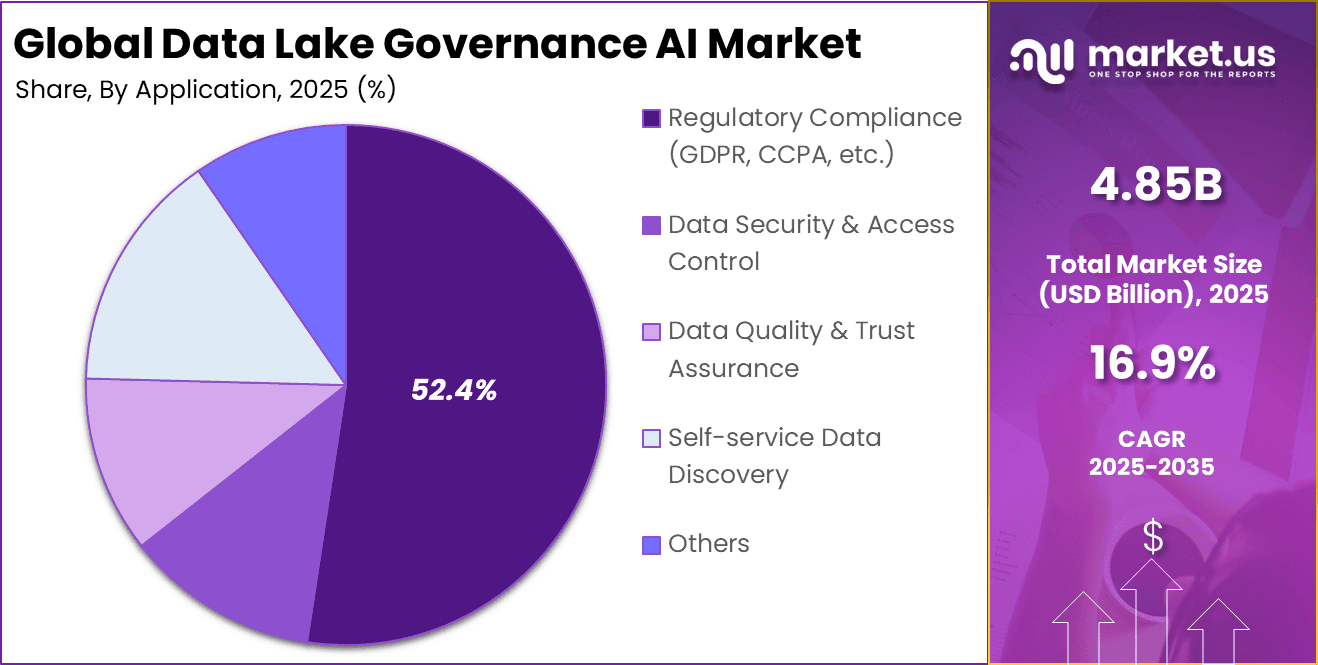
- The regulatory compliance segment held 52.4%, as organizations focused on meeting data protection, privacy, and audit obligations through AI driven governance tools.
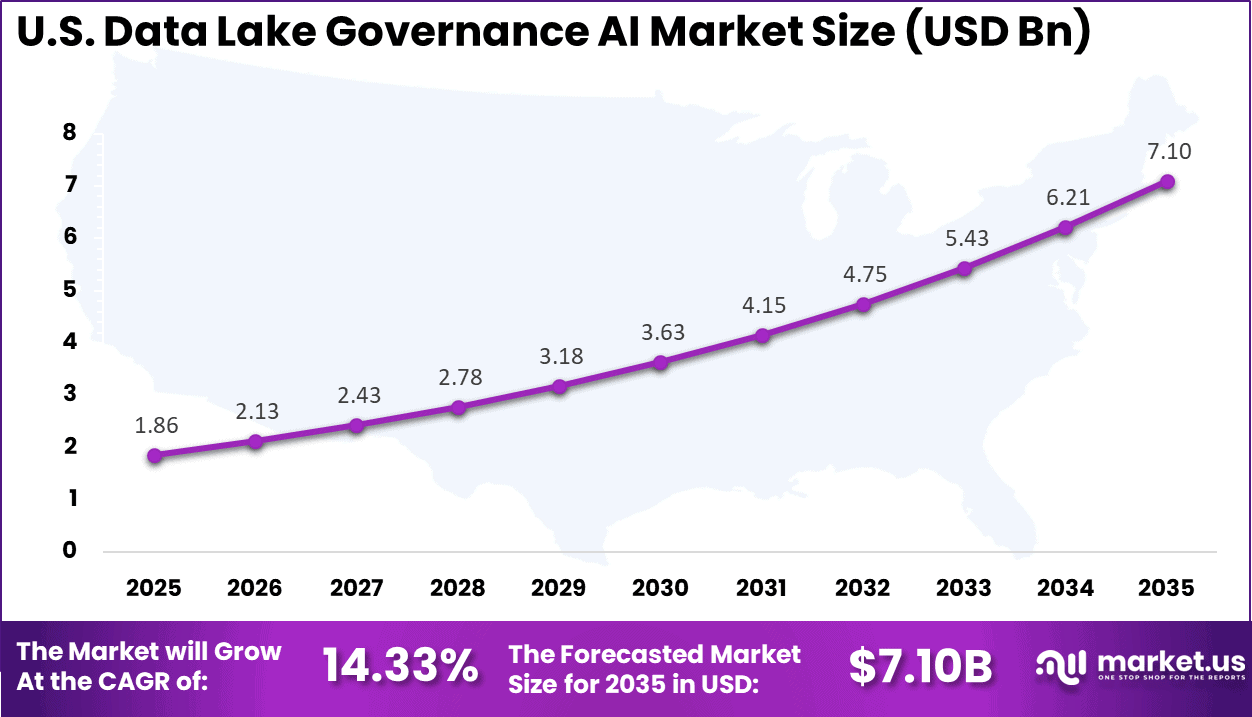
- The US market was valued at USD 1.86 billion in 2025 and is growing at a 14.33% CAGR, supported by advanced data infrastructure and high enterprise AI adoption.
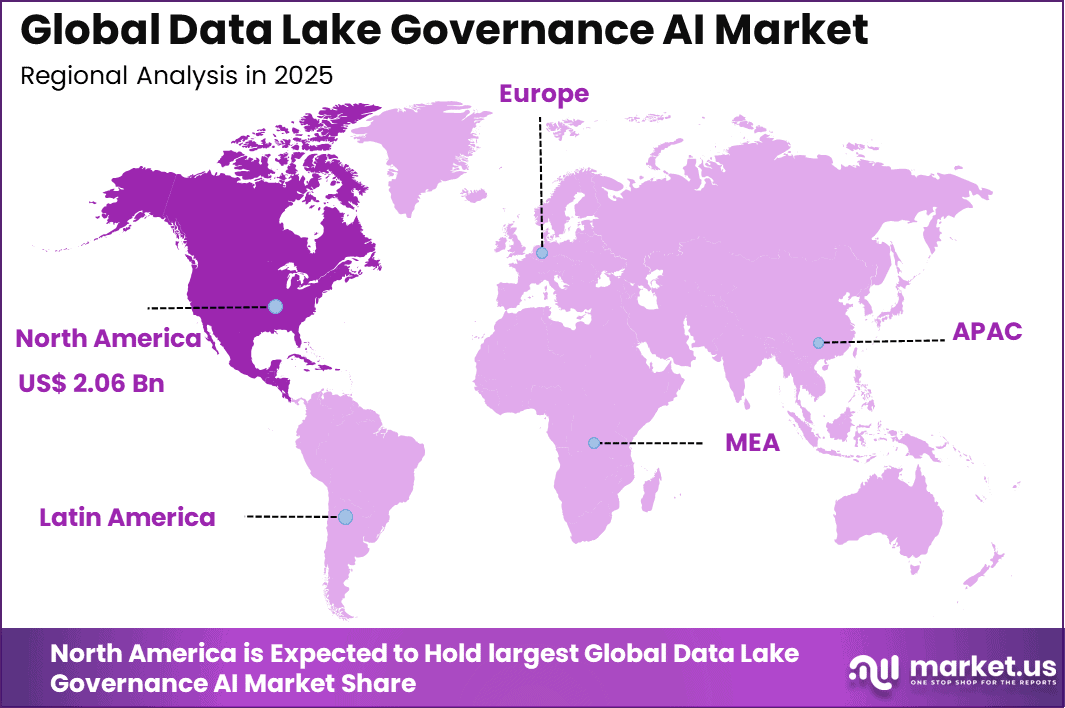
- North America led globally with more than 42.62% share, driven by early cloud adoption, strict compliance needs, and strong investment in data governance technologies.
Key Insights Summary
General AI Adoption Rates
- 78% of organizations used AI in at least one business function in 2024, up sharply from 55% in the prior year.
- Generative AI adoption increased rapidly, rising from 33% in 2023 to 71% in 2024.
- The UAE reported the highest AI adoption rate at 64%, followed by Singapore at 60.9%.
AI Governance Usage Statistics
- A clear maturity gap exists, as 93% of organizations use AI, but only 7% have fully embedded AI governance into development workflows.
- Around 75% of organizations have defined internal AI usage policies, yet only 36% have implemented formal governance frameworks to enforce them.
- 97% of organizations affected by AI related security breaches lacked proper access controls for AI models.
- Only 27% of corporate boards have formally included AI governance in committee charters, although 62% now discuss AI topics regularly at the board level.
Usage by Industry and Function
- The technology sector leads frequent AI use at 50%, followed by professional services at 34% and finance at 32%.
- Organizations with mature AI governance report a 28% increase in employees effectively using AI compared with those without governance structures.
- 90% of companies cite AI as a key reason for expanding privacy programs, with 38% spending more than USD 5 million annually on privacy and governance initiatives.
Drivers Impact Analysis
Key Growth Driver Influence on Projected Growth (~)% Geographical Significance Expected Timeframe of Impact Rapid expansion of enterprise data lakes and lakehouse architectures +5.8% North America, Europe Short to medium term Rising regulatory pressure on data privacy and governance +5.1% Europe, North America Medium term Increasing adoption of AI for automated data classification and controls +4.6% North America, Asia Pacific Medium term Growth in advanced analytics and AI workloads using shared data lakes +4.0% Global Medium to long term Demand for real time visibility into data access and usage +3.3% Global Long term Restraint Impact Analysis
Key Restraint Influence on Projected Growth (~)% Geographical Significance Expected Timeframe of Impact High implementation complexity across heterogeneous data environments -2.9% Global Short to medium term Shortage of skilled data governance and AI specialists -2.5% North America, Europe Medium term Budget constraints among small and mid sized enterprises -2.1% Asia Pacific, Latin America Medium term Integration challenges with legacy data management systems -1.8% Europe, emerging markets Medium to long term Concerns around AI transparency and explainability -1.4% Europe, North America Long term U.S. Market Size
The market for Data Lake Governance AI within the U.S. is growing tremendously and is currently valued at USD 1.86 billion, the market has a projected CAGR of 14.33%. The market is growing due to surging data volumes from IoT and cloud apps, needing AI to automate quality checks and lineage tracking.
Strict rules like CCPA drive demand for compliance tools that prove secure handling. Enterprises here lead in AI pilots, relying on governed lakes for reliable insights, while heavy tech investments and cloud shifts from giants like AWS cut costs and scale ops.
For instance, in November 2025, Cloudera advanced unified data access and governance with AI-powered federation and lineage features, integrating Trino, Shared Data Experience (SDX), and Octopai Data Lineage. This enables enterprises to discover, govern, and access data across estates with AI-driven automation, reinforcing U.S. leadership in scalable data lake governance solutions.
In 2025, North America held a dominant market position in the Global Data Lake Governance AI Market, capturing more than a 42.62% share, holding USD 2.06 billion in revenue. This dominance is due to the region’s early adoption of cloud platforms, AI-driven analytics, and advanced data management practices across large enterprises.
Strong regulatory oversight around data privacy and security has pushed organizations to invest in governance solutions that ensure control and transparency. High digital maturity, widespread use of data lakes, and strong enterprise focus on compliance and risk management continue to support North America’s leading position in this market.
For instance, in July 2025, Alation was named a Leader in the 2025 Forrester Wave for Data Governance Solutions, earning top scores in strategy and excelling in AI-augmented federated governance. Its agentic platform automates workflows for trusted data accessibility, powering 40% of Fortune 100 companies.
Regional Driver Comparison
Region Core Demand Driver Growth Influence Level Market Maturity North America Strong enterprise adoption of AI driven governance platforms Very High Mature Europe Strict regulatory enforcement and compliance focus High Mature Asia Pacific Rapid cloud migration and analytics expansion Medium to High Developing Middle East Government led data governance initiatives Medium Developing Latin America Gradual adoption of centralized data platforms Low to Medium Early stage Africa Emerging digital transformation programs Low Early stage Component Analysis
In 2025, The Software segment held a dominant market position, capturing a 81.6% share of the Global Data Lake Governance AI Market. AI-enabled governance software helps automate metadata management, detect anomalies, and flag policy violations in real time. These tools reduce manual effort and improve trust in enterprise data, especially as data volumes expand across cloud environments.
Software adoption also rises because enterprises prefer scalable solutions that integrate with existing analytics, BI, and security stacks. Governance software supports audit readiness and internal controls without disrupting data workflows. AI-driven features such as automated classification and risk scoring improve decision making for data owners.
For Instance, in October 2025, Collibra released platform updates with AI-powered data quality and observability tools tailored for data lake governance. These enhancements automate monitoring and resolution of data issues in lake environments, bridging data and AI assets effectively. This strengthens software’s role by enabling proactive governance, helping teams trust their data for AI workflows without constant manual checks.
Deployment Mode Analysis
In 2025, the Cloud-based/SaaS segment held a dominant market position, capturing a 78.9% share of the Global Data Lake Governance AI Market. Organizations increasingly migrate data lakes to cloud platforms to support analytics, AI, and real time processing.
Cloud governance solutions align naturally with these architectures and provide continuous monitoring without heavy infrastructure investment. They also support remote access and collaboration across distributed teams, which has become standard for global enterprises. SaaS delivery further simplifies updates and compliance alignment.
Vendors regularly roll out enhancements to address evolving regulations and security risks. Enterprises benefit from lower maintenance overhead and predictable costs. Cloud based governance also scales easily as data volumes grow, making it suitable for enterprises handling petabyte scale datasets across regions and business units.
For instance, in November 2025, Microsoft Purview rolled out AI observability and unified catalog features in its cloud platform for data security posture management. The updates integrate governance across cloud data estates, supporting SaaS scalability for lake governance. Organizations gain real-time insights and remediation, making cloud deployments ideal for handling growing AI data volumes securely and efficiently.
Organization Size Analysis
In 2025, The Large Enterprises segment held a dominant market position, capturing a 87.3% share of the Global Data Lake Governance AI Market. These organizations face higher regulatory scrutiny and internal governance requirements. AI powered governance tools help standardize policies, monitor usage, and maintain accountability across thousands of users and data assets.
Large enterprises also possess the budgets and technical maturity to implement advanced governance frameworks. They often operate hybrid or multi cloud environments, which increases governance risk. AI based solutions provide visibility across silos and support executive level reporting.
For Instance, in September 2025, IBM enhanced Watsonx.data with built-in governance compatible with Watson Knowledge Catalog for enterprise lakehouses. The features provide centralized control over large-scale data and AI assets, aiding big firms in compliance and self-service access. This supports large enterprises by simplifying oversight in complex environments, boosting AI readiness without fragmented tools.
Application Analysis
In 2025, The Regulatory Compliance segment held a dominant market position, capturing a 52.4% share of the Global Data Lake Governance AI Market. Enterprises must demonstrate control over data access, usage, and retention. AI driven governance platforms automate compliance checks and generate audit trails that simplify regulatory reporting. This reduces the risk of penalties and reputational damage.
Compliance focused adoption also reflects growing oversight on data used for AI and analytics. Organizations must ensure ethical use and transparency. Governance tools help enforce consent rules and data usage policies. As regulations continue to evolve, compliance remains the most critical application driving investment in governance AI solutions.
For Instance, in January 2026, Oracle launched Database 26ai with embedded AI governance for production databases and lakehouses. It unifies security policies like row-level access and auditing for human and AI users, easing regulatory proof. Enterprises benefit from reduced compliance risks in data lakes, ensuring traceable and secure AI operations across regulated sectors.
Investor Type Impact Matrix
Investor Type Strategic Objective Risk Tolerance Market Influence Enterprise data platform providers Expansion of governance and compliance portfolios Medium High Cloud service providers Strengthening secure data ecosystem adoption Low to Medium High Venture capital firms Scalable AI driven governance platforms High Medium Private equity investors Long term SaaS governance investments Medium Medium Strategic enterprise investors Risk reduction and regulatory assurance Low to Medium Medium Technology Enablement Analysis
Technology Enabler Functional Role Impact on Adoption Adoption Timeline AI based data classification and tagging Automated policy enforcement at scale Very High Short term Machine learning driven access monitoring Detection of anomalous data usage High Short to medium term Metadata driven governance frameworks Centralized visibility across data lakes High Medium term Cloud native governance architectures Scalable deployment across hybrid environments Very High Short term Explainable AI for compliance reporting Improved auditability and regulator confidence Medium Medium to long term Emerging Trends Analysis
AI-driven governance is transforming how data lakes handle quality, metadata, and compliance by automating what were previously manual processes. Large language models and AI agents are increasingly used to generate metadata, enforce policies, and respond to anomalies in real time rather than relying on static rule sets. This shift is enabling more intuitive search and contextual understanding of datasets across structured and unstructured sources.
A second noticeable trend is the integration of natural language and semantic technologies to support intelligent data discovery and classification. These capabilities allow users and systems to interact with data lakes through more human-like queries and improve the visibility of data lineage and provenance without extensive manual tagging efforts. This enhances accessibility across technical and non-technical stakeholders, supporting broader governance objectives.
Opportunity Analysis
A clear opportunity exists in applying AI to automate audit and compliance reporting for data lakes. By using AI to continuously monitor and enforce governance rules, organizations can reduce the time and cost associated with preparing for audits and demonstrating compliance across data sets. This automation not only improves operational efficiency but also strengthens risk management practices.
Another opportunity lies in enhancing data discoverability and semantic understanding through AI-augmented tools. These systems can classify and tag data more effectively than manual processes, enabling broader use of data assets for analytics, machine learning, and business insights. Improved discoverability increases the value of data lakes as strategic repositories rather than passive storage.
Challenge Analysis
A core challenge is ensuring that AI governance tools operate transparently and ethically, avoiding biased or opaque decision-making. Algorithms that enforce governance policies must themselves be governed to ensure fairness, reliability, and accountability, especially when they influence access or classification of data. Achieving this balance requires careful oversight and ongoing evaluation of AI behavior.
Another challenge is protecting governance systems from security vulnerabilities, as governance tools often have wide access to data and control functions. Ensuring robust security practices while maintaining the accessibility and usability of governance features is complex. Failure to adequately secure these tools can introduce risks that compromise the very data protections they are intended to enforce.
Key Market Segments
By Component
- Software
- Services
By Deployment Mode
- Cloud-based/SaaS
- On-premises
By Organization Size
- Large Enterprises
- Small and Medium-sized Enterprises
By Application
- Regulatory Compliance (GDPR, CCPA, etc.)
- Data Security & Access Control
- Data Quality & Trust Assurance
- Self-service Data Discovery
- Others
Key Regions and Countries
North America
- US
- Canada
Europe
- Germany
- France
- The UK
- Spain
- Italy
- Russia
- Netherlands
- Rest of Europe
Asia Pacific
- China
- Japan
- South Korea
- India
- Australia
- Singapore
- Thailand
- Vietnam
- Rest of APAC
Latin America
- Brazil
- Mexico
- Rest of Latin America
Middle East & Africa
- South Africa
- Saudi Arabia
- UAE
- Rest of MEA
Key Players Analysis
One of the leading players in June 2025, Collibra, Inc., acquired Raito, a data access governance specialist, to strengthen its unified governance platform for data lakes and AI. This move adds advanced data quality monitoring, lineage tracking, and AI model governance, helping enterprises manage fragmented data environments amid rising AI demands. Collibra’s platform now offers better visibility and control across data ecosystems.
Top Key Players in the Market
- Collibra, Inc.
- Informatica Inc.
- Alation, Inc.
- IBM Corporation
- Microsoft Corporation
- Amazon Web Services, Inc.
- Google LLC
- Oracle Corporation
- SAP SE
- Talend S.A.
- Ataccama Corporation
- World, Inc.
- Waterline Data
- Unifi Software
- Cloudera, Inc.
- Others
Recent Developments
- In May 2025, SAP SE expanded Business Data Cloud at Sapphire 2025 for intelligent data lake applications, now available on AWS with Google Cloud and Azure support planned. This multi-cloud approach powers AI governance beyond SAP ecosystems.
- In October 2025, Informatica Inc. launched its Fall 2025 release with AI governance innovations for data lake catalogs. New features include unstructured data scanning/classification and multi-agent AI system modeling, plus integration with Google Vertex AI for enterprise-wide AI asset inventory.
Report Scope
Report Features Description Market Value (2025) USD 4.8 Bn Forecast Revenue (2035) USD 23.1 Bn CAGR(2026-2035) 16.9% Base Year for Estimation 2025 Historic Period 2020-2024 Forecast Period 2026-2035 Report Coverage Revenue forecast, AI impact on Market trends, Share Insights, Company ranking, competitive landscape, Recent Developments, Market Dynamics and Emerging Trends Segments Covered By Component (Software, Services), By Deployment Mode (Cloud-based/SaaS, On-premises), By Organization Size (Large Enterprises, Small and Medium-sized Enterprises), By Application (Regulatory Compliance (GDPR, CCPA, etc.), Data Security & Access Control, Data Quality & Trust Assurance, Self-service Data Discovery, Others) Regional Analysis North America – US, Canada; Europe – Germany, France, The UK, Spain, Italy, Russia, Netherlands, Rest of Europe; Asia Pacific – China, Japan, South Korea, India, New Zealand, Singapore, Thailand, Vietnam, Rest of Latin America; Latin America – Brazil, Mexico, Rest of Latin America; Middle East & Africa – South Africa, Saudi Arabia, UAE, Rest of MEA Competitive Landscape Collibra, Inc., Informatica Inc., Alation, Inc., IBM Corporation, Microsoft Corporation, Amazon Web Services, Inc., Google LLC, Oracle Corporation, SAP SE, Talend S.A., Ataccama Corporation, data.World, Inc., Waterline Data, Unifi Software, Cloudera, Inc., Others Customization Scope Customization for segments, region/country-level will be provided. Moreover, additional customization can be done based on the requirements. Purchase Options We have three license to opt for: Single User License, Multi-User License (Up to 5 Users), Corporate Use License (Unlimited User and Printable PDF)  Data Lake Governance AI MarketPublished date: Jan. 2026add_shopping_cartBuy Now get_appDownload Sample
 -
-
- Collibra, Inc.
- Informatica Inc.
- Alation, Inc.
- IBM Corporation
- Microsoft Corporation
- Amazon Web Services, Inc.
- Google LLC
- Oracle Corporation
- SAP SE
- Talend S.A.
- Ataccama Corporation
- World, Inc.
- Waterline Data
- Unifi Software
- Cloudera, Inc.
- Others
Our Clients

- 176056
- Jan. 2026









