


Global Data Drift Detection Market By Component (Software/Solutions, Services), By Deployment Mode (Cloud-based, On-premises), By Organization Size (Large Enterprises, Small and Medium-sized Enterprises), By Application (Machine Learning Model Monitoring, Production Analytics and BI Monitoring, Others), By End-User Industry (Financial Services, Technology and Software, Healthcare, Retail and E-commerce, Others), By Regional Analysis, Global Trends and Opportunity, Future Outlook By 2025-2035
- Published date: Feb. 2026
- Report ID: 178127
- Number of Pages: 379
- Format:
-
keyboard_arrow_up
Quick Navigation
- Report Overview
- Top Market Takeaways
- Drivers Impact Analysis
- Restraints Impact Analysis
- By Component
- By Deployment Mode
- By Organization Size
- By Application
- By End User Industry
- Emerging Trends
- Growth Factors
- Key Market Segments
- Regional Analysis
- Investor Type Impact Matrix
- Technology Enablement Analysis
- Competitive Analysis
- Future Outlook
- Recent Developments
- Report Scope
Report Overview
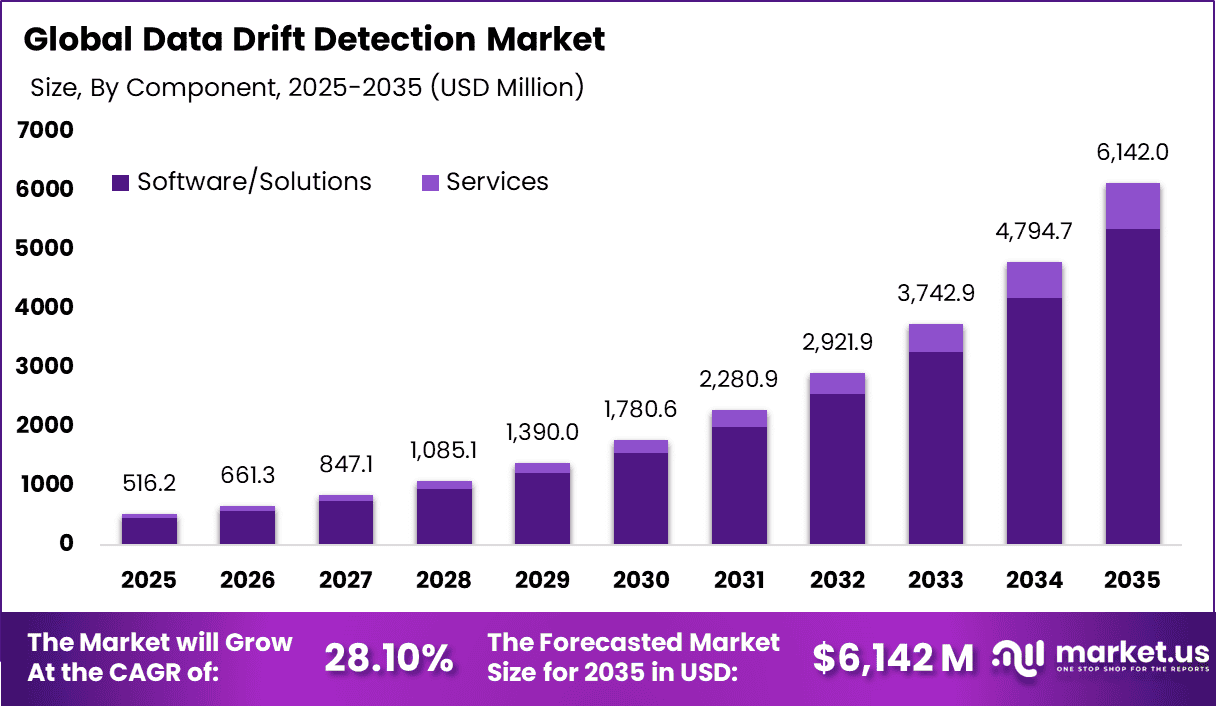
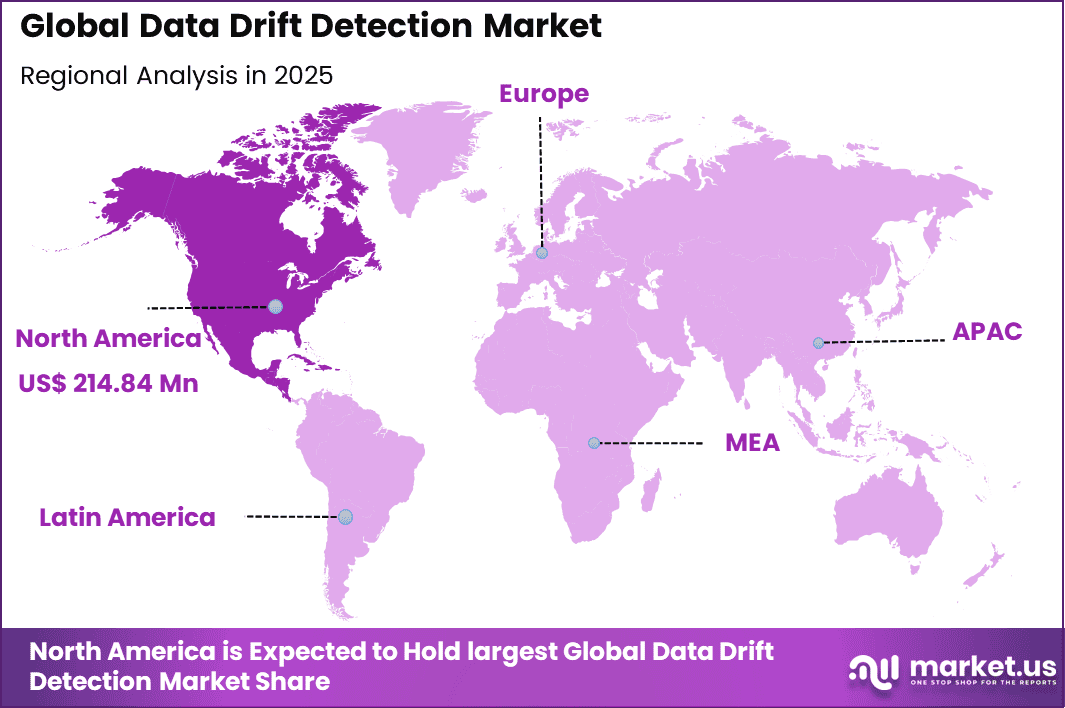
The Global Data Drift Detection Market generated USD 516.2 million in 2025 and is predicted to register growth from USD 661.3 million in 2026 to about USD 6,142 million by 2035, recording a CAGR of 28.10% throughout the forecast span. In 2025, North America held a dominan market position, capturing more than a 41.62% share, holding USD 214.84 Million revenue.
The Data Drift Detection Market refers to technologies and solutions that monitor and identify shifts in data patterns used by analytical models, especially machine learning systems. Data drift occurs when the statistical properties of input data change over time, potentially degrading model accuracy and reliability. Solutions in this market evaluate data streams, model inputs, and outcomes to detect deviations from expected distributions. This capability helps organizations maintain performance and trust in their analytics and AI systems.
The market has expanded as enterprises increasingly depend on machine learning for decision making, automation, and predictive insights. When models encounter new or evolving data patterns, undetected drift can lead to incorrect predictions and business risk. Data drift detection tools provide continuous monitoring, alerting, and diagnostic insights that support timely intervention. Growing deployment of AI and analytics in production environments has heightened the necessity for robust drift management.
One key driver of the Data Drift Detection Market is the widespread adoption of machine learning and AI across business functions. Organizations implement models for customer segmentation, forecasting, fraud detection, and operational optimization. These models are exposed to dynamic data that reflects changing customer behavior, market conditions, and external events. Without drift detection, model performance can deteriorate, prompting interest in solutions that safeguard accuracy.
Demand for drift detection solutions is concentrated among organizations with mature analytics practices and high dependency on automated decision systems. Finance, healthcare, telecommunications, and e-commerce sectors exhibit strong demand due to the critical nature of their predictive models. These industries require reliable performance and timely detection of anomalies that could impact revenue, compliance, or customer experience. Early adopters integrate drift detection within their model governance frameworks.
Top Market Takeaways
- By component, software/solutions account for 87.4% of the market, providing automated drift detection, alerting, and remediation for production ML models.
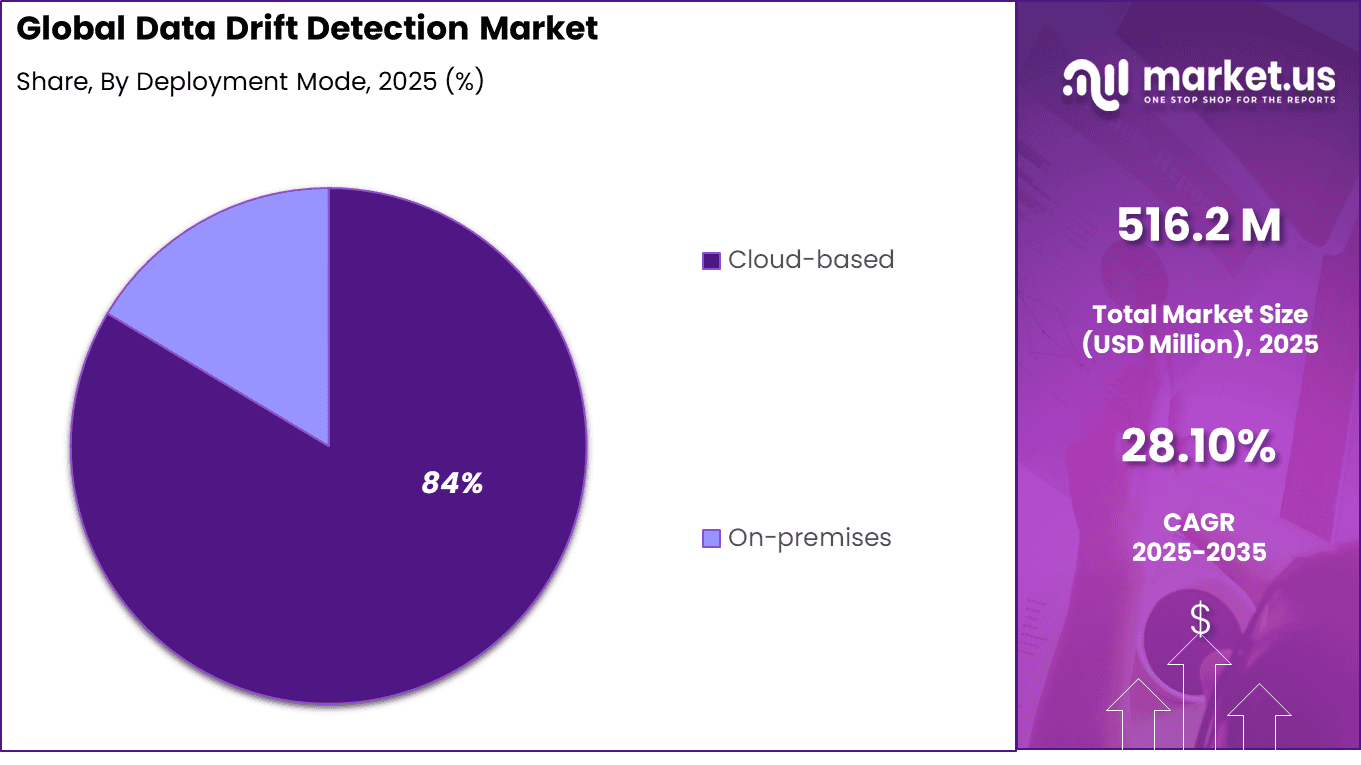
- By deployment mode, cloud-based platforms represent 83.6%, enabling scalable monitoring across distributed data pipelines and model endpoints.
- By organization size, large enterprises hold 81.9% share, addressing complex AI estates and governance in regulated sectors.
- By application, machine learning model monitoring captures 58.3%, preventing performance degradation from data and concept drift.
- By end-user industry, financial services command 46.7%, applying detection to credit risk, fraud, and trading models.
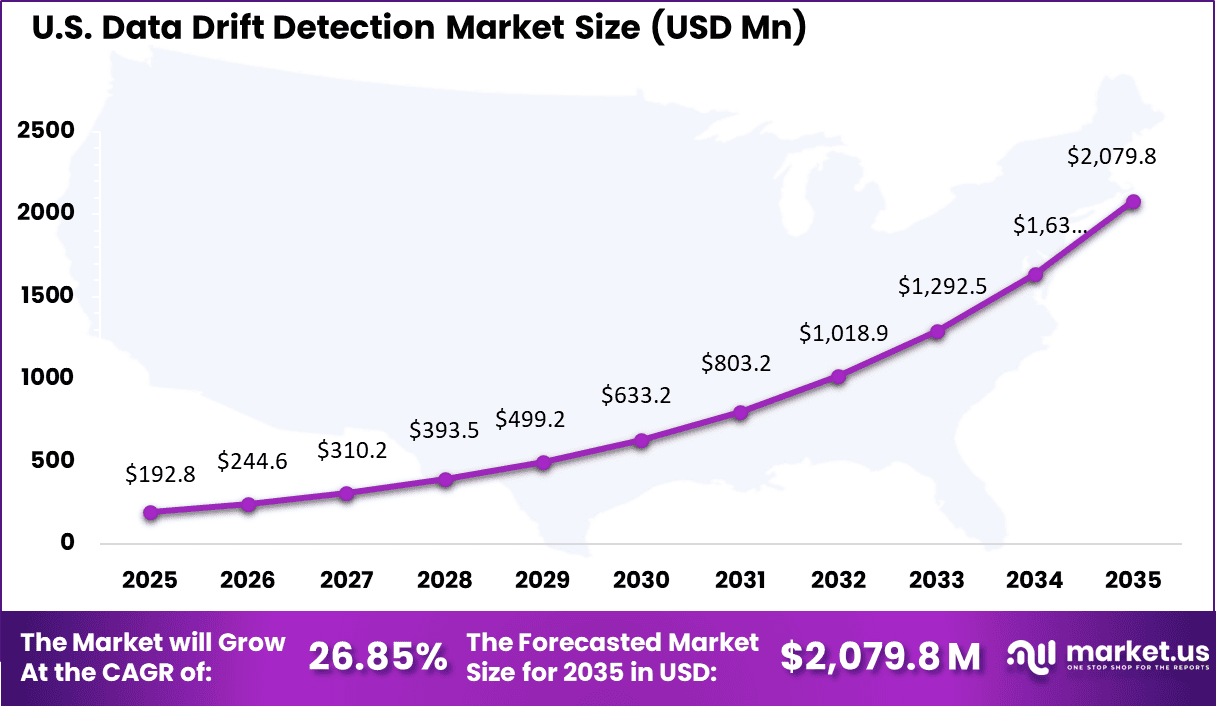
- By region, North America leads with 41.62% of the global market, with the U.S. valued at USD 192.8 million and a projected CAGR of 26.85%.
Drivers Impact Analysis
Key Driver Impact on CAGR Forecast (~%) Geographic Relevance Impact Timeline Rapid deployment of AI and machine learning models in production +7.1% North America, Europe Short to medium term Increasing risk of model performance degradation over time +6.2% Global Short term Growing regulatory focus on AI transparency and accountability +5.4% Europe, North America Medium term Expansion of real-time analytics and streaming data systems +4.8% Global Medium term Adoption of MLOps and continuous model monitoring frameworks +4.1% North America, Asia Pacific Medium to long term Restraints Impact Analysis
Key Restraint Impact on CAGR Forecast (~%) Geographic Relevance Impact Timeline High implementation and integration complexity -4.2% Global Short to medium term Limited MLOps maturity in mid-sized enterprises -3.6% Asia Pacific, Latin America Medium term Shortage of skilled AI and data science professionals -3.2% Global Medium term False positives and alert fatigue in monitoring systems -2.8% Global Medium term Data governance and privacy constraints -2.4% Europe, North America Medium to long term By Component
Software and solutions dominate the data drift detection market with a share of 87.4%. As machine learning models are increasingly deployed in production environments, continuous monitoring tools have become essential. Data drift detection software identifies shifts in data distribution that may impact model accuracy and reliability.
These tools automatically compare incoming data with baseline training datasets to detect deviations. This ensures that predictive systems remain stable and aligned with business objectives. Advanced software platforms provide dashboards, alert systems, and automated retraining triggers. They help data science teams respond quickly to performance degradation.
Integration with MLOps pipelines enhances operational efficiency and reduces manual oversight. Organizations rely on these solutions to maintain trust in artificial intelligence-driven decisions. The need for automation and precision explains the strong dominance of software in this segment.
By Deployment Mode
Cloud-based deployment accounts for 83.6% of the market, reflecting the rapid migration of machine learning workloads to cloud infrastructure. Cloud environments support scalable computing resources required for continuous data monitoring.
Drift detection systems in the cloud can process large data volumes in real time. This allows organizations to maintain model performance across distributed applications. The flexibility of cloud infrastructure strengthens adoption rates. Cloud deployment also enables centralized model monitoring across multiple regions.
Enterprises benefit from automatic updates, integrated security controls, and reduced infrastructure management overhead. Real-time analytics capabilities support faster detection of data anomalies. As more AI workloads operate in cloud-native environments, cloud-based drift detection continues to expand. These operational efficiencies drive its dominant market share.
By Organization Size
Large enterprises represent 81.9% of total adoption within the data drift detection market. These organizations deploy machine learning models across diverse business units and geographic regions. Ensuring model reliability at scale requires structured monitoring systems.
Drift detection tools provide centralized visibility into model behavior and data quality. This reduces operational risk and protects revenue streams linked to predictive systems. Enterprise-scale AI deployments often support critical functions such as credit scoring, fraud detection, and supply chain forecasting.
Even minor performance deviations can have financial and reputational consequences. Automated drift monitoring reduces the need for constant manual evaluation. Integration with enterprise governance frameworks further strengthens compliance oversight. The scale and complexity of large enterprises explain their leading share.
By Application
Machine learning model monitoring accounts for 58.3% of market share. As models are exposed to evolving real-world data, performance can deteriorate over time. Drift detection systems continuously evaluate prediction accuracy and input data consistency. This ensures that models remain aligned with changing market conditions. Reliable monitoring supports long-term stability of AI investments.
Monitoring solutions also track concept drift and data quality issues. They provide alerts when performance metrics deviate beyond predefined thresholds. This enables timely retraining or recalibration of models. Organizations benefit from sustained predictive accuracy and reduced model bias. The growing dependence on AI-driven decision systems strengthens demand in this application segment.
By End User Industry
Financial services account for 46.7% of the data drift detection market. Institutions rely heavily on predictive analytics for credit risk assessment, fraud prevention, and customer profiling. Accurate and stable models are critical for regulatory compliance and operational efficiency. Drift detection tools help ensure that model outputs remain reliable over time. This reduces the risk of incorrect financial decisions.
Financial institutions operate in dynamic economic environments where data patterns shift rapidly. Continuous monitoring allows early detection of anomalies in transaction data and customer behavior. Automated alerts support faster corrective action and improved governance oversight. Strong regulatory expectations further drive investment in monitoring infrastructure. The sector’s reliance on high-accuracy models explains its significant share.
Emerging Trends
In the Data Drift Detection market, a prominent trend is the shift from periodic sampling checks to continuous monitoring that tracks changes in data quality, distribution, and feature relevance in real time. Rather than waiting for scheduled reviews, organisations are implementing systems that detect subtle shifts in incoming data streams, flagging when patterns deviate from established baselines.
This trend reflects a deeper understanding that drift can erode model performance and decision accuracy if left unnoticed, especially in environments where data inputs evolve rapidly. Another emerging pattern is the integration of contextual explanations alongside alerts, helping teams understand not just that drift has occurred but why it matters for specific models or business outcomes.
Growth Factors
A key growth driver in this market is the widespread reliance on machine learning and analytical models that are sensitive to changes in input data. As models are deployed across dynamic environments such as customer scoring and operational forecasting, even small data shifts can lead to inaccurate predictions and operational risk. Early detection supports stable performance and helps maintain confidence in model outputs.
Another important driver is the growing complexity of enterprise data ecosystems, where multiple data sources and transformation steps can introduce unexpected variation. Automated drift detection reduces the manual burden of validation and enables data teams to focus on model improvement and governance control rather than routine monitoring tasks.
Key Market Segments
By Component
- Software/Solutions
- Services
By Deployment Mode
- Cloud-based
- On-premises
By Organization Size
- Large Enterprises
- Small and Medium-sized Enterprises
By Application
- Machine Learning Model Monitoring
- Production Analytics and BI Monitoring
- Data Pipeline and ETL Monitoring
- Regulatory and Compliance Monitoring
- Others
By End-User Industry
- Financial Services
- Technology and Software
- Healthcare
- Retail and E-commerce
- Others
Regional Analysis
North America holds 41.62% of the global data drift detection market. The region demonstrates strong adoption of artificial intelligence and advanced analytics across industries. Enterprises prioritize robust MLOps frameworks to maintain model transparency and performance. Cloud infrastructure expansion further supports monitoring solution deployment. This sustained investment drives steady regional growth.
The United States leads regional activity with a market value of USD 192.8 Mn and a CAGR of 26.85%. Organizations are increasingly embedding AI into core business processes. Strong regulatory oversight in financial and healthcare sectors supports demand for monitoring tools. Continuous digital transformation initiatives further strengthen market expansion. North America remains a leading hub for data drift detection innovation and deployment.
Key Regions and Countries
- North America
- US
- Canada
- Europe
- Germany
- France
- The UK
- Spain
- Italy
- Russia
- Netherlands
- Rest of Europe
- Asia Pacific
- China
- Japan
- South Korea
- India
- Australia
- Singapore
- Thailand
- Vietnam
- Rest of APAC
- Latin America
- Brazil
- Mexico
- Rest of Latin America
- Middle East & Africa
- South Africa
- Saudi Arabia
- UAE
- Rest of MEA
Investor Type Impact Matrix
Investor Type Growth Sensitivity Risk Exposure Geographic Focus Investment Outlook AI monitoring and MLOps platform providers Very High Medium North America, Europe Strong SaaS scalability Cloud and AI infrastructure vendors High Medium Global Embedded monitoring opportunity Enterprise AI solution providers High Medium Global Platform extension potential Private equity firms Medium Medium North America, Europe Consolidation of AI governance tools Venture capital investors Very High High North America Innovation in AI reliability tools Technology Enablement Analysis
Technology Enabler Impact on CAGR Forecast (~%) Primary Function Geographic Relevance Adoption Timeline Automated statistical drift detection algorithms +7.6% Model input/output monitoring Global Short to medium term Real-time streaming model performance dashboards +6.4% Continuous visibility Global Medium term AI-driven root cause analysis tools +5.3% Performance issue diagnosis North America, Europe Medium term Integration with CI/CD and MLOps pipelines +4.6% Automated deployment validation Global Medium to long term Explainable AI and compliance reporting modules +3.9% Regulatory transparency Europe, North America Long term Competitive Analysis
AI monitoring and model observability specialists such as Arize AI, Fiddler AI, WhyLabs, and Evidently AI lead the data drift detection market. Their platforms focus on tracking data quality, model accuracy, and feature distribution shifts in production environments. These solutions provide real-time alerts and root cause analysis. Demand is driven by rising deployment of AI models across finance, retail, and healthcare sectors.
Enterprise AI and cloud providers such as IBM, Microsoft, Amazon Web Services, and Google integrate drift detection into broader machine learning operations frameworks. DataRobot and H2O.ai enhance automated retraining and governance workflows. Adoption is strong among enterprises scaling AI across multiple business units.
Model lifecycle and feature management vendors such as Domino Data Lab, Datatron, Tecton, Splunk, and Neptune.ai support continuous monitoring and experiment tracking. These players emphasize explainability and regulatory compliance. Other vendors expand innovation and regional reach, supporting steady growth in data drift detection solutions globally.
Top Key Players in the Market
- Arize AI
- Fiddler AI
- WhyLabs
- Evidently AI
- Domino Data Lab
- Datatron
- IBM
- Microsoft
- Amazon Web Services
- Tecton
- Splunk
- DataRobot
- H2O.ai
- Neptune.ai
- Others
Future Outlook
The future outlook for the Data Drift Detection Market is positive as organizations increasingly use machine learning and AI models in decision making. Demand for data drift detection solutions is expected to grow because these tools help identify changes in data patterns that can reduce model accuracy.
Adoption of automated monitoring, real-time alerts, and analytics will support more reliable model performance and faster corrective action. Growth can be attributed to rising use of predictive models, stronger focus on model governance, and the need to maintain trusted insights. Overall, the market is expected to expand as businesses prioritize stable and accurate data-driven operations.
Recent Developments
- July 2025: Evidently AI stressed production scaling for multi-model drift in pipelines, with stats viz for tabular data.
- May 2025: Tecton and Fiddler AI teamed up for real-time feature/prediction drift, with fraud detection examples and early alerts via consistent pipelines.
Report Scope
Report Features Description Market Value (2025) USD 516.2 Million Forecast Revenue (2035) USD 6,142 Million CAGR(2025-2035) 28.10% Base Year for Estimation 2024 Historic Period 2020-2024 Forecast Period 2025-2035 Report Coverage Revenue forecast, AI impact on Market trends, Share Insights, Company ranking, competitive landscape, Recent Developments, Market Dynamics and Emerging Trends Segments Covered By Component (Software/Solutions, Services), By Deployment Mode (Cloud-based, On-premises), By Organization Size (Large Enterprises, Small and Medium-sized Enterprises), By Application (Machine Learning Model Monitoring, Production Analytics and BI Monitoring, Others), By End-User Industry (Financial Services, Technology and Software, Healthcare, Retail and E-commerce, Others) Regional Analysis North America – US, Canada; Europe – Germany, France, The UK, Spain, Italy, Russia, Netherlands, Rest of Europe; Asia Pacific – China, Japan, South Korea, India, New Zealand, Singapore, Thailand, Vietnam, Rest of Latin America; Latin America – Brazil, Mexico, Rest of Latin America; Middle East & Africa – South Africa, Saudi Arabia, UAE, Rest of MEA Competitive Landscape Arize AI, Fiddler AI, WhyLabs, Evidently AI, Domino Data Lab, Datatron, IBM, Microsoft, Amazon Web Services, Google, Tecton, Splunk, DataRobot, H2O.ai, Neptune.ai, Others Customization Scope Customization for segments, region/country-level will be provided. Moreover, additional customization can be done based on the requirements. Purchase Options We have three license to opt for: Single User License, Multi-User License (Up to 5 Users), Corporate Use License (Unlimited User and Printable PDF)  Data Drift Detection MarketPublished date: Feb. 2026add_shopping_cartBuy Now get_appDownload Sample
 -
-
- Arize AI
- Fiddler AI
- WhyLabs
- Evidently AI
- Domino Data Lab
- Datatron
- IBM
- Microsoft
- Amazon Web Services
- Tecton
- Splunk
- DataRobot
- H2O.ai
- Neptune.ai
- Others
Our Clients

- 178127
- Feb. 2026









