Report Overview
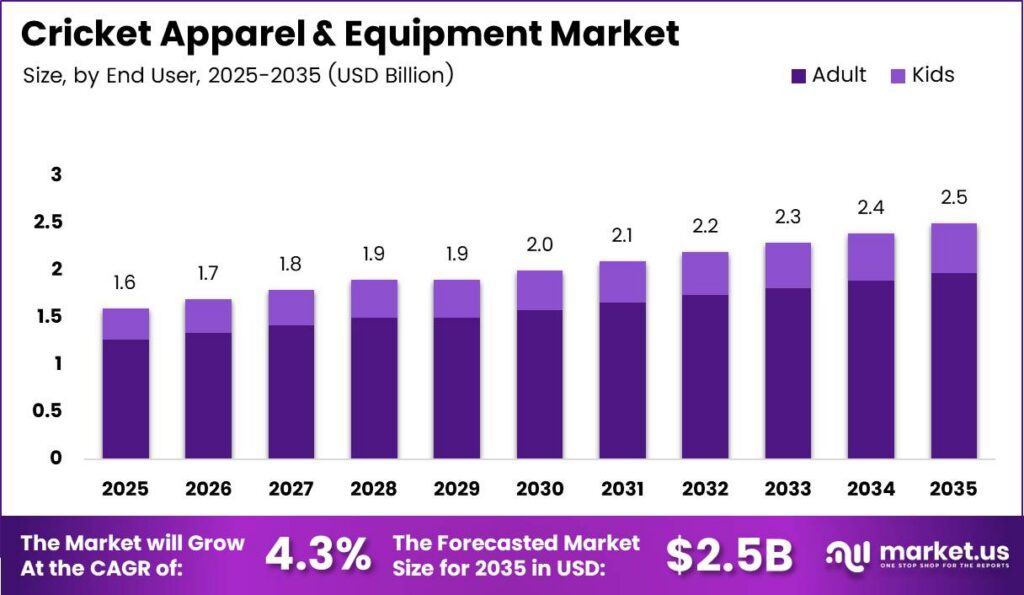
Global Cricket Apparel & Equipment Market size is expected to be worth around USD 2.5 Billion by 2035 from USD 1.6 Billion in 2025, growing at a CAGR of 4.3% during the forecast period 2026 to 2035. Cricket apparel and equipment encompass engineered willow bats, stitched leather balls, impact-rated protective gear, performance sportswear, spiked footwear, and kit bags built for match play and training. Commercial leagues and youth academies rely on these products to protect athletes and monetize supporter merchandise.
Professional clubs, schools, and amateur leagues anchor end-use purchasing across global tournaments. According to the International Olympic Committee, the Los Angeles 2028 Olympic Games will feature 6 teams per gender across 28 T20 matches and 90 athlete quotas per gender. National Olympic committees now fund dedicated cricket high-performance programs in non-traditional territories. Therefore, equipment suppliers gain institutional procurement contracts across associate nations well ahead of 2028.
Key Takeaways
- The global Cricket Apparel & Equipment Market was valued at USD 1.6 Billion in 2025.
- Global market revenue will reach USD 2.5 Billion by 2035.
- The market expands at a CAGR of 4.3% during the forecast period from 2026 to 2035.
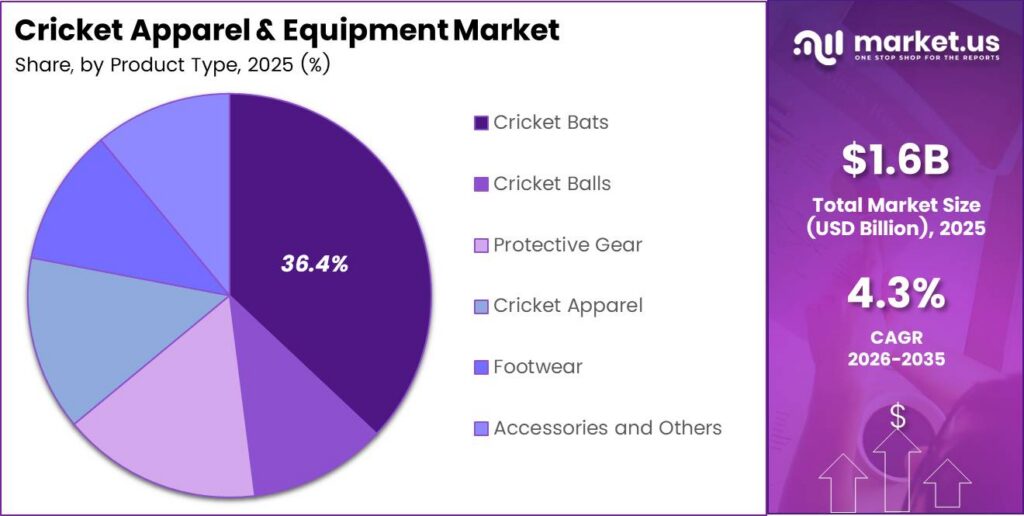
- By Product Type, Cricket Bats led the market with a 36.43% share in 2025, while Protective Gear represents the fastest-growing product category.
- By End User, the Adult segment accounted for a 78.21% share in 2025, whereas the Kids segment registers the fastest growth.
- By User Category, Personal Use captured an 83.11% share in 2025, while Commercial Use expands at the fastest rate.
- By Distribution Channel, Offline Channels held a 78.56% share in 2025, whereas Online Channels record the fastest expansion.
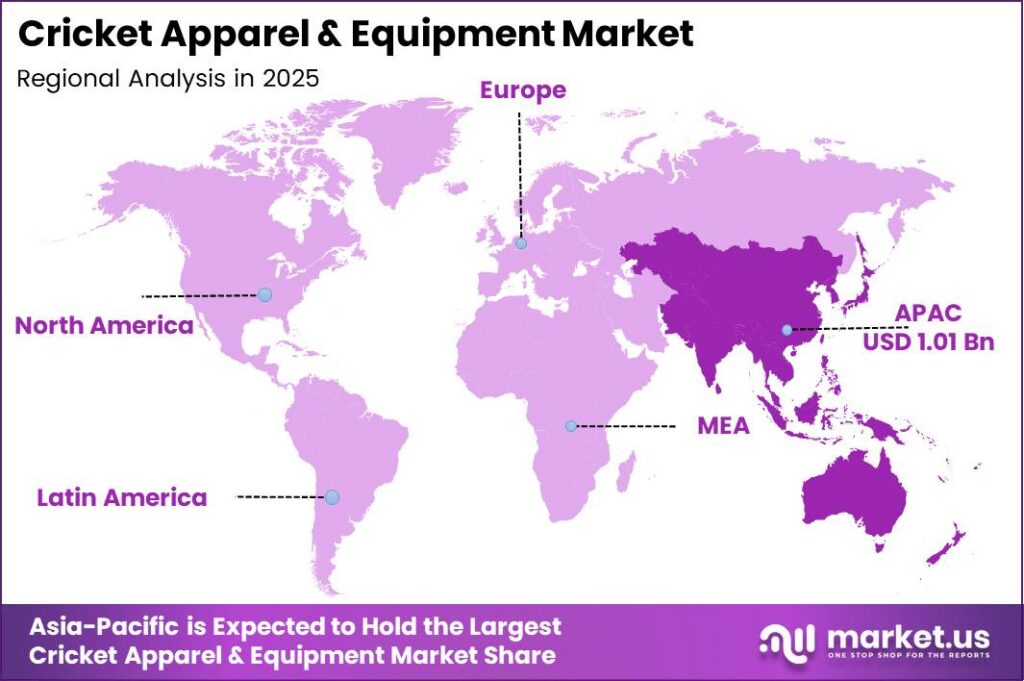
- Asia-Pacific dominated regional revenue with a 63.23% share valued at USD 1.01 Billion in 2025, while North America is the fastest-growing region over 2026 to 2035.
Targeted industrial policy is reshaping production scale across South Asian manufacturing hubs. As reported by the Press Information Bureau of the Government of India, the Union Cabinet approved INR 1,856.67 crore for the Khelo India Sports Goods Manufacturing Scheme, citing USD 2.5 billion in domestic sports demand and USD 275 million in equipment exports. Dedicated manufacturing zones lower unit compliance and testing costs for domestic factories. Consequently, export-ready producers can capture higher-margin international wholesale contracts.
Private equity and corporate buyers are also restructuring league-level kit licensing models. In July 2025, the England and Wales Cricket Board completed equity stake sales across 8 franchises in The Hundred at a GBP 975 million valuation, raising over GBP 520 million . Private team owners now control seasonal jersey design, direct merchandise drops, and kit sponsorships independently. This signals higher upfront royalty guarantees and faster annual kit refresh cycles for apparel brands.
Asia-Pacific leads global revenue with a 63.23% market share in 2025, backed by dense playing populations and factory clusters in India and Pakistan. Data from the World Intellectual Property Organization shows global sports filings exceeded 65,700 patents growing 7.6% annually between 2016 and 2025, with Asia generating 63% of patents and 76% of designs . Local manufacturers pair low-cost textile and willow craftsmanship with proprietary design registrations. As a result, regional suppliers retain tight pricing power across global export channels.
Franchise venue construction outside Commonwealth borders further widens commercial equipment sales. In September 2025, American Cricket Enterprises surpassed USD 150 million in cumulative United States cricket investment after a 53% ticket surge across 34 matches, committing another USD 150 million for 10 venues by 2030 . Permanent turf pitches require specialized spiked footwear, leather balls, and sight-screen hardware rather than casual backyard gear. Therefore, premium equipment brands can build profitable North American specialty distribution networks.
Product Type Analysis
Cricket Bats dominates with 36.43% share in 2025 due to high willow unit replacement prices.
In 2025, Cricket Bats held a 36.43% share in the Product Type segment of the Cricket Apparel & Equipment Market. Figures from the Directorate General of Commercial Intelligence and Statistics show India exported USD 570.95 million under HS Chapter 95 in fiscal 2025, including INR 1,664.29 crore in HS 9506 sports equipment. Aggressive T20 power hitting compresses willow fibers rapidly and cracks bat edges within 2 to 3 seasons. Therefore, manufacturers capture recurring premium replacement margins from frequent blade turnover.
Cricket Balls serve as the highest-frequency consumable across professional leagues, clubs, and training nets because seam abrasion degrades swing and bounce within 80 overs. Eurostat found that extra-EU sporting goods imports reached EUR 11.8 billion in 2025, with balls representing 60% of all sporting goods import value sourced from Pakistan . Hand-stitched alum-tanned leather cores must maintain strict weight and compression tolerances on abrasive turf pitches. Consequently, institutional buyers lock in multi-season bulk supply contracts to prevent mid-season stockouts.
Protective Gear represents the fastest-growing product segment as cricket boards enforce stricter head, neck, and impact safety standards across all age tiers. Based on Pakistan Bureau of Statistics data, national sports goods exports climbed 10.08% to USD 424.349 million in fiscal 2026, including USD 59.567 million in sports gloves and USD 108.059 million in non-football gear . Ball speeds exceeding 140 kilometers per hour require high-density foam pads, reinforced gloves, and certified titanium-grille helmets. This creates strong pricing power for safety-certified manufacturers.
End User Analysis
Adult dominates with 78.21% share in 2025 due to high spending on pro-grade gear.
In 2025, Adult held a 78.21% share in the End User segment of the Cricket Apparel & Equipment Market. The World Health Organization indicates that 31% of adults worldwide, or 1.8 billion adults, fail to meet 150 weekly minutes of physical activity, a rate projected to hit 35% by 2030 . Corporate wellness programs and municipal leagues are funding weekend amateur T20 and box-cricket tournaments to reverse adult inactivity. This means retailers can upsell higher-margin English willow bats and spiked shoes to salaried adult players.
Kids form the fastest-growing end-user group as schools and private academies introduce structured junior coaching for boys and girls. According to the World Health Organization, 86% of adolescents aged 11 to 17 log fewer than 7 active days weekly, and 240 million youths report 0 active days . Physical growth spurts force parents to replace junior-sized bats, helmets, and pads every 12 to 18 months for proper biomechanical fit. Therefore, brands offering lightweight junior size progressions secure multi-year household loyalty.
Youth and Grassroots Pathway Programs bridge recreational school play and professional franchise rosters through talent camps. As reported by the Sports & Fitness Industry Association, United States team sports participation rose 7.6% to 92.3 million in 2025, with regular youth team play hitting 41%. In July 2026, New Balance and Belgravia Apparel partnered with Cricket NSW to outfit Sydney Sixers and Sydney Thunder youth academies . Standardized academy kits require bulk apparel sizing, giving sponsors early brand visibility among future athletes.
User Category Analysis
Personal Use dominates with 83.11% share in 2025 due to individual bat and kit ownership.
In 2025, Personal Use held an 83.11% share in the User Category segment of the Cricket Apparel & Equipment Market. Data from Eurostat shows European Union real household consumption rose 1.5% in 2024, while personal spending on recreation, sport, and culture grew 3.0% to reach 7.5% of household budgets . Cricketers purchase personal bats, gloves, abdominal guards, and helmets individually because grip weight, sweat hygiene, and head sizing cannot be shared safely. Consequently, consumer brands earn their highest unit volumes through individual retail kits.
Commercial Use registers the fastest growth as pay-and-play indoor cricket lanes, turf facilities, and coaching centers expand across cities. The Health & Fitness Association found that commercial sports and fitness facility revenues grew 8% in 2024 as facility counts rose 4% and United States memberships hit 104.7 million . High daily footfall subjects shared bowling-machine balls, turf mats, and rental pads to heavy mechanical wear every week. This creates predictable quarterly B2B restocking contracts for durable commercial-grade equipment suppliers.
Franchise and Institutional Academies procure standardized teamwear and training gear in bulk for men’s, women’s, and pathway squads. Based on England and Wales Cricket Board data, official supplier Castore donated GBP 150,000 worth of cricket performance kit in July 2026 for grassroots women’s and girls’ clubs under its 10-year, GBP 25 million contract . Institutional buyers require moisture-wicking fabrics tailored specifically to female and junior athletic proportions. Therefore, manufacturers with custom teamwear sublimation lines win lucrative multi-year governing body tenders.
Distribution Channel Analysis
Offline Channels dominates with 78.56% share in 2025 due to physical bat balance testing.
In 2025, Offline Channels held a 78.56% share in the Distribution Channel segment of the Cricket Apparel & Equipment Market. Figures from the U.S. Census Bureau show physical sporting goods, hobby, musical instrument, and book stores generated USD 79.236 billion in annual retail sales . In August 2024, Decathlon committed EUR 100 million, or INR 933 crore, to reach 190 Indian stores across 90 cities . Players test bat pick-up weight and helmet grille visibility in person before buying, keeping specialty shops vital for premium hardware.
Online Channels represent the fastest-growing distribution route as fans order licensed T20 replica jerseys and accessories on marketplaces during tournament windows. According to the U.S. Census Bureau, quarterly e-commerce retail sales climbed 12.2% year-on-year to USD 340.2 billion in Q2 2026, capturing 17.1% of total retail spending . Standardized apparel sizing and lower warehouse overhead allow online sellers to ship match-week merchandise nationwide within 48 hours. As a result, brands shifting seasonal jersey drops online capture faster inventory turns.
Direct-to-Consumer and Brand E-Commerce portals allow manufacturers to bypass wholesale markups and sell limited-edition player collections directly to fans. Eurostat indicates that 78% of European Union internet users shopped online in 2025, with 45% purchasing clothing and sportswear and 16% buying sports equipment . Direct digital storefronts let brands bundle custom bat knocking-in services, laser handle engraving, and authenticated jersey QR codes at checkout. Therefore, manufacturers expand gross margins while protecting buyers from grey-market counterfeits.
Key Market Segments
By Product Type
- Cricket Bats
- Cricket Balls
- Protective Gear
- Cricket Apparel
- Footwear
- Accessories and Others
By End User
- Adult
- Kids
By User Category
- Personal Use
- Commercial Use
By Distribution Channel
- Offline Channels
- Online Channels
Regional Analysis
Asia-Pacific Dominates the Cricket Apparel & Equipment Market with a Market Share of 63.23% in 2025, Valued at USD 1.01 Billion
Asia-Pacific generated USD 1.01 Billion in 2025, capturing 63.23% of global revenue through massive playing populations in India, Australia, Pakistan, and Bangladesh. As reported by the World Bank, South Asia’s GDP growth forecast rose to 6.9% for 2026 while India’s fiscal 2027 projection reached 7.1% on strong domestic consumption . Rising household incomes and tax rationalization allow amateur players to upgrade from unbranded wooden bats to branded protective gear and licensed jerseys. Consequently, domestic brands scale multi-tier retail networks across tier-2 cities.
North America is the fastest-growing regional market as South Asian diaspora leagues, youth academies, and Major League Cricket spur equipment adoption across the United States and Canada. Data from the National Retail Federation shows United States core retail sales will grow 4.4% in 2026 to USD 5.6 trillion, with holiday spending rising 4.2% to USD 1.013 trillion . Affluent suburban cricket households spend heavily on imported English willow bats and turf shoes, supporting premium specialty distributors.
Europe, Middle East and Africa, and Latin America sustain steady club and franchise equipment replacement cycles. The World Bank found that developing Europe and Central Asia GDP growth moderates to 2.2% in 2026, while Latin America grows 2.2% and the Caribbean cricket subregion expands 2.5% . By contrast, the International Monetary Fund indicates that Sub-Saharan Africa grows 4.3% in 2026 after hitting 4.5% in 2025 . Strong South African and Caribbean T20 leagues keep regional ball and kit imports profitable.
Key Regions and Countries
North America
- US
- Canada
Europe
- Germany
- France
- The UK
- Spain
- Italy
- Rest of Europe
Asia Pacific
- China
- Japan
- South Korea
- India
- Australia
- Rest of APAC
Latin America
- Brazil
- Mexico
- Rest of Latin America
Middle East and Africa
- GCC
- South Africa
- Rest of MEA
Market Dynamics
Market profitability balances high-margin franchise merchandise and smart-sensor upgrades against illicit apparel counterfeiting and raw material bottlenecks. Based on Organisation for Economic Co-operation and Development data, global counterfeit trade reached USD 467 billion, or 2.3% of world imports, with clothing, footwear, and leather representing 62% of customs seizures . Meanwhile, Str8bat raised USD 3.5 million in October 2024 to scale embedded bat sensors with SG Cricket . Brands must pair authenticated digital hardware with strict marketplace enforcement to protect margins.
Drivers
Commercial cricket has shifted from bilateral tours to franchise T20 leagues. After the 2023 to 2027 IPL media-rights deal reached INR 48,390 crore, leagues including SA20, ILT20, Major League Cricket, The Hundred, and WPL pushed global franchise squads past 80. Teams refresh kits annually, concentrating replica sales into an 8 to 10 week tournament window and lifting inventory turns by 15% to 20%. This pushes suppliers toward fast-turn seasonal manufacturing.
Consequently, brands are pivoting from wholesale team supply toward franchise-licensed direct-to-consumer drops. Apparel makers commit upfront royalty guarantees of 10% to 15% of retail value to secure short-cycle digital merchandise rights. Online channels have captured 35% to 40% of Indian replica jersey sales since 2024. Direct sales generate contribution margins 8 to 12 percentage points above traditional sporting goods retail, rewarding brands that invest in agile digital fulfillment.
| Driver | (~) % Impact on CAGR Forecast | Geographic Relevance | Impact Timeline |
|---|---|---|---|
| Franchise T20 League Proliferation | +1.4% | India, Australia, UK, UAE, South Africa, USA | Short term (≤ 2 years) |
| Women’s Cricket Participation Surge | +0.9% | Global, led by India, England, Australia | Medium term (2–4 years) |
| Olympic Inclusion (LA28) Momentum | +0.7% | USA, Europe, Associate Nations | Medium term (2–4 years) |
| Licensed Replica Jersey Demand | +0.6% | South Asia, UK, Australia | Short term (≤ 2 years) |
| Grassroots Academy & School Expansion | +0.5% | India, Pakistan, Bangladesh, Sri Lanka | Long term (≥ 4 years) |
| Diaspora-Led Cricket in North America | +0.4% | USA, Canada | Medium term (2–4 years) |
Restraints
Wide price gaps between official kits and illicit copies restrain licensed apparel revenue. Official replica jerseys retail at INR 2,500 to INR 5,000, whereas unlicensed sublimated copies from Tiruppur, Ludhiana, and Sialkot sell for INR 300 to INR 600. Counterfeits capture 50% to 60% of Indian jersey volume during tournament peaks. Marketplace takedowns require 7 to 21 days, outlasting match-week buying windows and draining full-price licensed volume.
Weak enforcement leaves official licensees holding excess inventory of 20% to 25% of seasonal replica orders after tournaments end. Brands must clear unsold jerseys at markdowns of 30% to 50%, compressing licensed apparel gross margins by 4 to 6 percentage points. As a result, apparel sponsors trim initial production orders and delay capital spending on domestic printing capacity, capping near-term revenue realization in emerging markets.
| Restraint | (~) % Impact on CAGR Forecast | Geographic Relevance | Impact Timeline |
|---|---|---|---|
| Counterfeit & Grey-Market Merchandise | -0.9% | South Asia, Middle East | Short term (≤ 2 years) |
| High Price of Premium Bats & Protective Gear | -0.6% | Emerging Asia, Africa, Associate Nations | Short term (≤ 2 years) |
| Geographically Narrow Playing Base | -0.5% | Global ex-Commonwealth | Long term (≥ 4 years) |
| US Reciprocal Tariffs on South Asian Imports | -0.4% | USA, India, Pakistan | Short term (≤ 2 years) |
| Limited Ground & Facility Infrastructure | -0.3% | Urban India, USA, Europe | Medium term (2–4 years) |
Challenges
Premium cricket bat production relies almost entirely on Salix alba var. caerulea English willow grown in Essex and Suffolk. Trees require 15 to 20 years to reach harvestable girth, and historical under-planting prevents supply from matching global T20 bat demand. Only 35% to 40% of harvested clefts achieve Grade 1 or Grade 2 quality, pushing top-grade raw cleft prices up 25% to 40% since 2023.
Import lead times for Indian and Pakistani bat assemblers have doubled from 8 to 10 weeks to 16 to 20 weeks, capping seasonal output of pro-grade blades despite strong buyer orders. Manufacturers must lock in multi-year plantation contracts, test non-UK willow cultivation, and shift mid-tier ranges toward substitute grades. Each mitigation step demands 3 to 5 years of working capital commitment before usable timber volumes expand.
| Challenge | (~) % CAGR Friction Drag | Geographic Relevance | Mitigation Horizon |
|---|---|---|---|
| English Willow Supply Scarcity | -0.8% | UK, India, Pakistan | Long term (≥ 4 years) |
| Kashmir Willow Quality Depletion | -0.4% | India | Long term (≥ 4 years) |
| Leather & Cork Input Volatility | -0.3% | India, Pakistan, Portugal | Medium term (2–4 years) |
| Skilled Bat-Maker Shortage | -0.3% | UK, Jalandhar, Meerut, Sialkot | Medium term (2–4 years) |
| Helmet Safety Certification Compliance | -0.2% | UK, Australia, Global | Short term (≤ 2 years) |
Opportunities
Sensor-embedded smart equipment remains largely untapped across academies and amateur clubs, where over 90% of cricket gear units are sold. Embedding a handle sensor at a 15% to 25% bat price premium alongside an INR 199 to INR 499 monthly coaching app subscription converts a 3 to 4 year hardware purchase into recurring revenue. Early movers can build sticky digital ecosystems before rivals standardize smart bats.
Hardware economics strongly favor integrated subscription models as MEMS sensor costs fall 8% to 10% annually from a current unit cost of INR 800 to INR 1,200. Once software subscription attach rates pass 20%, blended gross margins can expand from 35% to 40% up to 50% to 55%. Captured swing telemetry also lowers customer acquisition costs by triggering automated bat replacement offers when performance drops.
| Opportunity | (~) % Potential CAGR Upside | Geographic Relevance | Execution Window |
|---|---|---|---|
| Sensor-Embedded Smart Equipment | +0.9% | India, Australia, UK | Medium term (2–4 years) |
| Women-Specific Fit & Protective Ranges | +0.7% | Global | Short term (≤ 2 years) |
| Tennis-Ball & Box Cricket Gear Formalization | +0.6% | India, Bangladesh, Nepal, Gulf | Short term (≤ 2 years) |
| Recycled & Bio-Based Performance Apparel | +0.4% | UK, Australia, New Zealand | Long term (≥ 4 years) |
| Regional Brand Roll-Up Consolidation | +0.3% | India, Pakistan | Medium term (2–4 years) |
Key Company Insights
Adidas AG holds a leading tier-1 position in global cricket performance apparel, spiked footwear, and national replica merchandise across Europe, Asia-Pacific, and South Africa. Figures from the Adidas AG Annual Report show the company generated record consolidated net sales of EUR 24,811 million in 2025, with brand sales rising 13% currency-neutral and operating profit reaching EUR 2,056 million . Scale sourcing lets Adidas absorb high national board sponsorship fees while protecting direct-to-consumer margins.
Adidas monetizes major ICC tournaments through tiered pricing across authentic player kits and mass-market supporter jerseys. According to Adidas India and afaqs!, the brand unveiled Team India’s 2026 T20 World Cup match jersey in December 2025 at INR 6,599 alongside an INR 999 fan edition under its contract running through March 2028 . Sub-INR 1,000 fan pricing directly counters grey-market counterfeits and captures high-volume youth buyers across India.
Nike Inc. competes in technical cricket footwear, moisture-wicking training apparel, and elite franchise teamwear across India, the United Kingdom, Australia, and North America. As reported by NIKE, Inc. Form 10-K SEC filings, consolidated revenues reached USD 46,398 million, or USD 46.4 billion, with net income of USD 3.11 billion in fiscal 2026 . Deep R&D budgets in foam cushioning and breathable knitwear allow Nike to command premium retail price points.
Nike is aggressively re-entering T20 franchise cricket licensing rather than bidding on costly bilateral national contracts. Based on Nike Official Newsroom data, Nike signed a multi-year official kit partnership in October 2026 with 5-time champion Mumbai Indians covering men’s IPL and women’s WPL squads starting in 2027, returning to the IPL after 19 years . Partnering with global multi-league franchises unlocks year-round fanwear demand across domestic and diaspora retail stores.
Key Players
- Adidas AG
- Nike Inc.
- Gunn & Moore (DXM)
- Sareen Sports Industries (SS)
- Sanspareils Greenlands (SG)
- Kookaburra Sport Pty Ltd.
- Gray-Nicolls Sports Pty Ltd.
- Puma SE
- New Balance Athletics Inc.
- MRF Limited
- Spartan Sports
- Slazenger (Frasers Group)
- Shrey Sports
- Masuri Group
- CA Sports
- Other Key Players
Recent Developments
2026
- October 2026: Sanspareils Greenlands (SG) product launch introduced Hardik Pandya’s BORN TO BE footwear and apparel line featuring 333 numbered Vibram-outsole shoes at INR 20,000 and INR 25,000 alongside apparel from INR 1,000 to INR 12,000 according to Apparel Resources .
- October 2026: Washington Freedom capacity expansion broke ground on Frederick Cricket Park in Maryland, a privately funded USD 45 million, 10,000-seat stadium across 24 acres according to The Daily Record .
- October 2026: Agilitas Sports and One8 merger received NCLT regulatory approval, lifting Virat Kohli’s stake from 1.8% to 6.4% after his INR 40 crore investment to target INR 2,000 to 3,000 crore revenue according to The Economic Times .
- September 2026: Puma SE product launch debuted 3 PUMA x RCB x Dhruv Kapoor jackets at Milan Fashion Week after 2026 RCB authentic jerseys priced at INR 5,499 recorded a 300% sales jump according to InFashion Business .
- July 2026: Knight Riders Group capacity expansion opened a 5,000-seat cricket stadium in Pomona, California for 7 MLC games ahead of an expansion past 20,000 seats for LA28 according to Associated Press .
- June 2026: Agilitas Sports funding round raised INR 225 crore from Nexus Venture Partners and Rainmatter as footwear subsidiary Mochiko Shoes reached INR 1,350 crore in fiscal 2026 revenue according to Agilitas Official Press Release .
- April 2026: Skechers agreement renewed its Official Kit Partner contract with Mumbai Indians for a 3rd consecutive season, retailing fan jerseys at INR 699 to INR 999 according to NDTV Sports .
- January 2026: Shrey Sports partnership signed a 5-year contract through 2030 with Cricket South Africa as Official Helmet and Luggage Partner for Proteas squads according to Cricket South Africa.
2025
- November 2025: Gray-Nicolls Sports Pty Ltd. product launch released its 2026 Havoc and Imperia cricket ranges with NEOCORE technology priced from GBP 36.99 to GBP 999.99 according to Gray-Nicolls Official .
- November 2025: Gunn & Moore (DXM) product launch introduced BS7928-compliant Maestro helmets from GBP 51.95 and Nottingham-made L540 DXM English willow bats up to GBP 999.95 according to Gunn & Moore .
- July 2025: New Balance Athletics Inc. partnership signed a 5-year agreement with Cricket Australia to supply playing and fan kits for 8 BBL and 8 WBBL clubs starting in 2025 to 2026 according to Sportcal .
Geopolitical Impact Analysis
Tariff escalations and maritime corridor conflicts directly inflate cross-border freight and customs expenses between UK raw willow suppliers, South Asian factories, and Western buyers. According to the World Trade Organization, global merchandise trade volume grows 3.9% in 2026, yet reciprocal tariffs impose a 3.5% contraction drag on tariff-exposed trade while Middle East conflict trims services trade growth to 3.3% . Data from UNCTAD shows Red Sea rerouting around the Cape of Good Hope pushed the Shanghai Containerized Freight Index up 149% to 2,496 points, stretched vessel ton-miles by 6%, and slowed 2025 seaborne trade growth to 0.5% . Meanwhile, the World Shipping Council found that containers lost at sea jumped 156% to 1,478 out of 280 million shipped in 2025 . Longer sea transit delays English willow cleft deliveries to Meerut and Sialkot while raising landed duties on cricket kits entering United States ports, forcing distributors to hold larger buffer inventories.
Middle East energy shocks simultaneously raise factory utility bills and petrochemical resin costs for synthetic cricket apparel and protective gear. The International Monetary Fund indicates that global headline inflation reaches 4.7% in 2026 as crude oil prices jump to USD 95.74 per barrel from USD 67.74 in 2025, slowing global GDP growth to 3.1% . Figures from the International Energy Agency show peak global electricity demand climbs 40% by 2035 while petrochemical feedstocks push oil demand toward 113 million barrels per day . Polyester sublimation jerseys, EVA foam leg-guard padding, polyurethane shoe soles, and ABS helmet shells depend directly on crude-derived feedstocks. Therefore, equipment makers face tighter gross margins and must pass 5% to 8% wholesale price increases onto retail buyers.
Report Scope
| Report Features | Description |
|---|---|
| Market Value (2025) | USD 1.6 Billion |
| Forecast Revenue (2035) | USD 2.5 Billion |
| CAGR (2026-2035) | 4.3% |
| Base Year for Estimation | 2025 |
| Historic Period | 2021-2025 |
| Forecast Period | 2026-2035 |
| Report Coverage | Revenue Forecast, Market Dynamics, Market Opportunity Analysis, Technology and Innovation Landscape, Competitive Landscape, Recent Developments |
| Segments Covered | By Product Type (Cricket Bats, Cricket Balls, Protective Gear, Cricket Apparel, Footwear, Accessories and Others), By End User (Adult, Kids), By User Category (Personal Use, Commercial Use), By Distribution Channel (Offline Channels, Online Channels) |
| Regional Analysis | North America (US and Canada), Europe (Germany, France, The UK, Spain, Italy, and Rest of Europe), Asia Pacific (China, Japan, South Korea, India, Australia, and Rest of APAC), Latin America (Brazil, Mexico, and Rest of Latin America), Middle East and Africa (GCC, South Africa, and Rest of MEA) |
| Competitive Landscape | Adidas AG, Nike Inc., Gunn & Moore (DXM), Sareen Sports Industries (SS), Sanspareils Greenlands (SG), Kookaburra Sport Pty Ltd., Gray-Nicolls Sports Pty Ltd., Puma SE, New Balance Athletics Inc., MRF Limited, Spartan Sports, Slazenger (Frasers Group), Shrey Sports, Masuri Group, CA Sports, Other Key Players |
| Customization Scope | Customization for segments, region / country-level will be provided. Additional customization can be done based on requirements. |
| Purchase Options | We have three licenses to opt for: Single User License | Multi-User License (Up to 5 Users) | Corporate Use License (Unlimited User and Printable PDF) |