Global Contract Abstraction AI Market Size, Share and Analysis By Component (Software/Solutions, Services), By Deployment Mode (Cloud-based/SaaS, On-premises), By Contract Type (Commercial Agreements, Corporate & Legal, Industry-Specific), By End-User (Corporate Legal Departments, Law Firms, Procurement & Supply Chain Teams, Others), By Organization Size (Large Enterprises, Small and Medium-sized Enterprises), By Regional Analysis, Global Trends and Opportunity, Future Outlook By 2025-2035
- Published date: April 2026
- Report ID: 183980
- Number of Pages: 390
- Format:
-
keyboard_arrow_up
Quick Navigation
- Report Overview
- Top Market Takeaways
- Key Insights Summary
- By Component
- By Deployment Mode
- By Contract Type
- By End-User
- By Organization Size
- Regional Analysis
- Country Analysis
- Key Market Segments
- Emerging Trends Analysis
- Driver Analysis
- Restraint Analysis
- Opportunity Analysis
- Challenge Analysis
- Competitive Analysis
- Recent Developments
- Report Scope
Report Overview
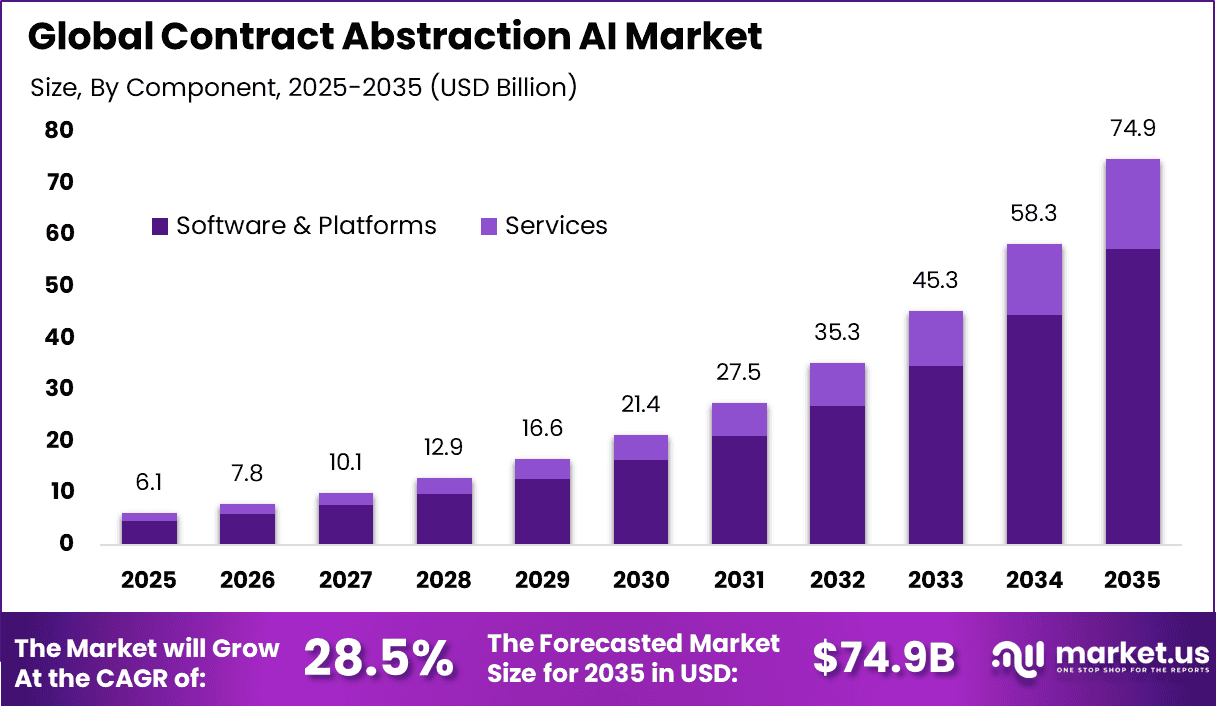
The Global Contract Abstraction AI Market size is expected to be worth around USD 74.9 Billion By 2035, from USD 6.1 billion in 2025, growing at a CAGR of 28.5% during the forecast period from 2026 to 2035. North America held a dominant Market position, capturing more than a 39.1% share, holding USD 2.3 Billion revenue.
The contract abstraction AI market refers to intelligent software solutions that automatically extract, organize, and summarize key information from legal contracts. These systems are designed to process large volumes of unstructured legal text and convert it into structured, usable data. Organizations across industries are increasingly relying on such tools to manage complex agreements efficiently. The shift toward digital workflows and data driven operations has made automated contract understanding an essential capability for modern enterprises.
AI-powered contract abstraction improves both efficiency and accuracy in legal and business workflows by reducing the time required for manual contract review by as much as 80% to 90%. These tools help organizations process large volumes of agreements faster while improving consistency in document analysis. Using Natural Language Processing and Machine Learning, contract abstraction platforms can identify and extract important information such as renewal dates, liability terms, and clause definitions with accuracy levels that often exceed 94%.
Demand analysis shows that adoption is particularly strong in sectors such as financial services, healthcare, and large scale enterprises. These sectors manage high volumes of contracts related to compliance, procurement, partnerships, and customer agreements. Legal teams, procurement departments, and compliance units are key users, as they require quick access to contract insights for decision making. The demand is further supported by the need for transparency and centralized contract visibility across organizations.
Increasing adoption technologies in this market are centered on natural language processing, machine learning, and cloud based platforms. Natural language processing enables systems to understand legal language and extract relevant clauses. Machine learning improves performance over time by learning from previous contract data. Cloud deployment supports scalability and allows teams to collaborate in real time. Integration with enterprise systems is also expanding, enabling seamless workflows across legal and operational functions.
Top Market Takeaways
- In the contract abstraction AI market, software and solutions accounted for 76.5%, reflecting strong demand for automated contract review tools.
- Cloud-based and SaaS deployment led with 87.3%, supported by easier access, faster implementation, and scalable processing.
- Commercial agreements held a dominant share of 68.4%, as businesses increasingly automate the review of high-volume contract types.
- Corporate legal departments represented 52.7% of the market, making them the leading end-user segment.
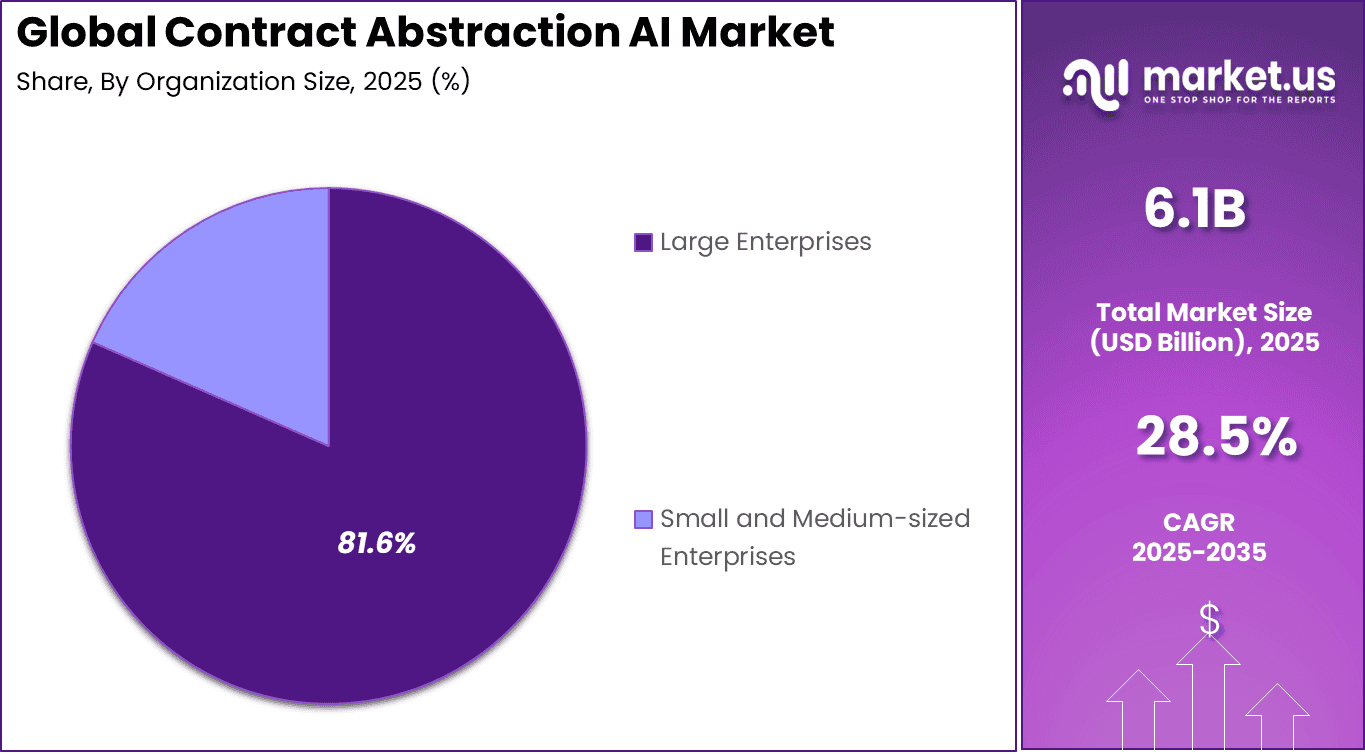
- Large enterprises captured 81.6%, driven by complex contract portfolios and higher technology adoption.
- North America held a leading market share of 39.14%.
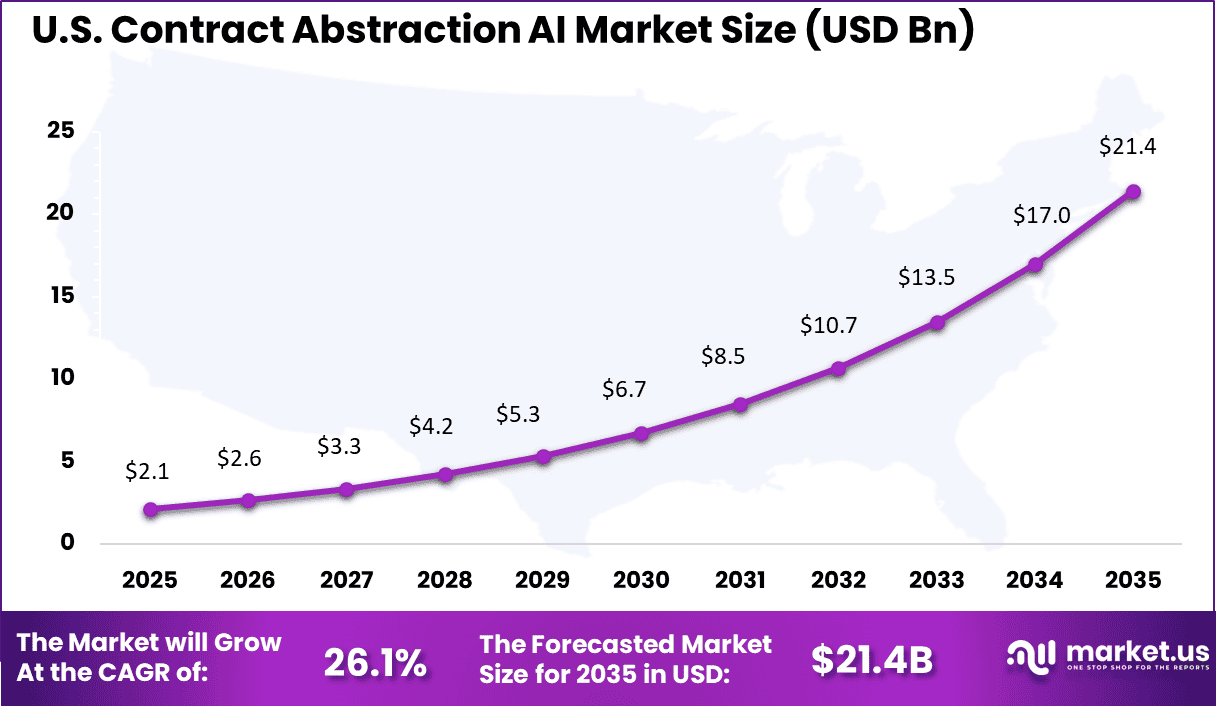
- The U.S. market was valued at USD 2.19 billion and is projected to grow at a CAGR of 26.15%.
Key Insights Summary
- AI can reduce contract review and abstraction time by 80% to 90%, turning tasks that normally take 3 to 5 hours into work completed within minutes.
- Contract abstraction tools process documents about 75% faster than manual reviewers, improving legal workflow efficiency.
- AI-powered systems achieve more than 94% to 95% accuracy in identifying important clauses, obligations, and contract terms.
- Organizations using AI for contract abstraction can reduce related operating costs by up to 50% or more.
- AI also allows companies to handle much larger contract volumes without adding proportional headcount.
- Around 44% of organizations report that they are already using AI in contracting workflows, especially for redlining, contract review, and summarization.
- In one in-house legal survey, 52% of teams said they were either already using or actively evaluating AI tools for contract review.
- Legal teams spend an average of 3.1 hours reviewing a single contract, while 79% of AI users report lower time spent on routine tasks.
- About 67% of respondents say AI has improved business response speed and contract turnaround time.
- AI-based abstraction and review can reduce review time by up to 80%, while contract creation time can fall by around 60% through automated clause extraction and data capture.
- Contract summarization tools can reduce first-pass review time by up to 95% by extracting key clauses, obligations, and important dates before human validation.
By Component
In 2025, the software and solutions segment dominated the contract abstraction AI market with a share of 76.5%, driven by the growing adoption of AI-powered platforms for automated contract review and data extraction. These solutions enable organizations to identify key clauses, obligations, and risks within large volumes of legal documents.
The increasing need to reduce manual effort and improve accuracy has accelerated the adoption of intelligent contract management tools. As enterprises deal with complex legal workflows, software-led solutions remain central to operational efficiency. The segment’s growth is further supported by advancements in natural language processing and machine learning technologies.
These innovations allow systems to interpret legal language with higher precision and deliver actionable insights. Organizations are integrating such tools into their legal and compliance frameworks to streamline contract lifecycle management. This has strengthened the position of software solutions as the primary component in the market.
By Deployment Mode
In 2025, the cloud-based and SaaS segment accounted for 87.3% share, reflecting strong preference for scalable and accessible contract abstraction platforms. Cloud deployment enables legal teams to access systems remotely and collaborate across departments in real time. This flexibility is particularly valuable for organizations managing contracts across multiple locations. As digital transformation accelerates, cloud-based solutions have become the preferred deployment model.
The segment’s expansion is also driven by lower infrastructure costs and faster implementation compared to traditional systems. SaaS platforms provide automatic updates, enhanced security features, and seamless integration with enterprise applications. Organizations benefit from improved efficiency and reduced maintenance requirements. This has reinforced the dominance of cloud-based deployment in the market.
By Contract Type
In 2025, the commercial agreements segment held a dominant share of 68.4%, supported by the high volume of business contracts across industries. These agreements include supplier contracts, partnership deals, and service-level agreements that require continuous monitoring and analysis. AI-based abstraction tools help organizations extract critical data points and ensure compliance with contractual terms. This has increased their adoption in managing commercial contracts.
The segment’s growth is further influenced by the need to mitigate risks and improve contract visibility. Businesses are focusing on identifying key clauses related to pricing, obligations, and timelines to enhance decision-making. Automated abstraction reduces errors and improves consistency in contract analysis. This has positioned commercial agreements as the leading contract type in the market.
By End-User
In 2025, the corporate legal departments segment accounted for 52.7% share, driven by the increasing need for efficient contract management within organizations. Legal teams are adopting AI-based tools to streamline contract review, reduce processing time, and improve accuracy. These solutions enable faster identification of risks and obligations, supporting better compliance management. As legal workloads increase, automation has become essential for maintaining efficiency.
The segment’s leadership is also supported by the growing complexity of regulatory requirements and legal documentation. Corporate legal departments are focusing on improving productivity and reducing operational costs through technology adoption. AI-powered abstraction tools help manage large contract volumes with greater consistency. This has strengthened their role as primary end-users in the market.
By Organization Size
In 2025, the large enterprises segment held a dominant share of 81.6%, reflecting their extensive contract portfolios and higher investment capacity. These organizations manage large volumes of agreements across multiple business units and regions. As a result, they require advanced tools to automate contract analysis and ensure compliance. This has driven strong adoption of contract abstraction AI solutions among large enterprises.
The segment’s dominance is further supported by their focus on digital transformation and risk management. Large enterprises are investing in AI technologies to improve operational efficiency and reduce manual workload. Integration with enterprise systems enhances visibility and control over contract data. This consistent investment has reinforced their leading position in the market.
Regional Analysis
In 2025, North America accounted for 39.14% of the contract abstraction AI market, supported by strong adoption of advanced technologies and digital legal solutions. Organizations in the region are early adopters of AI-driven tools to improve efficiency and compliance. The presence of a mature legal and corporate ecosystem further supports market growth. This has positioned North America as a leading region in the global market.
The region’s dominance is also driven by increasing investments in artificial intelligence and automation technologies. Companies are focusing on enhancing contract management processes through advanced analytics and machine learning. Regulatory requirements and data governance standards further encourage adoption. These factors collectively contribute to sustained market expansion.

Country Analysis
In 2025, the United States contract abstraction AI market reached USD 2.19 billion and is expanding at a CAGR of 26.15%, reflecting rapid growth driven by digital transformation in legal operations. Organizations across industries are adopting AI-based solutions to manage contracts more efficiently and reduce risks. The strong presence of technology providers and large enterprises has supported widespread adoption. This has contributed to consistent market growth.
The growth in the U.S. is also influenced by increasing demand for automation and data-driven decision-making. Companies are focusing on improving legal workflows and reducing operational complexity. Continuous advancements in AI technologies further enhance solution capabilities. As a result, the United States remains a key contributor to the global contract abstraction AI market.
Key Market Segments
By Component
- Software/Solutions
- Natural Language Processing for Clause Identification
- Key Data Point Extraction & Normalization
- Obligation & Date Tracking Engines
- Risk & Compliance Flagging
- Integration with CLM & Repository Systems
- Others
- Services
- Professional Services
- Managed Abstraction Services
- Others
By Deployment Mode
- Cloud-based/SaaS
- On-premises
By Contract Type
- Commercial Agreements
- Master Service Agreements
- Non-Disclosure Agreements
- Statements of Work
- Corporate & Legal
- Mergers & Acquisitions
- Employment & Partnership Agreements
- Industry-Specific
- Real Estate Leases
- Construction Contracts
By End-User
- Corporate Legal Departments
- Law Firms
- Procurement & Supply Chain Teams
- Others
By Organization Size
- Large Enterprises
- Small and Medium-sized Enterprises
Regional Analysis and Coverage
- North America
- US
- Canada
- Europe
- Germany
- France
- The UK
- Spain
- Italy
- Russia
- Netherlands
- Rest of Europe
- Asia Pacific
- China
- Japan
- South Korea
- India
- Australia
- Singapore
- Thailand
- Vietnam
- Rest of Latin America
- Latin America
- Brazil
- Mexico
- Rest of Latin America
- Middle East & Africa
- South Africa
- Saudi Arabia
- UAE
- Rest of MEA
Emerging Trends Analysis
The contract abstraction AI market is moving toward advanced language models that can understand complex legal text with higher contextual accuracy. These systems are increasingly capable of identifying key clauses such as obligations, renewal terms, risks, and compliance conditions from large volumes of contracts. This shift is reducing reliance on manual review and enabling faster processing of legal documents across enterprises.
The use of AI is transforming contract data into structured insights that support decision-making and operational efficiency. Another key trend is the integration of contract abstraction tools with enterprise workflows. These solutions are being connected with procurement, finance, and legal systems to enable seamless data flow and real-time visibility into contract performance.
Cloud-based deployment is also gaining traction, allowing organizations to scale operations and access contract intelligence across global teams. This trend is helping businesses manage contracts more strategically rather than treating them as static documents.
Driver Analysis
The primary driver of the contract abstraction AI market is the growing volume and complexity of contracts across industries. Organizations handle thousands of agreements, which require significant time and effort to review manually. AI-based abstraction tools automate this process, enabling faster extraction of key data points and improving overall efficiency. This is particularly important for large enterprises where contract management directly impacts revenue and compliance.
In addition, the increasing focus on regulatory compliance and risk management is accelerating adoption. Organizations must ensure that contract terms align with legal requirements and internal policies. AI tools help identify potential risks, missing clauses, or non-compliant terms, allowing businesses to take corrective action early. This reduces legal exposure and improves governance across contract lifecycles.
Restraint Analysis
One of the key restraints in the contract abstraction AI market is the complexity and variability of legal language. Contracts often include non-standard wording and industry-specific clauses, which can make it difficult for AI systems to interpret them accurately. This requires continuous model training and customization, which can increase implementation time and cost.
Another restraint is concerns related to data security and confidentiality. Contracts often contain sensitive business information, and organizations may hesitate to adopt AI solutions due to risks associated with data exposure. Ensuring secure data handling and compliance with privacy regulations is essential for wider adoption.
Opportunity Analysis
Significant opportunities are emerging from the increasing adoption of digital transformation across enterprises. As organizations move toward automated workflows, there is a growing need for tools that can convert unstructured contract data into actionable insights. Contract abstraction AI enables better visibility into obligations, timelines, and financial terms, supporting improved decision-making.
Additionally, the development of domain-specific AI models is creating new opportunities. Tailored solutions for industries such as legal services, healthcare, and real estate can improve accuracy and efficiency. Multilingual capabilities are also expanding the use of these tools in global organizations, allowing them to manage contracts across different regions more effectively.
Challenge Analysis
A major challenge in the contract abstraction AI market is maintaining high accuracy across diverse contract formats. Variations in language, structure, and terminology can impact the performance of AI models. Ensuring consistent and reliable outputs requires continuous monitoring and model refinement.
Another challenge is building trust in automated systems. Organizations may be cautious about relying fully on AI for critical legal decisions. Human validation is often required to ensure accuracy, which can limit the level of automation. Balancing automation with oversight remains a key challenge in achieving widespread adoption.
Competitive Analysis
The Contract Abstraction AI Market is led by established contract lifecycle management providers offering AI-driven automation solutions. DocuSign, Inc., Icertis, Inc., and Conga, Inc. deliver platforms that streamline contract review and data extraction. Ironclad, Inc. and Agiloft, Inc. enhance workflow automation and compliance tracking. These companies focus on reducing manual effort. Their solutions improve contract accuracy. This supports faster decision-making across legal teams.
AI-focused legal technology firms play a critical role in intelligent contract analysis. Evisort, Inc., Kira Systems, and Luminance Technologies Ltd. offer advanced natural language processing capabilities. Seal Software and LawGeex improve risk identification and compliance monitoring. These firms focus on automated clause extraction. Their tools enhance contract visibility. This reduces legal risks and operational delays.
Emerging players contribute to innovation in contract intelligence and workflow optimization. SirionLabs, ThoughtTrace, Inc., and LinkSquares, Inc. provide data-driven contract insights. BlackBoiler and Lexion, Inc. support automated contract redlining and analysis. These companies enhance efficiency and accuracy. Other key players continue to expand capabilities. This competitive landscape supports growth in AI-driven contract abstraction solutions.
Top Key Players in the Market
- Ironclad, Inc.
- Icertis, Inc.
- Conga, Inc.
- DocuSign, Inc.
- Agiloft, Inc.
- SirionLabs
- Evisort, Inc.
- Kira Systems
- Luminance Technologies Ltd.
- Seal Software
- LawGeex
- ThoughtTrace, Inc.
- LinkSquares, Inc.
- BlackBoiler
- Lexion, Inc.
- Others
Recent Developments
- January, 2026 – Ironclad Workflow Designer added agentic AI for contract generation from templates. Legal teams create playbook-compliant NDAs 90% faster. Fortune 500 firms reduced cycle times from 14 days to 2 hours.
- February, 2026 – Icertis Contract Intelligence launched Contract Copilot with multilingual abstraction. Global enterprises extract terms from 50 languages with 97% precision. EMEA rollout covered EUR 5 billion portfolios.
Report Scope
Report Features Description Market Value (2025) USD 6.1 Bn Forecast Revenue (2035) USD 74.9 Bn CAGR (2026-2035) 28.5% Base Year for Estimation 2025 Historic Period 2020-2024 Forecast Period 2026-2035 Report Coverage Revenue forecast, AI impact on Market trends, Share Insights, Company ranking, competitive landscape, Recent Developments, Market Dynamics and Emerging Trends Segments Covered By Component (Software/Solutions, Services), By Deployment Mode (Cloud-based/SaaS, On-premises), By Contract Type (Commercial Agreements, Corporate & Legal, Industry-Specific), By End-User (Corporate Legal Departments, Law Firms, Procurement & Supply Chain Teams, Others), By Organization Size (Large Enterprises, Small and Medium-sized Enterprises) Regional Analysis North America – US, Canada; Europe – Germany, France, The UK, Spain, Italy, Russia, Netherlands, Rest of Europe; Asia Pacific – China, Japan, South Korea, India, New Zealand, Singapore, Thailand, Vietnam, Rest of Latin America; Latin America – Brazil, Mexico, Rest of Latin America; Middle East & Africa – South Africa, Saudi Arabia, UAE, Rest of MEA Competitive Landscape Ironclad, Inc., Icertis, Inc., Conga, Inc., DocuSign, Inc., Agiloft, Inc., SirionLabs, Evisort, Inc., Kira Systems, Luminance Technologies Ltd., Seal Software, LawGeex, ThoughtTrace, Inc., LinkSquares, Inc., BlackBoiler, Lexion, Inc., Others Customization Scope Customization for segments, region/country-level will be provided. Moreover, additional customization can be done based on the requirements. Purchase Options We have three license to opt for: Single User License, Multi-User License (Up to 5 Users), Corporate Use License (Unlimited User and Printable PDF)  Contract Abstraction AI MarketPublished date: April 2026add_shopping_cartBuy Now get_appDownload Sample
 -
-
- Ironclad, Inc.
- Icertis, Inc.
- Conga, Inc.
- DocuSign, Inc.
- Agiloft, Inc.
- SirionLabs
- Evisort, Inc.
- Kira Systems
- Luminance Technologies Ltd.
- Seal Software
- LawGeex
- ThoughtTrace, Inc.
- LinkSquares, Inc.
- BlackBoiler
- Lexion, Inc.
- Others
Our Clients

- 183980
- April 2026