


Report Overview
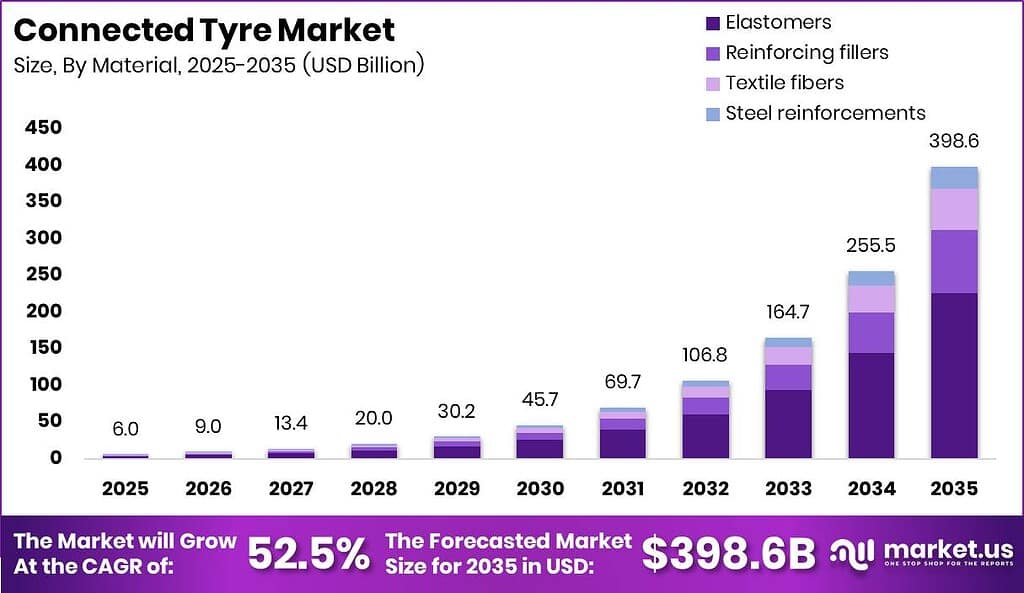
Global Connected Tyre Market size is expected to be worth around USD 398.6 Billion by 2035 from USD 6.0 Billion in 2025, growing at a CAGR of 52.5% during the forecast period 2026 to 2035. This expansion converts the tyre from a passive wear item into a continuous data node. Investors who treat connectivity as optional hardware risk missing the shift toward software attach revenue.
Therefore, the Connected Tyre Market covers sensor embedded tyres, pressure and temperature modules, and linked fleet software that feed vehicle control and maintenance systems. The structure spans tire type, technology stack, material chemistry, and vehicle class. Buyers now purchase a data stream alongside rubber, which changes pricing power for suppliers who control both compound and analytics.
Key Takeaways
- The market is valued at USD 6.0 Billion in 2025 and is projected to reach USD 398.6 Billion by 2035 at a CAGR of 52.5%.
- Pneumatic tires lead By Tire Type with a 62.3% share, while run flat tires stand as the fastest growing tire type.
- Run flat technology leads By Technology with a 33.3% share and ranks as the fastest growing technology line.
- Passenger vehicles lead By Vehicle with a 37.4% share.
- Asia Pacific leads the regional landscape with a 44.3% share valued at USD 2.67 Billion.
Continental upgraded its Generation 5 commercial portfolio in January 2025, adding embedded RFID technology and optional factory fitted sensors linked to ContiConnect. This factory fit path locks OEMs into a single monitoring stack early. As a result, aftermarket sensor vendors face higher switching costs once fleets standardize on embedded modules.
Continental reports that about 40% of sudden wheel breakdowns stem from underinflated tyres, a failure mode that connected pressure monitoring targets directly. This share keeps safety budgets focused on continuous inflation alerts rather than reactive roadside repair. Michelin Connected Fleet introduced Smart Predictive Tire technology in November 2025, matching temperature and wear logs with predictive warning algorithms, which tightens the link between sensor data and planned tyre changes.
However, Continental also reports that correct tyre pressure can extend tyre life by 7,500 km, which cuts replacement cycles for high mileage fleets. As per our research, a proposed connected TPMS held a 6.45% pressure reading variation while remaining stable in 2025 laboratory and road tests. This stability gives fleet managers confidence to delay physical inspections without raising safety risk.
Tire Type Analysis
Pneumatic tires dominate with 62.3% due to mature mass production scale.
In 2025, Pneumatic tires held a dominant market position in the By Tire Type segment of Connected Tyre Market, with a 62.3% share. OICA data show global vehicle production reached 96.4 million units in 2025, up from 92.7 million in 2024. This installed base keeps air filled carcasses as the default platform for sensor mounts. Suppliers who certify connected modules first on pneumatic SKUs will capture the widest OEM bill of materials coverage.
Run flat tires form the fastest growing tire type because they keep mobility after pressure loss and pair cleanly with continuous monitoring alerts. UNECE rules made TPMS fitment mandatory for all new vehicles in expanded commercial categories from July 2024, which raises the value of run flat constructions that buy time after a warning. Fleets that specify run flat plus connected sensors reduce roadside recovery calls and protect delivery schedules.
Airless tires remove the inflation chamber and shift failure modes toward structural wear that sensors must redefine. Official materials statistics cited in 2025 note nearly 3 billion new tires produced each year globally, so even a small airless share implies large absolute volume if OEMs accept new compounds. Early movers who design load and temperature algorithms for non pneumatic geometry will own the specification before standards freeze.
Low rolling resistance and eco tires cut energy loss at the contact patch and matter most on electrified platforms. OICA figures show China produced 16.626 million new energy vehicles in 2025, up 29% year on year. This volume rewards eco compounds that report pressure and temperature in real time so range models stay accurate. Tyre makers who bundle eco carcasses with live efficiency scores will win EV OEM nominations.
Technology Analysis
Run-flat technology dominates with 33.3% due to post-puncture mobility retention.
In 2025, Run flat technology held a dominant market position in the By Technology segment of Connected Tyre Market, with a 33.3% share. USTMA forecasts total U.S. tire shipments at 340.2 million units in 2025, which anchors a large base for run flat capable fitments in regulated markets. This share signals that mobility after deflation remains the primary technology budget for many fleets. Vendors who pair run flat sidewalls with live pressure alerts will defend premium pricing.
Chip embedded and smart tires place RF modules and processors inside the carcass to stream condition data to the vehicle. OICA reports Asia Pacific vehicle production rose to about 59.2 million units in 2025, more than 61% of global output. This manufacturing density favors chip embedded SKUs that leave the plant already paired to vehicle electronics. Suppliers who win Asian OEM lines secure scale that later funds software feature packs.
Self sealing tires close small punctures with internal sealant and reduce the number of sudden pressure collapse events. USTMA projects U.S. replacement passenger tire shipments at 224.2 million units in 2025, a large pool where sealant plus sensors can prove fewer emergency stops. This pairing lowers downtime claims for rental and shared fleets. Channel partners that market sealant tyres with app based leak alerts will lift attachment rates in retail replacement.
Self inflating and multichamber systems actively restore pressure, while all in one advanced concepts combine sensing, sealing, and control in a single architecture. Goodyear and TNO conducted an advanced demonstration in January 2025 merging SightLine with Automatic Emergency Braking to shorten stopping intervals on wet and low friction surfaces. Europe produced 17.2 million vehicles in 2025 per OICA, a base that rewards integrated chassis and tyre software. Investors should track joint brake and tyre demos as proof that data leaves the tyre and enters safety loops.
Material Analysis
Elastomers dominate with 56.7% due to core carcass compound demand.
In 2025, Elastomers held a dominant market position in the By Material segment of Connected Tyre Market, with a 56.7% share. FAO linked analysis notes that about 70% of natural rubber and 60% of synthetic rubber feed automotive tyre manufacturing within a global rubber market near 18 million tonnes. This concentration means elastomer cost swings move connected tyre margins faster than sensor chip costs. Buyers who secure dual source rubber contracts protect sensor rich SKU profitability.
Reinforcing fillers raise tread stiffness and heat management so embedded electronics face a more stable thermal envelope. USTMA expects U.S. original equipment passenger tire shipments at 42.3 million units in 2025, a volume where filler grade choices lock in early. Stable heat profiles reduce false temperature alarms from smart modules. Compounders who publish filler recipes optimized for sensor accuracy will win joint development seats with module makers.
Textile fibers form the fastest growing material line as lighter carcass packages support efficiency targets without dropping load ratings. OICA reports India produced 6.49 million vehicles with record domestic sales above 4.6 million passenger vehicles in fiscal 2025 to 2026. This growth pulls textile reinforced connected tyres into high volume Asian platforms. Fiber suppliers that certify RF friendly cord packages will ride that production ramp.
Steel reinforcements deliver bead and belt strength for heavier loads where sensor housings must survive high flex cycles. Japan produced 8.41 million vehicles in 2025 according to OICA, sustaining demand for steel belted constructions on export quality lines. This structural role keeps steel relevant even as light weighting spreads. Connected tyre programs that validate sensor mounts against steel belt harmonics will avoid field failures on premium fitments.
Vehicle Analysis
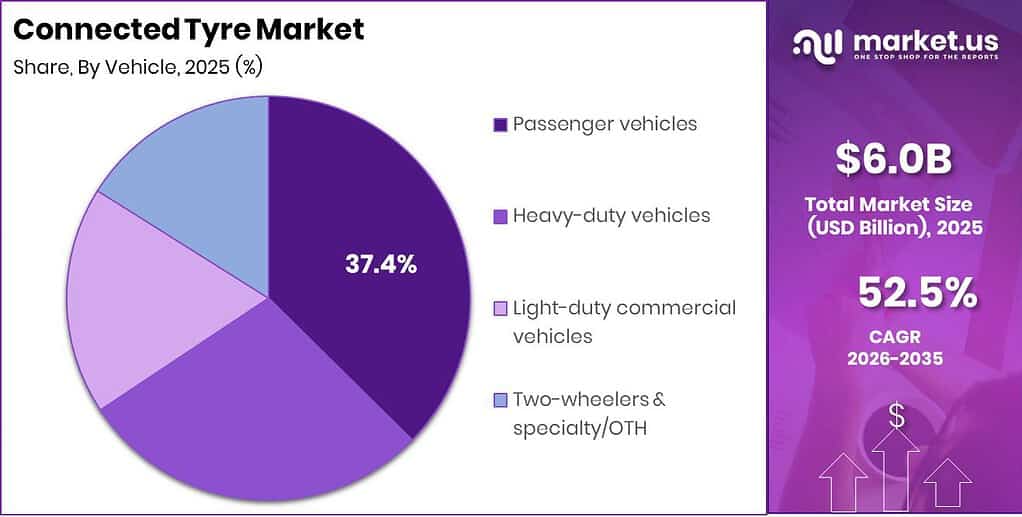
Passenger vehicles dominate with 37.4% due to high unit volume fitment.
In 2025, Passenger vehicles held a dominant market position in the By Vehicle segment of Connected Tyre Market, with a 37.4% share. OICA recorded global vehicle sales of 99.8 million units in 2025, up from 95.3 million in 2024, with passenger platforms carrying most regulated TPMS fitments. This volume makes passenger programs the fastest path to sensor cost decline. Suppliers who amortize chip designs on passenger lines can later price commercial kits more aggressively.
Heavy duty vehicles generate the highest tyre cost per mile and gain the most from predictive wear and pressure analytics. India recorded more than 1 million trucks and buses sold in fiscal 2025 to 2026 per OICA linked national figures. This freight intensity favors always on trailer and tractor monitoring. Pirelli announced in September 2025 that Aston Martin will adopt Pirelli Cyber Tyre technology in future production models to supply real time telemetry to vehicle control computers, proving premium passenger pull through that funds heavy duty software stacks.
Light duty commercial vehicles sit between passenger comfort targets and fleet uptime targets, so buyers want simple dashboards rather than complex engineering tools. The United States produced 10.24 million vehicles and sold 16.7 million in 2025 according to OICA. This gap between build and sale highlights import and fleet turnover that still needs aftermarket connected kits. Vendors who offer plug and play light commercial packages will win dealers who service mixed city fleets.
Two wheelers and specialty vehicles need compact sensors, low power draw, and low unit cost to clear price barriers in dense Asian cities. OICA shows Asia, Oceania and Middle East sales at 55.02 million units in 2025, above 55% of global sales. This regional weight keeps two wheeler and specialty programs strategic for long run unit growth. Entrants who design motorcycle grade connected valves early will avoid redesign costs later.
Key Market Segments
By Tire Type
- Pneumatic tires
- Run-flat tires
- Airless tires
- Low rolling-resistance / eco tires
By Technology
- Run-flat technology
- Chip-embedded / smart tires
- Self-sealing tires
- Self-inflating & multichamber
- All-in-one advanced concepts
By Material
- Elastomers
- Reinforcing fillers
- Textile fibers
- Steel reinforcements
By Vehicle
- Passenger vehicles
- Heavy-duty vehicles
- Light-duty commercial vehicles
- Two-wheelers & specialty/OTH
Regional Analysis
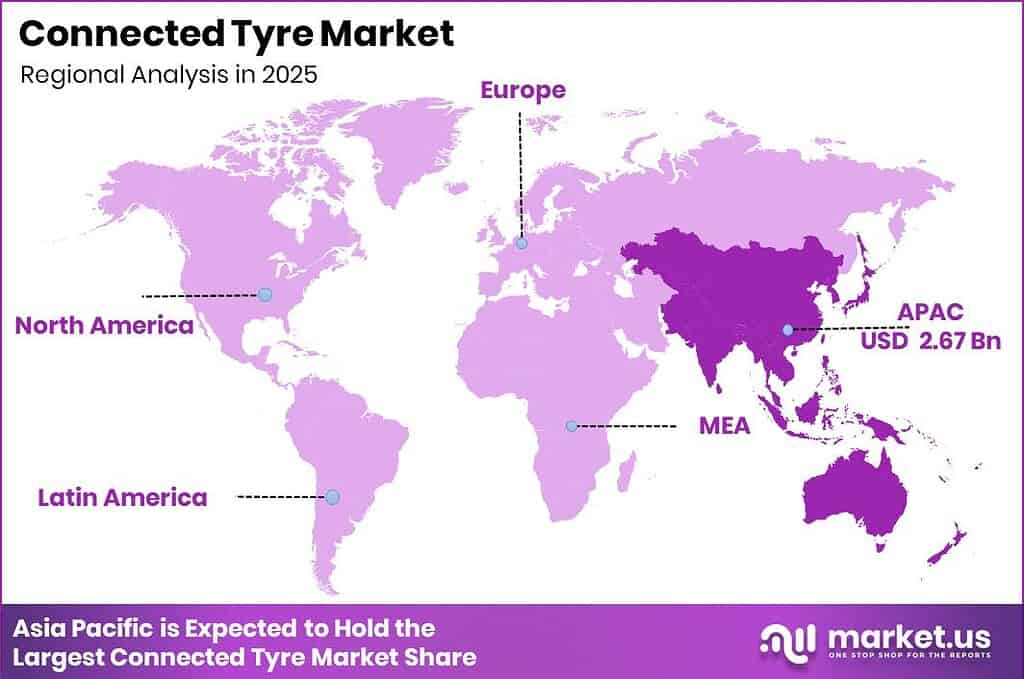
Asia Pacific Dominates the Connected Tyre Market with a Market Share of 44.3%, Valued at USD 2.67 Billion
Asia Pacific leads because the region hosts the densest vehicle production and the fastest OEM electronics integration. OICA shows the region produced about 59.2 million vehicles in 2025, more than 61% of world output, which pulls factory fitted sensors into high volume lines. This concentration shortens payback for local module plants. Investors who localize RF calibration and battery packing in Asia cut logistics lag into OEM ramps.
Continental showcased smart tire solutions for port operations at TOC Europe 2025 in May 2025, highlighting terminal efficiency and sustainable logistics across European freight nodes. This event signals Europe’s focus on industrial and port fleets rather than pure passenger volume. Pirelli’s Cyber Tyre platform won the V2X Innovation of the Year award at the AutoTech Breakthrough Awards 2025 in October 2025, which raises European software visibility with automakers. Suppliers who translate award grade V2X stacks into fleet contracts will monetize regulation driven fitment beyond the badge moment.
North America remains a high value fleet software market where downtime savings justify premium subscriptions even when unit growth trails Asia. Latin America and Middle East and Africa trail on embedded fitment but open retrofit kit demand as used vehicle parks age. This means channel partners who stock Bluetooth and app first kits can seed those regions before full OEM mandates arrive.
Key Regions and Countries
North America
- US
- Canada
Europe
- Germany
- France
- The UK
- Spain
- Italy
- Rest of Europe
Asia Pacific
- China
- Japan
- South Korea
- India
- Australia
- Rest of APAC
Latin America
- Brazil
- Mexico
- Rest of Latin America
Middle East and Africa
- GCC
- South Africa
- Rest of MEA
Market Dynamics
Market Opportunity Analysis - Airless fitments, two wheeler kits, and service subscriptions still leave open entry lanes
Airless tires remain underexploited inside the tire type mix even though pneumatic products still hold the volume lead. Most OEM tooling and service bays still assume an inflation chamber, so airless programs face slow homologation. This creates space for specialists who redesign sensor algorithms around structural strain rather than pressure alone. New entrants that fund airless pilot fleets with logistics operators can set the reference specification before majors fully retool.
Two wheelers and specialty vehicles sit at the bottom of the vehicle hierarchy despite Asia’s majority share of global sales. Compact, low cost connected valves are still sparse in dealer channels across dense city markets. This means investors who underwrite motorcycle grade sensor designs can lock distribution with regional assemblers before passenger focused rivals adapt. Early catalog presence matters more than brand scale in this price tier.
Textile fiber growth inside materials points to lighter connected carcasses that majors have not fully productized as branded efficiency SKUs. Many connected offers still market the sensor first and the cord package second. Suppliers who sell RF friendly textile belts as a named efficiency option can win EV platforms that already chase range. This creates a materials led entry path that avoids head on sensor chip competition.
By contrast, tire as a service style subscriptions remain thinly executed even where hardware fitment is rising. Fleets still buy monitoring as a feature rather than a monthly data tier in most regions outside lead North American and European pilots. Software first firms that bill per vehicle month can enter without owning rubber plants. That model favors capital light attackers who partner for carcass supply and own the alert workflow.
Technology and Innovation Landscape - Sensor accuracy races and fuel metrics redefine product proof points
According to a 2025 academic evaluation on Conscientia Beam archives, an IoT smart tyre pressure monitoring prototype using an ESP32 C3 and ESP NOW achieved 95.91% accuracy in real time tyre condition detection. This score shows low cost connected designs can approach commercial grade detection. Component vendors who publish open accuracy benchmarks will shorten OEM validation cycles and win design slots on budget platforms.
As reported by the same 2025 evaluation, the commercial comparator designated Level A achieved 99.87% accuracy, versus the proposed connected TPMS result. This gap sets the performance bar that new modules must clear for premium vehicle programs. Investors should treat sub one point shortfalls as acceptable only when unit cost falls enough to open mass market fitment.
Data from the 2025 smart TPMS test shows the other commercial comparator, Level B, achieved 95.35% accuracy. The proposed connected TPMS also showed 10.00% temperature sensitivity during laboratory and real world performance testing. This combination tells buyers that accuracy alone is incomplete without thermal stability claims. Product teams that certify both metrics together will reduce warranty disputes tied to heat soak false alerts.
Based on Continental’s 2026 smart tyre technology report, maintaining optimal tyre pressure delivers an average fuel economy improvement of 0.6% and a maximum potential fuel saving of 3%. These figures convert sensor alerts into finance ready efficiency claims for fleet controllers. Manufacturers who print fuel savings beside pressure alerts in cabin software will defend higher subscription fees against pure safety messaging rivals.
Drivers
UNECE Regulation No. 141 extended mandatory tire pressure monitoring from M1 passenger vehicles to N1 light commercial platforms, with a compliance deadline of July 2024 and stricter post sale inspection audits carried into 2026. This rule forces tier 1 suppliers and OEMs to move from optional aftermarket sensors to embedded, connectivity enabled tire modules at assembly. Over 60% of new commercial vehicle registrations across the EU 27 bloc now carry OE fitted connected pressure and temperature sensors, up from about 38% two years earlier.
Consequently, ETRMA shipment figures show tier 1 tire makers raised sensor integrated SKU output by roughly 22% year on year to meet type approval timelines. Compliance is compressing per unit sensor costs by an estimated 12% to 15% as sourcing scales, while plant retrofit lead times extend by 4 to 6 weeks. This converts a once optional accessory into a mandatory bill of materials line and expands recurring data service attach rates for suppliers.
| Driver | (~) % Impact on CAGR Forecast | Geographic Relevance | Impact Timeline |
|---|---|---|---|
| Regulatory TPMS Mandate Enforcement (UNECE R141) | +8.5% | Europe, expanding to Asia Pacific | Short term (2 years or less) |
| Fleet Telematics-Driven Predictive Maintenance | +7.0% | North America, Europe | Short term (2 years or less) |
| EV-Specific Tire Performance Monitoring Demand | +6.0% | Global | Short term (2 years or less) |
| OEM RFID-Enabled Automated Tire-Vehicle Pairing | +5.5% | Global OEM manufacturing hubs | Short term (2 years or less) |
| Insurance Telematics Usage-Based Premium Programs | +4.0% | North America, Europe | Medium term (2 to 4 years) |
| 5G/V2X Connectivity Infrastructure Rollout | +3.5% | Asia Pacific, Global | Medium term (2 to 4 years) |
Restraints
High bill of materials cost for RF transceivers, micro batteries, and pressure and temperature arrays still adds an estimated 18% to 24% to base manufacturing cost per tire. This premium freezes adoption in price sensitive replacement segments across South Asia and Southeast Asia, where household budgets limit average selling prices. Financing costs for OEM tooling upgrades also rose with benchmark rate hikes of 75 to 100 basis points across several emerging market central banks over two years.
As a result, planned sensor line capital expenditure slipped by two to three fiscal quarters at multiple regional tire hubs. Gross margins on connected tire SKUs in these geographies compress by roughly 5 to 7 percentage points versus standard lines. Manufacturers must either subsidize sensors near breakeven or confine connected offers to premium fleet and export tiers, which stalls broader retail penetration in the near term.
| Restraint | (~) % Impact on CAGR Forecast | Geographic Relevance | Impact Timeline |
|---|---|---|---|
| High Sensor Bill-of-Materials Cost | -6.0% | South Asia, Southeast Asia | Short term (2 years or less) |
| Lack of Global Sensor Protocol Standardization | -4.5% | Global | Short term (2 years or less) |
| Elevated Financing Rates Delaying Capex | -3.5% | Emerging markets, Europe | Short term (2 years or less) |
| Micro-Battery and Power Source Limitations | -3.0% | Global | Short term (2 years or less) |
| Semiconductor Module Supply Constraints | -2.5% | Asia Pacific (Taiwan, China) | Short term (2 years or less) |
Challenges
Legacy tire and wheel assemblies predate standard sensor brackets and unified radio protocols, so retrofit kits rarely pair cleanly on the first try. Direct and indirect TPMS designs still split across 315 MHz and 433 MHz bands under SAE guidance. GSMA linked tracking shows fewer than 35% of aftermarket retrofit kits achieve seamless cross platform pairing with fleet telematics on first installation, adding an estimated 2 to 3 extra service bay visits and 48 to 72 hours of turnaround.
This friction deepens with a shortage of roughly 15,000 to 20,000 trained RF and embedded calibration technicians relative to retrofit demand through 2030. Continuous spend on technician certification and modular adapter R&D replaces any hope of a one time fix. This creates a durable training and adapter revenue stream for service networks that certify multi band kits faster than rivals.
| Challenge | (~) % CAGR Friction Drag | Geographic Relevance | Mitigation Horizon |
|---|---|---|---|
| Aftermarket Retrofit Compatibility Gaps | -2.2% | Global | Long term (4 years or more) |
| Tire Data Cybersecurity Vulnerabilities | -2.0% | Global | Medium term (2 to 4 years) |
| Embedded IoT/RF Engineering Talent Shortage | -1.8% | North America, Europe | Medium term (2 to 4 years) |
| Sensor-Compound Raw Material Volatility | -1.7% | Southeast Asia, Global | Medium term (2 to 4 years) |
| Data Ownership and Privacy Disputes | -1.5% | Europe | Medium term (2 to 4 years) |
| Sparse After-Sales Calibration Networks | -1.3% | Emerging markets | Long term (4 years or more) |
Opportunities
Tire as a service subscription models still sit outside most baseline hardware forecasts because fleets and majors bundle connectivity as a one time feature rather than a billed data product. Shifting sensor revenue from equipment into services could move blended gross margins from an estimated 18% to 22% on hardware only sales toward 35% to 40% on recurring data contracts. Early North American and European fleet pilots show willingness to pay a monthly fee equal to 3% to 5% of average tire replacement cost.
This signals a scalable path from capital cost selling to recurring revenue without new TPMS hardware laws. Capturing it requires go to market contracts built around data service tiers rather than component invoices. Early movers who rewrite fleet agreements around predictive replacement alerts will lock multi year cash flows before peers finish reclassifying sensor lines in investor reports as of the 2026 baseline year.
| Opportunity | (~) % Potential CAGR Upside | Geographic Relevance | Execution Window |
|---|---|---|---|
| Tire-as-a-Service Subscription Monetization | +3.5% | North America, Europe | Medium term (2 to 4 years) |
| Autonomous Vehicle Safety-Stack Integration | +2.8% | United States, China, Global | Long term (4 years or more) |
| Two/Three-Wheeler Connected Tire Expansion | +2.5% | Asia Pacific | Long term (4 years or more) |
| Emerging-Market Retrofit Kit Roll-Up | +2.2% | Latin America, Africa, India | Long term (4 years or more) |
| Sensor Startup M&A Consolidation | +2.0% | Global | Medium term (2 to 4 years) |
| Sustainability Data Monetization | +1.8% | Europe | Medium term (2 to 4 years) |
Key Company Insights
Michelin Group is pushing fleet grade predictive software through Michelin Connected Fleet, which officially rolled out Smart Predictive Tire for Class 7 and 8 heavy duty vehicles in March 2026. This move ties temperature and wear analytics to the highest downtime cost vehicle classes. The approach creates an advantage in subscription attach on long haul fleets that already budget for tyre programs as operating expense.
Bridgestone Corporation strengthens fleet retention through Bridgestone Fleet Care, where combined in yard and real time TPMS monitoring with digital inspections can cut tyre related fleet downtime by up to 40%. This downtime claim gives procurement teams a clear productivity metric when comparing vendors. The risk is that rivals copy the inspection plus sensor bundle and compress the service premium unless Bridgestone keeps algorithm quality ahead.
Key Players
- Michelin Group
- Bridgestone Corporation
- Goodyear Tire & Rubber Company
- Continental AG
- Pirelli Tyre S.p.A
- Yokohama Rubber Company
- Hankook Tire & Technology Co., Ltd.
- Sumitomo Rubber Industries
- Toyo Tire Corporation
- Kumho Tire
- Sailun Group
- Zhongce Rubber
- Giti Tire
- Apollo Tyres Ltd.
- MRF
Recent Developments
- February 2026: Continental launched the Conti Hybrid HT 5 trailer tire complete with factory pre installed smart sensors.
- April 2026: Pirelli partnered with Swedish computer vision firm Univrses, taking a 30% stake to enhance Cyber Tyre data with AI based environmental and road perception systems.
- January 2024: Goodyear and ZF integrated Goodyear SightLine tire intelligence with the ZF cubiX motion control system.
- January 2024: Goodyear and TDK partnered to combine TDK sensor expertise with Goodyear tire development for next generation tire intelligence technologies.
- January 2024: Goodyear and TNO demonstrated SightLine intelligence integrated into Advanced Anti lock Braking Systems to improve stopping distance.
- February 2024: Continental launched the ContiConnect Lite app, expanding smartphone based tire pressure and temperature tracking to smaller fleets.
- March 2024: Continental expanded ContiConnect Lite for Off The Road applications, linking Bluetooth sensors in agricultural and earthmoving tires directly to phones.
- September 2024: Pirelli and Bosch signed a joint agreement to co develop intelligent tire software and vehicle control functions using embedded tire sensors.
Geopolitical Impact Analysis
Figures from UNCTAD show maritime trade growth is expected to slow to just 0.5% in 2025 after 2.2% growth in 2024, while shipping still carries over 80% of world trade. Red Sea disruption left Suez Canal tonnage 70% below 2023 levels by May 2025, stretching routes that move natural rubber, steel cord, and finished tyres. This lengthens lead times for connected tyre plants that import RF modules and micro batteries. Procurement teams must dual source elastomer and semiconductor paths or accept higher safety stock costs.
However, UNCTAD also reports the Shanghai Containerized Freight Index averaged 2,496 points in 2024, up 149% from 2023, with July spot rates reaching USD 3,600 per container. These rate spikes raise landed cost for sensor laden tyre shipments between Asia Pacific factories and European or North American OEMs. As a result, regional finishing of connected modules near vehicle plants becomes a hedge against freight volatility and tariff uncertainty on foreign built equipment.
Report Scope
| Report Features | Description |
|---|---|
| Market Value (2025) | USD 6.0 Billion |
| Forecast Revenue (2035) | USD 398.6 Billion |
| CAGR (2026-2035) | 52.5% |
| Base Year for Estimation | 2025 |
| Historic Period | 2020-2024 |
| Forecast Period | 2026-2035 |
| Report Coverage | Revenue Forecast, Market Dynamics, Market Opportunity Analysis, Technology and Innovation Landscape, Competitive Landscape, Recent Developments |
| Segments Covered | By Tire Type (Pneumatic tires, Run-flat tires, Airless tires, Low rolling-resistance / eco tires), By Technology (Run-flat technology, Chip-embedded / smart tires, Self-sealing tires, Self-inflating & multichamber, All-in-one advanced concepts), By Material (Elastomers, Reinforcing fillers, Textile fibers, Steel reinforcements), By Vehicle (Passenger vehicles, Heavy-duty vehicles, Light-duty commercial vehicles, Two-wheelers & specialty/OTH) |
| Regional Analysis | North America (US and Canada), Europe (Germany, France, The UK, Spain, Italy, and Rest of Europe), Asia Pacific (China, Japan, South Korea, India, Australia, and Rest of APAC), Latin America (Brazil, Mexico, and Rest of Latin America), Middle East and Africa (GCC, South Africa, and Rest of MEA) |
| Competitive Landscape | Michelin Group, Bridgestone Corporation, Goodyear Tire & Rubber Company, Continental AG, Pirelli Tyre S.p.A, Yokohama Rubber Company, Hankook Tire & Technology Co., Ltd., Sumitomo Rubber Industries, Toyo Tire Corporation, Kumho Tire, Sailun Group, Zhongce Rubber, Giti Tire, Apollo Tyres Ltd., MRF |
| Customization Scope | Customization for segments, region / country-level will be provided. Additional customization can be done based on requirements. |
| Purchase Options | We have three licenses to opt for: Single User License | Multi-User License (Up to 5 Users) | Corporate Use License (Unlimited User and Printable PDF) |





































