Report Overview
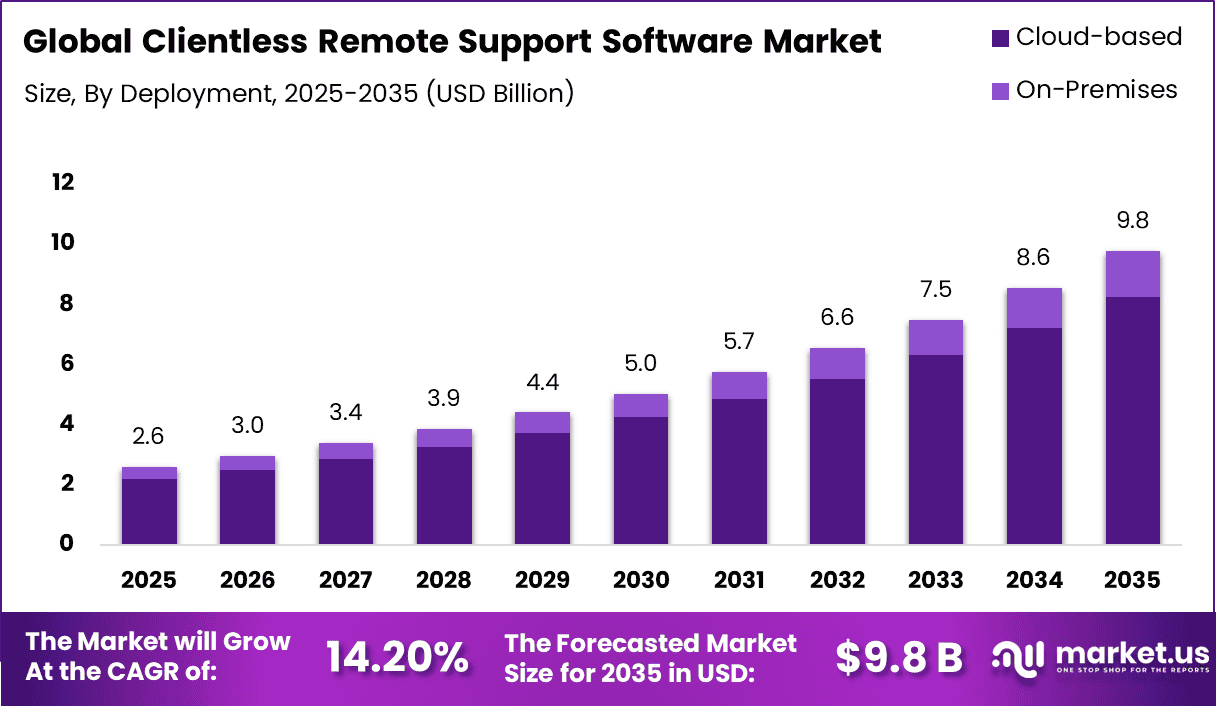
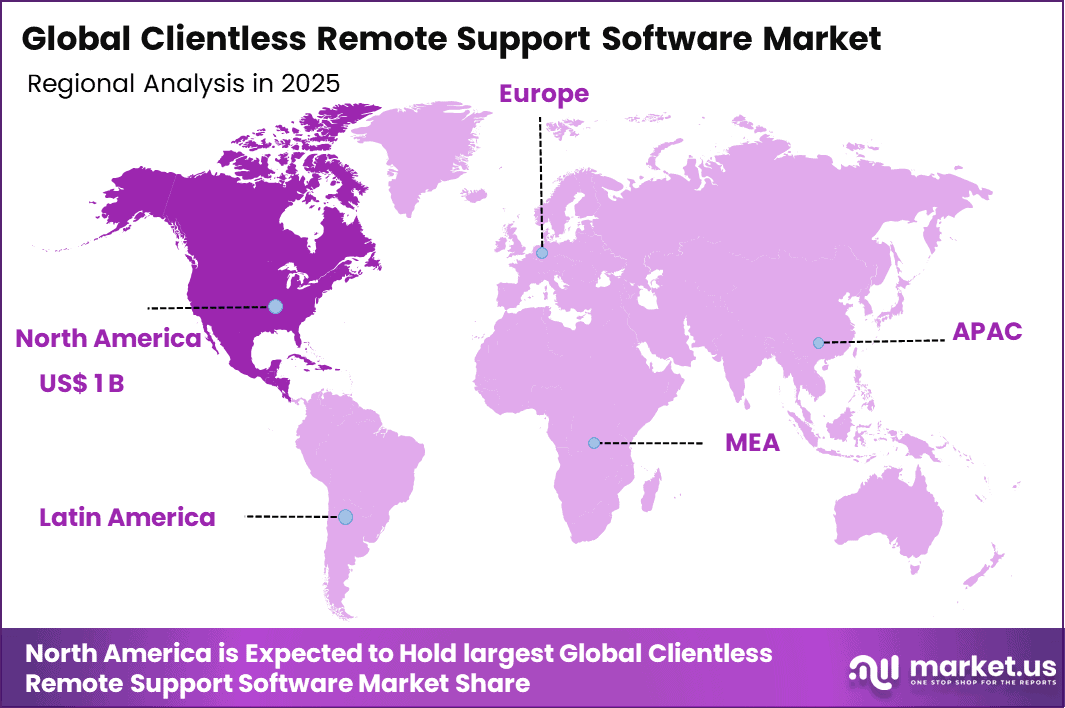
The Global Clientless Remote Support Software Market generated USD 2.6 billion in 2025 and is predicted to register growth from USD 3 billion in 2026 to about USD 9.8 billion by 2035, recording a CAGR of 14.20% throughout the forecast span. In 2025, North America held a dominant market position, capturing more than a 38.9% share, holding USD 1 Billion revenue.
Top Market Takeaways
- Cloud-based deployment dominates at 84.3%, offering instant access without client installations, scalable infrastructure, and seamless integration across firewalls for global support teams.
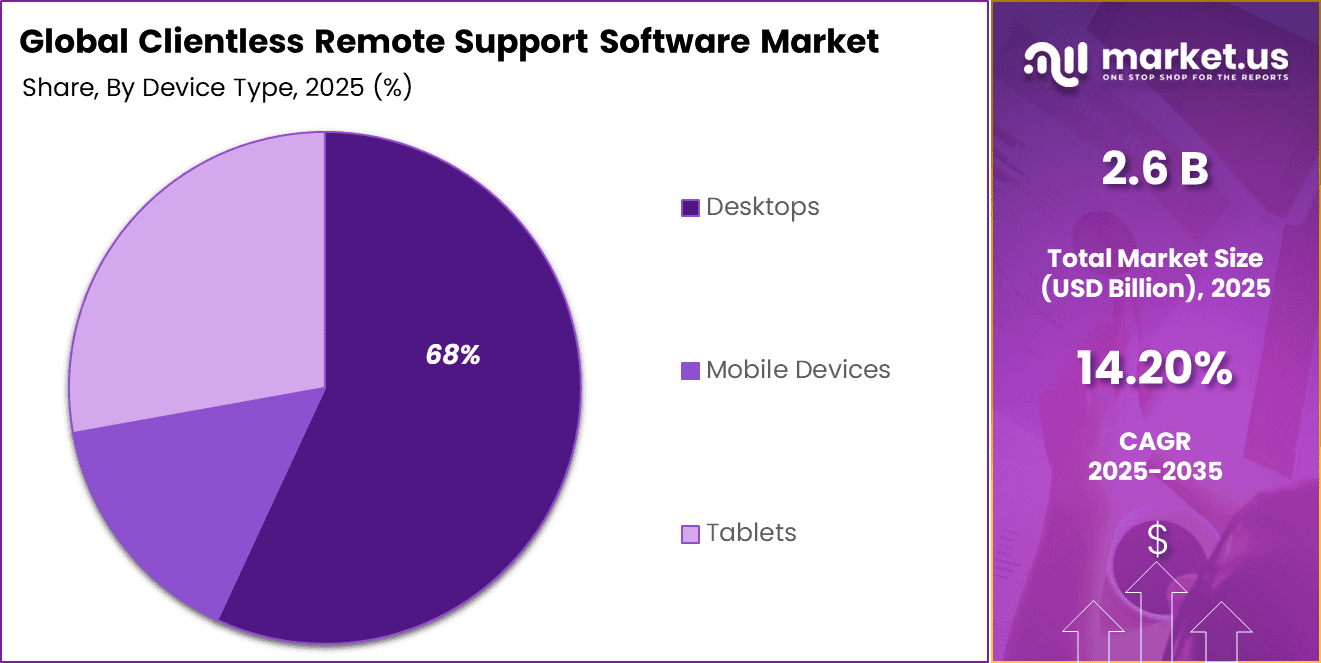
- Desktops claim 67.5% by device type, supporting enterprise troubleshooting, software diagnostics, and system maintenance through lightweight HTML5 connections.
- IT & Telecom end-use holds 25.8%, enabling network monitoring, device configuration, and customer service resolution without physical presence.
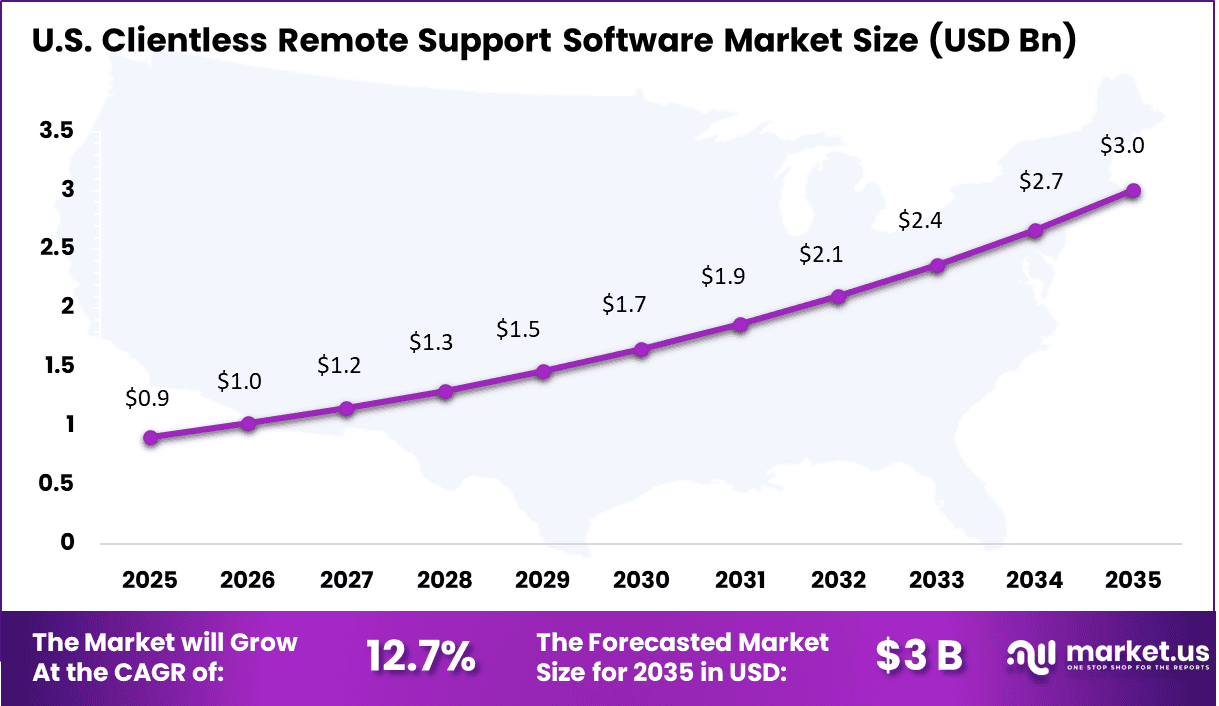
- North America drives 38.9% global share, with U.S. market at USD 0.91 billion and 12.7% CAGR, fueled by cybersecurity priorities and digital transformation acceleration.
Clientless remote support software is designed to provide technical assistance without requiring users to install any application on their device. It allows support teams to access systems through a web browser or secure session link, making the process faster and more convenient.
This approach is becoming important as organizations handle support requests across different devices and locations. It reduces setup time and removes compatibility issues, which helps both users and support teams resolve problems quickly.
One of the main driving factors is the growing need for quick and hassle free technical support in remote and distributed work environments. Organizations are supporting employees, customers, and partners across different locations, and clientless solutions simplify access without installation barriers. Security concerns are also pushing adoption, as these tools can provide controlled and temporary access without leaving permanent software on the device.
In addition, businesses are focusing on improving user experience, and reducing the steps required to get support plays a key role in that. The increasing use of web based applications is further supporting the shift toward browser driven support solutions.
Demand for clientless remote support software is rising as companies look for flexible and efficient support systems. There is a strong preference for solutions that can provide instant access, maintain security, and work across multiple devices and operating systems.
Organizations are also seeking tools that can integrate with helpdesk platforms and provide features such as session recording, user authentication, and real time communication. The demand is particularly strong in industries that handle large volumes of support requests, where speed and ease of use are critical. As remote work and digital services continue to expand, the need for simple and secure remote support solutions is expected to grow steadily.
Drivers Impact Analysis
| Key Driver | Impact on CAGR Forecast (~%) | Geographic Relevance | Impact Timeline | Additional Insight |
|---|---|---|---|---|
| Rising demand for remote IT support and troubleshooting | +3.9% | North America, Europe, Asia Pacific | Short to medium term | Remote work drives support demand |
| Increasing adoption of cloud-based support solutions | +3.5% | Global | Medium term | Cloud enables flexible access |
| Growth in distributed workforce and BYOD trends | +3.2% | Global | Medium to long term | More devices require remote support |
| Need for quick and efficient customer support services | +2.8% | Global | Short to medium term | Faster issue resolution improves service |
| Expansion of IT and telecom sector | +2.5% | Global | Medium to long term | Industry growth supports adoption |
Restraints Impact Analysis
| Key Restraint | Impact on CAGR Forecast (~%) | Geographic Relevance | Impact Timeline | Additional Insight |
|---|---|---|---|---|
| Security concerns related to remote access | -3.2% | Global | Medium term | Access risks limit adoption |
| Dependence on stable internet connectivity | -2.7% | Developing regions | Short to medium term | Connectivity issues affect performance |
| Compatibility issues across devices and systems | -2.3% | Global | Medium term | Integration challenges persist |
| Limited awareness among small businesses | -1.9% | Emerging markets | Medium term | Smaller firms adopt slowly |
| Data privacy and compliance challenges | -1.6% | North America, Europe | Medium to long term | Regulations affect deployment |
By Deployment Analysis
The cloud-based segment accounted for 84.3% of the market share, reflecting its strong role in enabling remote support without the need for complex installations. This dominance is supported by the growing demand for flexible and scalable solutions that allow technicians to access and resolve issues from any location. Cloud deployment simplifies setup and reduces dependency on on-premise infrastructure, making it a preferred choice for organizations seeking efficient support systems.
Another factor driving this segment is the increasing shift toward remote work and distributed IT environments. Cloud-based platforms provide real-time access, faster updates, and centralized management, which improve response times and service quality. Their ability to support multiple users and devices simultaneously further strengthens their adoption across industries.
By Device Type Analysis
The desktops segment held 68% share, driven by their widespread use in corporate and enterprise environments. Desktops remain a primary device for business operations, making them a key focus for remote support solutions. Clientless support software enables technicians to troubleshoot and resolve issues quickly without requiring additional installations on these systems.
In addition, desktops are often used for critical applications that require stable performance and continuous monitoring. This increases the need for efficient support tools that can handle maintenance and issue resolution remotely. The ability to provide seamless support without interrupting user activity contributes to the continued importance of this segment.
By End-Use Analysis
The IT and telecom segment captured 25.8% of the market, driven by the need to manage large-scale networks and provide continuous technical support. Organizations in this sector rely on clientless remote support software to handle system maintenance, troubleshoot issues, and ensure smooth operations across distributed environments. These tools help improve efficiency and reduce downtime.
Furthermore, the growing complexity of IT infrastructure and increasing demand for uninterrupted services have encouraged adoption in this segment. Clientless solutions allow support teams to respond quickly and manage multiple systems efficiently. This capability is essential for maintaining service quality and meeting the operational demands of IT and telecom environments.
Investor Type Impact Analysis
| Investor Type | Growth Sensitivity | Risk Exposure | Geographic Focus | Investment Outlook |
|---|---|---|---|---|
| Venture capital firms | High | High | US, Europe | Investing in remote support SaaS platforms |
| Private equity firms | Moderate to high | Moderate | North America and Europe | Scaling IT support solution providers |
| Corporate investors | High | Moderate | Global | Strategic investments in enterprise IT tools |
| Institutional investors | Moderate | Low to moderate | Developed markets | Prefer stable software and IT service firms |
| Government and public funding bodies | Moderate | Low | Global | Supporting digital infrastructure and remote services |
Technology Enablement Analysis
| Technology | Impact on CAGR Forecast (~%) | Geographic Relevance | Impact Timeline | Additional Insight |
|---|---|---|---|---|
| AI-powered remote diagnostics and automation | +4.1% | US, Europe | Medium to long term | Improves issue resolution speed |
| Cloud-based remote support platforms | +3.7% | Global | Short to medium term | Enables scalable deployment |
| Integration with endpoint management systems | +3.2% | Global | Medium term | Enhances device control |
| Browser-based clientless access technologies | +2.9% | Global | Medium term | Eliminates need for installations |
| Secure access and encryption technologies | +2.6% | Global | Medium to long term | Strengthens data protection |
Key Challenges
- Security concerns as remote access can expose systems to risks.
- Dependence on stable internet connection for smooth remote sessions.
- Limited functionality compared to full remote desktop software.
- Compatibility issues with different devices and operating systems.
- User trust issues when allowing remote access to devices.
- Integration challenges with existing IT support systems.
- Performance issues like lag or disconnection during sessions.
- Lack of advanced features for complex troubleshooting tasks.
- Data privacy concerns during remote support interactions.
- Need for user consent and permissions before starting sessions.
Emerging Trends
The clientless remote support software market is evolving toward faster and more secure access solutions that remove the need for installing dedicated applications on user devices. One key emerging trend is the growing use of browser based support sessions, where technicians can connect instantly through secure web links, reducing setup time and improving user convenience.
Another important trend is the integration of advanced security features such as multi factor authentication, session recording, and role based access controls to ensure safe remote interactions. There is also increasing adoption of AI assisted troubleshooting tools that help identify common issues and guide technicians with suggested fixes in real time.
In addition, support platforms are becoming more integrated with helpdesk and IT service management systems, allowing seamless ticket handling and faster resolution. The shift toward supporting a wide range of devices, including mobile and IoT endpoints, is further expanding the scope of these solutions.
Growth Factors
The growth of this market is driven by the rising demand for efficient remote IT support across distributed work environments. As organizations adopt remote and hybrid work models, there is a strong need for tools that allow quick issue resolution without requiring complex installations. The increasing reliance on digital systems for daily operations is also pushing businesses to minimize downtime and ensure continuous support availability.
Another major factor is the need to reduce operational costs associated with on site support visits, making remote solutions more attractive. Organizations are also focusing on improving user experience by offering instant and hassle free support, which is encouraging adoption of clientless platforms. Furthermore, growing concerns around data security and compliance are driving demand for solutions that provide secure, controlled, and auditable remote access, supporting long term growth in this market.
Key Market Segments
By Deployment
- Cloud-based
- On-Premises
By Device Type
- Desktops
- Mobile Devices
- Tablets
By End-Use
- Education
- Healthcare
- IT & Telecom
- Retail
- Government
- BFSI
- Customer Care Centres
- Defense
- Others
Regional Analysis
North America accounted for 38.9% of the Clientless Remote Support Software market, supported by strong adoption of digital support solutions across enterprises and service providers. The region benefits from a mature IT infrastructure and high demand for remote troubleshooting, where organizations prefer solutions that do not require software installation on end-user devices.
This approach improves ease of access, reduces setup time, and enhances user experience. Increasing reliance on remote work and distributed teams is further driving the need for secure and efficient support tools. In addition, growing focus on cybersecurity and data protection is encouraging the use of browser-based remote support platforms that offer controlled and secure access.
The U.S. market reached USD 0.91 Billion and is projected to grow at a CAGR of 12.7%, driven by rising demand for flexible IT support solutions across industries. Businesses are adopting clientless platforms to simplify remote assistance for employees and customers without complex configurations.
The expansion of cloud-based services and increasing digital transformation initiatives are also supporting adoption. IT teams are focusing on improving response times and reducing downtime, which is strengthening the demand for instant remote access solutions. This trend is expected to support steady growth in the US market over the coming years.
Key Regions and Countries
- North America
- US
- Canada
- Europe
- Germany
- France
- The UK
- Spain
- Italy
- Russia
- Netherlands
- Rest of Europe
- Asia Pacific
- China
- Japan
- South Korea
- India
- Australia
- Singapore
- Thailand
- Vietnam
- Rest of APAC
- Latin America
- Brazil
- Mexico
- Rest of Latin America
- Middle East & Africa
- South Africa
- Saudi Arabia
- UAE
- Rest of MEA
Competitive Analysis
The competitive landscape of the Clientless Remote Support Software Market is driven by a mix of established IT service providers and remote access solution companies. Companies such as Cisco WebEx LLC, LogMeIn Inc., TeamViewer GmbH, Citrix Systems Inc., and VMware Inc. focus on delivering secure and scalable remote support platforms for enterprises.
These players emphasize ease of access through web-based connections, strong security features, and integration with enterprise IT systems. Their solutions are widely used by large organizations to manage remote troubleshooting and support without requiring software installation on client devices.
At the same time, companies such as Bomgar Corporation, RSupport Inc., RealVNC Limited, Splashtop Inc., Techinline, and NTRglobal Group Ltd. focus on user-friendly and cost-effective solutions for small and medium-sized businesses.
Firms like F5 Networks, Inc., Juniper Networks, and Barracuda Networks integrate remote support capabilities with broader network and security solutions. Competition in this market is driven by ease of deployment, strong data protection, and the ability to provide fast and reliable remote access across different devices and operating systems.
Top Key Players in the Market
- Cisco WebEx LLC
- LogMeIn Inc.
- Bomgar Corporation
- RSupport Inc.
- TeamViewer GmbH
- Citrix Systems Inc.
- F5 Networks, Inc.
- NTRglobal Group Ltd.
- VMware Inc.
- RealVNC Limited
- Splashtop Inc.
- Techinline
- Juniper Networks
- Barracuda Networks
- Others
Future Outlook
The future outlook for the Clientless Remote Support Software Market looks positive as businesses continue to shift toward remote work and digital support services. The market is expected to grow with increasing demand for quick and secure remote access solutions that do not require software installation on user devices. IT teams are anticipated to prefer these tools for faster troubleshooting and improved user experience. In the coming years, advancements in cloud technology, security features, and integration with other IT systems are expected to make clientless remote support more efficient and widely adopted across industries.
Recent Developments
- March, 2026 – Cisco WebEx Assist adds AI session summaries auto-filling ServiceNow tickets. Zero-trust browser isolation blocks malware while 4K screen sharing handles CAD files. Enterprise secure remote standard.
- February, 2026 – LogMeIn Rescue gains one-click macOS diagnostics scanning 50+ system metrics. AI chat translation supports global helpdesks while crash report analysis prevents repeats. Multi-platform leader.
Report Scope
| Report Features | Description |
|---|---|
| Market Value (2025) | USD 2.6 Billion |
| Forecast Revenue (2035) | USD 9.8 Billion |
| CAGR(2025-2035) | 14.20% |
| Base Year for Estimation | 2024 |
| Historic Period | 2020-2024 |
| Forecast Period | 2025-2035 |
| Report Coverage | Revenue forecast, AI impact on Market trends, Share Insights, Company ranking, competitive landscape, Recent Developments, Market Dynamics and Emerging Trends |
| Segments Covered | By Deployment (Cloud-based, On-Premises), By Device Type (Desktops, Mobile Devices, Tablets), By End-Use (Education, Healthcare, IT & Telecom, Retail, Government, BFSI, Customer Care Centres, Defense, Others) |
| Regional Analysis | North America – US, Canada; Europe – Germany, France, The UK, Spain, Italy, Russia, Netherlands, Rest of Europe; Asia Pacific – China, Japan, South Korea, India, New Zealand, Singapore, Thailand, Vietnam, Rest of Latin America; Latin America – Brazil, Mexico, Rest of Latin America; Middle East & Africa – South Africa, Saudi Arabia, UAE, Rest of MEA |
| Competitive Landscape | Cisco WebEx LLC, LogMeIn Inc., Bomgar Corporation, RSupport Inc., TeamViewer GmbH, Citrix Systems Inc., F5 Networks, Inc., NTRglobal Group Ltd., VMware Inc., RealVNC Limited, Splashtop Inc., Techinline, Juniper Networks, Barracuda Networks, Others |
| Customization Scope | Customization for segments, region/country-level will be provided. Moreover, additional customization can be done based on the requirements. |
| Purchase Options | We have three license to opt for: Single User License, Multi-User License (Up to 5 Users), Corporate Use License (Unlimited User and Printable PDF) |