


Global Calcium Nitrate Market Size, Share, And Business Benefits By Product Type (Liquid, Melt, Crystals), By Process (Limestone with Nitric Acid, Phosphate Rock with Nitric Acid, Ammonium Nitrate with Calcium Hydroxide), By Application (Fertilizers, Waste Water Treatment, Concrete, Explosives, Refrigerants), By Region and Companies - Industry Segment Outlook, Market Assessment, Competition Scenario, Trends, and Forecast 2025-2034
- Published date: November 2025
- Report ID: 166535
- Number of Pages: 253
- Format:
-
keyboard_arrow_up
Quick Navigation
Report Overview
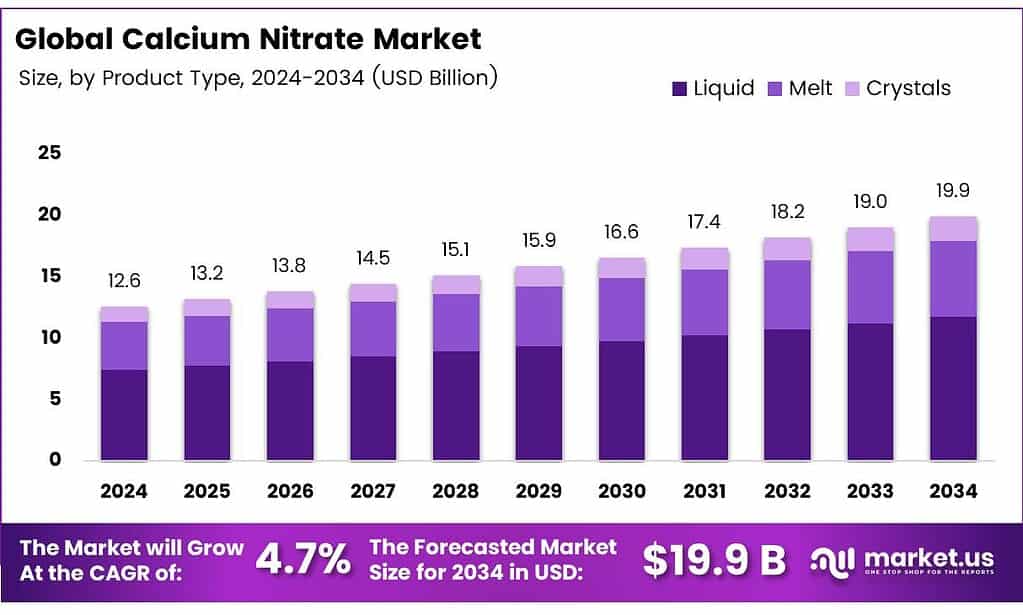
The Global Calcium Nitrate Market size is expected to be worth around USD 19.9 billion by 2034, from USD 12.6 billion in 2024, growing at a CAGR of 4.7% during the forecast period from 2025 to 2034.
Calcium nitrate, with the molecular formula Ca(NO₃)₂, is a highly soluble inorganic salt widely used in construction, agriculture, and industrial processes. It serves as an effective concrete set accelerator, provides essential calcium and nitrogen nutrients to plants, and aids water treatment systems. Commercially, it is typically supplied as the tetrahydrate (Ca(NO₃)₂·4H₂O), appearing as a white crystalline solid that dissolves rapidly in water, releasing calcium and nitrate ions for immediate availability.
Calcium nitrate is highly hygroscopic, caking when humidity exceeds 40% for 24–48 hours, and decomposes above 104 °F (40 °C), releasing toxic NOx gases. For safe storage, keep it below 77 °F (25 °C) and 30% relative humidity in airtight, moisture-resistant containers, polyethene-lined bags, or HDPE drums to prevent up to 50% loss of effectiveness and 25% higher degradation in uncontrolled conditions.
- Calcium nitrate, a strong oxidiser, must be kept away from combustibles like sugar, wood, oil, and sawdust. Never use sprinkler systems—water worsens reactions; use only Class D extinguishers. Store and handle with stainless steel, PE, or PP equipment (carbon steel corrodes quickly). Workers must wear nitrile/PVC gloves, eye/face protection, and N95/P100 respirators if dust >5 mg/m³ (OSHA limits: 15 mg/m³ total, 5 mg/m³ respirable). No eating, drinking, or smoking; wash thoroughly after handling.
Although calcium nitrate has relatively low acute toxicity (oral LD50 in rats 300–2000 mg/kg), inhalation and prolonged skin contact should be avoided, and good ventilation is required in enclosed spaces. Environmentally, it is not highly toxic and breaks down into naturally occurring calcium and nitrate ions, but its oxidising nature can intensify fires, and any spills must be diluted, contained, and disposed of in accordance with local regulations. Robust emergency response plans and proper ventilation to control potential nitrogen oxide fumes remain critical for safe use.
Key Takeaways
- The Global Calcium Nitrate Market is valued at USD 12.6 billion in 2024 and is projected to reach USD 19.9 billion by 2034, at a CAGR of 4.7% between 2025 and 2034.
- The liquid product type leads the market with a dominant share of 58.9% in 2024.
- The Limestone with Nitric Acid route holds the highest share at 49.2% in 2024.
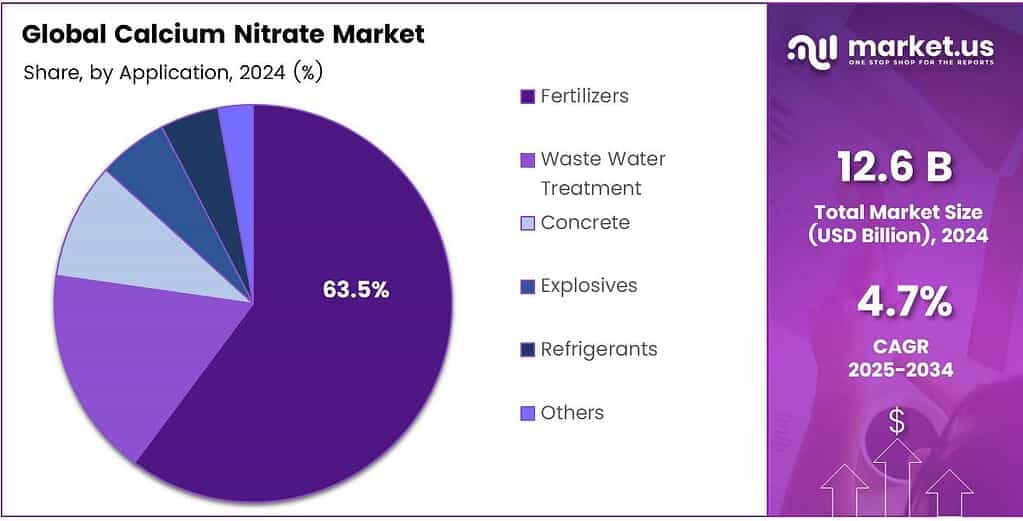
- Fertilizers dominate the application segment with a strong market share of 63.5% in 2024.
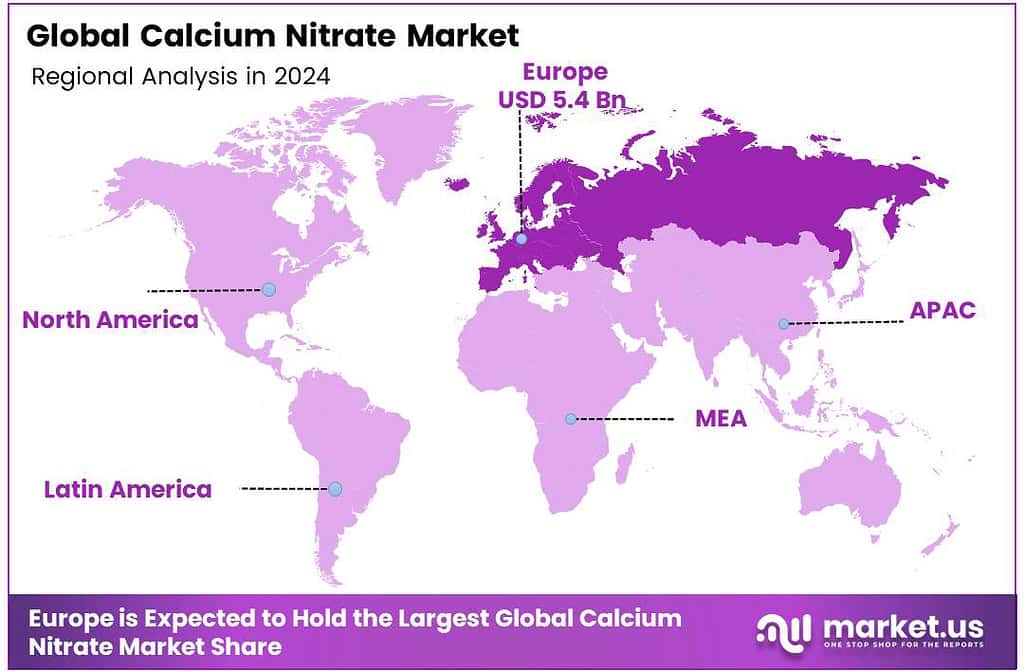
- Europe is the leading regional market with a 43.5% share, valued at USD 5.4 billion in 2024.
By Product Type Analysis
Liquid dominates with 58.9% due to its wide use in fertilizers and industrial processes.
In 2024, Liquid held a dominant market position in the By Product Type segment of the Calcium Nitrate Market, with a 58.9% share. It grows steadily as agriculture, mining, and chemical industries prefer ready-to-use inputs. Moreover, liquid grades improve solubility, reduce material waste, and support modern fertigation systems globally.
Melt calcium nitrate continues expanding as industries shift toward controlled formulations. It offers improved purity and stability during transportation. Additionally, melt products serve specialty applications requiring consistent composition. Therefore, industrial chemicals, specialty coatings, and customized fertilizer blends adopt melt grades to achieve predictable performance in diverse operating environments.
Crystals remain relevant in applications requiring stable, long-shelf-life forms. They offer ease of packaging, broader storage capability, and reduced moisture sensitivity. Furthermore, crystal forms support explosives, concrete additives, and nitrogen-rich fertilizer mixes. Their controlled release profile further strengthens their utility across construction and industrial sectors seeking reliable nitrate-based additives.
By Process Analysis
Limestone with Nitric Acid dominates with 49.2% because of cost efficiency and large-scale production feasibility.
In 2024, Limestone with Nitric Acid held a dominant market position in the By Process segment of the Calcium Nitrate Market, with a 49.2% share. This route ensures high yield, stable quality, and low production cost. It is widely preferred by fertilizer plants and chemical manufacturers requiring reliable and scalable nitrate synthesis methods.
Phosphate Rock with Nitric Acid remains important as it supports integrated fertilizer complexes. This process helps utilize existing phosphate production infrastructure. Furthermore, the method provides valuable byproducts for agricultural applications. Producers favor it when aligning with multi-nutrient fertilizer manufacturing strategies and long-term resource efficiency goals.
Ammonium Nitrate with Calcium Hydroxide continues gaining attention in regions focusing on flexible and modular production. This route enables smaller facilities to produce calcium nitrate efficiently. Additionally, it ensures consistent chemical quality and supports localized fertilizer distribution. Industries also adopt it for applications requiring controlled nitrate-calcium ratios in compound formulations.
By Application Analysis
Fertilizers dominate with 63.5% due to the strong demand for nitrogen-calcium nutrition in global agriculture.
In 2024, Fertilizers held a dominant market position in the By Application segment of the Calcium Nitrate Market, with a 63.5% share. Farmers prefer it for improving nitrogen uptake, preventing calcium deficiency, and boosting yields. It also supports drip irrigation, hydroponics, and high-value crops where nutrient precision is essential.
Waste Water Treatment continues growing as industries and municipalities adopt nitrate-based solutions for odor control and sludge management. Calcium nitrate helps prevent hydrogen sulfide formation. Consequently, treatment plants achieve better operational performance and odor reduction while maintaining cost-efficient dosing systems across varied municipal environments.
Concrete applications remain vital as calcium nitrate accelerates setting time and improves freeze-thaw durability. Construction firms use it in cold climates to maintain project timelines. Additionally, its corrosion-inhibiting properties enhance structural life, making it a favored additive in infrastructure, roads, bridges, and industrial flooring applications.
Refrigerants include calcium-nitrate-based cooling salts in specialized thermal applications. These salts support efficient heat transfer and maintain stability across temperature cycles. As industries explore alternative cooling materials, calcium-based salts gain relevance in niche thermal energy storage and process-cooling applications.
Key Market Segments
By Product Type
- Liquid
- Melt
- Crystals
By Process
- Limestone with Nitric Acid
- Phosphate Rock with Nitric Acid
- Ammonium Nitrate with Calcium Hydroxide
By Application
- Fertilizers
- Waste Water Treatment
- Concrete
- Explosives
- Refrigerants
- Others
Emerging Trends
Rising Use of Calcium Nitrate in Modern Farming Drives Market Growth
The Calcium Nitrate Market is seeing steady momentum as farmers shift toward more efficient nutrient management practices. One major trend is the growing use of calcium nitrate in fertigation systems, where it dissolves easily and delivers both calcium and nitrogen directly to plant roots. This improves yield and reduces nutrient loss, making it popular in high-value crops like fruits, vegetables, and greenhouse produce.
- FAO’s latest fertilizer highlight shows world inorganic fertilizer production at about 208 million tonnes, with nitrogen fertilizers accounting for roughly 120 million tonnes, or 58% of the total. When such a big nitrogen volume is in play, even a small shift from traditional ammonium nitrate toward calcium nitrate creates a meaningful demand wave for bulk producers.
Calcium nitrate is also gaining traction in soil-health improvement programs, especially in regions facing soil acidity and calcium deficiency. Governments promoting balanced fertilization are supporting its wider usage. These initiatives help farmers adopt calcium-rich fertilizers to boost nutrient absorption and reduce soil-related crop stress.
Drivers
Rising Use of Calcium Nitrate in Fertigation Boosts Market Demand
Calcium nitrate demand is rising as farmers shift toward modern fertigation systems to improve crop quality. This fertilizer dissolves easily in water and delivers calcium and nitrogen together, helping plants grow stronger and resist diseases. As drip-irrigation expands across Asia and Latin America, the use of calcium nitrate continues to increase steadily.
Moreover, calcium nitrate supports higher yields in fruits, vegetables, and greenhouse crops, sectors that are growing quickly due to urban consumption trends. Farmers prefer it because it prevents calcium deficiency, which leads to problems like blossom-end rot and poor fruit texture. This reliability encourages consistent purchasing throughout the year.
Additionally, governments are promoting efficient nutrient-management practices to reduce soil degradation and water waste. Subsidies for drip systems and controlled fertigation encourage the adoption of specialty fertilizers such as calcium nitrate. These initiatives make the product more accessible to small and medium growers.
Industrial applications are also contributing to market growth. Calcium nitrate is widely used in wastewater treatment, concrete acceleration, and explosives manufacturing. As construction and municipal infrastructure projects expand worldwide, the need for calcium-based additives grows further. Together, these agricultural and industrial drivers strengthen the long-term outlook for the calcium nitrate market.
Restraints
High Sensitivity to Moisture and Storage Limitations Restrains Market Growth
Calcium nitrate faces strong restraints due to its high sensitivity to moisture. The compound absorbs water quickly, which leads to clumping and reduced product quality. This limits its long-term usability, especially in humid regions where storage conditions are harder to control. As a result, farmers and industrial users may prefer more stable alternatives.
- Another major restraint comes from the strict storage requirements needed to maintain calcium nitrate’s effectiveness. If humidity crosses 40% for just 24–48 hours, the material can cake and lose up to half its performance value. This forces businesses to invest in sealed packaging, temperature-controlled rooms, and proper ventilation systems, increasing operational costs for distributors and end-users.
Transportation challenges also act as a barrier to market expansion. Calcium nitrate decomposes when exposed to temperatures above 40°C, releasing toxic gases. This requires careful handling, specialized containers, and compliance with safety regulations, especially in tropical markets where high temperatures are common. These additional safety obligations slow down logistics and raise shipping expenses.
Growth Factors
Rising Use in Fertigation Systems Creates Strong Growth Opportunities
Growing adoption of modern irrigation systems is creating new opportunities for the calcium nitrate market. Farmers are increasingly using drip and sprinkler irrigation to improve water efficiency, and calcium nitrate works well in these systems because it dissolves quickly and provides fast nutrient delivery. This trend is supporting higher demand from large-scale agricultural projects.
Another major opportunity comes from the rising need for high-quality fruits and vegetables. Calcium nitrate helps prevent common crop issues like blossom-end rot and improves fruit firmness and shelf life. As export-oriented farming expands in regions such as the Asia-Pacific and Latin America, the demand for nutrient-rich fertilizers like calcium nitrate is expected to grow steadily.
Additionally, controlled-environment agriculture—including greenhouses and hydroponic farms—is expanding worldwide. These systems require precise nutrient management, and calcium nitrate is preferred due to its purity and compatibility with automated dosing units. This shift toward high-tech farming is opening a strong long-term growth window for suppliers.
Regional Analysis
Europe Dominates the Calcium Nitrate Market with a Market Share of 43.5%, Valued at USD 5.4 Billion
Europe leads the global calcium nitrate market due to strong fertilizer consumption, advanced greenhouse farming, and strict soil-nutrient management regulations. In 2024, the region accounted for a dominant 43.5% share, valued at USD 5.4 billion, driven by widespread adoption in high-value crops and wastewater treatment. Growing demand for calcium-rich fertilizers and nitrate-based formulations further reinforces Europe’s leadership.
North America shows steady growth supported by precision agriculture, rising horticulture acreage, and increasing use of calcium nitrate in wastewater treatment. The region benefits from modern irrigation infrastructure and nutrient-optimized fertilizer programs. Expanding greenhouse vegetable production and growing awareness about calcium deficiency in soils continue to create positive market momentum.
Asia Pacific expands rapidly as farmers adopt fertigation and drip irrigation for fruits, vegetables, and commercial crops. Countries like China and India are increasing calcium nitrate usage due to soil health concerns and intensive cropping cycles. Government support for balanced nutrient application and improved agricultural productivity further boosts regional demand.
Latin America’s growth is driven by large-scale farming of sugarcane, coffee, fruits, and vegetables, where calcium nitrate enhances yield and crop quality. Strong fertilizer consumption in Brazil, Mexico, and Chile supports market expansion. Adoption of nitrate-based fertilizers in horticulture and protected farming is gradually strengthening regional uptake.
Key Regions and Countries
North America
- US
- Canada
Europe
- Germany
- France
- The UK
- Spain
- Italy
- Rest of Europe
Asia Pacific
- China
- Japan
- South Korea
- India
- Australia
- Rest of APAC
Latin America
- Brazil
- Mexico
- Rest of Latin America
Middle East & Africa
- GCC
- South Africa
- Rest of MEA
Key Players Analysis
Yara International ASA continues to anchor the global calcium nitrate landscape with its extensive fertilizer portfolio and deep agronomic networks. The company leverages large-scale production, integrated logistics, and digital farming platforms to push higher adoption in high-value crops and fertigation systems. Its focus on product reliability, crop-specific advisory, and climate-smart nutrient programs helps defend pricing power in volatile input-cost cycles.
GFS Chemicals positions itself as a specialty producer in the calcium nitrate value chain, focusing on high-purity grades for laboratory, water treatment, and industrial applications. By emphasizing tight quality control, smaller batch flexibility, and technical support, it captures niche, higher-margin demand beyond bulk fertilizer use. This specialization allows the company to benefit from rising regulatory requirements for consistent and traceable chemical inputs.
San Corporation plays a meaningful role in supplying calcium nitrate across fertilizers, concrete admixtures, and explosives segments, particularly in cost-sensitive markets. Its strategy centers on competitive pricing, dependable bulk supply, and long-term contracts with distributors and construction material players. By broadening application coverage and improving process efficiencies, the company aims to strengthen its foothold in emerging economies with growing infrastructure investments.
Uralchem capitalizes on its strong position in nitrogen-based fertilizers to expand calcium nitrate offerings across Eastern Europe, CIS, and export markets. The company benefits from backward integration into ammonia and nitric acid, enabling more flexible production planning and margin capture. With growing emphasis on nutrient use efficiency and balanced fertilization, Uralchem is well placed to promote calcium nitrate as a value-added complement to traditional NPK programs.
Top Key Players in the Market
- Yara International ASA
- GFS Chemicals
- San Corporation
- Uralchem
- Sasol Ltd.
- Wenton Potassium Salt Group Co. Ltd.
- Sterling Chemicals
- Jiaocheng Sanxi Chemical Co., Ltd.
- Haifa Group
- ADOB
Recent Developments
- In 2024, Yara, a leading global producer of nitrogen-based fertilizers including calcium nitrate formulations, has focused on expanding renewable and low-carbon production capacities. Yara signed a non-binding Heads of Terms agreement with ATOME PLC for the long-term offtake of all output.
- In 2024, Uralchem, Russia’s largest producer of nitrogen fertilizers, has made significant strides in calcium nitrate production and sustainability. The company launched production of anhydrous calcium nitrate (Ca(NO₃)₂) at its Kirovo-Chepetsk Chemical Works (KCCW) plant, marking a new product line for EU exports.
Report Scope
Report Features Description Market Value (2024) USD 12.6 Billion Forecast Revenue (2034) USD 19.9 Billion CAGR (2025-2034) 4.7% Base Year for Estimation 2024 Historic Period 2020-2023 Forecast Period 2025-2034 Report Coverage Revenue Forecast, Market Dynamics, Competitive Landscape, Recent Developments Segments Covered By Product Type (Liquid, Melt, Crystals), By Process (Limestone with Nitric Acid, Phosphate Rock with Nitric Acid, Ammonium Nitrate with Calcium Hydroxide), By Application (Fertilizers, Waste Water Treatment, Concrete, Explosives, Refrigerants, Others) Regional Analysis North America (US and Canada), Europe (Germany, France, The UK, Spain, Italy, and Rest of Europe), Asia Pacific (China, Japan, South Korea, India, Australia, and Rest of APAC), Latin America (Brazil, Mexico, and Rest of Latin America), Middle East & Africa (GCC, South Africa, and Rest of MEA) Competitive Landscape Yara International ASA, GFS Chemicals, San Corporation, Uralchem, Sasol Ltd., Wenton Potassium Salt Group Co. Ltd., Sterling Chemicals, Jiaocheng Sanxi Chemical Co., Ltd., Haifa Group, ADOB Customization Scope Customization for segments, region/country-level will be provided. Moreover, additional customization can be done based on the requirements. Purchase Options We have three licenses to opt for: Single User License, Multi-User License (Up to 5 Users), Corporate Use License (Unlimited Users and Printable PDF)  Calcium Nitrate MarketPublished date: November 2025add_shopping_cartBuy Now get_appDownload Sample
 -
-
- Yara International ASA
- GFS Chemicals
- San Corporation
- Uralchem
- Sasol Ltd.
- Wenton Potassium Salt Group Co. Ltd.
- Sterling Chemicals
- Jiaocheng Sanxi Chemical Co., Ltd.
- Haifa Group
- ADOB
Our Clients

- 166535
- November 2025






