


Global Black Pepper Market Size, Share, And Enhanced Productivity By Form (Ground Black Pepper, Rough Cracked Black Pepper, Whole Black Pepper), By Source (Organic, Conventional), By Application (Food and Beverages, Pharmaceuticals, Personal Care, Others), By Distribution Channel (B2B, B2C (Supermarkets and Hypermarkets, Convenience Stores, Specialty Stores, Online Retail, Others)), By Region and Companies - Industry Segment Outlook, Market Assessment, Competition Scenario, Trends, and Forecast 2026-2035
- Published date: March 2026
- Report ID: 181461
- Number of Pages: 272
- Format:
-
keyboard_arrow_up
Quick Navigation
Report Overview
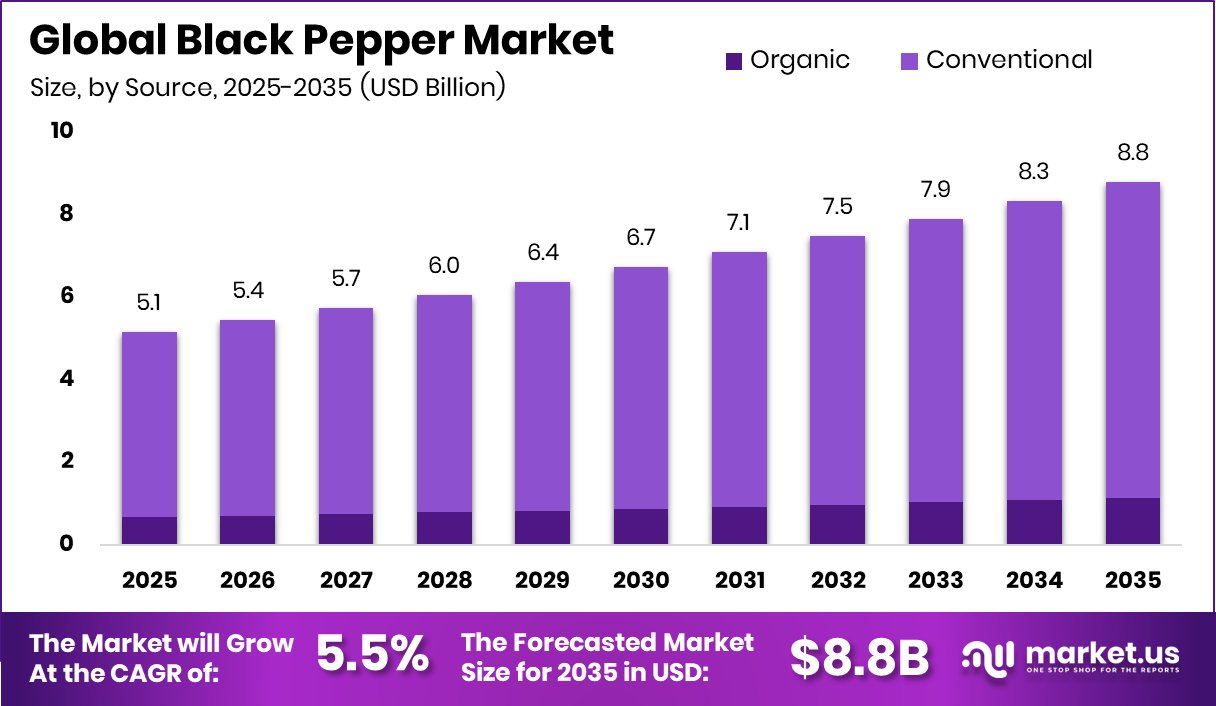
The Global Black Pepper Market is expected to be worth around USD 8.8 billion by 2035, up from USD 5.1 billion in 2026, and is projected to grow at a CAGR of 5.5% from 2026 to 2035. Black Pepper Market in the Asia Pacific accounted for 43.8%, totaling approximately USD 2.2 Bn.
Black pepper is a widely used spice obtained from the dried berries of the Piper nigrum plant. The berries are harvested when they are nearly ripe and then dried to produce the characteristic dark, wrinkled peppercorns. Black pepper is known for its strong aroma, sharp flavor, and versatility in cooking. It is commonly used in whole, ground, or cracked forms to enhance the taste of various dishes. Beyond culinary use, black pepper is also applied in traditional remedies, herbal formulations, and certain personal care products because of its natural compounds and warming properties.
The Black Pepper Market refers to the global trade and commercial ecosystem involved in the production, processing, distribution, and sale of black pepper products. The market includes different forms such as ground black pepper, rough cracked black pepper, and whole peppercorns. It also covers supply from organic and conventional farming sources and serves multiple applications, including food and beverages, pharmaceuticals, personal care, and other specialty uses. Distribution occurs through both B2B channels, which supply bulk pepper to manufacturers and restaurants, and B2C channels that cater to retail consumers.
One of the key growth factors in the black pepper industry is the increasing use of natural spices in everyday cooking and food manufacturing. Consumers across many regions are shifting toward ingredients that add flavor without artificial additives, which supports steady demand for spices like black pepper. Government initiatives have also supported the sector, such as funding programs aimed at strengthening the pepper industry, including allocations reaching RM45.8 million to enhance cultivation, productivity, and farmer support.
Demand for black pepper continues to rise as global food culture expands and more cuisines incorporate bold seasoning profiles. Restaurants, packaged food producers, and home cooking trends all contribute to higher consumption of pepper-based seasonings. At the same time, broader investments in food and technology sectors show how the ingredient ecosystem is evolving, highlighted by funding activities such as $30 million secured to empower independent foodservice distributors, $16 million raised earlier that helped expand customer bases and product features, a $500 million securitisation move in commercial real estate financing, and a $100 million funding round supporting alternative protein development that also increases the need for flavor-enhancing spices.
Opportunities in the market are emerging through product innovation, value-added spice blends, and expanding distribution networks. Companies are exploring improved processing methods, better packaging solutions, and stronger supply chains to maintain quality and extend shelf life. Growing interest in global cuisines, premium spices, and natural flavor ingredients continues to open new avenues for black pepper in foodservice, packaged foods, and emerging culinary applications worldwide.
- In August 2025, McCormick announced an agreement to acquire an additional 25% ownership in McCormick de Mexico, increasing its stake to 75%. The move strengthens the company’s position in the Mexican spice and seasoning market and supports expansion across Latin America for products including herbs, spices, and pepper-based seasonings.
Key Takeaways
- The Global Black Pepper Market is expected to be worth around USD 8.8 billion by 2035, up from USD 5.1 billion in 2026, and is projected to grow at a CAGR of 5.5% from 2026 to 2035.
- Ground black pepper dominates the Black Pepper Market, accounting for 49.5% share due to widespread culinary usage.
- Conventional black pepper leads the Black Pepper Market source segment with 87.4% share globally.
- Food and beverages dominate the Black Pepper Market application segment, contributing 78.2% demand worldwide.
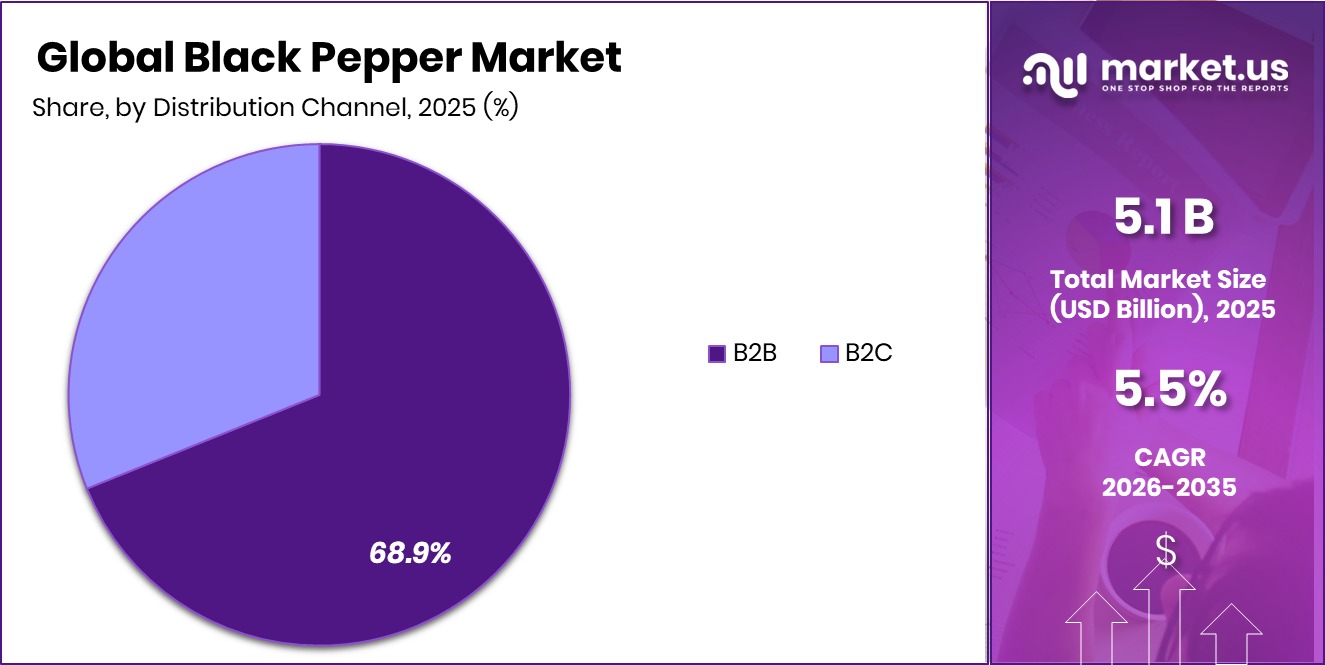
- B2B distribution channels hold 68.9% share in the Black Pepper Market, supporting large-scale industry supply.
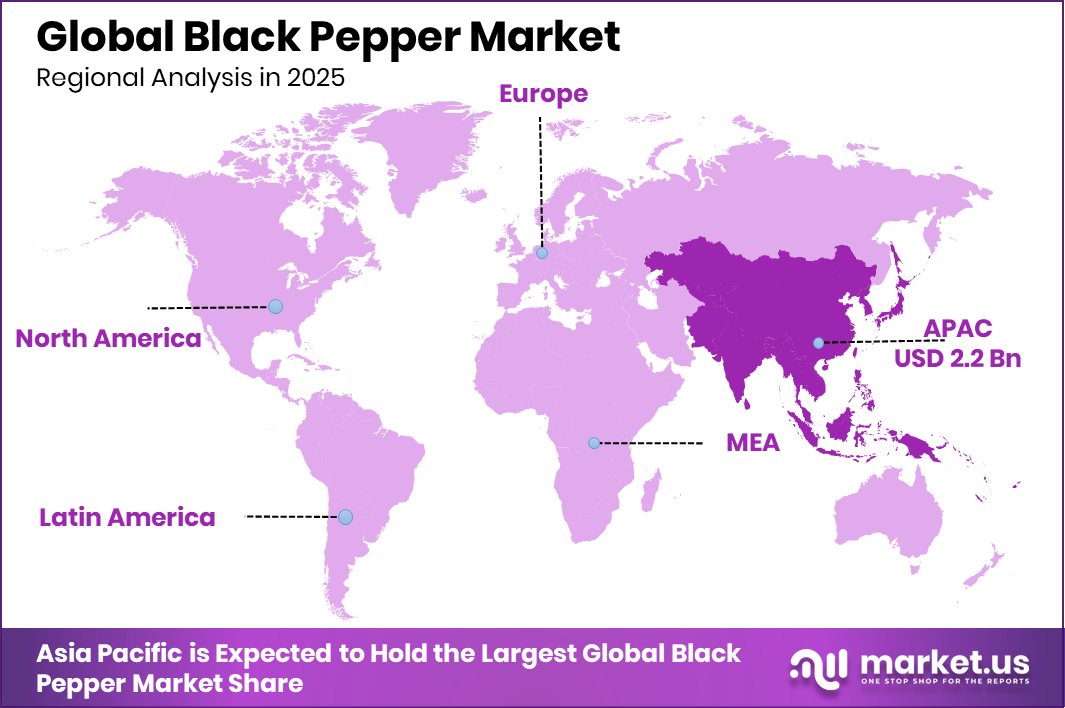
- Asia Pacific dominated Black Pepper Market with 43.8% share, reaching USD 2.2 Bn value.
By Form Analysis
Ground black pepper dominates the Black Pepper Market, holding 49.5% share globally.
In 2025, the Black Pepper Market continued to be strongly influenced by the dominance of ground black pepper, which accounted for 49.5% of the market by form. Ground pepper remains the preferred format because of its convenience, consistent flavor distribution, and ease of use across household kitchens, food processing units, and foodservice establishments. Manufacturers favor ground pepper as it can be easily blended into spice mixes, sauces, marinades, and ready-to-eat meals.
The increasing demand for packaged spices and processed foods further supported this segment’s growth. Additionally, advancements in grinding and packaging technologies have improved shelf life and aroma retention, making ground pepper more attractive to both consumers and commercial buyers, thereby strengthening its leading share within the market.
By Source Analysis
Conventional black pepper leads the Black Pepper Market with 87.4% source share.
In 2025, conventional black pepper dominated the Black Pepper Market by source, holding an 87.4% share. Conventional farming remains the primary cultivation method because it offers higher production volumes and lower costs compared to organic farming. Major pepper-producing countries such as Vietnam, India, Brazil, and Indonesia rely heavily on conventional agricultural practices to meet the growing global demand.
The well-established supply chains and large-scale plantations help ensure consistent availability for exporters, processors, and manufacturers. Additionally, conventional pepper is widely accepted across food processing industries due to its affordability and accessibility. Although organic pepper is gaining attention among health-conscious consumers, conventional production continues to lead the market because of its strong production capacity and efficient distribution networks.
By Application Analysis
Food and beverages drive Black Pepper Market demand, accounting for 78.2% usage.
In 2025, the food and beverages segment held a significant 78.2% share of the Black Pepper Market by application. Black pepper remains one of the most widely used spices in the global culinary industry due to its distinctive flavor, aroma, and versatility. It is extensively used in sauces, soups, meat products, snacks, ready-to-cook meals, and seasoning blends.
The rapid expansion of the processed food industry and the growing popularity of international cuisines have further increased demand for black pepper in food manufacturing. Restaurants, fast-food chains, and packaged food producers rely on black pepper as a staple seasoning ingredient. Its natural preservative properties and ability to enhance taste profiles make it an essential component in a wide range of food and beverage formulations worldwide.
By Distribution Channel Analysis
B2B distribution dominates the Black Pepper Market, representing 68.9% global sales.
In 2025, the B2B segment accounted for 68.9% of the Black Pepper Market by distribution channel, reflecting strong demand from commercial buyers and food manufacturers. Bulk purchasing by spice processors, food processing companies, restaurants, and catering businesses drives this segment’s growth. B2B channels allow large-scale procurement of black pepper in raw, ground, or processed forms, ensuring cost efficiency and consistent supply for industrial use.
Many global spice exporters and wholesalers maintain long-term partnerships with food manufacturers and seasoning producers to secure steady distribution. Additionally, the expansion of the packaged food industry and increasing demand for spice blends have strengthened the importance of B2B networks, making them a crucial distribution pathway within the black pepper market ecosystem.
Key Market Segments
By Form
- Ground Black Pepper
- Rough Cracked Black Pepper
- Whole Black Pepper
By Source
- Organic
- Conventional
By Application
- Food and Beverages
- Pharmaceuticals
- Personal Care
- Others
By Distribution Channel
- B2B
- B2C
- Supermarkets and Hypermarkets
- Convenience Stores
- Specialty Stores
- Online Retail
- Others
Driving Factors
Rising demand for natural spice ingredients
The Black Pepper Market is experiencing steady growth due to the rising demand for natural spice ingredients in everyday cooking and food production. Consumers increasingly prefer products that deliver authentic flavor without artificial additives, which strengthens the role of spices such as black pepper in global cuisines. This shift toward natural flavor solutions is encouraging food companies and restaurants to rely more on traditional spices in their recipes and processed food offerings.
In parallel, supply chain innovation is gaining attention across the food sector. For example, GrubMarket raised $50 million for food supply chain B2B solutions, highlighting the broader industry effort to modernize ingredient sourcing, distribution, and logistics, which indirectly supports efficient trade and availability of spices like black pepper in international markets.
Expanding the global food processing industry
The expansion of the global food processing industry is another important driver supporting the Black Pepper Market. Processed foods, ready-to-eat meals, snacks, and seasoning blends rely heavily on spices to maintain flavor consistency and enhance taste profiles. Black pepper is widely used in these products because it complements a wide range of ingredients and cuisines.
As food manufacturers continue to scale production and introduce new products, the demand for stable and versatile spices continues to grow. Investment activity across the food and beverage sector also reflects this expansion. For instance, prebiotic soda brand Olipop was valued at $1.85 billion in its latest funding round, demonstrating strong investor confidence in innovative food and beverage products that often depend on flavoring ingredients and seasonings.
Restraining Factors
Fluctuating black pepper production and prices
One of the key challenges affecting the Black Pepper Market is the fluctuation in production levels and market prices. Pepper cultivation depends on agricultural conditions, seasonal cycles, and global supply patterns, which can create variations in availability and cost. These price fluctuations can impact spice processors, exporters, and food manufacturers that rely on stable ingredient sourcing. When supply becomes inconsistent, businesses may face higher procurement costs or supply disruptions.
At the same time, the food industry continues to invest in innovation and data-driven solutions to manage supply chain uncertainties. For example, Starday raised $11 million in Series A funding to expand data-informed food innovation and retail partnerships, showing how companies are exploring new strategies to improve food product development and market responsiveness.
Climate impact on pepper crop yields
Climate conditions remain a significant factor influencing pepper cultivation and long-term supply stability in the Black Pepper Market. Changes in rainfall patterns, temperature variations, and extreme weather events can affect crop productivity and farming cycles. Such environmental factors may reduce yields in key producing regions and create uncertainty for exporters and processors. Farmers and agricultural communities are increasingly seeking support to adapt to these challenges and maintain sustainable production levels.
Funding initiatives within the food and beverage sector illustrate ongoing efforts to support industry resilience. For instance, food and beverage businesses in Western Australia received a combined funding share of $680,000, highlighting regional support programs aimed at strengthening food sector development and improving operational capacity.
Growth Opportunity
Growing demand for organic black pepper
A major opportunity emerging within the Black Pepper Market is the growing demand for organic black pepper. Consumers are becoming more attentive to ingredient sourcing, sustainability, and chemical-free agricultural practices. As a result, organically cultivated spices are gaining attention in retail markets and premium food products. Organic pepper is increasingly used in specialty foods, health-focused products, and clean-label formulations. The broader food innovation ecosystem also reflects rising interest in health-oriented products.
For example, a functional beverage startup recently raised $4.5 million in funding, demonstrating the growing momentum around products that prioritize natural ingredients and wellness-focused consumption patterns, which can further support demand for high-quality spice ingredients like organic black pepper.
Expanding spice exports in emerging markets
Expanding spice exports from emerging markets presents another promising growth opportunity for the Black Pepper Market. Many developing economies with strong agricultural capabilities are strengthening their export infrastructure to supply spices to international buyers. Improvements in logistics, processing technology, and trade networks are helping these regions reach new global markets. As global demand for authentic and diverse flavors increases, exporters are finding new opportunities to position spices in international food supply chains.
Innovation within the food technology sector also highlights the growing connection between technology and food development. For example, AKA Foods secured $17.2 million in seed funding to launch the world’s first secure AI platform for food innovation, showing how digital tools are beginning to reshape product development and ingredient research.
Latest Trends
Increasing popularity of premium spice blends
A notable trend shaping the Black Pepper Market is the increasing popularity of premium spice blends. Consumers and chefs are exploring more complex flavor combinations that incorporate high-quality spices and seasoning mixes. Black pepper remains a foundational ingredient in many of these blends due to its bold flavor and compatibility with diverse cuisines. Premium blends are becoming common in gourmet products, restaurant menus, and packaged seasonings, reflecting a shift toward elevated culinary experiences.
At the same time, investment activity continues across beverage and flavor-focused brands. For instance, Willie Nelson’s hemp beverage brand launched a $15 million Series A funding round, highlighting how new beverage concepts and flavor innovation continue to influence ingredient usage across the broader food and beverage landscape.
Rising demand for convenient ground pepper
Convenience remains an important trend influencing the Black Pepper Market, particularly the rising demand for ground black pepper. Consumers increasingly prefer ready-to-use spices that simplify cooking while maintaining strong flavor and aroma. Ground pepper is widely used in households, restaurants, and packaged foods because it blends easily with sauces, soups, snacks, and prepared meals. The demand for convenient ingredients aligns with broader innovation across the food industry, where companies are introducing new formats and alternative products.
For example, Prefer raised $4.2 million and launched soluble bean-free coffee and cocoa powders, demonstrating how modern food technology is creating convenient ingredient solutions that match evolving consumer lifestyles and preparation preferences.
Regional Analysis
In 2025, the Asia Pacific held 43.8% share in Black Pepper Market, valued at USD 2.2 Bn.
The Black Pepper Market demonstrates varied regional dynamics across North America, Europe, Asia Pacific, the Middle East & Africa, and Latin America, reflecting differences in consumption patterns, trade flows, and production capacities.
Asia Pacific dominates the global market, accounting for 43.8% share with a market value of USD 2.2 Bn, supported by strong cultivation and export activities in major producing countries such as India, Vietnam, and Indonesia. The region also benefits from high domestic consumption due to extensive culinary use of spices and expanding food processing industries.
North America represents a significant consumption-driven market, where demand is supported by the growth of packaged food products, seasoning blends, and restaurant chains. Europe maintains steady demand as black pepper remains an essential ingredient in processed foods, sauces, and ready-to-eat meals across the region.
Meanwhile, the Middle East & Africa market is influenced by growing foodservice sectors and increasing spice imports for traditional cuisines. Latin America also contributes to the global market through both consumption and regional production, particularly in countries involved in spice cultivation and export activities.
Key Regions and Countries
- North America
- US
- Canada
- Europe
- Germany
- France
- The UK
- Spain
- Italy
- Rest of Europe
- Asia Pacific
- China
- Japan
- South Korea
- India
- Australia
- Rest of APAC
- Latin America
- Brazil
- Mexico
- Rest of Latin America
- Middle East & Africa
- GCC
- South Africa
- Rest of MEA
Key Players Analysis
McCormick & Company, Inc. remains a prominent participant in the global Black Pepper Market in 2025, supported by its extensive portfolio of spices and seasonings. The company’s strong brand recognition and wide retail presence allow it to maintain a stable position in consumer markets. McCormick focuses on delivering consistent quality, standardized flavor profiles, and reliable packaging formats that meet the expectations of both household consumers and foodservice providers. Its structured supply network and established distribution capabilities also support efficient movement of black pepper products across multiple regions, strengthening its presence in packaged spice categories.
Olam International Limited plays a key role in the black pepper value chain through its strong agricultural sourcing and global supply capabilities. The company’s involvement in sourcing, processing, and supplying spices positions it as an important participant in the bulk pepper trade. Olam’s operational model emphasizes supply chain integration and direct engagement with producing regions, enabling a steady flow of black pepper to food manufacturers and industrial buyers. Its global footprint allows it to serve diverse markets while maintaining consistent procurement and quality management practices.
Everest Spices Pvt. Ltd. continues to strengthen its position in the black pepper segment through its well-established spice brand and strong distribution network. The company is recognized for its packaged spice products that cater primarily to household and foodservice consumers. Everest’s focus on maintaining consistent flavor quality, standardized processing, and accessible retail packaging helps it sustain demand across domestic and regional markets where spice consumption remains high.
Top Key Players in the Market
- McCormick & Company, Inc.
- Olam International Limited
- Everest Spices Pvt. Ltd.
- Mahashian Di Hatti (MDH) Pvt. Ltd.
- Synthite Industries Ltd.
- British Pepper & Spice Co. Ltd.
- Ajinomoto Co., Inc.
- DS Group
- ITC Limited
- Kancor Ingredients Ltd.
Recent Developments
- In February 2025, Olam Food Ingredients released an update on the global spice trade through its spices market insights. The report noted that Vietnam exported about 27.2k metric tons of pepper, including 22.2k metric tons of black pepper, highlighting the company’s active role in sourcing and tracking global pepper supply. Olam works in sourcing, processing, and distributing spices to food manufacturers, so these updates help buyers and processors understand supply trends and pricing movements in the pepper trade.
- In August 2024, Ajinomoto introduced a new food innovation brand called Atlr.72™ (Atelier Seven Two) from Singapore. The initiative focuses on developing modern food products and new flavor solutions using advanced ingredients. The launch supports the company’s wider seasoning and flavor business, where pepper-based products and seasoning blends are commonly used to enhance taste in ready-to-cook and processed foods. This development reflects Ajinomoto’s effort to expand innovation in its food and flavor portfolio.
Report Scope
Report Features Description Market Value (2025) USD 5.1 Billion Forecast Revenue (2035) USD 8.8 Billion CAGR (2026-2035) 5.5% Base Year for Estimation 2025 Historic Period 2020-2024 Forecast Period 2026-2035 Report Coverage Revenue Forecast, Market Dynamics, Competitive Landscape, Recent Developments Segments Covered By Form (Ground Black Pepper, Rough Cracked Black Pepper, Whole Black Pepper), By Source (Organic, Conventional), By Application (Food and Beverages, Pharmaceuticals, Personal Care, Others), By Distribution Channel (B2B, B2C (Supermarkets and Hypermarkets, Convenience Stores, Specialty Stores, Online Retail, Others)) Regional Analysis North America – US, Canada; Europe – Germany, France, The UK, Spain, Italy, Rest of Europe; Asia Pacific – China, Japan, South Korea, India, Australia, Singapore, Rest of APAC; Latin America – Brazil, Mexico, Rest of Latin America; Middle East & Africa – GCC, South Africa, Rest of MEA Competitive Landscape McCormick & Company, Inc., Olam International Limited, Everest Spices Pvt. Ltd., Mahashian Di Hatti (MDH) Pvt. Ltd., Synthite Industries Ltd., British Pepper & Spice Co. Ltd., Ajinomoto Co., Inc., DS Group, ITC Limited, Kancor Ingredients Ltd. Customization Scope Customization for segments, region/country-level will be provided. Moreover, additional customization can be done based on the requirements. Purchase Options We have three licenses to opt for: Single User License, Multi-User License (Up to 5 Users), Corporate Use License (Unlimited User and Printable PDF) 
-
-
- McCormick & Company, Inc.
- Olam International Limited
- Everest Spices Pvt. Ltd.
- Mahashian Di Hatti (MDH) Pvt. Ltd.
- Synthite Industries Ltd.
- British Pepper & Spice Co. Ltd.
- Ajinomoto Co., Inc.
- DS Group
- ITC Limited
- Kancor Ingredients Ltd.
Our Clients

- 181461
- March 2026






