


Report Overview
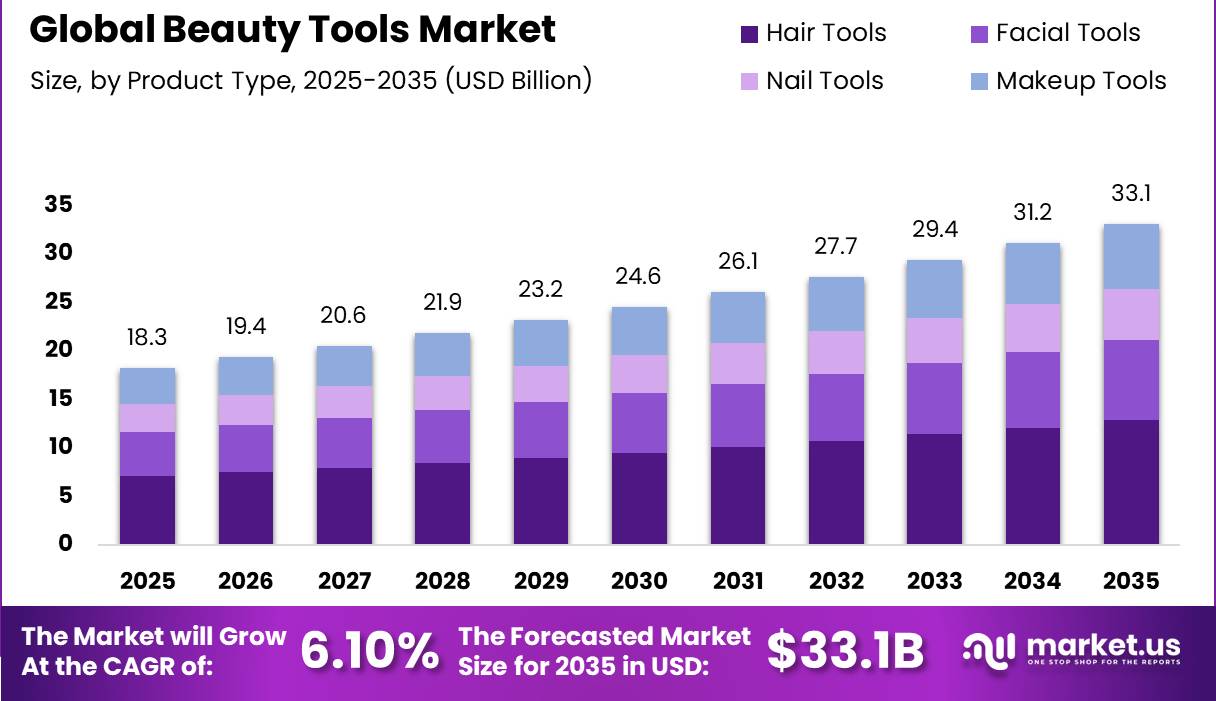
Global Beauty Tools Market size is expected to be worth around USD 33.1 Billion by 2035 from USD 18.3 Billion in 2025, growing at a CAGR of 6.1% during the forecast period 2026 to 2035.
The beauty tools market covers devices and implements used for personal care, grooming, and aesthetic treatment across hair, face, nails, and makeup applications. The market spans electric and manual product types sold through offline retail and online channels. This reflects a broad consumer base ranging from everyday household users to professional salon operators.
Key Takeaways
- Market size in 2025: USD 18.3 Billion
- Forecast market size by 2035: USD 33.1 Billion
- CAGR (2026 to 2035): 6.1%
- Dominant product segment: Hair Tools with 38.9% share
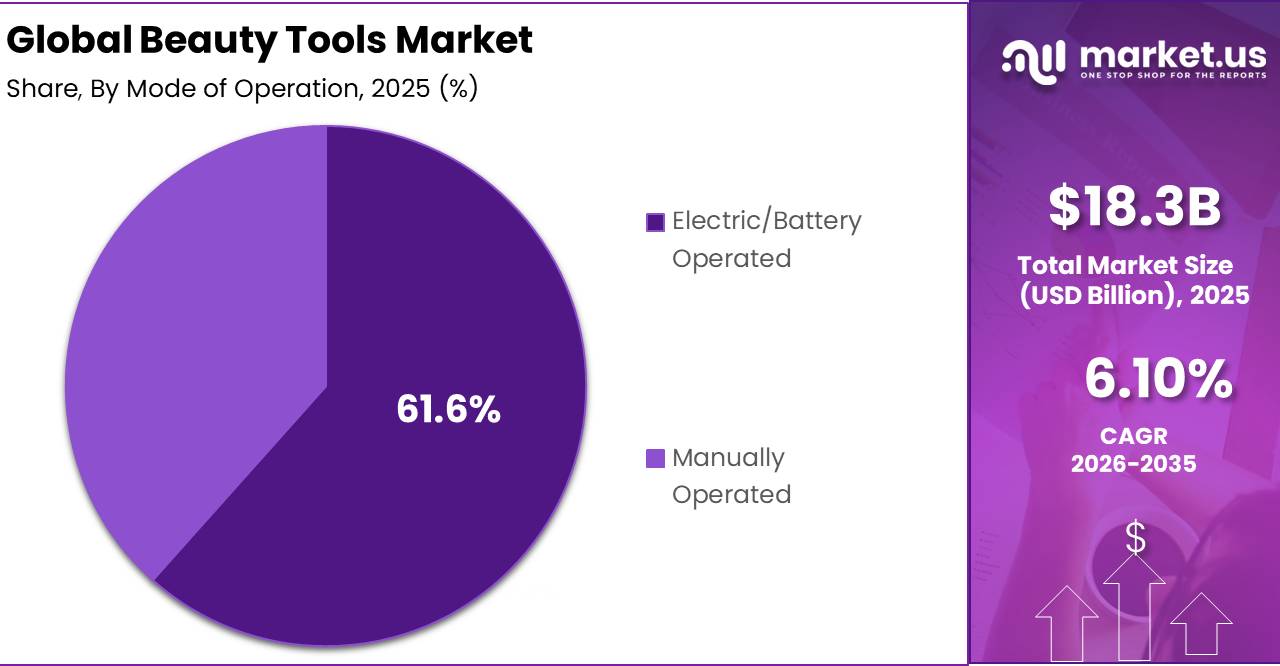
- Dominant mode of operation: Electric/Battery Operated with 61.6% share
- Dominant distribution channel: Offline with 73.2% share
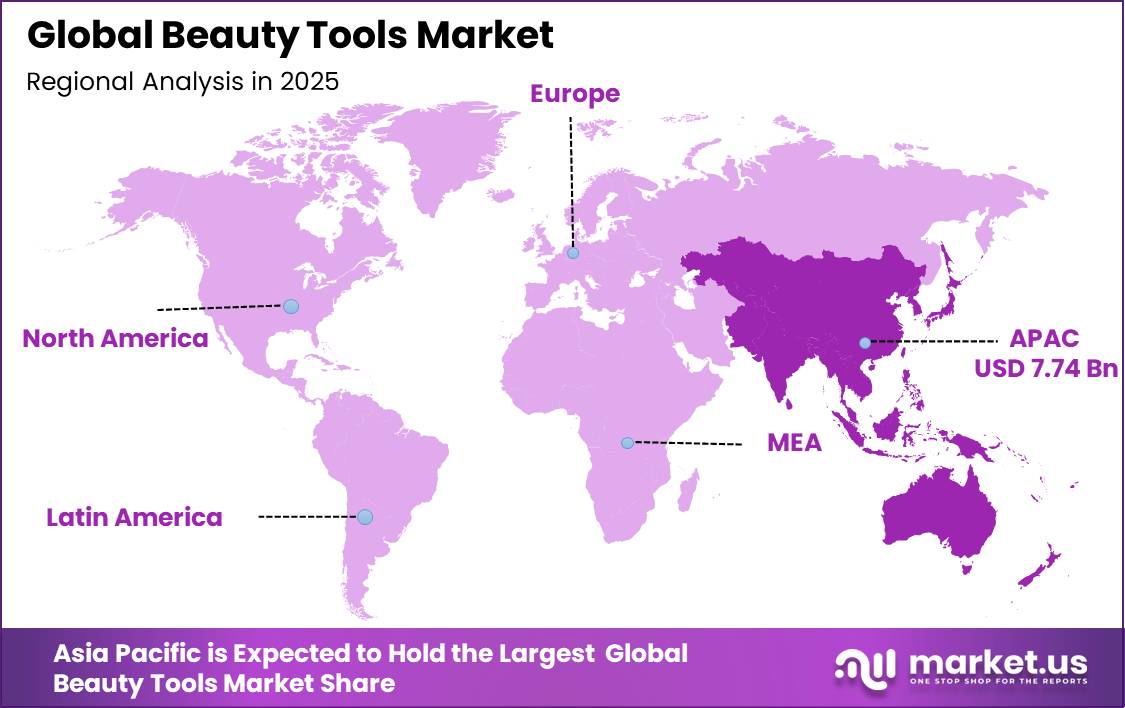
- Dominant region: Asia-Pacific with 42.3% share, valued at USD 7.74 Billion
Government health and safety agencies across North America and Europe have tightened oversight of skin-contact and electrically powered personal care devices. Regulatory frameworks such as MoCRA in the United States and the EU Packaging and Packaging Waste Regulation from August 2026 raise the compliance bar. Brands that meet these standards gain a structural advantage in export markets and premium retail channels.
According to CurrentBody clinical trials, biological skin elasticity improved by 57.1% among participants using an LED face mask over 56 days. This clinical evidence creates direct commercial pressure on traditional beauty tool categories. Brands that can attach validated clinical outcomes to their products will command stronger shelf positioning and justify premium price points.
Data from CurrentBody clinical trials shows a 36.0% increase in skin hydration after LED mask usage in the same 56-day study. This result reinforces consumer confidence in at-home clinical devices. As a result, the product category is shifting from cosmetic tool to outcome-driven wellness instrument, which expands the addressable buyer base beyond traditional beauty shoppers.
Hair Tools Analysis
Hair Dryers dominates with the largest share due to high replacement frequency and universal household use.
In 2025, Hair Tools held a dominant market position in the By Product Type segment of the Beauty Tools Market, with a 38.9% share. This leadership reflects deep household penetration across all income tiers and geographies. Vendors operating in this segment benefit from stable replacement cycles and broad distribution reach, making it the most accessible entry point for new market participants.
Facial Tools represent a high-growth sub-segment driven by clinical-grade device adoption outside professional settings. As reported by theindustry.beauty, TikTok Shop recorded a 400% increase in Facial Beauty Device sales, driven largely by LED and red-light therapy devices. This channel performance signals a direct link between social commerce virality and category trial, giving digitally native facial tool brands an acquisition channel that requires far less retail infrastructure than traditional distribution.
Nail Tools serve a value-driven buyer base that prioritizes convenience and affordability in personal grooming routines. Figures from theindustry.beauty show that approximately 26% of red-light therapy mask purchases on TikTok Shop were completed through LIVE Shopping sessions. This purchase behavior is not exclusive to facial devices. It points to a broader shift in how beauty consumers engage with live-format content, which creates an emerging opportunity for nail tool brands to adopt similar commerce formats.
Mode of Operation Analysis
Electric/Battery Operated dominates with 61.6% due to consumer preference for powered performance outcomes.
In 2025, Electric/Battery Operated tools held a dominant market position in the By Mode of Operation segment of the Beauty Tools Market, with a 61.6% share. This majority reflects the consumer-validated belief that powered devices deliver faster and more consistent results than manual alternatives. Device manufacturers targeting this segment benefit from higher average selling prices and stronger brand differentiation potential through technology features.
Manually Operated tools retain relevance through affordability and accessibility for price-sensitive consumer segments globally. These products face limited threat from premiumization trends but benefit from volume-based distribution at mass-market retail. This means the segment serves as a gateway category for first-time buyers who later trade up to electric alternatives, making it a feeder segment rather than a standalone growth engine.
Distribution Channel Analysis
Offline dominates with 73.2% due to physical trial preference for skin-contact beauty products.
In 2025, Offline channels held a dominant market position in the By Distribution Channel segment of the Beauty Tools Market, with a 73.2% share. Physical retail gives consumers the ability to evaluate device ergonomics, finish quality, and tactile features before purchase. This sensory dimension is especially important for higher-ticket electric devices, where trust in the product must be established before a commitment is made.
Online channels are the faster-growing distribution segment, powered by social commerce platforms and direct-to-consumer brand investments. Beauty technology brand Medicube generated USD 102.9 Million in TikTok Shop sales, demonstrating the revenue scale that digital-first distribution can achieve. This performance signals that online channels are no longer a secondary shelf but a primary revenue engine for brands that invest in creator networks and live commerce infrastructure.
Key Market Segments
By Product Type
- Hair Tools
- Hair Dryers
- Hair Straighteners
- Curling Irons
- Hair Brushes and Combs
- Others
- Facial Tools
- Cleansing Brushes
- Face Massagers
- Derma Rollers
- Facial Steamers
- Others
- Nail Tools
- Nail Clippers
- Nail Files and Buffers
- Others
- Makeup Tools
- Makeup Brushes
- Sponges and Blenders
- Others
By Mode of Operation
- Electric/Battery Operated
- Manually Operated
By Distribution Channel
- Offline
- Online
Drivers
Generative AI has entered the active purchase funnel for beauty tools, restructuring how consumers discover and evaluate devices. According to market.us Beauty 2026 reveals that 49% of consumers have already received beauty product recommendations from generative AI tools such as ChatGPT, used by 37% of respondents. This behavioral shift means brands that fail to optimize product content for AI-generated recommendation outputs will lose visibility at the most critical decision moment.
Market.us State of Beauty 2025 finds that only 10% of beauty executives regularly use AI, while 60% remain in the exploratory phase. This gap between consumer AI adoption and brand AI deployment represents a structural first-mover window. Brands that invest now in AI search optimization and structured clinical claim documentation will establish durable algorithmic advantages before competitors reach operational maturity.
At-home professional treatment demand is rising as clinical-device cost efficiency improves relative to salon visit economics. CurrentBody clinical trials confirm that 100% of participants showed measurable improvements in both biological elasticity and skin hydration after consistent LED face mask use. This outcome universality removes a major buyer hesitation barrier and directly supports premium device pricing strategies for brands with validated clinical documentation.
Demographic aging is creating a structurally expanding buyer pool for anti-aging beauty tools across mature markets. CurrentBody clinical data shows forehead wrinkle volume decreased by 29.8% and crow’s feet wrinkle volume decreased by 25.7% after 56 days of LED face mask treatment. These measurable outcomes give anti-aging device brands a clinically grounded marketing message that differentiates them from cosmetic-only competitors and supports higher conversion rates among outcome-focused buyers.
| Driver | (~) % Impact on CAGR Forecast | Geographic Relevance | Impact Timeline |
|---|---|---|---|
| GenAI & Algorithmic Discovery restructuring the path-to-purchase for beauty tools via AI-powered recommendations | +2.1% | North America & East Asia (South Korea, Japan, China) core; EU fast follower | Long term (≥ 4 years) |
| At-Home Professional Treatment Demand driven by clinical-device cost efficiency vs. salon/clinic visit economics | +1.8% | North America & Western Europe dominant; APAC affluent urban rising | Medium term (2–4 years) |
| Demographic Aging & Anti-Aging Device Adoption sustained by WHO-documented global 60+ population surge | +1.5% | Europe & North America primary; Japan & South Korea mature; India high-growth | Long term (≥ 4 years) |
| Social Commerce & TikTok Shop Virality compressing the purchase funnel via live-stream and viral moments | +1.4% | APAC (China, Southeast Asia) peak; North America secondary; EU nascent | Short term (≤ 2 years) |
| Male Grooming Mainstream unlocking an underpenetrated TAM via gender-neutral self-care normalization | +1.2% | North America baseline; APAC fastest expansion corridor | Medium term (2–4 years) |
| MoCRA & EU PPWR Compliance raising supply chain credibility and structurally rewarding compliant brands | +1.0% | USA primary (MoCRA); EU from August 2026 (PPWR); global trade spillover | Medium term (2–4 years) |
Restraints
US-China trade friction continues to compress margins across the beauty tools supply chain. Approximately 55-60% of global electric beauty tools are manufactured in China, while over 35% of end-demand originates from North America, creating cumulative tariff exposure of 17-25% on finished goods entering the US. This exposure compresses gross margins by an estimated 280-350 basis points unless brands pass costs fully to consumers, a strategy that directly risks volume loss in price-sensitive tiers.
Nearshoring efforts have reduced tariff exposure by only approximately 40% due to component dependency on Chinese-origin parts. Tooling relocation capital expenditure averages USD 8-15 Million per SKU family, extending break-even timelines beyond 36 months. This financial reality slows product refresh cycles and delays revenue realization, which means brands with deep China manufacturing dependencies face a structural disadvantage in markets where annual product innovation is expected.
| Restraint | (~) % Impact on CAGR Forecast | Geographic Relevance | Impact Timeline |
|---|---|---|---|
| US–China Tariff & Trade Friction | -1.9% | North America core, China export hubs | Short term (≤ 2 years) |
| Multi-Jurisdiction Regulatory Compliance Load | -1.4% | EU, UK, North America, South Korea | Medium term (2–4 years) |
| Precision Component Supply Volatility | -1.6% | East Asia manufacturing corridor, EU assemblers | Short term (≤ 2 years) |
| Cost Inflation in Thermoplastics & Metals | -1.2% | Global manufacturing base | Short term (≤ 2 years) |
| Skilled Manufacturing & QA Labor Shortage | -0.9% | China coastal zones, Eastern Europe, Mexico | Medium term (2–4 years) |
| Product Liability & Safety Recall Exposure | -0.8% | North America, EU | Long term (≥ 4 years) |
Challenges
The EU AI Act entered into force on August 1, 2024, with full enforcement reaching most provisions on August 2, 2026. Beauty devices featuring biometric data capture or AI-driven diagnostic outputs are classified as high-risk under Annex II, requiring dual certification under both MDR/IVDR and the AI Act. This compliance structure demands engagement with Notified Bodies trained in AI-specific assessments, a pool that remains critically undercapacity across Europe.
FDA’s January 2025 draft guidance on AI-Enabled Device Software Functions establishes transparency, bias mitigation, and clinical validation requirements for AI-powered beauty devices. Less than one-third of FDA-authorized devices provided sex-specific data, and only 23.2% addressed age-related subgroups. This systemic data gap affects the majority of current AI-enabled beauty tools and requires costly retroactive clinical validation studies before these products can achieve regulatory clearance.
The combined compliance cost of meeting both FDA and EU AI Act requirements is estimated at USD 150,000 to USD 500,000 per SKU in regulatory counsel, clinical validation, and Notified Body fees. This regulatory overhead adds 12 to 24 months to product development timelines. The financial and time burden creates asymmetric competitive impact, disproportionately constraining mid-tier indie brands relative to large incumbents with dedicated regulatory affairs infrastructure.
| Challenge | (~) % CAGR Friction Drag | Geographic Relevance | Mitigation Horizon |
|---|---|---|---|
| Tariff-Driven Input Cost Inflation compressing margins on import-heavy device supply chains | -1.6% | USA primary; EU & APAC corridors secondary | Medium term (2–4 years) |
| AI & Device Regulatory Complexity navigating dual FDA/EU AI Act compliance for smart tools | -1.3% | EU high-risk compliance burden; USA FDA 510(k) pipeline; global spillover | Long term (≥ 4 years) |
| Consumer Value Skepticism constraining premium device pricing power amid scrutiny on efficacy claims | -1.2% | North America & Western Europe dominant; global digital-savvy segments | Medium term (2–4 years) |
| AI & Tech Talent Deficit limiting in-house capability to build, validate, and maintain smart device ecosystems | -1.1% | Global; most acute in North America & EU; emerging in APAC | Long term (≥ 4 years) |
| Counterfeit & Grey Market Erosion undermining brand equity, pricing integrity, and consumer safety | -0.9% | APAC e-commerce corridors; EU & North America online channels | Medium term (2–4 years) |
| Supply Chain Geopolitical Fragility creating unpredictable lead times and component cost volatility | -1.0% | China-dependent APAC manufacturing; US importers; EU sourcing hubs | Long term (≥ 4 years) |
Opportunities
The longevity economy presents a structural repositioning opportunity for beauty tools brands with clinical product documentation. UBS projects annual revenues from the longevity economy will reach USD 8 Trillion by 2030, growing from USD 5.3 Trillion in 2023. Brands that reframe their devices as preventive healthspan instruments rather than cosmetic accessories can access this capital cycle and command higher average selling prices from a younger, outcome-oriented buyer cohort.
The global healthcare sector represents an adjacent distribution and credibility channel for premium beauty device brands. UBS projects the global healthcare sector market opportunity to reach USD 2.2 Trillion by 2030, with consumer goods brands identified as growing beneficiaries. This creates a direct commercial case for beauty tool brands to pursue dermatologist co-prescribing pathways and clinically adjacent distribution through wellness and longevity health platforms.
The aging global population creates a structurally expanding long-term buyer base for outcome-driven beauty devices. The UN’s World Population Prospects 2024 confirms the global population aged over 60 will double by 2050 to surpass 2 Billion people. This demographic certainty gives brands building anti-aging device portfolios today a runway measured in decades rather than product cycles, making early investment in clinical validation and aging-skin research a durable competitive asset.
Social commerce content trends point to an underexploited niche in age-specific and skin-condition-targeted beauty devices. Posts tagged #matureskincare increased by 75% on TikTok Shop during Q4 2025, while posts tagged #dryskin increased by 20% quarter-over-quarter. This content acceleration signals unmet consumer demand for tools specifically formulated and marketed for mature and sensitive skin profiles, a product gap that early-mover brands can capture before the category becomes commoditized.
| Opportunity | (~) % Potential CAGR Upside | Geographic Relevance | Execution Window |
|---|---|---|---|
| Dermocosmetic Protocol Channel: co-prescribing beauty tools via dermatologist clinical pathways | +2.3% | North America primary; EU & APAC expansion | Medium term (2–4 years) |
| Longevity Economy Repositioning: reframing beauty tools as preventive healthspan instruments in the USD 8T longevity market | +2.0% | North America & Western Europe core; Japan pioneer | Long term (≥ 4 years) |
| Southeast Asia & India Luxury TAM Unlock: capturing the underpenetrated USD 7.6B luxury beauty opportunity | +1.8% | India & Southeast Asia (Thailand, Vietnam, Indonesia); MENA secondary | Medium term (2–4 years) |
| Device-as-a-Service (DaaS): converting hardware unit sales into subscription-based recurring revenue models | +1.5% | North America & Western Europe first-mover; APAC to follow | Short term (≤ 2 years) |
| Science-Led M&A Roll-Up: consolidating indie device brands with clinical IP into category-defining portfolios | +1.3% | Global strategic; North America & EU deal execution hubs | Short term (≤ 2 years) |
| Male Prestige Device White Space: building dedicated premium tool range for the tool-absent male grooming consumer | +1.2% | North America & UK baseline; South Korea & India high-growth | Medium term (2–4 years) |
Regional Analysis
Asia-Pacific Dominates the Beauty Tools Market with a Market Share of 42.3%, Valued at USD 7.74 Billion
Asia-Pacific commands the largest regional share at 42.3%, valued at USD 7.74 Billion in 2025. The region’s dominance reflects a combination of large manufacturing capacity, a culturally embedded beauty care routine, and rising disposable incomes across China, South Korea, Japan, and India. South Korea’s K-Beauty influence in particular drives product innovation cycles that are then exported to Western markets.
North America holds a structurally important position in the global market, supported by strong consumer spending power and an established professional and at-home beauty care culture. newsroom.tiktok.com indicates that TikTok Shop recorded a 60% year-over-year increase in beauty sales in the UK during 2025. This growth pattern mirrors broader North American social commerce adoption, where platform-native purchase behavior is compressing the distance between product discovery and transaction.
Europe represents a compliance-intensive but high-value regional market for beauty tools manufacturers. Based on TikTok Shop data, searches for K-Beauty products on the platform increased by 125%, with TikTok Shop becoming the fourth-largest beauty retailer in the United Kingdom. This signals a rapid shift in European consumer discovery behavior toward social channels, giving brands with strong digital content infrastructure a measurable advantage over traditional retail-dependent competitors.
Latin America and the Middle East and Africa represent earlier-stage markets where offline distribution and affordability remain the primary purchase drivers. These regions offer volume opportunity for mass-market beauty tool brands, though premium device penetration remains limited by income distribution. Consequently, market entry strategies in these regions favor accessible price tiers and established retail partnerships over direct-to-consumer digital investment.
Key Regions and Countries
North America
- US
- Canada
Europe
- Germany
- France
- The UK
- Spain
- Italy
- Rest of Europe
Asia Pacific
- China
- Japan
- South Korea
- India
- Australia
- Rest of APAC
Latin America
- Brazil
- Mexico
- Rest of Latin America
Middle East and Africa
- GCC
- South Africa
- Rest of MEA
Key Company Insights
The Procter and Gamble Company holds broad distribution reach across mass-market and professional retail channels globally. Its portfolio scale allows cost-efficient product launches and extensive shelf coverage in both offline and online environments. However, its reliance on established category formats may create slower response times relative to indie brands that move at digital-native speed.
Medicube has demonstrated a commercially distinct model centered on TikTok Shop and affiliate creator networks. In March 2026, Medicube AGE-R launched the Booster Pro X2, featuring AI-powered personalization and Bluetooth app connectivity. With more than 34,000 creators promoting its products and USD 22 Million in Amazon Prime Day sales alone, Medicube’s channel diversification positions it as a benchmark for digital-first beauty device commercialization.
Key Players
- The Procter and Gamble Company
- PPI Beauty
- e.l.f. Cosmetics, Inc.
- Avon Products, Inc.
- Edgewell Personal Care
- Louis Vuitton
- Coty, Inc.
- Loreal SA
- Shiseido Co. Ltd.
- TRIA BEAUTY
Recent Developments
- January 2025 – NuFACE launched the FIX MicroWand, a portable microcurrent beauty device designed for targeted treatment of eyes, lips, and fine lines, featuring three treatment modes and FDA-cleared technology.
- January 2025 – Nanoleaf entered the beauty technology market with the launch of its LED Light Therapy Face Mask, featuring seven treatment modes and near-infrared light therapy for acne, fine lines, and uneven skin tone.
- March 2026 – Medicube AGE-R officially unveiled the Booster Pro X2 globally, featuring enhanced energy delivery and improved cosmetic absorption efficiency compared with the previous Booster Pro device.
Report Scope
| Report Features | Description |
|---|---|
| Market Value (2025) | USD 18.3 Billion |
| Forecast Revenue (2035) | USD 33.1 Billion |
| CAGR (2026-2035) | 6.1% |
| Base Year for Estimation | 2025 |
| Historic Period | 2020-2024 |
| Forecast Period | 2026-2035 |
| Report Coverage | Revenue Forecast, Market Dynamics, Market Opportunity Analysis, Technology and Innovation Landscape, Competitive Landscape, Recent Developments |
| Segments Covered | By Product Type (Hair Tools, Facial Tools, Nail Tools, Makeup Tools), By Mode of Operation (Electric/Battery Operated, Manually Operated), By Distribution Channel (Offline, Online) |
| Regional Analysis | North America (US and Canada), Europe (Germany, France, The UK, Spain, Italy, and Rest of Europe), Asia Pacific (China, Japan, South Korea, India, Australia, and Rest of APAC), Latin America (Brazil, Mexico, and Rest of Latin America), Middle East and Africa (GCC, South Africa, and Rest of MEA) |
| Competitive Landscape | The Procter and Gamble Company, PPI Beauty, e.l.f. Cosmetics Inc., Avon Products Inc., Edgewell Personal Care, Louis Vuitton, Coty Inc., Loreal SA, Shiseido Co. Ltd., TRIA BEAUTY |
| Customization Scope | Customization for segments, region/country-level will be provided. Additional customization can be done based on requirements. |
| Purchase Options | We have three licenses to opt for: Single User License, Multi-User License (Up to 5 Users), Corporate Use License (Unlimited User and Printable PDF) |





































