


Global Bamboo Fiber Trays Market Size, Share, Growth Analysis By Material (Bamboo Pulp / Fiber, Bagasse-Bamboo Blends, Fully Compostable Fiber, Local Bamboo Blends, Others), By Packaging Format (Clamshell Trays, Compartment Trays, Hinged Trays, Sleeved Trays, Others), By Technology (Molded Pulp Thermoforming, Compression Molding, High-speed Press Molding, Wet Molding, Others), By End-use (Ready Meals & Retail, Foodservice / Takeaway, Retail Bakery, Catering & Events, Others), By Region and Companies - Industry Segment Outlook, Market Assessment, Competition Scenario, Statistics, Trends and Forecast 2025-2034
- Published date: Dec 2025
- Report ID: 171711
- Number of Pages: 353
- Format:
-
keyboard_arrow_up
Quick Navigation
Report Overview
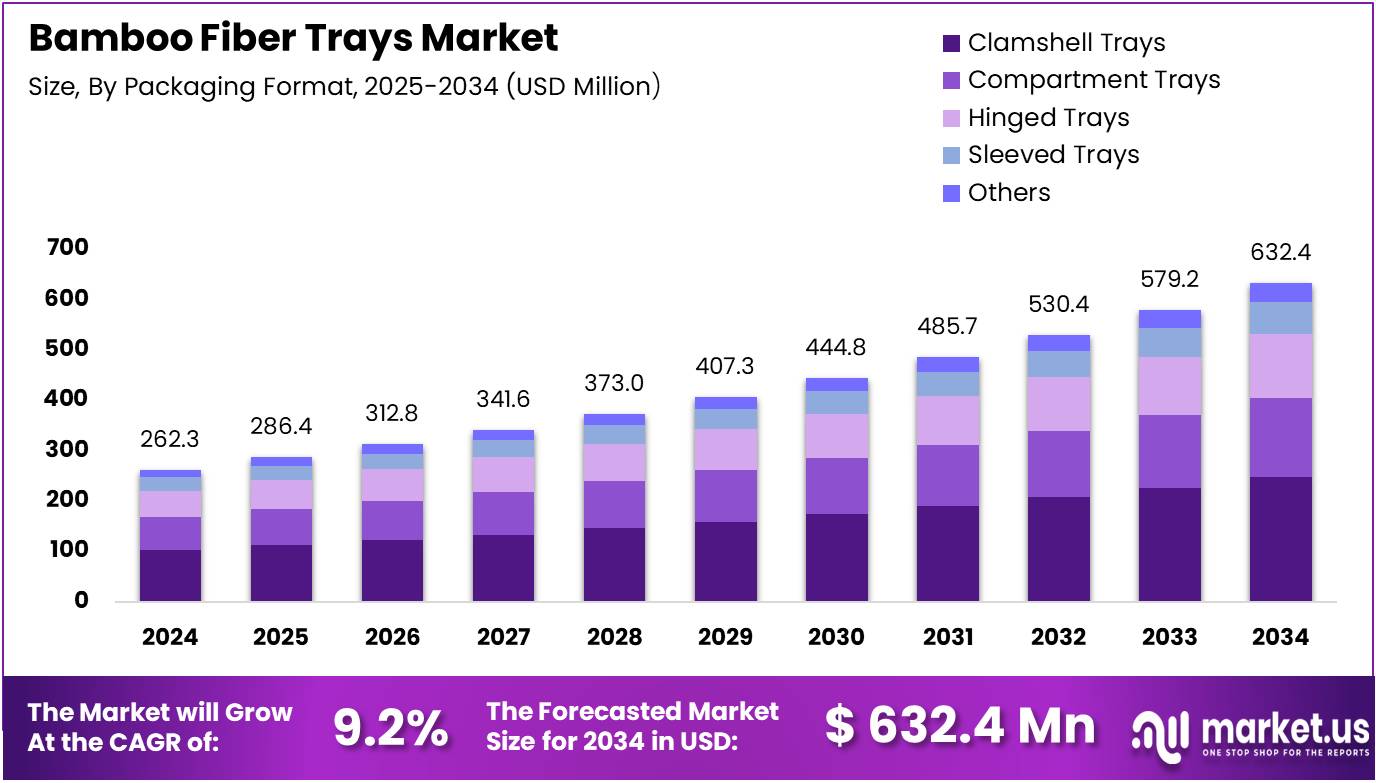
The Global Bamboo Fiber Trays Market size is expected to be worth around USD 632.4 Million by 2034, from USD 262.3 Million in 2024, growing at a CAGR of 9.2% during the forecast period from 2025 to 2034.
The Bamboo Fiber Trays Market is experiencing strong growth as industries increasingly seek eco-friendly and sustainable packaging solutions. Businesses are adopting renewable alternatives that are durable, lightweight, and compostable, making them suitable for retail and foodservice applications. This trend aligns with growing consumer awareness and corporate sustainability goals.
Market expansion is supported by rising demand in ready meals and takeaway segments. Companies are transitioning from traditional plastic and paper trays to bamboo fiber options. Advances in molding and manufacturing technologies enhance tray quality and production efficiency, allowing businesses to meet consumer expectations while reducing operational challenges and ensuring consistent product performance.
Government regulations and supportive policies encourage the adoption of biodegradable packaging. Incentives, subsidies, and eco-friendly packaging mandates motivate manufacturers to invest in bamboo fiber solutions. These measures strengthen market growth prospects, promote sustainable manufacturing practices, and enable businesses to align with environmental standards while maintaining competitiveness in packaging and logistics operations.
Opportunities emerge in customizable and high-volume packaging applications. Bamboo fiber trays can be tailored to specific product sizes, shapes, and designs, offering differentiation for brands. Collaboration with local bamboo suppliers enhances cost-effectiveness, reduces supply chain risks, and promotes sustainability, enabling manufacturers to efficiently scale production while supporting regional economic development and resource optimization.
Operational and environmental advantages drive adoption further. Transitioning to bamboo trays can reduce packaging costs by 12%, while generating up to 97% less CO2 during production. These benefits support corporate sustainability initiatives and offer measurable improvements in both financial and environmental performance, strengthening the business case for bamboo fiber trays.
Additionally, bamboo fiber trays minimize logistics challenges and environmental impact. Packaging-related emissions are reduced by 43%, while product damage during shipping decreases significantly. These factors improve operational efficiency, reduce costs, and enhance sustainability credentials, making bamboo fiber trays a compelling choice for manufacturers and retailers in the growing eco-conscious packaging market.
Key Takeaways
- The Global Bamboo Fiber Trays Market is expected to grow from USD 262.3 Million in 2024 to USD 632.4 Million by 2034, at a CAGR of 9.2%.
- Bamboo Pulp / Fiber dominates the market with a 39.7% share in the By Material segment.
- Clamshell Trays lead the By Packaging Format segment with a 38.6% share.
- Molded Pulp Thermoforming holds the largest share in the By Technology segment at 36.2%.
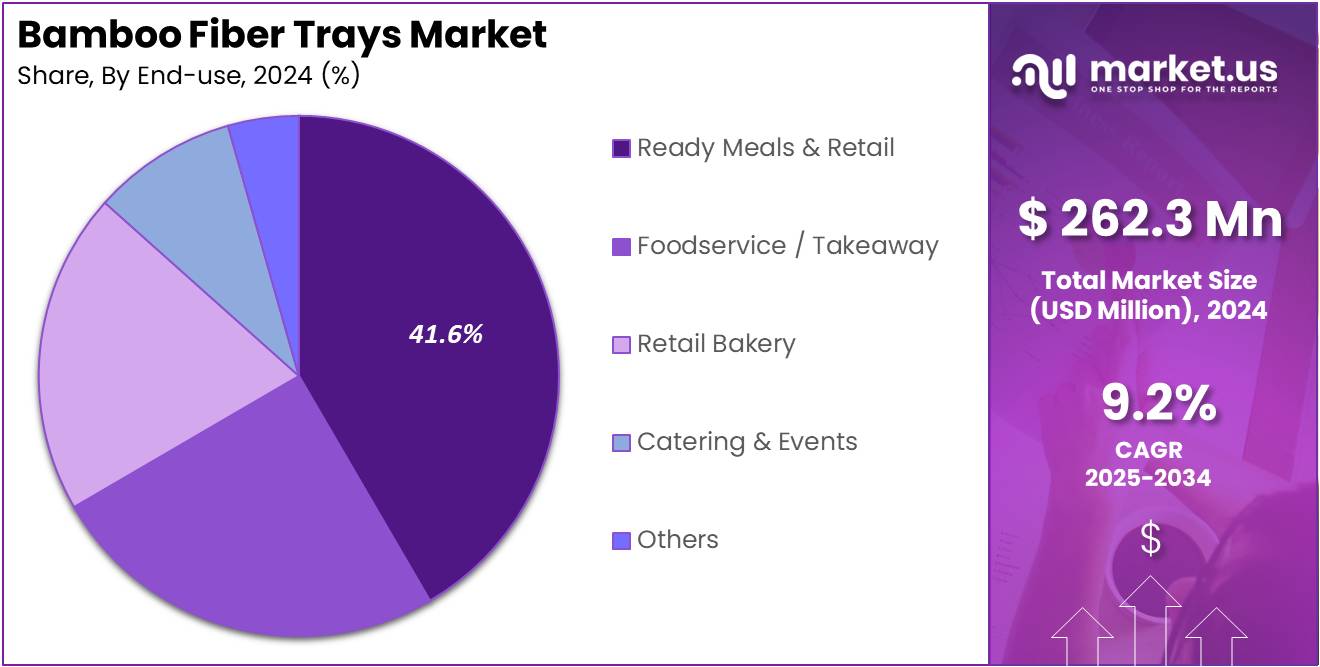
- Ready Meals & Retail is the dominant end-use segment with a 41.6% market share.
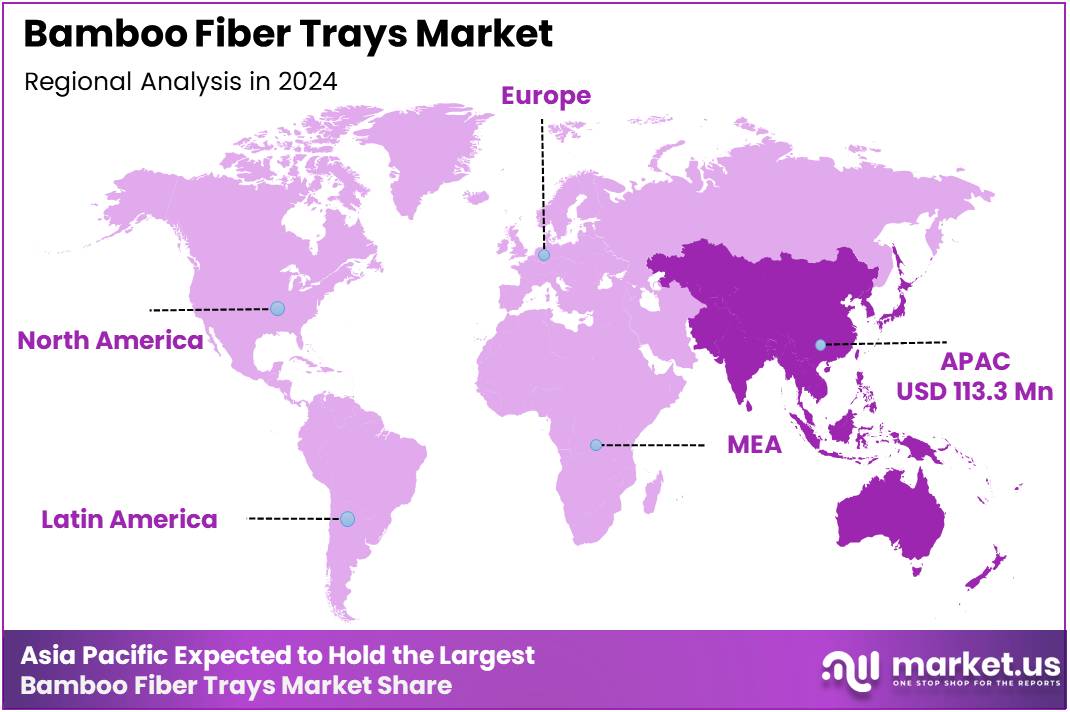
- Asia Pacific leads the regional market with a 43.2% share, valued at USD 113.3 Million in 2024.
By Material Analysis
Bamboo Pulp / Fiber dominates with 39.7% due to its eco-friendly nature and high durability.
In 2024, Bamboo Pulp / Fiber held a dominant market position in the By Material segment of Bamboo Fiber Trays Market, with a 39.7% share. Its renewable properties and cost-effective production have encouraged manufacturers to adopt this material extensively across multiple packaging applications, boosting market adoption globally. The material is lightweight yet strong, offering superior protection during transit.
Bagasse-Bamboo Blends offer an alternative that combines sustainability with improved strength. Manufacturers increasingly prefer these blends as they balance eco-consciousness and durability, appealing to consumers seeking environmentally responsible packaging without compromising on product performance.They also allow customization in tray design and thickness, making them versatile for various food categories.
Fully Compostable Fiber is gaining attention due to rising environmental regulations. Its ability to decompose rapidly and reduce landfill waste has positioned it as a preferred choice for brands committed to sustainability initiatives and green packaging strategies. Consumers are increasingly selecting products with compostable packaging. It also enhances corporate sustainability credentials, influencing purchasing decisions positively.
Local Bamboo Blends are becoming relevant in regional markets. By utilizing locally sourced bamboo, producers reduce transportation costs, lower carbon footprint, and support local economies, creating a favorable perception among environmentally aware consumers. This approach strengthens local supply chains and ensures consistent raw material quality. It also fosters community engagement and promotes regional sustainability efforts.
Other materials include emerging bio-based fibers. While they currently hold a smaller share, ongoing innovation in alternative natural fibers may enhance their adoption in future bamboo tray applications, especially in niche markets focused on eco-friendly solutions. Research continues to explore higher strength and biodegradability. Early adoption in premium products may drive gradual market growth.
By Packaging Format Analysis
Clamshell Trays dominates with 38.6% due to its convenience and secure packaging benefits.
In 2024, Clamshell Trays held a dominant market position in the By Packaging Format segment of Bamboo Fiber Trays Market, with a 38.6% share. Their versatility and tamper-resistant design make them popular in ready-to-eat meals, enhancing consumer convenience and reducing product spillage during transport. The trays are easy to stack and store. They also provide extended product shelf-life compared to other formats.
Compartment Trays are widely used for meals requiring separate sections. These trays prevent mixing of food items, maintain visual appeal, and enhance portion control, making them ideal for both retail and foodservice applications. They are highly preferred for multi-item meals. Additionally, they improve customer satisfaction by keeping foods fresh and organized.
Hinged Trays provide user-friendly access while maintaining product security. Their foldable design simplifies storage and transportation, making them suitable for both single-use and takeaway scenarios where convenience is a priority. They reduce handling errors and minimize spillage. Their reclosable feature also encourages reuse in some settings, adding extra convenience for consumers and retailers alike.
Sleeved Trays are emerging in premium segments. Their customizable sleeves offer branding opportunities and additional protection for delicate products, attracting high-end food retailers aiming to enhance shelf appeal and customer experience. The trays also help in marketing products effectively. They maintain product integrity while delivering a premium unboxing experience.
Other tray formats include niche designs like collapsible or modular trays. Though currently limited in adoption, they are gaining traction due to their space-saving attributes and ability to cater to specialized packaging requirements. These formats support innovative food presentation. They are particularly suitable for gourmet and specialty markets.
By Technology Analysis
Molded Pulp Thermoforming dominates with 36.2% due to efficiency and consistent tray quality.
In 2024, Molded Pulp Thermoforming held a dominant market position in the By Technology segment of Bamboo Fiber Trays Market, with a 36.2% share. Its capability to produce high-quality, lightweight trays at scale has made it a preferred choice for manufacturers worldwide. The method allows precise molding of shapes. It also ensures uniform thickness and strength across trays. This technology continues to lead due to its scalability and cost-effectiveness for mass production.
Compression Molding offers durability and structural strength. It is favored for heavy-duty trays that require higher load-bearing capacity, making it suitable for industrial and bulk packaging applications. The technique allows customization in density. Additionally, it ensures long-lasting tray performance under challenging conditions. Manufacturers benefit from reduced breakage and enhanced tray lifespan in demanding applications.
High-speed Press Molding emphasizes production efficiency. Manufacturers adopt this method to meet growing demand while maintaining quality, reducing production time, and ensuring rapid market availability for bamboo trays. The technology supports large-scale operations. It also minimizes labor costs while optimizing throughput. This method is increasingly used in regions with high-volume packaging requirements.
Wet Molding enables flexibility in design and material usage. Its adaptability allows manufacturers to experiment with innovative tray shapes and sizes, catering to evolving packaging trends and consumer preferences. Wet molding supports creative surface textures. It is particularly useful for eco-conscious, artisanal food products requiring unique packaging. It also helps brands differentiate through custom designs and finishes.
Other technologies include hybrid molding and emerging methods. These are gradually gaining attention due to their potential to improve tray performance, reduce material waste, and support sustainable production practices. They encourage innovation in lightweight tray designs. They may also enable faster adaptation to changing packaging standards.
By End-use Analysis
Ready Meals & Retail dominates with 41.6% due to increasing demand for convenient and eco-friendly food packaging.
In 2024, Ready Meals & Retail held a dominant market position in the By End-use segment of Bamboo Fiber Trays Market, with a 41.6% share. Rising urbanization and on-the-go consumption trends have fueled demand for convenient, sustainable packaging solutions. Ready meal producers benefit from eco-friendly branding. Consumers increasingly prefer packaging that aligns with their sustainability values.
Foodservice / Takeaway applications leverage bamboo trays for their eco-friendly and hygienic properties. Restaurants and cafes increasingly adopt these trays to meet customer expectations for sustainability and convenience. The trays simplify waste management. They also enhance operational efficiency during busy service hours.
Retail Bakery products benefit from bamboo trays due to their strength and aesthetic appeal. These trays maintain product freshness, enhance visual presentation, and attract environmentally conscious consumers seeking sustainable packaging. The trays prevent damage during transportation. They also contribute to premium product perception in-store.
Catering & Events use bamboo trays for large-scale food distribution. Their durability and compostable nature simplify cleanup while supporting environmentally responsible practices during events, catering services, and institutional meals. Trays are easy to transport and stack. They also meet regulatory sustainability requirements for large gatherings.
Other end-use applications include niche food segments and specialty retail. While these currently hold smaller shares, they provide opportunities for innovation in sustainable packaging solutions, meeting evolving consumer and regulatory demands. They also support experimental packaging for limited-edition or seasonal products.
Key Market Segments
By Material
- Bamboo Pulp / Fiber
- Bagasse-Bamboo Blends
- Fully Compostable Fiber
- Local Bamboo Blends
- Others
By Packaging Format
- Clamshell Trays
- Compartment Trays
- Hinged Trays
- Sleeved Trays
- Others
By Technology
- Molded Pulp Thermoforming
- Compression Molding
- High-speed Press Molding
- Wet Molding
- Others
By End-use
- Ready Meals & Retail
- Foodservice / Takeaway
- Retail Bakery
- Catering & Events
- Others
Drivers
Rising Demand for Sustainable and Eco-Friendly Packaging Solutions
Stringent regulations on single-use plastics are pushing the foodservice industry to look for alternatives. Many governments now limit or ban plastic packaging, creating a strong market opportunity for bamboo fiber trays. This regulatory support is encouraging manufacturers to invest more in eco-friendly options, related to global efforts to reduce plastic waste.
Consumer awareness about environmental impact is also growing. Shoppers increasingly prefer products with eco-friendly packaging, and this trend is influencing purchasing decisions. Bamboo fiber trays offer a natural and sustainable solution, aligning with these consumer values and boosting adoption across foodservice and retail sectors. This shift in consumer behavior is related to the growing demand for sustainable lifestyle products.
The retail and quick-service restaurant segments are witnessing rapid growth in sustainable packaging. Many brands are switching from plastic to compostable trays to appeal to environmentally conscious customers. This shift is driving innovation and increasing production of bamboo fiber trays globally.
Moreover, sustainable packaging helps companies enhance their brand image. Businesses adopting bamboo fiber trays can highlight their environmental responsibility, which attracts more consumers and supports long-term market growth. This trend is related to marketing strategies focused on sustainability and corporate social responsibility.
Restraints
Performance and Design Limitations Restrict Wider Adoption of Bamboo Fiber Trays
One of the key restraints in the bamboo fiber trays market is their limited resistance to moisture and heat when compared to plastic and coated paper trays. Bamboo fiber trays can absorb water over time, which may weaken their structure and reduce product safety. This limits their use in foods with high moisture content, such as gravies, sauces, and oily meals. As a result, some foodservice operators still prefer conventional materials for better performance.
Heat resistance is another challenge affecting market growth. Bamboo fiber trays may deform or lose strength when exposed to high temperatures, especially during reheating or hot food storage. This creates concerns for ready-to-eat meals and hot takeaway applications. In contrast, plastic and coated paper trays offer more stable performance under heat, making them a preferred choice in some use cases.
Another important restraint is the lack of standardization in tray sizes and shapes. Food producers often need specific dimensions to fit automated filling, sealing, and stacking systems. Variations in bamboo fiber tray designs can lead to inefficiencies and higher operational costs. This makes large-scale adoption difficult for manufacturers seeking uniform packaging solutions.
Growth Factors
Rising Demand for Sustainable Food Packaging Drives Market Growth
The bamboo fiber trays market shows strong growth opportunities due to rising use in ready-to-eat meals and food delivery packaging. As urban lifestyles become busier, consumers prefer convenient food options with safe and eco-friendly packaging. Bamboo fiber trays meet this need by offering plastic-free, disposable solutions that align with sustainability goals of food brands and delivery platforms.
Another key opportunity comes from the expanding demand for compostable packaging in hospitality and catering services. Hotels, restaurants, and event caterers are actively reducing plastic usage to meet environmental standards. Bamboo fiber trays help these businesses improve their green image while maintaining hygiene and food presentation. This shift supports steady demand from large-scale food service operations.
The increasing use of bamboo fiber trays in fresh produce and meat packaging is also creating new growth avenues. Retailers are replacing foam and plastic trays with natural fiber-based alternatives to appeal to eco-conscious shoppers. Bamboo fiber trays provide adequate strength and visual appeal, making them suitable for fruits, vegetables, and fresh meat displays.
Emerging Trends
Rising Preference for Home-Compostable and Plastic-Free Food Packaging Drives Market Growth
The bamboo fiber trays market is witnessing a clear shift toward unbleached and chemical-free products. Food brands and packaging buyers are focusing on natural fiber appearance to improve sustainability perception. These trays reduce chemical usage during production, support safer food contact, and align well with clean-label packaging trends.
Another key trend is the growing integration of molded fiber technology for customized tray designs. Manufacturers are using advanced molding techniques to create trays with better strength, improved shape accuracy, and tailored compartments. This helps foodservice and ready-meal companies improve product presentation while maintaining eco-friendly packaging goals.
Customization through molded fiber technology also supports brand differentiation. Trays can be designed for specific portion sizes, food types, and handling needs. As automation improves, production efficiency is increasing, making customized bamboo fiber trays more commercially viable for large-scale food packaging operations. This trend is helping food brands balance visual appeal with sustainability and cost efficiency.
Rising preference for home-compostable and plastic-free food packaging is further accelerating market demand. Consumers increasingly want packaging that can be disposed of easily without harming the environment. Bamboo fiber trays meet this need by offering compostability without additional coatings or plastic layers.
Regional Analysis
Asia Pacific Dominates the Bamboo Fiber Trays Market with a Market Share of 43.2%, Valued at USD 113.3 Million
Asia Pacific remains the dominant region in the Bamboo Fiber Trays Market due to abundant raw material availability and cost-efficient manufacturing capabilities. In 2024, the region captured 43.2% of the global market, reaching a value of USD 113.3 Million. Rapid growth of ready-to-eat meals, expanding food delivery platforms, and government-backed sustainability initiatives are accelerating adoption. Additionally, rising urban populations and shifting consumer preferences toward eco-friendly packaging strengthen long-term market leadership.
North America Bamboo Fiber Trays Market Trends
North America demonstrates consistent growth, supported by increasing regulatory pressure on plastic-based food packaging. Foodservice providers are actively transitioning toward fiber trays to meet sustainability targets and improve brand perception. Strong demand from takeaway meals and institutional catering continues to drive stable market expansion across the region.
Europe Bamboo Fiber Trays Market Trends
Europe is characterized by a well-established sustainability framework and high acceptance of biodegradable packaging solutions. Strict environmental regulations encourage food manufacturers to adopt bamboo fiber trays as compliant alternatives. Continuous investment in recyclable and compostable packaging innovations further supports moderate but steady regional growth.
Middle East and Africa Bamboo Fiber Trays Market Trends
The Middle East and Africa market is gradually gaining momentum, driven by expanding hospitality, tourism, and organized foodservice sectors. Growing awareness of environmental responsibility is encouraging the adoption of fiber-based trays. However, market growth remains measured due to limited local production and higher dependence on imports.
Latin America Bamboo Fiber Trays Market Trends
Latin America represents an emerging market, with increasing focus on sustainable packaging across retail and foodservice industries. Rising consumption of packaged and convenience foods supports demand for bamboo fiber trays. Improvements in regulatory frameworks and supply chain infrastructure are expected to enhance market penetration over time.
Key Regions and Countries
North America
- US
- Canada
Europe
- Germany
- France
- The UK
- Spain
- Italy
- Rest of Europe
Asia Pacific
- China
- Japan
- South Korea
- India
- Australia
- Rest of APAC
Latin America
- Brazil
- Mexico
- Rest of Latin America
Middle East & Africa
- GCC
- South Africa
- Rest of MEA
Key Bamboo Fiber Trays Company Insights
Huhtamaki continues to solidify its leadership in the bamboo fiber trays segment by leveraging its extensive global footprint and strong sustainability credentials. The company’s emphasis on closed-loop production and renewable materials positions it well against evolving regulatory pressures and growing customer demand for eco-friendly packaging. Its operational scale allows for competitive pricing while maintaining quality standards.
Duni is gaining traction through targeted innovation and design-led product differentiation in the sustainable packaging space. Focused investments in biodegradable solutions resonate with premium food service operators seeking both aesthetic appeal and environmental performance. Duni’s agile product development also enables quicker responses to shifting consumer preferences in key markets across Europe and Asia.
Stora Enso benefits from deep expertise in fiber materials and a strategic pivot toward bio-based trays, underpinned by strong R&D capabilities. The company’s integration of bamboo fiber into its broader portfolio enhances its appeal to large food and retail partners aiming to reduce plastic dependency. Stora Enso’s commitment to circularity also strengthens long-term partnerships with environmentally conscious brands.
Uflex leverages its broad packaging solutions infrastructure to expand in the bamboo fiber trays market with an emphasis on scalable manufacturing and cost efficiency. Uflex’s established relationships across food and beverage sectors support accelerated adoption of its sustainable tray products. Its focus on operational excellence and supply chain optimization mitigates input cost pressures and supports competitive delivery timelines.
Top Key Players in the Market
- Huhtamaki
- Duni
- Stora Enso
- Uflex
- Toppan
- Others
Recent Developments
- In October 2025, G-COVE launched eco-friendly bamboo fiber molded pulp produce trays for supermarkets and fresh food retail.This launch focused on replacing plastic trays with sustainable alternatives while improving shelf appeal and environmental performance.
- In July 2025, Top Bamboo Technology introduced its independently developed biodegradable bamboo fiber trays for fresh produce and food packaging.The product range strengthened market availability of fully biodegradable trays designed for daily foodservice and retail use.
- In February 2024, UK-based envoPAP secured funding of $490,000 to scale agricultural waste-based packaging solutions.The investment supported expansion of bamboo and bagasse fiber trays, targeting wider adoption of sustainable food packaging.
Report Scope
Report Features Description Market Value (2024) USD 262.3 Million Forecast Revenue (2034) USD 632.4 Million CAGR (2025-2034) 9.2% Base Year for Estimation 2024 Historic Period 2020-2023 Forecast Period 2025-2034 Report Coverage Revenue Forecast, Market Dynamics, Competitive Landscape, Recent Developments Segments Covered By Material (Bamboo Pulp / Fiber, Bagasse-Bamboo Blends, Fully Compostable Fiber, Local Bamboo Blends, Others), By Packaging Format (Clamshell Trays, Compartment Trays, Hinged Trays, Sleeved Trays, Others), By Technology (Molded Pulp Thermoforming, Compression Molding, High-speed Press Molding, Wet Molding, Others), By End-use (Ready Meals & Retail, Foodservice / Takeaway, Retail Bakery, Catering & Events, Others) Regional Analysis North America (US and Canada), Europe (Germany, France, The UK, Spain, Italy, and Rest of Europe), Asia Pacific (China, Japan, South Korea, India, Australia, and Rest of APAC), Latin America (Brazil, Mexico, and Rest of Latin America), Middle East & Africa (GCC, South Africa, and Rest of MEA) Competitive Landscape Huhtamaki, Duni, Stora Enso, Uflex, Toppan, Others Customization Scope Customization for segments, region/country-level will be provided. Moreover, additional customization can be done based on the requirements. Purchase Options We have three licenses to opt for: Single User License, Multi-User License (Up to 5 Users), Corporate Use License (Unlimited User and Printable PDF) 
-
-
- Huhtamaki
- Duni
- Stora Enso
- Uflex
- Toppan
- Others
Our Clients

- 171711
- Dec 2025






