


Global Avenanthramides Market By Type (Natural and Synthetic), By Purity (Up to 98% and Above 98%), By Application (Personal Care And Cosmetics, Pharmaceutical, Nutraceuticals, and Others), By Region and Companies - Industry Segment Outlook, Market Assessment, Competition Scenario, Trends and Forecast 2025-2035
- Published date: Mar 2026
- Report ID: 180497
- Number of Pages: 211
- Format:
-
keyboard_arrow_up
Quick Navigation
Report Overview
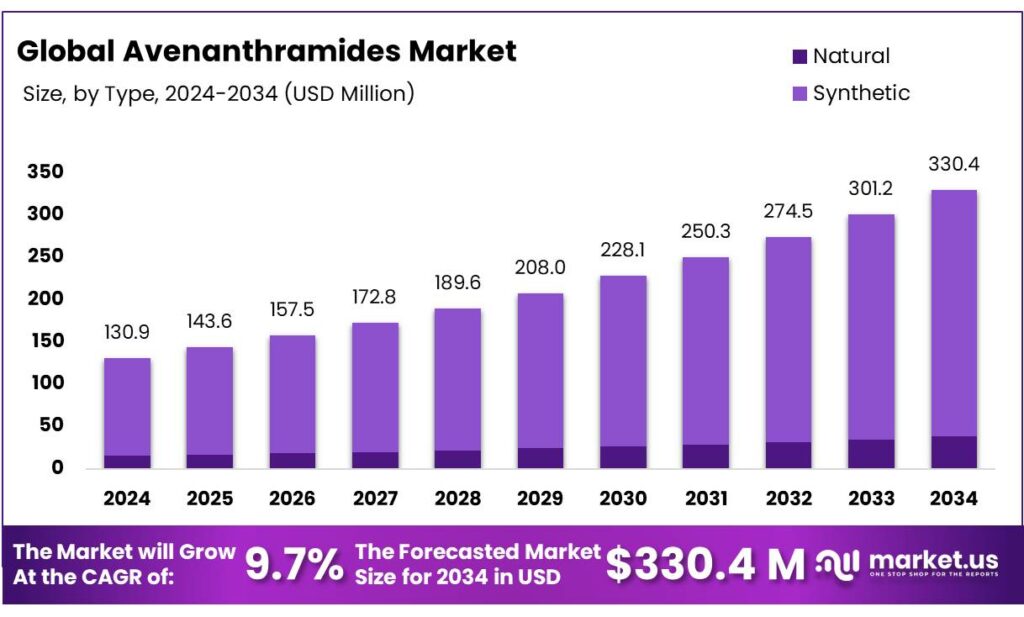
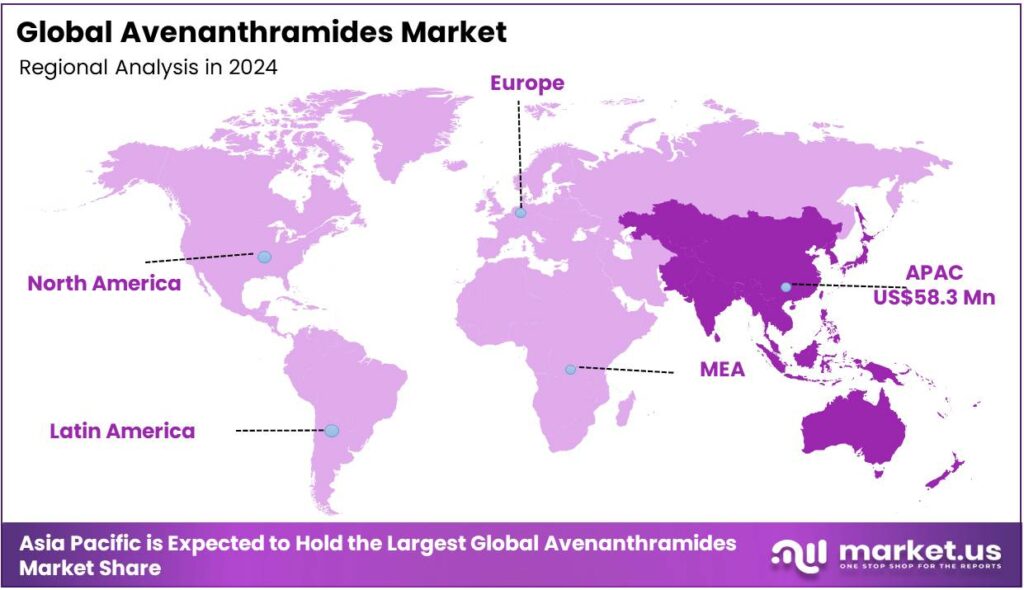
Global Avenanthramides Market is expected to be worth around USD 330.4 Million by 2035, up from USD 130.9 Million in 2025, at a CAGR of 9.7% from 2026 to 2035. The Asia Pacific segment maintained 44.5%, supporting a Avenanthramides value of USD 58.3 Mn.
Avenanthramides (AVNS) are unique antioxidants and anti-inflammatory compounds found exclusively in oats, and are known for their potential health benefits, including soothing skin irritation, improving heart health, and combating inflammation by scavenging free radicals.
- Oats, Avena sativa L., are cereal crops with the same origin as medicines and food, ranking 6th in terms of cereal production worldwide, followed by wheat, maize, rice, barley, and sorghum.
The market is largely driven by their use in the personal care and cosmetics industries, where they are valued for their potent anti-inflammatory and antioxidant properties. The shift towards natural and clean beauty products has further fueled demand for avenanthramides, with consumers increasingly seeking ingredients that are effective and gentle.
- The crude milling oat products, including oat grains, oat flour, oat bran, oat cereal, and oat bread, contain around 37-45, 33-70, 33-94, 25-78, and 5-6 µg/g AVNs, respectively. Refined oat products, such as extruded breakfast cereal and oat pasta, contain fewer AVNs, ranging from 2 to 30 µg/g, compared to crude milling oat products.
These polyphenols, which are abundant in oat bran and flakes, are bioavailable in humans. Although their use extends to the pharmaceutical and nutraceutical sectors, particularly for managing skin conditions, the personal care industry remains the largest consumer due to the widespread popularity of topical treatments.
However, the market faces challenges such as fluctuations in global oat production, geopolitical tensions, and the competition between synthetic and natural sources, which could affect the stability and growth of the avenanthramides supply chain. Despite these obstacles, avenanthramides continue to hold significant potential across various health and wellness sectors.
- In the United States, oat production has suffered a dramatic 98% drop over the past several decades, with harvested acreage in key agricultural states such as Illinois, Iowa, Minnesota, and Wisconsin plummeting from 18.3 million acres in 1950 to just 294,000 acres in 2024.
Key Takeaways:
- The global avenanthramides market was valued at US$130.9 million in 2024.
- The global avenanthramides market is projected to grow at a CAGR of 9.7% and is estimated to reach US$330.4 million by 2034.
- On the basis of product type, synthetic avenanthramides dominated the market, constituting 88.4% of the total market share.
- Based on the purity, avenanthramides that are more than 98% pure dominated the market, with a substantial market share of around 72.1%.
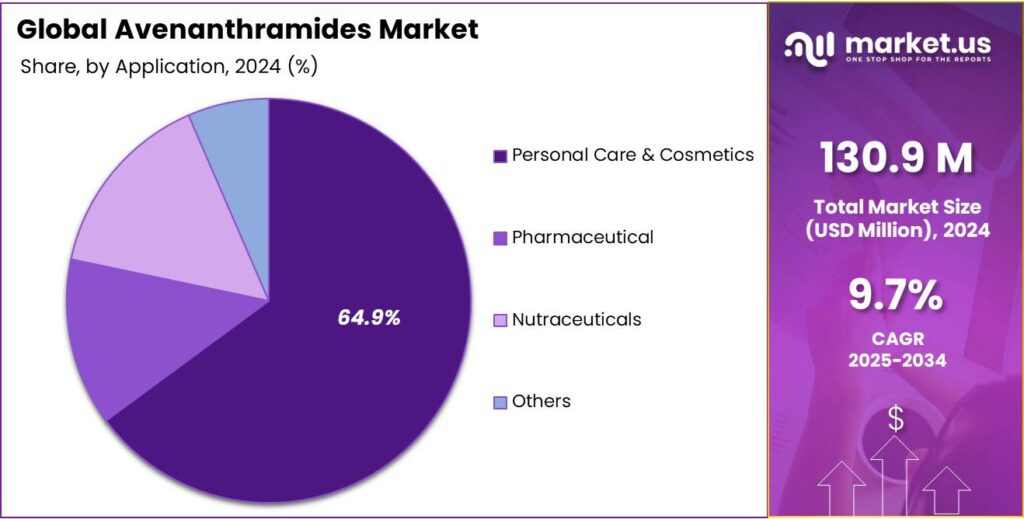
- Among the applications, the personal care & cosmetics sector held a major share in the avenanthramides market, 64.9% of the market share.
- In 2024, the Asia Pacific was the most dominant region in the avenanthramides market, accounting for 44.5% of the total global consumption.
Product Type Analysis
Synthetic Avenanthramides are a Prominent Segment in the Market.
The avenanthramides market is segmented based on product type into natural and synthetic. The synthetic avenanthramides led the market, comprising 88.4% of the market share, due to several factors, primarily cost efficiency and scalability in production. The synthetic version can be produced in large quantities with greater consistency, which makes it more accessible for manufacturers in the cosmetics and pharmaceutical industries.
Additionally, synthetic avenanthramides offer more precise control over the formulation, ensuring uniformity in product performance. In contrast, the natural avenanthramides require significant amounts of raw oats, and their extraction process can be more labor-intensive and expensive, which limits their widespread use.
Purity Analysis
Avenanthramides That is More Than 98% Pure Dominated the Market.
On the basis of purity, the avenanthramides market is segmented into up to 98% and above 98%. The avenanthramides that have purity above 98% dominated the market, comprising 72.1% of the market share, due to their higher efficacy and reliability in formulations. The greater the purity, the more concentrated the active compounds, which translates into stronger anti-inflammatory and antioxidant properties, which is particularly important in the cosmetics and pharmaceutical industries, where product performance is a key differentiator.
Additionally, highly purified avenanthramides have fewer impurities, which reduces the risk of adverse reactions in sensitive skin types. Consequently, manufacturers prioritize high-purity avenanthramides to meet consumer expectations for safety, quality, and efficacy, ultimately enhancing the product’s overall market appeal.
Application Analysis
Avenanthramides Products Are Mostly Utilized for the Manufacturing of Personal Care & Cosmetic Products.
Based on the applications, the avenanthramides market is segmented into personal care & cosmetics, pharmaceuticals, nutraceuticals, and others. Among the applications of the avenanthramides, 64.9% of the products consumed globally are from the personal care & cosmetics industry, as they are primarily sought after for their topical benefits, particularly their anti-inflammatory and antioxidant properties. In skincare, avenanthramides are highly effective in soothing irritated or sensitive skin, reducing redness, and improving skin hydration, making them ideal for a wide range of products such as moisturizers, sunscreens, and anti-aging creams.
In addition, the cosmetics industry benefits from the growing trend toward clean beauty, where consumers demand natural, gentle ingredients. While there is potential for avenanthramides in pharmaceuticals and nutraceuticals, their use is more limited due to the regulatory requirements, higher formulation complexity, and a narrower range of clinical applications compared to their cosmetic uses, where they provide immediate and visible benefits.
Key Market Segments:
By Product Type
- Natural
- Synthetic
By Purity
- Up to 98%
- Above 98%
By Application
- Personal Care & Cosmetics
- Skin Care
- Hair Care
- Others
- Pharmaceutical
- Nutraceuticals
- Others
Drivers
Booming Personal Care and Cosmetics Industry Drives the Avenanthramides Market.
The booming personal care and cosmetics industry has significantly contributed to the growing demand for avenanthramides, active compounds derived from oats known for their anti-inflammatory and antioxidant properties. Avenanthramides have become increasingly popular in skincare formulations, particularly in products targeting sensitive or irritated skin. Their ability to soothe inflammation, reduce redness, and enhance skin hydration has made them a key ingredient in various cosmetics, such as moisturizers, serums, and sunscreens.
- According to a global survey conducted by IBM and the National Retail Federation, 71% of the respondents who indicated that traceability of ingredients is very important in consumer products, including beauty, are willing to pay a premium for brands that provide it.
Moreover, with consumers becoming more conscious of ingredient transparency and seeking natural, plant-based alternatives, the demand for avenanthramides in skincare has surged. For instance, brands such as Aveeno have effectively incorporated oats and avenanthramides into their products, capitalizing on the growing trend of clean beauty. As consumer preference shifts toward products with minimal chemicals and sustainable ingredients, avenanthramides are likely to remain a favored choice, driving further innovation and expansion in the cosmetics sector.
Restraints
Declining Oat Production Globally Might Dampen the Growth of the Avenanthramides Market.
The global decline in oat production poses a potential challenge to the growth of the avenanthramides market. As oats are the primary source of avenanthramides, the reduced acreage and limited cultivation may constrain the availability of this key ingredient. The sharp decline is attributed to the consolidation of agricultural practices around more economically profitable crops such as corn and soybeans, which have displaced oats.
- According to the US Department of Agriculture, the global oat production saw a staggering 11.4% decline from 25.5 million metric tons in 2020 to 22.6 million metric tons in 2024.
Market Production (2024, Metric Tons) Production (2020, Metric Tons) European Union 7.76 Million 8.5 Million Canada 3.36 Million 4.1 Million Russia 3 Million 4.6 Million Australia 1.32 Million 1.9 Million Brazil 1.04 Million 954,000 United States 992,000 853,000 United Kingdom 986,000 1.0 Million China 850,000 760,000 Argentina 556,000 510,000 Chile 475,000 525,000 Rest of the World 2.3 Million 2.2 Million Total 22.6 Million 25.5 Million Additionally, limited research into new oat cultivars has further impeded the crop’s growth potential. This situation may lead to supply chain issues for manufacturers in the personal care and cosmetics industry that rely on oats and avenanthramides for their products, potentially impacting the growth of the market.
Opportunity
Growing Application in Pharmaceutical Industry Creates Opportunities in the Avenanthramides Market.
The increasing application of avenanthramides in the pharmaceutical industry presents a significant opportunity for market expansion. The compound is known for its potent anti-inflammatory and antioxidant properties, and has been increasingly incorporated into formulations for managing conditions such as eczema, dermatitis, and psoriasis. Several studies demonstrated their ability to alleviate skin irritation and inflammation, making them a valuable component in topical treatments.
For instance, clinical trials have shown that avenanthramides can reduce the severity of eczema symptoms when included in ointments or creams, offering a natural alternative to traditional corticosteroid treatments. The growing trend of patients seeking plant-based, non-steroidal options further supports the demand for avenanthramides.
Additionally, the anti-inflammatory properties of avenanthramides have sparked interest in their potential for oral supplements aimed at managing systemic inflammation and related conditions. Leveraging the trend, several players offer concentrated oat powder. This expanding role in topical and oral pharmaceutical applications positions avenanthramides as a promising ingredient for future growth within the healthcare sector.
Trends
Shift Towards Bioengineering for Avenanthramide Production.
The shift toward bioengineering for avenanthramide production is an emerging and necessary trend driven by rising global demand and the limitations of traditional oat-based sources. Although oats are the primary natural source of AVNs, their production is highly variable and unsustainable due to dependence on growth stage, environmental conditions, and crop management. While agronomic strategies such as germination, elicitor treatment, gene overexpression, and mutagenesis can significantly enhance AVN accumulation in oats, these approaches remain constrained by biological variability and scalability challenges.
In contrast, advances in metabolic engineering have enabled the reconstruction of AVN biosynthetic pathways in heterologous microorganisms such as Escherichia coli and Saccharomyces cerevisiae. These microbial platforms offer controlled, scalable, and year-round production, achieving higher and more consistent yields of both natural and novel AVNs with demonstrated bioactivities. Consequently, bioengineering-based production is increasingly viewed as a sustainable, efficient, and industrially viable alternative, positioning microbial AVN synthesis as a key future direction for meeting nutraceutical and functional food market demands.
Geopolitical Impact Analysis
Geopolitical Tensions Have Led to Disruption in the Production of Avenanthramides.
The geopolitical tensions, particularly between the United States and Canada, have the potential to significantly impact the avenanthramides market, primarily due to the strong dependence of avenanthramides production on oat supplies. As oats are the main source of avenanthramides, disruptions in the global oat market, such as those caused by tariffs, low oat stocks in Canada, and geopolitical instability, could hinder the availability of this key ingredient.
The US and Canada are deeply integrated in the oat market, with Canada being the largest supplier of oats to the US, which accounts for a substantial portion of global oat consumption. However, recent tariff complications between the two countries, along with disruptions in grain flows due to geopolitical tensions such as the conflict in Ukraine, have caused uncertainty in supply chains.
For instance, in 2025, the oat market in the US faced difficulties due to low stocks in Canada, compounded by the potential for escalating trade conflicts. This uncertainty has affected oat prices, with oats on the Chicago Board of Trade showing a downward trend, which may exacerbate challenges for companies relying on stable oat supplies for avenanthramides production.
Additionally, the increased shipping costs and the shift in export competitiveness could further strain the market, making it harder for manufacturers in the cosmetics and pharmaceutical sectors to secure a consistent supply of avenanthramides.
Regional Analysis
Asia Pacific Held the Largest Share of the Global Avenanthramides Market.
In 2024, the Asia Pacific dominated the global avenanthramides market, holding about 44.5% of the total global consumption, driven by increasing consumer demand for natural, plant-based ingredients in skincare and health products. Countries such as China, Japan, and South Korea have witnessed significant growth in the adoption of avenanthramides due to their anti-inflammatory and antioxidant properties, which align with the growing emphasis on holistic skincare and wellness.
In particular, China’s expanding middle class and growing interest in clean beauty products have made it a key market for ingredients like avenanthramides, commonly used in moisturizers and anti-aging treatments. Additionally, South Korea, known for its advanced skincare industry, favors natural ingredients, contributing to the surge in avenanthramide demand. Similarly, the region’s heightened awareness of skin sensitivity and dermatological issues has led to a preference for gentle, soothing ingredients, positioning avenanthramides as a critical component in the Asia Pacific’s skincare formulations.
- According to the United States Department of Agriculture, oat production is led by Australia and China, as Australian production reached approximately 1.3 million metric tons and Chinese production about 850,000 metric tons. This large production of oats translates to a large production of avenanthramides.
Key Regions and Countries:
- North America
- The US
- Canada
- Europe
- Germany
- France
- The UK
- Spain
- Italy
- Russia & CIS
- Rest of Europe
- APAC
- China
- Japan
- South Korea
- India
- ASEAN
- Rest of APAC
- Latin America
- Brazil
- Mexico
- Rest of Latin America
- Middle East & Africa
- GCC
- South Africa
- Rest of MEA
Key Players Analysis:
Companies in the avenanthramides market focus on investing in research and development to create innovative products that cater to the growing demand for natural, skin-friendly ingredients. This includes formulating new skincare and pharmaceutical products with enhanced efficacy, focusing on the anti-inflammatory and antioxidant properties of avenanthramides. Additionally, partnerships with major cosmetics and pharmaceutical brands enable companies to expand their reach. Furthermore, companies emphasize leveraging sustainable sourcing and transparent supply chains to align with the increasing consumer demand for eco-friendly and ethical products.
The Major Players in The Industry
- Cosciens Biopharma Inc.
- Chemicea Limited
- Symrise AG
- Henan Steeda Industrial Co., Ltd
- Oat Cosmetics
- Henan Alfa Chemical Co., Ltd.
- Xi’an Chen Lang Biological Technology Co., Ltd
- BOC Sciences
- Shaanxi Changsheng Industrial Co., Ltd.
- Xi’an Kev Biotech Inc.
- Other Key Players
Key Development:
- In March 2025, COSCIENS Biopharma, a life sciences company engaged in the development and commercialization of a diversified portfolio of cosmeceutical, nutraceutical, and pharmaceutical products, announced the initiation of its Phase 2a clinical efficacy study for its flagship avenanthramides product, which is being developed for potential applications in the management of inflammation-related conditions.
- In September 2023, Symrise launched SymCalmin Avena, an organic and sustainable cosmetic ingredient derived from oats, designed to soothe sensitive skin, reduce itching, and regulate moisture balance, with its highly concentrated content of avenanthramides of about 200-250 ppm.
Report Scope:
Report Features Description Market Value (2024) US$130.9 Mn Forecast Revenue (2034) US$330.4 Mn CAGR (2025-2034) 9.7% Base Year for Estimation 2024 Historic Period 2020-2023 Forecast Period 2025-2034 Report Coverage Revenue Forecast, Market Dynamics, Competitive Landscape, Recent Developments Segments Covered By Type (Natural and Synthetic), By Purity (Up to 98% and Above 98%), By Application (Personal Care & Cosmetics, Pharmaceutical, Nutraceuticals, and Others) Regional Analysis North America – The US & Canada; Europe – Germany, France, The UK, Spain, Italy, Russia & CIS, Rest of Europe; APAC– China, Japan, South Korea, India, ASEAN & Rest of APAC; Latin America– Brazil, Mexico & Rest of Latin America; Middle East & Africa– GCC, South Africa, & Rest of MEA Competitive Landscape Cosciens Biopharma, Chemicea Limited, Symrise AG, Henan Steeda Industrial Co., Ltd., Oat Cosmetics, Henan Alfa Chemical Co., Ltd., Xi’an Chen Lang Biological Technology Co., Ltd., BOC Sciences, Shaanxi Changsheng Industrial Co., Ltd., Xi’an Kev Biotech Inc., and Other Players. Customization Scope Customization for segments, region/country-level will be provided. Moreover, additional customization can be done based on the requirements. Purchase Options We have three licenses to opt for: Single User License, Multi-User License (Up to 5 Users), Corporate Use License (Unlimited Users and Printable PDF) 
-
-
- Cosciens Biopharma Inc.
- Chemicea Limited
- Symrise AG
- Henan Steeda Industrial Co., Ltd
- Oat Cosmetics
- Henan Alfa Chemical Co., Ltd.
- Xi'an Chen Lang Biological Technology Co., Ltd
- BOC Sciences
- Shaanxi Changsheng Industrial Co., Ltd.
- Xi'an Kev Biotech Inc.
- Other Key Players
Our Clients

- 180497
- Mar 2026






