


Report Overview
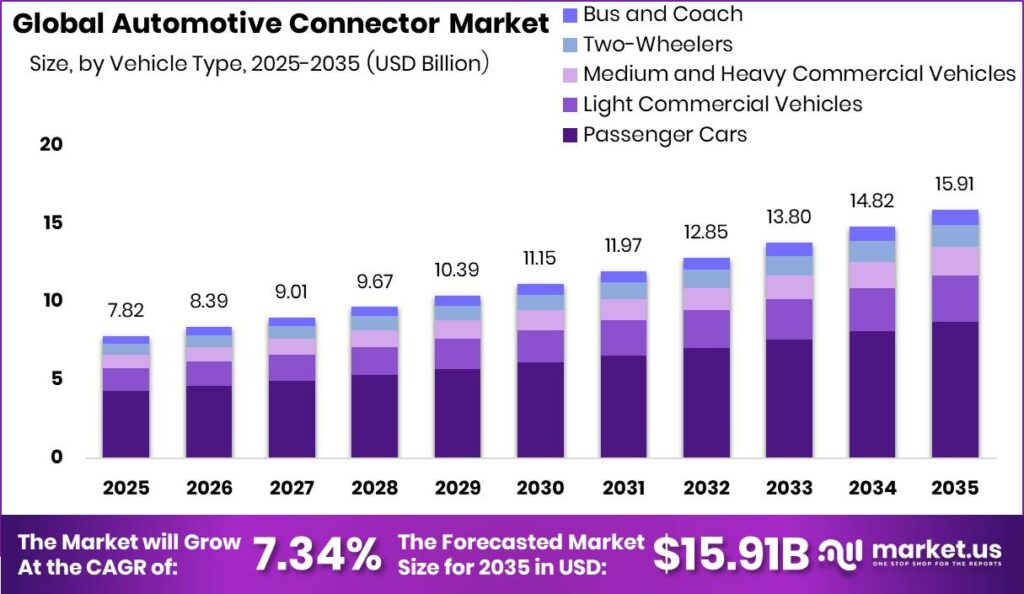
Global Automotive Connector Market size is expected to be worth around USD 15.91 Billion by 2035 from USD 7.82 Billion in 2025, growing at a CAGR of 7.34% during the forecast period 2026 to 2035. This trajectory reflects deepening electrical integration across all vehicle categories and powertrain types, signaling sustained procurement expansion for connector suppliers over the next decade.
The Automotive Wiring Harness market connects vehicles to their electrical systems through terminals, housings, seals, and interface assemblies spanning powertrain, safety, body, infotainment, and emerging autonomous functions. Connector suppliers serve OEMs and tier-one harness integrators, making design-in timing and validation cycles the primary competitive variable. This means early supplier engagement at the platform level determines revenue capture for the full vehicle lifecycle.
Key Takeaways
- Global Automotive Connector Market was valued at USD 7.82 Billion in 2025 and is forecast to reach USD 15.91 Billion by 2035.
- The market is projected to expand at a CAGR of 7.34% from 2026 to 2035.
- By Vehicle Type, Passenger Cars holds the dominant segment position with a 55.00% share.
- By Application, Powertrain leads with a 33.85% share, reflecting high connector intensity per vehicle.
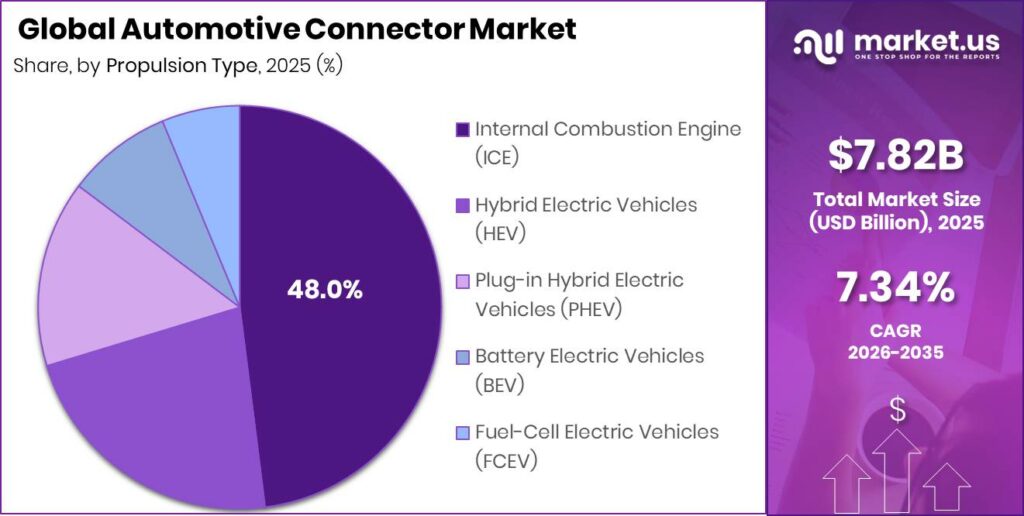
- By Propulsion Type, Internal Combustion Engine holds the largest share at 48.00%, with Battery Electric Vehicles identified as the fastest-growing sub-segment.
- By Connector Type, Wire-to-Wire leads with a 32.00% share; High-Speed and High-Voltage connectors are the fastest-growing sub-segment.
- By Connection Sealing, Sealed connectors dominate with a 69.00% share.
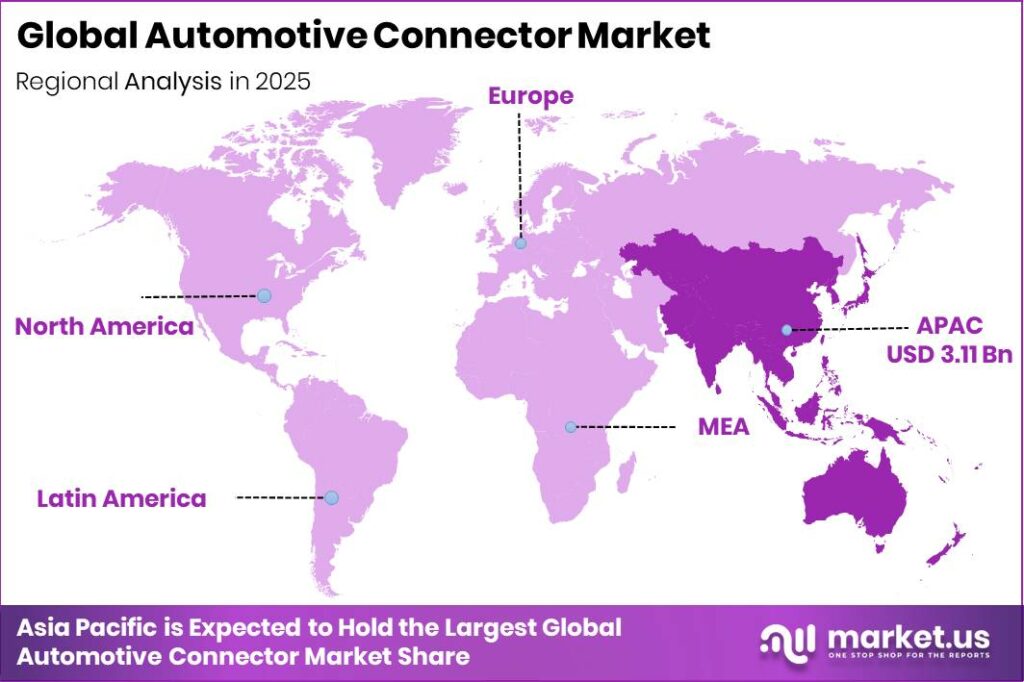
- Asia-Pacific is the leading region, holding a 39.85% market share valued at USD 3.12 Billion.
However, the shift toward electrified and software-defined vehicles is raising the electrical content per vehicle at every price tier. In July 2025, TE Connectivity contributed automation-ready connector geometry to the Next2OEM research initiative, targeting robotic harness assembly compatibility. This development signals that connector design is converging with manufacturing process engineering, giving suppliers who invest in automation-ready formats a structural cost and qualification advantage over those selling standard-geometry components.
Government fleet electrification mandates across China, the European Union, and North America are accelerating OEM platform transitions to higher-voltage architectures. Automotive Electronics content growth compounds connector demand because each new electronic control unit, sensor cluster, and power distribution node requires dedicated interconnect solutions. Suppliers positioned in sealed, high-voltage, and high-speed connector categories will disproportionately benefit from this regulatory push.
Vehicle Type Analysis
Passenger Cars dominates with 55.00% due to highest per-vehicle connector volume.
In 2025, Passenger Cars held a dominant market position in the By Vehicle Type segment of the Automotive Connector Market, with a 55.00% share. Passenger vehicles carry the densest electrical architecture among all vehicle categories, integrating powertrain management, active safety, infotainment, and body control modules across a single platform. According to the International Organization of Motor Vehicle Manufacturers, global passenger car production reached approximately 70 million units in 2024, sustaining high absolute connector demand. Suppliers focused on this segment hold the most defensible volume base in the market.
Light Commercial Vehicles represent the second-largest buyer group by connector content, driven by fleet electrification programs and expanding last-mile delivery requirements. The International Energy Agency reported that electric light commercial vehicles accounted for a growing share of new commercial registrations in 2024, with European fleet operators accelerating transition timelines under urban emission zone policies. This creates structural pull for sealed, vibration-resistant connector assemblies suited to mixed-use duty cycles. Suppliers serving this segment benefit from longer platform lifespans and higher aftermarket replacement rates than passenger vehicles.
Medium and Heavy Commercial Vehicles require fewer units per vehicle but demand higher-rated connectors for powertrain control, telematics, and safety systems operating under severe duty conditions. According to UNECE vehicle regulation data, heavy vehicles must meet stringent electromagnetic compatibility and electrical safety standards, raising validation requirements for connector suppliers. This segment rewards suppliers with certified high-current and ruggedized connector portfolios rather than those offering standard passenger-car configurations.
Two-Wheelers are identified as the fastest-growing sub-segment within vehicle type, driven by rapid electric two-wheeler adoption across Southeast Asia and India. According to the International Energy Agency, electric two-wheeler sales across Asia exceeded 20 million units in 2024, creating a high-volume, cost-sensitive connector demand pool. Bus and Coach vehicles round out the segment, requiring multi-circuit sealed connectors for electrified drivetrains and passenger information systems; collectively these two sub-segments hold the remaining share of the vehicle type segment.
Application Analysis
Powertrain dominates with 33.85% due to highest connector count per vehicle system.
In 2025, Powertrain held a dominant market position in the By Application segment of the Automotive Connector Market, with a 33.85% share. Powertrain systems integrate engine or motor controllers, transmission units, fuel management, thermal regulation, and battery management nodes, each requiring multiple sealed, vibration-resistant connectors rated for extreme temperature and current exposure. According to UNIDO industrial output data, global automotive component manufacturing output expanded in 2024, with powertrain-related components sustaining the highest connector density per assembly. Suppliers with validated powertrain connector portfolios hold preferred-supplier status on high-volume platforms.
Safety and Security systems form the second application cluster, covering airbag control units, anti-lock braking, electronic stability control, and advanced driver-assistance sensor networks. According to the European New Car Assessment Programme, new vehicle safety ratings increasingly require multi-sensor ADAS architectures, expanding connector count per vehicle. This regulatory pull raises average connector revenue per vehicle in the safety category, rewarding suppliers who can qualify products across diverse OEM safety system platforms simultaneously.
Body Wiring and Power Distribution covers door modules, lighting controllers, power window actuators, and central junction boxes. According to IEC industry standards bodies, the shift to zonal electrical architecture is consolidating traditional distributed body wiring into fewer, higher-capacity power distribution nodes. This structural change reduces total connector count in some platforms but raises the value per connector position, shifting supplier competition from volume pricing toward engineered module solutions.
Comfort, Convenience and Entertainment, Navigation and Instrumentation, and Charging and Energy Management (EV) each occupy distinct connector specification tiers. ADAS and Autonomous Systems is the fastest-growing application, with high-speed data connectors required at every sensor and compute node. According to SAE International technical publications, autonomous system architectures require connectors sustaining data rates above 1 Gbps per link. Charging and Energy Management connectors for EVs represent the highest-value individual connector positions in the entire vehicle.
Propulsion Type Analysis
Internal Combustion Engine dominates with 48.00% due to global installed vehicle fleet scale.
In 2025, Internal Combustion Engine held a dominant market position in the By Propulsion Type segment of the Automotive Connector Market, with a 48.00% share. The global ICE vehicle fleet remains the largest active vehicle population, sustaining consistent demand for powertrain management, emission control, and body connector systems. According to the International Energy Agency, more than 1.4 billion ICE-powered vehicles remained in global operation as of 2024, ensuring multi-decade aftermarket and OEM replacement connector demand. ICE connector revenue is structurally stable despite new vehicle mix shifting toward electrified platforms.
Hybrid Electric Vehicles represent a transitional but high-value connector segment because each HEV platform integrates both a combustion powertrain and an electric motor with a battery management system, effectively doubling the connector architecture relative to a pure ICE vehicle. According to the International Energy Agency, global hybrid vehicle sales exceeded 10 million units annually in recent reporting periods, sustaining a distinct procurement channel. Suppliers who qualify connectors for both high-voltage and conventional powertrain circuits in a single platform hold a cost and validation advantage over single-architecture specialists.
Plug-in Hybrid Electric Vehicles add high-power charging interfaces to the hybrid architecture, requiring additional sealed high-voltage connectors for AC and DC charging inlet assemblies. According to IEA trade data on Automotive ECU adoption, PHEV platforms carry the highest total connector count among all propulsion types currently in production. This positions PHEV connector assemblies as the highest average-revenue-per-vehicle opportunity within propulsion type for suppliers with broad certified portfolios.
Battery Electric Vehicles are the fastest-growing propulsion sub-segment, with global sales exceeding 10 million BEV-only units in 2024 according to IEA Global EV Outlook data. Fuel-Cell Electric Vehicles remain in low-volume deployment, primarily across commercial trucking and bus segments in Japan, South Korea, and China; together FCEV and BEV sub-segments hold the remaining share of the propulsion type segment and represent the highest long-term connector content per vehicle.
Connector Type Analysis
Wire-to-Wire dominates with 32.00% due to universal use across all harness junctions.
In 2025, Wire-to-Wire held a dominant market position in the By Connector Type segment of the Automotive Connector Market, with a 32.00% share. Wire-to-wire connectors form the structural backbone of every vehicle wiring harness, linking power and signal circuits across body zones, powertrain bays, and cabin modules. According to trade association data from the International Brotherhood of Electrical Workers and customs shipment records, wire-to-wire connector imports into North America exceeded 400 million units in 2024. This volume scale gives wire-to-wire suppliers procurement leverage and tooling amortization advantages unavailable to lower-volume connector categories.
Wire-to-Board connectors serve the interface between flexible wiring and printed circuit boards inside control units and sensor modules. According to IPC global electronics manufacturing association data, automotive PCB production grew in 2024 as OEMs increased electronic control unit density per platform. Each additional ECU integration point represents a discrete wire-to-board connector position, making this sub-segment a direct beneficiary of rising electronic content per vehicle. Suppliers offering compact, vibration-rated wire-to-board systems for automotive-grade PCBs command premium pricing over standard consumer-electronics connector formats.
Board-to-Board connectors enable stacked or adjacent PCB interconnection inside computing modules, sensor fusion units, and domain controllers. According to JEDEC solid-state technology standards and semiconductor industry data, automotive-grade board-to-board connectors must sustain reliable contact over thermal cycling ranges exceeding 150 degrees Celsius, a specification that limits qualified suppliers and supports margin retention. In September 2025, TE Connectivity launched its Inside Device Connectivity portfolio introducing board-to-board, flex-to-board, and wire-to-board solutions for software-defined vehicle ECUs, signaling growing OEM demand for integrated multi-interface connector platforms within a single housing.
I/O and Circular connectors serve external vehicle interface applications including diagnostics, charging inlets, and sensor pod connections, while FFC/FPC and Micro connectors address space-constrained display and sensor ribbon applications. High-Speed and High-Voltage is the fastest-growing connector type sub-segment; in April 2026, Molex announced an agreement to acquire Teramount Ltd., adding fiber-to-chip connectivity to its high-speed interconnect portfolio. Together these sub-segments hold the remaining share of the connector type segment and represent the most technically differentiated and highest-margin connector product families in the market.
Connection Sealing Analysis
Sealed dominates with 69.00% due to mandatory ingress protection across vehicle systems.
In 2025, Sealed held a dominant market position in the By Connection Sealing segment of the Automotive Connector Market, with a 69.00% share. Sealed connectors are mandatory across powertrain, chassis, underbody, and electrified system applications because they prevent moisture, dust, fluid, and thermal contamination from degrading contact resistance. According to ISO 20653 ingress protection standards, automotive-grade sealed connectors must meet defined IP ratings for immersion and particulate exposure, restricting qualified supply to producers with validated sealing component systems. This regulatory baseline ensures that sealed connector pricing sustains a meaningful premium over unsealed alternatives.
Unsealed connectors retain a 31.00% share within dry, interior-cabin applications where ingress exposure risk is low, including instrument cluster interfaces, interior lighting bus connections, and in-cabin infotainment wiring. According to SAE J1928 contact resistance standards, even unsealed connectors must maintain initial contact resistance below 2.5 milliohms for power circuits, ensuring a performance floor that limits cost-only competition in this sub-segment. As vehicle interiors add more display surfaces, speaker arrays, and ambient lighting circuits, the unsealed connector count per vehicle rises, providing stable volume growth even as sealed connectors capture a larger revenue share.
Key Market Segments
By Vehicle Type
- Passenger Cars
- Light Commercial Vehicles
- Medium and Heavy Commercial Vehicles
- Two-Wheelers
- Bus and Coach
By Application
- Powertrain
- Safety and Security
- Body Wiring and Power Distribution
- Comfort, Convenience and Entertainment
- Navigation and Instrumentation
- ADAS and Autonomous Systems
- Charging and Energy Management (EV)
By Propulsion Type
- Internal Combustion Engine (ICE)
- Hybrid Electric Vehicles (HEV)
- Plug-in Hybrid Electric Vehicles (PHEV)
- Battery Electric Vehicles (BEV)
- Fuel-Cell Electric Vehicles (FCEV)
By Connector Type
- Wire-to-Wire
- Wire-to-Board
- Board-to-Board
- I/O and Circular
- FFC/FPC and Micro
- High-Speed and High-Voltage
By Connection Sealing
- Sealed
- Unsealed
Regional Analysis
Asia-Pacific Dominates the Automotive Connector Market with a Market Share of 39.85%, Valued at USD 3.12 Billion
Asia-Pacific leads the global automotive connector market because it hosts the world’s largest vehicle production base, including China’s dominant passenger car manufacturing output, Japan’s established tier-one supplier ecosystem, South Korea’s integrated OEM-supplier networks, and India’s fast-expanding domestic production capacity. As per our research, the region commands a 39.85% share valued at USD 3.12 Billion, reflecting its structural role as both a manufacturing hub and a primary end market for automotive electrical components. Suppliers with localized production in Asia-Pacific hold lead-time and cost advantages that are structurally difficult for import-dependent competitors to replicate.
The fastest-growing regional opportunity sits outside the established Asia-Pacific core, with India, Southeast Asia, and parts of Latin America accelerating local vehicle assembly and electrification investment. According to World Bank economic indicator data, India’s automotive sector registered consistent output growth through 2024, with government incentive schemes directly supporting electric two-wheeler and passenger car production expansion. This creates a near-term entry window for Automotive Electrical Distribution System suppliers willing to localize connector assembly and validation closer to emerging OEM program centers.
North America and Europe represent mature but structurally important connector markets, where regulatory pressure on vehicle emissions and safety content continues to raise average connector value per vehicle even as total production volumes face cyclical pressure. By contrast, Middle East and Africa markets remain nascent in connector procurement scale, though fleet expansion programs in GCC countries and South Africa are creating incremental connector demand for commercial and utility vehicle segments. These regions collectively represent margin-recovery markets for suppliers who have saturated high-competition share in Asia-Pacific and Europe.
Key Regions and Countries
North America
- US
- Canada
Europe
- Germany
- France
- The UK
- Spain
- Italy
- Rest of Europe
Asia Pacific
- China
- Japan
- South Korea
- India
- Australia
- Rest of APAC
Latin America
- Brazil
- Mexico
- Rest of Latin America
Middle East and Africa
- GCC
- South Africa
- Rest of MEA
Market Dynamics
Market Opportunity Analysis - Underserved propulsion and application sub-segments offer high-value entry points for specialized connector suppliers
The ADAS and Autonomous Systems application sub-segment is the fastest-growing application category in the market but remains underserved by suppliers with full high-speed data connector portfolios validated for automotive environments. Most current supply is concentrated among a small number of tier-one qualified producers. New entrants who complete automotive-grade qualification for connectors sustaining data rates above 1 Gbps per link can access design-in opportunities on next-generation sensor fusion and compute platforms before incumbent suppliers lock all positions.
Fuel-Cell Electric Vehicles remain in low-volume deployment across Japan, South Korea, and China, meaning connector suppliers have not yet competed aggressively for FCEV-specific interconnect positions. This creates an early-mover window because FCEV powertrain architectures require connectors tolerant of hydrogen-adjacent environments, high-voltage fuel-cell stacks, and thermal management systems that differ substantially from BEV specifications. Suppliers who invest in FCEV-compatible connector validation now can capture sole-source positions on the limited number of programs that will scale through the decade.
Two-Wheelers are the fastest-growing vehicle type sub-segment, driven by electric two-wheeler adoption across Southeast Asia and India, yet connector product development in this category lags passenger car and commercial vehicle segments. Electric two-wheeler platforms require compact, cost-optimized, vibration-resistant connectors suited to open-air powertrain environments. Suppliers willing to develop application-specific connector families for this segment, rather than adapting passenger-car parts, can establish dominant positions before local Asian manufacturers vertically integrate connector supply.
India’s localized manufacturing opportunity represents an underexploited regional entry point. According to World Bank economic data, India’s automotive sector maintained consistent output expansion through 2024 under government production-linked incentive programs. Connector suppliers without local Indian manufacturing capacity currently serve this market through imports, creating margin leakage and supply-chain vulnerability. Establishing localized assembly and validation in India ahead of anticipated OEM volume ramp positions suppliers for preferred-vendor status on domestic programs that will scale through the latter half of the forecast period.
Technology and Innovation Landscape - High-speed data interconnects and sealed terminal engineering define the next competitive frontier
Automotive Ethernet adoption is the most consequential technology shift reshaping connector specifications across the market. As reported by technical sources in 2025, automotive networking data rates have expanded from 10 Mbps to 10 Gbps across IEEE 802.3 physical layers, representing a 1000-fold increase in available bandwidth. Devices operating below 2.5 Gbps are increasingly viewed as inadequate for domain-level infrastructure in next-generation vehicles. This means connector suppliers must now qualify high-speed differential-pair and shielded-pair connector systems that were not part of standard automotive portfolios a decade ago.
Molex’s HSAutoLink G connector system, announced in July 2026, supports differential Ethernet links at data rates up to 25 Gbps over STP/UTP cabling for ADAS, LiDAR, and central compute modules. This specification illustrates the hardware demands that software-defined vehicle architectures place on connector design, particularly for in-vehicle networks where signal integrity at multi-gigabit speeds requires precision-manufactured housings and shielded terminations. Suppliers who cannot meet 25 Gbps link-speed requirements within automotive-grade mechanical and thermal specifications face disqualification from the most technically advanced and highest-margin connector positions.
Terminal engineering innovations at the contact level are creating measurable reliability advantages for suppliers who adopt them. A 2025 technical guidance on connector failure prevention specifies that double-latch terminals can increase connector retention force by 60%, directly reducing field failure rates under vibration. The same guidance recommends self-aligning connector designs tolerating assembly misalignment up to ±0.5 mm, cutting mating damage risk in high-volume robotic harness assembly environments. These design improvements translate into lower warranty costs per vehicle and stronger OEM approval outcomes, creating a defensible quality differentiation advantage.
Contact plating and insulation resistance standards define a technical floor that separates qualified automotive connector producers from commodity suppliers. A 2025 connector reliability framework specifies a minimum 0.5 μm gold plating thickness on contacts for high-reliability applications and requires insulation resistance above 100 MΩ in service to prevent leakage currents in harsh environments. Connectors that pass 1000 thermal cycles with less than 10% change in contact resistance meet the performance threshold that automotive OEMs require for electrified-vehicle programs. Suppliers who certify to these parameters hold qualification advantages that are time-consuming and capital-intensive for new entrants to replicate.
Drivers
EV powertrain electrification is raising connector content per vehicle because battery packs, inverters, onboard chargers, DC-DC converters, and charging interfaces require sealed, high-current interconnects rather than the lower-voltage harness configurations used in ICE platforms. According to the International Energy Agency, global electric-car sales exceeded 17 million units in 2024, rising more than 25% year on year. The IEA also projected approximately 25% additional sales growth for 2025. This volume trajectory directly expands OEM demand for higher-voltage connector portfolios and automated terminal-assembly capacity.
In Europe, Eurostat recorded a 2% decline in EU hybrid and electric-car production value in 2024 versus 2023, but output remained 86% above its 2019 level. This means the electrified-vehicle connector installation base is structurally expanded even where near-term unit production is uneven. The commercial outcome is a durable shift toward higher-value sealed and high-voltage assemblies, supporting CAGR through connector content-per-vehicle gains across all vehicle categories.
| Driver | (~) % Impact on CAGR Forecast | Geographic Relevance | Impact Timeline |
|---|---|---|---|
| EV Powertrain Electrification | +1.55% | China, Europe, North America | Short term (2 years or less) |
| ADAS Sensor Proliferation | +1.15% | Global Premium and Mid-Range Vehicles | Short term (2 years or less) |
| Vehicle E/E Architecture Growth | +0.95% | Global | Medium term (2 to 4 years) |
| Hybrid Vehicle Output Expansion | +0.75% | Japan, China, Europe, North America | Short term (2 years or less) |
| Commercial Vehicle Electrification | +0.55% | China, Europe, North America | Medium term (2 to 4 years) |
| In-Cabin Digital Content | +0.40% | Global | Medium term (2 to 4 years) |
Restraints
Copper tariff cost inflation constrains connector margins by lifting the delivered cost of terminals, busbars, cables, and electrical assemblies at a time when automotive supply agreements restrict rapid cost pass-through. The United States imposed a 50% Section 232 tariff on specified semi-finished copper products and copper-intensive derivatives effective August 1, 2025, according to the U.S. presidential proclamation and U.S. Customs and Border Protection guidance. The covered scope includes cables, connectors, and electrical components, directly impacting connector producers supplying U.S.-bound vehicle programs.
The tariff applies to copper content and increases working-capital requirements across the supply chain. Connector manufacturers serving U.S.-bound programs face margin compression, pressure to requalify domestic sources, and deferred capital expenditure when commodity costs and customer recovery mechanisms remain misaligned. Suppliers without commodity-indexation clauses in existing customer contracts absorb the greatest near-term earnings risk from this policy shift.
| Restraint | (~) % Impact on CAGR Forecast | Geographic Relevance | Impact Timeline |
|---|---|---|---|
| Copper Tariff Cost Inflation | -1.05% | United States Import Supply Chains | Short term (2 years or less) |
| Automotive Demand Cyclicality | -0.85% | Europe, North America, China | Short term (2 years or less) |
| OEM Price-Down Mandates | -0.70% | Global | Short term (2 years or less) |
| EV Incentive Policy Revisions | -0.55% | North America and Europe | Short term (2 years or less) |
| High Validation Capital Needs | -0.45% | Global | Medium term (2 to 4 years) |
| Vehicle Production Curtailments | -0.35% | Europe and North America | Short term (2 years or less) |
Challenges
High-voltage reliability validation remains a persistent friction point because connectors in electrified vehicles must endure elevated voltage, thermal cycling, vibration, moisture ingress, and repeated mating cycles across long service lives. The IEA recorded more than 17 million electric-car sales in 2024, enlarging the installed base exposed to high-voltage interconnect reliability requirements. The additional 3.5 million electric cars sold in 2024 versus 2023 intensifies OEM demand for validated designs while reducing tolerance for field-failure risk across batteries, charging systems, and traction inverters.
The European Commission’s vehicle-type-approval framework requires manufacturers to demonstrate continuing conformity for regulated vehicle systems. UNECE technical regulations create cross-border compliance obligations for electrical safety and electromagnetic compatibility. Connector producers must maintain duplicated laboratory capacity, traceability systems, accelerated-life testing, and program-specific validation documentation. This increases engineering cost per platform and slows the pace at which new architectures convert into scalable revenue for all participating suppliers.
| Challenge | (~) % CAGR Friction Drag | Geographic Relevance | Mitigation Horizon |
|---|---|---|---|
| High-Voltage Reliability Validation | -0.90% | Global Electrified-Vehicle Programs | Medium term (2 to 4 years) |
| Semiconductor Allocation Volatility | -0.70% | Global | Short term (2 years or less) |
| Harness Integration Complexity | -0.65% | Global | Medium term (2 to 4 years) |
| Regional Standards Fragmentation | -0.55% | North America, Europe, Asia Pacific | Long term (4 years or more) |
| Skilled Manufacturing Labor Gaps | -0.45% | North America and Europe | Medium term (2 to 4 years) |
| Counterfeit Component Exposure | -0.30% | Global Aftermarket Supply Chains | Medium term (2 to 4 years) |
Opportunities
Software-defined vehicle zonal platforms represent the most significant emerging white space in the connector market. Broad migration from distributed ECUs to consolidated zonal architectures requires OEM platform redesign, standardized high-speed data interfaces, and modular interconnect systems. The IEA projected approximately 25% growth in global electric-car sales for 2025, reinforcing the technical base for centralized compute and connected vehicle functions that zonal architectures require. UNECE cybersecurity and software-update regulations add further design rigor to these interconnect systems.
Capturing the software-defined vehicle opportunity requires suppliers to shift from component sales toward modular zonal power-and-data assemblies, application engineering, and lifecycle service contracts. This transition can raise value capture per platform and improve gross-margin potential by an estimated 200 to 400 basis points where engineered modules replace single-interface commodity sales. Winning early design-in positions before zonal platform standards lock into next-generation programs is the primary execution requirement for suppliers targeting this upside.
| Opportunity | (~) % Potential CAGR Upside | Geographic Relevance | Execution Window |
|---|---|---|---|
| Software-Defined Vehicle Zonal Platforms | +1.30% | China, Europe, North America | Medium term (2 to 4 years) |
| High-Power Charging Interconnects | +1.00% | Global Charging Infrastructure | Medium term (2 to 4 years) |
| Automotive Data Connector Services | +0.75% | Global | Medium term (2 to 4 years) |
| India Localized Manufacturing | +0.65% | India and South Asia | Long term (4 years or more) |
| Circular Connector Recovery Models | +0.45% | Europe and North America | Long term (4 years or more) |
| Off-Highway Electrification Expansion | +0.40% | Europe, North America, China | Long term (4 years or more) |
Key Company Insights
TE Connectivity Ltd. holds a structural advantage through its breadth of sealed, high-voltage, and data-rated connector families validated across passenger car, commercial vehicle, and charging infrastructure platforms globally. In February 2026, TE Connectivity acquired electric vehicle charging inlet assets from Phoenix Contact E-Mobility GmbH, directly expanding its electrification portfolio. This acquisition tightens its grip on EV charging interface supply, a product position that is nearly impossible for smaller suppliers to contest without comparable validation histories and OEM approved-supplier status.
Aptiv PLC competes on system-level integration rather than individual connector components, bundling connector assemblies within complete electrical architecture solutions for OEM platform programs. In October 2025, Molex announced an agreement to acquire Smiths Interconnect, signaling that top-tier suppliers are competing to broaden high-reliability connector portfolios through acquisition rather than organic development alone. Aptiv’s software-defined vehicle and electrical architecture credentials position it as a strategic partner rather than a commodity supplier, reducing its exposure to unit-price-down pressure on individual connector positions.
Key Players
- TE Connectivity Ltd.
- Aptiv PLC
- Amphenol Corporation
- Yazaki Corporation
- Molex Incorporated
- Sumitomo Electric Industries, Ltd.
- Hirose Electric Co., Ltd.
- JST Manufacturing Co., Ltd.
- Kyocera Corporation
- Rosenberger Group
Recent Developments
- September 2025: TE Connectivity launched its Inside Device Connectivity portfolio for automotive ECUs, introducing board-to-board, wire-to-board, flex-to-board, and wire-to-wire connector solutions designed for software-defined vehicles, ADAS systems, battery management systems, and high-performance computing modules.
- November 2025: Molex introduced the eHV60 High-Voltage Automotive Connector, expanding its high-voltage connector portfolio for electric and hybrid vehicles with applications including DC/DC converters, onboard chargers, electric compressors, and e-axles.
- December 2025: Molex launched MX-DaSH Modular Wire-to-Wire Connectors, a modular automotive connector platform combining power and signal terminals in a single housing to support zonal vehicle architectures and reduce wiring harness complexity.
- April 2026: Molex completed the acquisition of Smiths Interconnect, combining connector engineering capabilities and manufacturing networks to expand its high-reliability interconnect product portfolio.
Geopolitical Impact Analysis
Trade policy volatility is directly raising input costs across the automotive connector supply chain. According to WTO tariff schedule data, the United States applied a 50% Section 232 tariff on copper-intensive derivatives including connectors and cables effective August 2025, while maintaining separate automotive-part tariffs that compound landed-cost calculations for imported assemblies. The World Bank Commodity Markets Outlook reported copper price increases of more than 15% between early 2024 and mid-2025, driven by supply concentration in Chile and the Democratic Republic of Congo. Together these pressures force connector manufacturers to absorb cost increases that existing fixed-price supply contracts do not recover.
Supply chain rerouting adds logistics cost and lead-time risk to connector procurement. According to the World Shipping Council, container shipping rates on Asia-to-Europe lanes remained elevated through 2025 due to Red Sea route avoidance, adding an estimated 14 to 20 transit days per voyage compared with pre-disruption baselines. This means Asian connector manufacturers serving European OEMs face longer inventory cycles and higher working-capital requirements per shipment. According to UNCTAD data, global trade route disruptions contributed to a 10% to 15% increase in freight costs for electronics components between 2024 and early 2026, placing additional pressure on connector suppliers who have not yet diversified their production and distribution footprints outside the primary Asia-Pacific manufacturing base.
Report Scope
| Report Features | Description |
|---|---|
| Market Value (2025) | USD 7.82 Billion |
| Forecast Revenue (2035) | USD 15.91 Billion |
| CAGR (2026-2035) | 7.34% |
| Base Year for Estimation | 2025 |
| Historic Period | 2020-2024 |
| Forecast Period | 2026-2035 |
| Report Coverage | Revenue Forecast, Market Dynamics, Market Opportunity Analysis, Technology and Innovation Landscape, Competitive Landscape, Recent Developments |
| Segments Covered | By Vehicle Type (Passenger Cars, Light Commercial Vehicles, Medium and Heavy Commercial Vehicles, Two-Wheelers, Bus and Coach), By Application (Powertrain, Safety and Security, Body Wiring and Power Distribution, Comfort, Convenience and Entertainment, Navigation and Instrumentation, ADAS and Autonomous Systems, Charging and Energy Management (EV)), By Propulsion Type (Internal Combustion Engine (ICE), Hybrid Electric Vehicles (HEV), Plug-in Hybrid Electric Vehicles (PHEV), Battery Electric Vehicles (BEV), Fuel-Cell Electric Vehicles (FCEV)), By Connector Type (Wire-to-Wire, Wire-to-Board, Board-to-Board, I/O and Circular, FFC/FPC and Micro, High-Speed and High-Voltage), By Connection Sealing (Sealed, Unsealed) |
| Regional Analysis | North America (US and Canada), Europe (Germany, France, The UK, Spain, Italy, and Rest of Europe), Asia Pacific (China, Japan, South Korea, India, Australia, and Rest of APAC), Latin America (Brazil, Mexico, and Rest of Latin America), Middle East and Africa (GCC, South Africa, and Rest of MEA) |
| Competitive Landscape | TE Connectivity Ltd., Aptiv PLC, Amphenol Corporation, Yazaki Corporation, Molex Incorporated, Sumitomo Electric Industries, Ltd., Hirose Electric Co., Ltd., JST Manufacturing Co., Ltd., Kyocera Corporation, Rosenberger Group |
| Customization Scope | Customization for segments, region / country-level will be provided. Additional customization can be done based on requirements. |
| Purchase Options | We have three licenses to opt for: Single User License | Multi-User License (Up to 5 Users) | Corporate Use License (Unlimited User and Printable PDF) |





































