


Global Automotive Belt Tensioner Pulleys Market Size, Share, Growth Analysis By Component (Automatic Belt Tensioner Pulleys, Manual Belt Tensioner Pulleys), By Vehicle (Passenger Vehicle [Hatchback, Sedan, SUVs], Commercial Vehicle [Light Commercial Vehicles, Medium Commercial Vehicles, Heavy Commercial Vehicles]), By Material (Metal, Plastic), By Application (Engine Timing System, Alternator System, Power Steering System, Air Conditioning System, Water Pump System, Others), By Sales Channel (OEM, Aftermarket), By Region and Companies - Industry Segment Outlook, Market Assessment, Competition Scenario, Statistics, Trends and Forecast 2026-2035
- Published date: Feb 2026
- Report ID: 179282
- Number of Pages: 292
- Format:
-
keyboard_arrow_up
Quick Navigation
Report Overview
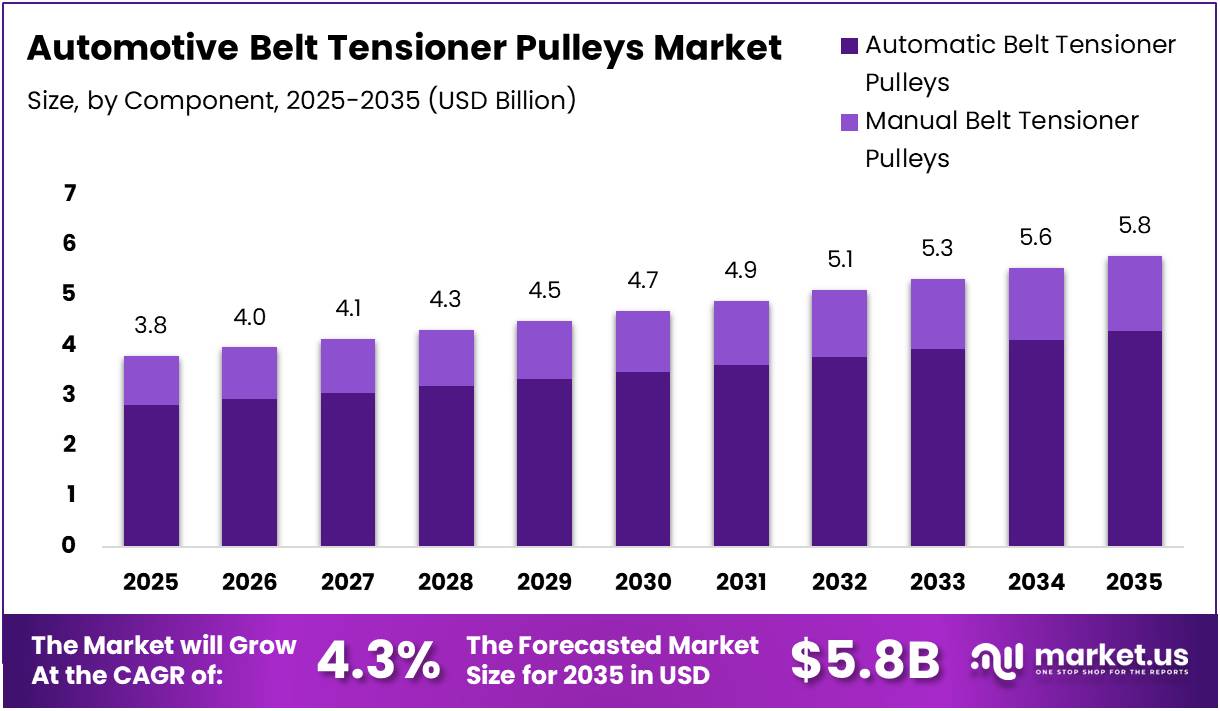
The Global Automotive Belt Tensioner Pulleys Market size is expected to be worth around USD 5.8 Billion by 2035 from USD 3.8 Billion in 2025, growing at a CAGR of 4.3% during the forecast period 2026 to 2035.
The automotive belt tensioner pulleys market covers components that maintain correct tension in engine drive belts, including timing belts and serpentine belts. These components are critical for smooth power transmission across engine systems such as the alternator, power steering pump, and air conditioning compressor.
Belt tensioner pulleys are used across passenger vehicles and commercial vehicles in both OEM and aftermarket channels. They play a direct role in engine efficiency, belt longevity, and overall vehicle performance. Moreover, as vehicles become more complex, the demand for high-precision tensioner systems continues to grow.
Growth in this market is driven by rising global vehicle production and increasing consumer focus on fuel economy. Governments in key economies are enforcing emission norms that push automakers to optimize engine systems, indirectly increasing demand for advanced belt tensioner solutions. Additionally, the expanding automotive aftermarket further supports replacement demand.
Regulatory frameworks across North America, Europe, and Asia Pacific require reduced emissions and improved fuel performance. These policies encourage the adoption of lightweight and precision-engineered tensioner components. Consequently, manufacturers are investing in product innovation to meet evolving compliance standards.
According to china-kontinental.com, 60% of new tensioner designs now integrate noise reduction features below 45 dB for hybrid powertrains. The same source notes that laser-balanced pulleys cut rotational friction by 18%, improving fuel efficiency by 2–3% in ICE vehicles. Furthermore, standardized tensioner-pulley assemblies reduce SKUs by 50%, enabling rapid customization across engine types from 1.0L to 6.0L.
According to chinasundy.com, energy-efficient tensioners with dynamic tension control reduce transmission system energy consumption by 18%–25% compared to traditional tensioners. Additionally, pulleys coated with nano-alumina ceramic layers achieve a friction coefficient of just 0.02–0.03, which is over 75% lower than conventional steel pulleys, indicating a significant leap in material performance.
Key Takeaways
- The global Automotive Belt Tensioner Pulleys Market was valued at USD 3.8 Billion in 2025 and is projected to reach USD 5.8 Billion by 2035.
- The market is expected to grow at a CAGR of 4.3% during the forecast period 2026 to 2035.
- By Component, Automatic Belt Tensioner Pulleys dominated with a 73.6% share in 2025.
- By Vehicle, Passenger Vehicles held the largest share at 68.4% in 2025.
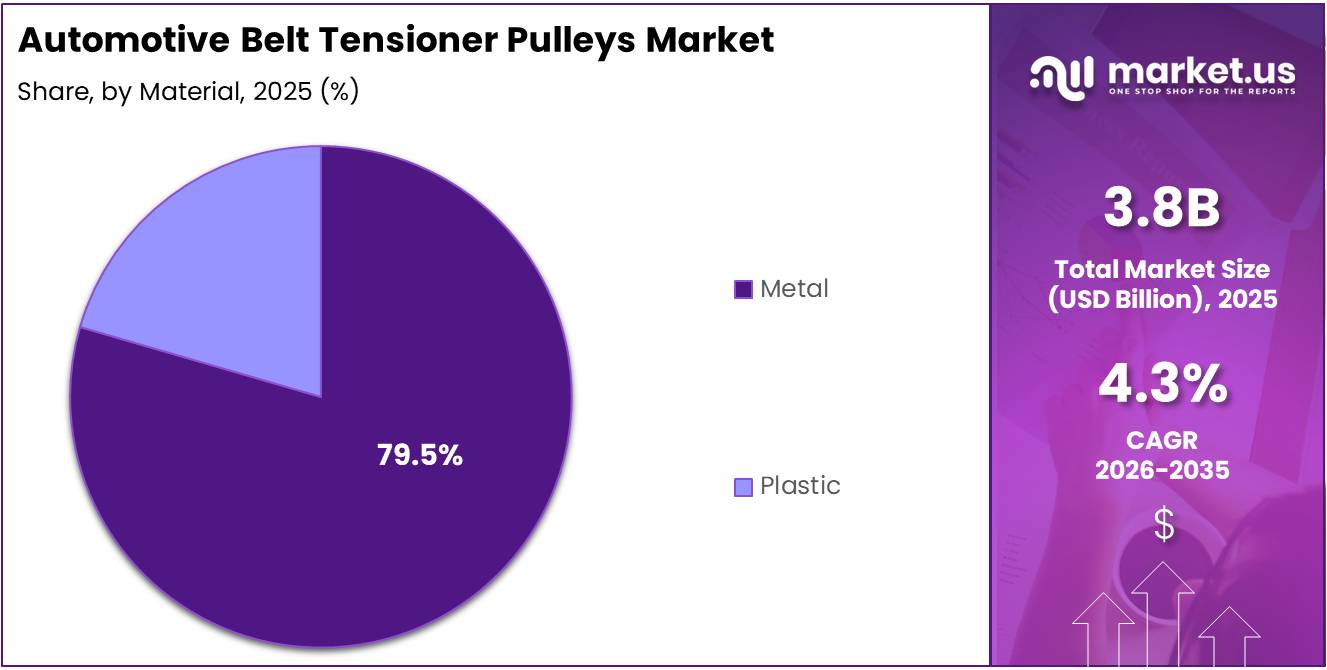
- By Material, Metal segment accounted for 79.5% of the market in 2025.
- By Application, Engine Timing System led with a 38.9% share in 2025.
- By Sales Channel, OEM segment dominated with a 79.1% share in 2025.
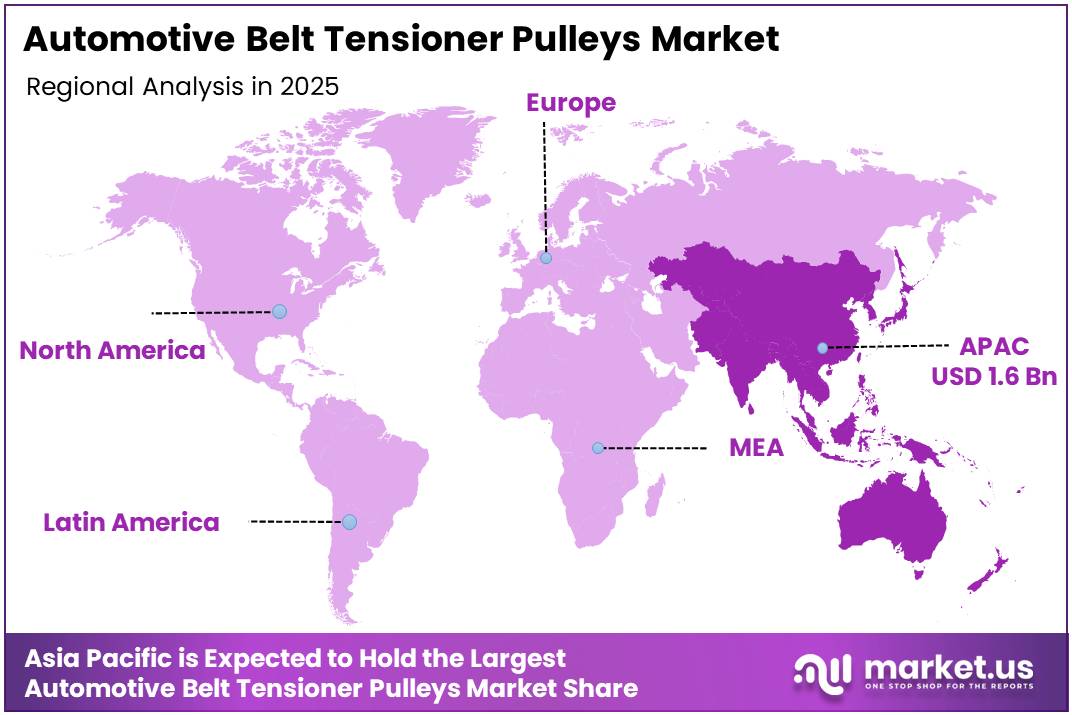
- Asia Pacific dominated the global market with a 43.70% share, valued at USD 1.6 Billion in 2025.
By Component Analysis
Automatic Belt Tensioner Pulleys dominate with 73.6% due to growing demand for self-adjusting, low-maintenance engine components.
In 2025, Automatic Belt Tensioner Pulleys held a dominant market position in the By Component segment of the Automotive Belt Tensioner Pulleys Market, with a 73.6% share. These components are widely adopted across modern passenger and commercial vehicles due to their ability to self-regulate belt tension, reduce engine vibration, and lower maintenance requirements significantly.
In contrast, Manual Belt Tensioner Pulleys continue to serve legacy and cost-sensitive vehicle segments. However, their share is gradually declining as automakers shift toward automated systems. Manual variants remain relevant in specific commercial applications and budget vehicle platforms where simplicity and lower upfront costs are prioritized over advanced functionality.
By Vehicle Analysis
Passenger Vehicles dominate with 68.4% due to high global production volumes and broader adoption of multi-belt engine systems.
In 2025, Passenger Vehicles held a dominant market position in the By Vehicle segment of the Automotive Belt Tensioner Pulleys Market, with a 68.4% share. This segment benefits from consistently high global production volumes across hatchbacks, sedans, and SUVs. Moreover, widespread use of multi-accessory belt drive systems in modern passenger car platforms continues to sustain strong OEM tensioner pulley demand worldwide.
The Commercial Vehicle segment, comprising Light, Medium, and Heavy Commercial Vehicles, represents a steadily growing share of the market. Heavy-duty applications demand high-durability tensioner systems capable of withstanding continuous mechanical stress and extreme operating conditions. Consequently, manufacturers are developing specialized tensioner pulley solutions tailored to the distinct load and performance requirements of LCV, MCV, and HCV platforms.
By Material Analysis
Metal dominates with 79.5% due to its superior structural strength and long-established use in high-stress engine environments.
In 2025, Metal held a dominant market position in the By Material segment of the Automotive Belt Tensioner Pulleys Market, with a 79.5% share. Steel and aluminum alloys remain the preferred choice due to their heat resistance, load-bearing capacity, and reliability under continuous mechanical operation across diverse vehicle types and climates.
The Plastic segment, though smaller, is gaining attention as manufacturers explore lightweight materials to meet fuel efficiency targets. Advanced engineering polymers and composite blends offer weight reduction advantages. However, plastic components must meet stringent durability and thermal resistance standards before wider adoption across high-load engine belt systems.
By Application Analysis
Engine Timing System dominates with 38.9% due to its critical role in engine synchronization and performance reliability.
In 2025, Engine Timing System held a dominant market position in the By Application segment of the Automotive Belt Tensioner Pulleys Market, with a 38.9% share. Precise belt tension in timing systems is essential for maintaining valve-timing accuracy. Any deviation can lead to engine misfires or catastrophic damage, making high-quality tensioners indispensable in this application.
Alternator System represents a consistently significant application area for belt tensioner pulleys. Alternator belts operate under variable electrical load conditions, requiring tensioners that maintain consistent grip across fluctuating speeds. Moreover, as vehicle electrical demands increase with more onboard electronics, the performance requirements for alternator-side tensioner components continue to rise steadily.
Power Steering System relies on belt-driven hydraulic pumps in many conventional vehicle platforms. Tensioner pulleys in this application must handle lateral belt forces generated during steering maneuvers. Consequently, they are engineered for higher side-load tolerance and wear resistance compared to components used in lower-stress accessory drive positions across the engine bay.
Air Conditioning System places cyclic and intermittent load demands on belt tensioner pulleys due to compressor engagement and disengagement. This stop-start behavior accelerates wear if tensioners are not properly rated for dynamic load changes. Therefore, manufacturers engineer AC-side pulleys with enhanced damping characteristics to absorb belt slack and extend overall system service life.
Water Pump System requires tensioner pulleys capable of sustaining continuous operation under high-temperature engine environments. Coolant pump belts run at constant speed for extended durations, demanding components with superior thermal resistance and long fatigue life. Additionally, precise tension control in this application directly impacts engine cooling efficiency and overall thermal management system performance.
Others category captures emerging and specialized accessory drive applications across modern engine platforms. This includes balance shaft systems, vacuum pump drives, and other auxiliary components gaining relevance in downsized and turbocharged engines. Furthermore, as engine architectures evolve to accommodate electrification and efficiency mandates, new tensioner pulley applications within this category are expected to expand gradually.
By Sales Channel Analysis
OEM dominates with 79.1% due to mandatory integration of tensioner pulleys during vehicle assembly across all vehicle classes.
In 2025, OEM held a dominant market position in the By Sales Channel segment of the Automotive Belt Tensioner Pulleys Market, with a 79.1% share. Original equipment manufacturers require tensioner pulleys that meet precise engineering tolerances from the assembly stage. Therefore, direct supply agreements with automakers remain the primary revenue source for leading component manufacturers globally.
The Aftermarket segment is growing steadily as vehicle aging cycles lengthen and replacement demand increases in both developed and emerging economies. Aftermarket channels offer cost-effective alternatives for fleet operators and individual vehicle owners. Moreover, the rise of e-commerce and digital auto parts platforms is making aftermarket tensioner pulleys more accessible across all regions.
Key Market Segments
By Component
- Automatic Belt Tensioner Pulleys
- Manual Belt Tensioner Pulleys
By Vehicle
- Passenger Vehicle
- Hatchback
- Sedan
- SUVs
- Commercial Vehicle
- Light Commercial Vehicles (LCVs)
- Medium Commercial Vehicles (MCVs)
- Heavy Commercial Vehicles (HCVs)
By Material
- Metal
- Plastic
By Application
- Engine Timing System
- Alternator System
- Power Steering System
- Air Conditioning System
- Water Pump System
- Others
By Sales Channel
- OEM
- Aftermarket
Drivers
Rising Vehicle Production and Engine Efficiency Demands Drive Automotive Belt Tensioner Pulleys Market Growth
Global vehicle production volumes continue to expand across both passenger and commercial segments. As automakers scale output in Asia Pacific, Europe, and North America, the demand for precision belt tensioner pulleys grows in parallel. This direct link between production rates and component demand provides a stable and sustained foundation for market growth.
Automakers and fleet operators are increasingly focused on reducing mechanical losses within engine systems. Belt tensioner pulleys play a key role in minimizing friction and maintaining optimal belt performance. Consequently, demand for high-precision, low-friction tensioner components is rising as manufacturers prioritize drivetrain efficiency and compliance with fuel economy regulations.
The automotive aftermarket replacement cycle is expanding as aging vehicle fleets require regular component maintenance. Belt tensioner pulleys have defined service intervals, making replacement demand predictable and consistent. Moreover, rising vehicle ownership in developing economies is further accelerating aftermarket consumption, creating significant and recurring revenue opportunities for both OEM suppliers and independent parts distributors.
Restraints
EV Adoption and Component Integration Trends Restrain Automotive Belt Tensioner Pulleys Market Expansion
The accelerating transition toward fully electric vehicles presents a structural challenge for the belt tensioner pulleys market. EVs eliminate internal combustion engines and the associated belt drive systems entirely. Therefore, as EV penetration rates rise in key markets, the addressable vehicle population requiring tensioner pulleys is gradually contracting over the medium to long term.
Modern engine designs are increasingly consolidating multiple accessory drives into integrated modules. This component integration trend reduces the number of standalone pulleys required per vehicle. Consequently, the unit demand per vehicle is declining even within the ICE segment, limiting volume growth for individual belt tensioner pulley components despite overall vehicle production remaining strong.
Manufacturers must invest heavily in product redesign and new platform development to remain relevant as powertrain architectures evolve. However, the cost and time required to develop tensioner solutions compatible with hybrid and downsized engine platforms can strain mid-sized suppliers. Additionally, longer OEM qualification cycles further delay revenue realization from newly developed tensioner product lines.
Growth Factors
Advanced Materials and Heavy-Duty Innovations Accelerate Automotive Belt Tensioner Pulleys Market Expansion
The integration of advanced lightweight composite materials in pulley manufacturing is opening new performance possibilities. Composites and engineering polymers reduce component weight while maintaining structural integrity, supporting fuel efficiency targets. Moreover, nano-coated and surface-treated materials are delivering significant friction reductions, extending belt and tensioner service life across diverse engine operating conditions.
Growing demand for heavy-duty commercial vehicles in infrastructure, logistics, and construction sectors is driving the need for high-durability tensioner systems. These applications expose components to extreme loads, heat, and vibration cycles. Therefore, manufacturers developing reinforced and application-specific tensioner solutions for HCVs and MCVs are well-positioned to capture premium market segments with higher margins.
Advancements in noise, vibration, and harshness reduction technologies are creating differentiated product opportunities. NVH-optimized tensioner pulleys are increasingly specified by OEMs for premium and hybrid vehicles where cabin quietness is a key selling point. Additionally, regulatory pressure on noise emissions in commercial vehicles is further broadening the addressable market for NVH-focused tensioner pulley innovations.
Emerging Trends
Smart Technologies and Miniaturization Reshape the Automotive Belt Tensioner Pulleys Market Landscape
Automatic and hydraulic belt tensioner technologies are gaining widespread adoption across both passenger and commercial vehicle platforms. These systems offer consistent belt tension across variable engine speeds and temperature ranges. Consequently, automakers are increasingly specifying automatic tensioners as standard components, displacing manual variants in new vehicle platforms globally.
Modern engine bay designs demand increasingly compact component architectures. Automakers are reducing under-hood space to accommodate hybrid systems, thermal management modules, and advanced electronics. Therefore, tensioner pulley manufacturers are investing in miniaturization engineering to deliver components with equivalent or superior performance within significantly reduced physical footprints and tighter geometric tolerances.
Predictive maintenance and real-time component monitoring are emerging as key trends in fleet and commercial vehicle management. Sensors and embedded diagnostics are being integrated with belt drive systems to detect tensioner wear before failure occurs. Moreover, this shift toward connected and data-driven maintenance supports longer service intervals and lower total ownership costs for vehicle operators across multiple industries.
Regional Analysis
Asia Pacific Dominates the Automotive Belt Tensioner Pulleys Market with a Market Share of 43.70%, Valued at USD 1.6 Billion
Asia Pacific held a dominant position in the global Automotive Belt Tensioner Pulleys Market with a 43.70% share, valued at approximately USD 1.6 Billion in 2025. The region benefits from large-scale vehicle production in China, India, Japan, and South Korea. Additionally, the presence of major OEM assembly hubs and a growing automotive aftermarket reinforces the region’s leading contribution to global tensioner pulley demand.
North America Automotive Belt Tensioner Pulleys Market Trends
North America represents a mature but stable market for automotive belt tensioner pulleys, supported by high vehicle ownership rates and a well-established replacement aftermarket. The United States accounts for the largest share within the region, driven by continued demand from both passenger and light commercial vehicle segments. Moreover, growing hybrid vehicle adoption is sustaining component demand across the OEM channel.
Europe Automotive Belt Tensioner Pulleys Market Trends
Europe maintains a significant presence in the global market, driven by strong automotive manufacturing activity in Germany, France, Italy, and Spain. Stringent emission regulations across the EU are pushing OEMs to adopt more efficient engine components, including advanced belt tensioner systems. Furthermore, the region’s focus on NVH performance and lightweight engineering aligns well with current product innovation trends in this market.
Middle East and Africa Automotive Belt Tensioner Pulleys Market Trends
The Middle East and Africa region is emerging as a growth market for automotive belt tensioner pulleys, driven by expanding vehicle fleets and increasing road infrastructure investment. Commercial vehicle demand in GCC countries and logistics growth across Sub-Saharan Africa are supporting aftermarket consumption. Additionally, rising import activity of ICE-powered vehicles sustains steady demand for replacement tensioner components throughout the region.
Latin America Automotive Belt Tensioner Pulleys Market Trends
Latin America presents moderate growth opportunities, led by Brazil and Mexico as the primary automotive markets in the region. Both countries maintain active vehicle assembly operations that generate consistent OEM component demand. However, economic volatility and currency fluctuations can affect consumer spending on vehicle maintenance, creating variability in aftermarket demand cycles for belt tensioner pulleys.
Key Regions and Countries
North America
- US
- Canada
Europe
- Germany
- France
- The UK
- Spain
- Italy
- Rest of Europe
Asia Pacific
- China
- Japan
- South Korea
- India
- Australia
- Rest of APAC
Latin America
- Brazil
- Mexico
- Rest of Latin America
Middle East & Africa
- GCC
- South Africa
- Rest of MEA
Key Company Insights
Aisin Seiki is a Japan-based automotive components manufacturer with a strong portfolio in drivetrain and engine accessory products, including belt tensioner pulleys. The company leverages its close integration with major Asian automakers to secure long-term OEM supply contracts. Its engineering capabilities in precision components and lightweight design continue to reinforce its competitive standing in the global market.
Continental operates as a diversified automotive technology group with significant expertise in power transmission systems and belt drive components. The company’s tensioner pulley products are engineered for high-performance and fuel-efficient applications across passenger and commercial vehicles. Continental’s investments in hybrid-compatible component platforms position it well for the ongoing transition in global powertrain architectures.
Dayco Products specializes in engine products and drive systems, with a broad portfolio of belt tensioners and pulley assemblies serving OEM and aftermarket customers globally. The company is recognized for its deep application engineering expertise across diverse engine configurations. Dayco’s strong aftermarket distribution network provides consistent revenue contribution alongside its OEM partnerships across North America, Europe, and Asia.
Gates is a globally recognized leader in power transmission belts and fluid power products, with automotive belt tensioner pulleys forming a core part of its engine systems offering. The company serves both OEM and aftermarket channels across more than 100 countries. Gates continues to invest in advanced material technologies and digital tools that support predictive maintenance and tensioner monitoring capabilities for fleet customers.
Key Players
- Aisin Seiki
- Continental
- Dayco Products
- Gates
- Hutchinson
- Litens Automotive
- NSK Automation
- NTN
- Schaeffler
- SKF
Recent Developments
- February 2024 – Cloyes Gear and Products announced the acquisition of ATI, Automotive Tensioners Inc., expanding its engine timing and belt tensioner product capabilities. This strategic move strengthens Cloyes’ position in the North American automotive tensioner pulleys market by adding specialized tensioner manufacturing expertise and an established customer base to its existing drivetrain components portfolio.
Report Scope
Report Features Description Market Value (2025) USD 3.8 Billion Forecast Revenue (2035) USD 5.8 Billion CAGR (2026-2035) 4.3% Base Year for Estimation 2025 Historic Period 2020-2024 Forecast Period 2026-2035 Report Coverage Revenue Forecast, Market Dynamics, Competitive Landscape, Recent Developments Segments Covered By Component (Automatic Belt Tensioner Pulleys, Manual Belt Tensioner Pulleys), By Vehicle (Passenger Vehicle (Hatchback, Sedan, SUVs), Commercial Vehicle (Light Commercial Vehicles, Medium Commercial Vehicles, Heavy Commercial Vehicles)), By Material (Metal, Plastic), By Application (Engine Timing System, Alternator System, Power Steering System, Air Conditioning System, Water Pump System, Others), By Sales Channel (OEM, Aftermarket) Regional Analysis North America (US and Canada), Europe (Germany, France, The UK, Spain, Italy, and Rest of Europe), Asia Pacific (China, Japan, South Korea, India, Australia, and Rest of APAC), Latin America (Brazil, Mexico, and Rest of Latin America), Middle East & Africa (GCC, South Africa, and Rest of MEA) Competitive Landscape Aisin Seiki, Continental, Dayco Products, Gates, Hutchinson, Litens Automotive, NSK Automation, NTN, Schaeffler, SKF Customization Scope Customization for segments, region/country-level will be provided. Moreover, additional customization can be done based on the requirements. Purchase Options We have three licenses to opt for: Single User License, Multi-User License (Up to 5 Users), Corporate Use License (Unlimited User and Printable PDF)  Automotive Belt Tensioner Pulleys MarketPublished date: Feb 2026add_shopping_cartBuy Now get_appDownload Sample
 -
-
- Aisin Seiki
- Continental
- Dayco Products
- Gates
- Hutchinson
- Litens Automotive
- NSK Automation
- NTN
- Schaeffler
- SKF
Our Clients

- 179282
- Feb 2026






