


Global Automated Cage Handling Systems Market Size, Share, Growth Analysis By Products (Robotic Cage Washing Systems, Automated Cage Transport Systems, Integrated Bedding Dispensing Units, Automated Cage Storage & Retrieval, Software & Facility Control Platforms), By Applications (Rodent Research Facilities, Preclinical CRO Laboratories, Pharma & Biotech R&D Centers, Academic Animal Research Institutes, Government Research Labs), By End Users (Pharmaceutical Companies, CROs, Academic Research Institutes, Government Labs, Private Research Facilities), By Region and Companies - Industry Segment Outlook, Market Assessment, Competition Scenario, Statistics, Trends and Forecast 2026-2035
- Published date: Jan 2026
- Report ID: 175387
- Number of Pages: 228
- Format:
-
keyboard_arrow_up
Quick Navigation
Report Overview
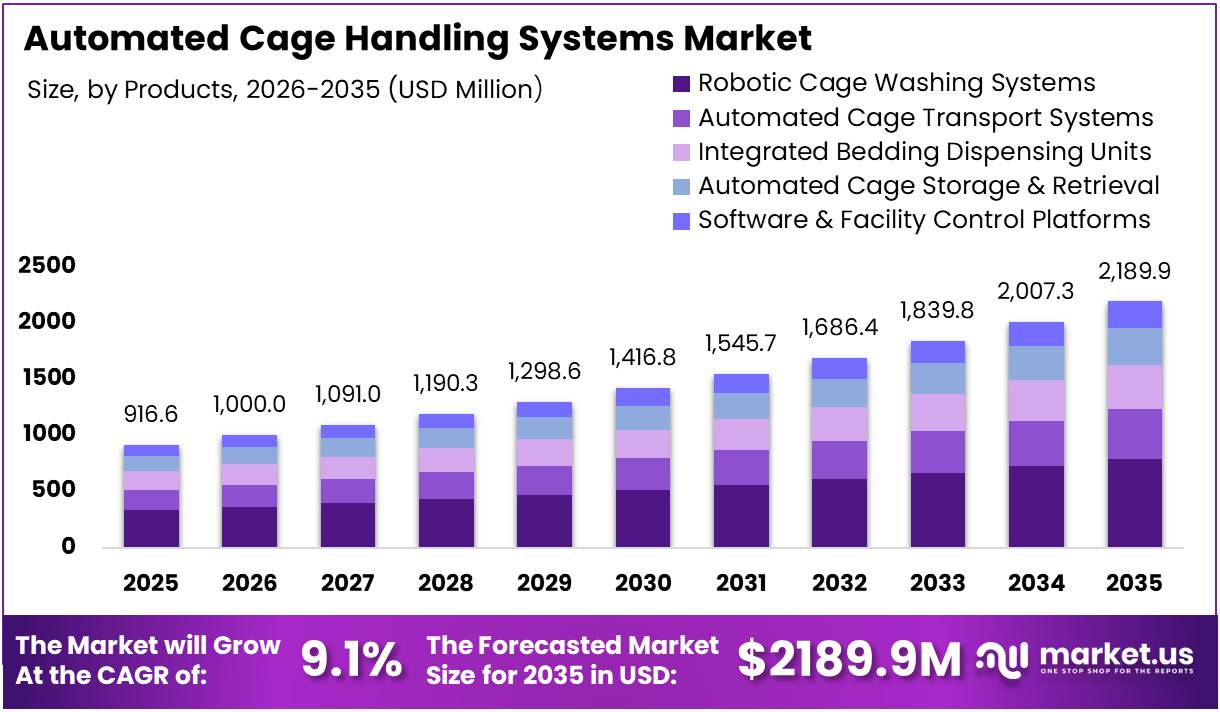
The Global Automated Cage Handling Systems Market size is expected to be worth around USD 2189.9 Million by 2035 from USD 916.6 Million in 2025, growing at a CAGR of 9.1% during the forecast period 2026 to 2035.
The Automated Cage Handling Systems Market encompasses advanced mechanical and robotic solutions designed to streamline cage management operations in research facilities and farming environments. These systems automate washing, transport, storage, bedding dispensing, and facility monitoring processes. Moreover, they integrate software platforms that enable centralized control and real-time operational oversight.
This market serves pharmaceutical laboratories, contract research organizations, academic institutions, and government research centers worldwide. These facilities require precise environmental control and consistent hygiene protocols for animal housing. Consequently, automated systems deliver superior repeatability and compliance compared to manual handling methods.
Growth opportunities stem from expanding preclinical research activities and increasing pharmaceutical R&D investments globally. Additionally, stricter animal welfare regulations and heightened biosecurity requirements drive adoption across research sectors. Therefore, facilities seek solutions that minimize contamination risks while optimizing workflow efficiency.
Technological advancements in robotics, IoT integration, and AI-powered predictive maintenance accelerate market expansion. Furthermore, growing demand for large-scale commercial farming operations creates additional application opportunities. However, initial capital requirements and technical expertise needs present adoption challenges for smaller operators.
Government initiatives supporting biomedical research infrastructure development provide sustained market momentum. Consequently, regions with established pharmaceutical ecosystems demonstrate stronger adoption rates. The convergence of automation technology and stringent regulatory frameworks continues reshaping facility operations.
According to research, automated poultry cage deployments achieve approximately 60-70% reduction in labor costs and roughly 22% increases in production output at scale. Additionally, modern automated cage systems maintain temperature stability within ±0.5°C and humidity targets between 40-60% through integrated sensors and feedback control mechanisms.
These performance metrics demonstrate quantifiable operational benefits that justify investment decisions across research and farming sectors. Therefore, market participants increasingly prioritize automation solutions that deliver measurable efficiency gains. The competitive landscape continues evolving as established players enhance product portfolios with digital integration capabilities.
Key Takeaways
- The global Automated Cage Handling Systems Market is projected to reach USD 2189.9 Million by 2035, growing at a CAGR of 9.1% from 2025 to 2035.
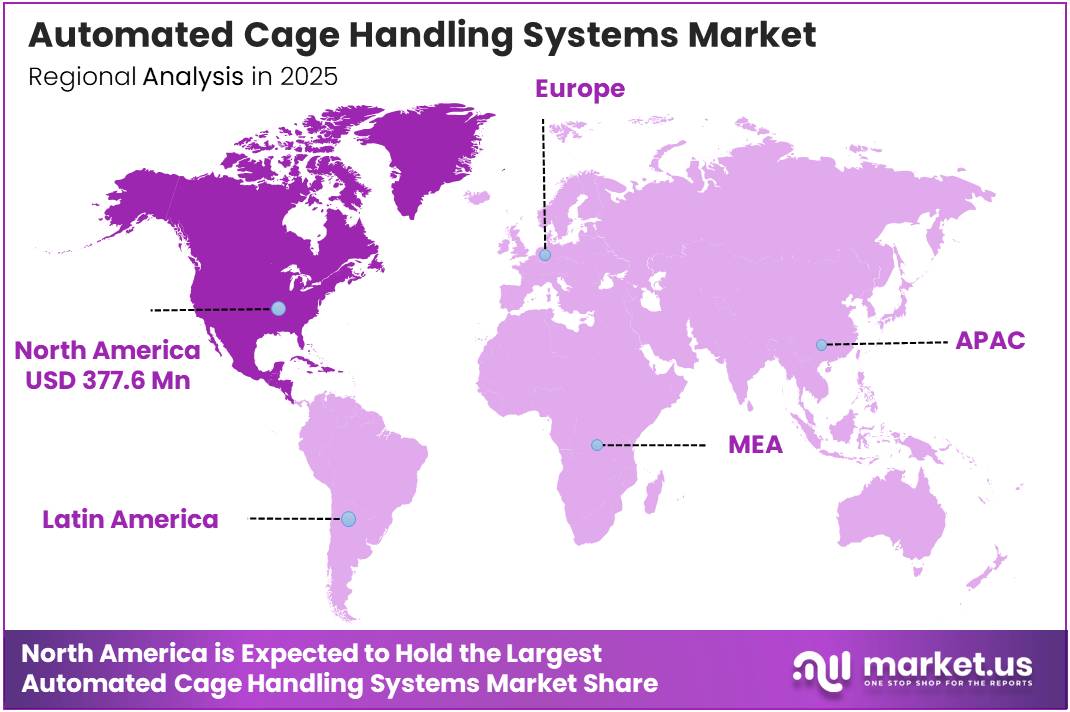
- North America dominates the market with a 41.20% share, valued at USD 377.6 Million in 2025.
- Robotic Cage Washing Systems lead the By Products segment with a 36.2% market share in 2025.
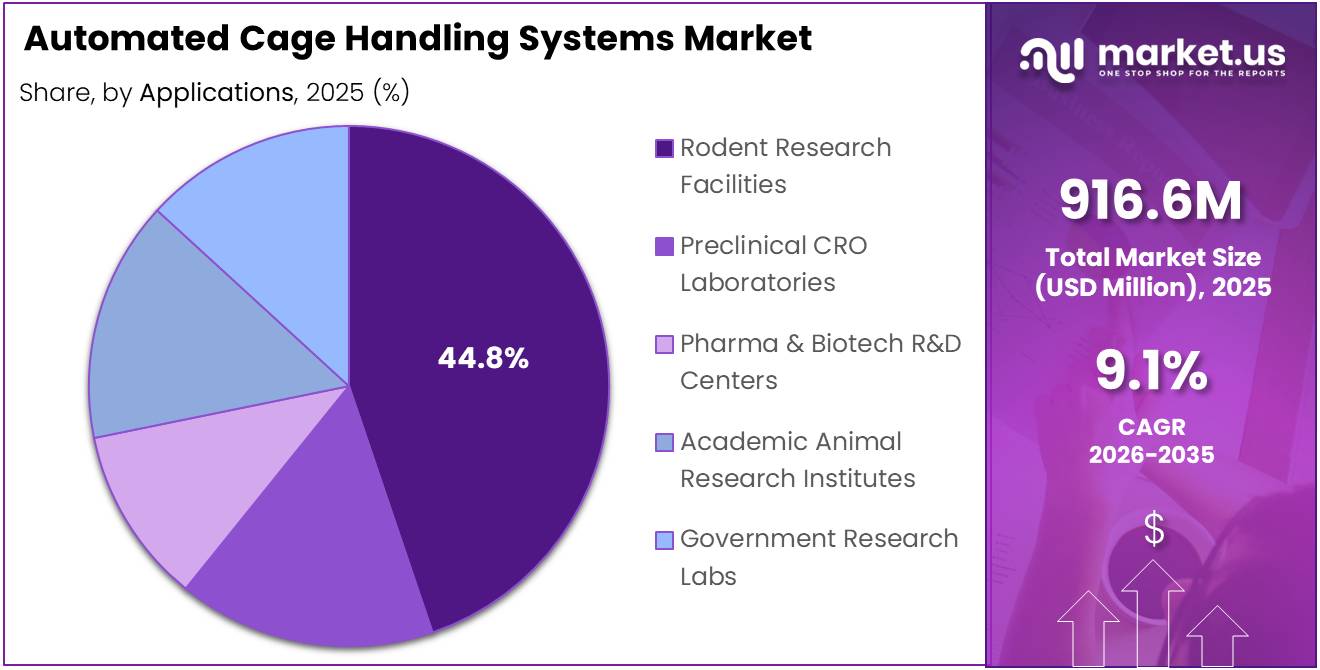
- Rodent Research Facilities account for 44.8% of the By Applications segment in 2025.
- Pharmaceutical Companies represent 32.7% of the By End Users segment in 2025.
- Automated systems reduce labor costs by 60-70% and increase production output by approximately 22%.
- Modern cage systems maintain temperature within ±0.5°C and humidity between 40-60% through sensor technology.
Products Analysis
Robotic Cage Washing Systems dominate with 36.2% due to critical hygiene requirements in research facilities.
In 2025, Robotic Cage Washing Systems held a dominant market position in the By Products segment of Automated Cage Handling Systems Market, with a 36.2% share. These systems automate cleaning protocols, ensuring consistent sanitation standards while reducing manual labor and contamination risks. Consequently, research facilities prioritize robotic washing solutions for compliance and operational efficiency.
Automated Cage Transport Systems facilitate seamless movement of housing units throughout research facilities and farming operations. These solutions minimize handling time and reduce animal stress during transfers. Moreover, transport automation integrates with facility management platforms for optimized workflow coordination and tracking capabilities.
Integrated Bedding Dispensing Units provide automated substrate distribution that maintains consistent cage environments across large-scale operations. These units reduce material waste while ensuring uniform bedding depth. Additionally, automated dispensing eliminates manual handling variations that could compromise animal welfare standards.
Automated Cage Storage & Retrieval systems optimize space utilization and inventory management within research facilities. These solutions enable high-density storage configurations with rapid access capabilities. Furthermore, retrieval automation reduces equipment damage and improves operational safety during handling procedures.
Software & Facility Control Platforms deliver centralized management of automated cage handling operations through integrated dashboards. These platforms enable real-time monitoring, scheduling, and performance analytics. Therefore, facilities achieve enhanced operational visibility and data-driven decision-making capabilities across their automation ecosystems.
Applications Analysis
Rodent Research Facilities dominate with 44.8% due to extensive small animal model utilization in biomedical research.
In 2025, Rodent Research Facilities held a dominant market position in the By Applications segment of Automated Cage Handling Systems Market, with a 44.8% share. These facilities conduct extensive preclinical studies requiring high-volume cage management and stringent environmental controls. Consequently, automation becomes essential for maintaining research integrity and operational scalability.
Preclinical CRO Laboratories leverage automated cage handling to support diverse client projects with varying protocol requirements. These organizations demand flexible automation that adapts to changing study parameters. Moreover, CRO operations benefit from standardized processes that ensure consistency across multiple concurrent research programs.
Pharma & Biotech R&D Centers implement automation to accelerate drug discovery timelines and enhance data reliability. These facilities manage complex experimental designs requiring precise environmental conditions. Additionally, pharmaceutical operations prioritize systems that integrate with electronic data capture platforms for regulatory compliance.
Academic Animal Research Institutes adopt automated solutions to optimize limited resources while expanding research capacity. These institutions balance educational objectives with advanced research requirements. Furthermore, automation enables academic facilities to maintain competitive research capabilities despite budgetary constraints.
Government Research Labs utilize automated cage handling to support regulatory testing and public health research initiatives. These facilities require robust systems that ensure long-term operational reliability. Therefore, government operations emphasize automation solutions with comprehensive validation documentation and extended service support.
End Users Analysis
Pharmaceutical Companies dominate with 32.7% due to extensive preclinical research requirements and regulatory compliance needs.
In 2025, Pharmaceutical Companies held a dominant market position in the By End Users segment of Automated Cage Handling Systems Market, with a 32.7% share. These organizations conduct high-volume preclinical studies requiring standardized cage management protocols and comprehensive documentation. Consequently, pharmaceutical operations prioritize automation that supports regulatory submissions and audit readiness.
CROs represent significant end users as they provide outsourced research services across pharmaceutical and biotechnology sectors. These organizations require scalable automation that accommodates diverse client protocols. Moreover, CRO facilities benefit from operational flexibility that enables rapid project transitions and resource optimization.
Academic Research Institutes utilize automated cage handling to support investigator-initiated studies and collaborative research programs. These institutions balance multiple research disciplines with shared facility resources. Additionally, academic operations emphasize cost-effective automation that maximizes research throughput within budget limitations.
Government Labs implement automated systems to support regulatory testing, disease surveillance, and public health research mandates. These facilities require validated solutions that ensure data integrity and operational transparency. Furthermore, government operations prioritize long-term vendor relationships that provide consistent technical support and system upgrades.
Private Research Facilities adopt automation to maintain competitive research capabilities and specialized service offerings. These organizations often focus on niche research areas requiring customized cage handling protocols. Therefore, private facilities seek flexible automation platforms that adapt to specialized operational requirements.
Key Market Segments
By Products
- Robotic Cage Washing Systems
- Automated Cage Transport Systems
- Integrated Bedding Dispensing Units
- Automated Cage Storage & Retrieval
- Software & Facility Control Platforms
By Applications
- Rodent Research Facilities
- Preclinical CRO Laboratories
- Pharma & Biotech R&D Centers
- Academic Animal Research Institutes
- Government Research Labs
By End Users
- Pharmaceutical Companies
- CROs
- Academic Research Institutes
- Government Labs
- Private Research Facilities
Drivers
Rising Adoption of Robotics and Automation Drives Operational Efficiency Across Research Facilities
Research institutions increasingly deploy robotic cage handling systems to address labor shortages and enhance operational consistency. Automation eliminates manual handling variability while reducing repetitive strain injuries among facility staff. Moreover, robotic systems operate continuously without fatigue, enabling round-the-clock facility operations. Consequently, organizations achieve significant productivity gains through automated workflow integration.
Large-scale commercial farming operations adopt automated cage systems to manage expanding production volumes efficiently. These facilities require standardized processes that ensure uniform animal welfare conditions across thousands of housing units. Additionally, automation platforms deliver real-time monitoring capabilities that enable proactive intervention before issues escalate.
Growing focus on animal welfare and hygiene compliance drives investment in automated cage handling technologies. Regulatory agencies impose stringent environmental standards that manual processes struggle to maintain consistently. Furthermore, automated systems provide comprehensive documentation that supports compliance verification and audit trails. These capabilities make automation essential for organizations maintaining accreditation and regulatory approvals across multiple jurisdictions.
Restraints
Limited Technical Expertise Among Operators Restricts Widespread Automation Adoption
Small and medium-sized research facilities often lack specialized personnel capable of operating and maintaining complex automated cage systems. These organizations struggle to justify dedicated technical staff for automation management. Moreover, training existing employees requires significant time investment and operational disruption. Consequently, many facilities postpone automation adoption despite recognizing potential benefits.
Traditional farming practices emphasize hands-on management approaches that conflict with automated system paradigms. Operators accustomed to manual cage handling express skepticism about technology reliability and effectiveness. Additionally, concerns about system failures and animal welfare during automation malfunctions create adoption resistance.
High initial capital requirements for automated cage handling systems present significant barriers for budget-constrained organizations. These investments require multi-year ROI justification that smaller operations find challenging to demonstrate. Furthermore, ongoing maintenance costs and software licensing fees add to total ownership expenses. These financial considerations limit market penetration among smaller research facilities and farming operations with constrained budgets.
Growth Factors
IoT Integration and Smart Sensor Technologies Accelerate Market Expansion
Integration of Internet of Things connectivity enables real-time monitoring of environmental parameters across automated cage systems. Smart sensors track temperature, humidity, and air quality with precision that manual methods cannot match. Moreover, IoT platforms aggregate data across facility operations for comprehensive performance analytics. Consequently, research organizations gain unprecedented visibility into cage environment consistency and operational efficiency.
Emerging economies experiencing rapid poultry production growth create substantial expansion opportunities for automated cage handling providers. These regions seek technology solutions that enable competitive production efficiency at scale. Additionally, government initiatives supporting agricultural modernization provide favorable conditions for automation adoption.
Development of energy-efficient and eco-friendly handling solutions addresses growing environmental sustainability concerns. Modern automated systems incorporate renewable energy integration and reduced water consumption features. Furthermore, sustainable automation platforms help organizations meet corporate environmental commitments while reducing operational costs.
Emerging Trends
AI-Enabled Predictive Maintenance Transforms Operational Reliability
Artificial intelligence algorithms analyze equipment performance data to predict maintenance requirements before failures occur. These predictive capabilities minimize unplanned downtime and extend equipment lifespan through optimized maintenance scheduling. Moreover, AI systems learn from operational patterns to recommend process improvements and efficiency enhancements.
Fully automated egg collection and cleaning systems gain market traction as commercial operations seek comprehensive automation solutions. These integrated platforms eliminate manual handling throughout the entire egg production process. Additionally, automated cleaning ensures consistent sanitation standards that manual methods struggle to maintain.
Integration with farm management software and data analytics platforms creates unified operational visibility across automated cage systems. These connections enable performance benchmarking, trend analysis, and predictive modeling capabilities. Furthermore, integrated platforms support data-driven decision-making that optimizes resource allocation and production planning. These analytical capabilities transform automated cage handling from isolated equipment into comprehensive management ecosystems that drive continuous operational improvement.
Regional Analysis
North America Dominates the Automated Cage Handling Systems Market with a Market Share of 41.20%, Valued at USD 377.6 Million
North America leads the global market with 41.20% share, valued at USD 377.6 Million, driven by extensive pharmaceutical research infrastructure and stringent animal welfare regulations. The region hosts numerous major pharmaceutical companies, CROs, and academic research institutions requiring advanced cage handling automation. Moreover, regulatory frameworks mandate comprehensive environmental controls that automated systems deliver efficiently. Consequently, North American facilities demonstrate highest automation adoption rates globally.
Europe Automated Cage Handling Systems Market Trends
Europe represents a significant market driven by robust pharmaceutical sectors and progressive animal welfare legislation across member states. The region emphasizes ethical research practices that favor automated systems minimizing animal stress. Additionally, European research institutions prioritize sustainability features in automation platforms. Therefore, vendors offering eco-friendly solutions gain competitive advantages in European markets.
Asia Pacific Automated Cage Handling Systems Market Trends
Asia Pacific demonstrates rapid market growth fueled by expanding pharmaceutical manufacturing and increasing research investments across China, Japan, and India. The region benefits from government initiatives supporting biomedical research infrastructure development. Moreover, growing poultry production operations create additional automation demand. Consequently, Asia Pacific represents the fastest-growing regional market with substantial long-term potential.
Latin America Automated Cage Handling Systems Market Trends
Latin America shows emerging adoption patterns as regional pharmaceutical sectors modernize research capabilities and farming operations expand. Brazil and Mexico lead regional market development with growing research infrastructure investments. Additionally, increasing awareness of animal welfare standards drives automation interest. Therefore, Latin America presents developing opportunities for market participants targeting growth markets.
Middle East & Africa Automated Cage Handling Systems Market Trends
Middle East & Africa exhibits gradual market development concentrated in GCC countries and South Africa with established research facilities. The region focuses on building biomedical research capabilities aligned with economic diversification strategies. Moreover, agricultural modernization initiatives create opportunities for farming automation applications. Consequently, selective market segments demonstrate growth potential despite overall nascent market maturity.
Key Regions and Countries
North America
- US
- Canada
Europe
- Germany
- France
- The UK
- Spain
- Italy
- Rest of Europe
Asia Pacific
- China
- Japan
- South Korea
- India
- Australia
- Rest of APAC
Latin America
- Brazil
- Mexico
- Rest of Latin America
Middle East & Africa
- GCC
- South Africa
- Rest of MEA
Key Company Insights
Tecniplast maintains market leadership through comprehensive product portfolios serving pharmaceutical, academic, and government research sectors globally. The company offers integrated cage handling solutions combining washing, transport, and facility management platforms. Moreover, Tecniplast emphasizes innovation in animal welfare technologies and digital integration capabilities. Their recent merger with Bioair strengthens their competitive position through expanded technical capabilities and market reach.
Allentown delivers advanced individually ventilated cage systems with cutting-edge monitoring technologies for research facilities. The company recently launched the Discovery IVC featuring infrared camera-based home-cage monitoring through AI-powered software platforms. Additionally, Allentown focuses on user-friendly designs that simplify facility operations while maintaining stringent environmental controls. Their technology innovations address growing demand for remote monitoring and data analytics capabilities.
Getinge provides comprehensive life science equipment portfolios including automated cage washing and sterilization systems for research facilities. The company leverages extensive healthcare equipment expertise to deliver reliable automation solutions meeting pharmaceutical industry standards. Moreover, Getinge emphasizes service excellence and long-term customer partnerships supporting operational continuity. Their global presence enables responsive technical support across major research markets worldwide.
BioZone specializes in customized cage handling solutions addressing unique facility requirements and specialized research applications. The company offers flexible automation platforms that adapt to diverse operational protocols and space constraints. Additionally, BioZone focuses on cost-effective solutions targeting mid-sized research facilities and emerging markets. Their tailored approach enables competitive differentiation in segments underserved by standardized automation platforms.
Key Players
- Tecniplast
- Allentown
- Getinge
- BioZone
- Lenderking
- Others
Recent Developments
- January 2026 – Tecniplast S.p.A completed merger by incorporation of Bioair S.p.A, expanding their technological capabilities and product portfolio in automated cage handling systems. This strategic consolidation strengthens Tecniplast’s market position through enhanced R&D resources and broader solution offerings for research facility automation.
- February 2025 – Allentown launched the Discovery™ IVC, a next-generation housing system featuring the In Vivo View (IVV) module with infrared camera-based technology enabling 24/7 remote home-cage monitoring. The system integrates AI-powered Envision Software™ that delivers advanced analytics and behavioral monitoring capabilities for research facilities.
Report Scope
Report Features Description Market Value (2025) USD 916.6 Million Forecast Revenue (2035) USD 2189.9 Million CAGR (2026-2035) 9.1% Base Year for Estimation 2025 Historic Period 2020-2024 Forecast Period 2026-2035 Report Coverage Revenue Forecast, Market Dynamics, Competitive Landscape, Recent Developments Segments Covered By Products (Robotic Cage Washing Systems, Automated Cage Transport Systems, Integrated Bedding Dispensing Units, Automated Cage Storage & Retrieval, Software & Facility Control Platforms), By Applications (Rodent Research Facilities, Preclinical CRO Laboratories, Pharma & Biotech R&D Centers, Academic Animal Research Institutes, Government Research Labs), By End Users (Pharmaceutical Companies, CROs, Academic Research Institutes, Government Labs, Private Research Facilities) Regional Analysis North America (US and Canada), Europe (Germany, France, The UK, Spain, Italy, and Rest of Europe), Asia Pacific (China, Japan, South Korea, India, Australia, and Rest of APAC), Latin America (Brazil, Mexico, and Rest of Latin America), Middle East & Africa (GCC, South Africa, and Rest of MEA) Competitive Landscape Tecniplast, Allentown, Getinge, BioZone, Lenderking, Others Customization Scope Customization for segments, region/country-level will be provided. Moreover, additional customization can be done based on the requirements. Purchase Options We have three licenses to opt for: Single User License, Multi-User License (Up to 5 Users), Corporate Use License (Unlimited User and Printable PDF)  Automated Cage Handling Systems MarketPublished date: Jan 2026add_shopping_cartBuy Now get_appDownload Sample
 -
-
- Tecniplast
- Allentown
- Getinge
- BioZone
- Lenderking
- Others
Our Clients

- 175387
- Jan 2026






