Report Overview
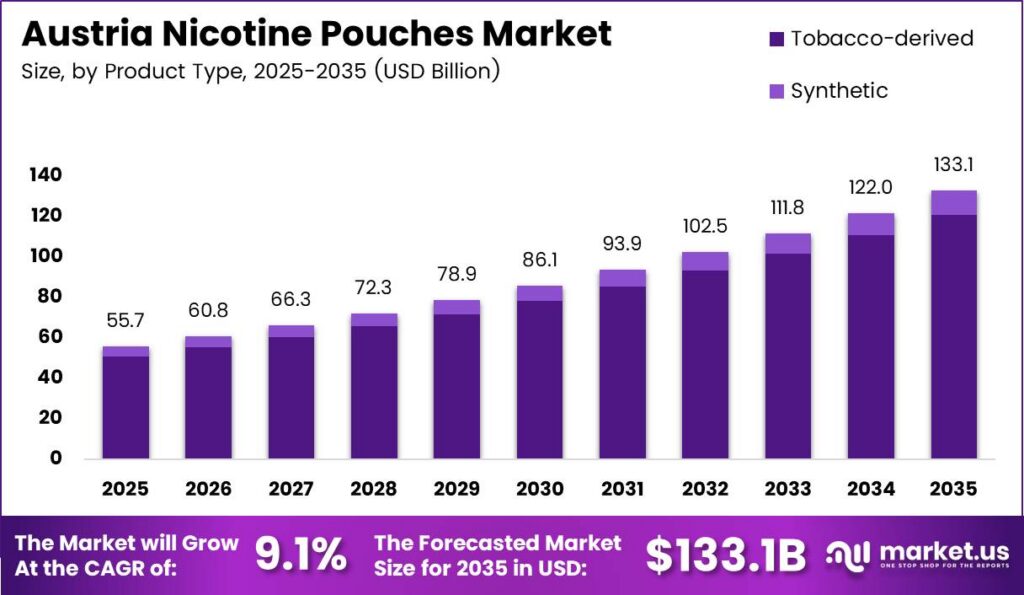
Austria Nicotine Pouches Market size is expected to be worth around USD 133.1 Billion by 2035 from USD 55.7 Billion in 2025, growing at a CAGR of 9.1% during the forecast period 2026 to 2035. Nicotine pouches are small, tobacco leaf free fiber packets placed under the upper lip that deliver pharmaceutical or tobacco derived nicotine directly through the oral mucosa without combustion or smoke.
Licensed monopoly retail stores, urban commuter hubs, and adult hospitality venues anchor end user consumption across the country. According to Statistics Austria, daily conventional cigarette smoking among Austrians aged 15 and older stood at 16.9% in 2025, while total daily use of any tobacco or nicotine product reached 20.2% . This 3.3 percentage point gap confirms active migration toward oral pouches. Therefore, suppliers must design multi pack subscriptions for repeat adult buyers.
Key Takeaways
- The Austria Nicotine Pouches Market size reached USD 55.7 Billion in 2025.
- Market valuation is forecast to reach USD 133.1 Billion by 2035.
- The market expands at a compound annual growth rate of 9.1% from 2026 to 2035.
- Tobacco derived products led the Product Type segment with a 91.23% share in 2025 and represent the fastest growing product category.
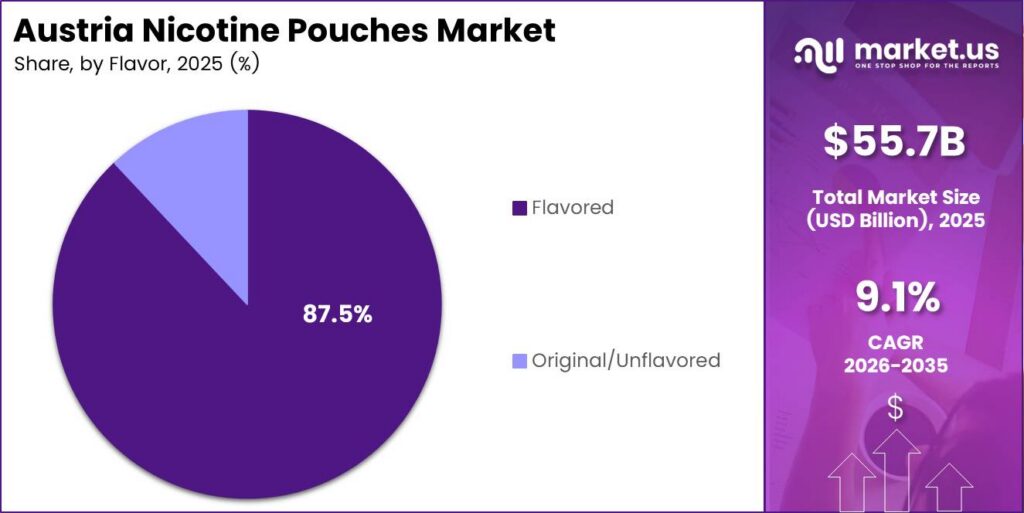
- Flavored pouches dominated the Flavor segment with an 87.56% share in 2025, while Original and Unflavored options grow fastest.
- Strong pouches containing 4 to 6 mg per pouch captured a leading 41.23% share of the Pouches Strength segment in 2025.
- Offline retail controlled an 86.34% share of the Distribution Channel segment in 2025, while Online channels expand fastest.
- Eastern Austria represents the leading domestic demand center in 2025, followed by Western Alpine and Southern provinces over the 2026 to 2035 forecast period.
Strict premarket scientific standards across major Western jurisdictions set a high bar for product formulation and toxicology dossiers. Data from the U.S. Food and Drug Administration shows that exactly 67 oral nicotine pouch products held active marketing authorizations for lawful commercial sale as of October 2026. Manufacturers operating in Austria reuse these standardized toxicological datasets to clear domestic notification hurdles. Consequently, well capitalized producers lock out unverified gray market imports.
Regional supply chains in Central Europe are scaling rapidly to guarantee uninterrupted shelf availability for compliant tobacco free pouches. In May 2026, a major international manufacturer expanded its production facility in Kutna Hora in neighboring Czechia, creating 100 to 120 specialized manufacturing jobs to supply oral pouches across 46 markets starting in early 2027 . As a result, Austrian wholesalers gain shorter lead times and lower cross border freight expenses.
Eastern Austria leads national consumption due to dense commuter traffic, corporate office smoking bans, and concentrated retail infrastructure. Based on World Bank data, Austria recorded a national population of 9,208,163 and a nominal GDP of USD 579.47 Billion in 2025, equating to USD 62,930.04 per capita . High disposable incomes in metropolitan Eastern Austria absorb excise price adjustments easily. This means premium pouch brands maintain pricing power across urban specialist shops.
Cross border corporate consolidation is also reshaping product pipelines entering European retail monopolies. In September 2025, two global tobacco and ginseng groups jointly acquired a leading Stockholm pouch manufacturer for SEK 1.76 Billion, or USD 186 Million, splitting ownership at 51% and 49% . This transaction injects heavy balance sheet capital into Nordic pouch recipes destined for Central European shelves. Therefore, independent Austrian importers face stiffer competition for retail slots.
Product Type Analysis
Tobacco derived dominates with 91.23% share in 2025 due to established extraction purity and compliance.
In 2025, Tobacco derived pouches held a 91.23% share in the Product Type segment of the Austria Nicotine Pouches Market. Figures from UN Comtrade show that Sweden accounted for 39% of global oral nicotine exports in 2025, while Japan Tobacco expanded its Swedish tobacco derived Nordic Spirit range to 8 SKUs at JPY 500 per 14 pouch can in November 2026 . Pharmaceutical distillation of natural leaf alkaloids yields enantiomerically pure S nicotine at lower unit cost. Therefore, distributors prioritize Swedish tobacco derived lines for monopoly shelves.
Synthetic nicotine pouches serve adult buyers seeking zero agricultural connection to traditional tobacco leaf cultivation. The U.S. Food and Drug Administration found that over 200 companies filed nearly 1 million non tobacco nicotine applications, yet 0 synthetic pouch products secured marketing authorization during initial federal review . Racemic synthetic synthesis requires costly chiral separation to match natural receptor binding without triggering separate toxicology audits. Consequently, investors favor natural nicotine extraction over synthetic lab formulations to avoid regulatory delays.
Flavor Analysis
Flavored dominates with 87.56% share in 2025 due to strong adult taste preference.
In 2025, Flavored products held an 87.56% share in the Flavor segment of the Austria Nicotine Pouches Market. As reported by the U.S. Food and Drug Administration, 90.8% of surveyed pouch consumers selected flavored variants, and Scandinavian Tobacco Group lifted its XQS Swedish share to nearly 14% with 8% organic Q2 sales growth after launching new menthol lines in August 2026 . Volatile cooling esters mask the natural bitterness of alkaline nicotine salts on oral tissue. This means manufacturers must protect mint recipes to retain core volume.
Original and Unflavored pouches register the fastest expansion rate among adult switchers adapting to stricter packaging rules. According to the National Institutes of Health, only 3.0% of surveyed users historically selected unflavored pouches most often compared to 58.6% choosing mint and 16.0% choosing fruit . Strict domestic limits on flavor descriptors push risk averse retailers to stock neutral pH buffered cellulose pouches that mimic plain tobacco aroma. Therefore, brands launching unflavored SKUs early secure durable Trafik shelf space.
Pouches Strength Analysis
Strong 4 to 6 mg per pouch dominates with 41.23% share in 2025 due to optimal smoker nicotine satisfaction.
Light pouches containing 2 mg per pouch serve entry level adult users and dual users cutting down daily intake. Data from the National Institutes of Health shows low dose pouches starting at 1.5 to 2 mg yield peak plasma nicotine of 3.2 ng per mL versus 12.2 ng per mL for cigarettes, prompting Altria to secure FDA clearance for 4 low dose on! SKUs in August 2026. Slower mucosal diffusion prevents acute nausea in lighter smokers. Consequently, brands use 2 mg cans as an onboarding tier.
Normal strength pouches at 3 mg per pouch represent the fastest growing strength tier across Austria. Based on German Federal Institute for Risk Assessment data, 3 mg pouches release 55.9% of their alkaloid load, delivering 1.59 mg of systemic nicotine and a 7.7 ng per mL peak blood level . Carbonate buffer salts at this dosage match low tar cigarette absorption curves while staying far below Austria’s 16.6 mg per gram statutory ceiling. As a result, suppliers are shifting production capacity toward 3 mg cans.
In 2025, Strong pouches at 4 to 6 mg per pouch held a 41.23% share in the Pouches Strength segment of the Austria Nicotine Pouches Market. The German Federal Institute for Risk Assessment indicates that 6 mg pouches achieve a 59.1% oral extraction rate, delivering 3.51 mg of absorbed nicotine, 14.7 ng per mL blood concentration, and a 10 beat per minute heart rate rise . That arterial delivery replicates full flavor cigarettes for heavy former smokers. This signals steady repeat margins for Trafik operators stocking 6 mg tins.
Distribution Channel Analysis
Offline dominates with 86.34% share in 2025 due to statutory tobacco monopoly exclusivity.
In 2025, Offline retail held an 86.34% share in the Distribution Channel segment of the Austria Nicotine Pouches Market. Figures from Monopolverwaltung GmbH show that Austria’s regulated network totaled 4,308 licensed Trafiken at the end of 2025, with 55.5% of specialist shops run by entrepreneurs with disabilities and pouches earning a fixed 32% retail margin from April 2026 . Statutory monopoly routing funnels physical foot traffic exclusively into licensed tobacconists. Therefore, manufacturers must invest in Trafik trade education rather than supermarket slotting fees.
Online channels record the fastest trajectory in consumer ordering behavior and cross border benchmark tracking. According to Eurostat, 78% of European Union internet users aged 16 to 74 bought goods online in 2025, while Haypp Group grew Q3 2026 online pouch sales by 28.2% to SEK 1,220.9 Million across 31.7 Million cans in November 2026 . Digital bulk pricing attracts price sensitive buyers even where domestic mail order bans push leakage across EU borders. Consequently, Austrian regulators and wholesalers closely monitor cross border parcel flows.
Key Market Segments
By Product Type
- Tobacco derived
- Synthetic
By Flavor
- Flavored
- Original and Unflavored
By Pouches Strength
- Light (2 mg/pouch)
- Normal (3 mg/pouch)
- Strong (4 to 6 mg/pouch)
- Extra Strong (More than 8 mg/pouch)
By Distribution Channel
- Offline
- Online
Market Dynamics
Fiscal restructuring and state monopoly integration govern profitability across Austria’s oral nicotine value chain between 2026 and 2035. Based on Austrian Federal Ministry of Finance data, expanding tobacco excise duties onto nicotine pouches and e liquids adds EUR 50.0 Million in 2025 and EUR 185.0 Million in 2026, lifting annual tobacco tax receipts to roughly EUR 2.3 Billion . Weight based taxation and strict licensing protect retail margins for compliant brands while squeezing undercapitalized importers out of the market.
Drivers
Austria’s December 2025 tax package hiked levies on cigarettes and heated tobacco starting in 2026 while taxing pouches strictly by weight. Pouch excise starts at EUR 35 per kilogram in April 2026, rising to EUR 40 in February 2027 and EUR 45 in February 2028. For a 20 pouch can weighing 32 grams at 1.6 grams per pouch, excise equals EUR 1.12 now and EUR 1.44 by 2028.
Because cigarette packs carry steep per unit and ad valorem taxes, per dose pouch nicotine stays 40% to 55% cheaper than combustibles. This durable price advantage converts price sensitive smokers into loyal repeat buyers inside licensed Trafiken and lowers customer acquisition costs. Consequently, manufacturers redirect restricted advertising budgets into multi tier retail pricing that preserves a wide cost gap against cigarettes through 2028.
| Driver | (~) % Impact on CAGR Forecast | Geographic Relevance | Impact Timeline |
|---|---|---|---|
| Widening price gap with combustibles after cigarette tax hikes | +1.8% | National, strongest in Vienna and urban Lower Austria | Short term (≤ 2 years) |
| Smokers switching to smoke-free nicotine | +1.4% | National | Medium term (2–4 years) |
| Monopoly-backed legitimacy of the Trafik shelf | +1.1% | National, Trafik-dense municipalities | Short term (≤ 2 years) |
| Use where smoking is banned (work, travel, hospitality) | +0.9% | Urban centres, Alpine tourism regions | Medium term (2–4 years) |
| Spillover from snus and pouch culture in Germany and the Nordics | +0.8% | Western Austria (Tyrol, Vorarlberg, Salzburg) | Long term (≥ 4 years) |
Restraints
Austria folded nicotine pouches into the state tobacco monopoly on 1 April 2026, restricting wholesale distribution to licensed entities and retail sales solely to Trafiken. Unregistered hospitality venues stopped selling in May 2026, general retail stock clears out by 31 December 2026, and hemp shops exit after 31 December 2028. Eliminating supermarkets, petrol stations, and kiosks cuts active retail outlets by 50% to 65%.
Rural districts with sparse Trafik coverage lose immediate impulse access, triggering a one time 8% to 12% dip in reported domestic volume across 2026 and 2027. Distributors built around general grocery logistics face stranded fleet assets and gross margin compression of 3 to 5 percentage points. Therefore, challenger brands are freezing Austrian launch budgets until monopoly shelf space stabilizes.
| Restraint | (~) % Impact on CAGR Forecast | Geographic Relevance | Impact Timeline |
|---|---|---|---|
| Trafik-only sales: supermarket, petrol station and hospitality channels lost | -1.6% | National, strongest in rural areas | Short term (≤ 2 years) |
| Domestic ban on online and mail-order sales | -1.0% | National | Short term (≤ 2 years) |
| Rising weight-based tobacco tax | -0.9% | National | Medium term (2–4 years) |
| Point-of-sale advertising ban | -0.6% | National | Short term (≤ 2 years) |
| Nicotine cap and minimum pack size | -0.5% | National | Medium term (2–4 years) |
Challenges
Section 8d of the Tobacco and Non Smoker Protection Act took effect on 20 August 2026, requiring EU CEG notification 6 months before sale at EUR 3,000 per variant. Unpaid fees void filings after 14 days, recipe tweaks restart the 6 month clock, and non compliant cans exit shelves on 30 June 2027. Packs require at least 15 pouches capped at 16.6 mg per gram and 1.6 grams each.
Filing 40 flavor and strength SKUs demands EUR 120,000 in upfront state fees alone, while full testing and labeling push per variant launch costs to EUR 8,000 to EUR 15,000. Austrian product introductions consequently lag neighboring European markets by 2 to 3 quarters. As a result, producers must prune domestic catalogs by 30% to 50%, driving smaller importers toward consolidation.
| Challenge | (~) % CAGR Friction Drag | Geographic Relevance | Mitigation Horizon |
|---|---|---|---|
| Product notification compliance burden | -0.7% | National, EU-CEG linked | Short term (≤ 2 years) |
| Cross-border personal-import leakage | -0.5% | Border regions with Germany, Czechia, Slovakia, Hungary | Medium term (2–4 years) |
| Monopoly wholesale registration gatekeeping | -0.3% | National | Short term (≤ 2 years) |
| Limits on flavour communication | -0.2% | National | Medium term (2–4 years) |
| Uncertainty over EU-wide rule changes | -0.2% | EU-wide, Austria included | Long term (≥ 4 years) |
Opportunities
Because non compliant stock exits on 30 June 2027 and notifications require 6 months, brands filing before December 2026 capture unallocated 2027 Trafik shelves first. Focusing on 12 to 15 high velocity SKUs at or below 16.6 mg per gram and 1.6 grams instead of 40 variants spreads the EUR 3,000 fee across higher volume. That focus cuts per can compliance overhead by 55% to 65%.
Engineering Slim pouches down from 1.0 gram to 0.7 gram also trims weight excise by EUR 0.21 per 20 pouch can at EUR 35 per kilogram and EUR 0.27 at EUR 45 per kilogram. Pairing lighter formats with early shelf lock in lifts manufacturer gross margins by 4 to 7 percentage points. Early movers therefore capture displaced volume as rival non compliant cans disappear.
| Opportunity | (~) % Potential CAGR Upside | Geographic Relevance | Execution Window |
|---|---|---|---|
| Pre-notified portfolios built to comply with the cap | +1.3% | National | Short term (≤ 2 years) |
| Category management partnerships with Trafiken | +1.0% | National, urban Trafik clusters | Short term (≤ 2 years) |
| Consolidation of licensed wholesalers and importers | +0.7% | National | Medium term (2–4 years) |
| Low-strength pouches for smokers trying to cut down | +0.6% | National, adults aged 35 and over | Medium term (2–4 years) |
| Expanding sales to former CBD-shop channels after 2028 | +0.5% | Urban centres | Long term (≥ 4 years) |
Key Company Insights
BRITISH AMERICAN TOBACCO p.l.c. commands a leading oral nicotine position across Austria and Europe through its flagship VELO portfolio of slim and mini pouches. According to British American Tobacco preliminary FY 2025 filings, Group revenue reached GBP 25,610 Million, while Modern Oral revenue climbed 47.4% to GBP 1,165 Million on a 47.1% volume jump . Scale manufacturing allows BAT to absorb Austrian EU CEG notification fees effortlessly.
Regional supply proximity strengthens BAT’s wholesale service into Austrian Trafiken. As reported by Invest in Baranya and HIPA, BAT Hungary topped out its HUF 60 Billion, or EUR 150.7 Million, 7,500 square meter nicotine pouch factory in Pecs in June 2026, adding 16 production lines and 450 jobs to supply over 40 export markets . Operating directly across the Hungarian border slashes delivery lead times into Vienna.
Swedish Match AB, operating as the oral nicotine subsidiary of Philip Morris International, anchors global category value through its ZYN dry and moist pouch ranges. Data from Philip Morris International Form 10 K and investor filings shows FY 2025 net revenue reached USD 40.6 Billion, with global oral shipments hitting 879.6 Million cans and smoke free products generating 42% of Q2 2026 revenue . Deep cash flow funds aggressive Trafik category partnerships.
Scientific validation further differentiates Swedish Match formulations among adult switchers and health regulators. Based on U.S. Food and Drug Administration regulatory records, Swedish Match secured the first ever Modified Risk Tobacco Product orders in June 2026 covering 20 ZYN pouch variants in 3 mg and 6 mg strengths . This landmark toxicological clearance reinforces medical credibility as Austrian smokers evaluate smoke free alternatives inside licensed tobacconists.
Key Players
- BRITISH AMERICAN TOBACCO p.l.c.
- Swedish Match AB
- Another Snus Factory AG
- N.G.P TOBACCO ApS
- Insurgent Ventures Ii A/S
- Ministry of Snus
- Yoik AB
- Other Key Players
Recent Developments
2026
- November 2026: British American Tobacco Hungary, CTP Hungary, and Raben Group initiated capacity expansion on a 14,200 square meter Pecs logistics center valued at HUF 5 Billion with 30,000 pallet spaces according to TradeMagazin .
- September 2026: Imperial Brands PLC completed the acquisition of 100% of Swedish Helwit pouch manufacturer Yoik Group AB holding a 3.4% Swedish share for SEK 515 Million, or GBP 39.8 Million, according to Imperial Brands .
- September 2026: Altria Group launched a USD 250 Million manufacturing investment and capacity expansion at its smokeless campus in Hopkinsville, Kentucky according to Altria corporate releases .
- September 2026: N.G.P Tobacco ApS executed a product launch of nicotine free KILLA ENERGY at 75 mg caffeine and PABLO ENERGY at 100 mg caffeine across 6 flavors backed by 1 Million cans daily capacity according to PouchWire .
- August 2026: Philip Morris International and Swedish Match obtained U.S. FDA regulatory approval via Marketing Granted Orders for 11 ZYN ULTRA moist pouch products in 9 mg and 11 mg strengths according to PMI .
- July 2026: Philip Morris International started commercial ZYN capacity expansion and production for domestic and export markets at its USD 1.2 Billion plant in Aurora, Colorado according to PMI filings .
- March 2026: Altria Group and Helix Innovations completed a nationwide retail product launch of 6 FDA fast track authorized on! PLUS pouch SKUs in 6 mg and 9 mg strengths according to the U.S. FDA .
2025
- April 2025: Philip Morris International committed a USD 232 Million investment to expand its Owensboro, Kentucky Swedish Match plant to roughly 900 Million cans annually according to corporate announcements .
2024
- July 2024: Scandinavian Tobacco Group A/S completed the acquisition of Mac Baren Tobacco Company A/S, owner of Ministry of Snus brands ACE and GRITT, for DKK 535 Million targeting DKK 150 Million in synergies according to STG .
Geopolitical Impact Analysis
Tariff fragmentation and maritime chokepoint disruptions directly inflate input costs for European oral pouch producers. According to the World Trade Organization, global merchandise trade volume grew 4.6% in 2025, yet trade conducted under Most Favoured Nation terms dropped from 80% in 2022 to 72% by early 2026 . Figures from UNCTAD show global trade hit USD 35 Trillion in 2025, up 4.7%, while 2026 container fleet capacity grows 4.0% after Red Sea rerouting pushed 1,600 to 1,999 TEU feeder vessel charter rates up 33% . Higher container rates raise landed prices for Asian food grade sucralose sweeteners, pharmaceutical nicotine salts, and microcrystalline cellulose fleece shipped into Nordic and Central European pouch plants. Consequently, manufacturers supplying Austria hold larger buffer inventories and lock in multi year European pulp contracts.
Middle East energy instability simultaneously drives up polymer packaging costs and squeezes Austrian household budgets. Data from the International Energy Agency shows Middle East tanker and infrastructure attacks lifted Brent crude futures by 13% since September 2026 to USD 107 per barrel while cutting 2026 global oil demand by 420 kb per day to 104 mb per day . The International Monetary Fund found that these energy shocks raised Austria’s 2026 inflation forecast by 0.6 percentage points to 3.1% and trimmed real GDP growth by 0.4 percentage points to 0.7% . Crude spikes raise polypropylene resin prices used in injection molded 20 pouch cans and increase diesel surcharges for licensed Trafik wholesalers. Therefore, suppliers lightweight plastic cans to protect wholesale margins.
Report Scope
| Report Features | Description |
|---|---|
| Market Value (2025) | USD 55.7 Billion |
| Forecast Revenue (2035) | USD 133.1 Billion |
| CAGR (2026-2035) | 9.1% |
| Base Year for Estimation | 2025 |
| Historic Period | 2021-2025 |
| Forecast Period | 2026-2035 |
| Report Coverage | Revenue Forecast, Market Dynamics, Market Opportunity Analysis, Technology and Innovation Landscape, Competitive Landscape, Recent Developments |
| Segments Covered | By Product Type (Tobacco-derived, Synthetic), By Flavor (Flavored, Original/Unflavored), By Pouches Strength (Light 2 mg/pouch, Normal 3 mg/pouch, Strong 4 to 6 mg/pouch, Extra Strong More than 8 mg/pouch), By Distribution Channel (Offline, Online) |
| Competitive Landscape | BRITISH AMERICAN TOBACCO p.l.c., Swedish Match AB, Another Snus Factory AG, N.G.P TOBACCO ApS, Insurgent Ventures Ii A/S, Ministry of Snus, Yoik AB, Other Key Players |
| Customization Scope | Customization for segments, region / country-level will be provided. Additional customization can be done based on requirements. |
| Purchase Options | We have three licenses to opt for: Single User License | Multi-User License (Up to 5 Users) | Corporate Use License (Unlimited User and Printable PDF) |