


Global Aquatic Herbicides Market Size, Share, And Enhanced Productivity By Type (2,4-D, Glyphosate, Imazapyr, Diquat, Others), By Mode of Action (Selective Herbicides, Non-selective Herbicides), By Type of Weed (Foliar (Emersed and Free-floating Weeds), Submersed Weeds), By Application Area (Fisheries, Recreational Waters, Agricultural Waters, Others), By Region and Companies - Industry Segment Outlook, Market Assessment, Competition Scenario, Trends, and Forecast 2026-2035
- Published date: March 2026
- Report ID: 180904
- Number of Pages: 393
- Format:
-
keyboard_arrow_up
Quick Navigation
Report Overview
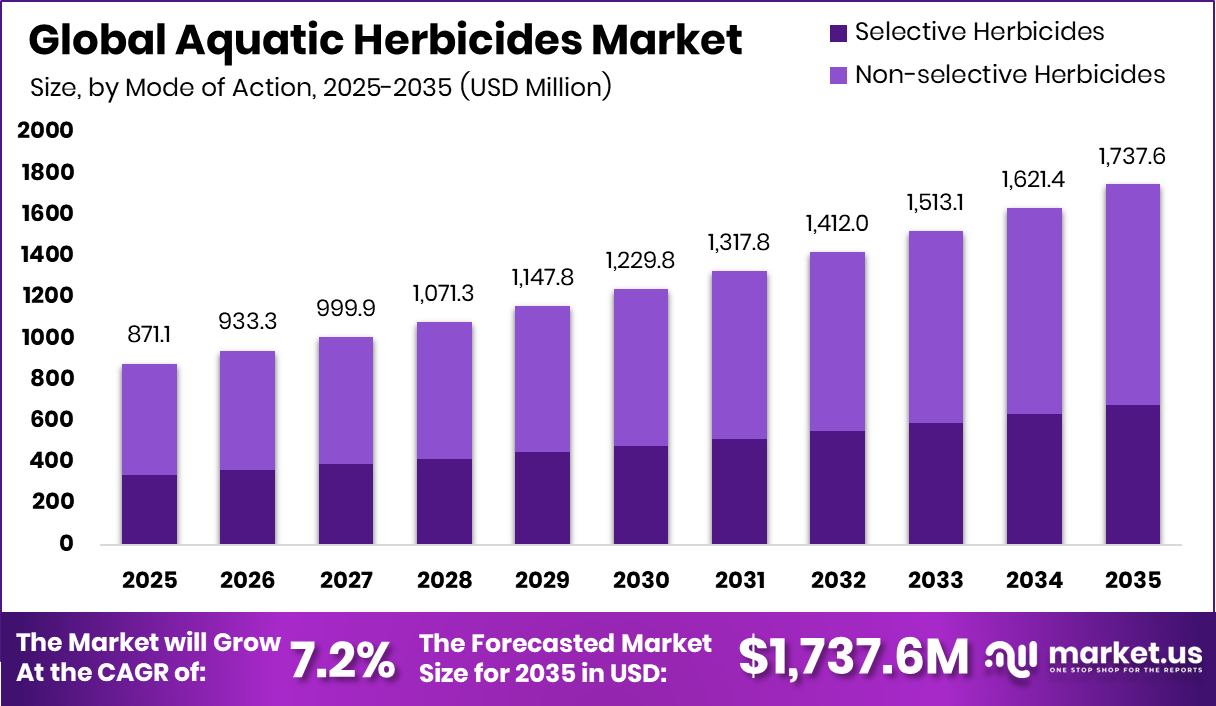
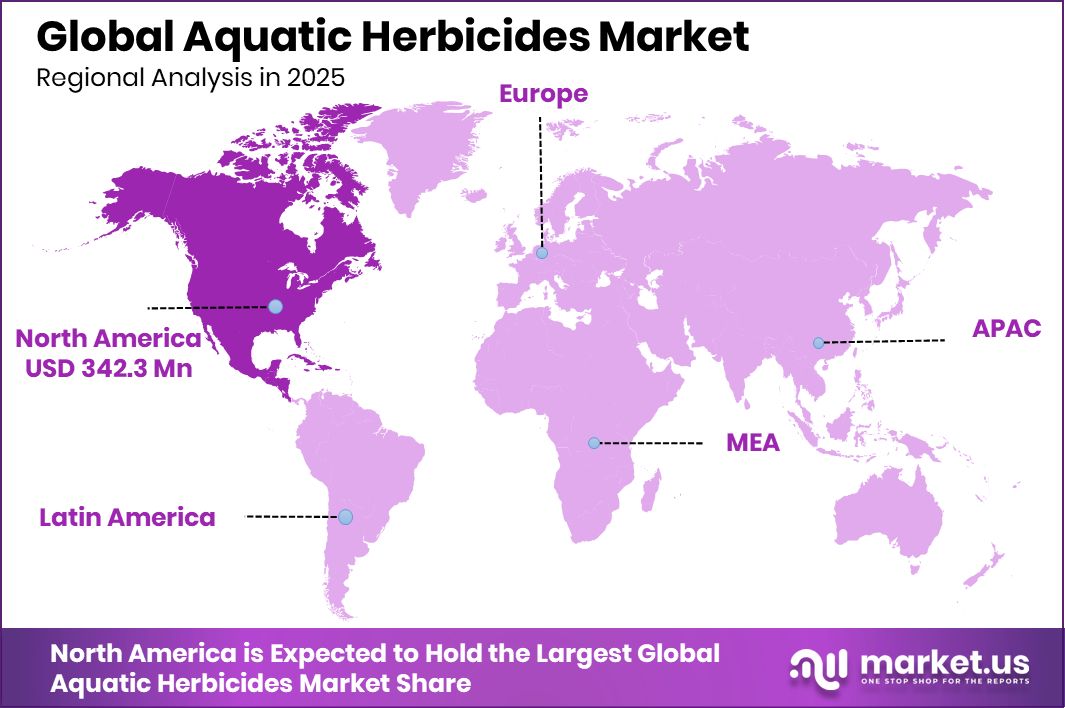
The Global Aquatic Herbicides Market is expected to be worth around USD 1,737.6 million by 2035, up from USD 871.1 million in 2025, and is projected to grow at a CAGR of 7.2% from 2026 to 2035. The Aquatic Herbicides Market in North America recorded a 39.3% share, valued at USD 342.3 million.
Aquatic herbicides are chemical solutions specifically designed to control or eliminate unwanted plants growing in water bodies such as lakes, ponds, reservoirs, irrigation canals, and rivers. These herbicides help manage invasive aquatic weeds that can disrupt water flow, reduce oxygen levels, and negatively affect fish habitats and aquatic ecosystems. Depending on the formulation, aquatic herbicides may target weeds growing above the water surface, floating weeds, or submerged vegetation. They are commonly used in fisheries, agricultural irrigation systems, and recreational waters to maintain healthy aquatic environments and ensure proper water utilization.
The Aquatic Herbicides Market refers to the global industry involved in the development, production, and application of herbicides used for aquatic weed management. The market includes different product types such as 2,4-D, glyphosate, imazapyr, diquat, and other specialized formulations. These products are applied using selective or non-selective modes of action to control foliar weeds, submerged weeds, and other invasive aquatic vegetation. The market supports multiple sectors, including fisheries, recreational waters, and agricultural water systems, where effective weed management is required to maintain water quality and operational efficiency.
Growth in the Aquatic Herbicides Market is primarily supported by the increasing need to manage invasive aquatic plants that threaten water ecosystems and agricultural irrigation systems. Excessive weed growth can block waterways, reduce water storage capacity, and disturb aquatic biodiversity. In many regions, governments and water authorities are strengthening water management programs to maintain lakes, reservoirs, and irrigation channels. These initiatives are encouraging the use of aquatic herbicides to ensure controlled vegetation growth and improve the overall sustainability of water resources.
Demand for aquatic herbicides is rising as water bodies are increasingly used for aquaculture, irrigation, and recreational activities. Maintaining clear and navigable water surfaces is essential for fisheries productivity and tourism-related activities. At the same time, technological progress in agricultural and weed-control solutions is creating new opportunities.
For example, crop.zone secured USD 11 million in equity funding, Greeneye raised USD 22 million for AI crop protection technologies, and Ecorobotix raised USD 150 million to scale plant-by-plant precision spraying. In addition, John Deere acquired Blue River Technology for USD 305 million, while the FGN/IFAD-VCDP program distributed farm inputs to 534 farmers in Kogi to support rice production, reflecting the growing focus on efficient crop and weed management systems that can indirectly support aquatic weed control practices.
Key Takeaways
- The Global Aquatic Herbicides Market is expected to be worth around USD 1,737.6 million by 2035, up from USD 871.1 million in 2025, and is projected to grow at a CAGR of 7.2% from 2026 to 2035.
- In the Aquatic Herbicides Market, 2,4-D accounts for 28.5% share due to effective weed control.
- Non-selective herbicides dominate the Aquatic Herbicides Market with 61.7% share driven by broad-spectrum weed management.
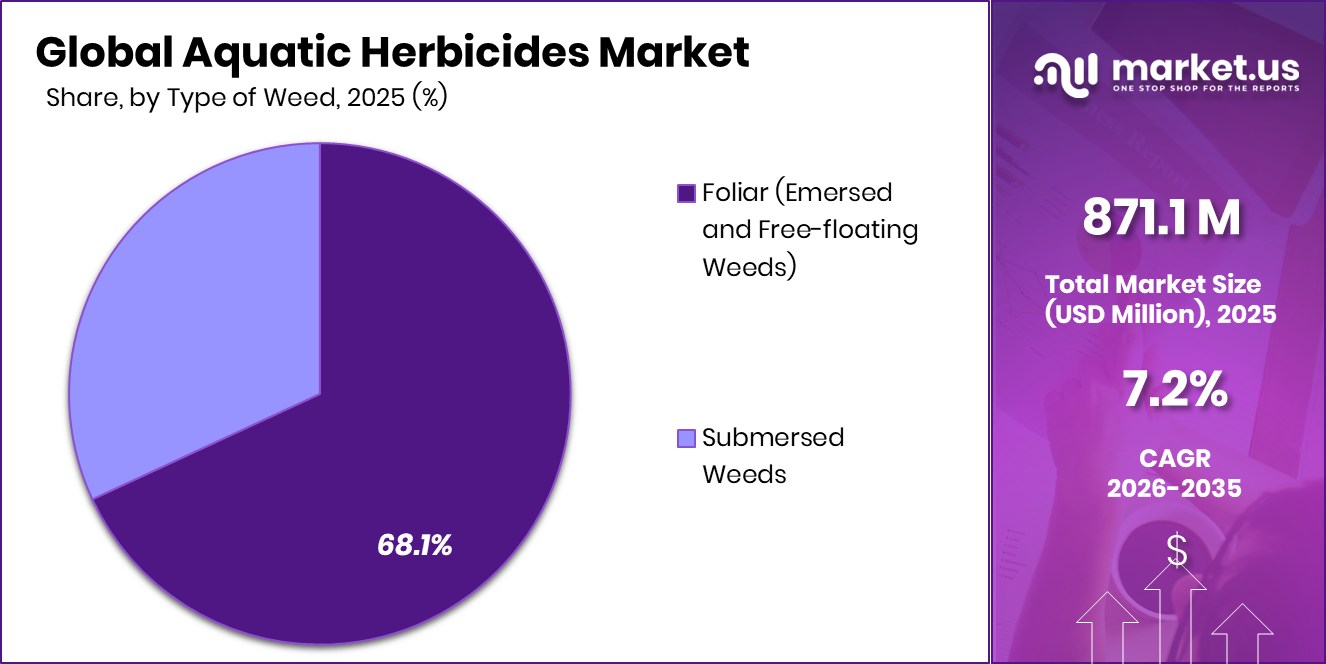
- Foliar applications targeting emersed and free-floating weeds represent 68.1% demand within the Aquatic Herbicides Market.
- Recreational waters account for 38.9% usage in the Aquatic Herbicides Market for aquatic vegetation control.
- In North America, the Aquatic Herbicides Market accounted for 39.3%, totaling USD 342.3 Mn revenue.
By Type Analysis
2,4-D type dominates Aquatic Herbicides Market with a significant 28.5% share globally.
In 2025, the Aquatic Herbicides Market shows strong growth in the segment classified by type, particularly with 2,4-D herbicides accounting for around 28.5% of the market share. This dominance is attributed to the chemical’s effectiveness in controlling broadleaf aquatic weeds while maintaining relatively low toxicity toward many aquatic organisms when applied correctly. Increasing concerns regarding invasive aquatic vegetation in lakes, reservoirs, and irrigation channels are driving the adoption of 2,4-D formulations.
Governments and water management agencies are increasingly implementing weed control programs to maintain water quality and ecosystem balance. Moreover, rising investments in water infrastructure and lake restoration initiatives across developed and emerging economies are further boosting demand for aquatic herbicides that provide reliable and cost-effective weed control solutions.
By Mode of Action Analysis
Non-selective herbicides lead Aquatic Herbicides Market mode segment, holding 61.7% share.
In 2025, the Aquatic Herbicides Market is significantly influenced by mode of action, with non-selective herbicides representing approximately 61.7% of the overall market share. These herbicides are widely used because they can eliminate a broad spectrum of aquatic weeds, including submerged, floating, and emergent plant species. Their versatility makes them particularly valuable in areas where dense weed infestations threaten water flow, biodiversity, and recreational activities.
Water management authorities and environmental agencies often rely on non-selective herbicides for large-scale weed control projects in lakes, canals, and reservoirs. Additionally, technological improvements in formulation and application methods have enhanced the effectiveness and environmental safety of these herbicides, making them an increasingly preferred option for integrated aquatic weed management strategies.
By Type of Weed Analysis
Foliar weeds category drives Aquatic Herbicides Market demand with 68.1% dominance.
In 2025, the Aquatic Herbicides Market demonstrates notable demand based on the type of weed targeted, with foliar weeds—including emergent and free-floating weeds—accounting for about 68.1% of the market share. These weeds often grow rapidly on the water surface and can significantly disrupt aquatic ecosystems by blocking sunlight, reducing oxygen levels, and hindering water circulation.
As a result, aquatic herbicides specifically designed for foliar application are widely used to manage invasive species such as water hyacinth and water lettuce. Increasing awareness about the ecological and economic damage caused by these weeds has encouraged more proactive control measures. Furthermore, ongoing research in herbicide formulations has improved selectivity and application efficiency, helping water management authorities control foliar weeds while minimizing environmental impact.
By Application Area Analysis
Recreational waters application area supports Aquatic Herbicides Market growth capturing 38.9%.
In 2025, the Aquatic Herbicides Market is also shaped by application areas, with recreational waters accounting for approximately 38.9% of the market share. Lakes, ponds, and reservoirs used for recreational activities such as boating, fishing, and swimming require consistent weed management to maintain water quality and accessibility. Excessive aquatic vegetation can negatively affect tourism, reduce property values, and disrupt recreational use of water bodies.
As a result, municipalities and private lake management organizations are investing in effective aquatic herbicide programs to maintain clean and navigable waters. The increasing popularity of outdoor recreation and eco-tourism is further contributing to market growth. Additionally, advancements in environmentally responsible herbicide products are encouraging broader adoption in recreational water management initiatives worldwide.
Key Market Segments
By Type
- 2,4-D
- Glyphosate
- Imazapyr
- Diquat
- Others
By Mode of Action
- Selective Herbicides
- Non-selective Herbicides
By Type of Weed
- Foliar (Emersed and Free-floating Weeds)
- Submersed Weeds
By Application Area
- Fisheries
- Recreational Waters
- Agricultural Waters
- Others
Driving Factors
Increasing invasive aquatic weeds are affecting waterbodies
The Aquatic Herbicides Market is influenced by the growing spread of invasive aquatic weeds that affect lakes, rivers, irrigation canals, and reservoirs. Excessive vegetation often restricts water movement, reduces oxygen levels, and disrupts aquatic ecosystems, creating a strong need for effective weed management solutions. Aquatic herbicides are increasingly used by water authorities and environmental managers to control these plant infestations and maintain balanced water systems.
In addition, government-backed conservation initiatives are strengthening attention toward the maintenance of water bodies and surrounding green spaces. For example, the Interior and Defense Departments jointly invested USD 15 million to preserve green spaces and improve recreational opportunities around military installations, indirectly supporting the need for controlled vegetation management across natural and managed water environments.
Restraining Factors
Strict environmental regulations limit herbicide applications
Despite increasing demand, the Aquatic Herbicides Market faces limitations due to strict environmental and regulatory frameworks governing chemical usage in water bodies. Authorities often require detailed assessments before herbicides can be applied in lakes, rivers, or wetlands to protect aquatic life, drinking water resources, and surrounding ecosystems. These regulations can slow approval processes and restrict the scale of herbicide use in certain locations.
Governments are also prioritizing broader environmental conservation and recreational land development initiatives. For instance, the Department of the Interior announced USD 279 million in funding to support public parks and expand outdoor recreation access, reflecting a growing emphasis on ecosystem preservation that can influence the regulatory environment surrounding aquatic vegetation management practices.
Growth Opportunity
Expanding aquaculture and irrigation water management
Expanding aquaculture activities and irrigation infrastructure are creating meaningful opportunities for the Aquatic Herbicides Market. As fish farming and agricultural water systems continue to grow, maintaining clear waterways and balanced aquatic ecosystems becomes increasingly important. Aquatic weeds can quickly spread in aquaculture ponds and irrigation canals, affecting water circulation and productivity.
As a result, controlled herbicide applications are becoming an essential part of water management strategies in these sectors. At the same time, public investment in recreational and environmental infrastructure is increasing. The U.S. Department of the Interior, through Secretary Haaland, announced USD 150 million to create public parks and expand recreation opportunities in urban areas, highlighting the importance of maintaining well-managed and vegetation-controlled water bodies in growing urban landscapes.
Latest Trends
Development of eco-friendly aquatic herbicides
A notable trend shaping the Aquatic Herbicides Market is the development of environmentally responsible herbicide formulations designed to minimize ecological impact while effectively managing aquatic weeds. Water management organizations are increasingly seeking solutions that balance weed control with ecosystem protection, encouraging the use of improved chemical formulations and integrated vegetation management approaches.
In parallel, investment in recreational water resources is expanding, reinforcing the importance of maintaining healthy and accessible aquatic environments. For example, California State Parks received USD 24.8 million from the Land and Water Conservation Fund to support outdoor recreation initiatives. Such investments highlight the rising focus on maintaining clean lakes, reservoirs, and water-based recreation areas, which in turn supports the continued demand for sustainable aquatic weed management solutions.
Regional Analysis
North America dominates the Aquatic Herbicides Market with 39.3% share, reaching a USD 342.3 Mn value.
The Aquatic Herbicides Market demonstrates varied regional dynamics across North America, Europe, Asia Pacific, the Middle East & Africa, and Latin America, supported by increasing aquatic weed management initiatives and water ecosystem maintenance programs.
North America dominates the market, accounting for 39.3% share with a value of USD 342.3 Mn, driven by extensive freshwater resources, established aquatic vegetation management programs, and strong regulatory frameworks for water quality maintenance. The United States and Canada continue to implement aquatic weed control measures across lakes, reservoirs, irrigation canals, and recreational water bodies, supporting regional market leadership.
Europe represents a significant regional market due to growing environmental monitoring and aquatic ecosystem restoration initiatives across countries such as Germany, France, and the United Kingdom.
Meanwhile, Asia Pacific is witnessing increasing adoption of aquatic herbicides due to expanding aquaculture activities, irrigation infrastructure, and growing awareness of invasive aquatic weeds in countries including China, India, and Southeast Asian nations.
The Middle East & Africa and Latin America are gradually emerging markets, supported by rising water management projects, reservoir maintenance programs, and expanding agricultural irrigation systems requiring aquatic weed control solutions.
Key Regions and Countries
- North America
- US
- Canada
- Europe
- Germany
- France
- The UK
- Spain
- Italy
- Rest of Europe
- Asia Pacific
- China
- Japan
- South Korea
- India
- Australia
- Rest of APAC
- Latin America
- Brazil
- Mexico
- Rest of Latin America
- Middle East & Africa
- GCC
- South Africa
- Rest of MEA
Key Players Analysis
In 2025, Dow Chemical remains a notable participant in the global Aquatic Herbicides Market through its diversified agrochemical and specialty chemical portfolio. The company leverages its long-standing expertise in crop protection chemistry and formulation technologies to support solutions used in aquatic vegetation management. Analysts observe that Dow Chemical’s strength lies in its strong manufacturing capabilities, advanced chemical research infrastructure, and established global distribution networks. These capabilities enable the company to deliver herbicide formulations designed for controlling invasive aquatic weeds in lakes, reservoirs, and irrigation channels.
BASF holds a strategic position in the Aquatic Herbicides Market due to its strong chemical innovation capabilities and global crop protection portfolio. Analysts highlight that the company’s research-driven approach enables the development of herbicide formulations designed for effective aquatic weed management while maintaining environmental considerations. BASF’s integrated chemical production structure allows it to optimize formulation efficiency and product stability, which supports herbicide applications across water bodies, irrigation systems, and aquatic ecosystem management programs. The company’s extensive presence in multiple regions also enables effective distribution and technical support for water management authorities and agricultural sectors.
Monsanto continues to be recognized as an influential agricultural biotechnology and herbicide developer contributing to the Aquatic Herbicides Market landscape. Analysts note that the company’s expertise in herbicide chemistry and weed management solutions supports applications beyond conventional agriculture, including aquatic weed control environments. Monsanto’s herbicide development capabilities focus on efficiency in controlling invasive plant species that impact water systems and aquatic ecosystems. The company’s experience in large-scale herbicide production and product development allows it to support various weed management strategies used by water management agencies.
Top Key Players in the Market
- Dow Chemical
- BASF
- Monsanto
- Syngenta
- Nufarm
- Lonza
- Land O’Lakes
- UPL
- Platform Specialty Products
- SePRO Corporation
- Albaugh
- Valent
- SANCO INDUSTRIES
Recent Developments
- In March 2024, Dow Chemical announced plans to invest in a new carbonate solvents production facility in the U.S. Gulf Coast. The company works in chemicals and materials science, supplying solutions for many industries, including agriculture and herbicides. The project aims to strengthen chemical production and support advanced product development across its portfolio.
- In February 2024, BASF announced that its Surtain™ herbicide received approval from the U.S. Environmental Protection Agency (EPA). BASF works in chemical manufacturing and agricultural solutions, including crop protection products such as herbicides. The product uses solid encapsulation technology to control many broadleaf and grass weeds and provide flexible application timing for farmers.
Report Scope
Report Features Description Market Value (2025) USD 871.1 Million Forecast Revenue (2035) USD 1,737.6 Million CAGR (2026-2035) 7.2% Base Year for Estimation 2025 Historic Period 2020-2024 Forecast Period 2026-2035 Report Coverage Revenue Forecast, Market Dynamics, Competitive Landscape, Recent Developments Segments Covered By Type (2,4-D, Glyphosate, Imazapyr, Diquat, Others), By Mode of Action (Selective Herbicides, Non-selective Herbicides), By Type of Weed (Foliar (Emersed and Free-floating Weeds), Submersed Weeds), By Application Area (Fisheries, Recreational Waters, Agricultural Waters, Others) Regional Analysis North America – US, Canada; Europe – Germany, France, The UK, Spain, Italy, Rest of Europe; Asia Pacific – China, Japan, South Korea, India, Australia, Singapore, Rest of APAC; Latin America – Brazil, Mexico, Rest of Latin America; Middle East & Africa – GCC, South Africa, Rest of MEA Competitive Landscape Dow Chemical, BASF, Monsanto, Syngenta, Nufarm, Lonza, Land O’Lakes, UPL, Platform Specialty Products, SePRO Corporation, Albaugh, Valent, SANCO INDUSTRIES Customization Scope Customization for segments, region/country-level will be provided. Moreover, additional customization can be done based on the requirements. Purchase Options We have three licenses to opt for: Single User License, Multi-User License (Up to 5 Users), Corporate Use License (Unlimited User and Printable PDF)  Aquatic Herbicides MarketPublished date: March 2026add_shopping_cartBuy Now get_appDownload Sample
 -
-
- Dow Chemical
- BASF
- Monsanto
- Syngenta
- Nufarm
- Lonza
- Land O'Lakes
- UPL
- Platform Specialty Products
- SePRO Corporation
- Albaugh
- Valent
- SANCO INDUSTRIES
Our Clients

- 180904
- March 2026






