


Global Animal Transport Carriers Market Size, Share, Growth Analysis By Product Type (Crates, Cages, Kennels, Carriers, Others), By Material (Plastic, Metal, Fabric, Others), By Animal Type (Dogs, Cats, Birds, Small Mammals, Others), By Application (Commercial, Household, Veterinary, Others), By Distribution Channel (Specialty Stores, Online Stores, Supermarkets/Hypermarkets, Others), By Region and Companies - Industry Segment Outlook, Market Assessment, Competition Scenario, Statistics, Trends and Forecast 2026-2035
- Published date: Feb 2026
- Report ID: 180278
- Number of Pages: 329
- Format:
-
keyboard_arrow_up
Quick Navigation
Report Overview
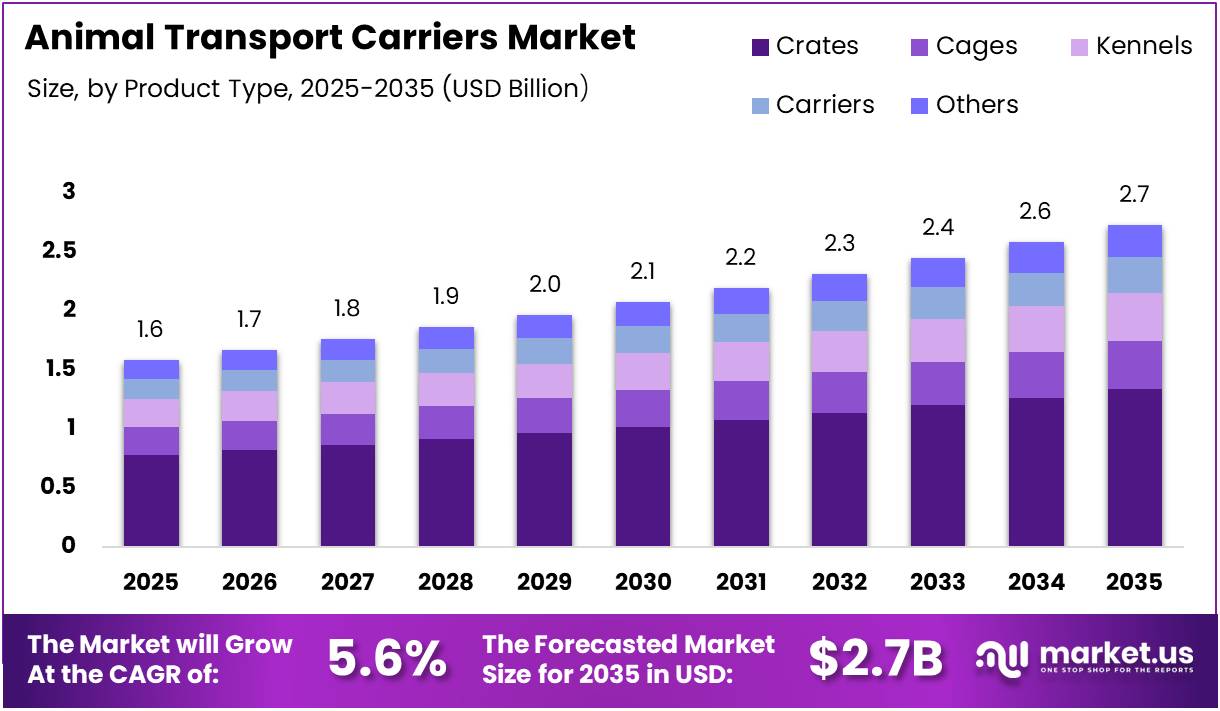
The Global Animal Transport Carriers Market size is expected to be worth around USD 2.7 Billion by 2035 from USD 1.58 Billion in 2025, growing at a CAGR of 5.6% during the forecast period 2026 to 2035.
The animal transport carriers market covers a broad range of products used to move pets and animals safely from one place to another. These include hard-sided crates, wire cages, kennels, and soft carriers. Moreover, they serve multiple needs, from everyday veterinary visits to long-distance air and road travel for both household pets and commercially transported animals.
Growing pet ownership worldwide is one of the strongest forces driving this market forward. Pet owners increasingly view their animals as family members and seek products that ensure comfort and safety during travel. Consequently, demand for purpose-built pet carriers with improved ventilation, structural support, and ergonomic design has grown consistently across all major regions.
Expansion of pet-friendly airline and public transportation policies is further accelerating market growth. Airlines and transit operators are setting clearer guidelines for onboard and in-hold animal transport. Therefore, consumers are actively seeking carriers that meet these compliance standards, creating a sustained and predictable demand for certified, regulation-compliant transport products.
Government bodies and international aviation authorities are introducing updated standards to ensure animal welfare during transit. These regulations define dimensions, materials, and ventilation requirements for compliant carriers. Additionally, growing awareness about animal stress during travel is encouraging both manufacturers and consumers to prioritize comfort-oriented, welfare-focused product designs in all market segments.
Statistical data further supports the strong momentum in this market. According to National Geographic, 44% of pet owners report using pet-specific travel carriers designed for dogs or cats during trips. Additionally, according to Kiplinger, 40% of US travelers aged 34 to 54 years old plan to include their pets on their next holiday, with 24% of those over 55 doing the same.
Industry records also confirm the overall safety and reliability of modern animal transportation systems. With a total of 161,335 animals transported, there is a less than 0.01% chance of something going wrong when traveling with pets. Furthermore, two-thirds of dog owners and 80% of cat owners reported taking their pets on a flight at least once in 2024, reflecting strong and growing consumer adoption of pet travel carriers.
Key Takeaways
- The Global Animal Transport Carriers Market was valued at USD 1.58 Billion in 2025 and is projected to reach USD 2.7 Billion by 2035.
- The market is expected to grow at a CAGR of 5.6% during the forecast period 2026 to 2035.
- By Product Type, Crates held the dominant position with a 48.10% market share in 2025.
- By Material, Plastic led the segment with a 45.35% share, driven by its durability, lightweight nature, and wide product availability.
- By Animal Type, Dogs accounted for the largest share at 57.80%, reflecting strong demand from dog-owning households globally.
- By Application, Commercial held the highest share at 61.40%, supported by growing use in pet transport services and commercial breeding operations.
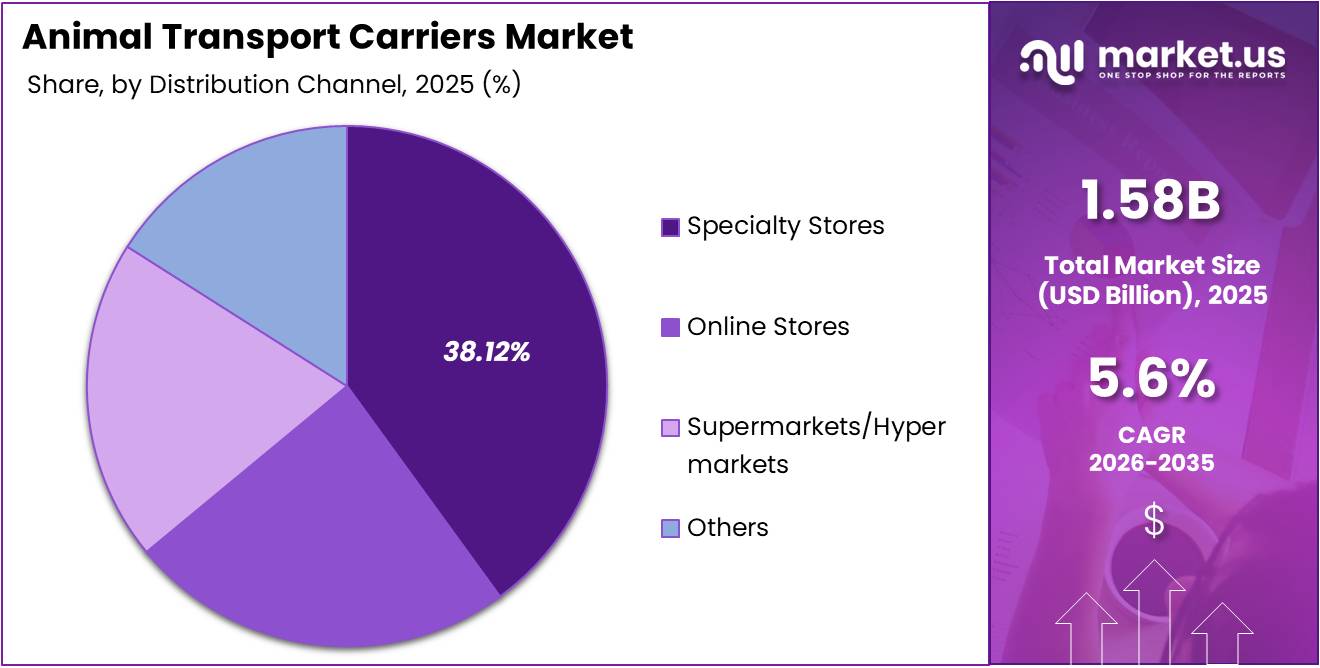
- By Distribution Channel, Specialty Stores led with a 38.12% share, preferred for their expert guidance and curated product selection.
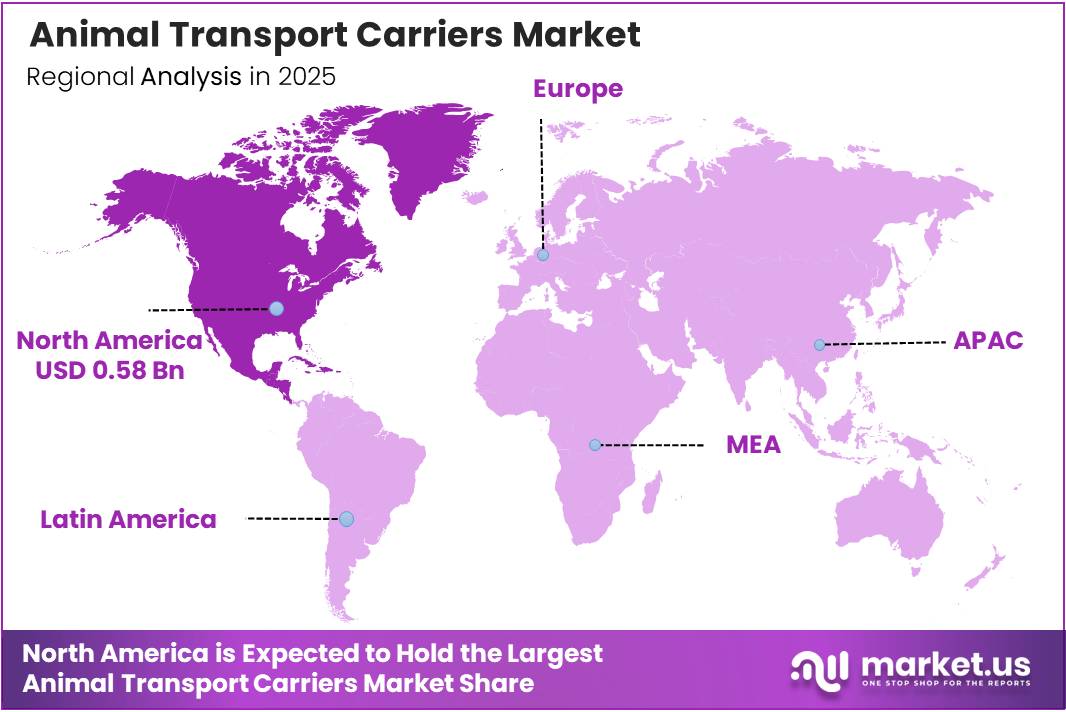
- North America dominated the regional landscape with a 36.70% share, valued at USD 0.58 Billion in 2025.
Product Type Analysis
Crates dominate with 48.10% due to their structural durability, airline compliance, and widespread use in commercial and household pet transport.
In 2025, Crates held a dominant market position in the By Product Type segment of the Animal Transport Carriers Market, with a 48.10% share. Their rigid construction offers superior protection for pets during air and road travel. Moreover, most airline-approved carriers fall under the crate category, making them the first choice for regulated pet transport globally.
Cages represent a significant share of the market, particularly for use in veterinary clinics and commercial animal facilities. They offer easy access, strong ventilation, and stackable designs for efficient storage and handling. Additionally, cages are widely used for transporting birds and small mammals in controlled environments.
Kennels serve a strong role in outdoor, shelter, and longer-duration transport scenarios. They are built to withstand extended use and varying weather conditions. Consequently, kennels remain popular among professional breeders, animal rescue organizations, and pet boarding facilities that require heavy-duty containment solutions.
Carriers, including soft-sided and backpack-style options, are gaining traction among everyday pet owners who prioritize portability and ease of use. These lightweight solutions are suitable for short-distance travel and public transport. Furthermore, the growing trend of urban pet ownership is boosting demand for compact, stylish, and comfortable carrier products.
Others in the product type segment include outdoor pet backpack, strollers, and modular transport systems designed for specific use cases. These products serve niche consumer needs that standard crates and carriers do not fully address. Additionally, innovation in this category is growing as manufacturers explore hybrid designs that combine multiple functions into a single transport solution.
Material Analysis
Plastic dominates with 45.35% due to its lightweight properties, ease of cleaning, durability, and compliance with airline carrier regulations.
In 2025, Plastic held a dominant market position in the By Material segment of the Animal Transport Carriers Market, with a 45.35% share. Plastic carriers offer a balance of strength, hygiene, and affordability. Moreover, they are easy to sanitize and resistant to wear, making them the preferred material for both household users and commercial operators.
Metal carriers and cages are widely used in professional and commercial settings where strength and security are priorities. They are ideal for large animals and long-term confinement applications such as shelters and veterinary facilities. Additionally, metal products offer long service life and resistance to damage from larger or more active animals.
Fabric carriers are growing in popularity among pet owners seeking comfortable and lightweight travel solutions for smaller pets. Their soft interiors reduce animal anxiety during short trips. Consequently, fabric carriers are frequently chosen for cabin travel and urban commuting, where portability and discretion are valued over heavy structural protection.
Others in the material segment include wood, bamboo, and composite blended materials used in specialty and premium carrier products. These materials appeal to consumers looking for unique aesthetics or enhanced sustainability credentials. Moreover, emerging material technologies are enabling manufacturers to produce carriers that are both structurally strong and significantly lighter than traditional plastic or metal alternatives.
Animal Type Analysis
Dogs dominate with 57.80% due to high global dog ownership rates and strong demand for travel-ready, airline-compliant dog carriers.
In 2025, Dogs held a dominant market position in the By Animal Type segment of the Animal Transport Carriers Market, with a 57.80% share. Dogs are the most commonly owned pets worldwide, and their transport needs are frequent across travel, veterinary, and outdoor recreation scenarios. Moreover, the high volume of dog-related products in the carrier market reflects broad consumer investment in canine travel safety.
Cats represent the second-largest segment within the animal type category. Cat owners increasingly seek carriers that reduce feline stress through enclosed designs, familiar scents, and comfortable padding. Additionally, growing demand for airline-cabin-approved cat carriers is pushing manufacturers to develop quieter, more compact, and anxiety-reducing transport solutions.
Birds require specialized carriers with secure latching, proper ventilation, and perch support. This niche segment continues to grow as exotic bird ownership rises in urban households. Consequently, manufacturers are developing bird-specific transport solutions that comply with international wildlife transport standards while ensuring comfort during travel.
Small Mammals such as rabbits, guinea pigs, and hamsters represent an emerging segment with growing product specialization. Their transport needs differ significantly from dogs and cats, requiring smaller enclosures with bedding and secure closures. Furthermore, rising ownership of small pets in apartment living environments is increasing demand for compact, purpose-built transport carriers for this category.
Others in the animal type segment include reptiles, fish, and exotic animals that require highly specialized transport conditions. These carriers must maintain specific temperature, humidity, and ventilation levels to ensure safe transit. Additionally, growing interest in exotic pet ownership and increasing international wildlife transport regulations are encouraging the development of purpose-engineered carriers for non-traditional companion animals.
Application Analysis
Commercial dominates with 61.40% due to high-volume demand from pet transport services, breeding facilities, and animal logistics companies.
In 2025, Commercial held a dominant market position in the By Application segment of the Animal Transport Carriers Market, with a 61.40% share. Commercial users include pet transport services, breeders, zoos, and animal welfare organizations that require durable, regulation-compliant carriers in large quantities. Moreover, growth in the pet logistics sector is consistently driving bulk procurement of commercial-grade transport solutions.
Household applications represent a substantial and growing share of the market as more consumers travel with their pets. Everyday use cases include veterinary appointments, vacations, and relocation trips. Additionally, the rising humanization of pets is motivating household consumers to invest in premium carriers that combine safety, comfort, and aesthetic appeal for their animals.
Veterinary use accounts for a steady share of the market, driven by the need for safe and hygienic animal transport within clinical environments. Veterinary facilities require carriers that are easy to clean, structurally sound, and accessible for handling animals under stress or sedation. Consequently, purpose-built veterinary transport carriers continue to see consistent demand across clinics and animal hospitals globally.
Others in the application segment include animal rescue operations, research institutions, and wildlife rehabilitation centers that require specialized transport carriers. These use cases demand robust, secure, and often custom-configured solutions that go beyond standard commercial or household products. Moreover, increasing funding for animal welfare programs globally is supporting steady procurement of high-performance carriers within this category.
Distribution Channel Analysis
Specialty Stores dominate with 38.12% due to expert staff guidance, curated product offerings, and consumer preference for in-person selection.
In 2025, Specialty Stores held a dominant market position in the By Distribution Channel segment of the Animal Transport Carriers Market, with a 38.12% share. Pet specialty retailers offer a focused shopping environment where consumers can physically inspect carrier quality and sizing. Moreover, trained staff provide guidance on product compliance and pet suitability, which supports higher-value purchase decisions.
Online Stores are experiencing the fastest growth among all distribution channels. E-commerce platforms provide convenience, competitive pricing, and access to a wider product range than physical retail. Additionally, detailed product descriptions, customer reviews, and size guides are encouraging more pet owners to shift their purchasing behavior toward online channels for carrier products.
Supermarkets and Hypermarkets serve as accessible points of purchase for cost-conscious consumers seeking basic pet travel products. These retail formats carry entry-level carriers alongside broader pet care assortments. Consequently, they attract impulse buyers and first-time pet owners who are beginning to explore travel and transport solutions for their animals.
Others in the distribution channel segment include direct-to-consumer brand websites, veterinary clinics, and trade shows where specialized carriers are purchased. These channels serve professional buyers and niche consumers who seek expert advice or exclusive products not available in mainstream retail. Additionally, subscription-based pet product boxes and direct wholesale channels are emerging as alternative pathways for carrier product distribution.
Key Market Segments
By Product Type
- Crates
- Cages
- Kennels
- Carriers
- Others
By Material
- Plastic
- Metal
- Fabric
- Others
By Animal Type
- Dogs
- Cats
- Birds
- Small Mammals
- Others
By Application
- Commercial
- Household
- Veterinary
- Others
By Distribution Channel
- Specialty Stores
- Online Stores
- Supermarkets/Hypermarkets
- Others
Drivers
Rising Pet Ownership and Growing Demand for Safe, Convenient Animal Travel Solutions Drive Market Growth
Rising global pet ownership is the primary force driving demand for animal transport carriers. More households now own dogs, cats, and small mammals, creating a growing need for safe travel solutions. Moreover, pet owners are increasingly treating animals as family members, which is directly translating into higher spending on quality transport and travel accessories.
The expansion of pet-friendly airline and public transportation policies worldwide is further supporting market growth. Airlines are standardizing their carrier compliance requirements, prompting consumers to purchase certified products. Consequently, this regulatory shift is encouraging manufacturers to develop a wider range of airline-approved carriers that meet updated safety and dimension standards across different transport modes.
Growing public awareness of animal welfare standards and safe transportation practices is also reinforcing purchase decisions in this market. Consumers are now more informed about the risks of improper animal handling during transit. Therefore, demand for purpose-designed, structurally sound, and ventilation-compliant carriers continues to rise, particularly in markets with strong pet ownership cultures and regulatory environments.
Restraints
Strict Transport Regulations and Animal Comfort Concerns Pose Challenges for Market Expansion
Strict airline and transportation regulations governing carrier dimensions, materials, and structural standards create compliance challenges for manufacturers. Meeting the varied requirements of different airlines and transit authorities increases production complexity and cost. Moreover, frequent changes to regulatory guidelines require manufacturers to continuously update their product lines, which adds operational burden and delays time-to-market for new designs.
Consumer confusion around varying compliance standards across airlines and countries also limits market adoption. Many pet owners are unsure which carriers are universally accepted, leading to purchase hesitation. Consequently, the lack of a single global standard for animal transport carrier compliance reduces consumer confidence and creates friction in the buying process across both online and retail channels.
Animal stress and comfort concerns associated with long-duration transport represent another significant restraint. Many pets experience anxiety, overheating, and physical discomfort during extended travel, which discourages some owners from using carriers altogether. Additionally, negative travel experiences reported by pet owners are drawing attention to the limitations of existing carrier designs, creating pressure on the industry to invest in improved comfort and welfare features.
Growth Factors
Demand for Functional, Lightweight Carriers and E-Commerce Expansion Accelerate Market Growth
Increasing demand for lightweight, foldable, and multi-functional animal transport carriers is creating strong product development opportunities. Consumers want carriers that offer portability without compromising structural integrity or animal safety. Moreover, innovation in collapsible designs and dual-purpose functionality, such as carriers that convert into pet beds, is attracting a broader range of buyers across different lifestyle categories.
The rapid expansion of e-commerce platforms offering specialized pet travel accessories is significantly broadening market reach. Online channels enable manufacturers and retailers to serve consumers in geographies underserved by traditional pet retail. Consequently, the combination of competitive pricing, detailed product listings, and direct-to-consumer distribution is accelerating purchase volume for both premium and budget-tier animal transport carriers globally.
The rising popularity of adventure travel and outdoor activities with pets is opening new growth avenues for the market. Hiking, camping, and road trips with dogs and cats are becoming mainstream lifestyle choices among younger pet owners. Therefore, demand for rugged, weather-resistant, and activity-specific transport carriers is growing, encouraging brands to develop dedicated product lines tailored to active and outdoor-oriented pet owners.
Emerging Trends
Smart Features, Airline-Approved Designs, and Sustainable Materials Are Reshaping the Animal Transport Carriers Market
Integration of smart features such as GPS tracking and temperature monitoring is emerging as a key trend in the animal transport carriers market. These technologies allow pet owners to remotely monitor their animals during transit, improving safety and peace of mind. Moreover, smart carriers appeal to tech-savvy consumers who prioritize real-time visibility and environmental control during both short and long-distance pet travel.
The rising popularity of airline-approved and cabin-friendly pet carrier designs is reshaping product development priorities. More manufacturers are engineering carriers specifically to meet international airline cabin standards for dimensions, ventilation, and materials. Additionally, as more pet owners choose to bring animals into the cabin rather than the cargo hold, demand for sleek, discreet, and regulation-compliant carriers continues to accelerate across premium product segments.
Increasing use of eco-friendly and sustainable materials in pet carrier manufacturing reflects a broader shift in consumer values across the market. Buyers are seeking products made from recycled plastics, organic fabrics, and non-toxic dyes that reduce environmental impact. Consequently, brands that adopt sustainable practices and transparent sourcing are gaining a competitive edge, particularly among environmentally conscious millennial and Gen Z pet owners globally.
Regional Analysis
North America Dominates the Animal Transport Carriers Market with a Market Share of 36.70%, Valued at USD 0.58 Billion
North America holds the leading position in the global animal transport carriers market, accounting for 36.70% of total market revenue and valued at USD 0.58 Billion in 2025. The region benefits from exceptionally high pet ownership rates, well-established airline pet travel policies, and strong consumer spending on premium pet products. Moreover, the presence of major market participants and advanced retail infrastructure further reinforces North America’s dominant market position.
Europe Animal Transport Carriers Market Trends
Europe represents a mature and steadily growing market for animal transport carriers, supported by strong animal welfare legislation and high pet ownership in countries such as Germany, France, and the United Kingdom. The region’s regulatory framework drives consistent demand for compliant, high-quality carrier products. Additionally, growing interest in sustainable and eco-friendly materials among European consumers is prompting manufacturers to invest in greener product development.
Asia Pacific Animal Transport Carriers Market Trends
Asia Pacific is emerging as one of the fastest-growing regions in the animal transport carriers market, driven by rapid urbanization, rising disposable incomes, and increasing pet adoption rates in China, Japan, and India. The region’s expanding middle class is showing a strong preference for premium pet travel products. Furthermore, the growth of e-commerce platforms across Southeast Asia is making a wider range of carriers more accessible to consumers.
Middle East and Africa Animal Transport Carriers Market Trends
The Middle East and Africa market is in an early growth stage, supported by rising pet ownership in urban centers and improving animal logistics infrastructure. The GCC countries are leading adoption due to growing expatriate communities with strong pet travel needs. Consequently, demand for airline-compliant and durable transport carriers is increasing, offering manufacturers new opportunities to enter and expand in this developing regional market.
Latin America Animal Transport Carriers Market Trends
Latin America presents a growing opportunity for the animal transport carriers market, particularly in Brazil and Mexico where pet ownership rates have been rising steadily over recent years. Increasing consumer awareness of animal welfare and the expansion of organized pet retail are supporting market development. Additionally, the growth of online shopping channels in the region is improving product accessibility for consumers in underserved markets.
Key Regions and Countries
North America
- US
- Canada
Europe
- Germany
- France
- The UK
- Spain
- Italy
- Rest of Europe
Asia Pacific
- China
- Japan
- South Korea
- India
- Australia
- Rest of APAC
Latin America
- Brazil
- Mexico
- Rest of Latin America
Middle East & Africa
- GCC
- South Africa
- Rest of MEA
Key Company Insights
Petmate Holdings is one of the most recognized names in the global animal transport carriers market. The company offers a comprehensive portfolio of crates, kennels, and carriers designed for both household and travel use. Moreover, Petmate’s long-standing expertise in durable, safety-focused product design and its broad retail distribution network across North America position it as a market leader in the pet travel accessories category.
Ferplast S.p.A. is a leading European manufacturer with a strong presence in the animal transport carrier segment. The Italy-based company produces a wide range of carriers and crates for dogs, cats, and small animals, combining functional design with aesthetic quality. Additionally, Ferplast’s global distribution reach and consistent focus on European regulatory compliance have helped the company establish a trusted brand identity across international markets.
IRIS Ohyama is a Japan-based manufacturer known for its innovative and space-efficient approach to pet product design. The company produces a range of plastic carriers and crates that reflect its core philosophy of practicality and lightweight engineering. Consequently, IRIS Ohyama has built a strong following in Asia Pacific markets and continues to expand its footprint in North America and Europe through strategic retail and e-commerce partnerships.
MidWest Homes for Pets specializes in metal and wire pet containment and transport products, including foldable crates and exercise pens widely used for dogs. The company’s products are recognized for their ease of assembly, durability, and compliance with major airline travel standards. Furthermore, MidWest’s strong wholesale relationships with pet specialty retailers and its focus on practical, value-driven product design continue to drive consistent performance in key markets.
Key Players
- Petmate Holdings
- Ferplast S.p.A.
- IRIS Ohyama
- MidWest Homes for Pets
- Savic NV
- Doskocil Manufacturing
- PetSafe
- Sherpa Pet
- K&H Pet Products
- Snoozer
- Gen7Pets
- Quaker Pet Group
- Others
Recent Developments
- February 2026 – Zeppelin Cat Carrier launched to widespread market enthusiasm, introducing new comfort and safety features specifically designed for adventure cats. The product has received strong early consumer interest due to its focus on feline-friendly ergonomics and secure structural design for active outdoor travel.
- October 2025 – Göktaşlar Et, based in Gaziantep, made a significant global expansion in the live animal transportation sector by acquiring one of the world’s largest live animal transport capacity shipping companies from Australia-based Wellard. The deal was valued at 82 million Australian Dollars, equivalent to approximately 51 million USD.
- January 2025 – Paw Prosper strengthened its commitment to pet well-being by completing the acquisition of Sleepypod, a globally recognized leader in crash-test-certified safety harnesses and carriers. This strategic acquisition expands Paw Prosper’s product portfolio and reinforces its position in the premium pet travel safety segment.
Report Scope
Report Features Description Market Value (2025) USD 1.58 Billion Forecast Revenue (2035) USD 2.7 Billion CAGR (2026-2035) 5.6% Base Year for Estimation 2025 Historic Period 2020-2024 Forecast Period 2026-2035 Report Coverage Revenue Forecast, Market Dynamics, Competitive Landscape, Recent Developments Segments Covered By Product Type (Crates, Cages, Kennels, Carriers, Others), By Material (Plastic, Metal, Fabric, Others), By Animal Type (Dogs, Cats, Birds, Small Mammals, Others), By Application (Commercial, Household, Veterinary, Others), By Distribution Channel (Specialty Stores, Online Stores, Supermarkets/Hypermarkets, Others) Regional Analysis North America (US and Canada), Europe (Germany, France, The UK, Spain, Italy, and Rest of Europe), Asia Pacific (China, Japan, South Korea, India, Australia, and Rest of APAC), Latin America (Brazil, Mexico, and Rest of Latin America), Middle East & Africa (GCC, South Africa, and Rest of MEA) Competitive Landscape Petmate Holdings, Ferplast S.p.A., IRIS Ohyama, MidWest Homes for Pets, Savic NV, Doskocil Manufacturing, PetSafe, Sherpa Pet, K&H Pet Products, Snoozer, Gen7Pets, Quaker Pet Group, Others Customization Scope Customization for segments, region/country-level will be provided. Moreover, additional customization can be done based on the requirements. Purchase Options We have three licenses to opt for: Single User License, Multi-User License (Up to 5 Users), Corporate Use License (Unlimited User and Printable PDF)  Animal Transport Carriers MarketPublished date: Feb 2026add_shopping_cartBuy Now get_appDownload Sample
 -
-
- Petmate Holdings
- Ferplast S.p.A.
- IRIS Ohyama
- MidWest Homes for Pets
- Savic NV
- Doskocil Manufacturing
- PetSafe
- Sherpa Pet
- K&H Pet Products
- Snoozer
- Gen7Pets
- Quaker Pet Group
- Others
Our Clients

- 180278
- Feb 2026






