


Global Analytics Cloud Market Size, Share, Industry Analysis Report By Component (Solutions, Services), By Organization Size (Large Enterprises, Small & Medium-Sized Enterprises), By Deployment (Public Cloud, Private Cloud, Hybrid Cloud), By Application (Sales and Marketing, Research & Development, Customer Service, Accounting & Finance, Human Resource, Others), By Industry Vertical (BFSI, IT & Telecommunication, Manufacturing, Healthcare & life sciences, Government, Energy & Utilities, Others), By Region and Companies - Industry Segment Outlook, Market Assessment, Competition Scenario, Trends and Forecast 2025-2034
- Published date: Sept. 2025
- Report ID: 156942
- Number of Pages: 285
- Format:
-
keyboard_arrow_up
Quick Navigation
- Report Overview
- Key Takeaway
- Analysts’ Viewpoint
- U.S. Analytics Cloud Market Size
- Component Analysis
- Organization Size Analysis
- Deployment Analysis
- Application Analysis
- Industry Vertical Analysis
- Key Market Segments
- Drivers
- Restraint
- Opportunities
- Challenges
- Latest Trends
- Key Regions and Countries
- Key Players Analysis
- Recent Developments
- Report Scope
Report Overview
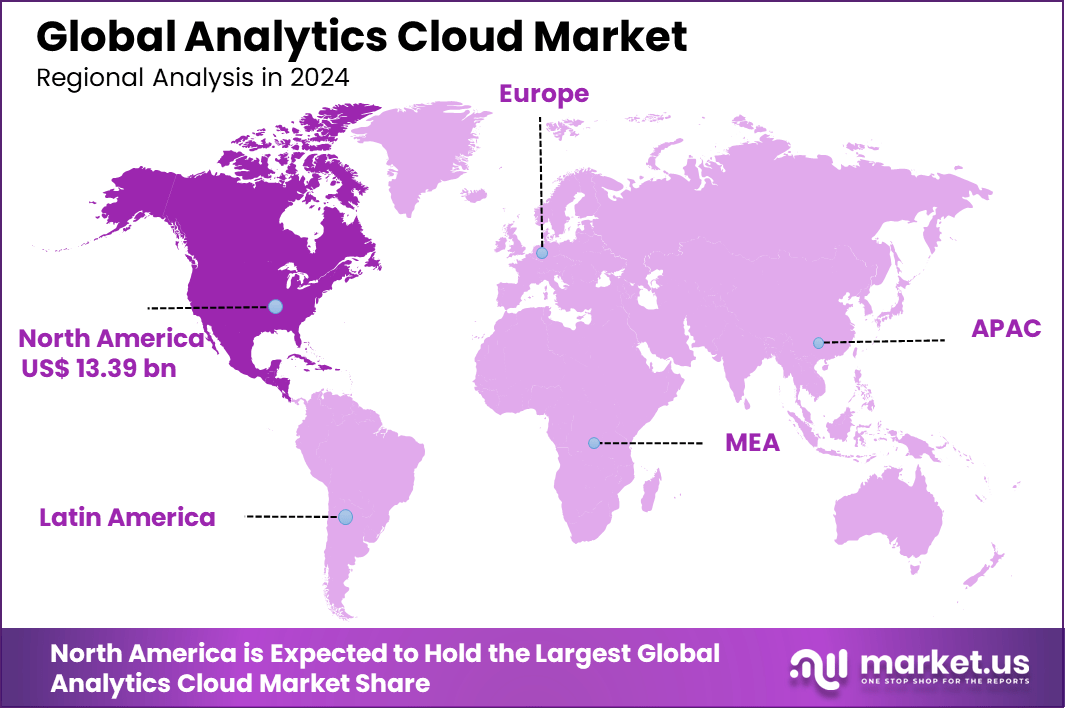
The Global Analytics Cloud Market size is expected to be worth around USD 358.50 Billion by 2034, from USD 34.71 Billion in 2024, growing at a CAGR of 26.3% during the forecast period from 2025 to 2034. In 2024, North America held a dominant market position, capturing more than a 38.6% share, holding USD 13.39 billion in revenue.
The analytics cloud market refers to the suite of cloud‑native platforms and services that enable organizations to collect, process, and analyze vast volumes of data using scalable infrastructure. These solutions allow users to access analytical tools via the web, with processing and storage managed remotely. Analytics workflows are powered by cloud hosting, which permits near‑real‑time data processing, visualization, and insight generation without the need to maintain significant local infrastructure.
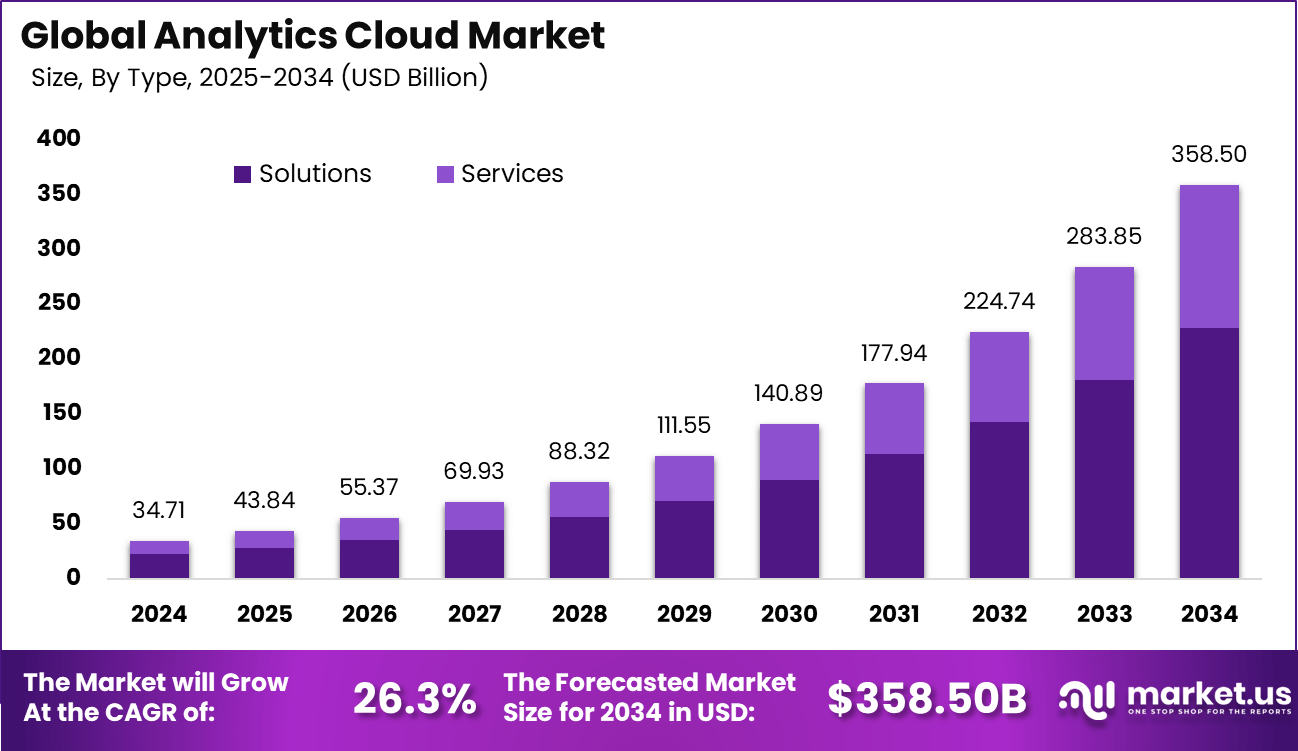
According to softwareoasis, 98% of U.S. organizations now use cloud technology, making it a core part of business operations. About 60% of companies store or process sensitive banking data in the cloud, showing strong trust in security systems. The hybrid model leads the market, with 73% of enterprises adopting it to balance scalability with tighter control over data protection.
Top driving factors in the Analytics Cloud market include the explosive growth in data volumes, the rise of connected devices, and advancements in artificial intelligence (AI) and machine learning (ML). The need to process real-time data and respond quickly to shifting conditions fuels adoption. Companies seek to integrate data from different sources, transforming it into clear, usable information that helps them anticipate customer needs and stay competitive
For instance, in April 2025, IBM acquired Hakkoda, a data and AI consultancy, to strengthen its Analytics Cloud and AI capabilities. This acquisition enhances IBM’s ability to deliver end-to-end cloud migration, data strategy, and AI-driven analytics solutions to enterprise clients. By integrating Hakkoda’s expertise in advanced analytics and AI implementation, IBM aims to accelerate the adoption of cloud-based intelligence platforms.
Key Takeaway
- Solutions accounted for the largest share, 63.7%, reflecting strong enterprise demand for advanced analytics platforms to process and interpret data effectively.
- Large Enterprises dominated the market with 67.4% share, showcasing their higher capacity for adopting cloud-based analytics due to larger datasets and budgets.
- Public Cloud led with 48.2% share, supported by cost efficiency, scalability, and broad accessibility, making it the preferred deployment mode across industries.
- Sales and Marketing emerged as the leading application area, capturing 31.7%, as businesses increasingly use analytics to drive customer insights, personalization, and revenue growth.
- The Banking, Financial Services, and Insurance (BFSI) sector held a 24.9% share, driven by the need for fraud detection, risk analysis, and real-time decision-making.
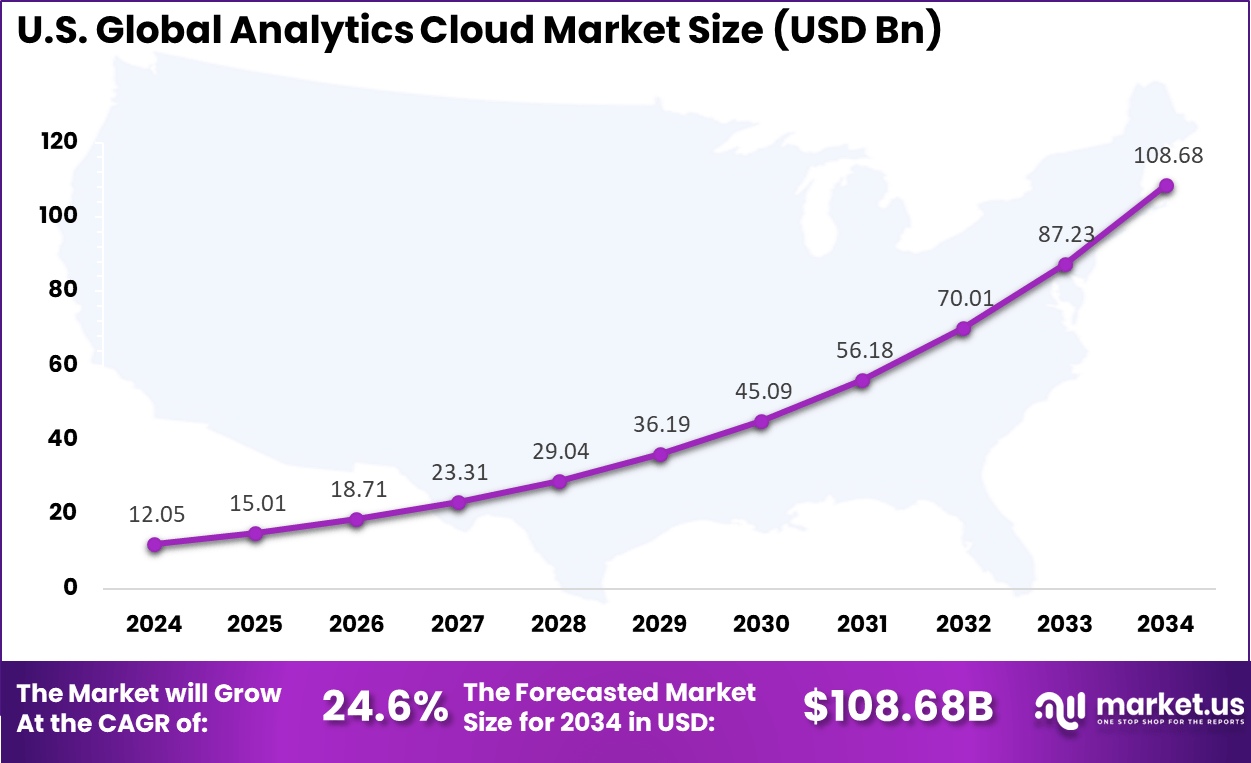
- The U.S. Analytics Cloud Market was valued at USD 12.05 Billion in 2024, with a robust CAGR of 24.6%.
- In 2024, North America held a dominant market position in the Global Analytics Cloud Market, capturing more than a 38.6% share.
Analysts’ Viewpoint
Investment opportunities in this market are particularly strong in sectors undergoing rapid digital transformation or generating large volumes of unstructured data. Interest is high in tools that blend AI, ML, and advanced analytics, allowing organizations to innovate more rapidly and create new business models. The Asia Pacific region is especially promising due to ongoing economic expansion and rising technology adoption.
Key business benefits of Analytics Cloud solutions include enhanced operational efficiency, greater speed to insight, improved collaboration, and the ability to innovate with fewer technology constraints. Centralizing data from multiple sources into a single, integrated environment helps to break down information silos and supports better forecasting, planning, and execution.
The regulatory environment for cloud analytics is evolving and can be highly regional. Data privacy, security, and sovereignty requirements play a critical role, especially for organizations handling personal or sensitive information. Regulatory compliance challenges include adapting to new laws that address where data is stored and processed.
U.S. Analytics Cloud Market Size
The market for Analytics Cloud within the U.S. is growing tremendously and is currently valued at USD 12.05 billion, the market has a projected CAGR of 24.6%. The market for Analytics Cloud within the U.S. is growing tremendously due to the rapid adoption of cloud computing, multi-cloud strategies, and digital transformation initiatives across industries.
Enterprises are increasingly leveraging AI and machine learning to derive actionable insights from large, complex datasets in real time. Rising demand for business intelligence, predictive analytics, and scalable cloud infrastructure, coupled with the need for operational efficiency, regulatory compliance, and enhanced customer experiences, is driving significant investment and fueling the growth.
For instance, in December 2023, U.S.-based data analytics firm FICO launched its cloud platform in India, highlighting the continuing dominance of American companies in the global cloud analytics market. By expanding its cloud-based solutions internationally, FICO reinforces the technological leadership and market influence of U.S. firms in analytics and AI-driven decision-making.
In 2024, North America held a dominant market position in the Global Analytics Cloud Market, capturing more than a 38.6% share, holding USD 13.39 billion in revenue. This dominance is due to early adoption of cloud technologies, widespread digital transformation initiatives, and the strong presence of leading analytics vendors such as IBM, Microsoft, AWS, and Oracle.
High investments in AI, machine learning, and business intelligence solutions, combined with robust IT infrastructure and regulatory support, enabled enterprises to leverage scalable cloud analytics platforms. These factors collectively fueled demand, innovation, and market leadership in North America.
For instance, in April 2025, Onix was recognized as the Google Cloud Partner of the Year for Data & Analytics in North America, highlighting the region’s leadership in cloud analytics. This award underscores North America’s dominance driven by advanced cloud adoption, strong enterprise demand for AI-powered analytics, and the presence of leading cloud providers and partners.
Component Analysis
In 2024, the Platform & Solutions segment held a dominant market position, capturing a 63.7% share of the Global Analytics Cloud Market. This dominance is due to the growing demand for comprehensive cloud-based analytics platforms that integrate data management, business intelligence, and AI/ML capabilities.
Enterprises increasingly prefer end-to-end solutions that simplify deployment, enable real-time insights, and support predictive and prescriptive analytics. Scalability, flexibility, and enhanced decision-making across industries further fueled the adoption of platform-centric cloud analytics solutions worldwide.
For Instance, in August 2025, Qlik announced that its cloud analytics solutions are now available on the AWS Marketplace, expanding accessibility for enterprises seeking scalable, cloud-native data analytics. This integration enables organizations to deploy Qlik’s analytics platform directly within AWS environments, leveraging real-time data insights, AI-driven analytics, and seamless scalability.
Organization Size Analysis
In 2024, the Large Enterprises segment held a dominant market position, capturing a 67.4% share of the Global Analytics Cloud Market. This strong demand is primarily driven by the need to manage massive volumes of structured and unstructured data, support complex analytics workflows, and enable enterprise-wide decision-making.
Large organizations are increasingly adopting cloud analytics for real-time insights, predictive modeling, and AI integration to enhance operational efficiency, optimize resource allocation, and gain a competitive edge, making scalable, secure, and flexible cloud solutions essential for their growth and innovation strategies.
For instance, in November 2024, NTT Data and Google Cloud expanded their partnership to support large organizations in adopting advanced cloud analytics and generative AI solutions. The collaboration focuses on delivering scalable, enterprise-grade analytics platforms that enable real-time insights, predictive modeling, and AI-driven decision-making across complex IT environments.
Deployment Analysis
In 2024, the Public Cloud segment held a dominant market position, capturing a 48.2% share of the Global Analytics Cloud Market. This dominance is due to its cost-effectiveness, scalability, and ease of deployment, allowing organizations to quickly access advanced analytics capabilities without heavy upfront infrastructure investments.
Public cloud platforms also offer seamless integration with AI, machine learning, and real-time data processing tools, enabling enterprises to derive actionable insights efficiently. Public cloud solutions continue to fuel their widespread adoption by flexibility, global accessibility, and rapid innovation.
For Instance, in September 2024, Avaya launched its Experience Platform on the public cloud in India, showcasing the growing adoption of cloud-based analytics and customer experience solutions. The platform leverages public cloud infrastructure to provide scalable, real-time analytics, enabling organizations to gain actionable insights and improve decision-making without heavy on-premises investments.
Application Analysis
In 2024, the Sales and Marketing segment held a dominant market position, capturing a 31.7% share of the Global Analytics Cloud Market. This dominance is due to the increasing need for data-driven strategies to enhance customer engagement, optimize marketing campaigns, and boost sales performance.
Cloud analytics enables real-time insights into customer behavior, preferences, and market trends, allowing organizations to personalize offerings, predict demand, and improve conversion rates. The scalability, AI integration, and advanced reporting capabilities of analytics cloud solutions further fuel adoption.
For Instance, in March 2024, Salesforce enhanced its Marketing Cloud with advanced analytics capabilities, reinforcing the role of cloud analytics in sales and marketing. The platform enables organizations to gain deeper insights into customer behavior, optimize campaigns, and personalize engagement across multiple channels.
Industry Vertical Analysis
In 2024, the BFSI segment held a dominant market position, capturing a 24.9% share of the Global Analytics Cloud Market. This dominance is driven by the sector’s need for real-time risk assessment, fraud detection, regulatory compliance, and customer insights.
Cloud analytics enables BFSI organizations to process large volumes of transactional and unstructured data efficiently, leverage AI and predictive models, and optimize decision-making. The ability to enhance operational efficiency, improve customer experience, and ensure data security continues to fuel adoption in this vertical.
For Instance, in May 2025, UniCredit partnered with Google Cloud to accelerate its digital transformation and showcased the growing adoption of Analytics Cloud solutions in the BFSI sector. The collaboration focuses on leveraging cloud-based analytics, AI, and machine learning to optimize risk management, enhance customer insights, and streamline operations across the bank’s global network.
Key Market Segments
By Component
- Solutions
- Services
By Organization Size
- Large Enterprises
- Small & Medium-Sized Enterprises
By Deployment
- Public Cloud
- Private Cloud
- Hybrid Cloud
By Application
- Sales and Marketing
- Research & Development
- Customer Service
- Accounting & Finance
- Human Resource
- Others
By Industry Vertical
- BFSI
- IT & Telecommunication
- Manufacturing
- Healthcare & life sciences
- Government
- Energy & Utilities
- Others
Drivers
Multi-Cloud and Hybrid Cloud Adoption
The rising adoption of multi-cloud and hybrid cloud strategies is a key growth driver for the analytics cloud market. Enterprises are increasingly diversifying their cloud deployments to avoid vendor lock-in, enhance resilience, and optimize performance.
This architectural flexibility enables organizations to integrate analytics solutions across public and private environments, ensuring scalability, continuity, and compliance. As digital transformation accelerates, the ability to seamlessly manage and analyze distributed data becomes a core enabler of competitive differentiation and operational agility.
For instance, in March 2025, Mahalingam Vaithilingam of Infosys, speaking at a VMware forum covered by Mashdigi, emphasized the accelerating adoption of multi-cloud and hybrid cloud environments as foundational to next-generation analytics platforms. He noted that organizations are increasingly leveraging cloud-agnostic infrastructures to ensure operational continuity, data accessibility, and cost optimization.
Restraint
Security, Privacy & Cyber‑Risk Concerns
Despite the advantages of cloud analytics, concerns around security, privacy, and cyber risk remain a critical restraint. Enterprises must navigate complex regulatory landscapes while ensuring robust data protection, particularly when handling sensitive or personally identifiable information. High-profile breaches and increasing scrutiny around data governance fuel skepticism.
Consequently, companies are cautious in migrating mission-critical analytics to the cloud, highlighting the need for stronger encryption, compliance frameworks, and zero-trust architectures to bolster confidence and safeguard enterprise data assets.
For instance, in May 2020, a report by BitSight revealed that cyberattacks targeting cloud services had doubled over the previous year, underscoring growing concerns around security, privacy, and cyber-risk in cloud environments. For analytics cloud platforms, these risks pose significant barriers to adoption, particularly in regulated industries.
Opportunities
AI & Machine Learning Augmentation
Cloud analytics platforms integrated with AI and machine learning are redefining how organizations derive value from data. These technologies automate insight generation, enable predictive modeling, and support real-time decision-making.
As enterprises strive to become more agile and data-driven, AI-enhanced analytics tools offer a strategic advantage, empowering teams to identify trends, mitigate risks, and uncover growth opportunities faster. This transformation is fueling demand for scalable, intelligent analytics infrastructure across industries seeking competitive differentiation.
For instance, in March 2025, OpenText unveiled Titanium X, a next-generation evolution of its AI-powered Analytics Cloud, designed to deliver hyper-automation, enhanced decision intelligence, and seamless integration across enterprise data ecosystems. The platform combines advanced machine learning, real-time analytics, and contextual insights to enable more proactive and predictive decision-making.
Challenges
Talent Shortage & Organizational Capabilities
The new generative AI has been creating more advanced threats, namely prompt injection attacks. By exploiting the AI models incorporated in the APIs, the hackers manipulate the input to the model to cause malicious actions.
By writing certain prompts, intruders will determine the AI behavior to retrieve sensitive, confidential data, respectively modify the output, or ultimately affect the weaknesses of the organization. Potential risks include data breaches and intellectual property theft. With more integration into company activities, securing AI-centric APIs against these threats would save business assets and credibility.
For instance, in July 2025, a report by ET CIO highlighted the escalating digital skills shortage as a silent crisis confronting Chief Information Officers (CIOs) worldwide. The article emphasized that gaps in data analytics, cloud computing, and AI expertise are significantly undermining the success of digital transformation initiatives.
Latest Trends
Modern cloud analytics platforms increasingly emphasize real-time processing, automated data preparation, and natural language interfaces. These innovations enable businesses to respond rapidly to evolving trends, customer behavior, and operational anomalies.
Real-time analytics empowers frontline decision-makers with actionable insights, while automation reduces manual intervention, accelerates reporting cycles, and enhances data accuracy. By democratizing access to insights through intuitive querying and dashboards, organizations can enhance agility, improve performance, and achieve faster time-to-value from their analytics investments.
For instance, in May 2021, Oracle enhanced its Oracle Analytics Cloud platform by introducing a suite of modern business intelligence features aimed at elevating user productivity and decision-making. These updates included natural language generation, mobile-friendly data visualizations, and improved self-service analytics capabilities.
Key Regions and Countries
North America
- US
- Canada
Europe
- Germany
- France
- The UK
- Spain
- Italy
- Russia
- Netherlands
- Rest of Europe
Asia Pacific
- China
- Japan
- South Korea
- India
- Australia
- Singapore
- Thailand
- Vietnam
- Rest of APAC
Latin America
- Brazil
- Mexico
- Rest of Latin America
Middle East & Africa
- South Africa
- Saudi Arabia
- UAE
- Rest of MEA
Key Players Analysis
In the Analytics Cloud Market, established technology leaders such as IBM Corporation, Microsoft Corporation, and Amazon Web Services, Inc. play a central role. Their dominance is driven by strong infrastructure capabilities, continuous innovation in AI and machine learning, and global cloud ecosystems. These companies provide scalable solutions for large enterprises, enabling advanced analytics and business intelligence.
Specialized providers such as Sisense Ltd., GoodData Corporation, and Tableau Software LLC (Salesforce, Inc.) add depth to the market. Their focus is on delivering intuitive analytics platforms, user-friendly dashboards, and embedded analytics for businesses of varying sizes. These players target mid-market and departmental needs where agility, customization, and cost efficiency are critical.
Advanced analytics and data integration are driven by firms like Databricks, Inc., SAS Institute Inc., Oracle Corporation, and Google LLC. Their strength lies in cloud-native data lakes, statistical modeling, and AI-powered data management. These companies support enterprises in handling large and complex datasets with speed and accuracy.
Top Key Players in the Market
- IBM Corporation
- Microsoft Corporation
- Amazon Web Services, Inc.
- Sisense Ltd.
- GoodData Corporation
- Tableau Software LLC (Salesforce, Inc.)
- Databricks, Inc.
- SAS Institute Inc.
- Oracle Corporation
- Google LLC
- Other Major Players
Recent Developments
- In June 2025, RWE and Amazon Web Services (AWS) entered a strategic collaboration to advance digital transformation and analytics cloud capabilities within the energy sector. The partnership focuses on leveraging AWS’s cloud infrastructure and AI-powered analytics to optimize RWE’s operations, improve data-driven decision-making, and enhance efficiency across renewable energy and grid management.
- In June 2025, Databricks announced a strategic AI partnership with Google Cloud to integrate Google’s Gemini models directly into the Databricks Data Intelligence Platform. This collaboration enables organizations to leverage advanced generative AI and analytics cloud capabilities natively within Databricks, streamlining data processing, predictive modeling, and insight generation.
Report Scope
Report Features Description Market Value (2024) USD 34.71 Bn Forecast Revenue (2034) USD 358.50 Bn CAGR(2025-2034) 26.3% Base Year for Estimation 2024 Historic Period 2020-2023 Forecast Period 2025-2034 Report Coverage Revenue forecast, AI impact on Market trends, Share Insights, Company ranking, competitive landscape, Recent Developments, Market Dynamics, nd Emerging Trends Segments Covered By Component (Solutions, Services), By Organization Size (Large Enterprises, Small & Medium-Sized Enterprises), By Deployment (Public Cloud, Private Cloud, Hybrid Cloud), By Application (Sales and Marketing, Research & Development, Customer Service, Accounting & Finance, Human Resource, Others), By Industry Vertical (BFSI, IT & Telecommunication, Manufacturing, Healthcare & life sciences, Government, Energy & Utilities, Others) Regional Analysis North America – US, Canada; Europe – Germany, France, The UK, Spain, Italy, Russia, Netherlands, Rest of Europe; Asia Pacific – China, Japan, South Korea, India, New Zealand, Singapore, Thailand, Vietnam, Rest of Latin America; Latin America – Brazil, Mexico, Rest of Latin America; Middle East & Africa – South Africa, Saudi Arabia, UAE, Rest of MEA Competitive Landscape IBM Corporation, Microsoft Corporation, Amazon Web Services, Inc., Sisense Ltd., GoodData Corporation, Tableau Software LLC (Salesforce, Inc.), Databricks, Inc., SAS Institute Inc., Oracle Corporation, Google LLC, Other Major Players Customization Scope Customization for segments, region/country-level will be provided. Moreover, additional customization can be done based on the requirements. Purchase Options We have three licenses to choose from: Single User License, Multi-User License (Up to 5 Users), Corporate Use License (Unlimited Users, Printable PDF) 
-
-
- IBM Corporation
- Microsoft Corporation
- Amazon Web Services, Inc.
- Sisense Ltd.
- GoodData Corporation
- Tableau Software LLC (Salesforce, Inc.)
- Databricks, Inc.
- SAS Institute Inc.
- Oracle Corporation
- Google LLC
- Other Major Players
Our Clients

- 156942
- Sept. 2025









