


Global Ambient Light Sensor Market By Application (Consumer Electronics, Automotive, Industrial), By Sensor Type (Photodiode, Photoresistor, Phototransistor), By Technology (Analog, Digital), By End-use (Residential, Commercial, Industrial), By Regional Analysis, Global Trends and Opportunity, Future Outlook By 2025-2034
- Published date: April 2026
- Report ID: 164474
- Number of Pages: 390
- Format:
-
keyboard_arrow_up
Quick Navigation
Report Overview
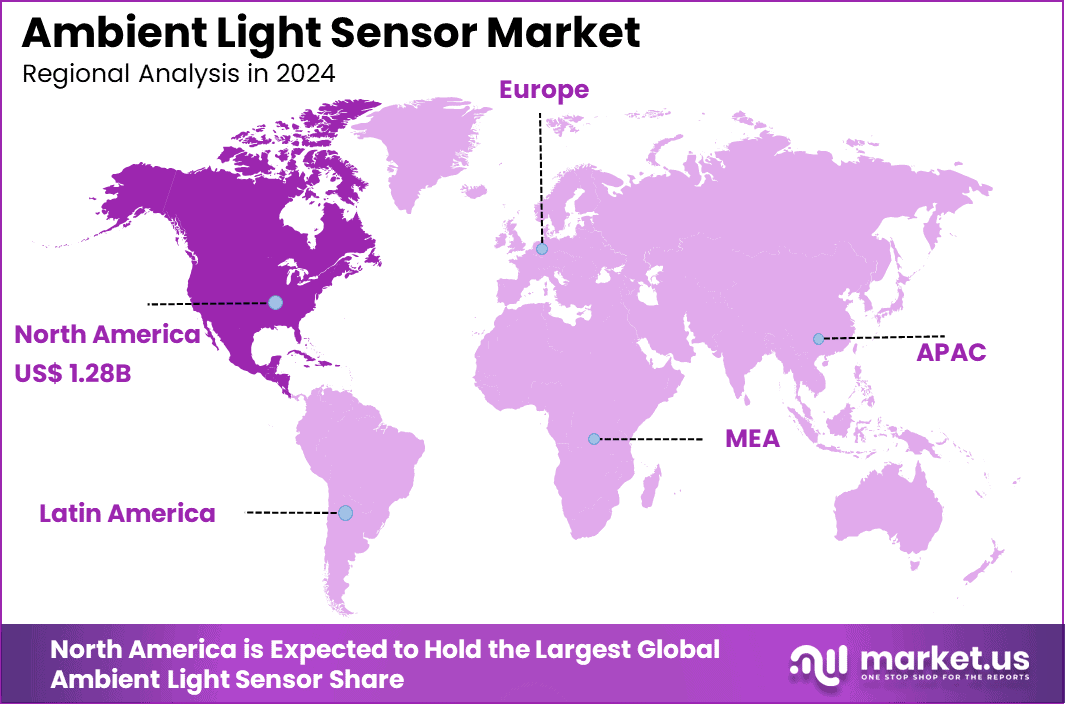
The Global Ambient Light Sensor Market generated USD 3.2 billion in 2024 and is predicted to register growth from USD 3.6 billion in 2025 to about USD 9.2 billion by 2034, recording a CAGR of 11.10% throughout the forecast span. In 2024, North America held a dominant market position, capturing more than a 40% share, holding USD 1.28 Billion revenue.
The Ambient Light Sensor market refers to the ecosystem of sensor components and related integration technologies used to measure surrounding light levels so that electronic systems can automatically adjust brightness, color balance, display readability, and lighting output. These sensors are now used across smartphones, tablets, laptops, wearables, automotive displays, instrument panels, smart lighting systems, and industrial control environments. Their value has increased because they improve visual comfort, reduce unnecessary power use, and support more intelligent device behavior in changing light conditions.
One of the top driving factors in the Ambient Light Sensor market is the need for better power efficiency in display-based electronics. Displays remain one of the biggest power-consuming elements in many consumer devices, so automatic brightness control has become an important design feature. The European Union’s 2023 ecodesign framework for smartphones and tablets states that there is substantial scope to reduce energy consumption in these products, while display test procedures in EU regulation also explicitly account for Auto Brightness Control.
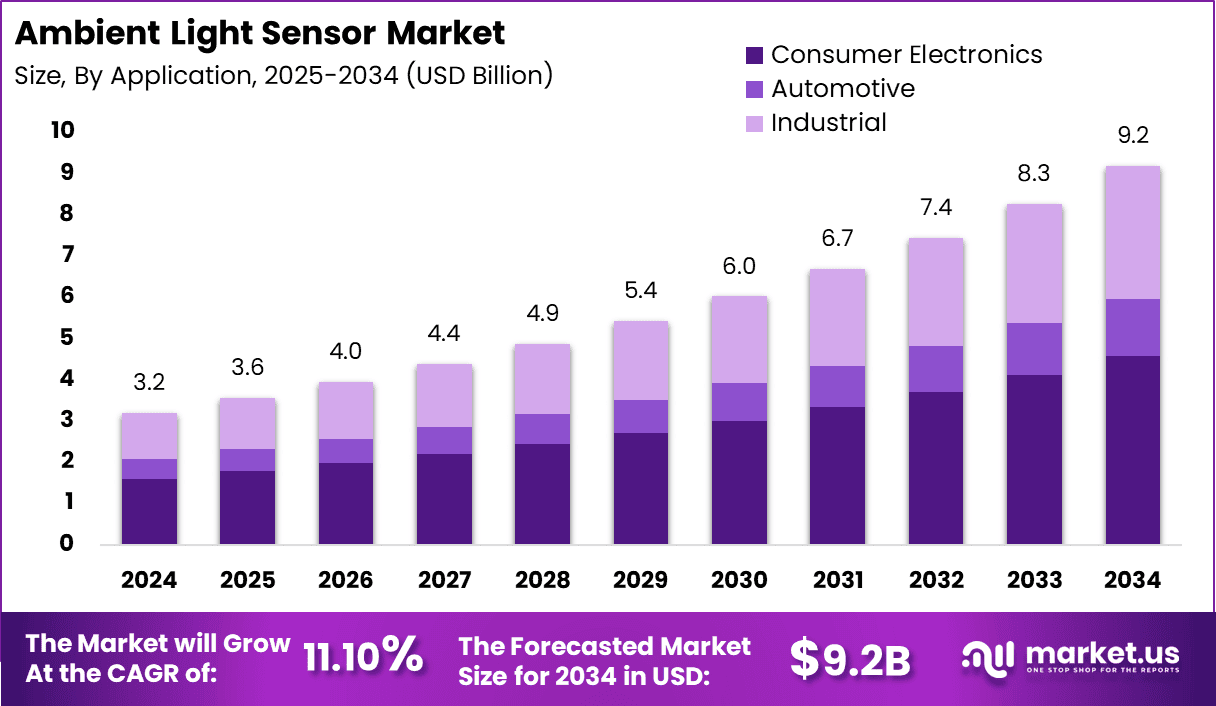
Demand analysis reveals that nearly 80% of ambient light sensor usage is driven by consumer electronics such as smartphones, tablets, and laptops. This trend is supported by the increasing miniaturization of sensors and integration with devices requiring adaptive brightness to enhance battery life and user experience. Additionally, smart home solutions and IoT adoption contribute notably, with smart lighting systems using these sensors growing steadily to optimize energy consumption and environmental comfort.
Top Market Takeaways
- By application, the consumer electronics segment holds 49.96% of the market share, driven by devices like smartphones, tablets, and smart home electronics.
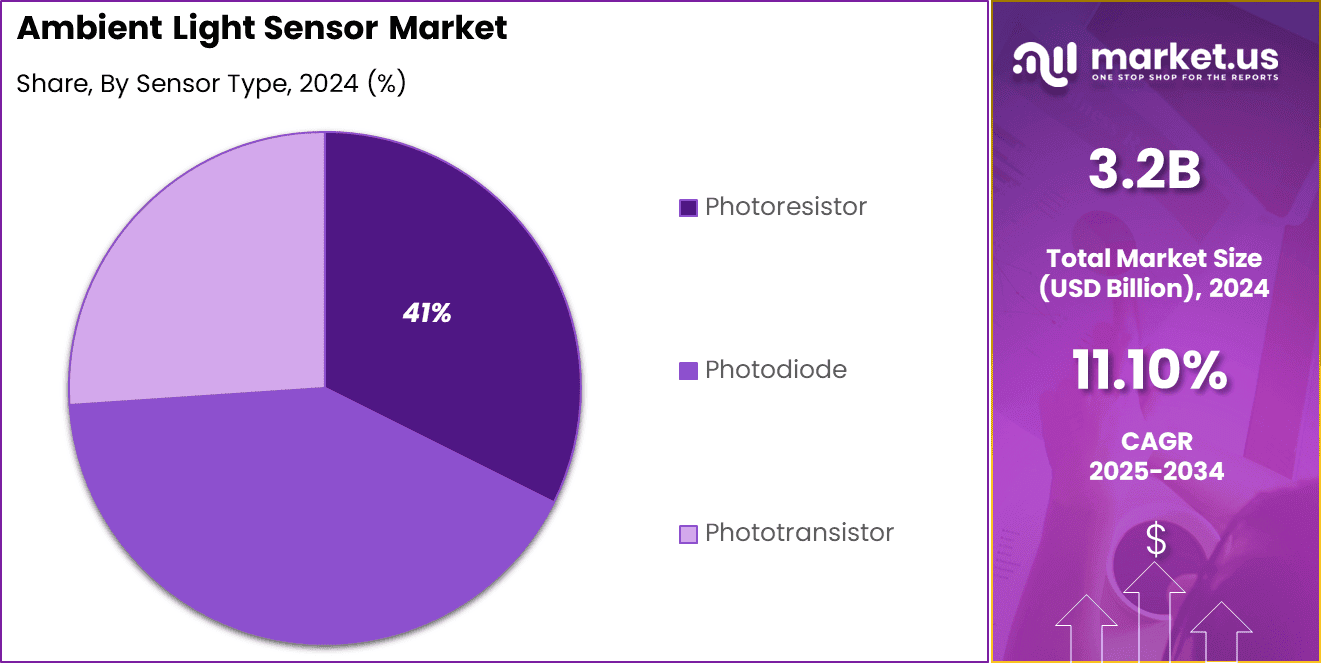
- By sensor type, the photoresistors segment leads with 41% share, favored for simplicity and cost-effectiveness.
- By technology, the analog sensors segment represents 35% of the market, popular for continuous response and easy integration.
- By end-use, the residential segment dominates with 55% share, supported by smart home and automation adoption.
- North America commands about 40% of the market, reflecting strong regional demand and innovation.
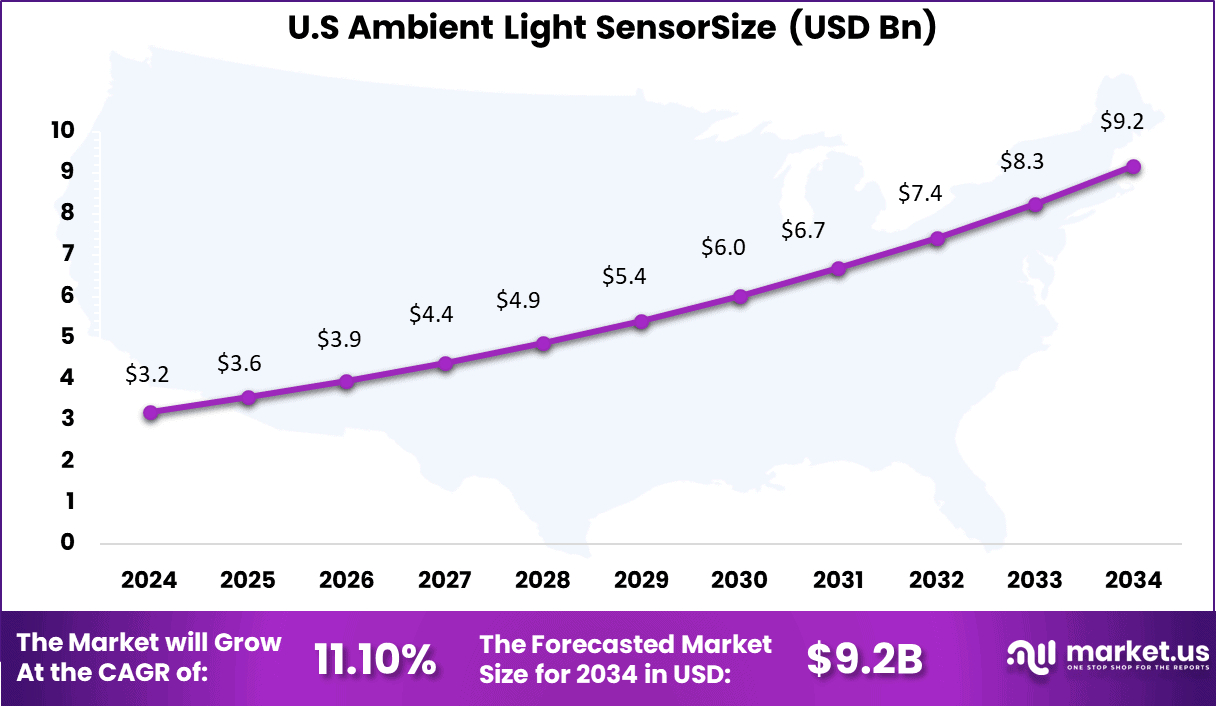
- The U.S. ambient light sensor market size is estimated at USD 1.2 billion in 2024, with forecasts projecting growth to approximately USD 2.44 billion by 2034 at a CAGR of around 10%.
- The global ambient light sensor market size was about USD 3.31 billion in 2025 and is expected to reach over USD 8.6 billion by 2035, expanding at a CAGR of approximately 10%.
- Growth factors include the rise of smart devices, IoT adoption, and smart lighting systems in residential and automotive sectors in North America.
- North American leadership is backed by strong innovation hubs, widespread smart device usage, and increasing implementation of smart city technologies and energy-efficient systems.
By Application
In 2024, the consumer electronics segment accounted for 49.96% of the ambient light sensor market, driven by the widespread integration of sensors in smartphones, tablets, laptops, and wearable devices. Ambient light sensors are used to automatically adjust screen brightness based on surrounding lighting conditions, improving user comfort and battery efficiency.
The increasing penetration of smart devices globally has significantly contributed to the growth of this segment. As consumers demand enhanced device performance and energy optimization, sensor adoption continues to rise. The segment’s expansion is further supported by continuous innovation in consumer electronics and rising demand for user-centric features.
Manufacturers are focusing on integrating sensors that enable adaptive display control and energy savings. The growth of wearable technology and smart home devices has also increased the need for ambient sensing capabilities. This has positioned consumer electronics as the leading application area in the market.
By Sensor Type
In 2024, the photoresistors segment held a 41% share, reflecting strong demand for cost-effective and reliable light sensing solutions. Photoresistors, also known as light-dependent resistors, are widely used due to their simplicity and affordability. They are commonly integrated into devices where basic light detection and brightness adjustment are required. Their ease of implementation has made them a preferred choice across various applications.
The growth of this segment is also driven by increasing adoption in consumer electronics and residential lighting systems. Photoresistors provide sufficient performance for applications that do not require high precision, making them suitable for large-scale deployment. Their low production cost supports widespread use in entry-level and mid-range devices.
By Technology
In 2024, the analog sensors segment captured 35% share, supported by their ability to provide continuous and real-time light intensity measurements. Analog ambient light sensors are widely used in applications where smooth and gradual brightness adjustment is required. These sensors offer reliable performance and are easier to integrate into various electronic systems.
Their consistent output makes them suitable for a range of consumer and industrial applications. The segment’s growth is further influenced by increasing demand for energy-efficient lighting and display systems.
Analog sensors enable precise control over brightness levels, which helps reduce power consumption. Their compatibility with a wide range of devices and systems also supports their adoption. As industries continue to focus on efficiency and performance, analog sensors remain a key technology in the market.
By End-Use
In 2024, the residential segment held a dominant share of 55%, driven by the growing adoption of smart home technologies and energy-efficient lighting systems. Ambient light sensors are increasingly used in residential settings to automate lighting and improve energy savings. These sensors adjust indoor lighting based on natural light availability, enhancing convenience and reducing electricity consumption. The rise in smart home installations has significantly contributed to this segment’s growth.
The segment’s leadership is also supported by increasing consumer awareness of energy conservation and home automation benefits. Homeowners are adopting intelligent lighting systems that integrate ambient light sensing for improved comfort and efficiency. Government initiatives promoting energy-efficient homes further support this trend. As smart home adoption continues to expand, the residential segment is expected to maintain its strong position in the market.
Emerging Trends
The ambient light sensor market is seeing some truly interesting trends shaping its growth. One emerging trend is the increasing integration of multiple sensors into a single module. Sensors that combine ambient light detection with proximity, color, and motion sensing are becoming more common.
This integration enriches a device’s ability to understand and respond to its environment, making features like adaptive displays and gesture recognition more accurate and useful. Another growing trend is the use of AI and machine learning within these sensors. By learning user behaviors and lighting patterns, these smart sensors can optimize lighting adjustments, enhancing user comfort and saving energy without user input.
Growth Factors
An important growth factor is the push for ultra-low power consumption, especially in wearable devices and the Internet of Things. Manufacturers are focusing on improving power efficiency to extend battery life while delivering responsive performance. Additionally, the rise of smart homes and connected devices creates a steady demand for ambient light sensors, as they enable energy-efficient lighting and context-aware automation.
Health-related applications, like sleep monitoring and circadian rhythm tracking, are starting to use ambient light sensing, contributing to market expansion beyond conventional electronics. The rapid miniaturization of sensors, improved accuracy, and cost-effective production methods also keep the momentum moving.
Key Market Segments
By Application
- Consumer Electronics
- Automotive
- Industrial
By Sensor Type
- Photodiode
- Photoresistor
- Phototransistor
By Technology
- Analog
- Digital
By End-use
- Residential
- Commercial
- Industrial
Regional Analysis
North America holds a dominant share of around 40% in the global ambient light sensor market, driven by widespread adoption across consumer electronics, residential, and automotive sectors. The region’s growth is supported by smart home technology integration, energy efficiency regulations, and ongoing investments in smart city infrastructure, such as intelligent street lighting in major Canadian cities.
The analog sensor technology and photoresistor sensor type lead the market due to their reliability and energy efficiency, with residential end-use accounting for 55% of demand. North America’s expanding IoT ecosystem and strong regulatory emphasis on sustainability position it as a leading market poised for substantial growth in the coming years.
In the U.S., the ambient light sensor market was valued at approximately USD 1.2 billion in 2025 and is forecasted to grow at a CAGR of around 10% through 2034. The U.S. leads innovation with cutting-edge R&D facilities fostering advancements in sensor accuracy, power efficiency, and integration into smart consumer electronics, automotive systems, and security devices. Strict energy efficiency standards across sectors drive demand for sensors in smart buildings and connected devices.
The consumer electronics segment dominates the U.S. market with nearly 50% share, heavily relying on photoresistor and analog sensor technologies for display and power optimization in mobile and smart devices. Continuous product innovation coupled with regulatory support ensures the U.S. remains a powerhouse in ambient light sensor adoption and technological advancement.
Key Regions and Countries
- North America
- US
- Canada
- Europe
- Germany
- France
- The UK
- Spain
- Italy
- Russia
- Netherlands
- Rest of Europe
- Asia Pacific
- China
- Japan
- South Korea
- India
- Australia
- Singapore
- Thailand
- Vietnam
- Rest of APAC
- Latin America
- Brazil
- Mexico
- Rest of Latin America
- Middle East & Africa
- South Africa
- Saudi Arabia
- UAE
- Rest of MEA
Driver Analysis
The growth of the ambient light sensor market is primarily driven by the increasing demand for smart consumer electronics. Devices such as smartphones, tablets, laptops, and televisions rely on ambient light sensors to optimize screen brightness automatically. This functionality improves battery efficiency and enhances visual comfort, which has become an essential feature in modern electronic devices. The continuous increase in global device usage has significantly contributed to the widespread adoption of these sensors.
In addition, the automotive sector is contributing to market expansion through the adoption of digital dashboards and advanced infotainment systems. Ambient light sensors are used to adjust display brightness and interior lighting based on external light conditions, which improves driver visibility and safety. The increasing integration of electronic components in vehicles, along with the shift toward connected and electric vehicles, is supporting the long-term demand for ambient light sensing technologies.
Restraint Analysis
One of the key restraints in the ambient light sensor market is cost sensitivity in mass-market electronics. Manufacturers of budget devices often limit the use of advanced sensors to maintain competitive pricing. This restricts the adoption of high-performance ambient light sensors in entry-level products, which impacts overall market penetration. As a result, premium sensor technologies are primarily concentrated in mid-range and high-end devices.
Another restraint is the presence of alternative approaches to brightness control. Some devices utilize software-based solutions or camera-assisted sensing to estimate ambient lighting conditions. These alternatives can reduce the need for dedicated ambient light sensors in certain applications. Although these methods may not always provide the same level of accuracy, they present a viable option for cost-conscious manufacturers.
Opportunity Analysis
The increasing focus on energy efficiency is creating strong opportunities for the ambient light sensor market. These sensors are widely used in smart lighting systems to automatically adjust illumination levels in residential, commercial, and industrial environments. By optimizing light usage based on natural lighting conditions, energy consumption can be significantly reduced. This aligns with global efforts to promote sustainable infrastructure and reduce energy costs.
Additionally, emerging applications in healthcare devices and wearable technology are opening new growth avenues. Ambient light sensors are being integrated into fitness trackers and medical monitoring devices to enhance user experience and environmental adaptability. Industrial automation is also benefiting from these sensors, where they are used to optimize lighting conditions and improve operational efficiency in manufacturing environments.
Challenge Analysis
Maintaining high accuracy in varying lighting environments remains a major challenge for the ambient light sensor market. Factors such as sudden changes in light intensity, reflections, and shadows can affect sensor performance. Ensuring consistent and reliable readings across different conditions requires continuous improvement in sensor design and calibration techniques. This challenge becomes more critical in applications such as automotive and healthcare, where precision is essential.
Another challenge is the need for ongoing technological advancement while maintaining cost efficiency. As devices become more compact and feature-rich, there is increasing demand for smaller, low-power, and highly accurate sensors. Developing such advanced solutions requires significant investment in research and development. Smaller manufacturers may face difficulties in keeping pace with these requirements, which can limit innovation and competition within the market.
Competitive Analysis
The Ambient Light Sensor Market is led by global semiconductor companies with strong capabilities in sensor innovation and integration. ams AG, STMicroelectronics, and Infineon Technologies focus on high-performance sensing solutions for consumer electronics and automotive applications. Texas Instruments and Analog Devices enhance product efficiency through low-power designs. Their continuous investment in R&D supports improved accuracy and miniaturization. This strengthens their competitive positioning across multiple industries.
A significant contribution is observed from diversified electronic component manufacturers offering reliable sensing technologies. Vishay Intertechnology, ROHM Semiconductor, and ON Semiconductor provide cost-effective and scalable sensor solutions. NXP Semiconductors and Toshiba integrate ambient light sensing into broader system applications. These companies focus on performance optimization and durability. Their products support applications in smartphones, displays, and industrial systems. This drives steady demand across global markets.
Other key players contribute through specialized sensing and electronic solutions. Broadcom, Honeywell, and Sharp offer advanced optical and environmental sensing technologies. Maxim Integrated and Bourns support niche applications with compact and efficient designs. These companies focus on innovation and application-specific solutions. Their contributions enhance sensor performance and reliability. This supports the overall growth of the ambient light sensor ecosystem.
Top Key Players in the Market
- AMS
- STMicroelectronics
- Vishay Intertechnology
- Infineon Technologies
- Analog Devices
- Maxim Integrated
- ROHM Semiconductor
- Texas Instruments
- Toshiba
- ON Semiconductor
- NXP Semiconductors
- Bourns
- Honeywell
- Broadcom
- Sharp
Recent Developments
- In November 2025, ams-OSRAM AG reported continued progress in optical sensing solutions during its Annual Optical Technology Forum 2025. The company highlighted improvements in intelligent sensing, including ambient light sensing integration, to support smart mobility and consumer electronics applications. These developments are being used in smart cockpits, energy-efficient displays, and adaptive lighting systems, especially across Asia-Pacific markets.
- In May 2025, Vishay Intertechnology, Inc. introduced an AEC-Q100 qualified ambient light sensor for automotive applications. The product was launched in a compact 4.38 mm × 1.45 mm × 0.6 mm package and was designed to deliver accurate light detection even behind dark cover glass. Its use in cockpit systems supports adaptive display brightness, which helps improve driver visibility and safety under changing lighting conditions.
Report Scope
Report Features Description Market Value (2024) USD 3.2 Bn Forecast Revenue (2034) USD 9.2 Bn CAGR(2025-2034) 11.10% Base Year for Estimation 2024 Historic Period 2020-2023 Forecast Period 2025-2034 Report Coverage Revenue forecast, AI impact on Market trends, Share Insights, Company ranking, competitive landscape, Recent Developments, Market Dynamics and Emerging Trends Segments Covered Ambient Light Sensor Market By Application (Consumer Electronics, Automotive, Industrial), By Sensor Type (Photodiode, Photoresistor, Phototransistor), By Technology (Analog, Digital), By End-use (Residential, Commercial, Industrial) Regional Analysis North America – US, Canada; Europe – Germany, France, The UK, Spain, Italy, Russia, Netherlands, Rest of Europe; Asia Pacific – China, Japan, South Korea, India, New Zealand, Singapore, Thailand, Vietnam, Rest of Latin America; Latin America – Brazil, Mexico, Rest of Latin America; Middle East & Africa – South Africa, Saudi Arabia, UAE, Rest of MEA Competitive Landscape AMS, STMicroelectronics, Vishay Intertechnology, Infineon Technologies, Analog Devices, Maxim Integrated, ROHM Semiconductor, Texas Instruments, Toshiba, ON Semiconductor, NXP Semiconductors, Bourns, Honeywell, Broadcom, Sharp Customization Scope Customization for segments, region/country-level will be provided. Moreover, additional customization can be done based on the requirements. Purchase Options We have three license to opt for: Single User License, Multi-User License (Up to 5 Users), Corporate Use License (Unlimited User and Printable PDF)  Ambient Light Sensor MarketPublished date: April 2026add_shopping_cartBuy Now get_appDownload Sample
 -
-
- AMS
- STMicroelectronics
- Vishay Intertechnology
- Infineon Technologies
- Analog Devices
- Maxim Integrated
- ROHM Semiconductor
- Texas Instruments
- Toshiba
- ON Semiconductor
- NXP Semiconductors
- Bourns
- Honeywell
- Broadcom
- Sharp
Our Clients

- 164474
- April 2026






