


Global Aircraft Lighting Systems Market Size, Share Analysis Report By Aircraft Type (Commercial Aircraft (Narrow-body Aircraft, Wide-body Aircraft, Regional Jets), Business Aviation and General Aviation (Business Jets, Light Aircraft), Military Aircraft (Fighter Aircraft, Transport Aircraft), Helicopters (Commercial Helicopters, Military Helicopters)), By Light Type (Interior Lights, Exterior Lights, Cockpit Lights), By Technology (LED, HID, Others), By End-User (OEM, Aftermarket, MRO), By Region and Companies - Industry Segment Outlook, Market Assessment, Competition Scenario, Trends and Forecast 2025-2034
- Published date: July 2025
- Report ID: 153112
- Number of Pages: 377
- Format:
-
keyboard_arrow_up
Quick Navigation
Report Overview
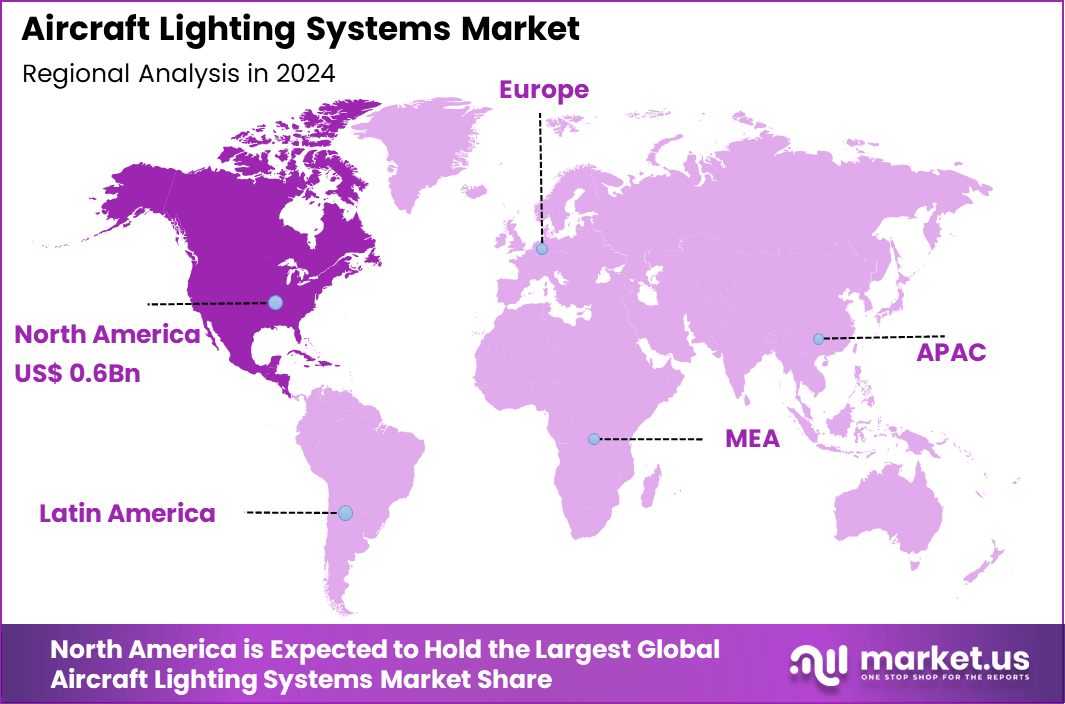
The Global Aircraft Lighting Systems Market size is expected to be worth around USD 4.0 Billion By 2034, from USD 1.9 billion in 2024, growing at a CAGR of 7.6% during the forecast period from 2025 to 2034. In 2024, North America held a dominant market position, capturing more than a 32% share, holding USD 0.6 Billion revenue.
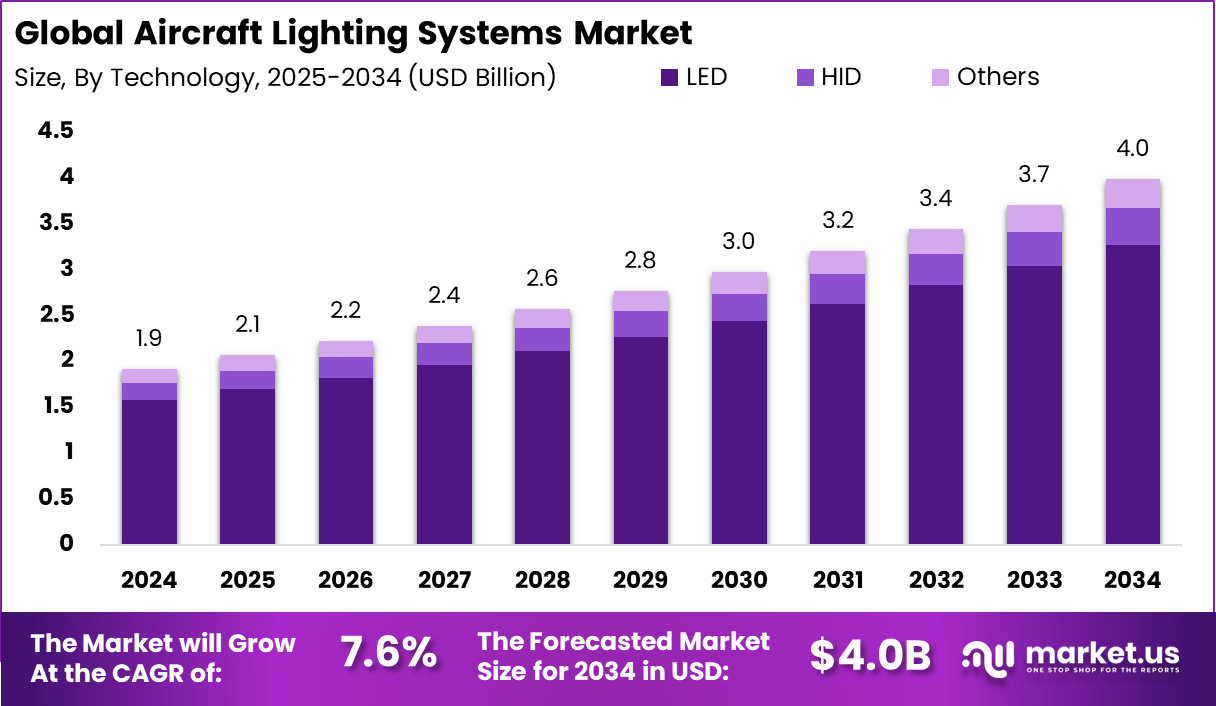
The aircraft lighting systems market has experienced robust demand driven primarily by the intensifying air traffic and a global surge in passenger mobility. With airlines expanding fleets and modernising existing aircraft, the demand for energy-efficient and regulatory-compliant lighting solutions has risen significantly. This expansion has been supported by a steady shift towards LED and OLED lighting technologies, which are favoured for their lower power consumption, extended lifespan, and reduced maintenance requirements.
Scope and Forecast
Report Features Description Market Value (2024) USD 1.9 Bn Forecast Revenue (2034) USD 4.0 Bn CAGR (2025-2034) 7.6% Largest market in 2024 North America [32% market share] One of the key drivers has been the industry’s focus on energy efficiency and sustainability. LED and OLED systems markedly decrease power usage, aligning with airlines’ cost-cutting and environmental objectives. Moreover, evolving safety regulations and cabin comfort standards compel the aviation sector to continually upgrade lighting solutions for enhanced visibility, collision avoidance, emergency evacuation, and passenger experience.
Commercial aviation remains the largest consumer of advanced lighting systems, due to scale and regulatory scrutiny. Military and general aviation sectors also contribute steadily, with demand often prompted by retrofit programmes, aesthetic improvements, and operational enhancements. Aftermarket services play a significant role as well, fueled by the growing volume of aircraft requiring upgrades throughout their lifecycle.
According to Market.us, The Global Aircraft Market is projected to reach USD 596.5 billion by 2033, rising from USD 414.8 billion in 2023, at a CAGR of 3.7% between 2024 and 2033. In 2023, North America held a dominant position in the global market, capturing 43.2% of the total share and generating USD 179.19 billion in revenue, driven by strong defense spending and the presence of major aircraft manufacturers.
There are compelling opportunities for investment within the aircraft lighting market, particularly in the realm of energy-efficient and smart lighting technologies. The ongoing replacement of legacy lighting in existing fleets and the growing number of electric and hybrid aircraft create demand for lightweight, sustainable lighting solutions. The trend of aircraft interior customization and development of greener aviation technologies continues to attract keen interest from stakeholders looking for long-term value.
Key Insight Summary
- The Global Aircraft Lighting Systems market is expected to grow from USD 1.9 billion in 2024 to approximately USD 4.0 billion by 2034, registering a steady 7.6% CAGR, driven by advancements in energy-efficient lighting technologies and increasing aircraft production.
- In 2024, North America led the market with over 32% share, generating about USD 0.6 billion, supported by robust aerospace manufacturing and fleet modernization initiatives.
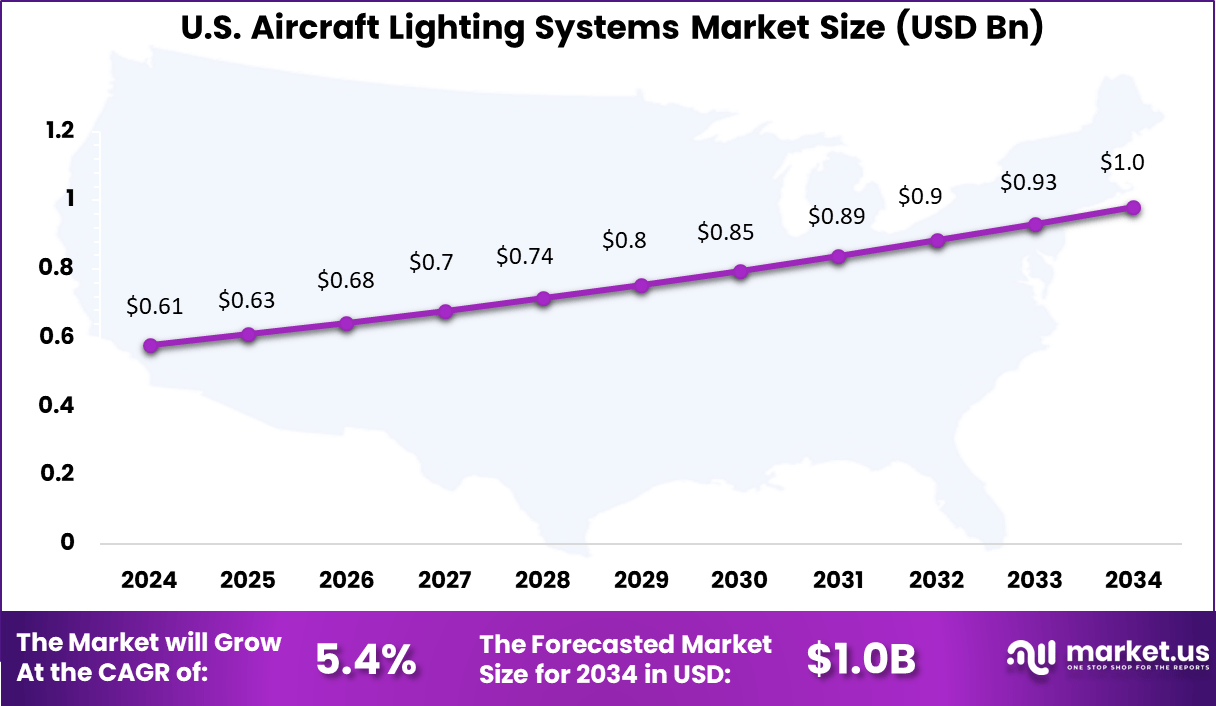
- The United States alone accounted for nearly USD 0.58 billion, with a projected 5.4% CAGR, reflecting sustained investments in commercial and defense aviation.
- By aircraft type, Commercial Aircraft dominated the market with 58% share, driven by rising passenger traffic and demand for new aircraft deliveries.
- By light type, Exterior Lights held a notable 40% share, highlighting their critical role in operational safety and visibility.
- By technology, LED-based lighting systems led the market with a commanding 82% share, owing to their durability, energy efficiency, and low maintenance.
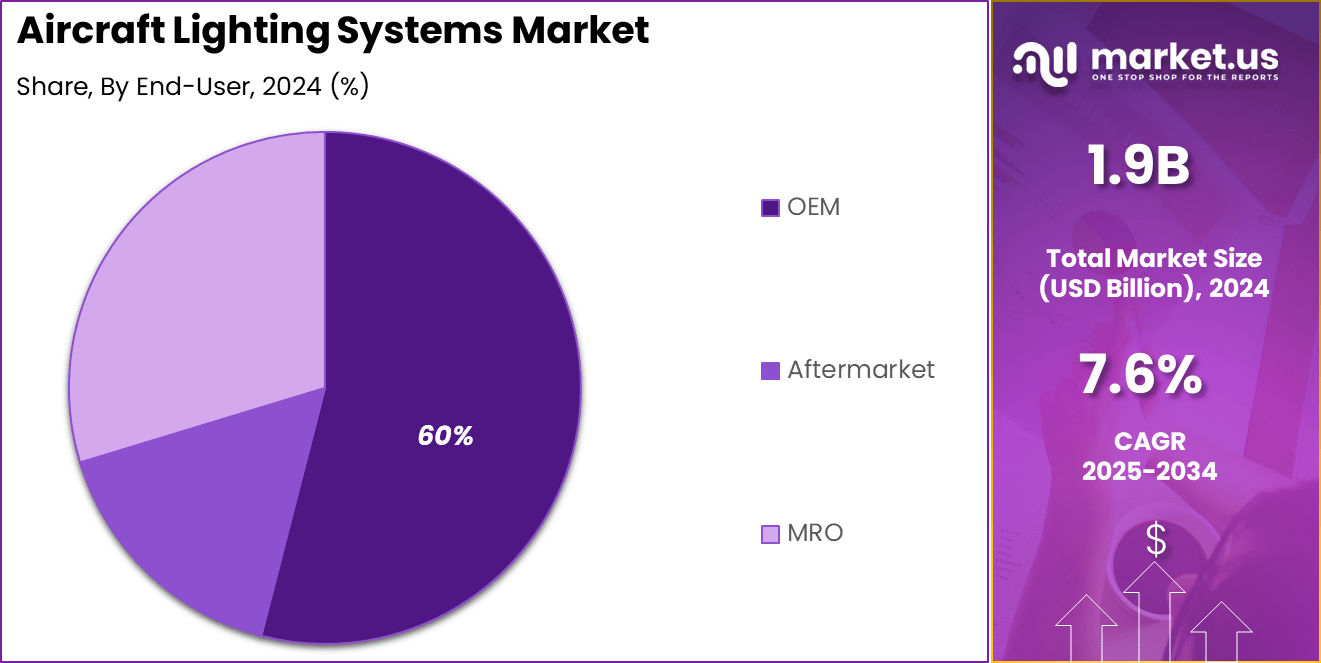
- By end-user, OEMs accounted for 60% share, as manufacturers increasingly integrate advanced lighting systems into new aircraft designs.
US Market Size
The U.S. Aircraft Lighting Systems Market was valued at USD 0.61 Billion in 2024 and is anticipated to reach approximately USD 1.0 Billion by 2034, expanding at a compound annual growth rate (CAGR) of 5.4% during the forecast period from 2025 to 2034.
In 2024, North America held a dominant market position, capturing more than a 32% share, holding USD 0.6 billion in revenue in the Aircraft Lighting Systems Market. This leadership stems from the region’s advanced aerospace manufacturing ecosystem and continuous fleet modernization initiatives.
The demand for next-generation lighting solutions has grown rapidly, driven by increasing aircraft deliveries and retrofitting programs in both commercial and military aviation sectors. North American carriers are investing in LED-based cabin and exterior lighting systems to improve passenger comfort, reduce power consumption, and ensure compliance with evolving safety standards.
By Aircraft Type: Commercial Aircraft
Commercial aircraft take the front seat in the aircraft lighting systems market, making up 58% of the share. The day-to-day demand for both safety and passenger comfort drives airlines to focus on modern lighting solutions. As passenger traffic rises globally, airlines are putting emphasis on lighting that enhances cabin ambiance, supports crew operations, and meets strict regulatory standards.
These lighting systems play a crucial part in keeping flights safe and operations smooth, particularly for large fleets navigating busy airspace and major airports. Another significant factor elevating commercial aircraft is the trend of increasing aircraft deliveries and retrofitting projects.
Airlines not only update their fleets with new aircraft but also invest in upgrading older planes to meet newer safety and aesthetic expectations. The need for robust and efficient lighting systems stems from customer expectations regarding comfort as well as aviation authorities’ rigorous requirements. As a result, commercial aircraft dominate as the leading end-users for advanced lighting technologies in this sector.
By Light Type: Exterior Lights
Exterior lights hold a prominent share, representing 40% of the market. These lighting systems are essential for ensuring an aircraft’s visibility in the sky and on the ground. They serve critical functions such as illuminating runways during landing and takeoff, helping pilots navigate during low-visibility conditions, and making aircraft clearly visible to other pilots and ground staff.
The focus on exterior lighting stems from its direct link to operational safety and compliance with global aviation regulations. Besides safety, exterior lighting has evolved with technological innovation, particularly the move towards energy-efficient and durable light sources.
Pilots rely on navigation, anti-collision, landing, and taxi lights to operate securely both in flight and on the ground. Airports and aviation authorities also expect high reliability and minimum maintenance from these systems, pushing the adoption of sophisticated exterior lighting solutions across new and retrofitted aircraft alike.
By Technology: LED
Light-Emitting Diode (LED) technology is in the spotlight, leading with an 82% share. LEDs have transformed aircraft lighting with their superior energy efficiency, long operational life, and exceptional brightness. Airlines and manufacturers favor LEDs because they use less power, generate less heat, and last far longer than traditional lights.
This shift helps airlines save on maintenance and operational costs, while supporting initiatives for better fuel efficiency and sustainability. Additionally, LEDs offer robust performance in challenging conditions like extreme temperatures and vibrations, making them ideal for both interior and exterior applications.
Their quick response time and consistent luminance elevate flight safety – especially in navigation and emergency systems. Moreover, human-centric LED lighting improves passenger comfort by simulating natural daylight, which can help reduce jet lag on long hauls and offer more customizable cabin ambiance for travelers.
By End-User: OEM
Original Equipment Manufacturers (OEMs) are the major customers in this market, accounting for 60% of demand. Aircraft manufacturers and suppliers are integrating advanced lighting solutions right at the production stage, which means that new aircraft feature the latest innovations in lighting – whether for safety, passenger comfort, or operational efficiency.
By installing state-of-the-art lighting systems from the outset, OEMs enable airlines to operate with fewer maintenance issues and improved energy efficiency. OEMs work closely with regulators and technology firms to design lighting systems that not only meet strict aviation safety standards but also appeal to airlines aiming to improve brand image and passenger experience.
Key Market Segments
By Aircraft Type
- Commercial Aircraft
- Narrow-body Aircraft
- Wide-body Aircraft
- Regional Jets
- Business Aviation and General Aviation
- Business Jets
- Light Aircraft
- Military Aircraft
- Fighter Aircraft
- Transport Aircraft
- Helicopters
- Commercial Helicopters
- Military Helicopters
By Light Type
- Interior Lights
- Signage Lights
- Ceiling and Wall Lights
- Floor Path Lighting Strip
- Reading Lights
- Lavatory Lights
- Exterior Lights
- Emergency Lights
- Navigation Lights
- Wings & Engine Inspection Lights
- Cargo & Service Lights
- Special Purpose Lights
- Cockpit Lights
- Console Panel Lights
- Floodlights
- Control Panel & Button Lights
- Others
By Technology
- LED
- HID
- Others
By End-User
- OEM
- Aftermarket
- MRO
Key Regions and Countries
- North America
- US
- Canada
- Europe
- Germany
- France
- The UK
- Spain
- Italy
- Russia
- Netherlands
- Rest of Europe
- Asia Pacific
- China
- Japan
- South Korea
- India
- Australia
- Singapore
- Thailand
- Vietnam
- Rest of Latin America
- Latin America
- Brazil
- Mexico
- Rest of Latin America
- Middle East & Africa
- South Africa
- Saudi Arabia
- UAE
- Rest of MEA
Emerging Trend
Intelligent Lighting Customization in Aircraft Cabins
A growing trend in aircraft lighting systems is the use of intelligent cabin lighting that adapts to real-time flight phases and passenger needs. Airlines are now deploying AI-based systems that change color and brightness to match the time of day, meal services, or sleep schedules.
This type of adaptive lighting helps to improve passenger comfort, reduce jet lag, and create a more personalized travel experience. The trend reflects a broader move toward smart interiors focused on passenger well-being and emotional comfort.
Driver
Shift Toward Energy-Efficient Lighting Technologies
The aviation sector is under constant pressure to reduce energy consumption and improve fuel efficiency. Traditional lighting systems are being replaced by energy-efficient LED solutions that consume less power and last longer.
This shift not only supports environmental goals but also reduces aircraft maintenance costs and downtime. The adoption of LED technology in both exterior and interior lighting systems is being driven by its durability, energy savings, and enhanced visual quality.
Restraint
Complex Certification and Retrofit Limitations
One of the key restraints is the complex regulatory approval process that lighting systems must go through before installation. Aviation authorities have strict rules for lighting placement, brightness, color, and interference with other electronic systems.
These certifications take time and add costs. In addition, retrofitting modern lighting into older aircraft is often difficult due to outdated wiring systems and limited compatibility, making upgrades costly and technically challenging.
Opportunity
Cabin Aesthetics in Premium Travel Segments
There is a growing opportunity in the premium segment of commercial aviation where cabin design and aesthetics are considered key differentiators. Airlines are using advanced lighting patterns, color gradients, and ambient effects to create a luxury feel in first and business-class cabins.
Creative lighting designs can also be used to display branding elements or cultural themes. This presents an opportunity for lighting manufacturers to offer bespoke lighting packages tailored to airline identity and passenger expectations.
Challenge
Managing Heat and Reliability in Compact Spaces
Despite the advantages of LED and other advanced lighting systems, managing heat output remains a serious challenge. Aircraft interiors have limited space for ventilation, which makes cooling difficult. Overheating can lead to failures or reduce the lifespan of the lighting units. Engineers are focusing on thermal management techniques such as heat sinks and smart material choices to ensure reliability without compromising cabin design or safety.
Key Player Analysis
In the Aircraft Lighting Systems market, RTX, Astronics Corporation, and Diehl Stiftung & Co. KG are recognized as key innovators. These companies focus on advanced cabin, exterior, and emergency lighting technologies. Their products are widely used in both commercial and defense aviation sectors. Continuous R&D and focus on lightweight, power-efficient systems have strengthened their market presence.
Honeywell International Inc., Thales, and Luminator Aerospace have contributed significantly to the expansion of integrated lighting systems. Their solutions often align with avionics and cabin management systems, enabling streamlined aircraft operations. These players also prioritize LED-based designs for enhanced durability and lower maintenance.
Emerging firms such as Qxley Group, Heads UP Technologies, Aveo Engineering Group SRO, and others like Cobalt Aerospace Group Limited and Bruce Aerospace are gaining traction. These companies are developing customized and modular lighting solutions for niche aircraft segments. STG Aerospace Limited, Whelen Aerospace Technologies, and Hoffman Engineering also hold relevance due to their innovations in night-vision compatible and high-visibility systems.
Top Key Players Covered
- RTX
- Astronics Corporation
- Diehl Stiftung & Co. KG
- Honeywell International Inc.
- Thales
- Luminator Aerospace
- Qxley Group
- Soderberg Manufacturing Company Inc.
- Heads UP Technologies
- Aveo Engineering Group SRO
- Cobalt Aerospace Group Limited
- Bruce Aerospace
- STG Aerospace Limited
- Hoffman ENgineering
- Whelen Aerospace Technologies
- Others
Recent Developments
- In October 2024, Collins Aerospace, a division of RTX, secured a 10-year contract with Air Europa to deliver maintenance, repair, and overhaul services for the airline’s 787 fleet. The agreement includes comprehensive fleet solutions such as FlightSense and DispatchSM, covering key systems like electric power, environmental control, avionics, lighting, and cargo.
Report Scope
Report Features Description Base Year for Estimation 2024 Historic Period 2020-2023 Forecast Period 2025-2034 Report Coverage Revenue forecast, AI impact on market trends, Share Insights, Company ranking, competitive landscape, Recent Developments, Market Dynamics and Emerging Trends Segments Covered By Aircraft Type (Commercial Aircraft (Narrow-body Aircraft, Wide-body Aircraft, Regional Jets), Business Aviation and General Aviation (Business Jets, Light Aircraft), Military Aircraft (Fighter Aircraft, Transport Aircraft), Helicopters (Commercial Helicopters, Military Helicopters)), By Light Type (Interior Lights, Exterior Lights, Cockpit Lights), By Technology (LED, HID, Others), By End-User (OEM, Aftermarket, MRO) Regional Analysis North America – US, Canada; Europe – Germany, France, The UK, Spain, Italy, Russia, Netherlands, Rest of Europe; Asia Pacific – China, Japan, South Korea, India, New Zealand, Singapore, Thailand, Vietnam, Rest of Latin America; Latin America – Brazil, Mexico, Rest of Latin America; Middle East & Africa – South Africa, Saudi Arabia, UAE, Rest of MEA Competitive Landscape RTX, Astronics Corporation, Diehl Stiftung & Co. KG, Honeywell International Inc., Thales, Luminator Aerospace, Qxley Group, Soderberg Manufacturing Company Inc., Heads UP Technologies, Aveo Engineering Group SRO, Cobalt Aerospace Group Limited, Bruce Aerospace, STG Aerospace Limited, Hoffman ENgineering, Whelen Aerospace Technologies, Others Customization Scope Customization for segments, region/country-level will be provided. Moreover, additional customization can be done based on the requirements. Purchase Options We have three license to opt for: Single User License, Multi-User License (Up to 5 Users), Corporate Use License (Unlimited User and Printable PDF)  Aircraft Lighting Systems MarketPublished date: July 2025add_shopping_cartBuy Now get_appDownload Sample
 -
-
- RTX
- Astronics Corporation
- Diehl Stiftung & Co. KG
- Honeywell International Inc.
- Thales
- Luminator Aerospace
- Qxley Group
- Soderberg Manufacturing Company Inc.
- Heads UP Technologies
- Aveo Engineering Group SRO
- Cobalt Aerospace Group Limited
- Bruce Aerospace
- STG Aerospace Limited
- Hoffman ENgineering
- Whelen Aerospace Technologies
- Others
Our Clients

- 153112
- July 2025






