


Global AI-powered Intelligent Process Automation (IPA) Market Size, Share and Analysis By Component (Solution, Services), By Technology (Machine Learning, Natural Language Processing, Robotic Process Automation (RPA), Virtual Agents, Computer vision, Others), By Deployment (Cloud-based, On-premise), By Organization Size (Large Enterprise, SME), By Application (IT Operations, Business Process Automation, Application Management, Content Management, Security Management, Other), By Vertical (BFSI, Healthcare, Retail, IT & Telecom, Communication and Media & Education, Manufacturing, Logistics, and Energy & Utilities, Others), By Regional Analysis, Global Trends and Opportunity, Future Outlook By 2025-2035
- Published date: March 2026
- Report ID: 181288
- Number of Pages: 306
- Format:
-
keyboard_arrow_up
Quick Navigation
- Report Overview
- Key Takeaway
- AI is Transforming IPA
- By Component
- By Technology
- By Deployment
- By Organization Size
- By Application
- By Vertical
- Regional Analysis
- Emerging Trends in the IPA Market
- Growth Factors
- Key Market Segments
- Key Regions and Countries
- Drivers
- Restraint
- Opportunities
- Challenges
- Key Players Analysis
- Recent Developments
- Report Scope
Report Overview
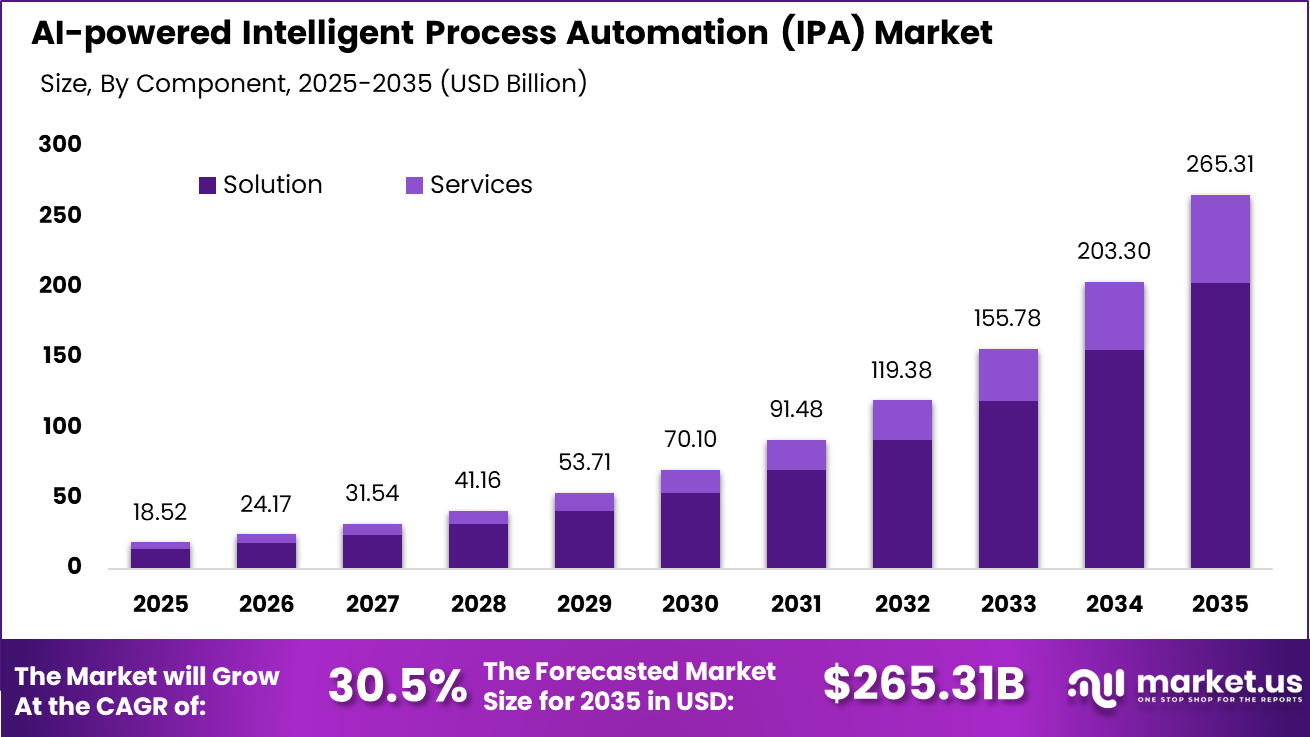
The Global AI-powered Intelligent Process Automation (IPA) Market size is expected to be worth around USD 265.31 billion by 2035, from USD 18.52 billion in 2025, growing at a CAGR of 30.5% during the forecast period from 2025 to 2035. North America held a dominant market position, capturing more than a 34.8% share, holding USD 6.44 billion in revenue.
The AI-powered Intelligent Process Automation (IPA) Market represents a rapidly expanding segment of enterprise automation technologies that combines artificial intelligence with robotic process automation and advanced analytics. IPA systems enable organizations to automate complex business processes that involve unstructured data, decision-making, and adaptive workflows.
Intelligent Process Automation enables organizations to automate nearly 50% to 70% of routine and rule-based operational tasks across departments such as finance, customer service, and IT operations. As a result, operational costs are typically reduced by 20% to 35%, while workflow efficiency improves through fewer manual interventions and lower error rates. At the same time, processing speeds increase by approximately 50% to 60%, allowing enterprises to manage higher transaction volumes and deliver faster service outcomes.
Intelligent process automation platforms address this challenge by coordinating automated actions with AI driven decision support. AI-powered Intelligent Process Automation is gaining traction as businesses aim to reduce slow manual tasks and improve operational speed. Nearly 70% of routine office work involves data verification or form processing, which consumes significant time. IPA automates repetitive tasks and analyzes data patterns to improve operational efficiency and reduce delays.
For instance, in March 2026, IBM enhanced Watson Orchestrate with multimodal AI, processing voice, text, and images in one workflow. A Fortune 100 client cut HR onboarding from days to hours, saving $2M annually. Armonk’s innovation cements Big Blue’s role in enterprise-grade IPA resilience.
Key Takeaway
- In 2025, the Solution segment led the AI Powered Intelligent Process Automation Market, accounting for 76.4% of total share.
- In 2025, Machine Learning represented the dominant technology segment with a 42.5% market share.
- In 2025, On Premise deployment remained dominant, capturing 58.7% of the market.
- In 2025, Large Enterprises represented the primary customer segment, contributing 70.2% of overall demand.
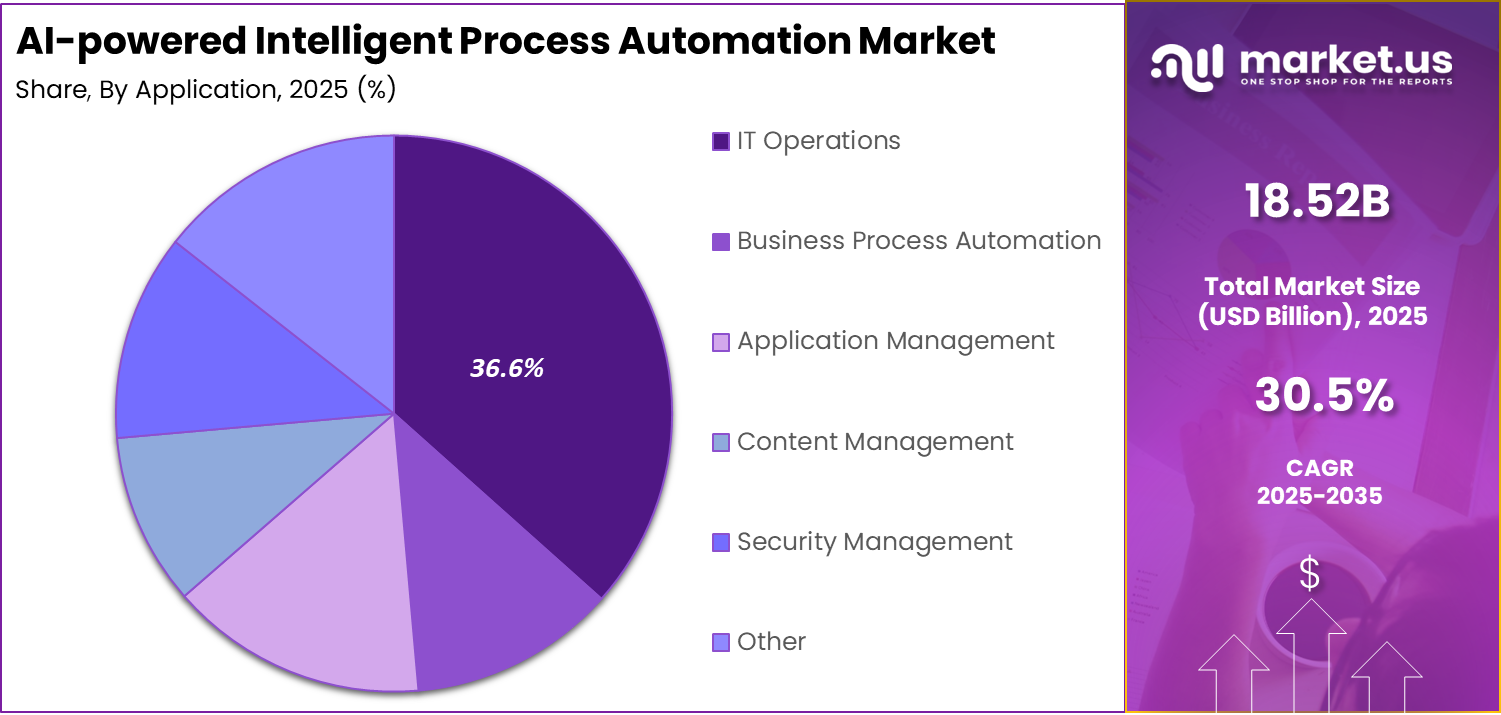
- In 2025, IT Operations emerged as the leading application area with a 36.6% share.
- In 2025, the BFSI sector held the largest vertical share at 34.4%.
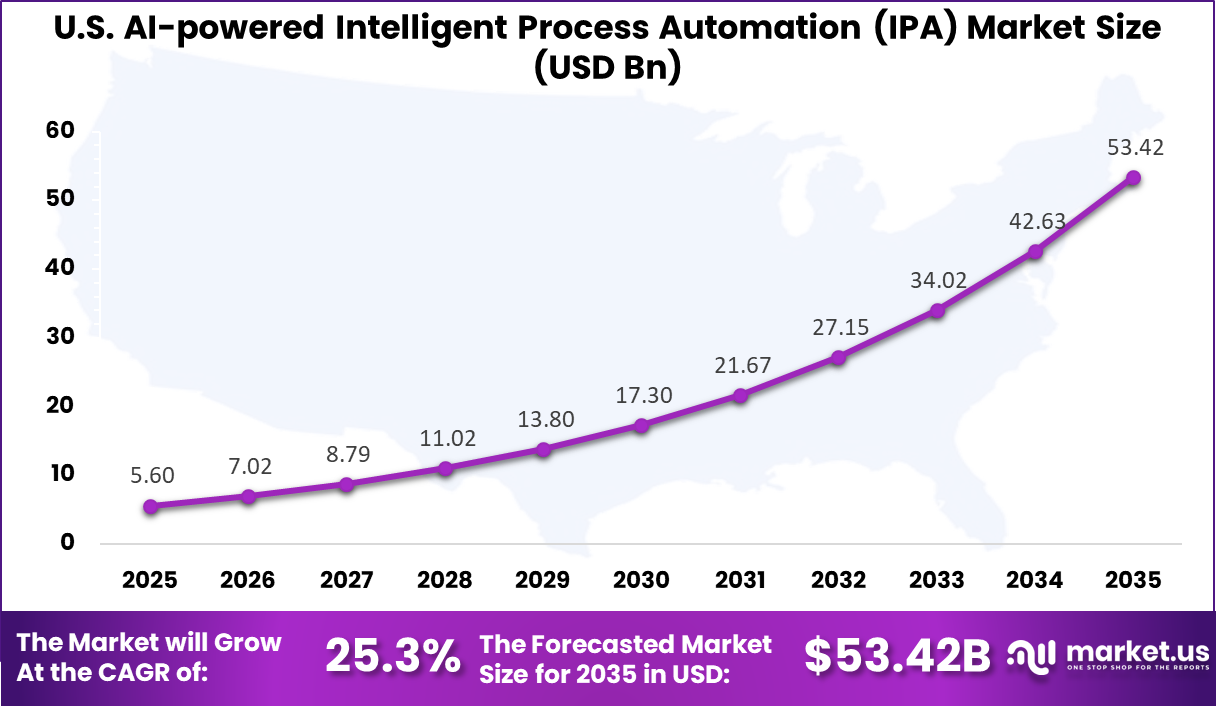
- In 2025, North America secured a 34.8% regional share, while the U.S. market reached USD 5.60 billion and recorded a growth rate of 25.3%.
AI is Transforming IPA
Artificial intelligence has fundamentally enhanced traditional automation platforms by enabling systems to interpret data, learn from patterns, and make context-based decisions. Earlier automation technologies were largely rule-based and limited to repetitive tasks. IPA platforms now combine AI with robotic process automation, allowing systems to process unstructured information such as documents, emails, and voice data.
Another major transformation involves the ability of AI-driven systems to orchestrate end-to-end workflows. Instead of automating isolated tasks, modern IPA platforms can coordinate multiple business processes across departments such as finance, customer service, human resources, and supply chain operations. This capability allows organizations to improve process efficiency while reducing manual intervention.
By Component
Solution based platforms accounted for 76.4% of adoption, reflecting enterprise preference for comprehensive automation systems that integrate AI capabilities with workflow management. These solutions combine process orchestration, analytics, and automation engines within a single platform. Centralized control improves visibility into automated operations. This reduces complexity in enterprise process management.
Integrated solutions enable organizations to automate entire process chains rather than individual tasks. Automation platforms coordinate interactions between applications, data systems, and employees. This creates end to end process efficiency. As enterprises scale automation initiatives, solution driven platforms remain dominant.
Continuous improvements in AI algorithms further strengthen these solutions. Platforms now include predictive capabilities that anticipate process issues before they occur. This proactive approach improves operational stability. Solution based offerings therefore continue to lead the market.
For Instance, in February 2026, UiPath launched a new suite of solution modules focused on blending AI with robotic automation for seamless process builds. Businesses can now drag-and-drop components to cut manual steps in approvals and reporting. This push strengthens the solutions lead, making it easier for users to deploy full automation stacks fast.
By Technology
Machine learning accounted for 42.5% of adoption as organizations increasingly rely on data driven intelligence to guide automated processes. Machine learning models analyze historical operational data to identify patterns and predict outcomes. This capability allows automation systems to adapt to changing business conditions. It also improves accuracy in decision making.
Machine learning enhances the ability of automation platforms to handle unstructured data such as documents and communication records. This expands the scope of automation beyond structured workflows. Organizations can automate more complex processes that previously required human intervention.
As data volumes continue to increase, machine learning driven automation becomes more valuable. Systems learn continuously from operational feedback and improve performance over time. This sustained learning capability supports long term automation efficiency.
For instance, in March 2026, IBM enhanced its Watson platform with deeper machine learning layers for predicting process bottlenecks in real time. The update trains models on live data to adapt workflows on the fly, cutting errors in dynamic environments. It underlines why ML drives this tech segment, turning raw info into proactive fixes.
By Deployment
On premises deployment accounted for 58.7% of adoption due to enterprise requirements for control over sensitive operational and financial data. Many organizations prefer to maintain automation infrastructure within their internal IT environments. This approach ensures compliance with security and governance policies. On premises systems also provide deeper customization capabilities.
Internal deployment allows organizations to tailor automation processes to their unique operational structures. Integration with legacy systems is often easier in controlled environments. This flexibility supports complex enterprise workflows. As a result, on premises deployment continues to maintain strong adoption.
However, hybrid approaches are gradually emerging as organizations explore scalable automation environments. Despite this shift, many enterprises still prioritize internal deployment for mission critical operations.
For Instance, in January 2026, Blue Prism released a fortified on-premise version with stronger data controls for regulated industries. It allows full customization within company servers, ensuring compliance without cloud dependencies. Such features cement on-premise dominance for setups needing tight security and hands-on tweaks.
By Organization Size
Large enterprises represented 70.2% of adoption because they manage complex operational processes across multiple departments and regions. These organizations often handle high transaction volumes and require efficient workflow coordination. Intelligent automation helps reduce operational costs while improving consistency.
Large enterprises also benefit from advanced analytics embedded in automation platforms. These insights allow management teams to identify inefficiencies and optimize processes continuously. Automation therefore becomes part of strategic operational planning.
Higher investment capacity further supports adoption among large organizations. Enterprises integrate IPA platforms with enterprise resource planning and analytics systems. This creates a comprehensive digital operations framework.
For Instance, in February 2026, Pegasystems inked a major deal with a global firm to scale IPA across thousands of users in enterprise-wide systems. The setup tackles multi-site coordination, from finance to supply chains, with tailored AI rules. It shows how big players fuel this segment through heavy investments in broad rollouts.
By Application
IT operations accounted for 36.6% of usage as automation platforms are widely applied to manage system monitoring, service management, and infrastructure tasks. IT departments handle large volumes of operational requests and system events. Intelligent automation reduces manual intervention and accelerates response times.
Automation systems can identify system anomalies, initiate corrective actions, and notify administrators automatically. This improves system reliability and reduces downtime. IT teams benefit from improved operational efficiency.
As organizations expand digital infrastructure, the workload on IT departments continues to increase. Intelligent process automation helps manage this complexity effectively. IT operations therefore remain a key application area.
For Instance, in March 2026, ServiceNow, via its IPA integrations, unveiled IT ops accelerators using AI for ticket triage and root-cause analysis. IT teams now automate monitoring and resolutions, slashing response times on alerts. This directly powers the IT ops segment by freeing staff for strategic work amid rising system complexity.
By Vertical
Banking, financial services, and insurance accounted for 34.4% of adoption due to their high transaction volumes and regulatory requirements. Financial institutions process complex workflows related to payments, risk assessment, and compliance monitoring. Intelligent automation helps streamline these processes while maintaining accuracy.
Automation platforms also improve operational transparency in financial institutions. Workflows can be monitored and audited more effectively. This supports regulatory compliance and operational governance. Digital banking services have increased process complexity across financial institutions. Automation helps manage these operations efficiently. As a result, the BFSI sector remains a major adopter of IPA platforms.
For Instance, in January 2026, WorkFusion advanced its no-code platform for BFSI compliance workflows, automating KYC and reporting with adaptive ML. Financial firms cut manual reviews, speeding service without risks. This vertical surges as sector pressures for speed and safety push cutting-edge IPA adoption.
Regional Analysis
North America accounted for 34.8% of market adoption due to its advanced enterprise technology infrastructure and strong investment in automation technologies. Organizations in the region actively implement AI driven automation to improve productivity and operational resilience. The presence of major technology companies further supports innovation.
For instance, in March 2026, Celonis expanded its North American process intelligence dominance with the AI-powered “Copilot for Processes” launched from its NYC headquarters. The solution identifies automation opportunities across supply chains, delivering manufacturers $200M+ annual savings through real-time process conformance and predictive bottleneck resolution.
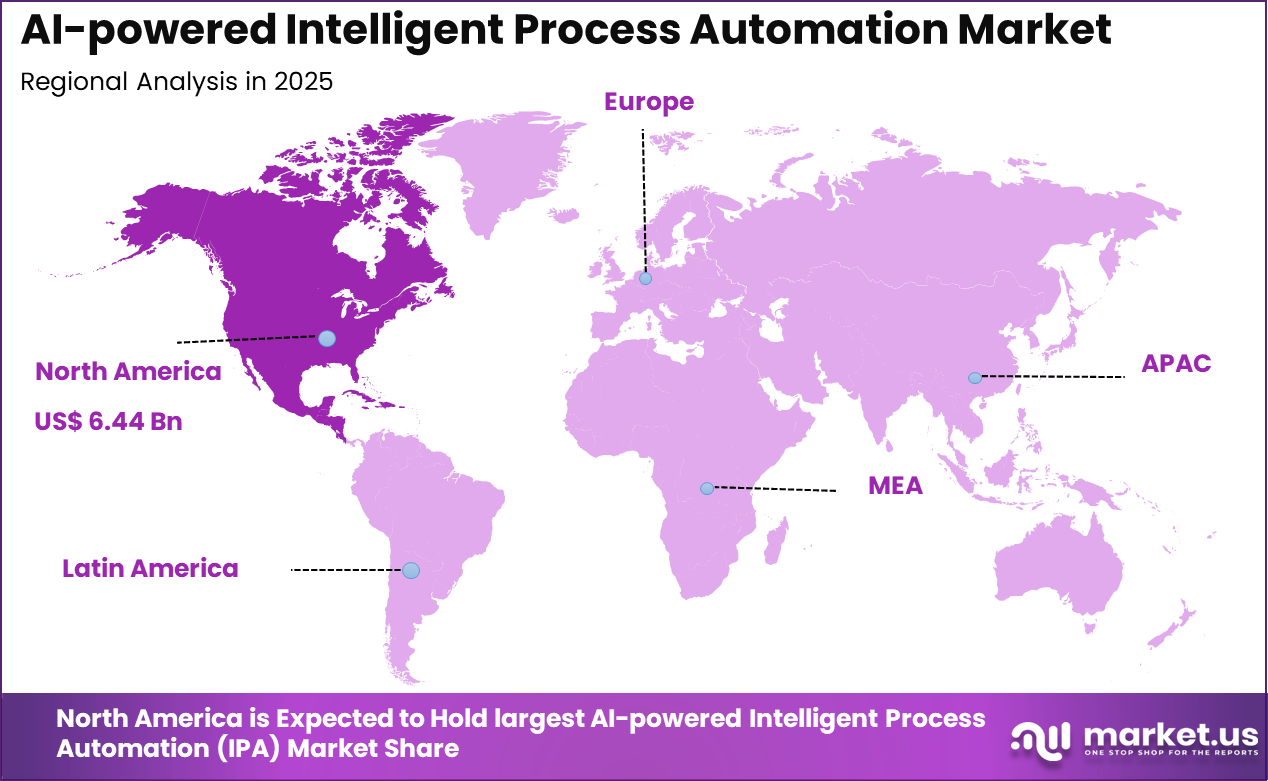
The United States leads regional activity with market value reaching USD 5.60 Bn and a CAGR of 25.3%. Enterprises across financial services, technology, and manufacturing sectors invest heavily in intelligent automation. These investments support faster digital transformation.
Ongoing innovation continues to reinforce regional leadership in the IPA market. Integration of AI with enterprise workflow systems has expanded automation capabilities. As businesses pursue operational efficiency and scalability, intelligent process automation remains a key strategic technology.
For instance, in February 2026, Appian solidified U.S. leadership in AI-powered IPA by launching its enhanced low-code platform with generative AI process mining capabilities. The Virginia-based firm now automates complex end-to-end workflows for Fortune 500 clients, achieving 40% faster deployment times across finance and healthcare sectors while maintaining enterprise-grade security.
Emerging Trends in the IPA Market
One emerging trend in the market is the integration of generative AI within process automation platforms. Generative AI models allow automation systems to generate reports, summarize documents, and interact with users using natural language interfaces. This capability enhances the usability and intelligence of automation systems.
Another trend involves the expansion of hyperautomation strategies. Hyperautomation refers to the integration of multiple digital technologies including AI, analytics, robotic process automation, and workflow orchestration to automate complex enterprise processes. Organizations are increasingly adopting hyperautomation frameworks to improve productivity across business operations.
Growth Factors
The rapid increase in digital data is a major factor supporting the expansion of Intelligent Process Automation. Businesses generate large volumes of information from applications, sensors, and digital platforms, which traditional systems struggle to manage. Organizations report nearly 75% better accuracy when AI powered automation tools help process and analyze this growing data.
Cost efficiency also plays a strong role in adoption. Many companies seek ways to improve productivity while operating within tighter budgets. Around 68% of operations leaders highlight savings achieved through automation that supports routine decision making, allowing employees to concentrate on more strategic tasks that contribute to long term growth.
Key Market Segments
By Component
- Solution
- Services
- Consulting
- Design & Implementation
- Training & Support
By Technology
- Machine Learning
- Natural Language Processing
- Robotic Process Automation (RPA)
- Virtual Agents
- Computer vision
- Others
By Deployment
- Cloud-based
- On-premise
By Organization Size
- Large Enterprise
- SME
By Application
- IT Operations
- Business Process Automation
- Application Management
- Content Management
- Security Management
- Other
By Vertical
- BFSI
- Healthcare
- Retail
- IT & Telecom
- Communication and Media & Education
- Manufacturing
- Logistics, and Energy & Utilities
- Others
Key Regions and Countries
North America
- US
- Canada
Europe
- Germany
- France
- The UK
- Spain
- Italy
- Russia
- Netherlands
- Rest of Europe
Asia Pacific
- China
- Japan
- South Korea
- India
- Australia
- Singapore
- Thailand
- Vietnam
- Rest of APAC
Latin America
- Brazil
- Mexico
- Rest of Latin America
Middle East & Africa
- South Africa
- Saudi Arabia
- UAE
- Rest of MEA
Drivers
Rising Need for Process Efficiency
Organizations increasingly adopt intelligent automation to improve operational speed and reduce the burden of repetitive administrative tasks. Many business processes still rely on manual document handling, approvals, and data entry. Automation systems help streamline these workflows, allowing companies to maintain smoother operations and improve overall productivity.
Improved process efficiency also allows employees to focus on analytical and strategic responsibilities rather than routine tasks. Automation supports consistent workflows, reduces human error, and helps organizations deliver faster internal and customer facing services while maintaining stable operational performance across departments.
For instance, in November 2025, Appian rolled out fresh AI tools that slot right into business workflows, handling tricky tasks like processing insurance quotes in bulk. Teams now spend less time on repeat work and more on big-picture goals, making daily operations feel lighter and faster. This move shows how firms push for smoother runs amid tight schedules.
Restraint
Data Privacy Concerns
Data protection concerns remain an important factor that slows the adoption of intelligent automation systems. Many automation platforms require access to internal records and operational information, which raises questions about data security and responsible handling of sensitive business and customer details.
Moreover, Organizations focus heavily on governance policies and secure infrastructure before expanding automation programs. Without proper safeguards and clear data management practices, businesses may hesitate to automate processes that involve confidential or regulated information.
For instance, in July 2025, Blue Prism shared a case where privacy checks slowed a client project, as rules clashed with open data sharing. Staff held back on full deployment until extra safeguards were in place, showing how trust issues linger in automated environments. Real-world hesitations like this hold things back.
Opportunities
Expansion of Digital Transformation
The ongoing shift toward digital business models creates strong opportunities for intelligent process automation. Many organizations are modernizing their operations by adopting technologies that improve efficiency, strengthen decision making, and support better coordination across departments.
Automation platforms help organizations manage digital workflows by connecting different systems and simplifying complex operational processes. As more companies rely on digital platforms to manage data and operations, intelligent automation becomes an important tool for supporting scalable and efficient business environments.
For instance, in May 2025, Automation Anywhere tied its tools to cloud upgrades at a conference, helping firms weave automation into broader tech shifts. Early users saw faster decision-making across departments, turning overhaul pains into gains. It positions automation as a key piece in going digital.
Challenges
Integration with Existing Systems
Integrating automation platforms with existing enterprise systems remains a major challenge for many organizations. Many businesses operate on older infrastructure that was not designed to work with modern artificial intelligence tools, which can make implementation difficult and time consuming.
Successful adoption often requires technical adjustments, workflow redesign, and collaboration between IT teams and operational departments. Without careful integration planning, companies may face difficulties connecting automation systems with existing platforms and achieving consistent performance across their processes.
For instance, in June 2025, Pegasystems noted in a release that tying AI workflows to legacy databases sparked format clashes. Project leads reworked connections step by step, stretching timelines and budgets. It underscores the tough fit between fresh automation and time-tested infrastructure.
Key Players Analysis
The AI powered Intelligent Process Automation (IPA) Market is led by enterprise software providers that integrate artificial intelligence with robotic process automation to streamline complex business operations. Microsoft, IBM, Appian, and Pegasystems Inc. provide automation platforms that combine workflow orchestration, AI driven decision engines, and data analytics. These systems help organizations automate repetitive tasks while improving operational efficiency and process accuracy.
Robotic process automation specialists contribute advanced intelligent automation capabilities. UiPath, Automation Anywhere, Blue Prism Limited, and NICE provide platforms that automate document processing, transaction workflows, and compliance operations. Their solutions integrate machine learning and natural language processing to handle unstructured data and complex decision making.
Process intelligence and data analytics vendors further strengthen the competitive ecosystem. Celonis, Fortra, Tungsten Automation Corporation, Nintex, WorkFusion, and ThoughtSpot provide technologies that analyze workflows and identify automation opportunities. Additional innovators including AntWorks focus on cognitive automation platforms powered by advanced data processing capabilities.
Top Key Players in the Market
- Appian
- AntWorks
- Automation Anywhere, Inc.
- Blue Prism Limited
- Celonis
- Fortra, LLC
- IBM
- Tungsten Automation Corporation (Kofax)
- Microsoft
- NICE
- Nintex UK Ltd
- Pegasystems Inc.
- UiPath
- WorkFusion, Inc.
- ThoughtSpot Inc.
- Others
Recent Developments
- In November 2025, Appian launched Agent Studio and Appian Composer, embedding AI agents directly into complex workflows for real-time decision-making. These tools cut app modernization time by 50% while handling massive datasets securely. Clients in insurance now process tens of millions of quotes yearly with minimal errors, proving Appian’s practical edge in enterprise IPA.
- In December 2025, Automation Anywhere rolled out its AI Agent Studio, letting businesses build custom bots that learn from documents and adapt on the fly. Early adopters saw 40% faster invoice processing. This move keeps them ahead in blending RPA with generative AI for finance teams buried in repetitive tasks.
Report Scope
Report Features Description Market Value (2025) USD 18.5 Bn Forecast Revenue (2035) USD 265.3 Bn CAGR (2025-2035) 30.5% Base Year for Estimation 2025 Historic Period 2020-2024 Forecast Period 2025-2035 Report Coverage Revenue forecast, AI impact on Market trends, Share Insights, Company ranking, competitive landscape, Recent Developments, Market Dynamics and Emerging Trends Segments Covered By Component (Solution, Services), By Technology (Machine Learning, Natural Language Processing, Robotic Process Automation (RPA), Virtual Agents, Computer vision, Others), By Deployment (Cloud-based, On-premise), By Organization Size (Large Enterprise, SME), By Application (IT Operations, Business Process Automation, Application Management, Content Management, Security Management, Other), By Vertical (BFSI, Healthcare, Retail, IT & Telecom, Communication and Media & Education, Manufacturing, Logistics, and Energy & Utilities, Others) Regional Analysis North America – US, Canada; Europe – Germany, France, The UK, Spain, Italy, Russia, Netherlands, Rest of Europe; Asia Pacific – China, Japan, South Korea, India, New Zealand, Singapore, Thailand, Vietnam, Rest of Latin America; Latin America – Brazil, Mexico, Rest of Latin America; Middle East & Africa – South Africa, Saudi Arabia, UAE, Rest of MEA Competitive Landscape Appian, AntWorks, Automation Anywhere, Inc., Blue Prism Limited, Celonis, Fortra, LLC, IBM, Tungsten Automation Corporation (Kofax), Microsoft, NICE, Nintex UK Ltd, Pegasystems Inc., UiPath, WorkFusion, Inc., ThoughtSpot Inc., Others Customization Scope Customization for segments, region/country-level will be provided. Moreover, additional customization can be done based on the requirements. Purchase Options We have three license to opt for: Single User License, Multi-User License (Up to 5 Users), Corporate Use License (Unlimited User and Printable PDF)  AI-powered Intelligent Process Automation (IPA) MarketPublished date: March 2026add_shopping_cartBuy Now get_appDownload Sample
 -
-
- Appian
- AntWorks
- Automation Anywhere, Inc.
- Blue Prism Limited
- Celonis
- Fortra, LLC
- IBM
- Tungsten Automation Corporation (Kofax)
- Microsoft
- NICE
- Nintex UK Ltd
- Pegasystems Inc.
- UiPath
- WorkFusion, Inc.
- ThoughtSpot Inc.
- Others
Our Clients

- 181288
- March 2026









