


Report Overview
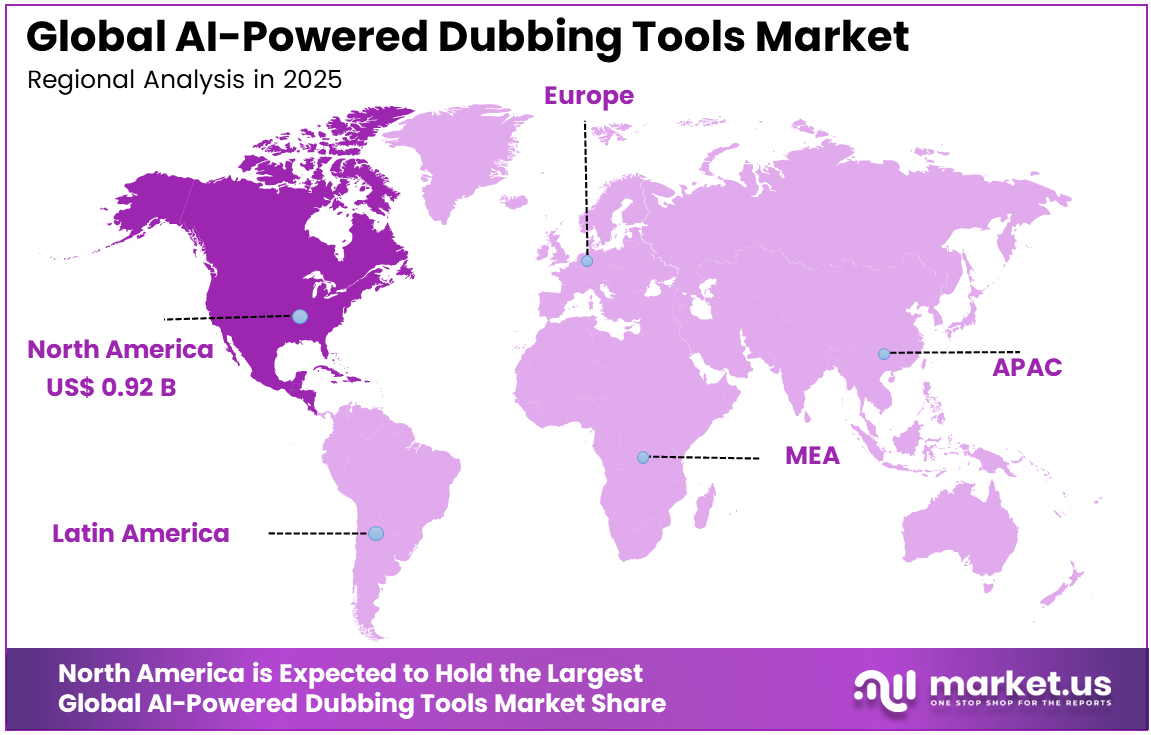
The Global AI-Powered Dubbing Tools Market size is expected to be worth around USD 18.96 billion by 2035, from USD 2.75 billion in 2025, growing at a CAGR of 21.3% during the forecast period from 2025 to 2035. North America held a dominant market position, capturing more than a 33.7% share, holding USD 0.92 billion in revenue.
AI-powered dubbing tools rely on artificial intelligence to translate speech and recreate voices in different languages for videos. They break down audio, match lip movements, and produce natural-sounding results fast. These tools help creators adapt movies, ads, and training content for global viewers without long waits. Over 190 countries now access dubbed material thanks to better algorithms. Teams use them daily to handle bulk jobs, cutting manual work by a lot. The tech keeps improving with clearer tones and accents that feel real to listeners everywhere.
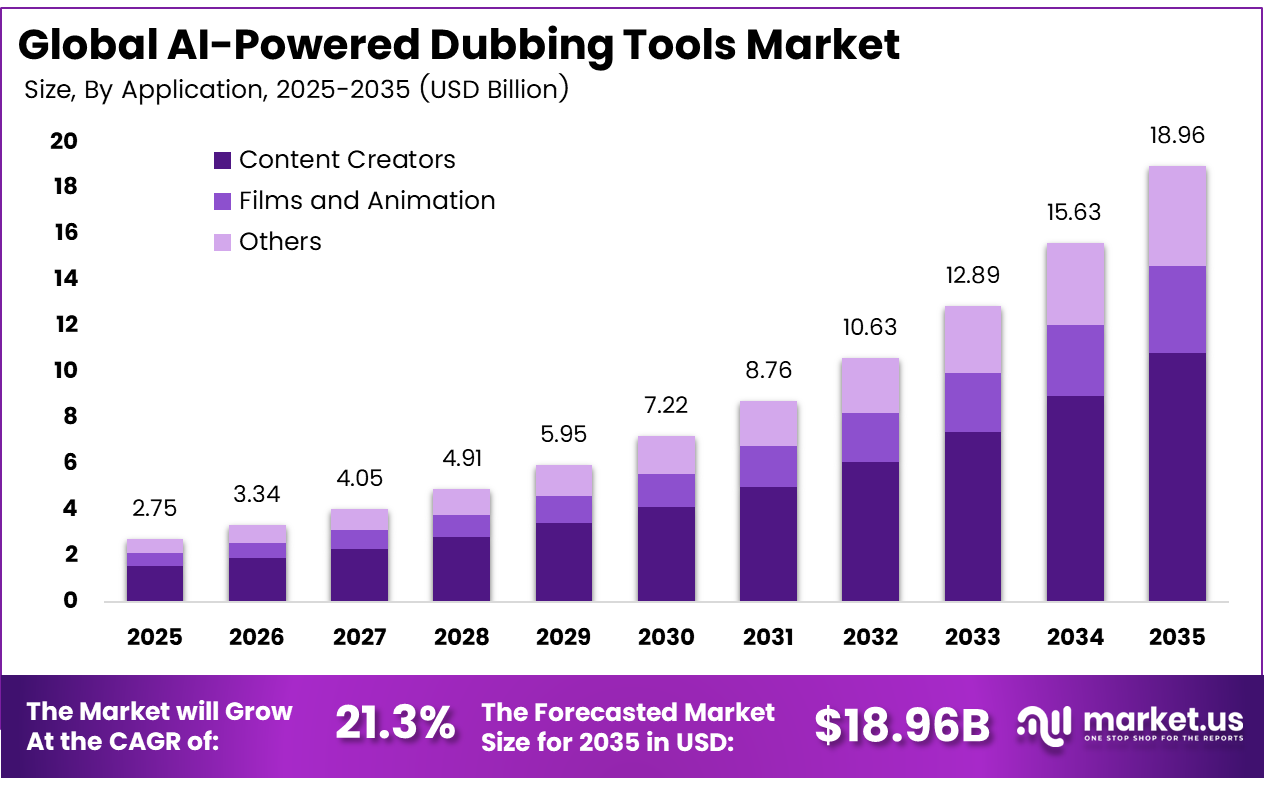
Global streaming platforms need content in multiple languages to pull in viewers from all over. Traditional dubbing costs a lot, often $500 to $5,000 per video, so businesses turn to AI for savings. Faster production lets creators launch shows quickly and stay ahead of rivals. Rising internet use in places like Asia drives demand for local versions of popular media. Voice tech advances make results sound human, pushing more teams to switch over. Content volume grows yearly, making efficiency a must for staying competitive.
The market for AI-Powered Dubbing Tools is driven by the rising demand for localized content in a global media landscape. Streaming services and content creators seek ways to reach diverse audiences quickly, and these tools deliver fast, affordable language adaptations that keep the original tone and emotion intact. Traditional dubbing takes weeks and high costs, but AI cuts that down sharply, opening doors to new viewers worldwide. This push helps platforms grow engagement without big production hurdles.
Demand for these tools spikes as platforms go worldwide and need speedy localization. They now cover 150+ languages, perfect for education clips and marketing videos. Teams manage bigger workloads without hiring extra staff, processing files in batches. Viewers expect content in their own tongue, boosting watch times by up to 40%. E-learning firms lead the charge, dubbing lessons for diverse students. Quick results fit tight schedules, fueling steady uptake across industries.
For instance, in July 2025, Amazon Web Services teamed up with CAMB.AI to bring emotion-aware multilingual dubbing to AWS Bedrock, supporting 140+ languages for live streaming. Broadcasters can add dubbed channels instantly using AWS Media Services, highlighting AWS’s role in powering cost-effective global content delivery.
Key Takeaway
- In 2025, the Content Creators segment held a dominant market position, capturing a 57.2% share of the Global AI-Powered Dubbing Tools Market.
- In 2025, the Cloud-Based segment held a dominant market position, capturing a 65.8% share of the Global AI-Powered Dubbing Tools Market.
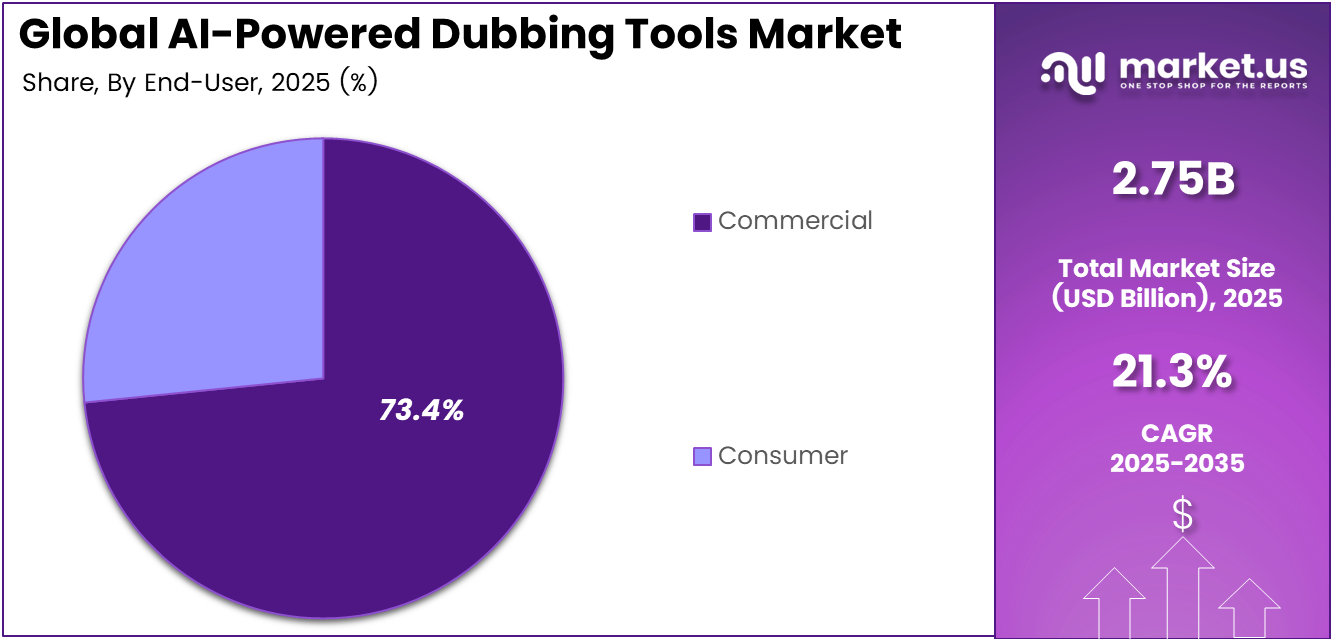
- In 2025, the Commercial segment held a dominant market position, capturing a 73.4% share of the Global AI-Powered Dubbing Tools Market.
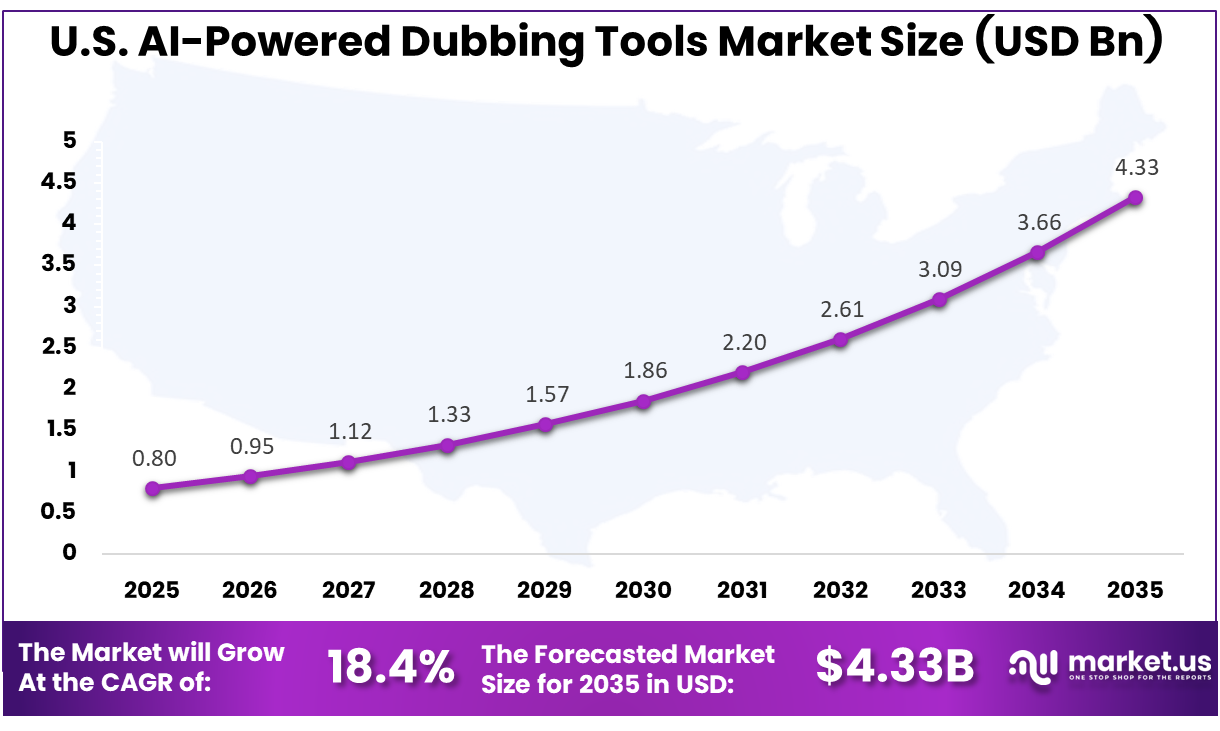
- The U.S. AI-Powered Dubbing Tools Market was valued at USD 0.80 Billion in 2025, with a robust CAGR of 18.4%.
- In 2025, North America held a dominant market position in the Global AI-Powered Dubbing Tools Market, capturing more than a 33.7% share.
Role of Generative AI
Generative AI forms the core of dubbing tools by turning text into natural voices that match the original speaker’s style and feelings. It handles tough jobs like instant translation and voice copying, which helps media teams work much faster. 93% of these tools now get lip-sync right, making results close to what humans do. Creators use it to localize content quickly, dubbing hours of video in less time. Studies note that 45% of entertainment users lead in taking it up, thanks to better accuracy across languages. This change lets small groups reach viewers everywhere with ease.
Teams depend on generative AI for smooth workflows in global projects, as it adapts speech patterns on the fly. It cuts down errors in tone and timing, vital for movies and streams. With tools supporting wide language sets, production stays simple even for dialects. Adoption grows because it fits daily needs, like short clips or long shows. The tech proves reliable in tests, pushing more firms to switch from old methods. Overall, it opens doors for fresh content ideas without big crews.
Investment and Business Benefits
Backers target platforms mixing AI with human tweaks for precise outputs in tough markets. E-learning and ad sectors grow fast, needing dialect support in Asia. Live event dubbing opens doors for real-time apps. Tools with strong security draw funds amid voice privacy worries. Custom voice creation for brands offers steady returns. Focus on mobile-first versions to tap billions of users.
Firms reach new regions without large crews, expanding audiences overnight. Costs fall 70%, letting startups rival big players. Local accents raise viewer stickiness and shares. Workflow speeds up team output threefold. Reusable voice profiles save repeat efforts. Analytics track engagement post-dub, guiding tweaks.
Regional Analysis
In 2025, North America held a dominant market position in the Global AI-Powered Dubbing Tools Market, capturing more than a 33.7% share, holding USD 0.92 billion in revenue. This lead comes from the region’s vast media and entertainment industry, home to giants like Netflix and Disney that localize content for international viewers. Advanced digital infrastructure and heavy AI investments speed up adoption, while tech hubs foster voice synthesis innovations. Streaming growth demands efficient multilingual solutions, cutting costs over manual dubbing. High internet use supports cloud-based tools for quick global reach.
For instance, in May 2025, Microsoft Corporation showcased Azure AI Video Translation at Microsoft Build with GenAI contextual translation, multi-speaker detection, lip-sync, and support for 70+ languages. The service preserves emotion and tone while syncing audio with mouth movements for authentic multilingual videos. This advancement reinforces North American dominance in professional-grade AI dubbing solutions.
U.S. AI-Powered Dubbing Tools Market Size
The market for AI-Powered Dubbing Tools within the U.S. is growing tremendously and is currently valued at USD 0.80 billion. The market has a projected CAGR of 18.4%. The growth stems from surging demand for multilingual content on streaming platforms like Netflix and Amazon Prime. These services localize shows for global viewers, cutting costs and time over traditional methods. Tech hubs drive adoption in media, gaming, and e-learning, where AI handles voice cloning and lip-syncing efficiently. Rising globalization boosts localization needs, while cloud integration scales solutions for businesses.
For instance, in April 2025, Descript Inc. made Overdub AI voice cloning available on all plans, allowing quick voice creation from brief audio uploads. The feature supports natural speech synthesis for editing audio by typing, boosting content localization efficiency. Descript’s accessibility advances U.S. leadership in user-friendly AI dubbing tools.
Key Regions and Countries
North America
- US
- Canada
Europe
- Germany
- France
- The UK
- Spain
- Italy
- Russia
- Netherlands
- Rest of Europe
Asia Pacific
- China
- Japan
- South Korea
- India
- Australia
- Singapore
- Thailand
- Vietnam
- Rest of APAC
Latin America
- Brazil
- Mexico
- Rest of Latin America
Middle East & Africa
- South Africa
- Saudi Arabia
- UAE
- Rest of MEA
Application Analysis
In 2025, the Content Creators segment held a dominant market position, capturing a 57.2% share of the Global AI-Powered Dubbing Tools Market. They turn to these tools to make videos accessible worldwide without the hassle of manual voice work. YouTubers, influencers, and small production teams find AI dubbing perfect for adding subtitles and synced voices in multiple languages fast. This lets them grow audiences across borders while keeping production costs low. The tools handle tricky parts like natural tone and lip movement, which used to take days of studio time.
Daily workflows change for creators using AI dubbing. They upload raw footage and get dubbed versions ready for platforms like TikTok or Instagram in hours. This speed helps them post consistently and test content in new markets. Smaller teams avoid hiring translators or actors, focusing instead on creative ideas. As global viewership rises, content creators see AI as essential for staying competitive in video content creation.
For instance, in November 2025, Descript added support for 39 more languages in caption translation and dubbing, including Bulgarian, Filipino, and Russian. Content creators now dub videos faster with better audio timing that matches the original speech rhythm. This update helps them localize short-form content for wider audiences quickly.
Types Analysis
In 2025, the Cloud-Based segment held a dominant market position, capturing a 65.8% share of the Global AI-Powered Dubbing Tools Market. Users like them because installation is not needed on computers. Just log in from any device and start work. This fits teams spread out or freelancers on the move. Servers handle big files, so local machines stay light. Updates roll out automatically, keeping features fresh. Costs stay low with pay-as-you-go plans. Scalability lets small jobs grow to huge ones smoothly. No downtime from crashes or slow loads.
Real-time work stands out in cloud setups. Teams edit and dub together from different spots. Share links mean quick feedback loops. Data stays safe in top centers with backups. This beats on-site systems that tie you down. Businesses save on hardware and tech staff. Peak times handle more traffic without extra buy-ins. Users pick voices and styles on the fly. Cloud leads because it matches modern workflows. Flexibility drives long-term use across sizes.
For instance, in July 2025, AWS integrated CAMB.AI’s dubbing into live streaming workflows using MediaLive and MediaPackage. This cloud setup adds dubbed audio tracks to streams for sports and news in multiple languages. It reduces latency and costs for scalable, real-time global delivery.
End-User Analysis
In 2025, the Commercial segment held a dominant market position, capturing a 73.4% share of the Global AI-Powered Dubbing Tools Market. Businesses in ads, training, and media use them to push content worldwide without delays. They dub product videos or staff guides into local tongues quickly. This cuts outsourcing fees and speeds launches. Quality matches pro standards with natural tones and timing. Firms gain an edge by serving global teams and buyers right away. Volume workflows easily on these platforms built for scale.
Global expansion drives their heavy use. Companies enter new markets by localizing key materials quickly. AI handles bulk jobs like e-learning modules or promo reels in dozens of languages. Turnaround drops from months to days, keeping campaigns fresh. Compliance with brand voice stays tight across versions. This segment thrives as trade borders fade and digital sales climb. Pros rely on dubbing to stay nimble in tough competition.
For instance, in September 2025, Deepdub released Lightning 2.5, a real-time voice model on NVIDIA GPUs for enterprise dubbing. It offers low-latency AI agents and content localization with 2.8X throughput. Commercial users gain scalable voiceovers for media and gaming.
Key Market Segments
By Application
- Content Creators
- Films and Animation
- Others
By Types
- Cloud-Based
- On-Premises
By End-User
- Commercial
- Consumer
Emerging Trends
Real-time dubbing picks up speed for live events and broadcasts, cutting wait times in translation. Neural networks boost lip-sync, so videos look real with no odd mouth moves. Cloud setups now cover 200 languages, easing work for teams anywhere. Users want custom voices for local dialects, making content feel personal. Voice tech nears human levels, good for all media types. Public groups use live translation for talks, helping more people join in.
Developers add features like auto-edits for cultural fit, keeping stories true across borders. Integration with video apps speeds up sharing on social sites. Focus stays on low-cost tools for creators in new markets. Advances in sound quality draw in the education and news fields. Trends point to mobile dubbing, right from phones, for quick posts. This keeps content fresh and open to all viewers daily.
Growth Factors
Lower costs pull in users, as AI skips fees for actors and studios per language. Tasks end in days, not weeks, perfect for fast social videos. It scales up for huge batches without hiring more people. Viewers seek native talk, and 66% like cultural shares through dubbed works. Speech tech gets better each year, building trust. Demand rises with streaming growth worldwide.
Ease of use helps non-experts dub at home, sparking new ideas. Reliable outputs mean less rework, saving time overall. Global teams mix it with human checks for top results. It fits tight budgets in small markets. As the internet spreads, more content needs quick localization. These points fuel a steady rise in everyday use.
Market Dynamics
Drivers - Rising Need for Localized Content
The growing demand for content in multiple languages is reshaping how creators connect with global audiences. AI dubbing tools have become valuable because they allow quick translation and voice adaptation across regions, cutting the time and cost of traditional dubbing. This shift helps streaming platforms and online media producers reach more viewers efficiently while maintaining production speed.
Audiences today expect stories in their native languages, which increases engagement and strengthens cultural connection. AI-powered dubbing supports this trend by providing scalable solutions for localized content delivery. As more platforms invest in multilingual programming, these tools help bridge language barriers and support global storytelling on a larger scale.
For instance, in June 2025, Microsoft launched a voice conversion feature in Azure AI Speech. Users transform recorded voices into AI-generated ones while preserving rhythm and emotion. This aids multilingual dubbing for consistent experiences across languages. Available initially in key regions, it reduces localization time for creators. The feature expands access to global viewers efficiently.
Restraint - Voice Quality Shortfalls
Despite technological advances, AI-generated voices often lack the emotional richness and nuance of human speech. Scenes that depend on expressive tone or subtle emotion can sound artificial, hurting the viewer’s immersion. This limitation keeps traditional dubbing teams relevant, particularly in film, animation, and story-driven projects that rely on high-quality voice performance.
Another challenge comes from the setup and integration costs associated with advanced AI dubbing tools. Smaller production houses and independent creators often find it hard to adopt such technology due to financial constraints. Until voice naturalness improves and costs become more accessible, these factors will slow the pace of widespread adoption.
For instance, in April 2025, Deepdub released Deepdub Live, but early feedback noted emotional subtleties missing in real-time dubbing. High setup for production-ready live content limits smaller users. Voice outputs can sound off in fast-paced scenarios like sports. Costs for integration add barriers despite quality advances. Refinements focus on a natural feel.
Opportunities - Emerging Market Expansion
Emerging markets with expanding digital media industries present new growth opportunities for AI dubbing providers. As internet access increases and audience bases diversify, the need for localized and affordable content rises. AI-driven dubbing can help creators reach new audiences more easily, providing a pathway for cross-cultural media exchange and quicker market entry.
The technology also aligns well with next-generation platforms such as AR and VR, where immersive experiences require seamless language adaptation. By offering real-time dubbing and localized audio, AI tools can enhance user engagement in virtual environments and open new creative possibilities for media developers worldwide.
For instance, in July 2025, Respeecher enhanced dubbing for multilingual enterprise projects. Focus on emerging markets with seamless post-production voice cloning. Supports localization in video and gaming for global expansion. Lowers entry barriers for new media hubs. Aligns with immersive tech like VR.
Challenges - Cultural Adaptation Hurdles
Adapting translated content to reflect cultural nuances remains a major obstacle for AI dubbing systems. Automated translations often miss local idioms or humor, resulting in awkward or inaccurate delivery that affects viewer connection. Ongoing refinement through human oversight and continuous model improvement is essential to solving these issues.
Furthermore, navigating regulations tied to data usage and voice rights adds complexity to AI dubbing projects. Collecting and processing voice data raises privacy and ownership concerns, especially when operating across different legal frameworks. Balancing innovation with compliance will be key to building trust and achieving global acceptance of AI dubbing technology.
For instance, in March 2025, Dubverse encountered hurdles with local dialects in the course of dubbing. AI swaps ignored contextual humor, harming authenticity. Voice data privacy rules varied by market, adding complexity. Teams addressed via custom edits. Regulatory alignment challenges persist.
Key Players Analysis
One of the leading players in June 2025, RWS acquired Papercup’s AI dubbing IP, blending voice synthesis with thousands of unique AI voices for high-quality, cost-effective multilingual video localization. This deal bolsters enterprise dubbing capabilities, showing how AI-human hybrid tech scales global content delivery while preserving speaker emotion and timing.
Top Key Players in the Market
- Google LLC
- Microsoft Corporation
- Amazon Web Services Inc.
- ZOO Digital Group plc
- Synthesia Limited
- Descript Inc.
- Invideo Innovation Pte Ltd.
- Speechify Inc.
- Deepdub Inc.
- Eleven Labs Inc.
- Resemble AI Inc.
- Papercup Technologies Limited
- Veed Limited
- VoiceQ Ltd.
- Respeecher Inc.
- Elai.io Inc.
- PlayHT
- Dubverse AI Pvt. Ltd.
- Flawless Protection Security Ltd.
- Wavel AI Inc.
- Rask AI
- Others
Recent Developments
- In December 2025, Verbit partnered with Deepdub to launch Verbit Dub, leveraging expressive TTS for scalable, controlled dubbing in content creation and broadcasting. The collaboration highlights growing demand for fast, authentic localization solutions.
- In November 2025, Palabra AI acquired Talo, launching real-time multilingual translation for video calls and events powered by sub-second speech tech. This enhances live dubbing workflows, reflecting consolidation for seamless global communication.
Report Scope
| Report Features | Description |
|---|---|
| Market Value (2025) | USD 2.75 Billion |
| Forecast Revenue (2035) | USD 18.96 Billion |
| CAGR (2026-2035) | 21.3% |
| Base Year for Estimation | 2025 |
| Historic Period | 2020-2024 |
| Forecast Period | 2026-2035 |
| Report Coverage | Revenue Forecast, Market Dynamics, Competitive Landscape, Recent Developments |
| Segments Covered | By Application (Content Creators, Films and Animation, Others), By Types (Cloud-Based, On-Premises), By End-User (Consumer, Commercial) |
| Regional Analysis | North America (US and Canada), Europe (Germany, France, The UK, Spain, Italy, and Rest of Europe), Asia Pacific (China, Japan, South Korea, India, Australia, and Rest of APAC), Latin America (Brazil, Mexico, and Rest of Latin America), Middle East & Africa (GCC, South Africa, and Rest of MEA) |
| Competitive Landscape | Google LLC, Microsoft Corporation, Amazon Web Services Inc., ZOO Digital Group plc, Synthesia Limited, Descript Inc., Invideo Innovation Pte Ltd., Speechify Inc., Deepdub Inc., Eleven Labs Inc., Resemble AI Inc., Papercup Technologies Limited, Veed Limited, VoiceQ Ltd., Respeecher Inc., Elai.io Inc., PlayHT, Dubverse AI Pvt. Ltd., Flawless Protection Security Ltd., Wavel AI Inc., Rask AI, Others |
| Customization Scope | Customization for segments, region/country-level will be provided. Moreover, additional customization can be done based on the requirements. |
| Purchase Options | We have three licenses to opt for: Single User License, Multi-User License (Up to 5 Users), Corporate Use License (Unlimited Users and Printable PDF) |





























