Global AI-powered CCTV Cameras Market By Product Type (PTZ (Pan-Tilt-Zoom) Cameras, Infrared/Night Vision CCTV Cameras, Bullet CCTV Cameras, Others), By Application (Smart Homes and Residential Security, Smart Cities and Civic Safety, Others), By End-User (Commercial, Residential, Industrial, Others),By Regional Analysis, Global Trends and Opportunity, Future Outlook By 2025-2035
- Published date: Jan .2026
- Report ID: 173596
- Number of Pages: 241
- Format:
-
keyboard_arrow_up
Quick Navigation
- Report Overview
- Top Market Takeaways
- Key Benefits and Application Insights
- Product Type Analysis
- Application Analysis
- End-User Analysis
- Investment Opportunities
- Business Benefits
- Regulatory Environment
- Emerging Trends
- Growth Factors
- Key Market Segments
- Regional Analysis
- Opportunity Analysis
- Challenge Analysis
- Competitive Analysis
- Future Outlook
- Recent Developments
- Report Scope
Report Overview
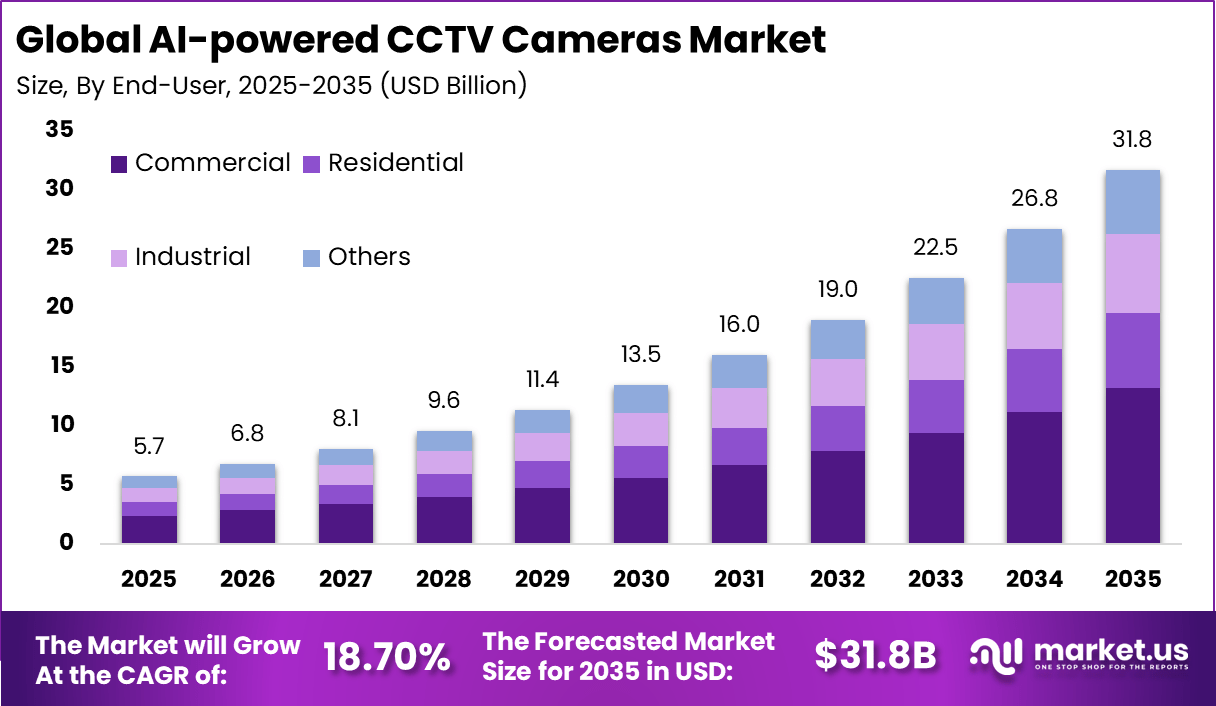
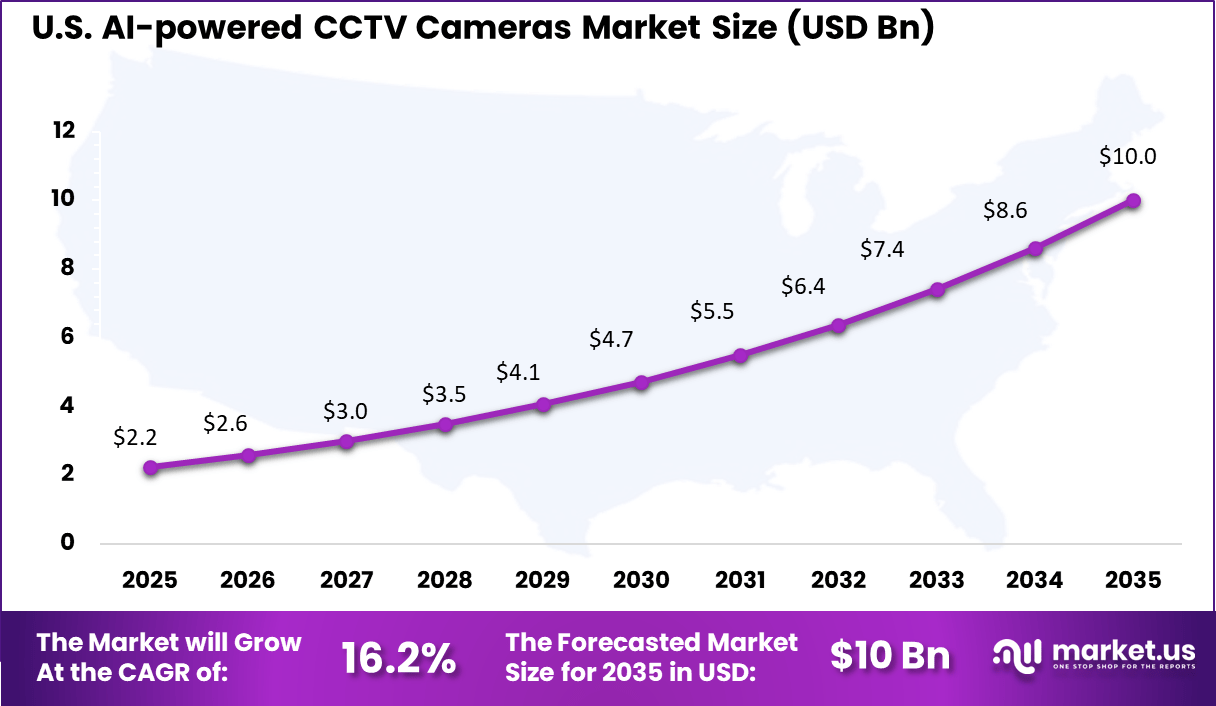
The Global AI-powered CCTV Cameras Market generated USD 5.7 billion in 2025 and is predicted to register growth from USD 6.8 billion in 2026 to about USD 31.8 billion by 2035, recording a CAGR of 18.70% throughout the forecast span. In 2025, North America held a dominan market position, capturing more than a 42.8% share, holding USD 2.44 Billion revenue.
The AI-powered CCTV cameras market refers to video surveillance systems that integrate artificial intelligence (AI) technologies such as machine learning, computer vision, and deep analytics to enhance monitoring, detection, and response capabilities. These systems go beyond traditional closed-circuit television by automatically recognising patterns, detecting anomalies, tracking objects, and generating actionable alerts in real time.
AI-powered CCTV cameras are deployed across commercial properties, critical infrastructure, public safety environments, transportation hubs, residential complexes, and industrial sites. Adoption supports improved situational awareness, automated threat detection, and seamless integration with broader security ecosystems.
One primary driver of the AI-powered CCTV cameras market is the increasing emphasis on public safety and threat detection across urban landscapes and critical facilities. Governments, transport authorities, and enterprise security teams require solutions that can detect suspicious behaviour, unattended objects, and perimeter breaches automatically. AI-powered cameras provide real-time analytics that improve response speed and reduce reliance on manual monitoring.
Demand for AI-powered CCTV systems is shaped by increased global investment in infrastructure protection and enterprise security. Industrial facilities, manufacturing plants, and logistics hubs seek systems capable of identifying anomalies such as unauthorised access, safety violations, and equipment hazards. These environments benefit from visual analytics that enhance operational oversight and compliance with safety standards.
Top Market Takeaways
- By product type, network/IP CCTV cameras took 70.3% of the AI-powered CCTV cameras market, offering high-resolution feeds and easy integration with AI analytics.
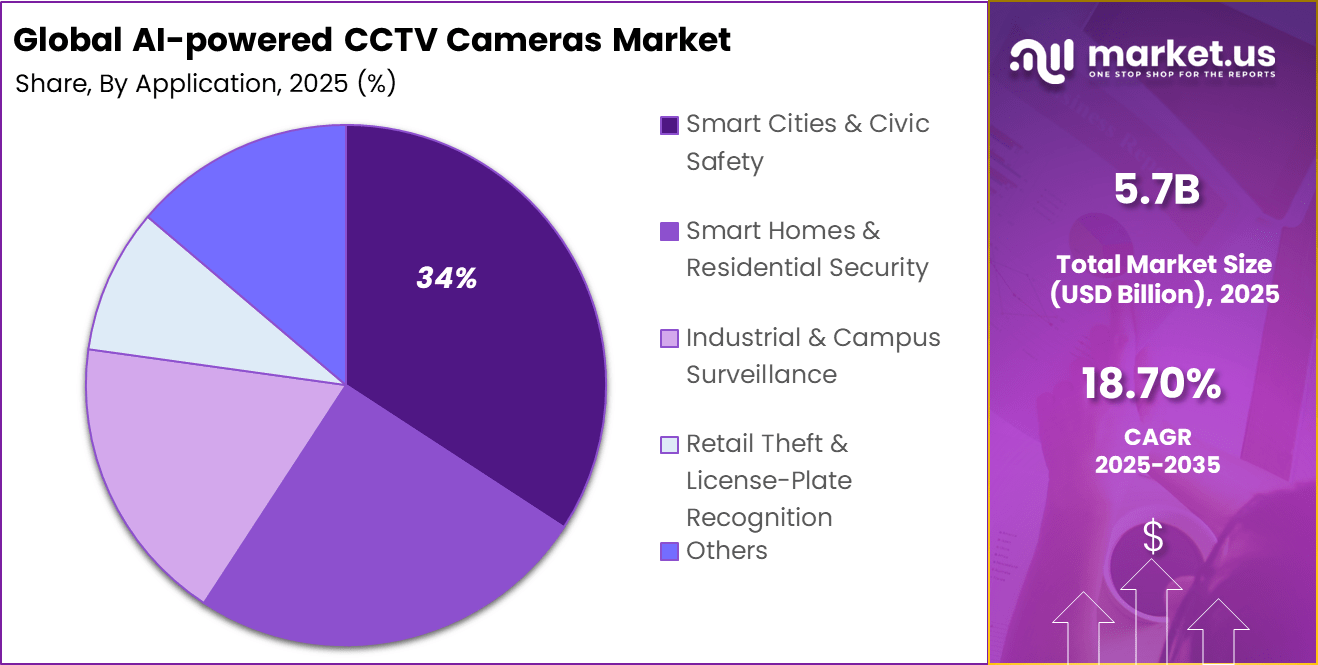
- By application, smart cities and civic safety held 34.2% share, using AI for traffic monitoring and public security.
- By end-user, commercial users captured 41.7%, deploying cameras in retail and offices for theft prevention and operations.
- North America had 42.8% of the global market, with the U.S. at USD 2.23 billion in 2025 and growing at a CAGR of 16.2%.
Key Benefits and Application Insights
- Efficiency and accuracy gains were clearly observed, as AI powered video analytics improved loss prevention effectiveness by up to 30%. In public safety monitoring, operational efficiency increased by nearly 50%, supported by faster data processing and automated alerts. Incident response times were reduced by about 25%, while threat identification accuracy improved by 20%.
- False alarm reduction remained one of the strongest value drivers, as AI based systems filtered non threat events with accuracy levels of up to 90%. This allowed security teams to focus on genuine risks rather than routine environmental triggers such as animals, shadows, or weather changes.
- Operational optimization benefits were evident across industries. In manufacturing environments, AI enabled CCTV systems reduced downtime by around 25% by monitoring safety compliance, including helmet and PPE usage. In transportation and traffic management, AI surveillance reduced accident rates by 20% and improved traffic flow by roughly 15% during peak periods.
- Automated tracking capabilities significantly lowered manual effort, as AI enabled PTZ cameras handled multi target tracking in about 85% of surveillance scenarios. This automation reduced reliance on human operators while maintaining consistent monitoring coverage and accuracy.
Product Type Analysis
Network and IP CCTV cameras account for 70.3%, highlighting their dominance in AI-powered surveillance deployments. These cameras support high-resolution video capture and real-time data transmission. IP-based architecture allows seamless integration with analytics software. Centralized management improves monitoring efficiency across multiple locations. Reliability and scalability remain key advantages.
The strong adoption of network and IP cameras is driven by advanced connectivity requirements. Organizations prefer systems that support remote access and control. AI capabilities enhance object detection and event analysis. Integration with existing networks reduces deployment complexity. This sustains continued preference for IP-based solutions.
Application Analysis
Smart cities and civic safety applications represent 34.2%, making them a leading use case. AI-powered cameras support traffic monitoring and public safety initiatives. Automated detection improves response times during incidents. Surveillance data assists urban planning and crowd management. Accuracy and coverage are essential.
Growth in this application is driven by urbanization and safety priorities. Municipal authorities invest in intelligent monitoring systems. AI enhances situational awareness across public spaces. Continuous monitoring supports preventive measures. This keeps civic safety a key application area.
End-User Analysis
The commercial segment accounts for 41.7%, making it the largest end-user group. Businesses use AI-powered cameras to protect assets and facilities. Surveillance supports theft prevention and operational oversight. AI features reduce the need for constant manual monitoring. Efficiency gains are important for commercial users.
Adoption in commercial settings is driven by security and compliance needs. Retail, offices, and industrial sites rely on continuous surveillance. AI analytics improve incident detection accuracy. Centralized systems support multi-site management. This sustains strong commercial adoption.
Investment Opportunities
Investment opportunities in the AI-powered CCTV cameras market exist in platforms that emphasise advanced analytics such as facial recognition, crowd density estimation, and heatmap generation. Solutions that combine multiple analytic layers add differentiation for high-security and smart city applications. Investors can focus on technologies that maintain high performance while managing privacy and compliance considerations.
Another opportunity lies in AI-enabled cloud services and managed detection platforms that provide subscription-based analytics, remote monitoring, and ongoing model optimisation. Hybrid cloud-edge solutions that balance real-time responsiveness with centralised intelligence can attract broad enterprise adoption. Investment in scalable platforms with robust cybersecurity and compliance features supports long-term market growth.
Business Benefits
AI-powered CCTV cameras enhance situational awareness and support faster, more informed decision making. Automated threat detection and real-time alerts reduce response times and strengthen incident mitigation. Organisations can reallocate security personnel from routine monitoring to strategic tasks. This efficiency improves operational performance and reduces security costs.
These systems also generate actionable insights that support compliance reporting, audit trails, and performance measurement. Integrated analytics help organisations monitor key performance indicators related to safety, security, and process optimisation. This data-centric approach enhances transparency and accountability.
Regulatory Environment
The regulatory environment for the AI-powered CCTV cameras market is influenced by data protection, privacy laws, and surveillance standards that govern how personal information and video data are collected, stored, and shared. Many jurisdictions require clear policies on consent, retention periods, access controls, and lawful surveillance practice. Compliance with frameworks such as GDPR, regional privacy statutes, and whistleblower protections is essential to maintain legal and ethical operation.
Security standards and certification requirements for critical infrastructure also shape how AI-powered CCTV systems are deployed. Camera systems must meet performance, interoperability, and cybersecurity criteria to be accepted in regulated environments. Adherence to regulatory and industry standards builds trust, reduces legal exposure, and supports wider adoption of intelligent surveillance technologies.
Emerging Trends
Key Trend Description Edge computing integration Cameras process AI analytics locally to deliver faster response times and reduced latency. Real-time behavioral analytics Advanced detection of anomalies, loitering, and threats using deep learning models. 5G and cloud-hybrid storage Supports seamless remote access and scalable video storage and management. Facial recognition enhancements Improved accuracy across varied lighting and environments with stronger privacy controls. Predictive maintenance features AI monitors camera and hardware health to prevent failures through proactive alerts. Growth Factors
Key Factors Description Rising security threats globally Growing safety concerns increase demand for proactive surveillance in public and private areas. Smart city infrastructure projects Urban development programs drive deployment of surveillance in traffic and public safety. Technological advancements in AI Progress in deep learning and video analytics accelerates adoption across industries. Government regulations and funding Mandates and public funding encourage installation of advanced security systems. Cost reductions in hardware More affordable AI cameras expand adoption among SMEs and residential users. Key Market Segments
By Product Type
- PTZ (Pan-Tilt-Zoom) Cameras
- Infrared/Night Vision CCTV Cameras
- Bullet CCTV Cameras
- Dome CCTV Cameras
- Network/IP CCTV Cameras
- Others
By Application
- Smart Homes & Residential Security
- Smart Cities & Civic Safety
- Industrial & Campus Surveillance
- Retail Theft & License-Plate Recognition
- Others
By End-User
- Commercial
- Residential
- Industrial
- Others
Regional Analysis
North America accounted for 42.8% share, supported by strong investment in intelligent security infrastructure across commercial buildings, public spaces, transportation hubs, and critical facilities. AI powered CCTV cameras have been widely adopted to enhance real time monitoring, threat detection, and incident response through video analytics.
Demand has been driven by rising security concerns, need for proactive surveillance, and increasing adoption of smart city initiatives. The region’s advanced network infrastructure and high acceptance of AI based security solutions have further supported steady market expansion.
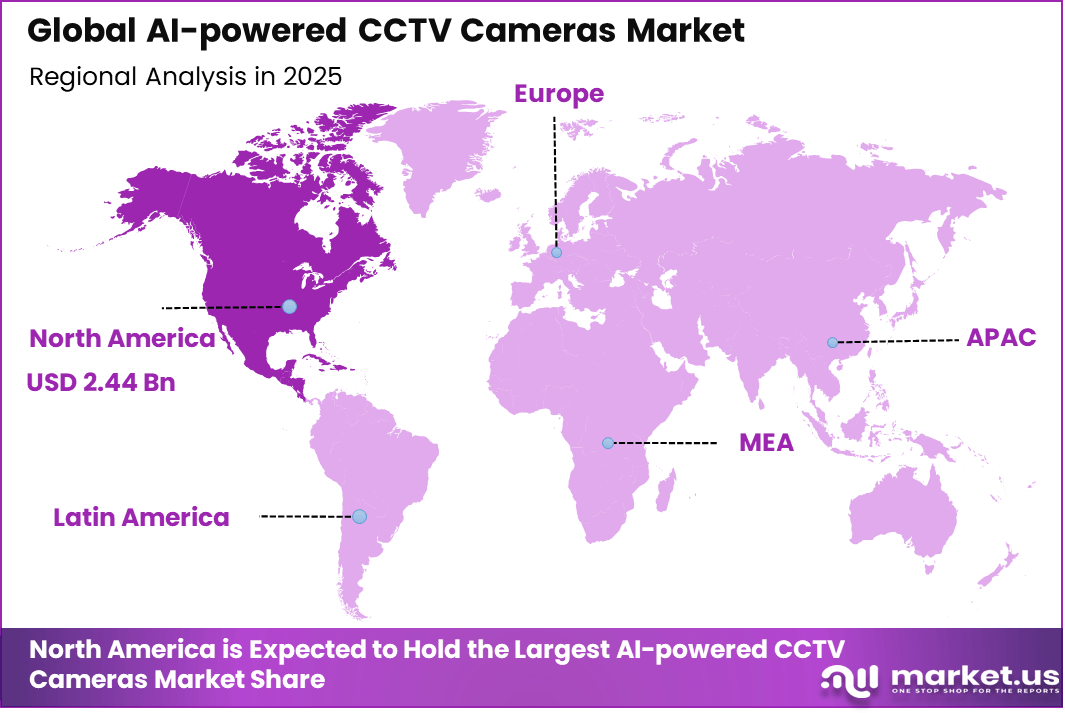
The U.S. market reached USD 2.23 Bn and is projected to grow at a 16.2% CAGR, reflecting strong demand from government agencies, enterprises, and urban infrastructure projects. Adoption has been driven by the need for advanced video analytics such as facial recognition, object detection, and behavior analysis. AI powered CCTV cameras have helped U.S. organizations improve situational awareness, reduce response time, and enhance overall security management.
Key Regions and Countries
- North America
- US
- Canada
- Europe
- Germany
- France
- The UK
- Spain
- Italy
- Russia
- Netherlands
- Rest of Europe
- Asia Pacific
- China
- Japan
- South Korea
- India
- Australia
- Singapore
- Thailand
- Vietnam
- Rest of APAC
- Latin America
- Brazil
- Mexico
- Rest of Latin America
- Middle East & Africa
- South Africa
- Saudi Arabia
- UAE
- Rest of MEA
Opportunity Analysis
Emerging opportunities in the AI-powered CCTV camera domain are linked to its applicability across diverse sectors beyond traditional security. Intelligent analytics can support operational insights in retail environments, crowd management for public events, and infrastructure monitoring for transportation hubs. Predictive monitoring capabilities offer value by identifying trends, optimizing resource allocation, and enhancing situational awareness.
Furthermore, the convergence of cloud technologies and Internet of Things connectivity allows surveillance systems to deliver scalable remote access and centralized management, unlocking service innovation for security providers and integration with broader smart infrastructure frameworks.
Challenge Analysis
One of the central challenges confronting this market is ensuring the accuracy and reliability of AI algorithms under varied real-world conditions. AI-enabled CCTV systems must consistently perform across diverse lighting environments, crowded scenes, and complex movement patterns while minimizing false positives.
Achieving high precision requires continuous refinement of machine learning models and robust validation against evolving scenarios. In addition, balancing on-device processing with cloud-based analytics to manage latency and bandwidth constraints remains a technical consideration. Deployment challenges, including integration with existing infrastructure and cost of advanced computing hardware, further compound this issue.
Competitive Analysis
The AI-powered CCTV Cameras Market is dominated by established global surveillance manufacturers such as Hikvision, Dahua Technology, Axis Communications, Honeywell, and Bosch Security Systems. These players focus on AI based video analytics, facial recognition, and real time threat detection. Their solutions are widely deployed in smart cities and critical infrastructure.
Consumer electronics and diversified technology companies strengthen the competitive landscape. Firms such as Panasonic, Samsung Techwin, LG Electronics, Sony, and FLIR Systems integrate imaging expertise with AI processing. Their cameras offer superior image quality and low light performance. These solutions are preferred in industrial, retail, and transportation settings. Brand trust supports long term adoption.
Regional manufacturers and service oriented providers add depth to the market. Companies including ADT, CP Plus, ZTE, Hanwha Techwin, Vivotek, Uniview, Pelco, Avigilon, CCTV Camera World, and Geovision focus on cost effective deployment and local customization. Other players support niche and emerging use cases.
Top Key Players in the Market
- Hikvision
- Dahua Technology
- Axis Communications
- Honeywell
- Bosch Security Systems
- Panasonic
- Samsung Techwin
- LG Electronics
- Sony
- FLIR Systems
- ADT
- CP Plus
- ZTE
- Hanwha Techwin
- Vivotek
- Uniview
- Pelco
- Avigilon
- CCTV Camera World
- Geovision
- Others
Future Outlook
Growth in the AI-powered Code Generator market is expected to accelerate as software development teams aim to improve productivity and reduce development time. These tools are being used to generate code, suggest fixes, and support testing across different programming languages.
Rising demand for faster application delivery and shortage of skilled developers are supporting adoption. Over time, better accuracy, secure code generation, and deeper integration with development environments are likely to increase trust and wider usage.
Recent Developments
- June, 2025: Hikvision rolled out its DeepinViewX-Series Bullet Cameras, powered by Guanlan large-scale AI models for sharper analytics and fewer false alarms.
- July, 2025: Bosch completed the sale of its security business to Triton, rebranded as Keenfinity, setting up expanded AI video solutions like edge-based thermal cameras.
Report Scope
Report Features Description Market Value (2025) USD 5.7 Bn Forecast Revenue (2035) USD 31.8 Bn CAGR(2025-2034) 18.70% Base Year for Estimation 2024 Historic Period 2020-2024 Forecast Period 2025-2035 Report Coverage Revenue forecast, AI impact on Market trends, Share Insights, Company ranking, competitive landscape, Recent Developments, Market Dynamics and Emerging Trends Segments Covered Global AI-powered CCTV Cameras Market By Product Type (PTZ (Pan-Tilt-Zoom) Cameras, Infrared/Night Vision CCTV Cameras, Bullet CCTV Cameras, Others), By Application (Smart Homes and Residential Security, Smart Cities and Civic Safety, Others), By End-User (Commercial, Residential, Industrial, Others) Regional Analysis North America – US, Canada; Europe – Germany, France, The UK, Spain, Italy, Russia, Netherlands, Rest of Europe; Asia Pacific – China, Japan, South Korea, India, New Zealand, Singapore, Thailand, Vietnam, Rest of Latin America; Latin America – Brazil, Mexico, Rest of Latin America; Middle East & Africa – South Africa, Saudi Arabia, UAE, Rest of MEA Competitive Landscape Hikvision, Dahua Technology, Axis Communications, Honeywell, Bosch Security Systems, Panasonic, Samsung Techwin, LG Electronics, Sony, FLIR Systems, ADT, CP Plus, ZTE, Hanwha Techwin, Vivotek, Uniview, Pelco, Avigilon, CCTV Camera World, Geovision, Others Customization Scope Customization for segments, region/country-level will be provided. Moreover, additional customization can be done based on the requirements. Purchase Options We have three license to opt for: Single User License, Multi-User License (Up to 5 Users), Corporate Use License (Unlimited User and Printable PDF)  AI-powered CCTV Cameras MarketPublished date: Jan .2026add_shopping_cartBuy Now get_appDownload Sample
 -
-
- Hikvision
- Dahua Technology
- Axis Communications
- Honeywell
- Bosch Security Systems
- Panasonic
- Samsung Techwin
- LG Electronics
- Sony
- FLIR Systems
- ADT
- CP Plus
- ZTE
- Hanwha Techwin
- Vivotek
- Uniview
- Pelco
- Avigilon
- CCTV Camera World
- Geovision
- Others
Our Clients

- 173596
- Jan .2026